Tough 5-4 loss in Giants’ series opener vs. Rockies

Photo credit: mercurynews.com

By Jeremy Kahn

Something rare happened in the opener for the San Francisco Giants against the Colorado Rockies, as the usual Giants solid bullpen fell apart.

Ian Desmond picked up a pinch-hit double off of Reyes Moronta in the bottom of the seventh inning, helping the Rockies to a come-from-behind 5-4 victory over the Giants at Coors Field.

Sam Selman, who made his major-league debut on Thursday afternoon against the Philadelphia Phillies at Citizens Bank Park, gave a big two-run home run to Ryan McMahon in the bottom of the sixth inning that tied up the game.

Mike Yastrzemski hit his 10th home run of the season off the façade of the third deck that was measured at 472 feet.

Moronta was wild in the seventh, as he went to three ball counts on the first three batters he faced, as Charlie Blackmon singled, Trevor Story walked and then Desmond hit a double off of Moronta that gave the Rockies the lead for good.

Andrew Suarez, who was recalled from Sacramento was shot in the arm for the Giants, especially on a play from Giants newcomer Scooter Gennett. Daniel Murphy hit a weak ground ball that Gennett fielded and threw to Buster Posey, who tagged Story, who was originally called safe; however, Bruce Bochy challenged the call and it was overturned via replay.

Shawn Anderson pitched five innings, allowing three runs on eight hits, walking two and did not strikeout a batter.

NOTES: Dereck Rodriguez was optioned to Sacramento following Thursdays 10-2 against the Phillies. Steven Duggar was recalled from Sacramento, and Tyler Austin was designated for assignment.

This was just the Giants second loss to a team from the National League West in 12 games since June 30.

UP NEXT: Madison Bumgarner will take the ball on Saturday evening for the Giants, while the Rockies will send Jon Gray to the mound.

Sakkari takes down #1 seed, highlights Day 5 of Mubadala Silicon Valley Classic

Photo credit: @Tennis

By Marko Ukalovic

SAN JOSE, Calif. — Déjà vu doesn’t happen often, but for Maria Sakkari she tends to make a habit of it when she performs in San Jose.  Down one set and one game away from being bounced in straight sets, the Greek freak made a remarkable comeback to defeat the number one seeded Elina Sviotlina 1-6 7-6 6-3 in quarterfinal action on Day 5 at the Mubadala Silicon Valley Classic on Thursday afternoon.

Last year at this same tournament Sakkari was in similar situation against Danielle Collins and fought her way back to win in the semi-finals. This time around she was down three games twice in the second (4-1 and 5-2) when she won four games in a row forcing Sviotlina to win the 12th game and the ensuing tiebreaker that Sakkari won 7-3 to prolong the match into the third set.

Sakkari cruised in the third winning it in 46 minutes to punch her ticket to the semi-finals where she will face Saisai Zheng.

“Maybe it’s something about this place,” said the 23-year-old Athens native about her comebacks in this tournament. “I really feel comfortable playing on the center court here. Really feels like home.”

Sakkari finished with seven aces on the day and 7/10 on first serve points won. She credits her serve as one of her main improvements from a year ago.

“My served has improved a lot,” said Sakkari. “I know today wasn’t one of my best hitting the ball, but my serve, my forehand is my weapon now when I was struggling (with them) I would say two years ago.”

In the first match of the day, number two seed Aryna Sabalenka rebounded from losing her first set of the match against number six seed Carla Suarez-Navarro to power her way into the semi-finals in a three-set victory 3-6 6-2 6-4. Despite serving up nine double faults, Sabalenka took control of the match in the second set and never looked back as she found her game to take down Suarez-Navarro.

The Croatian sensation that is Donna Vekic continued her winning ways in a straight sets victory over American Kristie Ahn in her quarterfinal matchup 7-5 6-0 that needed less than 90 minutes to complete. Vekic was down early in the first set 3-5 to Ahn who looked to be in control of the match. However, the native of Osijek, wouldn’t lose another game, going on a 10-game win streak to close out the match and into the semi-finals where she will take on Sabalenka.

“It’s easy to get carried away,” said Vekic when asked about being in a zone during the win streak. “I had to stay really focused and not take anything for granted. And really take one point at a time and not really think about the score.

Vekic finished with six aces, all in the second set, as her powerful serve was too much for Ahn to handle for most of the match. Vekic was also a perfect 9/9 in first service points won in the second set.

“I think I had quite a few aces today. It (my serve) was working really well for me. I had quite a lot of easy points as well and that’s always nice.”

In the night cap Zheng outlasted fourth seeded Amanda Anisimova in a three-set battle of the wills. Zheng won the opening set 7-5 when she would land some nice drop shots that Anisimova had little to no answers for.

Anisimova answered the call in the second set using a combination of forehand power shots with pin-point two-handed backhand shots to take the set 7-5 to even the match. However, she would pay a price for her effort as she had been suffering from an illness throughout the week. She was treated from her chair and then on the ground for 15 minutes before getting back up to start the final set.

“I have had a virus for the past couple of days and wasn’t feeling well today ,” said the 17-year old Anisimova. “I thought I needed a little help (to feel better)”. We both played very well. I think my opponent played super well. She got to almost every single ball, all the credit to her.”

With the score all evened at 4-4, Zheng was able to take control of the final two games as she took advantage of Anisimova’s ailment and won the set 6-4 and stamped her way to her first premiere level semi-final in her career. She will take on Sakkari in the first semi-final on Saturday.

“The whole match was very intense,” said Zheng. “I felt like I had to give a little bit more (than normal) until the end. It was really a tough match tonight.”

These changes were made for the San Jose State football team

Photo credit: sjsuspartans.com

By: Ana Kieu

SAN JOSE, Calif. — Summer has ended and the San Jose State Spartans football team opened their fall camp on Wednesday.

As you should already know, San Jose State has been a lowly team–especially in head coach Brent Brennan’s first and second seasons, respectively. So if SJSU wants to be a better team, then they’re going to have to show grit and fight in their upcoming games; but we all know that’s easier said than done.

Still, it doesn’t hurt to check out what the Spartans are up to.

San Jose State will undergo changes in its cornerback position. On defense, there will be two new starting cornerbacks–Tre White and Nehemiah Shelton–following the departure of seniors Dakari Monroe, now a rookie defensive back with the Kansas City Chiefs, and John Toussaint.

White and Shelton have the first chance to replace Monroe and Toussaint based on their performances in spring practice and the beginning of fall camp. White, from De La Salle High (Concord, Calif.), was a starter in San Jose State’s nickel defense against Washington State. In that same game, Shelton, a Long Beach College transfer, came up with one of the team’s three interceptions that night in Pullman, Wash.

Here’s what White and Shelton had to say when asked about being a good cornerback.

“To be a good defensive back is having a short-term memory. If something happens, it’s being able to turn around and focus and be ready for the next play,” said White, who saw action both as a cornerback and a fifth defensive back in certain pass defenses.

“Film. It takes a lot of hard work. It takes a lot of extra work,” Shelton said about becoming a good corner in the team’s defensive scheme.

Both cornerbacks sense the heightened focus so far during fall camp. Perhaps some of the focus is being more in tuned with what is going on instead of figuring out what to do.

“The intensity is way higher than last year. I like how we are bringing it. The effort, our “blue line,” everything is coming together. The energy is up,” said Shelton, who played in three games last season.

“As a team, we’re really showing our ‘blue line’ culture. The 100-100 is really showing up. It’s something we practice and preach. It’s being able to execute 100 percent effort, every single play 100 percent of the time. As a team, it gives us the juice and energy we need for practice.”

Defensive coordinator Derrick Odum reportedly likes the way the first few days have gone for White and Shelton specifically and for the defense in general.

“I do know we are farther along at the start of camp than we’ve ever been. I really enjoy that part of it–the guys understanding what we’re talking about before we get to the assignment at hand. It’s showing. The guys are flying around. They’re in great shape,” said Odum, who has returning starters on defense in lineman Cade Hall, linebackers Ethan Aguayo and Jesse Osuna, and safeties Tre Webb and Jay Lenard. White’s among seven other returning players to start in a game last season.

“I’m pleased with the first few days. Obviously we have a ways to go, but I like where we are.”

“We’re installing as we’re as we’re going. We don’t want to take a step back as far as our progression with techniques and assignments. We’re throwing a lot at them and they are handling it. So, everything will be right the next four days and we can move on from there,” Odum said about what he hopes to see in the remaining practices for the first week.

When it comes to Spartan football specialists, depth and target consistent appear to be there. Why’s that? San Jose State special teams coordinator Fred Guidici was a hit at one of the early football team meetings. The SJSU assistant, now in his sixth year on the staff and 36th year in coaching, got the room buzzing with his annual standing vertical jump with both feet on the floor to a safe landing position on a standard height desk top.

Guidici will be looking for similar leaps and bounds from his special teams units in 2019. He’s coached two of the five top kick scorers in school history in Austin Lopez and Bryce Crawford and punters Michael Carrizosa and Harrison Waid, one and two on the San Jose State list for career punting average. Oh wait, there’s more–devising schemes for blocking kicks and setting up punt and kickoff returns.

This year, Guidici has his biggest group of punters, kickers and long snappers. It’s a six-pack with only redshirt freshman placekicker Matt Mercurio returning from the 2018 team. For spring practice, Alex Galland transferred in from Yale and kicker Chris Wood and long snapper Will Butler, two community college transfers, made it a foursome. Long snapper Andrew Gonneville from Trabuco Hills High (Mission Viejo, Calif.) and kicker Collin Tamas from Amador Valley High (Pleasanton, Calif.)–both freshmen–joined the Spartans for fall camp.

“The good news is we have a lot of depth and a lot of competition. We have good kids. They’re pushing each other and I’m really proud to have these six guys in my (meeting) room with me,” said Guidici, who has spent the first three days of practice installing the team’s PAT and field goal schemes on both sides of the ball.

Giudici’s aim is for consistency and accuracy in all areas of special teams play. A high net punting average, which would include minimizing long opponent punt returns.

“We want accurate placekickers, have them battle it out under pressure (during camp) and may the best man win,” Giudici said.

Mercurio, who made all his kicks in the team’s weekend spring scrimmages, and Galland, a second-team All-Ivy League punter as a sophomore, came out of spring practice at the top of the depth chart. Wood and Tamas are in the mix for each of the kicking jobs.

“So far, so good. What people don’t understand is our game is more mental than physical. We’re not taking big hits out there or putting down big shots. It’s just 1-for-1 every time. You make the kick (and) forget about it. And, it’s on to the next one.  You miss it, same philosophy… It’s all about the next kick. 99 percent mental, 1 percent physical. You just get your mind right,” said Mercurio, who is somewhat amazed he is the “senior” member of the Spartans’ specialists after joining the team just a year ago from Palma High in Salinas, Calif.

Butler did all the long snapping in the spring. Gonneville, trained by Spartan alum Matt Wigley, the long snapper for the 2008 and 2009 teams, is challenging for the job.

“I’ve been a long snapper since I started playing football at six years old. I was a center and thankfully, one of my coaches knew the value of a long snapper on a team and knew where it could get me. So, I stuck with it all the way through Pop Warner into high school, went to community college and still long snapped,” said Butler, who has high school playing experience as a receiver and a linebacker.

“I’ve been long snapping since my freshman year (in high school). I played outside linebacker and got first-team all-league with that. I just did that on the side. I really wanted to pursue it (long snapping) at the collegiate level, because I love doing it,” said Gonneville, who trained with Wigley every Saturday for three years.

“I learned everything from him. When I first started snapping, I could barely get it back 15 yards. Over the years, I got better and better. Next thing I know, people start calling. San Jose called and that’s why I’m here.”

Whoever wins the long snapping duties, will be snapping to Galland for PATs and field goals. The grad student, who calls Bakersfield home, has experience as a holder from his junior season at Liberty High in Bakersfield, Calif. Focused on punting for the Spartans, he also is relying on his experiences kicking for Yale to give him the best perspective holding for the winner of the kick-scoring sweepstakes.

“Actually, having been a kicker for three years at Yale, it’s nice to know all the things I didn’t like that my holders have done. For example, you have to get your body out of the way of the ball as much as possible. You have sit back more than you want and keep your feet out of the way, get your head out of the way, knowing how to lean the ball.  It wasn’t that hard a transition,” said Galland, who is pursuing his master’s degree in public administration.

Guidici, Mercurio, Galland, Butler, Wood, Gonneville and Tamas will be chasing the unit’s goal of consistency throughout the weekend and the rest of fall camp in preparation for the season.

The Spartans’ first practice open to the public is Tuesday, August 6, at 9:40 am. The team’s first scrimmage is Saturday, August 10, 5:30 pm in CEFCU Stadium. There’s no admission charge.

A’s are banking on continuity, but what else should we know?

Photo credit: @Athletics

By Lewis Rubman

OAKLAND — Two things have been consistent—or nearly so—since Charlie Finley brought his Kansas City Athletics to Oakland for the 1968 season. A’s fans over the succeeding three decades could count, with short and infrequent exceptions, on the presence of the Coliseum itself and an outstanding fielder at third base.

The stadium opened in 1966 as the home of the Raiders. The A’s played their first home game there on the night of April 17, 1968, when the Orioles beat the home team, 4-1. The winning pitcher was Dave McNally, who bested Lew Krause. Tony La Russa got his first and only hit of the season, a pinch hit single to left to lead off the bottom of the ninth. Reggie Jackson made the last out, taking a called third strike. The night’s crowd of 50,164 was 6% of the A’s total home attendance for the season.

The Coliseum in its original configuration was a beautiful place to watch a ball game, although there were no seats in the bleachers, only benches, and they lacked backs. The view of the Oakland Hills to the east was lovely and easily surpassed anything Candlestick Park could offer. Baseball in the new venue was exciting as the prospects who had migrated from Kansas City developed into the stars who would earn the A’s a stranglehold on the World Series, which they won in 1972, ’73, and ’74.

Unfortunately, late summer and early fall also meant that the Raiders commandeered the field for football, with all the inconveniences that a shared use stadium and dealing with Al Davis entail. But that wasn’t the only trouble the Green and Gold would have with the Silver and Black.

Free agency for baseball players began in 1976, and Finley began to trade his best players before they could leave on their own for greener pastures. He sold Joe Rudi and Rollie Fingers’ contracts to the Red Sox for a million dollars each and Vida Blue’s to the Yankees for 1.5 million. Commissioner Kuhn nullified the deals, but the next year the three players were gone, and the A’s were in free fall.

Attendance already had been weak during their halcyon days. The World Series champions of 1973 and ’74 finished eighth and 11th, respectively, in that category among the 12 teams that comprised the American League. Attendance dropped further when the A’s stopped winning. The gate count at the April 17, 1979, game against the Mariners was all of 653. In 1980 Finley was on the verge of selling the team to Marvin Davis, who would have moved it to Denver. Shortly after that, Al Davis took his Raiders to Los Angeles in 1982, and the A’s had the Coliseum all to themselves. By that time, deferred maintenance, poor teams, and a correctly perceived disdain for the Charlie O’s fan base had led to the Coliseum’s derisive nickname of the Oakland Mausoleum.

Walter Haas, who had saved the A’s for Oakland when he bought the team in 1980, began to repair the damage Finley had wrought. Fan friendly policies and Billy Ball, which brought the Western Division title in the strike-shortened 1981 season to the East Bay, lifted spirits and attendance. By 1987, the rebuilt A’s were the powerhouse that won the AL pennant from 1988-1990 and swept the Giants in the 1989 World Series. The team had survived Charlie Finley. Now it survived the Loma Prieta earthquake.

Haas died in 1995, the same year that Al Davis brought his peripatetic Raiders back to Oakland on the condition that the Coliseum be remodeled to suit his exorbitant requirements. The work, which made access between levels cumbersome and destroyed the beautiful view of the Oakland Hills that the old configuration had provided, prevented the A’s from opening the 1996 season in their palace on the Nimitz. For the first time since their arrival in town, the A’s played a home game away from Oakland, playing their first six games as the home team at Cashman Park in Las Vegas. When baseball finally returned to the Coliseum, construction of the unfinished eyesore known as Mount Davis continued. As that monstrosity rose behind the bleachers, fans consoled themselves by watching the construction workers dance to the YMCA song during the seventh inning stretch.

Stephen Schott and Ken Hofmann, who bought the team from the Haas family on Walter Haas’ death and held on to it for a decade before selling it to John Fisher, brought a new type of Billy Ball to the Coliseum, Billy Beane’s Moneyball. Part of that complex concept consisted, in very crude terms, of getting the most while paying the least. That worked out fine on the field, but not on the ballpark. You can win, at least in the short run, with players whose strengths are undervalued on the market, and the A’s were underdog contenders in the early 21st century. But you can’t maintain a piece of real estate, without investing in its upkeep or maintain fan interest by churning your payroll contracts. Lew Wolff, who held a 10% stake in the team, was the infamous face of ownership during that period, in which the A’s got rid of their best players just as they reached baseball maturity and replaced them with a new crop of promising youngsters, who, in turn … you can fill in the rest. It was Wolff who announced the tarping over of the seats in Mount Davis, which didn’t offer much of a view of the action on the field any way, and the ones in the third deck, which did. Wolff sold most of his stock and resigned from his post as managing partner after the 2016 season, but not before sewage spills in the lower levels made a literal cesspool out of significant parts of the stadium.

The new management, led by Dave Kaval, has, when not pushing the development of a new ballpark, made real improvements to the current structure, notably the reopening of the third deck and the installation of hand rails to make climbing the steps there safer than it had been. New policies, like A’s Access, have lessened the fans’ well-earned cynicism towards the team’s front office and its home field. Even with Mount Davis there as a constant insult, the Coliseum is a grand place for watching baseball. Its sight lines and the raking of its seats provide a better view of the action than the one offered by the showcase across the bay. The most scenic part of the much-touted view from Oracle Park is of the East Bay shoreline. If you want to admire the statues of a Coke bottle and of Willie Mays’ glove, go to a game in San Francisco. If you want a view of 99% the playing area and a legible scoreboard, go to the Coliseum and sit anywhere but in the third row or higher behind sections 235 through 249. It may still be a bit of a dump, but it’s our dump and its design doesn’t detract from your enjoyment of the game.

Before I go on to talk about the A’s other constant, their apostolic succession of quality third basemen, I’d like to note briefly the other exceptions to the continuity of their use of the Coliseum for home games. The A’s were the home team in six MLB games played in Tokyo. They split two-game opening series with the Red Sox in 2008 and the Mariners in 2012 and were swept by the M’s in this year’s two-game set.

Sal Bando was the A’s regular third baseman from their arrival through 1976. Although his batting average with the team was only .255 over eleven years, he came in second in the MVP voting for 1971, third for 1974, and fourth for 1973. Captain Sal led the league in games played four times while with Oakland. A four-time All-Star, he didn’t have much range at the hot corner, but he had one hell of an arm. He also was a severe critic of Charlie Finley.

There was an interregnum following Bando’s angry departure from Oakland to Milwaukee at the end of the 1976 season. His successor,Wayne Gross, was serviceable but not in the same league as the erstwhile team captain. Gross’s replacement, Carney Lansford, was. He had a .290 lifetime batting average and one of .288 in his ten seasons (1983-1992) as the A’s third baseman. He was a spectacular fielder, throwing himself with wild abandon all over the field, an abandon he demonstrated on New Year’s Eve 1990, by injuring himself in a contract-violating snowmobile accident. Lansford was able to play in only five games the next season, but the Haas family paid him his full salary anyway.

There was another lull at the hot corner in 1993-98, but the A’s drafted a third baseman out of high school in their 1996 draft and assigned him to the advanced-A level Visalia Oaks for 1997. By the end of the next season, Eric Chavez had risen all the way to Oakland. In 1999, he started 98 games at third and, at the age of 21, was the team’s regular third sacker by 2000. Even though Chavez had played the position since high school, he wasn’t always comfortable there. At one pre-season meeting he told fans that when the signal came from the dugout to play in for a bunt by a right handed batter, his first reaction was, “Who, me?” But Chavvy polished his game under the tutelage of Ron Washington and went on to win six consecutive gold gloves from 2001 through 2006. In 2004, Chavez gave one of his growing collection of the trophies to Wash as a gesture of thanks and appreciation.

Chavez wasn’t just a great defensive player. Although his lifetime batting average was only .268 (.267 with the A’s and .273 during his Gold Glove years), he hit 230 home runs as an Athletic, for an average of 28 for each 162 games he played. Adjusted for inflation, that would be…

When Chavez’s chronic back troubles led the A’s grant him free agency after the 2010 season and to look for a new third baseman, it didn’t take them long to find one. It just took a while for them to realize that he was a third baseman. On July 28, 2008, the team had traded pitchers Chad Gaudin and Rich Harden to the Chicago Cubs for Sean Gallagher, Matt Murton, Eric Paterson, and a promising catcher named Josh Donaldson. He had played third at Auburn University but not as a professional. Oakland experimented with him in the infield in the hope that he might become a utility player but still thought of him as a receiver. An injury to Scott Sizemore gave Donaldson a chance to open the 2012 campaign at the hot corner for Oakland. He blew the chance (.153 batting average and 26 strikeouts in 28 games) and soon was back in Sacramento. While there, he tore up the PCL, hitting .335 with an OPS of 1.000 in 51 games. When Brian Inge, who by now was playing third for the A’s, injured his shoulder, Donaldson returned to the big club and hit .290 (51-for-176) with eight homers, 11 doubles and 26 RBI in 47 games. Just like that, the A’s had a star for their starting third baseman. In his remaining two seasons with the A’s, Donaldson came in fourth in the MVP voting for 2013 and eighth for ’14. He finally won the award, as well as being named MLB’s player of the year, for his work in 2015, after Oakland had traded him in the offseason to Toronto for Franklin Barreto, Kendall Graveman, Brett Lawrie and Sean Nolin.

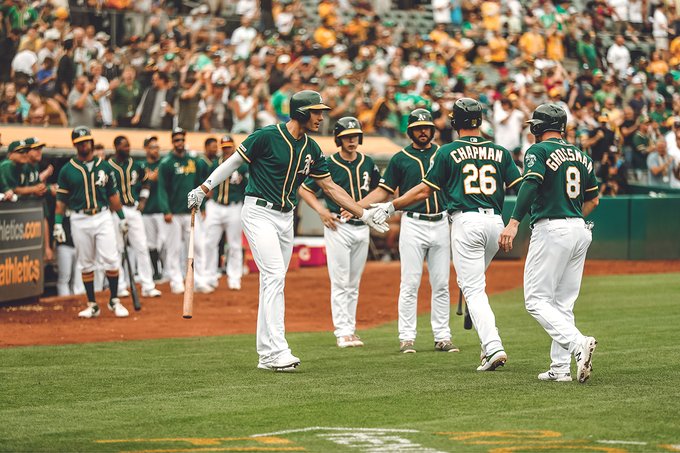
Donaldson, every bit as much as Bando, Lansford, and Chavez, was a tough act to follow, maybe even more so. An exciting and tough new third baseman. Matt Chapman followed. The hard hitting, incredibly elegant third baseman made his MLB debut in 2017 and was last year’s winner of the gold glove for the best fielder among AL third sackers and the Platinum Glove for being the best infielder in the league, as well as of the Wilson Defensive Player of the Year award for both of the major leagues. He and Liam Hendricks represented the A’s at this year’s All-Star Game.

So, while there’s always something new happening on the field, and MLB is busy tinkering with ways to make the game resemble football, basketball, and hockey, we can pretty much rely on two aspects of Oakland’s baseball universe, their third base dynasty and the Oakland-Alameda County Whoever Has the Naming Rights Coliseum. At least until we learn the results of the search for a new home.

Headline Sports with Tony Renteria

audio-connection-controller-265672

Headline Sports with Tony Renteria

It’s August and now it feels like football season for real!

  • Raiders are in camp for year two with Gruden
  • How will the team handle the brutal early road schedule?
  • The London game with the Bears could be pivotal
  • How will the new personnel impact the team?

The Giants held on to “Mad Bum” – good or bad decision?

  • Do the G-men have the players to make the playoffs?
  • What are their chances of making the Wild Card?

Take “20” and enjoy some sports talk with Tony

Vekic dominates former #1 Azarenka on Day 4 of Mubadala Silicon Valley Classic

Photo credit: @JJlovesTennis

By Marko Ukalovic

SAN JOSE, Calif. — Donna Vekic has been enjoying her first time in the Silicon Valley. After taking a trip to up to the Facebook headquarters earlier in the day, she finished out her day in style with an upset second round victory over former number one women’s player Victoria Azarenka in straight sets 6-4 6-3 highlighting Day 4 of the Mubadala Silicon Valley Classic on Thursday evening at San Jose State University.

The fifth-seeded Vekic fought her way out of a 0-2 hole twice to win in commanding fashion with her dominant serve and powerful two-hand backhanded swing that put Azarenka on the ropes late in the match. Down 4-1 in the first set, Vekic went on a five-game win streak to take the first set.

Azarenka, ranked 38th in the world, was frustrated throughout the match thanks to seven double faults. She threw down and broke her racket at the end of the first set after an unforced error.

“I’ve never played her (before). Actually, this was our first match,” said the 23-year old from Croatia. “I knew she was a great player, great competitor. I knew I had to bring my best game if I wanted to have a chance to win.”

In the second set, Vekic finished off Azarenka by winning the last three games and finished the match with six aces and winning five of the eight break points to head into the quarterfinals.

Vekic credits her ability to move around the court quicker as her game has evolved since she turned professional seven years ago at the age of 16.

“I don’t think I moved at all when I was 16”, Vekic said with a laugh. “I have a lot more patience now. I’m not afraid to stay in the rallies. In fact I like to be in the rallies and to build up the point.”

In earlier action Amanda Amisinova defeated Madison Brengle in straight sets 6-2 6-2 in a battle of Americans. China’s Saisai Zheng took down American Danielle Collins also in staight sets 6-2 6-0 and American Kristie Ahn was a winner against Belgium’s Elise Mertens 6-3 6-3 rounding out single’s play.

En-Shuo Liang and Zheng teamed up to beat Ellen Perez and Heather Watson in three sets 7-6 6-0 10-8 in the only doubles action of the day.

Chapman secures series win as A’s beat Brewers 5-3

Photo credit: @Athletics

By: Lewis Rubman

Milwaukee: 3-7-0 (10 LOB)

Oakland: 5-6-0 (6 LOB)

OAKLAND — The A’s sent Homer Bailey, who was 2-1, 8.59 ERA for them since being traded to the team from Kansas City on July 14, to the mound this afternoon. In his three Oakland starts, Bailey has been somewhat like the little girl with the little curl, right in the middle of her forehead. When he was good, he threw six innings of two-run, seven-hit ball against Seattle and 6 2/3 innings of three-run, seven-hit ball against Texas. One of those runs was charged to him after Ryan Buchter allowed a runner who had tripled off Bailey to score on a double. In between those starts, Bailey surrendered nine runs on eight hits in two horrendous innings against Houston. All of the runs he allowed in that game were earned.

Opposing him for the Brewers in today’s blearly eyed contest was Chase Anderson (5-2, 3.89 ERA), a 6’1″, 200 pound right handed hurler in his sixth year in the majors and whose current ERA exactly matches his lifetime figure. This was his 17th start of the season, which he has supplemented with five relief appearances. He features a four-seam fastball in the low to mid 90s and so far this campaign has managed to achieve an average of 8.69 strikeouts and 2.93 walks per nine innings. He throws some sort of fastball about half the time, although this figure has been decreasing steadily over his career.

Bailey threw nothing but strikes to the first two hitters he faced, and he retired both of them. But then he walked Keston Hiura on a 3-1 count, and cleanup hitter Mike Moustakas dropped a perfect bunt to third against the shift for a single that put Hiura in scoring position at second, from which he scored on Ryan Braun’s single to center. For the second straight game, Oakland was down a run before coming to bat.

Bailey pitched out of a jam in the third. With one down in the frame, Jurickson Profar committed a throwing error that enabled Christian Yellich to reach first safely. He advanced to third on Hiura’s single to center, Hiura taking second on the throw. The A’s starter rose to the occasion by getting Moustakas to pop out to Chapman and striking out Braun.

Chad Pinder led off the bottom half of the inning with a resounding round tripper off a 93 miles per hour four seam fast ball from Anderson.

The score remained tied for a very short time. A single by Eric Thames led off the fourth. That hit was followed by a walk to Travis Shaw. Orlando Arcia’s liner, knocked down by Bailey and thrown to Olson, retired the batter but moved the runners up to second and third. Trent Greshman, playing in his first major league game, got his first RBI with a sacrifice fly to Grossman in left center, unknotting the score.

Bailey left the game after thowing 101 pitches, 61 of them strikes, over six innings. He surrendered two runs, both earned, on five hits and three walks, while notching five strikeouts. He was good, although not very, very good.

Yellich extended his consecutive game hitting streak to 19 with a double off Bailey’s replacement, Jake Diekman, with a runner on first and no outs in the top of the seventh. The blast hit the right field scoreboard and tied Yellich for longest streak in the league. It was a weird inning for Diekman. He hit Hiura with a pitch to load the bases after Yellich’s two bagger had sent Grandal to third. Moustakas grounded sharply to Olson, who threw home for the force out. It took Diekman only three pitches to strike Ryan Braun out swinging on a wild pitch that enabled Yellich to sore from third, upping the Brewers’ advantage to 3-1. Diekman then needed only three more pitches to log another swinging K, this one against Thames to close out the inning.

Like Bailey, Anderson was lifted after six innings. He allowed one run, earned, on two hits, three walks, and a hit batter. He threw 92 pitches. 52 of them were strikes.

Anderson’s replacement in the home seventh, Junior Guerra, was as erratic as Diekman hd been. He let the A’s close the gap to one run by giving up a lead-off single to Canha, who moved up a base on a walk to Nick Martini, hitting for Pinder, after Profar had flown out at the center field fence. Beau Taylor’s ground out, first to the pitcher covering, moved each runner up a base, and Guerra’s wild pitch to Semien had the same effect, this time scoring Franklin Barreto, who was pinch running for Pinder and remained in the game at second, Profar moving to the outfield. Milwaukee now was up, 3-2.

Blake Treinen continued his comeback by setting down Milwaukee with one hit in the top of the eighth in relief of Diekman.

Josh Hader replaced the unfortunate Guerra, whose line was one each for innings pitched, runs, earned runs, walks, and hit batters. His pitch count was 25.

Josh Hader came in to pitch the eighth, his third relief apearance in as many days. The Brewers’ closer walked Grossman, the first man he faced. Then Chapman’s bat came alive as the A’s stellar third sacker rocketed a two run homer to straight away center field to give Oakland a 4-3 lead. Hader was pulled after Olson grounded out to first, unassisted. The reader won’t need any assistance from me to figure out Hader’s pitching line. He threw 16 pitches to earn it.

The resurgent Khris Davis greeted Hader’s replacement, Jay Jackson, with a single to center. Canha advanced the A’s DH to third with a line single to right. Canha then stole his second base of the game and advanced to third while Davis scored on Profar’s sacrifice fly to right.

Melvin called on Liam Hendricks to defend the A’s new found two run lead and in the process earn his tenth save of the season, which he had been unable to do Tuesday night. Today, he set down the side in order, striking out Yellich and Hiura and getting Moustakas to fly out to center for the game ending out.

Treinen got the win; he’s now 6-3. Hader was the losing pitcher; he’s now 1-5.

The A’s have a rare Friday off and will return to the Coliseum at 6:07 pm Saturday evening to face the Cardinals in another interleague battle. The scheduled starters are Mike Fiers (9-3, 3.54 ERA) for Oakland and the geographically named Dakota Hudson (10-5, 3.88 ERA) for St. Louis.

When the game ended at 3:50 pm, the A’s trailed Houston by 7 1/2 games for the division lead. They’re in a dead heat with Tampa Bay for the second wild card berth, both teams 2 1/2 games behind Cleveland.

San Jose Earthquakes podcast with Ana Kieu: Quakes to wrap up homestand and hit the road

Photo credit: sjearthquakes.com

On the San Jose Earthquakes podcast with Ana:

1. The Quakes defeated the Colorado Rapids 3-1 on July 27th.

2. The Quakes wrap up a two-game homestand vs. Columbus Crew SC on August 3rd.

3. The Quakes hit the road for a three-game trip against Colorado Rapids on August 10th, Sporting KC on August 17th, and LAFC on August 21st.

4. The Quakes acquired Argentine striker Andre Rios on July 30th.

5. Nashville SC extended their loan for Quakes defender Jimmy Ockford on July 31st.

Ana does the San Jose Earthquakes podcasts each week at http://www.sportsradioservice.com

3 things evident in San Jose State football’s first day of fall practice

Photo credit: sjsuspartans.com

By: Ana Kieu

Three things — excitement, energy and enthusiasm — were evident in San Jose State football’s first day of the fall practice period.

Brand-new shiny white helmets clearly stood out as the Spartans ran into CEFCU Stadium, but practice was more than just a sharp-looking helmet.

“It was great start. We have a lot of work to do. We are further along and you can see there is more scheming and guys are comfortable. Now, the next step is helping those new guys to become part of it, and those new guys to get into the mix where they can contribute and know what to do and understand it,” said San Jose State football head coach Brent Brennan.

“I think we spent two years going through a really hard time building this foundation and I think the expectations are clear. The expectations are clear, player to player, in what they expect of each other and how they expect them to work, behave and go about their business. So I think that’s the biggest thing. It was the best offseason we’ve ever had and I’m hoping that this is going to be the best fall camp. It’s off to a good start.”

Brennan mentioned one of the points of emphasis early on is winning the turnover battle. A year ago, San Jose State was the second most improved team in the FBS going from minus-26 in 2017 to plus-1 in 2018, an improvement of +27.

A similar improvement in 2019 would be an unreasonable expectation for any team, but simply going from +1 to +5 would portend well. 23 of those 39 FBS teams won nine or more games and only four didn’t get invited to a bowl game last season.

“Today was a huge emphasis on turnover battle and the defense won that handedly, so that was exciting to see. That is one of our big challenges for the season,” said Brennan.

“Before you get pads in, it’s a lot of repetition, a lot of technical work, a lot of scheme and teaching, and then once you get the pads on it becomes a little more combative and you get a little bit closer to playing real football. Tomorrow will be a lot like today.”

The Spartans’ upcoming practice schedule includes a morning session the next four days. The first open practice is on Tuesday, August 6, at 9:40 am.

The season opener is Thursday, August 29, with San Jose State hosting Northern Colorado in a 7 pm non-conference game. Tickets for all San Jose State home games are available at www.sjsuspartans.com/tickets.

NOTES: Former San Jose State offensive lineman Tom Bass, better known for 17 seasons as an assistant coach for four NFL teams between 1964 and 1985, passed away at age 83 on Saturday, July 27. He coached with Don Coryell at San Diego State and the San Diego Chargers and with San Jose State coaching legend Bill Walsh for three seasons as a Cincinnati Bengals assistant coach (1968-70). Bass was a member of the 1955 San Jose State team.

A’s fall to the Brewers 4-2 at home

Photo credit: @Brewers

By Lewis Rubman

Milwaukee: 4 | 9 | 1 | 7 LOB

Oakland: 2 | 7  | 1 | 8 LOB

OAKLAND — Milwaukee’s newly acquired right-hander Jordan Lyles brought an unimpressive 5-7, 5.36 ERA record to the mound at the Coliseum tonight. Even though those dismal numbers, compiled while he still was toiling for Pittsburgh, were in line with his lifetime mark of 36-59, 5.29 ERA, they don’t give an idea of how badly he’d been struggling before he was dealt to the Brewers. He had gone 0-5, 10.00 ERA in his last five contests and 4-7, 6.06 ERA in his last 15. He features a slightly below average four-seam fast ball and a knuckle curve, but he has a few other pitches in his repertory. He threw a lot of classical curve balls tonight.

Oakland countered with Brett Anderson (9-8, 4.05 ERA), who recently has pitched effectively for the first four innings or so, but has run into trouble after that.

He didn’t start effectively tonight, allowing lead-off hitter Lorenzo Cain his eighth home run of the season, a line drive to left that came on the second pitch of the game. In spite of a one out single to right by Ryan Braun, the A’s lefty avoided further damage by inducing clean-up batter Yasmani Grandal to bounce into a 4-6-3 double play.

Anderson allowed another run in the third frame, giving up a single to Orlando Arcia, followed by Christian Yellich’s double to right, which extended the Brewers’ left fielder’s hitting streak to 18 consecutive games and drove in his teammate.

The A’s got one run back in their half of the inning when Marcus Semien led off with a double, and two batters later, Matt Chapman, who has been struggling at the plate, drove him in with a sac fly to right.

But Anderson coughed up that run in the top of the fourth. Yasmani Grandal led off with a single to left, and Keston Hiura drove him in with a double to deep left center. Once again, Anderson snuffed out the rally, but by now, the A’s were trailing 3-1.

Oakland came close to narrowing the gap in the bottom of the fifth, and Semien again was instrumental. He drew a two-out walk and advanced to third when Lyle’s pick off attempt ended up deep in the right field bullpen. But Martini’s fly to right closed out the frame.

A leaping grab of Grandal’s line drive to the right field score board by Robbie Grossman provided excitement in the top of the sixth, but his diving stab at Mike Moustakas’ sinking liner to right center got past him for a double. Anderson got out of the resulting jam by retiring Manny Piña on a fly to Canha in center.

Lyles didn’t come out for the bottom of the sixth. His line for five innings’ work was 94 pitches, 64 of which were strikes, one run earned, three hits, two walks, and four bases on balls. His replacement, Matt Albers, surrendered a one out double to Olson before getting Davis on a hard hit line drive to Cain in center and a full count strike out of Mark Canha.

Albers had two strikeouts to go with the one hit he allowed in his inning of work before giving way to Jeremy Jeffress, who started the home half of the seventh for the Brewers. With one out, Chris Herrmann drove a slicing liner into the left field corner for a two bagger. Jurickson Profar pinch hit for Barreto and spanked a leg double to right center to narrow the visitors’ lead to one run at 3-2. But Semien struck out, and Nick Martini flied out to left to end the comeback.

After seven innings of work, in which he gave up three runs, all earned, on eight hits, one a home run, struck out three, and didn’t walk anyone, Anderson’s task was completed. He had thrown 95 pitches, 64 of them strikes, a record almost identical to Lyles’, and was replaced on the mound by Lou Trivino, still struggling, in spite of his good performance last Sunday against Texas, to regain the dominance he showed last season.

Dominant he wasn’t, giving up a double to Braun and walks to Hiura and Mustakas before unloading a wild pitch to Manny Piña that let in Ben Gamel, running for Braun, from third, and then refilling the bases by walking Piña. Trivino gave way to Wei-Chung Wang, off of whom Eric Thames launched a deep fly that Canha tracked down spectacularly on the warning track in right center field.

Junior Guerra, who entered the fray to start the bottom of the eighth, allowed only a walk to Olson.

Joakim Soria set Milwaukee down 1, 2, 3 in the ninth.

Josh Hader, last night’s losing pitcher, relieved Guerra for the ninth inning, hoping to redeem himself. He did, allowing only a single to Profar.

Lyles got the win. He’s now 6-7 with an ERA of 5.15. Anderson was tagged with the loss. His record stands at 9-7, 4.04 ERA. Hader was credited with his 24th save.

Before the game, the Athletics acquired right handed pitcher Tanner Roak from Cincinnati in exchange for outfielder Jameson Hannah, who had been with Stockton, and an undisclosed amount of cash. They also designated pitcher Andrew Triggs for assignment and placed Ramón Laureano and Josh Phegley on the 10-day injured list, retroactive to July 29. The team recalled Nick Martini and Beau Taylor from Las Vegas to replace them and out-righted pitcher Brian Schlitter to the Aviators.

The Oakland bullpen continues to give reason for concern, although Blake Treinan’s performance last night was encouraging. Also troubling is Matt Chapman’s current slump at the plate. He now is two for 27, including 12 strikeouts, in his last seven games. His fielding, however, remains brilliant. Losing speedy, hard throwing, and hard hitting Laureano for at least 10 days to what is called a right lower leg stress reaction, comes at a particularly unfortunate time.

The A’s now have a won-lost record of 61-48, eight games behind Houston for the division lead. They are a half a game behind Tampa Bay for the second wild card spot and 2 1/2 games behind Cleveland for the first wild card berth.

Right-handers Chase Anderson (5-2, 3.89 ERA) and Homer Bailey (9-7, 3.53 ERA overall and 2-1, 8.59 ERA for Oakland) will be on the mound for the Brewers and A’s, respectively, tomorrow afternoon. That’s when the dog days of August begin. By month’s end, we should have a better fix on who the top dog will be.