By DANIEL DULLUM
Pinch-hitting for Amaury Pi-Gonzalez
Saturday, October 26, 2013
Back in the 1960s, when Curt Gowdy was calling the Game of the Week for NBC, he often remarked about how pundits would claim that the then-new gadget called instant replay would show how bad the umpires were.
Instead, Gowdy told us, it showed how good the umpires really were.
And, on a chilly night in St. Louis, the late, great Cowboy would have been in his glory, making his point again.
That thought came back while watching the exciting finish to Game 3 of the 2013 World Series, which ended with, of all things, a walk-off obstruction call. If you truly like baseball and it’s nuances, this is fun stuff.
To recap, here’s the scenario:
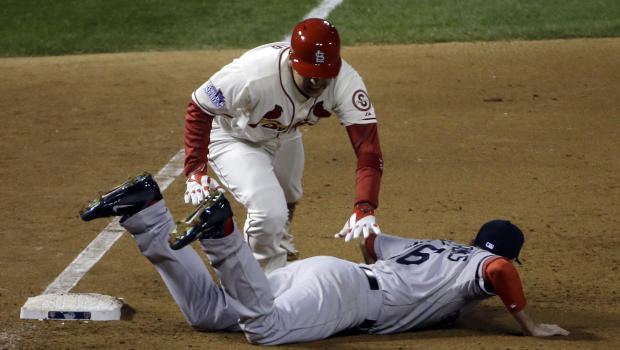
With runners at second and third with one out in the bottom of the ninth, the Cardinals’ Allen Craig had just reached third base on Jon Jay’s grounder to second with the infield drawn in. The lead runner, Yadier Molina, was thrown out at the plate. Jarrod Saltalamacchia, the Boston catcher, noticed Craig – hobbled by a foot injury – lumbering toward third. Saltalamacchia’s throw sailed down the left field line. Red Sox third baseman Will Middlebrooks, in his attempt to catch the throw, found himself blocking Craig’s base path.
Third base umpire Jim Joyce was all over it, with the correct ruling. According to the rulebook, it doesn’t matter whether or not obstruction was intentional. It’s a judgment call that gets a little sticky.
Any action that impedes the baserunner from advancing is called if the umpires determine that the runner – now advancing at his own risk – would have reached the next base safely. In this case, that base was home plate, and Craig slid across with the winning run in a 5-4 St. Louis victory.
Please note – the runner is not awarded the next base automatically, and home plate umpire Dana DeMuth ruled that Craig would have scored if not for getting tangled up with Middlebrooks. Theoretically, if Craig were thrown out by a proverbial country mile, DeMuth could have called him out, basing his decision on whether or not the obstruction made a difference. Had that happened, in all likelihood, the inning would have ended and the game moves along to the 10th.
But it was a close enough play to cite the obstruction rule, which the umps correctly did
In a rare postgame interview involving umpires, Joyce explained to the media, “The baserunner has every right to go unobstructed to home plate, and unfortunately for Middlebrooks he was right there. And there was contact. So (Craig) could not advance to home plate, naturally.”
Then, Crew Chief John Hirschbeck, clearly annoyed by the inquisition, clarified, “There does not have to be intent, OK?”
Understandably, the Red Sox players and coaches were stunned, confused, and downright upset. No one wants to lose a World Series on a technicality, but the Red Sox did.
However, as upset as the Red Sox are, the rule is clear, and the umpires got it right. The replays proved it, and Joyce deserves credit for a solid call under fire. If anything, Red Sox fans should be more upset that Saltalamacchia made that wild throw to third in the first place. With your closer on the hill and Pete Kozma (.217) on deck, extra innings seemed to be right around the corner.
Tim McCarver, working his final World Series for FOX, said that in his 50-plus years in baseball, he’d never seen a game end like that. Which is, again, one of the great things about baseball – no two games are alike, and the chances of seeing this happen again are slim at best.
For example, in September 1987 I was at the Metrodome in Minneapolis watching the Twins face Kansas City. In the first inning, the Twins turned a 5-4-2 doubled play (third-to-second-to-home for those who don’t know how to score a game) to kill a Royals rally, and left George Brett with the odd scoring of hitting into a DP while reaching safely on a fielder’s choice. I hadn’t seen a 5-4-2 DP before, and I haven’t seen one since. It’s part of the wonderful unpredictability of baseball, like a wild pitch on an intentional walk (which I’ve seen).
The ending of Game 3 is yet another reason why baseball is better. You can’t take a knee or dribble the ball at mid-court to run out a clock. The pitches must be thrown until that third out is recorded. Or, in this case, the winning run is scored.
Thankfully, instant replay isn’t a required part of baseball just quite yet. A 10-minute huddle in front of a monitor under a hood would have killed the moment, reducing it to the level of, say, the NFL – a model of micromanagement.
Let’s hear it for the human element in sports officiating, while we still have a chance to do so.
—
I’d like to thank Amaury for the opportunity to fill some space while he enjoys some well-deserved time off. Rock on! DD



 Sports Radio Service