Stanford Cardinal basketball podcast with Jerry Feitelberg: Oregon could be Stanford’s toughest challenge in Pac 12 play thus far this Sunday

by Jerry Feitelberg

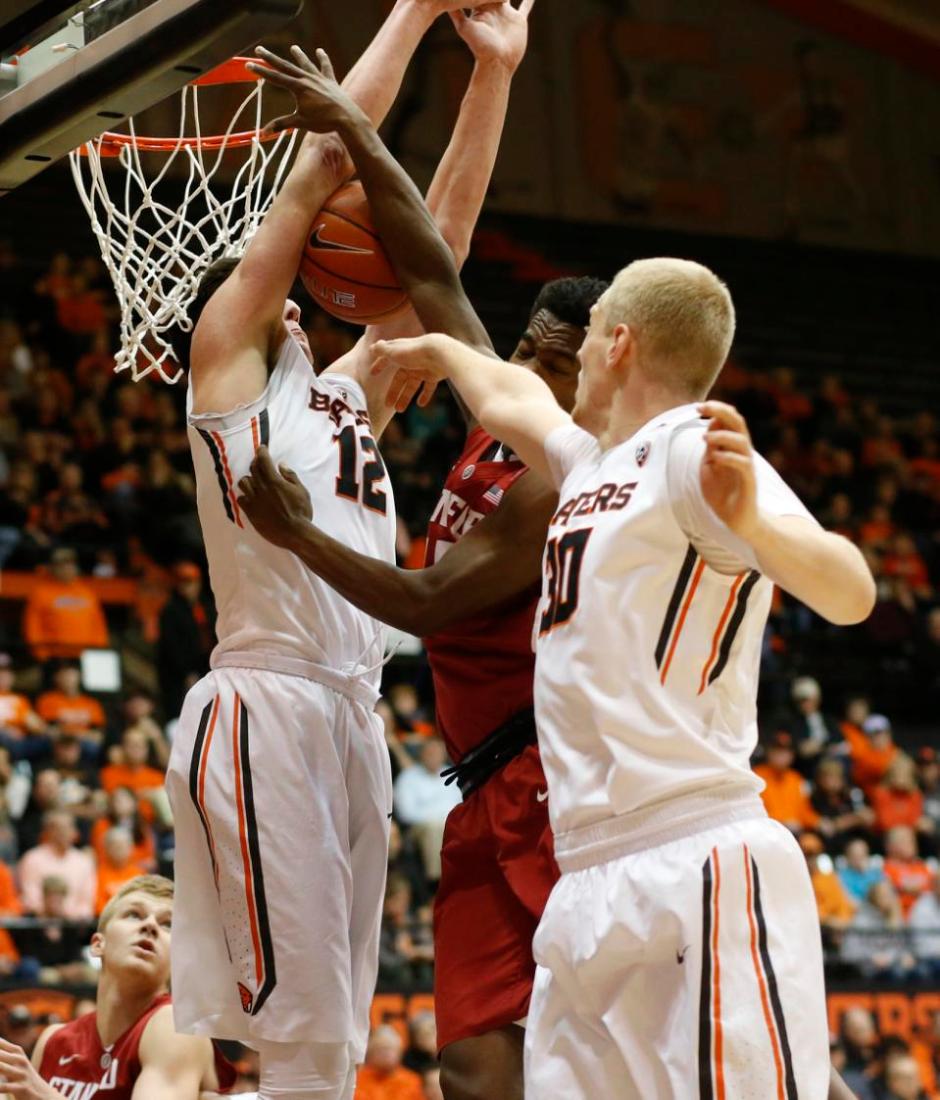
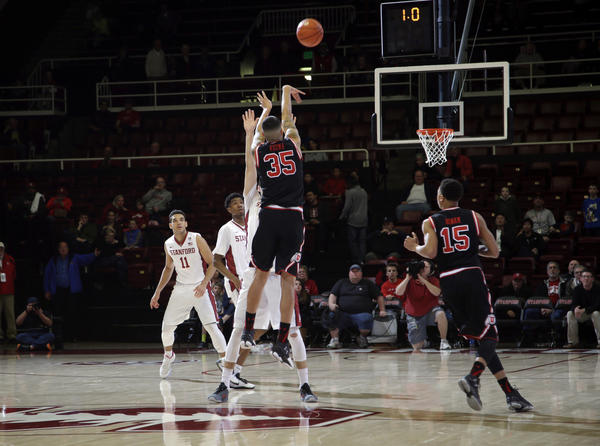
AP photo: Stanford’s Marcus Allen (center) has his shot blocked by Oregon State’s Drew Eubanks Wed Jan 6 game

PALO ALTO–The Stanford Cardinal (9-5) got a key win against a very furious win over the Oregon State Beavers 78-72 after dropping a razor edge close game against the Colorado Buffaloes 56-55. Had the Cardinal lost that game they would have been 1-2 in the Pac 12 Conference now there 2-1.

The Cardinal are headed to Knight Arena at the campus of the University of Oregon for Sunday’s game with the Ducks (12-3). The Cardinal are in for a very difficult battle Sunday it would have been nice if they had a chance to come back and beat Colorado.

The Cardinal are doing alright in the conference and are 9-5 for the season and hopefully they’ll do as well in Eugene they’re playing a very difficult Oregon Ducks team who are some nine game over .500 and playing very well.

Jerry Feitleberg is a beat writer covering Stanford Cardinal basketball right here at http://www.sportsradioservice.com listen to the podcast below

Cardinal hold off Beavers, 150th win for Dawkins

By Daniel Dullum
Sports Radio Service
Wednesday, January 6, 2016

photo credit: USA Today Rosco Allen one of the prime time players on the Stanford Cardinal

Stanford used a 21-point, eight rebound effort from Rosco Allen to hold off Oregon State 78-72 Wednesday in Pac-12 men’s basketball at Corvallis, Ore., snapping a four-game winning streak for the Beavers.

It was also career win No. 150 at Stanford for Coach Johnny Dawkins.

The Cardinal (9-5 overall, 2-1 Pac-12) also received 15 points and three steals from Marcus Allen and Dorian Pickens added 14 points.

Gary Payton II led the Beavers with 22 points, nine rebounds and six assists. Also for Oregon State (10-3, 1-1), Stephen Thompson scored 13 points and Drew Eubands chipped in with 13 points.

Oregon State pulled to within nine points twice in the first 10 minutes of the second half, and with the help of a 7-0 run, got within seven at 58-51 with 6:48 to play.

With 53.7 seconds remaining, Thompson buried a long 3-pointer to close the Beavers’ deficit to 72-66. OSU pressed the Cardinal, but was unable to force the needed turnovers and Stanford proceeded to sink 8 of 12 free throws in the final 63 seconds.

The Cardinal held a 46-29 rebounding edge, including 20 offensive boards. Stanford also scored 32 points in the paint.

Stanford travels to Oregon on Sunday.

Sun Devils hold Cardinal women to historic scoring low

By DANIEL DULLUM
Sports Radio Service
Monday, January 4, 2016

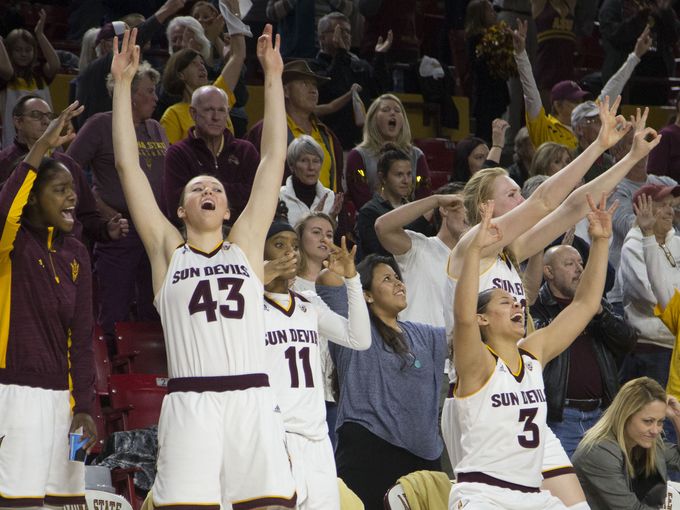
photo credit: azcentralsports.com ASU bench celebrates after ASU’s Elisha Davis buries a three pointer in third quarter

TEMPE, Arizona – Arizona State merely wanted to put together a solid defensive game plan for Monday’s Pac-12 women’s basketball encounter with Stanford. And it worked.

The result was an effort of historic proportions – literally. The Sun Devils held the No. 11-ranked Cardinal to its lowest point total ever in a 49-31 victory before 1,708 at Wells Fargo Arena.

“This certainly wasn’t our night,” Cardinal Coach Tara VanDerveer said. “We just missed too many shots, and Arizona State did a lot of things defensively that made it difficult to come back. They played a great game.”

Women’s basketball became a varsity sport at Stanford in 1974-75 as part of the old AIAW. Based on team statistics kept since the 1978-79 season, the Cardinal’s previous scoring low was in a 72-32 loss to Missouri on Jan. 2, 1984 in the Dial Classic at Miami, Fla.

“We had a beautiful scouting report that allowed us to know their personnel inside and out. That allowed us to play the defense that we played,” ASU guard and Bay Area native Elisha Davis said. “You can have a system, but if you don’t have the chemistry and the awareness on defense, it’s not going to work.”

Davis admitted that getting the wins over Cal and Stanford mean a little more to her, saying, “I’m really good friends with some of the girls at Cal, so that makes it a little more personal. With Stanford, it’s more of a rivalry. I’m thankful for both wins. To open up conference with wins against teams of their caliber speaks a lot to how much we’ve grown as a program.

“It’s a beautiful win, but it also shows how much our hard work is starting to show.”

Arnecia Hawkins and Sophie Brunner each scored a game-high 12 points for ASU (11-3 overall, 2-0 Pac-12), while Davis canned three 3-pointers to finish with nine points. Brunner pulled down 10 of the Sun Devils’ 41 rebounds, and teammate Katie Hempen had five assists.

“Rebounding was a big focus this weekend, especially with Stanford,” Brunner said. “Whoever was going to hit first was going to get the rebound. We really took that to heart, and tonight, we were the ones that hit first.

“When we hit them first, they seemed to get tired, and I wasn’t expecting them to get tired that easily,” she continued. “They (Stanford) just seemed to get tired early in the game, which we took advantage of.”

Hawkins didn’t want to consider the decisive win as a statement game, saying, “We treat every game like it’s a statement game.”

Davis added, “We want to show that anyone can win on any given day. We don’t think about rankings. None of that matters on the court. What you do with the ball and how you interact with your teammates and having a collective team effort is what’s most important.”

Sun Devils Coach Charli Turner Thorne said, “I thought we had a tremendous effort and worked hard the entire game. We never let (Stanford) get comfortable in their offensive mode.

Arizona State, which defeated Stanford twice last season, defeated the Cardinal for only the 14th time in 71 meetings.

Two days after a 59-34 win at Arizona, Stanford (11-3 overall, 1-1 Pac-12) never led in the game against ASU. After the 17th-ranked Sun Devils opened the game with a 14-4 run, Stanford was held to single-digit scoring until Kaylee Johnson’s layup with 1:02 left in the first half closed their deficit to 26-11.

“I didn’t think we would hold Stanford the way we held them,” Turner Thorne said. “I couldn’t believe the halftime score. We’ve had some defensive battles over the years with scores in the low 50s. But I was confident that we could do a great job defensively.

“Our goal is to make teams work for what they get. We won’t give anyone anything easy, and when we do that for 40 minutes, I like our chances.”

The Cardinal shot 24 percent (5 of 21) from the field in the first half and didn’t fare much better after halftime, making 6 of 22 shots (27 percent) in the third and fourth quarters.

Arizona State didn’t shoot much better (31 percent), but made 17 field goals and made 9 of 11 at the free throw line.

Thorne said one of the things that worked in ASU’s favor was “time of possession.”

“That’s usually a football term, and it worked in our favor in both of these games” Turner Thorne said, laughing. “With our leads, I thought we did a very good job of getting offensive rebounds, kicking it out, and make them keep playing defense. I thought our team played very poised, very smart in the fourth quarter in both games.”

After ASU’s Kelsey Moos opened the second half with a 3-pointer, Erica McCall’s inside jumper and a layup by Lili Thompson helped Stanford pull to within 29-17. The Cardinal got no closer than 31-19 on a pair of Brittany McPhee free throws.

“Our team is good at adjusting, so we had faith that we could adjust and we can usually do that to our advantage,” Hawkins said.

Davis’s third 3-pointer gave the Sun Devils a 39-19 lead with 1:56 remaining in the third quarter. Arizona State would take its final 20-point lead with :56 left in the game on two Sabrina Haines free throws.

Thompson was the Cardinal’s top scorer with seven points. Thompson and Johnson each had four rebounds.

“It came down to motivation; the team with the made-up mind was going to win this game,” Turner Thorne said. “We always want to be as relentless as we can be, and tonight, I thought we were.”

Stanford returns home Friday to host Utah (7 p.m.), with Colorado visiting Maples Pavilion on Sunday (noon).

TAGS: Stanford women’s basketball,Sports Radio Service,Daniel Dullum

Stanford Cardinal basketball podcast with Jerry Feitelberg: Cardinal seek to get back in win column after one point loss last Sunday

by Jerry Feitelberg

PALO ALTO–It was a very difficult loss for the Stanford Cardinal (8-5) losing by one point to the Colorado Buffaloes last Sunday at Maples Pavilion. They had an upset beating the Utah Utes to open Pac 12 play at Maples on Friday night and they were looking forward to taking on Colorado but lost to them by one. When you play these tight defensive games you never know what’s going to happen.

Stanford head coach Johnny Dawkins has the team on the right track right now. They might not do that well overall in the Pac 12 but they might end up in the NIT again. It was a close game against Colorado and losing a game like that sometimes you fall short.

Stanford’s Rosco Allen has been very productive he’s either a center or a power forward and he’s done a good job for the Cardinal. His shooting has been good, his defense has been good and sometimes he gets off to a slow start. Most every game he’s solid he’s going to be good for 18-20 points a game.

Jerry Feitelberg is the Stanford Cardinal beat writer join him each week right here at http://www.sportsrasdioservice click below for the podcast


Cardinal’s comeback falls just short

By Jeremy Harness

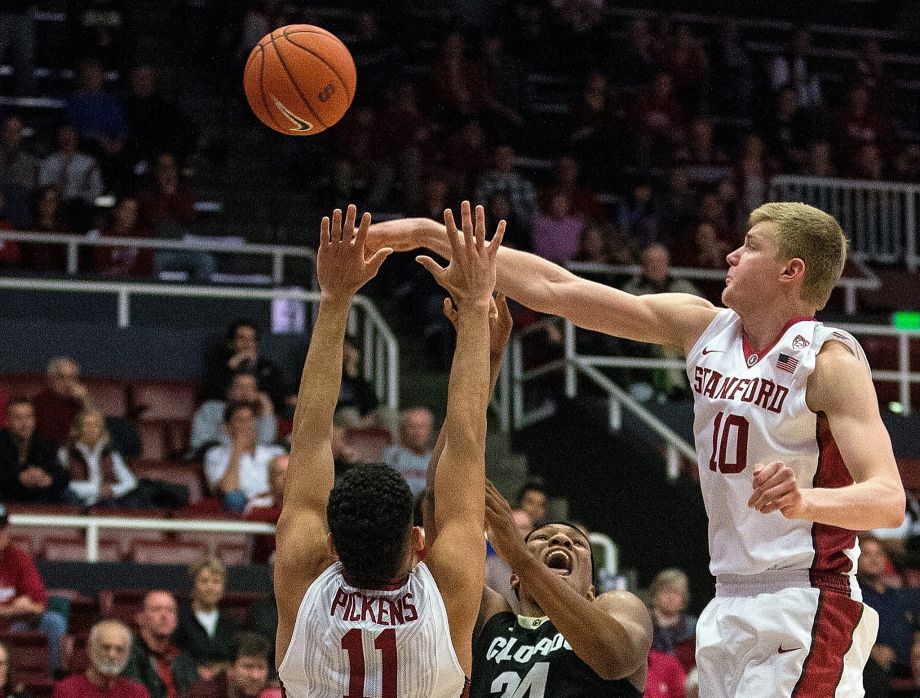
AP photo Michael Humphrey (10) blocks Colorado’s George King Sun 1-3-16

STANFORD – Usually, when you take better care of the basketball than the other team, that translates into a victory. That was not the case, however, for the Stanford basketball team on Sunday night.

Two nights after upsetting No. 25 Utah, the Cardinal fell behind early to Colorado and could not make up the ground quite fast enough, as time ran out on Stanford in a 56-55 loss to the Buffaloes at Maples Pavilion.

After being down by as many as 16 points at one point, Stanford took advantage of Colorado misfires and turnovers to make a big second-half charge and eventually cut the lead to a single point in the final two minutes of the game.

It appeared that Stanford, which did not hold the lead at any point of the contest, was going to have a chance to win when they forced a missed 3-pointer with six seconds remaining. However, in attempting to corral the loose ball, Rosco Allen stepped out of bounds, which gave the ball right back to the Buffaloes.

The Cardinal wrestled the ball away from Colorado on the ensuing possession, but Marcus Allen only had time for a half-court heave, which did not even draw iron, and Stanford dropped to an 8-5 overall record, 1-1 in the Pac-12.

Sophomore forward Michael Humphrey led all scorers with 19 points on 8-of-15 shooting and had a big hand in Stanford’s comeback in the second half. He also pulled down eight rebounds to go along with a pair of steals.

The turnover numbers are a bit perplexing, however. While the Cardinal turned the ball over only six times, Colorado committed 18 turnovers.

At the same time, it’s tough to win games if you can’t shoot the ball at all, and that was the issue that Stanford ran into, particularly in a first half that saw the Cardinal make only one of their 11 3-point attempts. Stanford made only 28 percent of their shots in the opening 20 minutes, and Colorado used that to race out to its big lead.

Forward Josh Scott paced Colorado with 14 points along with 14 rebounds, three assists and a pair of steals.

Another reason Colorado was able to build its lead was the ball movement. The Buffaloes finished the game with 14 assists to Stanford’s seven, and they simply moved the ball quicker and more smoothly than the Cardinal did in the first half, resulting in more open looks at the basket.

The Buffaloes made five of their 11 shots from behind the 3-point arc in the first half and made 50 percent of their field goals in that timeframe overall.

Stanford, however, applied more pressure in the second half, which slowed down Colorado’s ball movement and caused more turnovers on the part of the Buffaloes, allowing the Cardinal to march back into the game.


Stanford Cardinal basketball podcast with Daniel Dullum: Nothing like those home sweet home wins for Cardinal close games

by Daniel Dullum

photo credit: isiphotos.com Stanford’s Rosco Allen takes aim against Utah in last Sunday night’s win

For visiting teams Maples Pavilion at Stanford University is a really tough place to come in and try and win. The home floor can never be underestimated for a lot of reasons. The Stanford Cardinal know the practice floor, the rims, the crowd, and with the floor if you know where the dead spots are that’s advantageous for the Cardinal.

You know how to read the scoreboard, everything is just more comfortable and the home court can be real comfortable in that direction. Stanford played well against the Utah Utes and did what they had to do. The problem for Utah as they came into the game Friday night down the stretch they had seven shots from the charity stripe both in regulation and overtime.

That’s something that the Utes have to address and it was an fortunate situation for Stanford as the game could have went the other way. The Cardinal held on and got the job done with a 70-68 overtime win with Buffalo.

Daniel Dullum did the Stanford Cardinal basketball podcast and was filling in for Matt Harrington at http://www.sportsradioservice.com

Stanford Trips Up Ranked Runnin’ Utes in OT

By Matthew T.F. Harrington

photo credit: AP photo Utah Kyle Kuzma tried to stop a Stanford forward Rosco Allen shot on Friday night

STANFORD, Calif. – Stanford has a habit of making New Year’s Day memorable whenever they take the court. Prior to Friday night’s contest, in its lone January 1st appearance in 1938 Hank Luisetti set single-game school records in points (50) and field goals (23). Nobody scored 50 points at Maples Pavilion Friday, but the game was a standout showing in its own right.

The Stanford Cardinal came from behind to upset no. 21/22 Utah 70-68 in overtime, opening the New Year and Pac-12 play with a 1-0 record.

“Our guys have a big heart,” said Stanford coach Johnny Dawkins. “It’s not always pretty but they seem to find a way to give us a chance to win. That’s all you can ask for from a group.”

Rosco Allen and Marcus Sheffield scored 17 points for Stanford (8-4, 1-0) to give the Cardinal its 5th win in game 6 of a season-long 7 game homestand.

The freshman Sheffield stepped up big for the Cardinal in his first exposure to conference play. He was the only bench player to hit a field goal, going 7-for-13 from the floor.

“Growing up as a kid, I always dreamed of this,” said Sheffield. “Now that it’s coming to fruition it feels good.”

While Sheffield’s dreams are unfolding in front of him, for his coach and teammates visions of the forward’s potential are shining through.

“I think that will do wonders for his confidence,” said Dawkins. “To have that type of game on that type of stage. We believe in Marcus, it’s why we had him in there. I think he’s starting to realize some of the things he’s capable of doing. I still don’t think he’s fully realized how good he can be. He’s starting to figure it out.”

“He’s a super smooth player,” said Rosco Allen of Sheffield. “He’s really talented offensively. He has all the skills, all the moves in the books. He has the ability to take on guys one-on-one.”

While Sheffield wowed in regulation, Allen had an average regulation contest. The Hungarian-born baller battled foul trouble to produce just 10 points on 5-for-11 shooting. The senior turned it on in overtime however, scoring 5 of the Cardinal’s 7 points in the extra session.

“Rosco’s grown into that role,” said Dawkins. “He’s someone that everybody is confident in down the stretch.”

“I knew I had to come up clutch” said Allen. “We’ve done it before as a team, we did it against Arkansas so we had some experience with that.”

Stanford held Utah (11-3, 0-1) to 5 points in OT. But the Cardinal nearly didn’t make it to overtime.

Utah’s Brandon Taylor stepped up to the free throw line with 2 seconds left and the game tied 63-63. Taylor missed both shots from the charity stripe though and Stanford’s Dorian Pickens missed a heave at the buzzer to keep both teams knotted at 68-68 after 40 minutes.

Both Dawkins and Utah coach Larry Krystkowiak had to entrust major minutes to their reserves, with both teams finding their top players in danger of fouling out. Both team’s starting centers, Stanford’s Michael Humphrey and Utah’s Jakob Poeltl fouled out in the first 40 minutes. Poeltl was Utah’s leading scorer with 16 points but made himself unavailable for overtime after fouling out.

7 players in total, 3 from Stanford and 4 from Utah had 3 or more personal fouls in regulation. Both teams struggled from the free throw line, with Stanford going 14-for-25 and Utah hitting 11 of their 24 from the stripe.

“Maybe a little hangover from the Holidays,” said Dawkins with a chuckle.

The two teams engaged in a defensive dogfight in the first half, with Stanford hitting only 7 of 29 field goals. Utah was more successful from the field, hitting 12 of 23 would-be buckets but the Cardinal forced 10 Runnin’ Utes turnovers.

“Both teams defensively played exceptionally well,” said Dawkins. “They average 82 points a game. I thought our guys did a great job with their effort and energy to slow them down a bit.”

Despite forcing the visitors to mismanage the rock, Stanford still found itself down 30-21 at the half. The two teams were tied 10-10 halfway through the period, but Utah went on a 9-0 run to break the stalemate 19-10 with just under 7 minutes left in the half. The two teams would trade baskets down the stretch, each scoring 11 points to draw the half to an end.

“It was a match-up zone,” said Allen on the Utes defense. “We haven’t seen a lot of that this year. Give credit to them, we haven’t really seen it and we were stumped by it in the first half.”

The second half started much the way the first half ended, with the two teams trading baskets to maintain a double-digit Utes lead at 44-34 with 13:22 left in the game. The Cardinal roared back, scoring 11 of the next 12 points to tie the game at 45-all.

“Our defense was much more active in the second,” said Allen. “We got a lot more deflections. That gave us easier shots on the offensive end.”

Utah would regain the lead, but only get as far ahead as 5 points. With Stanford trailing by 4 in the final 34 seconds, Rosco Allen slammed home a dunk. After Jordon Loveridge missed a pair of free throws, Allen hit a floater over a pair of Utah defenders to tie the game up with 13 seconds. Marcus Allen was called for a foul on Utah’s next possession, and with both teams in the bonus, Brandon Taylor went to the line for his fateful free throw attempts.

With a close win in hand to open Pac-12 play, the Cardinal now turns its focus to a Sunday afternoon match-up with Colorado, another conference showdown.

Our conference is one of the toughest in the country,” said Dawkins. “We expect a battle every single night.”

For now though, Stanford knows it can hang with some of the tougher teams in the Nation.

“When you win a game like that I think it shows the possibilities,” said Dawkins. “As a coach we can always say ‘We believe in ourselves. We can win games like that.’ Until you do, kids will look at you like ‘I hear you coach’. But when you win one you have a reference point.”


Stanford smells roses, tramples all over Iowa

By Jeremy Harness

photo credit: nikeblog.com Stanford Rose Bowl promo

PASADENA – After its offense gained a first down deep in Stanford territory in the third quarter, Iowa’s band threw gold-colored confetti that sprayed into the end zone in celebration.

Four plays later, the Hawkeyes were forced to kick a field goal, but that didn’t stop the majority of their fans from cheering heartily nor the band from tossing up even more confetti that stretched all the way to the 20-yard line.

The way that Stanford thoroughly dismantled Iowa in a 45-16 victory to claim the 102nd edition of the Rose Bowl on Friday, you really can’t blame them.

For Stanford, this marked the second victory in this game in four years and wrapped up an unprecedented four-year stretch in school history, as the current senior class had also played in a third Rose Bowl in 2014.

“This is an unbelievable feeling for us, for our team, for our community,” said Christian McCaffrey, who was named the Offensive Player of the Game. “I couldn’t be more thankful to be a part of a group that’s Rose Bowl champs.”

McCaffrey may not have come away with the Heisman Trophy, but he sure played like he should have won it. The sophomore racked up 368 all-purpose yards on Friday, which broke the record previously set by Wisconsin’s Jared Abbrederis, who gained 346 against Oregon four years ago.

“It’s just the icing on the cake for us,” head coach David Shaw said. “I do think it’s a shame that a lot of people didn’t get a chance to see him during the course of the year. Apparently the games were too late.

“I told him at the Heisman ceremony and I told him again not too long after that, (that) we need him to lead, and he’s leading by example and showing guys how to work and push themselves, because that’s what great players do.”

One of the keys to the game for the Cardinal was to control the line of scrimmage on both sides of the ball, and that’s exactly what they did. As a result, they got the hot start they were looking for to grab a 35-0 halftime lead – the most points scored in any first half in Rose Bowl history – and Iowa never seemed to recover.

Kevin Hogan was never in any serious trouble, as his offensive line consistently gave him plenty of time to throw, an advantage that he parlayed into three touchdown passes while completing 11 of his 21 throws. He did throw an interception in the fourth quarter, but that came after the game had long been decided.

Defensively, the front line made things very difficult for the Hawkeyes from the very beginning and did not let up throughout the game. The Cardinal sacked Iowa quarterback C.J. Beathard seven times and limited a very good Iowa, normally a very good running team, to only 48 yards on the ground.

“Stanford just outplayed us at every turn,” Iowa head coach Kirk Ferentz said. “They did a great job. They have an excellent football team.”

With the same play that Stanford used to get itself back into the game against USC in the Pac-12 title game a month ago, it struck the first big blow on the very first play of this game. McCaffrey went out on a wheel route and instantly gained a step on safety Jordan Lomax, who was assigned to cover him.

Hogan then hit McCaffrey in stride, and the dynamic back then streaked 75 yards untouched into the end zone to immediately put Iowa on its collective heels.

“The bottom line is we try to get him matched up in space on everybody, whether it’s a linebacker, safety, whoever it is,” Shaw said. “That’s what that play was all about. We pushed the coverage to the (sides of the) field and (gave) Christian a one-on-one on the back side, and watched him do what he does.”

Then Stanford worked the play-action into a thing of beauty. On the Cardinal’s second possession, for instance, linebacker Parker Hesse was so focused on McCaffrey that he was completely fooled on one of Hogan’s said fakes, allowing the quarterback to take it into the end zone for an 8-yard score.

The Hawkeyes seemed to get a bit of a rhythm going on their second possession, using the legs of assorted running backs as well as those of Beathard to drive into Stanford territory. However, that momentum was squashed when Quenton Meeks jumped an out route by Matt VandeBerg en route to a 66-yard interception return for a touchdown for a 21-0 Stanford lead.

By the second quarter, the Hawkeyes had probably seen more than enough of McCaffrey to make their halftime walk in to their locker room much longer than they could have imagined.

Early in the quarter, Iowa gave McCaffrey a chance to return a punt, and they paid dearly for it. McCaffrey fielded the punt, made a few tacklers miss and forced the shell-shocked Iowa contingent to watch painfully as he marched untouched into their end zone for a 63-yard score.

Even when they screwed up, the Cardinal found a way to make it work remarkably well. Hogan actually faked a fumble of the shotgun snap, which compelled corner Desmond King to look into the backfield and allow receiver Michael Rector to get behind him. Hogan recovered the fumble in time to find Rector wide open in the end zone for a 31-yard scoring connection.

To further illustrate Stanford’s domination, Iowa was held scoreless for the first time this season. The Hawkeyes added a few scores late in the game, but the game was well in hand by that time.


Smothering Defense Keys Stanford’s Rose Bowl Victory

By: Ben Leonard

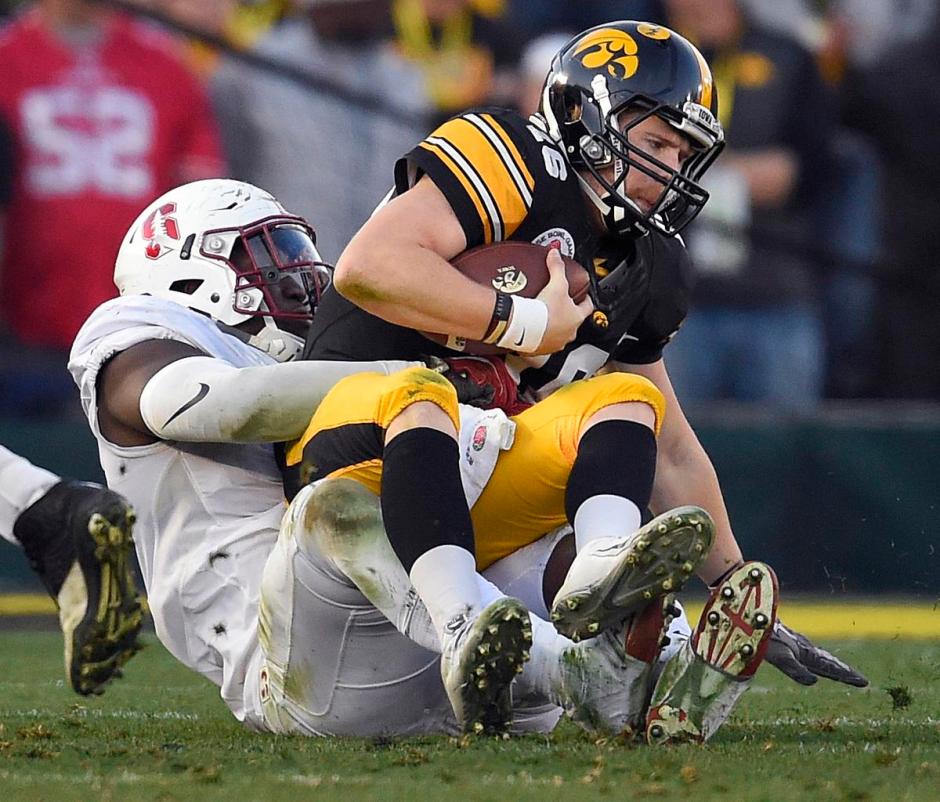
photo credit: AP Stanford defensive end Aziz Shittu sacks Iowa quarterback CJ Beathard at the Rose Bowl

PASADENA, Calif. — Bend but not break? That used to be the knock on Stanford’s defense, but you can’t say that anymore.

Iowa learned it the hard way — Stanford’s defense was tough, physical, and strong-willed, leading the Cardinal to a dominant 45-16 win in the 102nd Rose Bowl Game.

A team known for partying in the backfield in recent years, Stanford had acted like it was a Tuesday night for all of 2015, registering just 27 sacks all season long. The Cardinal used to a defensive powerhouse, but after returning just three starters heading into this season, it fell to a middling 45th nationally in total defense. As a unit, the defense bent a lot but mostly tightened in the red zone.

But they finally put it all together on Friday night, keeping Iowa off the scoreboard until just over three minutes left in the third quarter. Iowa had never trailed by more than seven points all season long, but Stanford’s “D” forced the Hawkeyes to stare at a 38 point deficit.

Heisman finalist Christian McCaffrey quickly put the Hawkeyes on their heels, dashing for a 75-yard touchdown on the first play from scrimmage before most fans had settled into their seats, just eleven seconds into the game. From there with a 7-0 lead and a boatload of confidence, the defense, led by Rose Bowl defensive MVP Aziz Shittu, took over the game. As head coach David Shaw put it, “If we can get ourselves the lead, we’re a tough team to beat.”

A fifth-year senior, Shittu had a career day in his final game at the college level, picking up career highs in sacks (1.5), tackles (10), and tackles for loss (3.5). The 6’3″, 279-pound defensive lineman was all over the field, making key stop after key stop for the Cardinal. His experience in Pasadena might have been a big part of it — it was Shittu’s third trip to the Rose Bowl, although just his first time seeing extensive playing time.

But in typical fashion, the team leader was quick to credit his teammates for the individual accomplishment. “It feels awesome, just to see all your hard work come and you be able to walk away with some hardware is never a bad thing,” Shittu said after the win. “But it’s really that the whole defense played a great job today. Wouldn’t have been able to do it myself. Wouldn’t have been able to make the plays I made today by myself. As a unit, we work so well together… It’s just been cool watching those guys that have done the job before me and be able to replicate that and play my hardest.”

Shittu was part of a defensive line that held Iowa, a team built around its run game, to a minuscule 1.3 yards per carry, and sacked dual-threat quarterback C.J. Beathard seven times. Shaw credited Shittu and the line for the victory: “Aziz was phenomenal today. When you can establish the line of scrimmage on the offensive side and establish line of scrimmage on the defensive side, you’ve got the edge.”

Once an afterthought, a defensive line buoyed by seniors Brennan Scarlett and Shittu put Iowa’s elite offensive line on their heels, so much so that it led some reporters to wonder whether the playing surface was affecting their grip.

Iowa head coach Kirk Ferentz quickly dispelled those thoughts, saying that the grass had nothing to do with it: “You’ve got to play with your feet up underneath you. That’s what it gets down to. The surface was excellent. That’s part of playing on natural grass. It wasn’t the shoes. It’s just they’re a good football team…They just outplayed us. They outplayed us in every turn, and credit goes to them.”

Winning the battle in the trenches has always been a huge point of emphasis for Shaw: “It’s a key for every football game. When you walk in the locker room, that’s the reason we put our locker room the way it is. When our players walk in the locker room, to the left is the offensive line, to the right is the defensive line. Our guys are reminded every day that the game starts in the trenches. That’s where it starts in establishing the physical nature.”

The secondary also did its part, once again coming up clutch, stopping whatever momentum the Hawkeyes had begun to gather. Down just 14-0, Iowa was driving deep into Stanford territory for the first time, holding the ball at the Cardinal 36 on third down and short.

But freshman cornerback Quenton Meeks came up big, picking off Beathard on a bad sideline pass and taking it 66 yards to the house, giving Stanford a 21-0 lead with four minutes left in the first. Meeks’ play sucked the life out of the throng of the gold and black clad fans at the Rose Bowl.

After three quarters, Iowa had thrown for just 87 passing yards on 22 attempts, of which they completed just 12. It was an overwhelming effort, all the more impressive because they were on the field so much. Because Stanford’s offense was moving so quickly, in the first half alone the Cardinal defense was on the field for nearly twenty minutes. They showed no signs of fatigue, only yielding large chunks of yards in garbage time while playing prevent defense.

They’re here to stay — Stanford is losing just three starters on a defense loaded with freshman and inexperienced players. Look out, Pac-12 offenses. Stanford’s defense is back.


ROSE BOWL GAME: Keys to victory for Stanford, Iowa

By Jeremy Harness

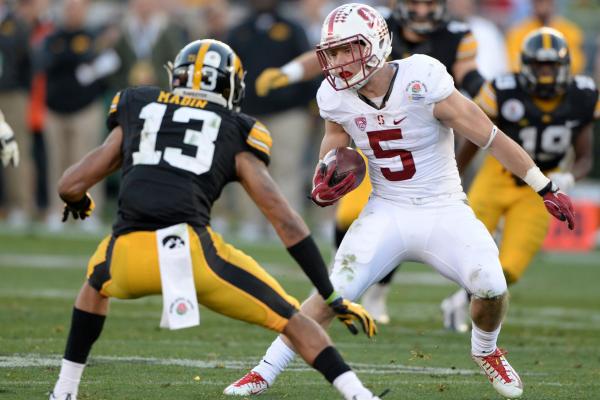
UPI photo Stanford running back Christian McCaffrey jukes Iowa Hawkeyes defensive back Greg Mabin

102nd Rose Bowl Game presented by Northwestern Mutual

Iowa (No. 5 in the College Football Playoff (CFP) standings, No. 6 in the Associated Press poll and No. 7 in the USA Today Coaches poll) vs. Stanford (No. 6 in the CFP standings, No. 5 in the AP poll and No. 6 by the coaches)

HISTORY: This is the first-ever meeting between the two schools

WHERE: Rose Bowl Stadium, Pasadena, CA

WHEN: 2:10 p.m. PST

TV: ESPN

RADIO: KZSU 90.1 FM

STANFORD WILL WIN IF: The Cardinal get off to a fast start by quickly controlling the line of scrimmage. Stanford has struck first in several games throughout the year, and that has often set the tone for the rest of the contest. Iowa, meanwhile, has struggled to find its rhythm early in games, so Stanford can certainly use that, as well as its bowl-game experience, to its advantage. The Cardinal will be playing in its third Rose Bowl in four years, which includes a win in 2013, while the Hawkeyes will be in their first since 1991.

Stanford will be in great shape if they can catch Iowa in a mismatch, particularly in using all-purpose running back Christian McCaffrey. To regain control of the Pac-12 title game against USC, quarterback Kevin Hogan found McCaffrey in a one-on-one situation against Trojans inside linebacker Olajuwon Tucker, a mismatch that the Cardinal exploited to the tune of a 67-yard catch-and-run that set up a Cardinal touchdown.

In the passing game Austin Hooper and Devon Cajuste, who is listed as a wide receiver but is more of a tight end, have consistently made big catches to keep crucial drives going as well as put the ball into the end zone. They are both 6-foot-4 with very good hands and route-running abilities and, therefore, have also created matchup nightmares for opposing teams. Look for the Cardinal to look for them by using play-action to get them in one-on-one situations.

Like Stanford, Iowa sets things up by establishing the run, so the Cardinal defense will need to put a heavy emphasis on stopping the run and making the Hawkeyes one-dimensional.

IOWA WILL WIN IF: The Hawkeyes are able to keep the game close by the time the fourth quarter rolls around. To accomplish this, they must limit McCaffrey’s effectiveness. It will be wise for Iowa to shadow McCaffrey with a quick defensive back, preferably third-team All-Big 10 free safety Jordan Lomax, to avoid getting caught in a mismatch with a linebacker that could prove to be fatal in a game that is as evenly-matched as this one.

Stanford has had trouble with quick running backs this year, which USC used to gain control early in the second half of the Pac-12 championship, so Iowa get gain the momentum that it needs if Jordan Canzeri, who has 976 rushing yards and 12 touchdowns this season, can get going.

Iowa has a real deep threat in receiver Tevaun Smith, so if he can get behind the Stanford secondary, it will greatly benefit Iowa. Expect Stanford to cover Smith primarily with corner Ronnie Harris, but the fifth-year senior has been hampered by an ankle injury that forced him to sit out the second half against USC a month ago.

The Hawkeyes’ defense has excelled in the fourth quarter of games this season, yielding only 22.9 rushing yards per game in the final 15 minutes. In addition, Iowa’s rush defense has been stout throughout the season, allowing 114.9 yards and only 10 rushing touchdowns in 2015, which is 10th-best in the nation.

PREDICTION: Stanford wins, 24-17. The Cardinal simply have too much experience working in their favor, and their tight ends provide them with a favorable matchup that the Hawkeyes will have real problems competing with.