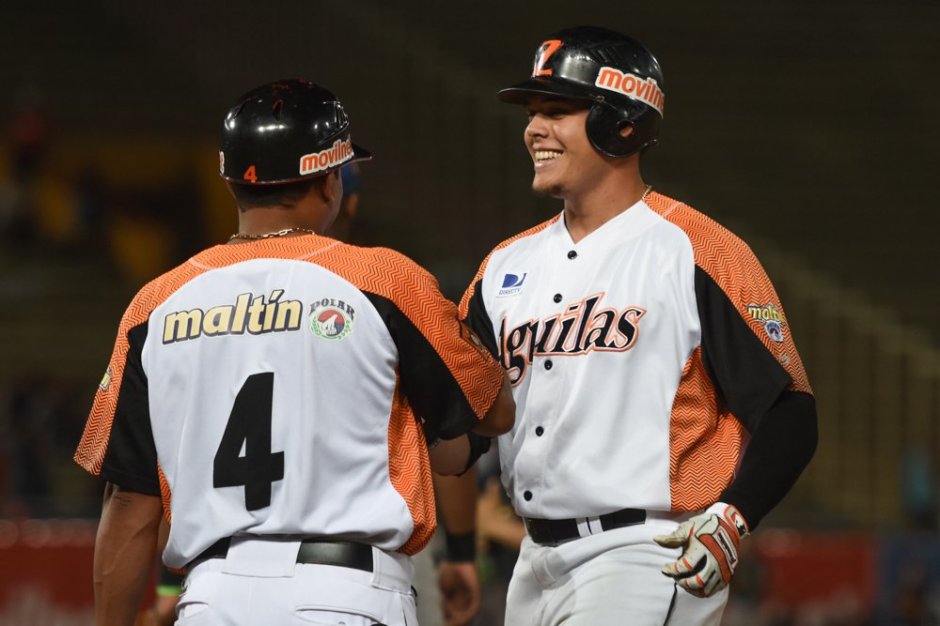
That’s Amaury’s News and Commentary podcast: Caribbean Series has a rich history that goes back to 1949; What a great three-game series in Baja California

Photo credit: mlb.com

On That’s Amaury’s News and Commentary podcast:

#1 The Mexicali Baseball Series was played this week in Baja California, but taking a look at the Caribbean Series, how important was this event for Spanish speaking baseball and its rich history going back to 1949?

#2 The Caribbean Series was revived in 1970, but was without Cuban participation and went on a hiatus in 1981.

#3 Cuba did win in 2015 when they returned as a guest in the Caribbean Series.

#4 The Atlanta Braves outfielder Ronald Acuna Jr. won the National League Rookie of the Year Award, hitting for the season .293, 78 runs, 64 RBIs,and 26 home runs.

#5 American League Rookie of the Year Award went to Los Angeles Angels’ Shohei Ohtani, who hit .285, 59 runs, 61 RBIs, 22 home runs. Ohtani pitched with a 4-2 record and a 3.31 ERA.

Amaury Pi-Gonzalez does News and Commentary each week at http://www.sportsradioservice.com

MLB Mexicali Baseball: Long Weekends and Extended Seasons Across the Border (Part 3)

Photo credit: @AguilasDeMxli

By: Lewis Rubman
SRS Contributor
November 11, 2018

Charros de Jalisco: 0 | 5 | 2
Aguilas de Mexicali: 7 | 11 | 0

MEXICALI, Baja California — The Caribbean Series is the culmination of the Winter Leagues’ season and, very likely, the most important event in the world of Spanish-speaking baseball. It began in 1949 and continued through 1960, as a result of Cuba’s ban on professional sports. Cuba, the Dominican Republic (then known as Santo Domingo), Puerto Rico, Panama, and Venezuela competed during the dozen years of this stage in Caribbean Series history. Each of these except Venezuela won at least one championship, with Cuba leading the pack with seven, followed by Puerto Rico with four, and Panama with one.

The Series was revived in 1970, without Cuban participation. The Liga Mexicana del Pacífico was added in 1971. The tournament has been celebrated every February since then with the exception of a one-year hiatus in 1981. Cuba returned to competition as a guest, but not a member, of the sponsoring Caribbean Baseball Federation, in 2015 and promptly won the tournament. Puerto Rico’s Caguas Criollos has brought the crown home to that island for the last two years. The totals for championships since 1949 is nineteen for the Dominican, sixteen for Puerto Rico, nine for Mexico, eight for the Cubans, seven for Venezuela, and one for Panama.

In its current format, the five participating teams play 13 games in seven days. In the first round, which lasts five days, each team plays two games against each of the others and enjoys one day of rest. At the end of this round, the team with the lowest won-lost percentage is eliminated.

Today, we won’t go into the complex tie breaking procedures. The surviving squads play a one-and-done four team double header, with the first and fourth place finishers facing each other, as do the second and third place teams. The winners of those games duke it out in the final game. In both the semi-finals and the final contest, the team with the higher winning percentage in the opening round gets to bat last. Jalisco has never competed as Mexico’s representative to the Series, while the closest Mexicali has come to winning since its 1968 championship was in 2017 when it lost the final game–played in Culiacán–to Puerto Rico’s Caguas Criollos by the score of 1-0.

I suffer from gout, so I can’t enjoy eating the tempting food for sale in the Estadio B’Air, aka the El Nido de los Aguilas, The Eagles’ Nest.But, just as General Sternwood indulged his vices by proxy while watching Phillip Marlowe down brandy and smoke a cigar at the beginning of The Big Sleep, I get great pleasure from watching people at the Nido enjoy the culinary delights that are denied to me. I mentioned one of them, Bubba Smith’s hotdogs, in yesterday’s report. They’re similar to the ones you can buy fresh off the griddle on the bridge between BART and the Oakland Coliseum and, judging by their smell, delicious. Another delicacy are the pig tails, fried and sold by Chel Vásquez and his family at the stadium. You might want something to wash down all your Bubbas and pig tails. Try a clamato, a juice invented in Mexicali. You can get it straight or mixed with olives. Cerveza Sol offers its beer mixed with clamato and sold in cans but served in plastic bottles at the ballpark. They were giving away shot glass sized samples at todays game. My wife says it was delicious. Tecate is another beer prominent on the premises. Or maybe you’d prefer a few tequilas with lime and salt. Indeed, lime and hot sauce are available with practically every bit of food or drink you want at the ball park.

Mexicali swept its three-game series with Jalisco by whipping them 7-0 in this afternoon’s contest, repeating many elements of last night and the night before’s story. Once again, neither team’s batter provided a home run. And the Aguilas starter again went deep into the game with an extremely strong performance. Javier Solano held the Charros scoreless over seven innings, in which he yielded five hits, struck out seven, and walked two. Michael Devine and Randel Lazo each pitched a perfect frame to preserve the win for Solano and Mexicali.

Agustin Murillo, the Charros’ usually sure handed third baseman contributed twice to Mexicali’s scoring. Jason Bourgeois opened the bottom of the third with a hard hit bouncer than skipped between his legs, leading to starting and losing pitcher Elián Leyva being yanked after two and two-thirds innings, even though none of the three runs he had alllowed was earning and he had given up only one hit. Still, it was clear that Leyva had no command over the situation. Felipe González, Jared Lakind, and Linder Castro held Mexicali at bay until things fell apart for the Charros in Mexicali’s bottom of the seventh, when they pushed four runs across the plate, aided by Murillo’s inability to handle Ramón Ríos’ hard shot to third. It was a tough play, and Ríos deserved the hit with which he was credited, but it opened the door for the four runs that put the game out of reach for the Jalisco nine.

Mexicali finished the weekend in third place, at 13-12. Jalisco, with a 12-14 record, slipped to seventh place in the eight-team league.

We were sorry to leave Mexicali, especially because after an hour and a half’s waiting in line to cross the border (it could be worse; a fellow press box denizen told us of a relative who had spent seven hours in line one day), we were randomly selected to wait another half an hour while our rental car received a secondary inspection. I’ve had a lot of good things to say about Mexicali, and I hope they will encourage some of you to enjoy the pleasures the city, its people, and its peloteros can provide. But I’d be remiss if I didn’t warn you about the unpleasant nature of a northbound border crossing.

MLB Mexicali Baseball: Long weekends and extended seasons along the border (Part 2)

Photo credit: @AguilasDeMxli

By: Lewis Rubman
SRS Contributor
November 10, 2018

Charros de Jalisco: 0 | 4 | 1
Aguilas de Mexicali: 8 | 14 | 1

MEXICALI, Baja California — Yesterday, I made a mistake. I said that Mike Sánchez had been credited with an unmerited save because when he entered last night’s game, the on=deck hitter didn’t represent the potential tying run. I had forgotten, that it was Rodolfo Aguilar who entered the game in that situation. After giving up a run-scoring single to the only batter he faced, Aguilar left the bases loaded for Sánchez, who did, indeed, began his stint with the potential tying run in the on deck circle.

I also promised to explain the Mexican Pacific League’s method of determining the final standings of its teams. Here goes. From October through December, the teams play a 68 game season, divided equally into two rounds. In each half season, the team with the best won-lost percentage receives eight points; the second, seven; the third, six; the fourth, five; the fifth, four and a half points; the sixth, four points; the seventh, three and a half; and the eighth, three. Then the totals for each half season are added up to determine the teams’ overall positions. The tie breakers for establishing the standings for all the fragments of the season until the participants in the semi-finals have been determined, are in decreasing order of importance, face-to-face won-lost records and the “run-average.” This last figure is computed by multiplying the teams’ total runs scored, multiplying it by 100, and dividing the result by the runs scored against them.

Starting just after New Year’s Day, there are three play-off rounds, each of them best of seven games. In the opening round, the first place team faces the sixth place finisher; the second, the fifth; and the third place team plays the fourth. The teams with the three best records, along with the wild card (called “the best loser”) advance to the semi-finals. The best loser is the one with the most play-off wins. The two tie-breakers are play-off run-average, followed by the place in the over-all regular season standings. For the semi-finals and final series, teams can add to players to their rosters (although one of them can play) from the two eliminated teams. The first seed plays the wild card team and the second and third place teams face each other in a best of seven series to determine the finalists, who then duke it out in another best of seven series. The survivor goes on to the Caribbean Series, which I’ll discuss in tomorrow’s article, the last of this three-part report.

I also promised to continue my brief history of the Aguilas after they left “organized” baseball in 1958. After years of unsuccessful attempts to enter what everyone calls the winter leagues, although almost all of their games are played in the fall, Mexicali was admitted to the Mexican Pacific League in 1976. It took the Eagles a decade to win their first league championship, but that 1985-86 team, with the A’s current minor league defensive coordinator, Juan Navarrete, playing second base and John Kruk in the outfield, went on to win the Caribbean Series. Three of the champions’ four wins came in the last inning. The Aguilas also topped the league in 1988-89, 1999-2000, and 2016-17, but that initial Caribbean victory was the only time they’ve taken home all the marbles. As I mentioned, the 1989 Series took place in Mexicali.

Over the years, many other players known to American fans have taken the field for the Aguilas. Among them are Mike Piazza, Fernando Valenzuela, Jonny Gomes, Rudy Seánez, Jeff Samardzija, Sergio Romo, Dan Serafini, Matt Joyce, David Cortés, Rubén Amaro, Yuniesky Betancourt, Jason Bourgoeois, Adam Rosales, and Ron Washington. Also, great Mexican players, not well known in the states, like Cananea Reyes, Matías Carrillo, and Houston Jiménez also have played for the Mexicali faithful. Some American players have carved out major careers playing in the Mexican League in the summer and the with the Eagles during the fall. Derrick Bell and Oakland born Chris Roberson are among these, as is the belovèd Bubba Smith (pronounced BOObah Esmith in Spanish), who was extremely popular with young fans in the US minor leagues, Korea, Japan, and Mexico. A rotund first baseman, Bubba gave his name to a hot dog stand at the Eagles’ Nest.

Eventually the word Bubba replaced salchica as the local word for that delicacy. Today you can walk into the local supermarket and find the clearly marked Bubbas section.

Tomorrow, I’ll provide a brief overview of the food available and The Nest, now it’s time to report on this evening’s game.

Mexicali even its record at 12-12 and dropped Jalisco below .500 at 11-13 by lambasted the Charros 8-0 at the Eagles’ Nest tonight. Taking a leaf from last night’s book, the Eagles soared to a commanding lead early in the game, this time going ahead 6-0 after two innings. Again, their starting pitcher held this lead as long as he was on the mound. Tonight, it was David Reyes, who held his opponent scoreless of six frames, yielding only three hits and one walk while striking out eight Charros. C.C. Delgado earned the save by pitching three shutout innings, allowing only one hit, an eighth inning double to Kevin Medrano, and striking out four of the 10 batters he faced. Jalisco’s unfortunate starter, Vince Malesky, was touched up for five runs, two of them earned, in one plus innings pitched.

The three unearned runs scored as the result of his own throwing error in the top of the second. A trio of Jalisco relievers held the Eagles to one run each over the remaining seven innings, but the damage was done.

For the second straight night, neither team hit a home run. The Eagles scored on a combination of timely hitting and hustle. Malesky’s fatal error occurred on a sacrifice bunt by Javier Salazar that allowed him to reach second and Ricky Alvarez to score while Ramón Ríos made it to third. David Harris stole a base, and Jason Boureois purloined two.

Tomorrow, we’ll see Mexicali go for the sweep, while Jalisco tries to salvage its honor in the series finale.

MLB Mexicali Baseball coverage: Long weekends and extended seasons along the border

Photo credit: @RinconAguilucho

By: Lewis Rubman
Sports Radio Service contributor
November 9, 2018

MEXICALI, Baja California — Long weekends and extended seasons along the border–#1.

Charros de Jalisco: 2 | 6 | 1

Aguilas de Mexicali: 6 | 10 | 0

When my wife, washing the dishes and listening the seventh game of the 1997 World Series, heard that Edgar Rentería had singled Craig Counsell home in the bottom of the 11th, she let out a wail of despair. So did thousands of Indian fans. But my wife wasn’t an Indian fan. What she cried out was, “I don’t know how we’re going to get through six months without baseball!”

“We don’t have to,” I consoled her and, in a moment of inspiration added, “There’s a winter league in Mexico, and they have a team right on the border in Mexicali.” Within a month, we were in Mexicali for a three day week end of baseball. We’ve gone there about a dozen times in the ensuing 21 years.

Mexicali, a two-hour drive east of San Diego, is celebrating its 115th  this year. It is the capital of the state of Baja California. Less well known to people on our side of the border than the beach resorts of southern Baja and the oft-maligned metropolis of Tijuana, it is a friendly, complex, and pleasant place to visit, especially in the early fall and early spring. The days are lovely in the winter, but the desert nights can be brutally cold. In the summer, the heat is brutal day and night.

Mexicali is as clean as a city can be, but it’s dusty, located, as it is, in the Sonora desert. Agriculture, maquilladora manufacturing, and government drive the local economy. The city, with a population of about 700,000, has a state-run theater, several small, well-designed and informative museums,  one on the campus of the Autonomous University of Baja California (UABC), and a plethora of restaurants, over 100 of them Chinese. Indeed, until the mid 1950s, the Chinese were the largest ethnic (ethnic, not minority) group in the city. For the over-night visitor, Mexicali offers a range of hotels, from the modest with neat and serviceable rooms at about $35 a night, to the five star, at about $100. (My recommendation for the former is the Regis, across the street from my recommendation for the latter, the Lucerna).

The city also is home to the huge Plaza Cachanilla shopping mall, the Plaza de Toros Califia, and the 17,000 seat Estadio B’air, home of the Aguilas de Mexiali, the Mexicali Eagles. The stadium, also known as the Eagles’ Nest, was enlarged and spiffy-ed up for the 2009 Caribbean Series and the 2017 Qualifying Round of the World Baseball Classic.

The Eagles first played professionally in 1948, as a member of the Class C Sunset League, finishing first in the 140 game regular season, but being eliminated in the first round of the play-offs. As the length of the season indicates, the Sunset was a summer league. In 1951, they again finished first, but this time they made it to the final play-off round before elimination, The Eagles’ manager that year and part of the next was Adolfo Luque, The Pride of Havana. Among his other[ accomplishments, Luque had won 27 games as a pitcher for the 1923 Cincinnati Reds. Ernest Hemingway mentioned him in The Old Man and the Sea, and Tom Lasorda has called him “the worst human being I have ever known.”

The Sunset League folded after the 1950 season, so the Eagles flew off to the newly formed Southwest International League, finally winning a championship, and defeating the second half winner, Phoenix, four games to one in the play-offs. Mexicali remained in Class C when it moved once more, this time to the Arizona-Texas League, where it remained through 1958. After that season, the Aguilas left “organized” baseball. I’ll pick up the thread of the team’s history in tomorrow’s dispatch. Now it’s time to report on the first of the three game series between Mexicali and the Charros de Jalisco, the Jalisco Horsemen, which began tonight at the Eagles’ Nest. Going into tonight’s contest, the Aguilas were in sixth  place, with a record of  10-12 and 3-3 since November 2, when Juan Gabriel Castro replaced Luis Sojo as manager. The Charros (or Equestrians), under the leadership of Roberto Vizcarra, were in third at 12-11. In tomorrow’s dispatch, I’ll explain the system used to determine  the team standings.

As part of Mexicali’s anniversary celebration, the home team wore a new jersey tonight, one they plan to wear at least through the end of this week end. Instead of the traditional “Aguilas” or “Mexicali,” the plumed warriors of the Sonora desert had “Cachanilla,” emblazoned on the front of their uniforms. A Cachanilla is a person who comes from the Mexicali region.

The real story of tonight’s game was the pitching of right-hander Frankie de la Cruz. He held the Charros scoreless in seven innings and giving up only three hits to even  his record at 1-1. Will Oliver, who entered the game at 2-0, 2.84 was charged with a well-earned loss. He lasted only two and two-thirds innings but gave up five runs, all of them earned. The save was credited to Jake Sánchez, even though he entered the game in the ninth inning with the bases loaded and a lead of 6-1. That is, the on deck batter didn’t represent the potential tying run.

The Aguilas will try to even their record while the Charros attempt to climb back above .500 in tomorrow evening’s encounter.

That’s Amaury’s News and Commentary: FOX trying to buy back RSN they sold to Disney

espn.com photo: ESPN who is owned by Disney and bought some 22 Regions from FOX now FOX wants to buy back the 22 regions back

FOX Trying to buy back RSN they sold to Disney

That’s Amaury News and Commentary

By: Amaury Pi-González

Last year, the FOX Network sold 22 Regional Sports Networks (RSN) to Disney for $71 billion. Now FOX is trying to buy-back the RSN from Disney at a discount. At the end, FOX may end up making billions from Disney. The DOJ (Department of Justice) forced Disney, who owns ESPN, to sell the assets because of concerns that Disney will have too much sports programming power and too much power in one hand of one company is not recommended.

Regional Sports Networks carry exclusive broadcast rights to local teams with loyal fan -bases. Among the 22 RSN in this deal,two popular networks are involved, the YES Network from New York and FSW (Fox Sports West) from Los Angeles. These Regional Sports Networks carry all major professional sports leagues in the country to their local audiences.

Years ago, Disney bought the Anaheim Ducks and re-named them, the Mighty Ducks, they eventually sold. Disney also once owned the Anaheim Angels, today the Los Angeles Angels,which they later sold to Mr Arte Moreno. Maybe Disney should stay away from sports, but if they sell these local networks back to FOX, they will lose billions of dollars.

That might the final lesson to Disney to “stay away from sports.”

Join Amaury each week for That’s Amaury’s News and Commentary at http://www.sportsradioservice.com

Many memories of McCovey shared at AT&T Park

Photo credit: @957thegame

By Jeremy Kahn

SAN FRANCISCO — There may not be a game at AT&T Park on this Thursday morning, but there are people in the stands.

Fans of the San Francisco Giants have flocked to the corner of Third and King Streets to say goodbyes, and pay their respects to number 44, Willie McCovey, who passed away on October 31, at the age of 80.

McCovey, who played 19 of his 22 seasons wearing the Orange and Black was probably the most beloved Giants player of them all, with the exception of fellow Alabama native, the incomparable Willie Mays.

During his Hall of Fame career, McCovey hit 521 home runs, tying him with his boyhood idol Ted Williams and Frank Thomas for 20th place all-time.

In 2588 games, McCovey hit .270, and also drove in 1555 runs in his career. He was also walked 1345 times, including getting intentionally walked 260 times. He also hit 18 grand slams during his career.

When McCovey made his Major League debut on July 30, 1959 for the Giants against the Philadelphia Phillies at Seals Stadium, a game that the Giants would win 7-2 behind a complete game by Mike McCormick before a crowd of 10,114 at Seals Stadium.

In that game, McCovey went 4-for-4 with three runs scored and two runs batted in. He also hit two triples all against future Hall of Famer Robin Roberts.

McCovey played 52 games in that 1959 season, McCovey hit .354 with 13 home runs and 38 runs batted in, as he was named the National League Rookie of the Year. Twenty-seven of McCovey’s 68 hits that season were extra base hits.

McCovey was intentionally walked a then record 45 times in 1969, which would stand as the major-league record until Barry Bonds obliterated that record in 2002, as he was intentionally walked 68 times. Two years later, Bonds was intentionally walked a whopping 120 times, over 2.5 times as many times as McCovey in 1969.

It was in that 1969 season that McCovey won his only National League Most Valuable Player award, as he batted .320 with 45 home runs and drove in 126 runs.

McCovey led the National League in home runs and RBIs, and finished fifth in batting behind Pete Rose, who led the National League with a .348 average.

After the 1973 season, McCovey was traded to the San Diego Padres with Bernie Williams for Mike Caldwell.

In two and a half seasons with the Padres, McCovey played in 321 games, while batting .242 with 52 home runs and 167 runs batted in.

On August 30, 1976, McCovey was purchased by the Oakland Athletics from the Padres. In 11 games with the A’s, McCovey batted .208 with zero home runs and zero runs batted in.

McCovey was granted free agency after the 1976 season, and returned to the Giants, with whom he played his final three and a half years before retiring on July 6, 1980 against the Los Angeles Dodgers at Dodger Stadium. In his final at-bat, McCovey hit a sacrifice fly off of Rick Sutcliffe to score Jack Clark.

Over his 22-year career, McCovey played in one World Series, where he lined out for the final out to Bobby Richardson in Game Seven of the 1962 World Series that gave the New York Yankees their 20th World Championship. If that hit would have been three feet higher, the Giants would have won the World Series.

Charles Schulz of Peanuts fame issued a cartoon on December 22, 1962 that shows Linus and Charlie sitting down and looking somber, and finally Charlie cries out “Why Couldn’t McCovey have hit the ball just three feet higher.”

McCovey was inducted into the National Baseball Hall of Fame in 1986 with 81.4% of the voting by the Baseball Writers Association of America.

Giants Public Address Announcer Renel Brooks-Moon shared a memory of when her mother met McCovey, and Mrs. Brooks reminded him of what he did in his first game on July 30, 1959.

Team President and Chief Executive Officer Larry Baer, who grew up in the city shared many memories of McCovey, including the first time he met him and sat on his lap at a store on the corner of Geary Blvd. and 29th Ave. Baer told McCovey story years later, and McCovey replied by saying that is why he had all those knee problems.

San Francisco Mayor London Breed shared stories about McCovey the person, as she wanted to leave the baseball stories to the players. Breed spoke about the Junior Giants, and his days in the community of San Francisco.

“This is a family, and we are celebrating a life,” said 1989 Willie Mac Award winner Dave Dravecky.

“I have never been around a more humbler man than Willie McCovey,” Dravecky added, as he stood there on the dais right in front of the pitchers’ mound.

McCovey’s godson Jeff Dudum talked about the man off the field, and shared the stories of how his family found a house for him in the East Bay, and McCovey replied by saying, “Now Jeffrey, I am a Giant and there is no way I can live in A’s territory.”

Baseball Hall of Fame President Jeff Idelson shared stories about the five Hall of Famers from Mobile, Alabama. That included McCovey, Hank Aaron, Ozzie Smith, Billy Williams and Satchel Paige.

McCovey wore the number 44 in honor of Aaron, who made his debut for the Milwaukee Braves in 1954.

Smith mentioned to Idelson that he got his first major league hit off of Jim Barr at Candlestick Park on April 8, 1978, and McCovey gave Smith the ball and said good luck.

Former teammates Gaylord Perry, Felipe Alou, Joe Amalfitano and Orlando Cepeda all shared great stories of their late teammate.

Barry Bonds thanked McCovey for letting him call him Uncle Mac, and mentioned how he was in left, his godfather Willie Mays was in center, his father Bobby in right, Uncle Mac at first, Fuentes at second, Chris Speier at short, he wished Jim Ray Hart could have been at third, Perry on the mound and Dave Rader was the catcher back when Bonds was a kid.

Mike Krukow and the other Willie Mac Award winners in attendance came up, and Krukow spoke about when he faced McCovey at Candlestick Park and McCovey hit his 19th grand slam, but it went foul. McCovey called Krukow number 19 for the rest of his relationship.

Krukow was joined on the dais by Buster Posey, Clark, Shawon Dunston, Nick Hundley, Marvin Benard, Dravecky and Joe Morgan.

The program then continued with a call from a Sunday afternoon game on June 29, 1980, where McCovey hit a game-winning double off of Bobby Castillo of the Dodgers to score Rennie Stennett, as the Giants defeated the Dodgers 4-3 in the first game of a doubleheader between the two longtime rivals.

Finally, like in any Giants home win, the song “I Left My Heart in San Francisco,” by Tony Bennett was played, as the San Francisco Fire Department Fire Boats sprayed water from their spouts in McCovey Cove.

That’s Amaury’s News and Commentary: Giants Usher the Era of Analytics

Photo credit: @NBCSGiants

By: Amaury Pi-González

The Giants won their three World Series in San Francisco in 2010, 2012 and 2014 with very good pitching, good defense, timely hitting and less power. Bu now, the game has drastically changed, and it is all about the modern metrics, analytics and the launch angle. Power, power and more power! Relief pitchers come in early after a starter has seen the lineup three times. That being said, there is a totally different approach to the game today than the last time the Giants won the World Series.

Farhan Zaid, aged 41, is the Giants’ new President of Baseball Operations and he will report only to Larry Baer, Chief Executive Officer, in San Francisco.

“He’s definitely an analytical-type guy who will use his computer skills to create a model for the Major League club and the Draft,” said a National League official.

However, Zaidi has a good reputation in working well with scouts.

Since the All-Star Break in 2016, the Giants have won a total 167 games. The Giants join the Orioles, White Sox and Padres on that woeful list. Zaidi is considered a top baseball mind who was the Dodgers’ General Manager for the previous four seasons reporting to Andrew Friedman, President of Baseball Operations, in Los Angeles.

Zaidi also worked for the A’s from 2005 to 2014. He urged the A’s to acquire Yoenis Céspedes. With an economic degree from MIT and a PhD in economics from UC Berkeley, he is an intelligent and educated baseball executive. Of the six consecutive NL West Division titles the Dodgers have won, four were under Zaidi.

The Giants’ Hall of Fame manager Bruce Bochy is your typical old school type of manager and many are skeptical if he is going to get along with Zaidi. That remains to be seen, but there is no question that Bochy’s legacy has been cemented. And even if he retired today, the Giants will have to move on, and he is the first to understand the game is changing and the Giants do not want to be the last team to join the party.

The Giants have some heavy contracts on their payroll and they will have to be extremely creative to return to be the contending team they were three years ago. Zaidi’s mission is to find the magic formula to return this franchise to success on the field and the obvious decisions he has to make right away, like, say, to keep ace Madison Bumgarner or to trade him? The Giants feel they do not have to rebuild,and believe they still have the pieces to return to be a power in the NL West. Some Zaidi’s first decisions could indicate which way the Giants are headed.

The Giants need younger and more athletic players as their current roster is not getting any younger. AT&T Park is not a home run friendly park, and even if they would acquire Bryce Harper and give him the $400 million contract he and his agent are seeking, they might still need more than Harper to fight the Dodgers, Rockies and Diamondbacks.

Headline Sports with London Marq: Can Giants really sign Harper?; The waving of Bruce Irvine; Chinese fans love Cal basketball; Gold Gloves for the A’s Matt’s

washingtonpost.com photo: Former Washington National Bryce Harper turned down a $300 million deal from the Nats and is seeking employment elsewhere. The Giants are actively seeking Harper’s services and could strike up a deal.

On Headline Sports with London:

#1 How realistic is it that the San Francisco Giants will be able to sign free agent Bryce Harper?

#2 The San Francisco Giants tried to pull all the strings without a general manager. The position was filled when they hired Farhan Zaidi as they rebuild the team. In reality everyone knows the one pulls all the levers and ropes behind the curtain for the Giants player personnel is that ole wizard team vice president Brian Sabean.

#3 How big of a mistake was it for the Oakland Raiders in waving defensive end Bruce Irvin?

#4 The Cal Bears will be in Shanghai this Friday for their second game of the season against Yale on Friday. Fans in Shanghai have been flocking to see the Cal and Yale teams.

#5 The Oakland A’s Matt Olson and Matt Chapman each won Gold Gloves. This is first time any A’s first or third baseman have won in 12 years.

London Marq does Headline Sports each week at http://www.sportsradioservice.com

Farhan Zaidi returns to the Bay Area

Photo credit: @SFGiants

By Jeremy Kahn

After letting Bobby Evans go as the General Manager of the San Francisco Giants, the team knew that they needed a leader who was a proven winner.

Giants President and Chief Executive Officer Larry Baer looked to the rival Los Angeles Dodgers for his new head of baseball operations, and it is Dodgers General Manager Farhan Zaidi, who spent the last four years down south.

“We set out to find one of the best minds in baseball and Farhan’s many accomplishments and expertise exceeded our expectations,” said Baer. “Farhan is widely viewed as one of the top executives in our industry and we are thrilled to have him lead the next chapter of Giants Baseball.”

Zaidi is now the President of Baseball Operations for the Giants, who also has ties to the Bay Area, as he spent 10 seasons across the bay with the Oakland A’s, where he started as a baseball operations analyst in 2005 before he was promoted to director of baseball operations in 2009. His last position with the A’s was as assistant general manager/director of baseball operations.

While with the Dodgers, the team won four consecutive National League Western Division Championships, making the National League Championship over the past three season and the World Series over the past two years. The Dodgers went 379-270, a winning percentage of .584 during those four years, the second highest winning percentage in Major League Baseball.

That’s Amaury News and Commentary: A’s Golden Pillars–Chapman and Olson

Photo credit: @Athletics

By: Amaury Pi-González

The dictionary definition of “pillars” is a firm upright support for a superstructure.

The Matt Dudes are those pillars in the corners for the A’s superstructure. Third baseman Matt Chapman and first baseman Matt Olson won their first (of many in the near future) Gold Gloves for their defensive excellence. The A’s infield was one of the best defensively in the game, second-baseman Jed Lowrie, who enjoyed his best season ever, was the runner up to Ian Kinsley of the Angels and Red Sox for the Gold Glove at second base in the AL.

Chapman’s first Gold Glove came as he ended as #1 in all of MLB (at any position) with 29 defensive runs saved. Chapman is so good that he might also win the Platinum Glove Award, which is given each year to the best player in the Majors among all positions. In other words, the best fielder in baseball,period. Since he came to the A’s, we knew of his reputation with the Gold Glove and he showed it this 2018 season. Olson won it on his third season in the Majors and his first full year of play. Olson ended as #1 among all first basemen with 14 defensive runs saved.

While the A’s will announce soon where their new ballpark is going to be build in Oakland, the organization already building a solid team that won 97 games last year who advanced into the playoff as a Wild Card team. Two of those young stars have been awarded with respective Gold Gloves. Chapman and Olson have an innate ability for fielding. Those types of players are adored by pitchers, because they can do stuff with their gloves that pitchers appreciate and many times are the difference between a win or a loss.

Chapman and Olson, who are also very good friends, both deserve the award. Usually there is less controversy when it comes to fielding, and these two showed us why.