Whatever the A’s had cooked up for Wednesday’s series finale against the Astros, they knew this, it had to be good.
It may have been better than that.
The A’s avoided a fifth, consecutive loss to baseball’s hottest team by being near perfect: stopping the Astros’ red hot offense dead in its tracks while coming up with a pair of key hits and making them stand up in a 2-1 win.
The challenge of stopping Houston’s 10-game win streak initially fell on starting pitcher Frankie Montas. He delivered.
“They’ve beaten us four times in a row and we have to have somebody go out there and put up some zeroes. That’s exactly what he did,” manager Bob Melvin said. “In a game like that you have to count on your starter to lead the way and he definitely did that.”
Montas allowed three hits and a run in six plus innings of work. He picked up the win, and avenged his only loss a week ago in Houston. More impressive than his line was Montas’ methods including first pitch strikes to 17 of the 25 hitters he faced. The former reliever racked up 15 called strikes as hitters struggled to distinguish his splitter from his slider, and he established himself immediately.
Houston’s first three hitters: George Springer, Jose Altuve and Alex Bregman saw just six pitches, four of those 96 mph plus. Springer struck out looking, Altuve popped out on the first pitch, and Bregman grounded to second base, but reached on Jurickson Profar’s poor throw. Montas wouldn’t allow a hit until the fifth inning, and he tossed strikes on 58 of his 88 pitches.
While Montas’ new and improved splitter drew questions in the postgame as observers noticed it confused the Houston hitters, all of his pitches were effective, the sign that the pitcher’s career is on a high trajectory.
“The slider was pretty good, too,” Melvin said. “A mix of pitches like that, throwing strikes and getting ahead, he’s a tough guy to hit when he’s ahead in the count and feeling pretty good.”
“He really didn’t concede much of anything,” Astros’ manager A.J. Hinch. “His power, his fastball was good, his breaking ball was good, he threw a split — his stuff was overpowering tonight.”
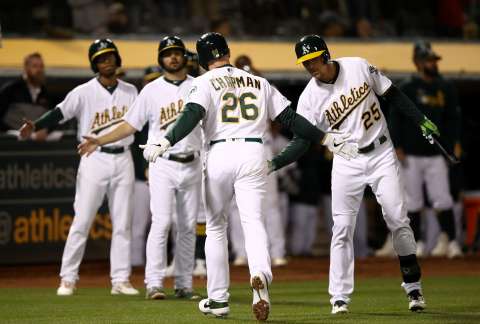
Profar rebounded from his throwing error with an RBI double scoring Mark Canha in the second. The former Ranger had two of the A’s four hits as Houston starter Wade Miley dealt as well.
But unlike Montas, Miley blinked in a big spot. Facing Matt Chapman in the sixth, a hitter Miley had retired in eight of his nine at-bats, he tried to get cute with off-speed offerings. But when Miley offered a cutter that caught the plate, Chapman jumped on it. The ball exited at 110 mph landing 441 feet away in the center field bleachers.
The A’s stayed on the defending AL West champs in the late innings with Lou Trivino downright filthy in the eighth, and Blake Treinen good as advertised in the ninth.
The A’s moved above. 500 with the win and get a day of rest before facing the Blue Jays over the weekend. Toronto has dropped six of their nine road contests, and will start winless Marcus Stroman on Friday night. Aaron Brooks starts for Oakland, a big spot for Brooks with starter Marco Estrada placed on the injured list before Wednesday’s game.
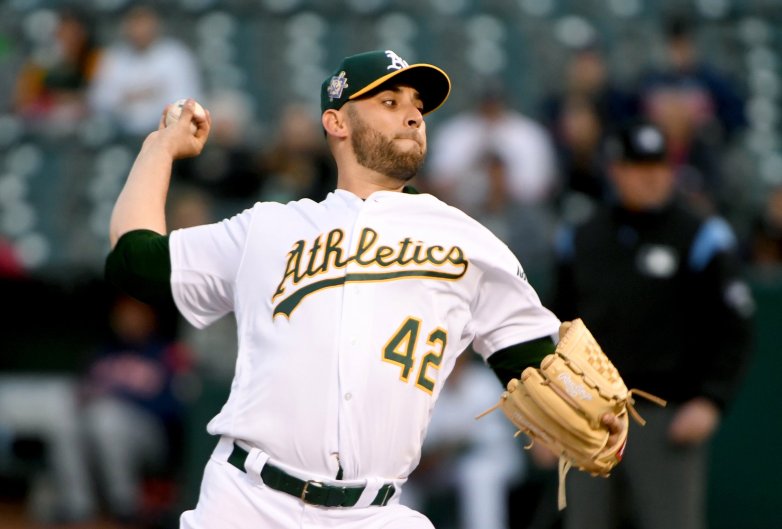
mercurynews.com file photo: Oakland A’s pitcher Marco Estrada (42) has been placed on the 10-day disabled list and the A’s have called up Chris Bassitt from Triple A Las Vegas Aviators.
By Daniel Dullum
Sports Radio Service
Thursday, April 18, 2019
At the conclusion of Oakland’s two-game series with AL West rival Houston, the A’s announced the placement of right-handed pitcher Marco Estrada on the 10-day injured list with a lumbar strain.
To replace Estrada, the A’s recalled right-handed pitcher Chris Bassitt from Triple-A Las Vegas.
Estrada was on the A’s Opening Day roster and is 0-2 with a 6.85 ERA and a .242 opponents batting average in five starts. He did not have a decision over his first three starts while posting a 2.76 ERA, but he has taken the loss in each of his last two starts, allowing 13 runs on 14 hits in 7.1 innings.
Bassitt began the season on the IL with a right lower leg contusion and started a rehab assignment with Single-A Stockton on April 4. He made one start with the Ports and two more with Las Vegas on April 9 and 14 and was a combined 0-0 with a 3.27 ERA and .190 opponents batting average in three starts when he was reinstated from the IL on Tuesday and optioned to Las Vegas.
A’S vs. BLUE JAYS
The A’s start a three-game weekend series against Toronto at the Coliseum on Friday. In a matchup of right-handers, Aaron Brooks (2-1, 4.24) starts for Oakland, and faces the Blue Jays’ Marcus Stroman (0-3, 1.99).
Oakland’s probables for Saturday and Sunday are Mike Fiers (2-1, 7.06 ERA) and Brett Anderson (3-0, 2.63 ERA).
Friday night is San Jose State University Night. Fans with a special ticket will receive an A’s/SJSU crew neck sweatshirt. Early arriving fans will receive a pet calendar, presented by AvoDerm Natural & Nylabone.
SENSORY ROOM
Earlier this week, the Athletics announced that as part of April’s National Autism Awareness Month, the Oakland A’s unveiled a new Sensory Room at the Oakland Coliseum.
The quiet space at East Plaza Level Suite 80 in centerfield will cater to fans of all ages with autism, Down syndrome, post-traumatic stress disorder, dementia, and similar conditions who can find comfort from a soothing atmosphere. The space will include “sensory bags,” filled with noise-canceling headphones, fidget toys, and other tools as calming mechanisms. The Sensory Room is available for every game for all fans.
The space was created in partnership with Micah’s Voice, which helps provide community, hope, and financial resources for families affected by autism.The nonprofit is named after the son of its co-founders Sharhonda and Shawn Stockman, who is also a founding member of Boyz II Men. The Stockmans will attend the A’s game and help unveil the Sensory Room.
The A’s will host their annual Autism Awareness Day on Saturday, April 20, when they play host to the Blue Jays at 1:07 p.m. For more information, visit athletics.com/specialevents.
Photo credit: Sports Graphic Number of Bungeishunjū Ltd.
By Lewis Rubman
SRS Contributor
March 17, 2019
OAKLAND — MLB is a game of ambivalence, paradox, constant decision making, and frequent boredom, interspersed with excitement, tension, and brief flashes of indescribable beauty, in which young men with short careers toil in their craft or sullen art, slogging through a season.
Grinding it out over 162 games whose venues extend from St. Petersburg, Fla., to Seattle and from Miami to San Francisco, after which the six division champions and four wild-card teams play three elimination rounds, which can consist of as many as 13 games, before the two remaining team face off against each other in the World Series, which, in turn, can last another four to seven games.
Games are played in four different time zones, and afternoon games often are played the day after night games, which can last into early morning, as we saw this past week end in SF. All this can wreak havoc with the players’ timing, and baseball isn’t just a game of inches; it’s also a game of split seconds. The six weeks of spring training that teams spend preparing for this ordeal, while necessary to get the squads into playing shape, also adds to the burden of weariness they accumulate over the season.
West Coast teams in the AL suffer more than any others from this grueling schedule. Not only must they fly across the continent to reach Boston, New York, Baltimore, and Tampa Bay, but the distance between the three west coast AL cities is intimidating. It’s roughly 795 miles from SeaTac Airport to Oakland International Airport and another 410 miles or so to John Wayne Airport in Orange County. (It’s 185 from New York’s LaGuardia Airport to Logan International Airport in Boston).
So, when the A’s and Mariners decided to interrupt their spring training this year to play a two-game, regular season series in Tokyo—with a 16-hour time difference across the international date line, 5,140 and 4,700 miles distant from Oakland and Seattle, respectively—it raised several questions about how this would effect the teams’ quality of play in Japan, when they got back to the states, and as the season progressed.
These notes don’t pretend to answer—or even ask—all of those questions. Rather, they are intended to offer some suggestions, facts, impressions, and opinions that can contribute the discussion.
In Japan, Oakland looked flat; Seattle did not. In the March 20 opener, A’s starter Mike Fiers coughed up an early two run lead and left trailing 3-2 after the third inning, having throwing 58 pitches, 40 of them in that fatidic frame. Liam Hendrick’s wildness cost him a run in his one inning, the fourth, and Ryan Dull surrendered three runs (two on a home run by Tim Beckham) in the two-thirds of an inning he struggled through.
The final score of 9-7, Seattle, showed that both teams’ hitters were ahead of the pitchers. The A’s lost the second game, 5-4, in 12 innings. The M’s scored what proved to be the winning run after Jurickson Profar took Marcus Semien’s high throw at second, leaped and threw to first while in the air, pulling Jay Bruce off the bag in a failed double play attempt that, if successful, would have closed down the frame.
Seattle, on the other hand, looked sharp. Hunter Strickland saved both games, and Ryon Healy sparkled on defense and hit a double and a homer in the second.
Although Oakland was officially the home team, emotionally, this was Seattle’s home (or home coming) opening series. Nintendo was the majority owner of the franchise from 1992 to 2016, which greatly increased the M’s following in Japan, not least because the team established a pattern of hiring Japanese players. Yusei Kiikuchi, the lefty who started the second game for Seattle, went 15-5, 3.04 ERA for the Saitama Seibu Lions in the Japanese Pacific League last year.
The crowd was with him on every pitch. And then, of course, there was the Ichiro factor. Seattle’s ageless star announced his long-anticipated retirement after the end of the series, followed by a long and emotional tribute. The series had been billed as the MGM-MLB Opening Series, which rings hollow even here and rang hollower still in Tokyo. A knowledgeable Japanese friend had to ask me what business MGM was in.
This cover from Japan’s leading sports magazine, Sports Graphic, with its title, “Ichiro Opening 2019,” sums up the Japanese view of the series:
The trans Pacific jaunt obviously didn’t hurt the Mariners’ performance while abroad. Going into tonight’s play, they have gone 11-7, a half-game behind Houston, who completed a three-game sweep of them over the weekend. But haven’t had to travel east of Chicago, and they seem to be in a tailspin.
Meanwhile, the A’s have struggled to hit their stride. They are 11-8 outside of Japan, with seven of the wins and three of the loses coming at home. Monday was their first day of rest after 18 straight days of work (unless you consider sitting around club house for hours on end waiting for it to stop raining in Arlington on Saturday night a day off).
In that period, the team traveled 5,550 miles and went through seven hours of time zone changes On the bright side, Khris Davis came out of it leading the majors with 10 home runs, and Profar seems to have overcome his distressing unevenness in the field.
Or at least it seemed so before he committed an unforced throwing error in the top of the second tonight. He also seems to have turned the corner in his hitting, having raised his average from .106 on April 7 to .200 after tonight’s game. The numbers are ugly, but the trend is hopeful. And it was his RBI double in the bottom of that same second inning that gave the A’s the first of their two runs in tonight’s 2-1 victory over Houston.
The Oakland bullpen, considered one of the best, has performed unevenly. Treinen, Hendricks, Trevino, and Petit have ERAs ranging from 0.79 to 1.42, with only one loss and one blown save (both charged to Treinen), including the Tokyo games. On the other end of the scale, the veteran Joakim Soria, who lost one of the games in Japan and posted a 15.00 ERA, has lost another game since then, although he has brought his ERA down to still unsatisfactory 9.72.
The well-traveled and extremely experienced Fernando Rodney pitched 1 2/3 innings over two games in Tokyo, surrendering only one hit. Since then, he has lost one game and seen his ERA balloon to 10.29. Ryan Dull had a disastrous outing against Seattle, surrendering three earned runs on a walk, a double, and home run in two-thirds of an inning. He has had more success since being reassigned to Las Vegas, where he has one save in five appearances and has yet to surrender a run.
As for the starters, Fiers, after his brief appearance in the Dome—whose hard surface, all-dirt infield is no help to pitchers or fielders—came back to get the win with a five inning, no run, one hit stint against the Angels in the Coliseum on March 28 only to give up a combined 14 hits and twelve runs, all earned, in 6 2/3 innings against in Houston and Arlington during the A’s stops in Texas.
Last night’s starter, Marco Estrada, was mediocre in his five inning, five run, three hit start in Tokyo, although he pitched well in his subsequent starts against the Angels and Red Sox in Oakland before losing his touch against the Orioles in Baltimore.
He didn’t recover it last night, surrendering a lead-off homer to George Springer and leaving with an inglorious line of seven runs, all earned, five hits, three walks, one strikeout, and a hit batter, in 3 1/3 innings. In fairness, I should note that one of the runs charged to Estrada was scored by Springer, whom Estrada had walked, but who crossed the plate on Alex Bregman’s homer off Ryan Buchter. I don’t think Estrada exceeded 88 mph on any of his 69 pitches. He was placed on the 10-day injured list with a lumbar strain before game time today.
Having traveled to Japan, with all the baggage that involves in terms of rest, diet, rhythm, and so on, most likely affected the play of the two teams while they were there. However, it clearly could not have been the deciding factor their performance. Their response to and preparation for the difficulties presented by the trip may, however, have been. But that really doesn’t tell us anything important about the underlying causes of the differences (and it assumes that the two teams were basically similar in the first place).
It is too early for anyone to write the final report on the effect of the trip on the 2019 AL season since it would be reasonable to anticipate that when the A’s and M’s have gotten over the original effects of their long journey, there will come a time later in the season when the weariness and strain of the experience will take their hidden toll.
Although, as they say in the advertisements for investment schemes, past performance is no guarantee of future results, it might be worthwhile when we think over the summer about how it all will work out in the long run to consider how the two teams performed in the 2012 season, which they also opened facing each other in the Big Egg.
Jeff Samardzija was in complete control of his pitches all night last Thursday, and it resulted in the best outing he has had in quite some time.
By the end of the first inning Wednesday night, it was clear that it was not going to be a repeat of that performance. He surrendered three runs in the opening stanza, coming from a pair of homers that were off of mistake pitches out over the plate, which sparked the San Francisco Giants’ 9-6 loss to the Washington Nationals.
Samardzija only lasted five innings and gave up a total of four runs on five hits, walking two and striking out seven, as his record fell to 1-1.
The Giants made their way back in the game in the fourth inning with a pair of runs, but the Nats distanced themselves in the seventh with a pair of homers, a two-run shot to go along with a three-run dinger that gave them a seven-run lead.
The Giants made yet another valiant effort in the ninth, as Gerardo Parra and Steven Duggar, who went 2-for-5 and has been slowly working his batting average up to his current mark of .247, each hit two-run homers. However, they simple ran out of outs, and the series was squared up at a game apiece.
Nats starter Jeremy Hellickson didn’t last much longer than Samardzija, but he did earn the win by surrendering only a pair of runs on five hits while walking four batters, running his mark to 2-0.
The Giants and Nats wrap up their series with a finale Thursday at 10:05 pm PT.
The playoffs are a whole different beast and if the first game of the opening round series between San Diego Gulls and the San Jose Barracuda is an indication on of what we’re in for you better strap on your helmet and don’t even think about blinking.
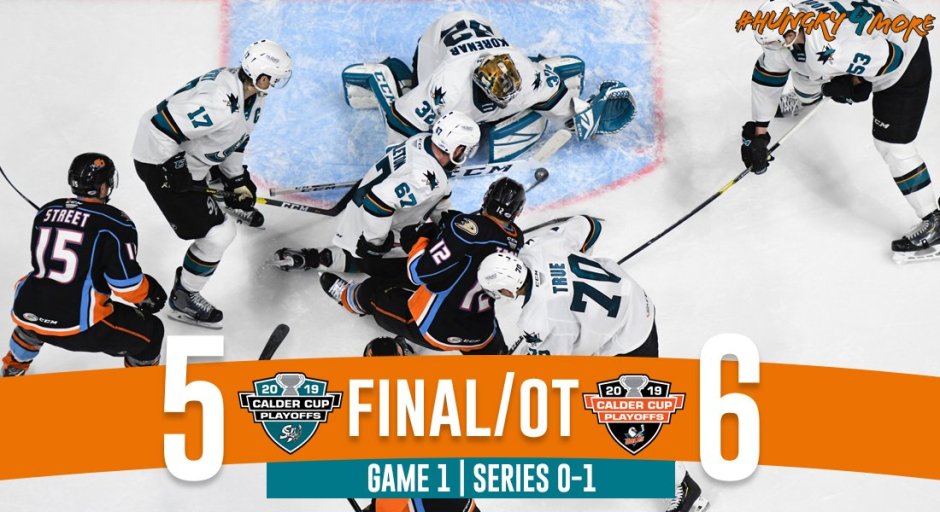
In a game that featured both starting goaltenders getting yanked in the first 10 minutes of the game, San Diego was the last man standing in a 6-5 victory on the final controversial goal on Wednesday evening at Pachenga Arena in San Diego, Calif.
Max Jones sent in a shot on goal that Cuda goalie Josef Korenar had stopped and had the puck covered with is glove. Keifer Sherwood crashed into Korenar sending the puck into the net for the game-winner at the 1:13 mark of overtime.
The Cuda argued the whistle should have blown to stop play, but to no avail as the referees ruled it a good goal for Sherwood, his second of the evening..
San Jose (0-1) drew first blood early in a wild first period. Kyle Wood found Ivan Chekhovich at the left point. Chekhovich fired a shot that TJ Hensick was able to redirect the puck past Gulls goalie Kevin Boyle for his seventh career playoff goal at the 3:17 mark.
The Cuda doubled their just over two minutes later. Alex True fed a pass down below the goal to Jeffery Viel. Viel, playing in his first AHL playoff game, was able to sneak his wrap around attempt past the five-hole of Boyle for his first goal of the playoffs at the 5:27 mark. Anti Suomela received the secondary assist.
Less than a minute later San Jose jumped out to a 3-0 lead. Hensick passed the puck to a wide-open Dylan Gambrell, who worked his away from behind the net, snapped a wrist shot past Boyle at the 6:15 mark. That would be the end of the night Boyle. Jeff Glass relieved Boyle after he gave up three goals on just seven shots.
San Diego (1-0) answered back with the next three goals. Simon Benoit fed a pass over to Jacob Larsen at the right point where Larsen was able to wire a wrist shot through a screened Cuda goalie Antoine Bibeau into the back of the net at the 7:10 mark.
Then, 37 seconds later, Ben Street centered a pass over to Sam Carrick, who buried a shot past Bibeau for his first playoff goal at the 7:47 mark.
San Diego scored the equalizer less than three minutes later. Carrick found Keifer Sherwood, who skated in and beat Bibeau with a wrist shot. That would be all for Bibeau as Korenar replaced Bibeau, who gave up three goals on eight shots.
Korenar made a fantastic left pad save on Jake Dotchin, while San Diego was on a power play late in the opening 20 minutes to keep the game tied heading into the first intermission. Both teams had 13 shots apiece.
San Jose regained the lead just under five minutes of the second period. Gambrell threaded a pass over to Chekhovich, who slapped it past Glass for his first professional playoff goal in his fifth career playoff game at the 4:47 mark. Hensick received the secondary assist for a three-point night (1G, 2A).
The Cuda extended their lead to 5-3 when Evan Weigner worked his way around the net, then fed a backdoor pass over to a wide-open John McCarthy. The captain buried the puck into the back of the net for his first goal of the playoffs at the 10:34 mark. Jayden Halbgewachs was credited with the secondary assist.
San Diego cut the deficit to a one goal late in the middle frame. Carrick blasted a puck from the and Corey Tropp poked home the rebound past the five-hole of Korenar from just above the crease for his first goal of the playoffs at the 14:47 mark.
Chase De Leo got things all even once again under two minutes later. He tipped the puck out of mid-air past Korenar for his first goal of the playoffs at the 16:35 mark. Justin Kloos and Sam Steel were credited with assists.
The third period was scoreless as San Diego outshot San Jose 13-9.
Glass (1-0) made 27 saves on 29 shots in relief to earn the win. Korenar (0-1) made 31 saves on 34 shots in suffering the hard luck loss.
GAME NOTES: San Jose was 0/3 on the power play. San Diego was 0/2.
Defenseman Ryan Merkley made his playoff debut for San Jose in just his third game with the team.
The announced attendance was 5,709.
UP NEXT: Game 2 between the Barracuda and Gulls is set for Thursday, April 18 at 7:00 pm at Pachenga Arena in San Diego, Calif
sfchronicle.com photo file: The Oakland Maritime Industry says that a new Oakland A’s stadium at the port would impact shipping, cause safety concerns, and will be a economic hit to the region’s import and exports.
On Headline Sports with London:
#1 Oakland’s Maritime Industry is saying that building a new stadium for the Oakland A’s at Jack London Square’s Howard Terminal would be a economic hazard for the port. It would disrupt ships that provide import and export that impact Oakland’s economics and would be a safety risk for ships trying to port. Does this sound like a legitimate argument from the Maritime to stop any construction of a new park for the A’s?
#2 This is obviously number one on A’s team president David Kaval’s bucket list of things to get moving. How much opposition will the A’s face in their attempts to build at Howard Terminal and can they work things out with the port?
#3 Is the 31-point comeback by the Los Angeles Clippers to win by four in Game 2 on Monday night a fluke or is it this Clippers team up for the challenge of making this a series against Golden State?
#4 How much of a factor has the Clippers’ Patrick Beverley been in this series trying to intimidate or at least get under the skin of the Warriors’ Kevin Durant? It might be working Durant was fouled out in Game 2 and thrown out in Game 1.
#5 The San Jose Sharks are in a hole after getting shutout in Las Vegas on Tuesday night at T-Mobile Center in Vegas in Game 4. The 5-0 loss puts the Sharks down 3-1 in the series with an elimination game on Thursday night at SAP Center in San Jose.
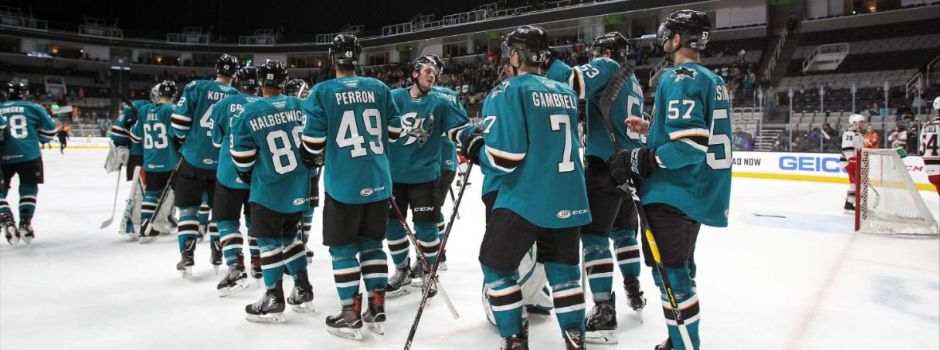
sjbarracuda.com photo: The San Jose Barracuda share congratulations, concluding their final home game on Saturday April 6th at SAP Center in San Jose. The Barracuda prepare for Game 1 tonight in San Diego in the AHL Calder Cup Playoffs.
On the SJ Barracuda podcast with Marko:
#1 First game tonight in San Diego between the Gulls and Barracuda. How did the two teams match up throughout the season?
#2 Pachenga Arena is noted for it’s sellouts, loud fan support, and one of the toughest venues to play in the AHL. Will this make much a difference to the Barracuda, who’ve played there numerous times this season?
#3 Barracuda head coach Roy Sommer prepares this team to face the Gulls. Is this expected to be an offensive series because the Gulls can play some defense?
#4 There are a number of players who finished the regular season in double figures for goals scored. Talk about the top three: Alexander True (24), Francis Perron (18) and Nick DeSimone (14) and the job they did on scoring this season.
#5 Talk about the goaltenders Antoine Bibeau and Josef Korenar. Can the Barracuda expect to start Bibeau for most of these playoff games?
#6 The Sharks, the Cuda’s parent team, are on the brink of elimination. Do you see the Cuda getting some of those fans for some home games if the Sharks do get eliminated in their first round series with the Vegas Golden Knights?
Join Marko throughout the AHL Calder Cup/San Jose Barracuda post season for exclusive coverage and podcasts at http://www.sportsradioservice.com
One of the biggest question marks entering spring practice was whether reduced hitting would delay the development of young and inexperienced Stanford Cardinal football players heading into fall camp.
After watching last Saturday’s Cardinal and White Spring Game, that doesn’t seem to be the case for the team.
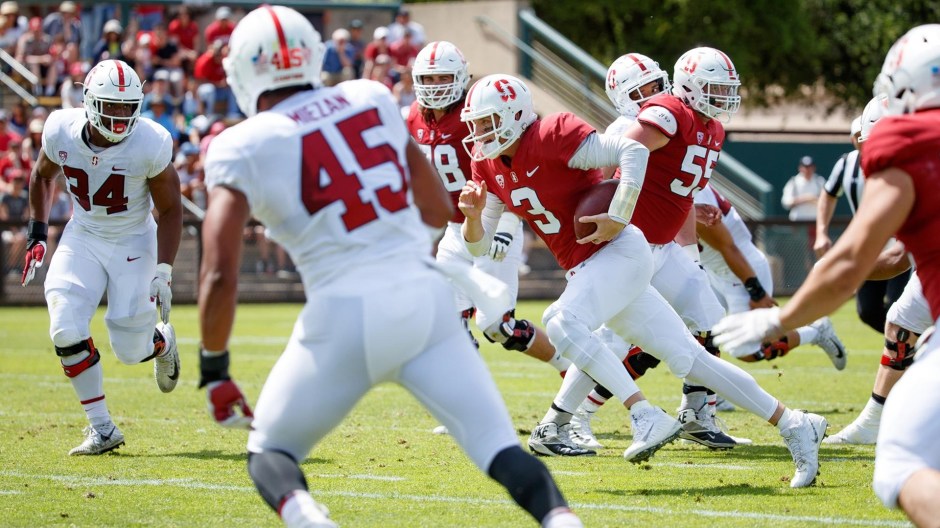
Bodies were flying around Cagan Stadium, especially on defense, who recorded a 20-14 win by limiting the offense to two touchdowns. The defense recorded four sacks against four quarterbacks and played aggressively throughout.
“I like where our defensive backs and young linebackers are right now,” said David Shaw, the Bradford M. Freeman Director of Football.
Due to injuries, especially on the offensive line, Shaw and his staff chose to limit physical contact and focus on technique and individual skill development this spring.
“We played fast and hard,” said freshman inside linebacker Ricky Miezan, who hopes to contend for one of two spots created by the departure of mainstays Bobby Okereke and Sean Barton. “All the work we put in this spring manifested itself.”
Photo credit: gostanford.com
Miezan and Jacob Mangum-Farrar are expected to battle converted outside linebacker Curtis Robinson, Andrew Pryts and Ryan Beecher for inside playing time.
“In the fall, I picked up so much from Bobby and Sean,” Miezan said. “The older guys kind of mentored us into what a Stanford linebacker is.”
For the record, Okereke led the team with 96 tackles each of the last two seasons.
“Not having as many live periods definitely helped, just focusing in on us and building the inside linebackers,” said Miezan. “We haven’t had that much game experience, so we have been focusing on techniques. We need to start with the basics and build from there.”
The nation’s third-ranked high school lacrosse player, the Alexandria, Va., native, didn’t play football until his junior year, but caught on quickly. As a senior, he made 55 tackles and earned all-state honors.
“I was a midfielder, so the back and forth running really helped with conditioning,” he said. “I feel I can stay out and endure a lot of plays and stay fresh. Lacrosse really helped with my side-to-side movement and agility.”
As a true freshman last season, Miezan appeared in four Cardinal games on special teams. He quickly learned that skill does always translate to success.
“You can be a great athlete, but you need to know the scheme to be able to go out there and play,” said Miezan. “That’s the number one thing: hone-in on the details and understand what you’re doing so you can play fast.”
Photo credit: gostanford.com
New roles
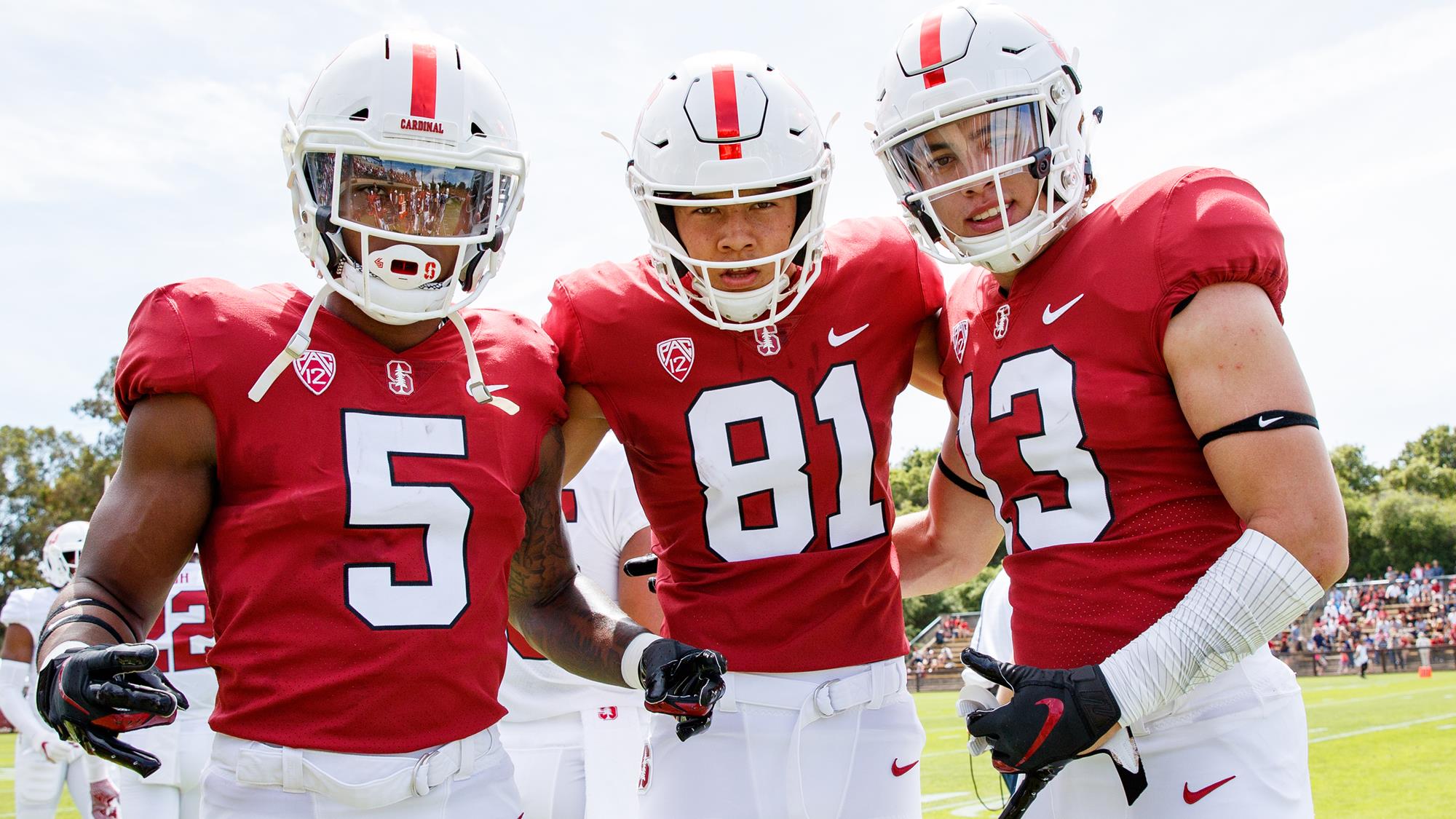
Several young receivers stood out this spring, notably Connor Wedington, Michael Wilson and Simi Fehoko. Wedington was limited by injuries last year and appeared in four games and redshirted, while the 6’2″ Wilson played in all 13 contests with two starts, catching 14 passes for 126 yards and two touchdowns. The 6’4″ Fehoko returned after a two-year church mission and saw action in the last four games, grabbing one reception.
“It’s been so good to finally get back on the field and play the game I love,” said Fehoko, who teamed up with K.J. Costello for a 19-yard touchdown catch Saturday on a short crossing route.
“We’re young but we’re talented.”
Big contributions are also expected from Osiris St. Brown, Donald Stewart and Brycen Tremayne.
Photo credit: gostanford.com
“We’re cautiously optimistic,” said Shaw, looking to replace JJ Arcega-Whiteside and Trenton Irwin. “Michael and Connor had outstanding springs. Simi started off with an injury but was able to come back. I think the combination of guys we have right now is pretty exciting.”
So does cornerback Paulson Adebo. As a first-year starter, he led the nation with 24 passes defended and earned FWAA All-America second team.
“We have a chance to let them loose and do some good things,” he said of the Stanford wideouts. “We didn’t get to see that much of Connor last year, but I think he’s going to do some big things.”
Costello and the other quarterbacks spent extra time after practice working with the receivers to improve timing and chemistry. That will continue during voluntary workouts the next few months.
Fehoko and Costello have a long-standing connection.
“All the way back to high school,” said Fehoko. “We played in the Army All-American Game together. We’re close and we’re going to get there.”
Added Costello, “The second half of last season, every guy on the field, every route they ran, I just had insane confidence.”
Admittedly, it’s a process.
“Even with JJ, I remember barely missing on stuff for a year-and-a-half,” Costello said. “I’m going to do everything I can to help them develop. I want success from one-on-one and seven-on-seven to correlate to the team.”
Photo credit: gostanford.com
Not satisfied Adebo intercepted one pass and nearly had another in the spring game.
“I gotta finish the second one,” he said.
After establishing himself as one of the top cornerbacks in the country last year, Adebo is looking to step up his game.
“I think the big thing for me is just trying to keep being aggressive, having good eye control, and knowing that there are going to be a lot of double moves since I’m jumping routes,” he said.
Photo credit: gostanford.com
Running backs, tight ends praised Shaw singled out his running backs for their work this spring. A new starter is assured with the loss of Bryce Love.
“I like the way they are running right now,” he said, “there are a lot of things we worked on that we didn’t do (Saturday), but our guys are running hard.
“I think we used our tight ends well. Maybe not like we typically do, but our tight ends are in a good spot. I told them I really appreciate all they have done. I told them to execute and that’s what we did.”
Photo credit: gostanford.com
Sense of urgency Fall training camp begins August 1 and the season opener is August 31 against the Northwestern Wildcats at Stanford Stadium. The Wildcats (9-5) were Big Ten West Division champs last year and capped their season by winning the Holiday Bowl 31-20 over the Utah Utes.
The Cardinal opens Pac-12 play at perennial rival USC on Sept. 7, then travels to Orlando to face UCF, who has lost one game in two years.
“Our offense needs to be ready to go by day one,” Costello said. “Last year, I feel like we started late. We got into a groove the last half of the season. If we can do that for the bulk of the season, everything else will take care of itself.”
Good stick Costello, a scratch golfer, found time after the season to sharpen his game. He fired a career-best 3-under-par 69 at California Golf Club in South San Francisco.
Costello is a big fan of Cardinal alum Tiger Woods, who earned his 15th major championship on Sunday at the Masters. Costello was glued to his television.
.@kj_costello got to meet Tiger Woods during his freshman year…well, kinda.
Full effort
Stanford was short on offensive lineman this spring so Drew Dalman, Henry Hattis, Grant Pease, Dylan Powell and Foster Sarell played every down in the Spring Game. The team needed each of them on every play to make the game possible and they delivered. Tucker Fisk also played a key role for the offensive line as he filled in when needed during spring practices.
Familiar faces
Among the former players who attended the Spring Game to lend support were Toby Gerhart, Kevin Hogan, Brennan Scarlett, Frank Buncom, Kaden Smith, Trenton Irwin, Nate Herbig, Keller Chryst, Jake Bailey, Arcega-Whiteside, Okereke and Nick Wilson.
Many attended an alumni networking social the previous night. Gerhart, enrolled at Stanford Graduate School of Business, arrived wearing cleats and had gloves hanging out of his back pocket. He left early to play in an intramural football game for his GSB team.
You know the popular methods employed by big league teams in 2019: home runs, walks and, accordingly strikeouts. Power pitching and at least for now, starters are ahead of bullpens, and both units are ahead of the hitters.
The Houston Astros are the current masters of all those methods, and they arrived in Oakland Tuesday with a reminder for the A’s of what having all those facets working looks like.
Like a 9-1 humbling defeat for the home team, the A’s fourth consecutive loss to the defending AL West champions, part of what is now a 10-game win streak for the Astros.
“I brought my worst game to a very good lineup,” said A’s starter Marco Estrada, who was lifted in the fourth inning with the A’s trailing 4-0. “Obviously that’s not going to cut it. Can’t go out there with missing the spots like I was today. Just not going to work against anybody.”
George Springer found himself staring at Estrada’s juciest offering six pitches in, an 86 mph fastball on a 3-2 count that the slugger deposited 440 feet from home plate. Josh Reddick hit his first home run of the season off Estrada in the second with Yuri Gurriel aboard. And the 35-year old was done after issuing Springer a bases loaded walk in the fourth.
“They didn’t chase, he walked some guys, got in some deep counts.. (Estrada) wasn’t throwing anything off the plate today that they were chasing,” manager Bob Melvin said of his starter who fell to 0-2 with an unsightly 6.85 ERA.
Liam Hendricks inherited Estrada’s mess and struck out the planet’s hottest hitter, Jose Altuve. The diminutive slugger homered six times in a five-game streak last week, and took a pair of healthy cuts against the A’s reliever without success.
That was good.
But Alex Bregman followed and was all over Hendricks’ changeup that traveled just 82 mph to the plate.
That was bad.
Bregman’s grand slam was the third Astros’ slam during their streak that started April 5 against Oakland. It gave Houston an insurmountable 8-0 lead and prompted Bregman’s quote-fest after the game.
“I think I’ve just been terrible, honestly,” Bregman confessed. “I haven’t been good at all offensively. Today was a step in the right direction. I’m getting beat by heaters that I never get beat by. Basically [I’m] just horrible at the plate. Honest, I’ve been terrible.”
Max Pacioretty led the Vegas Golden Knights with a four-point night over the San Jose Sharks in a Game 4 win 5-0 at T-Mobile Arena Tuesday.
Pacioretty had a goal and an assist for the third straight game, two apiece at the end. Vegas had an identical game score March 21.
The last time the Sharks were held scoreless was February 21. It was their biggest margin in a loss since November 24.
Marc-Andre Fleury made a perfect 28 saves in the victory.
Max Pacioretty on the Golden Knights' 3rd shutout in 10 playoff games against the SJS: “Our forecheck wasn’t great early. We relied on Flower way too much. That’s why we have him. When you see him have two periods like that, you want to try and get him the doughnut." #VegasBorn
Meanwhile, San Jose used two goalies again like in Game 2, but this time, Martin Jones took the loss and Aaron Dell gave up more goals.
The Sharks were still without defenseman Marc-Edouard Vlasic and also without Micheal Haley and Joe Thornton, who served his one-game suspension for a hit to the head in Game 3.
Vegas scored their third and fifth goals on the power play. San Jose went 0-for-4 and were outhit 54-37.
Gallant on using this… unique… lineup- "It was rewarding them and trying not to embarrass someone else. You respect the game, you play the game hard and I'm not going to try to run up the score." https://t.co/yj1nUZKOPZ
The game-winner ended up being the fourth straight goal that came within the opening two minutes of a period and involved two familiar players. The Sharks failed to keep the puck within the Knights’ zone and Mark Stone picked up the loose puck at the far blue line. He then dropped the puck back for Pacioretty before moving the defenseman, as Pacioretty shot from the top of the right faceoff circle near the slot at 1:11.
Both teams then got two penalties apiece when they committed four penalties in the span of six minutes. San Jose generated momentum on both of their power plays, with four shots during the first one and six in the second.
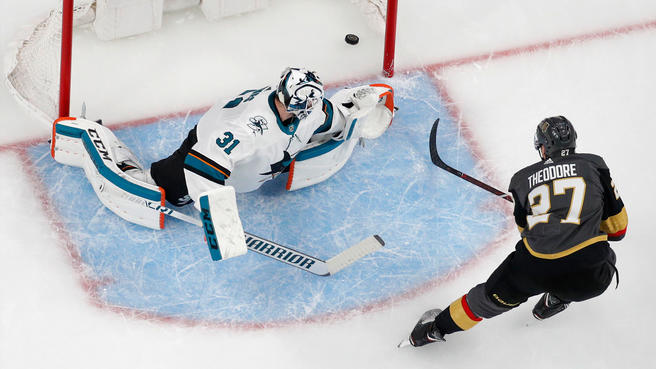
However, the Sharks’ enthusiasm was curbed when Shea Theodore managed to nab a 2-0 goal with less than a minute remaining.
San Jose led shots 18-7 by the end of the first period.
The start of the second period marked a change in goalies as Dell came in for Jones.
Vegas’s William Karlsson hit the goal post.
Dell lost his immunity in the game when he made an initial save versus Pacioretty and then inadvertently transferred the puck over to the right for a long rebound back to Pacioretty. Stone made a long pass across the ice past four San Jose players right before.
The Sharks’ Kevin Labanc hit the goal post with one minute to go.
Alex Tuch and Jonathan Marchessault had their first goals of the playoffs at 6:37 and 16:24 of the third, respectively.
San Jose was outshot 13-2 in the final period.
Up Next: The Sharks face the Knights with their backs against the wall. Game 5 is Thursday in San Jose at 7 pm.