50 Years Ago: Pilots Land in Milwaukee Pt 2 of 5 part series By Daniel Dullum

image from sportslogos.net

50 Years Ago: Pilots Land in Milwaukee Part 2

By Daniel Dullum

Author’s note: This is the second of a five-part series detailing an unusual Major League Baseball franchise shift — In 1970, the Seattle Pilots arrived at spring training in Tempe, Arizona, and left at the end of March as the Milwaukee Brewers. At the conclusion of Part 1, Bud Selig’s group Milwaukee Brewers Inc. was rejected in its bid to purchase the Chicago White Sox and move the team to Milwaukee.)

Because ill feelings still lingered from the failed antitrust litigation against the National League, Selig’s group was persona non grata with the Lords of Baseball. They drove this point home at the American League owners’ meeting of October 18, 1967, when, after granting the Athletics permission to move from Kansas City to Oakland, an expansion team was promised to Kansas City for 1971. But after U.S. Senator Stuart Symington of Missouri played the antitrust exemption card and Kansas City Mayor Ilus W. “Ike” Davis threatened legal action, AL President Joe Cronin reopened expansion dialogue and moved the timetable up to 1969 for Kansas City.

Now, needing an even number of clubs, the American League awarded its 12th franchise to Seattle on December 1, 1967. Two weeks earlier, National League President Warren Giles had said the Senior Circuit would not oppose the American League’s expansion plans, and would go ahead with its own.

The second blow to Milwaukee Brewers Inc. — the one that hurt Selig the most — was delivered at the National League owners’ meeting in Chicago on May 28, 1968, when the league announced it would expand to San Diego and Montreal for 1969. Selig was so despondent after the meeting that for the next few hours, he walked the Windy City’s streets alone.

To compound Selig’s frustration, Commissioner Bowie Kuhn addressed the media in Atlanta on July 1, 1969, and told them, “I see no expansion for the major leagues over the next 10 years.” In the meantime, White Sox home-away-from-home games at County Stadium proved popular with Milwaukee baseball fans, drawing 196,684 fans in 11 dates.

One of those games was played on June 16, 1969, against the Seattle Pilots, won by Chicago 8–3. The 13,133 people in attendance didn’t realize it at the time, but in less than 10 months, the visiting team on the County Stadium scoreboard that day would be the ballpark’s next permanent residents. — – By September 1969, the Pilots were putting the finishing touches on a dismal debut season in the Pacific Northwest, winding up in the AL West Division cellar with a 64–98 record, 33 games behind first-place Minnesota.

Attendance was disappointing — 677,944 in 72 home dates (with nine doubleheaders) at rickety Sicks’ Stadium, the old home of the Pacific Coast League’s Seattle Rainiers that was never completely upgraded to major league specifications. “It was not a major league facility. It had its own uniqueness, but that’s all they [Seattle] had at the time and the players understood that,” Rich Rollins pointed out. “It was a minor league ballpark is what it was. They did the best they could with what they had at that particular time. “We didn’t think about the field all that much — we had too many other problems!”

Despite losing a reported $850,000 in 1969, the Pilots still outdrew four other teams — Cleveland and Chicago in the American League, and Philadelphia and San Diego in the National League. If there were rumblings about the team’s possible relocation, word hadn’t filtered down to the dingy Pilots’ clubhouse, at least initially.

Reserve catcher Jim Pagliaroni, acquired in mid-season from Oakland, didn’t recall any talk of the Pilots leaving Seattle. “Not at that time,” he said. “There was nothing. No talk about a move. There was no clue.” Pilots’ first baseman-outfielder Mike Hegan remembered hearing rumors of a possible move toward the end of the 1969 season. “The rumors were there,” he said. “It wasn’t a done deal at the beginning of spring training, but I was one of the few players who actually stayed in Seattle in the off-season. “What’s funny is that it was an ongoing story all winter in Seattle.”

William R. Daley, the Pilots’ absentee board chairman who made his fortune with Otis Elevator and resided in Cleveland, reportedly was ready to sell midway through the 1969 season. In mid-September, Pilots President Dewey Soriano strongly denied rumors of a shift to Dallas-Fort Worth while feuding with Floyd Miller, Seattle’s interim mayor. Miller threatened to evict the Pilots from Sicks’ Stadium unless they presented a security bond of $150,000 and a promised letter of credit for $660,000.

Dewey Soriano responded by refusing to put up the bond, claiming the city failed to keep its promises to upgrade the aging ballpark. Two weeks later, on September 28, Daley confirmed that an offer from Texas millionaire Lamar Hunt was rejected, and that the Pilots would remain in Seattle. Hunt, owner of the American Football League’s Kansas City Chiefs, wanted to purchase the club and move it to Dallas-Fort Worth.

Catching wind of the “Seattle situation,” Selig got busy. He had met secretly with Seattle co-owners Dewey and Max Soriano throughout the month of September and, during game one of the 1969 World Series in Baltimore, hammered out a deal to buy the Pilots for $10.8 million, contingent on approval from the American League and the lack of a local buyer.

The American League, fearing the possibility of lawsuits and congressional action, refused to approve the deal and spoke only in public about keeping the Pilots in Seattle. Daley, meanwhile, issued an ultimatum to the Emerald City’s baseball fans at an October 1969 press conference, declaring, “Seattle has one more year to prove itself.” Looking for a convenient scapegoat, he added, “It’s all the fault of the press.”

George N. Meyers, sports editor of The Seattle Times, noted in a column the Pilots’ top ticket price of $6, as well as 75-cent beer and 35-cent Cracker Jack at Sicks’ Stadium concession stands, then wrote, “That’s upside down, isn’t it? What we’re really doing is giving Daley one more chance.”

American League President Joe Cronin and a six-man committee of the league’s owners met with a Seattle delegation on October 21 and issued three conditions for the city to keep the Pilots: 1) Upgrade Sicks’ Stadium to the original unfulfilled specs. 2) Start construction of a new, domed stadium before the deadline of December 31, 1970. 3) Find a local ownership group to acquire the club by October 30, 1969, a deadline the league later extended to November 5.

Amidst the chaos, Pilots General Manager Marvin Milkes continued conducting the business of running the ballclub. He dismissed pitching coach Sal Maglie, first base coach Ron Plaza, farm system director Art Parrack, and scouting director Ray Swallow. Manager Joe Schultz initially was advised by the club to consider other employment offers and was eventually fired on November 20, replaced four days later by former Cincinnati Reds skipper Dave Bristol.

The Pilots completely overhauled the coaching staff, and, unlike Schultz, Bristol was allowed to select his own assistants, as per normal for major league managers. Gone from 1969 were third base coach Frank Crosetti (hired along with Maglie by Milkes), Eddie O’Brien (hired by Dewey Soriano) and Sibby Sisti (hired by Milkes). O’Brien and Sisti had been brought aboard primarily to accrue enough time in uniform to qualify for a major league pension.

Immediately, Bristol brought in Cal Ermer — a former Minnesota Twins coach and manager — as the new third base coach, along with baseball veterans Roy McMillan (the former All-Star shortstop) and Jackie Moore. To complete the staff, Seattle-area native Wes Stock was hired away from the New York Mets, where he had been the minor league pitching instructor. “It was quite an experience because Seattle was my home, so that was a special reason I wanted to go back to Seattle,” said Stock, who had pitched in the majors with Baltimore and the Kansas City A’s. “We were trying to make the best club we could come up with as far as being a pitching coach. It was a tough situation because the guys didn’t know where they were going to go.”

For a while, it looked as though the Pilots would stay put. Fred Danz, a local theater chain owner, announced on November 17 that his 12-man group of investors had purchased the club for a reported $10.3 million, and the American League approved the transaction on December 5. But on January 3, 1970, Danz held another press conference, this time to explain that the Bank of California had requested immediate payment of a $3.5 million loan it made to Pacific Northwest Sports and that his group was unable to meet that demand.

By mid-January, the AL withdrew its approval of the sale to Danz, and ownership of the Pilots boomeranged back to Pacific Northwest Sports. By now, the Hot Stove League was rampant with solutions for the Pilots. John Wilson, a sports writer for The Houston Chronicle, added grist to the rumor mill on January 23, reporting that the American League already approved a shift of the Pilots to Dallas-Fort Worth with a vote by telephone survey. But AL President Joe Cronin, White Sox owner John Allyn and Athletics owner Charles O. Finley all denied the report.

Edward E. Carlson, board chairman of Western International Hotels, announced on January 27 that he’d put a group together that wanted to run the Pilots as a non-profit organization. The AL owners, feeling the approach would devalue the league’s other franchises, also rejected the bid from Carlson’s group.

On January 28, the Pilots were given nine days to come up with necessary financing to remain in Seattle. Three days later, Edward J. Daley, president of World Airways of Oakland, California, said he was interested in buying the team and keeping it in Seattle. And on February 5, 1970, the Bank of California offered to renegotiate its $3.5 million loan — on its terms. The Bank of California later offered to remain involved for $750,000 if other Seattle banks would join in. But two banks backed out and the proposed consortium fizzled.

Despite the misinformation and ongoing chaos, Mike Hegan was so impressed that he ignored the rumors, plus the dark financial cloud that hovered over the Pilots, and decided to move from Massachusetts to suburban Seattle. Hegan explained, “It looked at one time like there was going to be an infusion of new money into the ballclub that would keep the Pilots in Seattle.

At that time, my wife and I were looking to plant roots someplace anyway, so we bought a house in Seattle.” Meanwhile, General Manager Marvin Milkes continued to make deals. He acquired veteran lefthander Bob Bolin from San Francisco for outfielder Steve Whitaker and utility man Dick Simpson. Reliable pitcher Diego Segui returned to the Athletics along with light-hitting Ray Oyler in exchange for infielder Ted Kubiak, and reliever Dave Baldwin arrived from the Washington Senators.

On January 15, 1970, the Pilots made another deal with Oakland, swapping All-Star first baseman Don Mincher and journeyman infielder Ron Clark to the A’s for outfielder Mike Hershberger, righthander Lew Krausse, catcher Phil Roof and reliever Ken Sanders. Upon joining the Pilots’ fold, Roof recalled, “Rumors [about moving] were there right off the bat. They knew the ownership in Seattle was short on cash and also, the park wasn’t a major league park. That was another detriment. They couldn’t come up with concrete plans to build a stadium on short notice at that point.”

Three days later, at the Milwaukee Baseball Writers’ 17th annual Diamond Dinner on January 18, Commissioner Bowie Kuhn discussed the possibility of the Pilots landing in Milwaukee. “If this does not take place, it would not be my advice to Milwaukee to give up hope. When I think the sponge should be thrown in for Milwaukee, I’ll say so. “I do not think that time is now, and I hope it never comes,” the commissioner continued. “I can assure you that there is no grudge in baseball against Milwaukee and Wisconsin. When and if a franchise becomes available, Milwaukee will receive serious consideration.” Kuhn added that he hoped Seattle would find a solution to its financial woes, but noted, “I do not encourage shifting of franchises because I believe they hurt the stability of baseball. But we recognize that in certain circumstances, shifts can become likely.”

Selig also spoke at the Diamond Dinner, issuing a thinly veiled reference to the Seattle situation: “We do not consider ourselves predatory raiders. At no time have we instituted any negotiations for a franchise. Accusations that we have are unjustified and completely without fact.” At a meeting of American League owners in Chicago on February 10, 1970, AL President Joe Cronin confirmed that there was one possible solution — the league could operate the Pilots until a buyer could be found. He reiterated that the league wanted the Pilots to remain in Seattle, and when the meetings concluded, the AL owners decided that the Soriano brothers and Daley would again operate the Pilots.

On the legal front, Seattle attorney Alfred J. Schweppe filed a “ticket buyer’s” lawsuit against the Pilots’ owners on behalf of himself as a season ticket holder, and obtained a temporary restraining order on March 13 to keep the Pilots from leaving Seattle. Schweppe had purchased two field box seats for $700 and a season parking space for $75 for the next four seasons.

On March 16, 1970, when rumors about a shift of the Pilots to Milwaukee resurfaced, William Dwyer, special assistant to Washington Attorney General Slade Gorton, followed through on earlier threats and filed breach-of-contract and antitrust suits against the American League. King County and the City of Seattle also joined the legal action, which involved a minimum $75 million in damages and sought a temporary restraining order and injunction to block any move of the ballclub.

In addition, Washington’s U.S. Senators — Warren G. Magnuson and Henry M. “Scoop” Jackson — said they would introduce legislation to repeal baseball’s longtime immunity from antitrust laws (dating back to a landmark 1922 Supreme Court ruling), claiming a transfer of the Pilots would clearly show baseball to be a business, rather than a sport. — — The American League owners voted to loan the Seattle Pilots $650,000 on March 9, 1970, to operate through spring training. They also appointed Roy Hamey, a semi-retired former general manager of Pittsburgh, the Philadelphia Phillies, and the New York Yankees, as “special supervisor” to oversee the operation, with Milkes still in place as the team’s general manager.

Hamey was granted a leave of absence from his part-time post as the Yankees’ West Coast scouting director to assume babysitting duties on behalf of the league. During the meeting, Milkes (who was promoted to team vice president when Hamey was brought on board) walked out in disgust when Baltimore Orioles owner Jerry Hoffberger suggested developing a trusteeship of the Pilots with the American League, and that Bill DeWitt, the former general manager of the St. Louis Browns, Detroit Tigers and Cincinnati Reds, be placed in charge.

Seattle sports writer Hy Zimmerman observed in his weekly report for The Sporting News, “Here sat Milkes, who had gone without pay, who had pleaded with and cajoled other unpaid employees to hang tough, who had kept the organization together with hairpins and chewing gum. “Now they were going to make an errand boy out of him. He could not, and would not, take it, and left in a huff.”

After the meeting — held on Ash Wednesday — concluded, one unnamed AL owner quipped, “The American League has given up $650,000 for Lent!” As the Pilots began arriving in Tempe for spring drills, work toward beginning construction of a 55,000-seat domed stadium in Seattle remained on schedule, according to John Spellman, a King County spokesman. The only visible problem was a legal tussle over whether to build the stadium downtown or in the suburbs. But other problems continued to mount for the Pilots.

When the American League granted its loan, $400,000 was paid out immediately to cover outstanding debts, leaving $250,000 — not enough to get the Pilots through spring training. After being asked by Commissioner Kuhn to resubmit its bid, Edward E. Carlson’s nonprofit group officially notified the American League on March 12 it was no longer interested in purchasing the Pilots.

As primary reasons to reconsider their offer, the Carlson group cited lagging season ticket sales, a renegotiated radio contract for less money (dropped from $815,000 to $215,000), the lack of a local television contract, and “public disgust and apathy.” When the American League owners met on March 17 in Tampa, Florida, they were served with papers by sheriff’s deputies and a representative of the State of Washington’s attorney general’s office, detailing a restraining order blocking any move of the Pilots.

The league’s owners faced possible jail time for contempt of court if they ignored the injunction. Schweppe also surprised the owners by obtaining a similar, but broader injunction from Circuit Court Judge Joe Bruton Jr. of Hillsborough County, Florida. Bruton ordered the AL to suspend its actions in the case until all legal questions were settled.

The league responded with a resolution saying it could not continue financial support of the Seattle Pilots “beyond the amount already committed.” An exasperated Cronin said, “Our hands are tied now.” Hinting at the possibility of folding the Pilots, he added, “It’s almost impossible to operate with 11 clubs.” But Alexander Hadden, the American League’s attorney, mildly disagreed, “It’s a theoretical possibility if legal constraints could not be removed before the start of the season.”

White Sox owner John Allyn agreed with Hadden, saying, “I think you’ll see your first [modern major league] baseball franchise go down the drain.” In a statement drenched in legalese, the American League admitted that the Pilots were broke. Two days later, on March 19, the Pilots’ minority owners attempt to have the lawsuits and injunctions against them and the American League withdrawn ended in failure. Meanwhile, on the field, the Pilots pressed on with its Cactus League schedule in Arizona, and the players and coaches wondered what their futures would bring.

NEXT: Part 3
50 Years Ago: The Seattle Pilots’ last-minute flight to Milwaukee

Seattle Pilots are the subject of Daniel Dullum’s five part book about the 1970 new franchise team that played only one season before moving to Milwaukee (image from sportslogo.com)

By Daniel Dullum

(Author’s note: This is the first of a five-part series detailing an unusual Major League Baseball franchise shift — In 1970, the Seattle Pilots arrived at spring training in Tempe, Arizona, and left at the end of March as the Milwaukee Brewers.)

On the morning of October 15, 1968, Rich Rollins was taking care of routine errands near his home in the Twin Cities suburb of Richfield, Minnesota. When Rollins drove his Pontiac station wagon into a neighborhood car wash, he was employed as a third baseman for the Minnesota Twins. At some point between the wax and rinse cycles, Rollins heard a radio report explaining that he’d become something called a Seattle Pilot.

The American League was holding its expansion draft that morning, and Rollins was the 26th player taken overall, right after the Kansas City Royals selected pitcher Wally Bunker from Baltimore and just ahead of the Pilots’ next choice, a little-known Cleveland farmhand named Lou Piniella.

For Rollins, it was a long and dispiriting descent from 1962, when he was the starting American League third baseman — and top vote getter — for both of that season’s All-Star Games while chasing the AL batting crown in 1962 and 1963.

“When I found out I got drafted, I was shocked — this was a major change in my life,” said Rollins, who was signed out of Kent State University by the old Washington Senators and moved with the club to Minneapolis-St. Paul in 1961.

“But that Monday, I was due to check in to University Hospital. Dr. [Harvey] O’Phelan [Twins team physician] was going to perform a knee operation. This had been set for about a month and a half. I have to report to the hospital Monday morning because my knee was really in bad shape.

“Right away, I come back home and put a call in to the Twins. I said, ‘What about me being scheduled for surgery? I just got drafted by Seattle.’ They said, ‘Rich, there’s not going to be an operation Monday.’”

Thinking back to the timing of the scheduled surgery, Rollins theorized, “It was borderline fraud is what it was. [The Twins] had to know. … “Despite not having the knee surgery, Rollins reported to the Pilots’ inaugural spring training in March 1969 at Tempe, Arizona, and made the squad. Less than two months into professional baseball’s centennial season, that decision caught up with the veteran infielder.

“My knee was swollen and everything else, so I went out there with a bad knee,” Rollins said. “And I said at that time, I probably owe it to [Seattle] to try and play on it, which I did for about a month and a half. I was playing in a whole lot of pain. Not that it mattered, but I had a hard time with it.

“We played a game in Boston one night and I ran to first base and hurt it again. I went back to my room, and the knee just swelled up like a balloon. At 3 o’clock in the morning, I’d been moaning a lot, I couldn’t sleep.

Don Mincher [a former Twins teammate] was my roommate and he was the player rep. He calls up the traveling secretary [Gabe Paul Jr.] and tells him, ‘Rich is laying in bed here, his knee is like a balloon, you better get him back to Seattle real quick.’ That’s the way he put it. ‘Get him on the first plane out of here.’ “And that trip was really bad. They set me up with an orthopedic guy; then I had a major knee operation. And that didn’t sit very well out there; they wanted me to keep playing. But I told them, ‘It’s not getting better. Simple as that.’ But it got to the point where I had to think about myself. My career was over and I needed the operation.”

As dismal as Rollins’ situation was, he still viewed his arrival in Seattle as “a fresh start,” but noted, “Anybody who knows anything about that situation out there in 1969 knows that it was a complete, chaotic disaster. There were 53 guys on the team during that year and it was just a fiasco the entire season.”

Rollins soon would discover the Pilots’ maiden voyage of 1969 was merely a dress rehearsal for the bizarre adventure awaiting the club when it convened for spring training in 1970. The Pilots’ strange final journey concluded with the culmination of one man’s mission to right a perceived wrong.

Allan H. (Bud) Selig grew up in Milwaukee, Wisconsin, monitored the construction of County Stadium as a teenager, rooted for the minor league Milwaukee Brewers, and began attending Braves games as soon as the National League team relocated from Boston in 1953.

After graduating from the University of Wisconsin in 1956 and serving a two-year hitch in the U.S. Army, he returned home to run Selig Ford, his father’s automobile dealership. By 1963, Selig also was the largest public investor in the Braves franchise.

Rumors began to surface as early as 1962 about the Braves leaving Milwaukee. When the rumors morphed into reality, Selig organized Teams Inc., a group that unsuccessfully filed antitrust suits against the Braves and the National League in an attempt to prevent the Braves from relocating.

The Braves’ Chicago-based ownership group, led by William Bartholomay, prevailed and moved the club to Atlanta in 1966, primarily for a substantial increase in local television revenue.

Because the initial legal action only ordered the Braves to fulfill its lease at County Stadium, their relocation to Dixie was postponed by a year, forcing the club to play a lame-duck 1965 season in Milwaukee. As a result, fan support was so poor — the announced attendance was often below 2,000 — that on June 9, 1965, Bartholomay’s group offered Milwaukee County $400,000 and Teams Inc. an additional $100,000 for permission to break the lease early and move the Braves to Atlanta during the All-Star break in July.

Seven days later, the Milwaukee County Board of Supervisors voted unanimously to reject the offer that would have okayed baseball’s first mid-season franchise shift.
The Braves wound up drawing 550,000 fans in 1965 — a drastic change from the 1950s, when they won back-to-back National League championships in 1957 and 1958 (winning the ’57 World Series) and tied the Los Angeles Dodgers for the 1959 NL pennant. From 1954 through 1957, the popular ball club drew more than two million fans a year, and more than 1.9 million in 1958.

When the Braves departed at the end of the 1965 season, Selig divested his stock in the club. It was during the antitrust hearings that Selig first met Bowie Kuhn, the National League’s defense attorney who later replaced William D. Eckert as commissioner of baseball in 1968. It wasn’t long before he and Selig’s paths would cross again.

After Kuhn passed away on March 15, 2007, Selig recalled that initial encounter. “It was the first time I was ever in a courtroom. It was 1965; I was 31 years old. Bowie was a big, imposing figure and had me on the stand — he was cross-examining me. “But we became friends, and once we got the team [the Brewers], Bowie really had a soft spot for Milwaukee. He came there a lot. I always felt that Bowie felt badly about what happened [with the Braves], and that was his way of atoning.”

The reality of the Braves’ departure from Milwaukee didn’t hit Selig until he sat in his car at a service station and listened to their 1966 season opener against Pittsburgh on KDKA, the Pirates’ 50,000-watt powerhouse flagship station at that time.

“I tuned in to Bob Prince out of Pittsburgh and he opened by saying ‘Greetings from Atlanta’s Fulton County Stadium. We’re a long ways from Milwaukee, Wisconsin,’” Selig remembered. “I had tears in my eyes. I remember a guy came over and asked if I was all right. It was very heartbreaking.”

For the next two years, Milwaukee County Stadium sat empty, except when the Green Bay Packers annually played two of its National Football League home games away from Lambeau Field. “There was many a day I sat there, staring out at the field,” Selig said.

When the subject of granting Milwaukee an expansion team came up, Commissioner Ford C. Frick was publicly noncommittal. Curiously, on October 26, 1965, C. Hayden Jamison, executive director of the Wisconsin Investment Board, testified in a deposition hearing that he met Frick on September 2, 1965, to determine if the board could purchase the Braves from its present ownership group.

Under oath, Jamison testified, “Ford [Frick] said he could assure me that the Braves would be in Atlanta in 1966. He said that Milwaukee would have obtained a franchise, if it had not been for the antitrust suits and if the Milwaukee official [reportedly Eugene Grobschmidt, chairman of the Milwaukee Board of Supervisors] would just shut up. He also said to me, ‘If you repeat this, I’ll deny it.’”

But on December 14, 1965, Frick admitted as much during his testimony in the State of Wisconsin’s antitrust suit against the Braves and the National League, “In my opinion, it is impossible for the major leagues to expand to Milwaukee before 1968.” He also denied there was a conspiracy to abandon or boycott Milwaukee as a major league baseball site.

Then, in reference to a rejected request for a new Milwaukee National League franchise to begin play in 1966, Frick said, “I know of no plan or understanding to operate major league ball in Milwaukee in 1966.” In spite of such comments, Selig didn’t give up. But when his Milwaukee Brewers Inc. group visited major league meetings, the door was either not opened or slammed in their faces.

Undaunted, Milwaukee Brewers Inc. approached the Chicago White Sox with a proposal to play nine “home-away-from-home” games at County Stadium in 1968, calling for the White Sox to play one game against each of the other American League clubs. The White Sox, whose attendance at aging Comiskey Park had been dwindling in recent years, were receptive to the notion and accepted the offer from Selig’s group on October 30, 1967.

The idea wasn’t unprecedented. It was the first time an American League team scheduled regular season home games away from its primary city since 1905, when the Detroit Tigers hosted two games at Neil Park in Columbus, Ohio. Later, the National League’s Brooklyn Dodgers played seven games in 1956 and eight in 1957 at Roosevelt Stadium in Jersey City, New Jersey.

Ken Sanders, a young relief pitcher with the Oakland Athletics in 1968, remembered making the detour to Milwaukee. “We used to eat at Ray Jackson’s restaurant, which is out of business now. It was close to the stadium and he used to have steaks and ribs after the game in the clubhouse. So it wasn’t too bad of a bus ride to go up there and play that one game a year for each team.”

The arrangement with Selig’s group went over so well that the White Sox agreed to play another 11 games in Milwaukee (because of expansion) in 1969. In fact, the games played in Milwaukee accounted for nearly one-third of the White Sox’s total home attendance in 1968 and 1969.

On April 24, 1968, the Variety Club in Milwaukee honored Selig for his work with Milwaukee Brewers Inc. and their efforts to land a National League expansion team. In accepting a plaque from the club, Selig said, “I wouldn’t want anyone to think this has been a one-man effort. I feel some embarrassment, lest anyone should have the mistaken idea that I have been doing this all alone.

“It has been an up-and-down experience, frustrating in some cases, and fraught with disappointments. You ask, yourself, ‘Why did I keep going?’ But you know what kind of a community Milwaukee is, and you say to yourself, ‘If that isn’t worth working for, what is?’”

Among the dignitaries on the dais was Circuit Judge Elmer Roller, who ruled in favor of the State of Wisconsin in the antitrust suit against the Braves but later was overruled by the Wisconsin Supreme Court. Judge Roller said of Selig, “We had an unfortunate event here in November 1964, and this man was among the handful of people who attempted to do something about it.

“Bud Selig and his group have demonstrated with two major league games at County Stadium the great interest of Milwaukee in major league baseball. They have effectively refuted the myth that Milwaukee is baseball’s problem child.”

At the banquet, former Braves shortstop Johnny Logan recited a poem he composed to honor Selig. It read, in part:
“We’re paying tribute to Bud Selig, a really great Joe;
Who’s putting Milwaukee baseball in high gear from low;
He’s fighting to join the major leagues with the Brewers;
Some guys are talkers, Bud is one of the doers.”

Late in the 1967 season, Al Hirshberg of the Boston Traveler reported rumors that the Chicago White Sox would be sold and moved to Milwaukee “within the next two or three years.” Arthur Allyn Jr., the White Sox owner, not only denied the rumors, but accused Hirshberg — a respected sports journalist — of “irresponsible journalism” and charged him with spreading “a pack of lies.”

However, as time passed, the rumors reported by Hirshberg proved to have substance as Selig had, in fact, worked to strike a deal to purchase the White Sox for a reported $13.7 million in September 1969 and move the club to Milwaukee. But Allyn Jr. backed out at the eleventh hour and sold his share of the team to his brother, John Allyn, who previously was a silent partner.

The Milwaukee group officially withdrew their offer after they canvassed American League owners and discovered the majority would vote against allowing the White Sox (and, more importantly, the American League) to vacate Chicago. AL President Joe Cronin also was opposed to the deal, and advised Selig’s group to “cease and desist” its pursuit of existing franchises.

“When that deal went up in smoke, my heart sank,” Selig told the Milwaukee Journal-Sentinel in 2000. “I knew we were coming to the end, that I couldn’t hold this group together much longer.”

NEXT: Part 2

That’s Amaury’s News and Commentary podcast: Kapler says Puig most likely will not join Giants

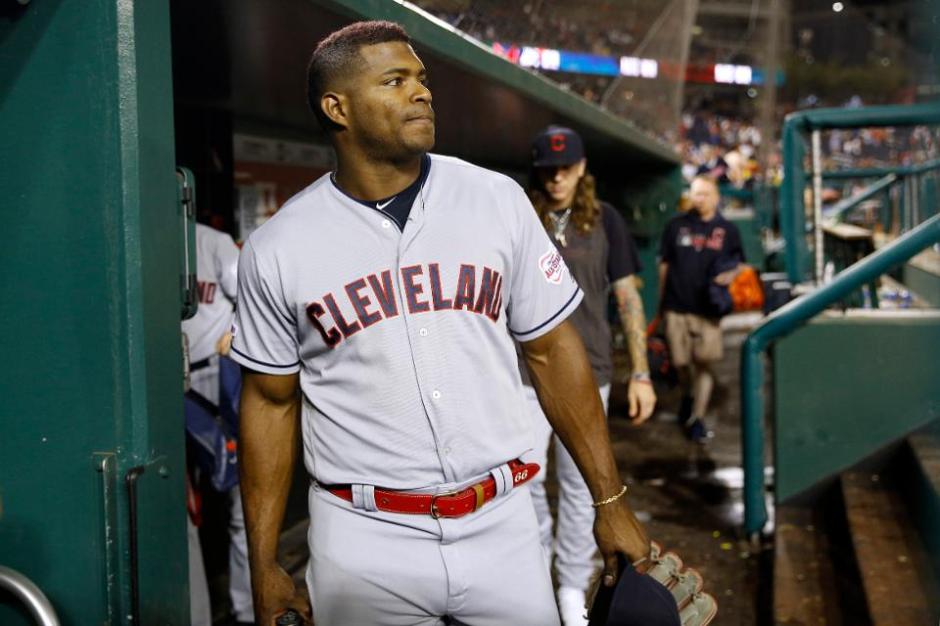
Former Cleveland outfielder Yasiel Puig leans against the dugout last season is negotiating with the San Francisco Giants in a deal that is reported to be close to getting done. (AP photo)

On That’s Amaury’s podcast:

#1 Giants manager Gabe Kapler said that a deal acquiring Yasiel Puig is not even close but sources said that Puig was for awhile on the Giants radar. How much would have a Yasiel Puig acquisition would have meant to the Giants.

#2 Yasiel had a reputation when he played with Los Angeles, Cincinnati and Cleveland and there were players who reportedly didn’t like him. He’s been shipped around since LA how would have fit in at the Giants?

#3 There is no doubt Puig is a talent with Cleveland he hit .267, 148 hits, 24 homers and 84 RBIs he can definitely provide power in the Giants offense.

#4  Would Puig have been the  same or somewhat kind of personality that former Giant Barry Bonds was in the clubhouse and field to the game?

#5 Some of the things that were said about Puig by some of his former teammates that he could be controversial and self fish could those issues be distractions if he had joined the Giants?

Amaury Pi Gonzalez is the Oakland A’s Spanish radio talent on KIQI 1010 and does News and Commentary each week at http://www.sportsradioservice.com


That’s Amaury’s News and Commentary podcast: Roberto Clemente #21 should be retired

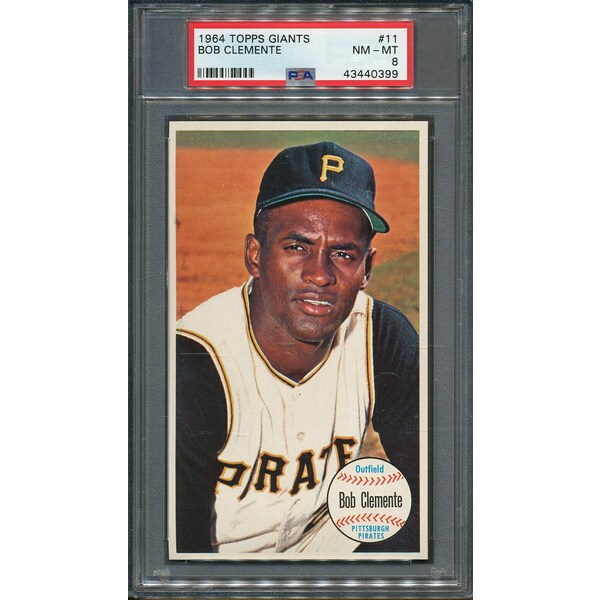
Roberto Clemente in his 1964 Topps Giants Card photo with the Pittsburgh Pirates (sportsmemorabila.com file photo)

Roberto Clemente #21 should be retired

That’s Amaury News and Commentary

By Amaury Pi-González

Although he was not the first Hispanic to play major league baseball, Roberto Clemente remains the most famous among all born in Latin America to play in the best baseball league in the world, and definitely the most historic figure.

There is only one number that was retired by all teams, and that was Jackie Robinson’s #42 in 1997. In Pittsburgh, were he played for his whole 18 year Hall of Fame career, there is a bronze statue of him at PNC Park and even the six street bridges, which is now the Roberto Clemente Bridge. Now, there are many statues of players, but how many do you know have a bridge with his name?

Just like Robinson, Clemente played under a lot of discrimination. Clemente also met racism in many forms, unlike Jackie Robinson, because, Clemente (from Puerto Rico) aside from the color of his skin, also had to fight his language and culture.

Many believed Clemente suffered more than Jackie Robinson. Because of his language barrier, Clemente was misquoted frequently, something he detested. Towards the end of his career, in the early 1970’s, as I was at Candlestick Park writing for El Mundo News, a Post Group publication Clemente’s Pirates team was facing the Giants and after he struck out, I heard somebody inside that press box shout “send him back in a banana boat!.”

Clemente was involved in charity. He chartered a plane from San Juan, Puerto Rico, filled with help for the suffering people of Managua, Nicaragua. It was a 6.3 magnitude earthquake that killed thousands. Clemente’s DC-3 airplane crashed north of San Juan on December 31, 1972. His very last hit was his 3,000 hit during his final at bat on September 30, 1972.

To the credit of Major League Baseball since 1973, one year after his disappearance, the Roberto Clemente Award (once the Commissioners Award) is given to the player in every team that exemplifies sportsmanship, community involvement and contributions to his team. And at the end one player among all 30 nominated wins the award.

Roberto Clemente was a quiet man. A professional baseball player with innate talent, a proud man, respectful of everybody regardless of race or nationality and most of all, he loved the game of baseball. The field was his canvas, and he could do anything on a baseball field. He died helping people in another country, not his own. In today’s narcissistic society, more men like Roberto are needed; these are the role models our youth need.

Many players born in Puerto Rico, like Candido (Candy) Maldonado, Rubén Sierra have told me they only wanted to wear “el número 21″for Roberto. But he is not only a national hero in Puerto Rico; his name is known internationally, especially in Latin America where more and more players are coming from to play in the United States.

The Hispanic Heritage Baseball Museum and Hall of Fame, since it was founded in 1998 has exhibited in numerous events across the country, All Star Games, Fan Fest and Museums and community events. There is no one player more popular than Roberto Clemente. During one of our exhibits at the San Francisco Main Library, we saw a man that was kneeling and praying in front of the Clemente exhibit. I asked him about that and he told me “I am Puerto Rican and he is like a God to us. His body was never recovered, but we know he is here with us”.

With the ever increasing demographics in the US which all point that in a few decades half of the US population could be Latino, not to mention the players coming from Latin America, baseball would be wise to retire number 21.

Eventually baseball will retire Roberto Clemente’s famous “número 21”. But why not now?

Amaury Pi Gonzalez is the vice president of the Major League Baseball Hispanic Heritage Museum and does News and Commentary each week at http://www.sportsradioservice.com

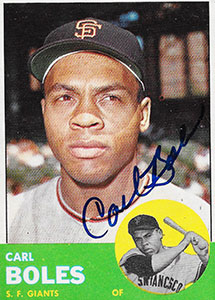
He was a Giant? Carl Boles and the Case of the Mistaken Identity

He Was A Giant?

Carl Boles and the Case of the Mistaken Identity

By Tony The Tiger Hayes

What could possibly be better than having Willie Mays on your team? Well, having two Willie Mays’ on your team of course!

The 1962 Giants weren’t lucky enough to have an actual clone of the “Say Hey Kid” on the roster. But in 27-year-old Boles, the squad had a player many people believed was Willie Mays.

Not the “next” Willie Mays mind you. But Willie Mays himself.

Like Mays, Boles was a brown eyed, handsome man. The OF was of comparable height and similar muscular build as Mays.

Typically, fans and media joyously flocked to the rookie with pen and paper ready. But some turned away puzzled.

“I’m signing more autographs than the veterans. The only thing is, after I sign my name they get mad at me,” Boles said in 1962. “Even newspaper reporters come up to me and start to interview me. They’ll say ‘Say Willie, about that hit…’ And when I say ‘I’m not Willie, some of THEM get mad.”

Why Was He a Giant?

Mays’ doppelgänger was promoted to San Francisco from the farm system in mid-1962 and remained with the club the final two months of the season.

The Giants were impressed with Boles rounded tool set.

“I don’t know how he’s going to hit up here,” said farm director Carl Hubbell, the former Giants Hall of Fame lefty. “But he’s not going to make many mistakes in the outfield and he’s a excellent base runner.”

Boles was on the Giants active roster as they clinched their first ever West Coast Pennant in Los Angeles.

In a bizarre scene, when the club returned home, still dizzy from their champagne celebration, they were met by a frenzied mob that spilled out on to the SFO tarmac.

As they tried to motor away, team bus was surrounded by a mob of frenzied Giants fans chanting “We Want Willie! We Want Willie!”

Unbeknownst to the throng – who how began rocking the coach back and forth – Mays had slipped into a taxi and was on his way home.

Of course there had to be a wise acre in the traveling party and OF Bob Nieman sarcastically crowed : “Let’s throw ‘em Boles and get the hell outta here!”

Before & After

The native Arkansan was signed by the Giants in 1954, but his career was interrupted by a military commitment with the Navy. By the time Boles got out of bell bottoms in 1959, he was an expert at knot tying, but a number of other Giants prospects had past him up in the pipe line.

Still, Boles clawed his way to Candlestick Park in ‘62, after batting .337, 18, 74 in 89 games at Double-AA El Paso.

“He’s fast and has a fine arm… He’s a fine OF prospect,” said Giants manager Alvin Dark.

Boles did all he was asked of in a reserve role, pinch hitting and running and spelling Felipe Alou in LF.

Unfortunately Boles would not return to the big leagues after ‘62.

A broken leg the following spring halted Boles momentum and he missed most of the 1963 season.

In 1965, it appeared Boles was retiring from playing when he took a position in the Giants scouting department.

He Never Got His Own Bobblehead. But…

Boles played in a total of 19 games with the Giants in ‘62, batting a satisfying.375 (9-for-24). Four of his hits came as a pinch hitter.

In a rare start, the Giants were trailing 2-1 in the 4th inning at Milwaukee when Boles drilled a game -tying RBI single off Bob Hendley. Later that frame, Boles scored the go ahead run on a Jose Pagan triple. SF hung on to win 6-4 (8/18/62).

Boles did not leave the dugout in the World Series vs. the Yankees that fall.

He did however score a game tying run as a pinch runner in the 7th inning of Game 2 in the special playoff series at LA. The Dodgers would eventually win the contest 8-7 (10/2/62).

Giant Footprint

Just when it appeared Boles’ baseball playing days were over he returned to the field… in Japan.

From 1966-71 Boles played with the Osaka Kintetsu Buffaloes and Nishitetsu Lions of the Japan Pacific League.

It was overseas that fans realized that not only did Boles resemble Willie Mays off the field, but on the field as well.

In his six seasons playing in the “Land of the Rising Sun,” Boles would slug 117 home runs.

When the Giants toured Japan for a series of exhibition games in 1970, one of few Americans to greet them was… Carl Boles.

Headline Sports podcast with Charlie O: Michael Jordan was offered a chance to play with the Oakland A’s in 1994; plus more headlines

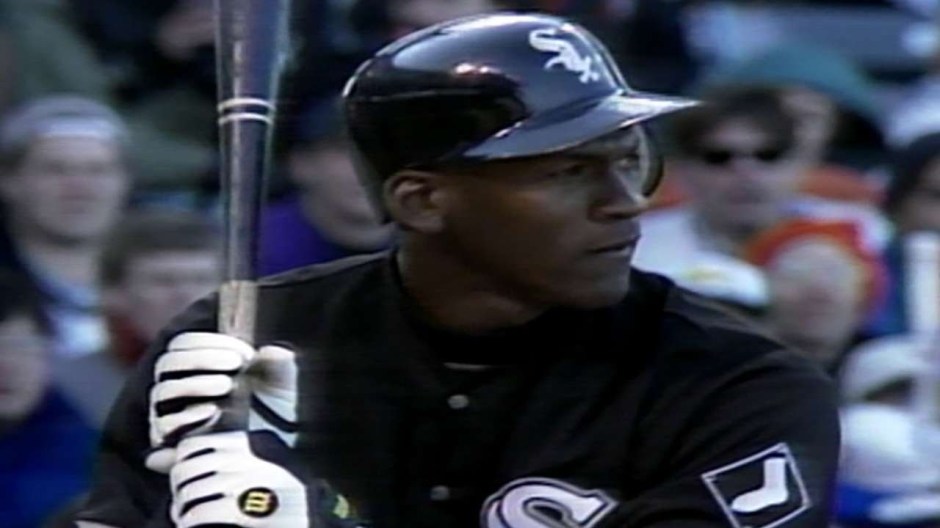
Former Chicago White Sox Michael Jordan taking an at bat against the Chicago Cubs at Wrigley before swinging for an RBI double in 1994 (cbssports.com file still)

On Headline Sports with Charlie O:

#1 The Michael Jordan documentary “Last Dance” has been the talk of the sports town. With it’s well received viewership on ESPN at 6.1 million viewers some of the topics have been interesting and extraordinary.

#2 The one story that stands out is when Jordan had retired from the NBA to play baseball in 1994 Jordan got an offer from then former Oakland A’s general manager Sandy Alderson who asked Jordan’s agent at the time if he would be interested in joining the A’s on their Major League roster. Jordan in double A for the Birmingham Barons declined saying he was loyal to White Sox owner Jerry Reinsdorf and didn’t want to upset the big leaguers who worked hard to get to the show by skipping grades to get to the A’s.

#3 Charlie how crucial is it for the state and the Sacramento community to have the state paying the Sacramento Kings $500,00 a month to rent Arco arena as a field hospital for incoming Coronavirus patients.

#4 Charlie could you fill us in on the MLB video game tournament that will be televised live and will there be a lot of ribbing and joshing amongst the players during a tournament like this?

# 5 Former Los Angeles Dodger play by play announcer Vin Scully certainly hasn’t lost his sense of humor after taking a tumble at home saying he’s done with head first slides.

#6 Charlie can you tell us about the Boston Red Sox losing a draft pick for sign stealing and that the penalty was far less than the penalties the Houston Astros got.

Join Charlie for Headline Sports every other Friday at http://www.sportsradioservice.com


That’s Amaury’s News and Commentary: The Baseball Situation

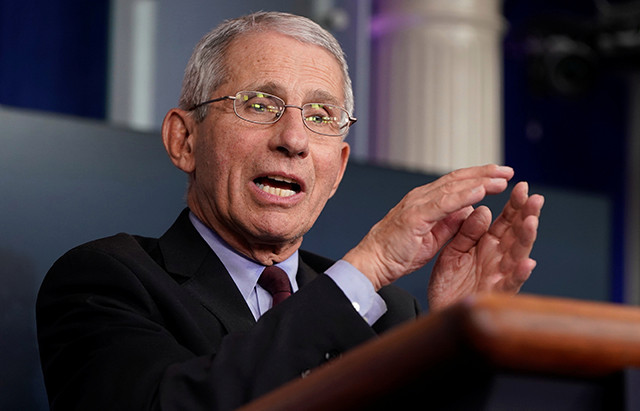
Dr. Anthony Fauci said MLB and sports needs to take a very cautious approach to re-opening the season that players, working personnel, and family do not infect each other. (file photo from minnpost.com)

The Baseball Situation

That’s Amaury News and Commentary

By Amaury Pi-González

Even if there is a 2020 season,under the most recent plan by Major League Baseball of some kind of a season with 15 teams in Arizona and 15 in Florida playing with no fans in attendance,all the powers-to-be at this time do not seem to agree on issues pertaining to a season. MLB, the owners,the players.

Why owners are hesitant to start the season? Teams have already lost money, no ticket sales,no sales of parking lot spaces, no sales of souvenirs, food, suite rentals,the advertising (signage) inside the stadiums. If season is shortened, players would get paid portion(pro-rated)per their contracts. However they will not receive their full salaries if the season takes place with the regular 162 game schedule, something that is very unlikely at this time.

Because we are in unprecedented situation,these issues are very fluid. MLB is listening not only to politicians who have the power to declare stay at home policies and all the other stuff that we by now have become accustomed to, for the first time in our lives, but also most of these decisions are under the guidance of the medical experts. For example,this is what renown Dr.Anthony Fauci, Director of the National Institute of Allergy and Infectious Diseases believes has to be done: “Nobody comes to the stadium. Put (the players) in big hotels, test them every week, and keep them very well under surveillance. Make sure they don’t wind up infecting each other or their families and let them play the season out.”

Some players might not want to take their families to Arizona or Florida.Two of the higher profile players,both from Los Angeles area teams, Mike Trout of the LA Angels and Clayton Kershaw of the LA Dodgers already objected to the long time separation from their families.

According to Major League Baseball the original March agreement did not protect clubs in the event games were played in empty ballparks.The union says salary issues were clearly covered. The main trust of the issue by owners (as it seems) is that nobody ever anticipated playing games in empty ballparks.

Millions of people are currently unemployed,some might never get their jobs back. Across the country thousands of businesses are trying to survive,some might, some might not,they are racing for loans and grants from the government.

In the best scenario,suppose teams go back and play May and June in Florida and Arizona with no fans and then if the situation greatly improves they return to their respective cities across the country and let the fans in. But how about the fans? Going to the park,if you do not have a job baseball is not going to be a priority anyway, it is a luxury.

A unique and different challenge to all the people in the business of baseball who has never been in this situation, but the country also has never been in this situation. According to a report by Forbes,  Major League Baseball grossed a record $10.7 billion in revenue for the 2019 Season an increase from the $10.3 billion the prior year

So I leave it to your imagination. At the end this might be too big to solve, for the National Pastime at least for 2020.

Join Amaury Pi Gonzalez for News and Commentary each week at http://www.sportsradioservice.com

Tony Renteria for That’s Amaury’s News and Commentary podcast: Best hitters in baseball missing out on making big numbers; Can MLB make it back by June?; plus more

wikipedia file photo: New York Yankees slugger Aaron Judge just one of many big league players missing out on improving their numbers this season as the shut down continues

Tony Renteria filled in for Amaury Pi Gonzalez:

#1 Taking a look at some of baseball’s big  boppers how badly are they missing this season names like New York Yankees Aaron Judge and the Philadelphia Phillies Bryce Harper.

#2 From the Oakland A’s Matt Chapman who had such a fine hitting season last year .249, 145 hits, 36 home runs, and 91 RBIs, he’s another player missing the opportunity to tee off this season.

#3 How possible could it be for MLB to start the season in June, play in two different states, hold fan interest, and hope that curve has been flatten in order to play this season?

#4 This was going to be the season that MLB was going to have a shot at increasing it’s attendance, getting a younger demographic and looking forward to improved TV ratings could that all be for not with an abbreviated season and most fans not having access to their local team?

#5 The A’s got criticized for not signing on with their former flagship radio station KTRB 860 and decided to stream all of it’s games home and away on itunes.com. Then came the shutdown for Covid 19. In hindsight considering all the advertising and business that has dried up and the A’s wanted to save money from buying air time it could very well be a good move and it might be a trailblazer move for other MLB teams.

Tony Renteria filled in for Amaury Pi Gonzalez who does News and Commentary podcasts each Tuesday at http://www.sportsradioservice.com

That’s Amaury’s News and Commentary podcast: Yankees owner Hank Steinbrenner passes at 63; Some of the greatest Cuban players I worked with; plus more

New York Yankees owner and son of George Steinbrenner III, Hank Steinbrenner passed away Tuesday for undisclosed reasons of death, he was 63. (file photo from twitter.com)

That’s Amaury’s News and Commentary podcast:

#1 New York Yankees owner Hank Steinbrenner passed away on Tuesday morning at age 63. Steinbrenner kept many of the business and traditional ideas of running the Yankees like his father George did.

#2 MLB.com raised a good question what would have happened if the Boston Red Sox had traded Babe Ruth to the Chicago White Sox. Amaury says baseball history would be different today had White Sox picked him up and who knows he might have been a manager something that Ruth wanted to do after he retired after his playing days.

#3 Amaury talks about some of the best Cuban players in MLB Leo Cardenas, Tony Olivia, Tony Perez, Jose Canseco and Minnie Minoso  and his experiences working with them.

Catch Amaury each Tuesday for That’s Amaury’s New and Commentary at http://www.sportsradioservice.com

He Was A Giant? Feature on former Giant Bob Schroder

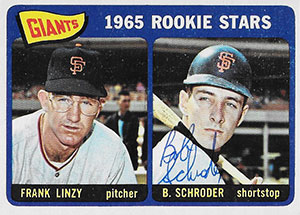
1965 Topps Rookie card of former San Francisco Giant Bob Schroder (right) who autographed the card is Tony The Tiger’s featured player in today’s article “He was a Giant?” (photo from baseball.almanac.com)

He Was A Giant?

By Tony The Tiger Hayes

Bob Schroder – IF – 1964-68 – # 10, 15

As odd as it seems to label someone who played in four straight seasons with San Francisco as an “unknown” – Schroder would qualify to be that guy.

A left-handed hitting utility infielder, Schroder batted .217, 0, 12 in 138 games between 1964-68 for the Orange & Black – failing to make any obvious impact other than providing a warm body with steady glove in blowouts and late inning situations.

In fact Schroder’s only claim to fame as a big leaguer was replacing a future Hall of Famer in the lineup after said high-kicking legend conked a Dodger over the head with a Louisville Slugger in the most infamous brawls in MLB history.

Why Was He A Giant?

Giants scouts found Schroder enjoying a dish of gumbo and char broiled oysters while starring at shortstop at New Orleans’ Loyola University in 1964.

A year later, after breezing through three low rung Giants minor league clubs, Schroder would make his big league debut in an other great restaurant town, pinch running for Tom Haller at Candlestick Park in a 3-1 loss to Pittsburgh (4/20/65).

Before & After

Born in New Jersey, Schroder didn’t exactly scream future star in his first season of pro ball when he batted a combined .273, 9, 46, at two levels of minor league ball.

Yet he made the big club out of spring training in ‘65 at age 20 and amazingly would spend the entire campaign with the big club, leading some to speculate that the kid had compromising photos of portly manager Herman Franks in a tutu or was an invaluable golf caddy for Willie Mays.

As a rookie Schroder appeared in just 31 games while amassing a paltry nine at-bats. He appeared in 10 more contests in 1966 with the big club – spending most of the year at Triple-A.

But Schroder was back for a full season in the City by the Bay in 1967 – seeing his most action in the bigs (.230, 0, 7) in a career high 65 games as the Giants primary backup infielder. In 1968 he split the season between SF and the minors.

After that, Schroder would spend all of 1969-70 with the Giants Triple-A Phoenix team and one final season of pro ball in 1971 in the Brewers system.

He was out of pro ball at age of 26.

He Never Got His Own Bobblehead. But…

Schroder enjoyed just eight multiple hit games as a Giant. In one rare starting assignment (9/7/67) he led the club in hits with three and scored the winning run in a 3-2 home edging of Houston. The catch is, it took 15 innings to accomplish the feat.

With two outs in the bottom of the 15th, Schroder sliced a line drive single to left field off Astros reliever Dave Eilers. The pitcher then plunked Ken Henderson with a pitch to move Schroder into scoring position. Jesus Alou then pounced on the next offering stinging a single into center as Schroder raced home to beat Jimmy Wynn’s throw.

Giant Footprint

The already testy Giants-Dodgers rivalry turned violent and bloody in the summer of 1965 when SF’s Juan Marichal swung and connected his bat; not at a Sandy Koufax pitch, but at Los Angeles catcher John Roseboro’s head.

Marichal alleged the LA receiver had intentionally grazed his ear with a particularly close return throw to the mound.

Thankfully Roseboro’s injury was not life threatening injury – but Marichal did open a sizable scalp wound on Roseboro head requiring more than a dozen stitches.

After the chaos dyed down 14 minutes later, Schroder was called upon to pinch-hit for the now disqualified Giants ace.

Saddled with a 1-1 count, Schroder quickly whiffed vs. Koufax and joined Marichal in the home clubhouse.