
San Jose State closes out home football schedule on Senior Day Saturday

Photo credit: sjsuspartans.com

By: Ana Kieu

SAN JOSE, Calif. — Saturday afternoon is going to be a special day for 15 San Jose State football seniors who will be honored in the pregame ceremonies at CEFCU stadium before the 2:00 pm PT kickoff versus Nevada. The Wolf Pack is a high scoring team, so it’ll likely be a challenge for the Spartans; but it’ll be a special day nonetheless.

Anyways, here’s what you need to know about Saturday’s game.

Basics
San Jose State vs. Nevada
Saturday, Nov. 17, 2018,
CEFCU Stadium
San Jose, Calif., 2:00 pm PT
ESPN3

San Jose State’s record
1-9, 1-5 Mountain West. Most recently, the Spartans lost at Utah State, 62-24, on Nov. 10.

Nevada’s record
6-4, 4-2 Mountain West. The Wolf Pack won their third consecutive game, 49-10, over Colorado State on Nov. 10.

How to get tickets?
• sjsuspartans.com/tickets • ticketmaster.com

Athletics Ticket Office, 1393 S. 7th Street, San Jose, CA 95112, weekdays, 9:00 am – 5:00 pm

For home games at CEFCU Stadium:
• New modern family plan
• Spartan alumni season ticket pricing in a distinct seating section

Series history
Nevada leads the series, 20-9-2, dating back to 1899. The Wolf Pack have wins in the last eight of the last nine meetings between these teams including a 59-14 victory in Reno a year ago.

The Spartans’ last win in the series was a 14-10 decision at home in 2016.

For 15 years, these teams held the NCAA FBS single-game record for total yards in a game by both teams (1,640). San Jose State out-gained Nevada, 849 to 791, in a 64-45 victory in San Jose on Nov. 10, 2001.

Radio
KLIV (1590 AM, San Jose) originates San Jose State football broadcasts. Justin Allegri calls the play-by-play. Kevin Richardson provides commentary. The Nevada broadcast begins at 1:30 pm PT with a pregame show.

San Jose State’s network affiliate is KION (1460 AM/101.1 FM, Salinas).

KSJS (90.5 FM, San Jose) also will broadcast the San Jose State-Nevada game starting at 1:45 pm PT.

Television
ESPN3 will provide play-by-play coverage of the San Jose State vs. Nevada game. Trey Bender calls the play-by-play. Al Groh offers analysis. The live telecast is scheduled for 2:00 pm PT.

Final home game for Spartan seniors
San Jose State will be recognizing 15 seniors in pregame ceremonies.

2018 schedule rated as one of the toughest
According to the NCAA Statistics Service for games played through Nov. 10, San Jose State’s first 10 opponents compiled a .593 winning percentage, tied for 34th best among FBS schools and tops along with Wyoming among the 12 Mountain West members.

Incorporating the current records of the Spartans’ final two opponents, Nevada and Fresno State, San Jose State’s schedule is tied for he 17th most challenging based on opponent winning percentage (.613). No other Mountain West school is in the top 50.

Tre Walker produces 2018 Mountain West best
Wide receiver Tre Walker produced the Mountain West’s first 200-plus yard receiving game of the 2018 season with his seven receptions for 209 yards and two touchdowns at Utah State on Nov. 10.

Walker’s 209 receiving yards are tied for 16th best nationally this season in games played through November 10. Prior to his breakout game, the Mountain West best was 188 yards by Colorado State’s Preston Williams in the Aug. 25 game at Hawaii.

Walker also became the first San Jose State player in 11 years to gain at least 200 yards in pass receiving in a game. The last time it was done was Kevin Jurovich’s 233 receiving yards in a 2007 game vs. New Mexico State.

Justin Holmes becomes the 29th
Senior Justin Holmes became the 29th San Jose State player to catch 100 passes in a career with his one reception at Utah State.

Seniors Tre Harley (97) and Josh Oliver (93) are next in line to the 100-career reception plateau.

A punt return for a touchdown
Freshman Tre Jenkins scored San Jose State’s first punt return touchdown in the Utah State game on a 41-yard return. Jenkins’ run back for a score was the first by a Spartan since Tyler Ervin’s 85-yard punt return for a touchdown in the 2015 AutoNation Cure Bowl.

MLB Mexicali Baseball: Long Weekends and Extended Seasons Across the Border (Part 3)

Photo credit: @AguilasDeMxli

By: Lewis Rubman
SRS Contributor
November 11, 2018

Charros de Jalisco: 0 | 5 | 2
Aguilas de Mexicali: 7 | 11 | 0

MEXICALI, Baja California — The Caribbean Series is the culmination of the Winter Leagues’ season and, very likely, the most important event in the world of Spanish-speaking baseball. It began in 1949 and continued through 1960, as a result of Cuba’s ban on professional sports. Cuba, the Dominican Republic (then known as Santo Domingo), Puerto Rico, Panama, and Venezuela competed during the dozen years of this stage in Caribbean Series history. Each of these except Venezuela won at least one championship, with Cuba leading the pack with seven, followed by Puerto Rico with four, and Panama with one.

The Series was revived in 1970, without Cuban participation. The Liga Mexicana del Pacífico was added in 1971. The tournament has been celebrated every February since then with the exception of a one-year hiatus in 1981. Cuba returned to competition as a guest, but not a member, of the sponsoring Caribbean Baseball Federation, in 2015 and promptly won the tournament. Puerto Rico’s Caguas Criollos has brought the crown home to that island for the last two years. The totals for championships since 1949 is nineteen for the Dominican, sixteen for Puerto Rico, nine for Mexico, eight for the Cubans, seven for Venezuela, and one for Panama.

In its current format, the five participating teams play 13 games in seven days. In the first round, which lasts five days, each team plays two games against each of the others and enjoys one day of rest. At the end of this round, the team with the lowest won-lost percentage is eliminated.

Today, we won’t go into the complex tie breaking procedures. The surviving squads play a one-and-done four team double header, with the first and fourth place finishers facing each other, as do the second and third place teams. The winners of those games duke it out in the final game. In both the semi-finals and the final contest, the team with the higher winning percentage in the opening round gets to bat last. Jalisco has never competed as Mexico’s representative to the Series, while the closest Mexicali has come to winning since its 1968 championship was in 2017 when it lost the final game–played in Culiacán–to Puerto Rico’s Caguas Criollos by the score of 1-0.

I suffer from gout, so I can’t enjoy eating the tempting food for sale in the Estadio B’Air, aka the El Nido de los Aguilas, The Eagles’ Nest.But, just as General Sternwood indulged his vices by proxy while watching Phillip Marlowe down brandy and smoke a cigar at the beginning of The Big Sleep, I get great pleasure from watching people at the Nido enjoy the culinary delights that are denied to me. I mentioned one of them, Bubba Smith’s hotdogs, in yesterday’s report. They’re similar to the ones you can buy fresh off the griddle on the bridge between BART and the Oakland Coliseum and, judging by their smell, delicious. Another delicacy are the pig tails, fried and sold by Chel Vásquez and his family at the stadium. You might want something to wash down all your Bubbas and pig tails. Try a clamato, a juice invented in Mexicali. You can get it straight or mixed with olives. Cerveza Sol offers its beer mixed with clamato and sold in cans but served in plastic bottles at the ballpark. They were giving away shot glass sized samples at todays game. My wife says it was delicious. Tecate is another beer prominent on the premises. Or maybe you’d prefer a few tequilas with lime and salt. Indeed, lime and hot sauce are available with practically every bit of food or drink you want at the ball park.

Mexicali swept its three-game series with Jalisco by whipping them 7-0 in this afternoon’s contest, repeating many elements of last night and the night before’s story. Once again, neither team’s batter provided a home run. And the Aguilas starter again went deep into the game with an extremely strong performance. Javier Solano held the Charros scoreless over seven innings, in which he yielded five hits, struck out seven, and walked two. Michael Devine and Randel Lazo each pitched a perfect frame to preserve the win for Solano and Mexicali.

Agustin Murillo, the Charros’ usually sure handed third baseman contributed twice to Mexicali’s scoring. Jason Bourgeois opened the bottom of the third with a hard hit bouncer than skipped between his legs, leading to starting and losing pitcher Elián Leyva being yanked after two and two-thirds innings, even though none of the three runs he had alllowed was earning and he had given up only one hit. Still, it was clear that Leyva had no command over the situation. Felipe González, Jared Lakind, and Linder Castro held Mexicali at bay until things fell apart for the Charros in Mexicali’s bottom of the seventh, when they pushed four runs across the plate, aided by Murillo’s inability to handle Ramón Ríos’ hard shot to third. It was a tough play, and Ríos deserved the hit with which he was credited, but it opened the door for the four runs that put the game out of reach for the Jalisco nine.

Mexicali finished the weekend in third place, at 13-12. Jalisco, with a 12-14 record, slipped to seventh place in the eight-team league.

We were sorry to leave Mexicali, especially because after an hour and a half’s waiting in line to cross the border (it could be worse; a fellow press box denizen told us of a relative who had spent seven hours in line one day), we were randomly selected to wait another half an hour while our rental car received a secondary inspection. I’ve had a lot of good things to say about Mexicali, and I hope they will encourage some of you to enjoy the pleasures the city, its people, and its peloteros can provide. But I’d be remiss if I didn’t warn you about the unpleasant nature of a northbound border crossing.

What’s new with the San Jose State football team?

Photo credit: @SJSUSpartanFB

By: Ana Kieu

SAN JOSE, Calif. — It was sort of expected, but I have to reiterate the unfortunate fact the Spartans got on the board first and then tied the score 10-10 before the Aggies took complete control of the game for a 62-24 blowout at the Maverick Stadium in Logan, Utah this past Saturday.

Fast forward to Monday afternoon. Spartans head coach Brent Brennan delivered his weekly press conference inside Simpkins Stadium Center in San Jose, Calif.

Here’s my Q&A with Brennan:

1. Utah State seemed to take advantage of most, if not all, of San Jose State’s mistakes. A lot of people know the Aggies have a good offense, but what are a few things about Jordan Love and company that they don’t know?
I think their running backs have played well. I didn’t know how good they were until I saw them in person. Even though they’re not very big, they’re incredibly powerful and hard to bring down. I thought they did a really good job breaking tackles.

The other thing that’s hard to see if you’ve watched the game on TV is the type of temperament that they played with. To me, it reminds me of when I was coaching at Oregon State, we were playing Oregon, Marcus (Mariota) and those guys and how fast they were on every snap.

2. San Jose State had their fare share of big plays and Tre Walker had himself a day, but what could you and the other coaches do during practice to make sure that pass plays lead to scores?
I think there’s just a consistency there. On Saturday, we dropped too many passes, and I thought there were a couple of breakdowns in protection; but for the most part, the protection was better. But that was just one of the things that I thought were what went wrong with that game. We dropped too many passes and some balls weren’t on the money.

I thought Michael Carrillo went in there and threw the ball well. So I think continuing to kind of to work on those details, just absolutely specific depths on routes, our connection with the football and where the ball placement is by the quarterback are a couple of things we need to know.

3. San Jose State will honor 15 seniors before this Saturday’s kickoff versus Nevada. There’s not much to be proud of in terms of the record, but what are you most proud of when it comes to this group of guys?
What I’m most proud of this group of guys is easy. It’s how they’ve continued to work and push the team, even though we weren’t getting the results on Saturday we wanted.

Since I’ve been here, this current group of seniors has been outstanding in every way–they’re good in the classroom, they work really hard during practice and they lead the team. I’m so appreciative of how hard they’re worked to help us move this program in the direction we want to take it.

I’m disappointed we haven’t gotten the results for them. That really hurts me.

Raiders lose fifth in a row, 20-6, to Chargers

By Jeremy Kahn

OAKLAND — Whenever the Oakland Raiders and the Los Angeles Chargers get together, you know that it is going be a battle between these two longtime rivals from the old American Football League.

Unfortunately, over the past two seasons, the rivalry has swayed towards the Chargers, especially after their 20-6 victory over the Raiders before a crowd of 54,750 at the Oakland-Alameda County Coliseum.

With the victory, the Chargers have won six in a row, and now stand at 7-2, while the Raiders are going the other way, as they have lost five in a row and are now 1-8 on the season.

This is the Chargers fourth straight win in the series after the Raiders won the previous four in a row from the Chargers, that included a 19-16 victory by the Raiders over the Chargers that helped the Raiders clinch their first postseason berth since the 2002 season.

The Raiders still lead the all-time with a record of 62-54-2 since the series began in the first year of the AFL back in 1960.

Things started out well for the Raiders, as on fourth-and-5, punter Johnny Townsend faked the punt and scrambled 42 yards down to the Chargers 21-yard line to give the Raiders a glimmer of hope; however, the Raiders were not able to get any points on the board, as the Chargers defense held Derek Carr for a no gain on fourth-and-goal and the Chargers took over on downs.

“I have always said that I believe in that kid. In that fake punt, you can see that he is one of our fastest players. He is a tremendous athlete. He took his medicine for a while like a lot of us, but he is going to be a really good punter for us,” said Jon Gruden.

After the Chargers went three-and-out on their initial series of the afternoon, the Raiders wasted not long to get on the board.

Daniel Carlson got the Raiders on the board in the first quarter, as he nailed a 46-yard field goal to give the Raiders a 3-0 lead.

Following another three-and out by the Chargers, the Raiders mounted a drive of their own; however, Carr was sacked for an 11-yard loss by Melvin Ingram III and fumbled the ball and was recovered by Corey Liuget, who rumbled 24 yards down to the Raiders’ 40-yard line.

“We came up big. Everybody made hell of plays. It was a great team win. We have a great group of young players. Those boys are special. They came up big. When you have rookies that can step up and make plays like that, it’s big,” said Ingram.

The Chargers got all the way down to the Raiders’ nine-yard line, but like the Raiders were forced to settle for a Michael Badgley field goal that tied up the game.

The Raiders offense could not muster a first down, as they were forced to punt the ball back to the Chargers, who went down the field and it culminated with a Philip Rivers touchdown pass to former CAL star Keenan Allen for 11 yards that gave the Chargers a 10-3 lead with just 24 seconds remaining in the first half.

Carr just took a knee to end the first half, and the Raiders trailed at the end of the first half by a score of 10-3.

Melvin Gordon finally got in on the act for the Chargers, as he took a Rivers pass and ran 66 yards to the end zone to give the Chargers a 14-point lead just 2:28 into the third quarter.

After yet another punt by the Raiders, they got ball back in a hurry, as Rivers threw a long pass down the field; however, Safety Marcus Gilchrist picked off the Rivers pass intended for Allen at the Raiders 31-yard line.

“That’s part of things I’m talking about that we can do better, that can possibly change that ‘W’ and ‘L’ column for us,” said Gilchrist.

Unfortunately, the Raiders could only muster five yards on the ensuing series before they punted the ball back to the Chargers.

Once again, the Raiders defense came up big, as they held the Chargers off the scoreboard, as they were forced to punt.

Carr and the Raiders got rolling, as he found Doug Martin for a 23-yard gain, and then on the next play, he found Jared Cook for 31 yards that got the Raiders down to the Chargers 13-yard line.

Carlson got the Raiders within 11, as he nailed a 30-yard field goal.

The Chargers then began a long drive that included a 42-yard touchdown run by Austin Ekeler that was nullified by a 10-yard holding penalty that was called on Russell Okung.

On the very next play, Rivers was sacked by Shilique Calhoun and Johnathan Hankins; however, Hankins was called for Roughing the Passer that gave the Chargers a first down at the Raiders’ 33-yard line.

“It’s one of those things. Where you look back on it and I just needed to get to him, get him down faster. If I get him down faster. If I get him down quick enough, I don’t have to worry about that penalty. It’s on me to make sure I complete the plat and finish the play out,” said Calhoun.

Rivers and Allen hooked up for a 18-yard completion that put the Chargers into field goal range, and four plays later, Badgley kicked a 41-yard field goal that gave the Chargers a two touchdown lead.

The Raiders got the ball back after the field goal, and began to drive down the field; however, the drive stalled, as Carr was unable to find anyone on a fourth-and-5 and was forced to throw the ball away, giving the ball back to the Chargers.

Carr ended the day by going 24-for-37 for 243 yards, while Jalen Richard led the Raiders in receiving with five catches for 52 yards.

Martin led the Raiders in rushing, as he carried the ball 15 times for 61 yards.

Rivers went 18-for-26 for 223 yards with two touchdowns and an interception on the afternoon for the victorious Chargers.

Gordon led the Chargers in rushing, as he carried the ball 18 times for 93 yards, and also caught five passes for 72 yards and a touchdown.

Allen was the leading receiver for the Chargers, as he hauled in six passes for 57 yards and a touchdown.

NOTES: Townsend became just the third punter since the 1970 AFL-NFL merger to have a run of at least 40 yards and a punt of 50 yards in the same game, as joins Reggie Hodges of the Cleveland Browns in 2010 and Jeff Hayes of the Washington Redskins in 1983.

Martavis Bryant was forced to leave the game for the Raiders in the third quarter with a knee injury, an injury that Gruden fears could be serious.

UP NEXT: The Raiders head out on the road for their next two games, as they will face the Arizona Cardinals on November 18 at 1:05 pm PT and then the Baltimore Ravens at M&T Bank Stadium on November 25 at 10:00 am PT. They return home on December 2 to face the Kansas City Chiefs at 1:05 pm PT.

MLB Mexicali Baseball: Long weekends and extended seasons along the border (Part 2)

Photo credit: @AguilasDeMxli

By: Lewis Rubman
SRS Contributor
November 10, 2018

Charros de Jalisco: 0 | 4 | 1
Aguilas de Mexicali: 8 | 14 | 1

MEXICALI, Baja California — Yesterday, I made a mistake. I said that Mike Sánchez had been credited with an unmerited save because when he entered last night’s game, the on=deck hitter didn’t represent the potential tying run. I had forgotten, that it was Rodolfo Aguilar who entered the game in that situation. After giving up a run-scoring single to the only batter he faced, Aguilar left the bases loaded for Sánchez, who did, indeed, began his stint with the potential tying run in the on deck circle.

I also promised to explain the Mexican Pacific League’s method of determining the final standings of its teams. Here goes. From October through December, the teams play a 68 game season, divided equally into two rounds. In each half season, the team with the best won-lost percentage receives eight points; the second, seven; the third, six; the fourth, five; the fifth, four and a half points; the sixth, four points; the seventh, three and a half; and the eighth, three. Then the totals for each half season are added up to determine the teams’ overall positions. The tie breakers for establishing the standings for all the fragments of the season until the participants in the semi-finals have been determined, are in decreasing order of importance, face-to-face won-lost records and the “run-average.” This last figure is computed by multiplying the teams’ total runs scored, multiplying it by 100, and dividing the result by the runs scored against them.

Starting just after New Year’s Day, there are three play-off rounds, each of them best of seven games. In the opening round, the first place team faces the sixth place finisher; the second, the fifth; and the third place team plays the fourth. The teams with the three best records, along with the wild card (called “the best loser”) advance to the semi-finals. The best loser is the one with the most play-off wins. The two tie-breakers are play-off run-average, followed by the place in the over-all regular season standings. For the semi-finals and final series, teams can add to players to their rosters (although one of them can play) from the two eliminated teams. The first seed plays the wild card team and the second and third place teams face each other in a best of seven series to determine the finalists, who then duke it out in another best of seven series. The survivor goes on to the Caribbean Series, which I’ll discuss in tomorrow’s article, the last of this three-part report.

I also promised to continue my brief history of the Aguilas after they left “organized” baseball in 1958. After years of unsuccessful attempts to enter what everyone calls the winter leagues, although almost all of their games are played in the fall, Mexicali was admitted to the Mexican Pacific League in 1976. It took the Eagles a decade to win their first league championship, but that 1985-86 team, with the A’s current minor league defensive coordinator, Juan Navarrete, playing second base and John Kruk in the outfield, went on to win the Caribbean Series. Three of the champions’ four wins came in the last inning. The Aguilas also topped the league in 1988-89, 1999-2000, and 2016-17, but that initial Caribbean victory was the only time they’ve taken home all the marbles. As I mentioned, the 1989 Series took place in Mexicali.

Over the years, many other players known to American fans have taken the field for the Aguilas. Among them are Mike Piazza, Fernando Valenzuela, Jonny Gomes, Rudy Seánez, Jeff Samardzija, Sergio Romo, Dan Serafini, Matt Joyce, David Cortés, Rubén Amaro, Yuniesky Betancourt, Jason Bourgoeois, Adam Rosales, and Ron Washington. Also, great Mexican players, not well known in the states, like Cananea Reyes, Matías Carrillo, and Houston Jiménez also have played for the Mexicali faithful. Some American players have carved out major careers playing in the Mexican League in the summer and the with the Eagles during the fall. Derrick Bell and Oakland born Chris Roberson are among these, as is the belovèd Bubba Smith (pronounced BOObah Esmith in Spanish), who was extremely popular with young fans in the US minor leagues, Korea, Japan, and Mexico. A rotund first baseman, Bubba gave his name to a hot dog stand at the Eagles’ Nest.

Eventually the word Bubba replaced salchica as the local word for that delicacy. Today you can walk into the local supermarket and find the clearly marked Bubbas section.

Tomorrow, I’ll provide a brief overview of the food available and The Nest, now it’s time to report on this evening’s game.

Mexicali even its record at 12-12 and dropped Jalisco below .500 at 11-13 by lambasted the Charros 8-0 at the Eagles’ Nest tonight. Taking a leaf from last night’s book, the Eagles soared to a commanding lead early in the game, this time going ahead 6-0 after two innings. Again, their starting pitcher held this lead as long as he was on the mound. Tonight, it was David Reyes, who held his opponent scoreless of six frames, yielding only three hits and one walk while striking out eight Charros. C.C. Delgado earned the save by pitching three shutout innings, allowing only one hit, an eighth inning double to Kevin Medrano, and striking out four of the 10 batters he faced. Jalisco’s unfortunate starter, Vince Malesky, was touched up for five runs, two of them earned, in one plus innings pitched.

The three unearned runs scored as the result of his own throwing error in the top of the second. A trio of Jalisco relievers held the Eagles to one run each over the remaining seven innings, but the damage was done.

For the second straight night, neither team hit a home run. The Eagles scored on a combination of timely hitting and hustle. Malesky’s fatal error occurred on a sacrifice bunt by Javier Salazar that allowed him to reach second and Ricky Alvarez to score while Ramón Ríos made it to third. David Harris stole a base, and Jason Boureois purloined two.

Tomorrow, we’ll see Mexicali go for the sweep, while Jalisco tries to salvage its honor in the series finale.

Cal Bears Football podcast with Morris Phillips: Cal, after surprise comeback at USC, gets set to host Stanford for the Big Game Saturday

Photo credit: @CalFootball

On the Cal Bears Football podcast with Morris:

#1 A miracle comeback for the Cal Bears (6-4) Saturday at USC (5-5) for a 15-14 win, snapping a 14-game losing streak to USC at the Los Angeles Coliseum.

#2 Cal head coach Justin Wilcox said it’s great to be bowl eligible.

#3 The Bears were hibernating in the first half of Saturday’s game at USC but started to make their comeback in the third quarter and Traveon Beck scored Cal’s second touchdown for the game winner.

#4 USC had a 14-0 lead, but the Bears roared back. Cal got their first touchdown in the third quarter and took a one-point lead 15-14.

#5 The Bears will face Stanford (6-4) and Colorado (5-5) for their next two games. The Big Game is this Saturday at Cal, which it could turn out to be one of the season’s best.

Morris does the Cal Bears podcasts each Monday at http://www.sportsradioservice.com

NCAAFB podcast with Daniel Dullum: New AP Top 25; Cardinal back in hunt for the bowl; USC coach Helton on the bubble after loss to Cal

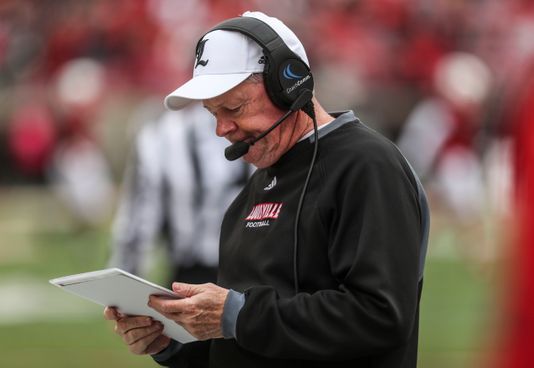
photo from Louisville Courier: Bobby Petrino didn’t have answers as Wake Forest beat the Cards 56-35, giving Louisville a record of 2-6 start, its worst season since 1997’s 1-10. Oct. 27, 2018.(Photo: Matt Stone/Louisville Courier Journal)

On the NCAAFB podcast with Daniel:

1. Louisville Cardinal Bobby Petrino (36-26) fired their coach during his show on WAVE TV. The announcement came from the crawl on the screen below.

2 The New AP Top 25.

3 Stanford romps past Oregon State, Cardinal now Bowl Eligible.

4 Cal slips past USC, Trojans coach can begin packing his bags; Bears are Bowl Eligible.

5 Arizona State stuns UCLA, Sun Devils now Bowl Eligible under Herm Edwards!

6 Boise State upsets No. 16 Fresno State in the Mountain West.

7 Minnesota upsets Purdue 41-10, same Boilermakers who drubbed Ohio State 49-20 on Oct. 20.

Daniel does the NCAAFB podcasts each Sunday for Michelle Richardson at http://www.sportsradioservice.com

Three takeaways from Stanford’s 48-17 win over Oregon State

Photo credit: @StanfordFball

By: Ana Kieu

PALO ALTO, Calif. — The Stanford Cardinal electrified Stanford Stadium on Saturday night, which was also Senior Night for the soon-to-be Stanford alumni, with a 48-17 win over the Oregon State Beavers. It was a fun night for those who were rooting for the Cardinal.

Here are my three takeaways from Stanford’s 48-17 over Oregon State.

Stanford’s apparent luck on Senior Night
It’s plain and simple, Stanford’s apparent luck on Senior Night has shined bright like a diamond for quite a while. With the win, Stanford improved to 7-1 under head coach David Shaw on Senior Nights. That statistic includes four wins in a row for the Cardinal.

Shaw told the media: “Proud of the way our football team came out. We made some changes to our routine. Put some pressure on some guys to step up as leaders, made sure we started the games better the rest of the year. And our guys came out tonight with a fire and energy.”

Shaw added: “So excited about our seniors. A lot of our seniors made big plays tonight, contributed a lot tonight. Both up front and on the offensive and defensive lines–Bryce Love, Cameron Scarlett, Jake Bailey. Guys came in and just made some great plays for us. Trenton Irwin made some nice catches.”

The new Cardinal in town
Look out, John Elway and Steve Stentstrom! There’s a new Cardinal in town–K.J. Costello!

On Saturday, Costello became the third Cardinal with six 300-yard passing games in a season, joining the likes of Elway (six in 1982) and Stentstrom (eight in 1993), respectively. Costello also moved into ninth place in Stanford history with 37 career touchdown passes, moving past Trent Edwards (36 from 2003-06).

When asked about Costello’s performance in Saturday’s game, Colby Parkinson said: “K.J. is awesome. He’s going to put the ball where it needs to be, going to give you a shot to go up and get it. Like I said earlier, this is stuff we’ve been working on for a year and a half now. It’s not something that just happened tonight. It’s not something that is spur of the moment. This is what we do every day in practice.”

37 years
It took only 37 years (just kidding, I’m only 25!) for the Cardinal to score 48 points in a game in which the Beavers were their opponent.

The Cardinal’s 48 points versus the Beavers on Saturday were the most by a Cardinal squad since their 63-9 blowout of the Beavers back in 1981. So yeah, it wasn’t only a high scoring game, it was also a statistic breaker.

Congratulations to the Cardinal on their huge victory over the Beavers!

San Jose State drops a 66-59 decision to Southern Utah

Photo credit: @SJSUMBB

By: Ana Kieu

When it comes to the men’s basketball program, San Jose State was looking to make it two wins in a row at the Event Center on Saturday night versus the Southern Utah Thunderbirds. Unfortunately, the Spartans’ wish didn’t come true, and they dropped a 66-59 decision to the Thunderbirds.

Southern Utah was off to a good start. Andre Adams made a jumper in the paint, Dwayne Morgan made a layup and Adams followed up with another jumper.

San Jose State, however, got themselves back into the game. The Spartans were benefited by Brae Ivey’s jumper in the paint and Zach Chappell’s free throw on the fastbreak. San Jose State held a 21-18 advantage over Southern Utah at the 7-minute mark of the first half. At the time, Seneca Knight led the Spartans with 6 points and Michael Steadman had 5 boards.

The Spartans and Thunderbirds were tied at 31 apiece at the half. Steadman led the Spartans with 8 points and 5 rebounds. Knight had 6 points.

The second half felt and looked ugly for the Spartans. The Spartans trailed the Thunderbirds 37-34 at the 17:12 mark of the half. While the Spartans could’ve bounced back to beat or at least even the score versus the Thunderbirds, that never happened, which left most, if not all, Spartan fans shaking their heads and asking why their team was unable to beat the Thunderbirds.

Despite the tough loss, there were a few positive things to note about the Spartans. Oumar Barry left a lasting memory on the Spartan fans with back-to-back 3-pointers and Craig LeCesne did the same thing to give the Spartans a 40-37 lead at the 16:05 mark of the half. LeCesne then recorded a game-high 11 points–9 in the final 4 minutes–as the Spartans led the Thunderbirds 48-41 at the 12:24 mark of the half.

The Thunderbirds weren’t ready to back down just yet. The Thunderbirds went on a 7-0 run to tie the game at 51 apiece with 7:37 left in the half.

At the time of the final media timeout, it was still a tight game and anyone’s game for that matter. The Spartans trailed the Thunderbirds 58-53, but stayed put in a hole that they sort of dug themselves in.

Final: 66 Thunderbirds, 59 Spartans

Notes
San Jose State’s starting lineup: Michael Steadman, Brae Ivey, Zach Chappell, Seneca Knight and Oumar Barry.

Up Next
San Jose State makes a visit to Weber State on Thursday, November 15 at 5:30 pm PT.

Cardinal rout the Beavers 48-17 on Senior Day at Stanford Stadium

Photo credit: @StanfordFball

By: Ana Kieu

PALO ALTO, Calif. — The Stanford Cardinal hosted the Oregon State Beavers in its home finale at Stanford Stadium on Saturday night. Not only that, it was also Senior Day for the Cardinal. Fans in attendance received Christian McCaffrey bobbleheads prior to the 6 pm kickoff.

Denver Broncos quarterback and Stanford alum Kevin Hogan took the field as the Cardinal’s honorary captain. Hogan was a three-time Pac-12 champion, two-time Rose Bowl champion and two-time team captain in his college career.

The Cardinal immediately broke open the scoring, thanks to Bryce Love’s 28-yard rushing touchdown. Collin Riccitelli kicked in the extra point to give the Cardinal a 7-0 lead at the 13:12 mark of the first quarter.

Just 3:04 later, the Beavers tied the score 7-7. Trevon Bradford caught a 63-yard pass from Jake Luton for the game-tying touchdown. Jordan Choukair kicked in the game-tying point.

The Cardinal looked to get ahead and did just that. Colby Parkinson scored a 28-yard passing touchdown off a pass from K.J. Costello with 5:25 left in the first. Riccitelli kicked in the extra point, but it was no good. The Cardinal settled for a 13-7 lead to end the first.

Parkinson worked his magic on the field to open the second quarter. Parkinson scored a 9-yard passing touchdown off a pass from Costello at the 14:17 mark of the second. Riccitelli kicked in the extra point to make it a 20-7 game for the Cardinal.

And, if two touchdowns weren’t enough, Parkinson scored his third touchdown of the game–a 75-yarder–off a pass from Costello. The Cardinal took a 27-7 lead just 1:30 later.

More magic was made as Parkinson scored a five-yard passing touchdown off a pass from Costello. Riccitelli kicked in the extra point to help the Cardinal to a 34-7 lead with 7:51 left in the second.

The Beavers pulled within 20 points with 2:36 left in the second, but they still had a long way to go if they wanted to get ahead of the Cardinal or at least tie the game to force overtime. Noah Togiai scored a 7-yard passing touchdown off a pass from Luton. Choukair kicked in the extra point. The score was now 34-14 in favor of the Cardinal.

Choukair closed out the first half with a 40-yard field goal. The Cardinal, however, continued to lead the Beavers 34-17 at the end of the half.

The Cardinal were back at it to start the second half. Cameron Scarlett ran for a 41-yard rushing touchdown. Riccatelli kicked in the extra point. The Cardinal took a 41-17 lead with 9:32 left in the third quarter.

The Cardinal maintained a 41-17 lead at the end of the third.

The Cardinal continued to soar in the fourth quarter. Dorian Maddox ran for a 1-yard rushing touchdown. Riccatelli kicked in the extra point. The Cardinal took a 48-17 lead at the 13:33 mark of the fourth.

After a second half look, that was all she wrote. The Cardinal routed the Beavers 48-17.

Notes
Tonight’s attendance was 34,671.

The Cardinal welcomed Debra Corrales ’91 as today’s Season Ticket Member of the Game. They thanked her for her six years as a Stanford season ticket member.

Up Next
The Cardinal head to Memorial Stadium to face the Cal Bears for the 2018 Big Game on Saturday, November 17.