How to Tell if You Have Mad Shark Disease

By Mary Walsh

The San Jose Sharks are engaging in some very strange behavior. They seem hell bent on alienating a fan base that they spent decades building up. They are firing favorites and making deranged threats about a losing season and possible relocations. Someone put something funny in the San Jose water.

The relocation noise seems to be connected to complaints about a painfully horrible 14 year tv contract that the Sharks have with CSN Bay Area. In theory, if the Sharks moved to Seattle, where they have no new arena, they would no longer be in the Bay Area and CSN could not hold them to the punitively bad agreement. The other relocation theory is that the Sharks would move only as far as Santa Clara, to be near the fancy new Levis stadium. Like Seattle, Santa Clara also does not have a new rink waiting for an NHL team to move in.

So either destination requires a lot of waiting and building. After the waiting and the building, there’s more waiting while people figure out that there is an NHL team in town (Seattle) or where their NHL team went (Santa Clara). Neither option will save the Sharks, directly or indirectly, from the gushing monetary losses they are (theoretically) suffering at the hands of CSN Bay Area.

The second symptom of mad Shark disease was the firing of Drew Remenda.

@MercPurdy: Just my opinion: Drew sometimes too honest on air for team’s taste. Also, were issues involving him not living here.  “@indgiuli1. Remenda?”

That is just one journalist’s opinion but it is ironic that he used the word “honest,” since that is Doug Wilson’s new catch phrase. The Sharks don’t have a problem with honesty. Their issue is with openness. There are obvious reasons to keep business dealings confidential but the degree of secrecy displayed by this team baffles the mind and I suppose reflects poorly on the reporters who are expected to dig things up. Nonetheless, it isn’t that the Sharks lie to the public, they just withhold so much that it borders on the absurd.

And that, I would argue, is where the team might have been at odds with Remenda. He shared his opinions… but if that isn’t an analyst’s job, what is?

Maybe it was because of Twitter. Remenda would not join Twitter and clearly everyone must join Twitter.

Whatever reasoning behind that decision, it was petty. It also revealed a complete disregard for the fan base, and for what worked for the Sharks. Dumb, dumb, dumb.

Yet another symptom of Shark madness is all this rebuild talk. Granted, Doug Wilson may be planning to take a different tack this Summer but to be throwing the R word around is confusing. The notion that the Sharks need to move their remaining vets out and prepare to lose a season or more has most people crying cuckoo.

Does he say “rebuild” to convince his vets to move on? Will that word send Thornton or Marleau running for the Eastern hills? Really? If they want to win so badly as that, do the Sharks want them to leave? And if it took outsiders a matter of minutes or hours to figure this ruse out, what are the chances it would work on hockey players or their agents?

Wilson doesn’t describe this rebuild process as anything like the many seasons the Kings and the Blackhawks spent missing the playoffs. In his interview with NHL Live, he talked about one or two poor seasons. If he can bolster a team so significantly in just one or two seasons, he’s redefining “rebuild.”

What I think it means is simply that Wilson has no plans to add major pieces to the team. He is not going to follow a “win now” plan. He will use his draft picks, he will give his younger players time to mature. He won’t tinker. Or I hope that’s what he means, because my second choice explanation is that Wilson has cracked up.

Sharks: Stalock, Brown Returning, Remenda Out

By Mary Walsh

The San Jose Sharks announced three moves Tuesday. Two players were resigned to two year contracts: forward Mike Brown, acquired at the trade deadline from the Edmonton Oilers last season for a fourth round pick in this year’s draft, and goaltender Alex Stalock. The third move was to let broadcaster Drew Remenda go. No particulars have been released by the team about this last decision.

According to CapGeek.com, Mike Brown’s two year contract will pay $1.2 million per year. His previous contract was for three years at an average of $736,667. Brown played in 56 games last season (48 with the Sharks) and six playoff games. He finished the regular season with two goals and three assists, and had a goal and an assist in the playoffs.

Stalock’s contract will pay $1.6 million per year. His previous one-year contract was for $625,000. He started 19 games last season and one in the playoffs. In the regular season he went 12-5-2 with a .932 save percentage.

Stalock was expected back, and said he expected to be back. Brown was said to be in talks with the team last week. If ice time in the playoffs is any indication, the coaching staff liked what he brought to the team. Of the moves, the third is by far the most surprising. In various radio and web interviews since the announcement, Remenda described the parting as “amicable.”

The tandem of Randy Hahn and Drew Remenda had grown in popularity beyond Shark Territory. Their team had been recognized numerous times by the Bay Area Emmys, including this year’s On-Camera Talent-Sports/Play by Play/Analyst. Even to hockey fans from other regions, they were recognizable. They occasionally did national broadcasts of other teams’ games, with the same energy and conviction they displayed covering Sharks games. There is no word yet on who will replaced Remenda. It seems most likely that it will be one of the other familiar faces from the broadcast team.

A friend once asked me if Remenda was as likable in person as on television. I think he is. To me he always was. His energy and candor will be missed.

Los Angeles Kings Win Stanley Cup Again

By Mary Walsh

The Los Angeles Kings have won the Stanley Cup for the second time in three seasons. The game winner was scored in double overtime by the Kings’ fourth line. Alec Martinez actually scored it, but he gave his linemates credit:

I just saw there was a loose puck in my own end, I just tried to get it in a forward’s hands. And I think Toffoli had a great shot, far pad, and fortunately the rebound came to me and I was able to put it in. It was a great play by them, I was just the benefactor.

It was Martinez’ second overtime game winner in these playoffs. The first was in the Western Conference Final against the Chicago Blackhawks. This time, it was 15 minutes into a second overtime period, to win the Stanley Cup. He talked about the team’s mindset after they fell behind at the end of the second period on a short-handed goal by Brian Boyle:

I mean, the New York Rangers are a hell of a hockey club and we knew that this was going to be a tough series. There’s a lot of guys who’ve been around, a couple years ago, we know the fourth one’s definitely the hardest one to get, So that’s what we were talking about in the locker room, we just had to dig deep and just keep grinding away. We believed we were going to win this game.

The Conn Smythe trophy was awarded to Justin Williams. To many, Williams was flying under the radar when these playoffs started. As the leading scorer in the Final and a now three-time Stanley Cup winner, it is hard to believe he was very far under the radar. In any case, he is on everyone’s screen now.

The Kings scored before the Rangers even had a shot on goal. That would not be very unusual except that it wasn’t a goal in the first two minutes. Over six minutes had gone by. The goal came after a scramble in front of the Rangers’ net, after several tries. The successful shot was taken by Justin Williams. Assists went to Dwight King and Jarret Stoll.

Martin St. Louis took the Rangers’ first shot of the game, just shy of eight minutes in. For his trouble, Dustin Brown hauled St. Louis down and gave the Rangers a power play. The Rangers started pretty strong and got a few shots in, but the power play fizzled in the last 30 seconds or so, with the Kings getting a step on them before they could get set up.

It took the Rangers well over 20 minutes to tie the game. The goal came on a power play earned by Mats Zuccarello, who took a stick to the face from Dwight King. It started out badly, with a misfired pass from McDonagh to Richards, and then another pass to the other team, this time from Martin St. Louis. After almost a minute wasted, the Rangers were finally set up, with Brad Richards at the point.

One of the knocks on Richards has been that he overstays on the power play. This time was one of those extended stays, a minute and 29 seconds had elapsed and he had started it. Of course, no one else had gone off either so perhaps the criticisms are unfairly specific.

Ryan McDonagh shot a puck in from the wall, and it went neatly to Kris Kreider’s on the far side of the blue paint. It went by Quick and Kings defenseman Greene and landed right on Chris Kreider’s stick. Kreider got the goal, McDonagh the primary assist and the secondary assist went to Brad Richards.

Before the Rangers were done, they took the lead to end the second period. They set themselves up by taking a penalty and playing short handed. Dominic Moore got called for a subtle stick infraction. The Kings had a good chance early in that power play but the Rangers kept them to the outside and only allowed one shot on goal.

In the final three seconds of the penalty, Brian Boyle and Carl Hagelin went the other way when Slava Voynov could not hold the puck in. After Hagelin corralled the puck and kept it away from Voynov near the Kings’ blue line, he passed it in Boyle’s direction. Boyle had to hustle and reach for it but he got it before Drew Doughty could. Boyle skated around Doughty in the slot and shot from a wide angle, skating left and shooting at the top right corner. Quick slid just a little too far to the right.

The Rangers started the third period pretty well but nearing the midpoint, the Kings had the Rangers pinned in their zone and scrambling. Lundqvist made some desperate saves but a tripping call on Zuccarello put the Kings on the power play. The call could have gone either way, as Zuccarello was chasing the puck to the blue line and Jake Muzzin did nothing to avoid having his leg run into. Logically, he should have, if he had any intention of chasing the puck the other way instead of letting it go right by him. So that call was mysterious.

The Kings only needed 17 seconds of power play time to tie the game. Henrik Lundqvist had stopped the shot but it was sitting just between his legs. Marian Gaborik was right in front of him, having squeezed in front of Anton Stralman. With a quick poke he shot the puck under Lundqvist. The shot had plenty of momentum in case of snow piles.

The Kings had consistently led on the shot clock, almost doubling the Rangers in total shots. In the third, however, the Kings were shooting the Rangers to pieces. The period totals were 12-3 for Los Angeles. The Kings finished with a very dangerous play. Anze Kopitar picked up the puck near the circle at the Rangers’ end, carried the puck into the corner and back out, despite being harassed by Ryan McDonagh. He held it long enough to find the late-arriving Jake Muzzin with a perfect backhand pass for a final shot through traffic. The shot went wide but it was a strong finish from the Kings.

Near the four minute mark of the first overtime, the Rangers drew a power play when Voynov went to the box for hooking. The Rangers, led by an impressive forecheck from Brad Richards, made a good start to the power play but it lost some steam when Ryan McDonagh’s shot beamed its way through some traffic only to hit the post.

The middle minutes of the period consisted of grueling up and down play, with the Kings continuing to outshoot the Rangers. With about six minutes left, Tanner Pearson had two tries at Lundqvist, a shot and then a wrap-around but Lundqvist got across to stop both.

A couple of minutes later, the Kings pinned the Rangers in their zone again. For the first time, the Rangers looked weary, losing battles on the boards and unable to get the puck out. Finally, Dominic Moore did get it out with a careful play off the boards. It was still an icing but his team needed the air.

The Kings were leading the period in shots 13-6.

Jonathan Quick showed uncanny tenacity in the last 90 seconds of the period, when the Rangers overwhelmed the Kings and peppered him with a couple of shots before crashing the net en masse. The referee took his time with the whistle but Quick did find the puck. Two more chances, one for each team ended the first OT. Chris Kreider had a breakaway stopped by Quick, and Jeff Carter had a chance thwarted by Rangers defenders.

It took the Kings almost 15 minutes of the second overtime to finish off the Rangers. They had to kill a penalty 5:43 in when Kyle Clifford went to the box for boarding. After some difficulty getting the puck away from his own net, Alec Martinez, Clifford and Toffoli went the other way in a three on two against Kevin Klein & John Moore. Martinez sent the puck across the neutral zone to Toffoli, who carried it in and took a shot from the half wall. Brian Boyle tried to get back to help but he was too late.  Lundqvist kicked the puck out right to Martinez who did not miss the open net.

It was a disappointing finish for Lundqvist after making 49 saves through almost five periods.

For all the talk of puck luck in this series, it is hard to ignore what looks like a special relationship between the Kings and Friday the 13th. The Kings also played a playoff game on Friday the 13th in 2012. That day, they beat the Vancouver Canucks. That was just a first round game, the second in the series. What are the odds they would win twice on Friday the 13th, and win the Cup both seasons?

Stanley Cup Final: New York Rangers Hang On to Win Game 4

By Mary Walsh

The New York Rangers saved themselves from a sweep at the hands of the Los Angeles Kings with a little luck and a lot of persistence. As usual, the Rangers took the early lead, but finally they were able to hold on to it for a 2-1 win. The third period was more harrowing than any we have seen so far in this series, with the Rangers managing only one shot on goal to the Comeback Kings’ 15. After the game, Rangers goaltender Henrik Lundqvist was asked about that third period:

It was a battle, the whole game. When they turn it up, you need to rely on your teammates and some luck. We’ve been talking about it all series: to beat this team, you need some sort of puck luck and we definitely had it tonight.

The win set a new NHL record, as the Rangers are now 8-0 in elimination games at home since 2008. Lundqvist has been in net for all of those wins.

Wednesday, Lundqvist made 40 saves on 41 shots. At the other end, Kings goaltender Jonathan Quick only faced 19 shots and gave up two goals. It was a reversal from Game 3, where the overworked Quick stood on his head for the win and Lundqvist couldn’t catch a break despite seeing far fewer shots. After the game, Lundqvist talked about the team’s mindset:

Whatever happens, we’re winning this game. We’re not losing two at home. We want to get back in this series… it’s not impossible, they’ve done it, we came back from 3-1, but you need to be so smart playing against this team. They’re good and they almost trick you sometimes, you think you have under control and they make a couple of quick plays and create something out of basically nothing.

The Kings were the faster team out of the gate. After five minutes, the Kings had three shots on goal, the Rangers none. The Rangers’ first shot had promise, with Rick Nash going to the net. Derrick Stepan’s shot from the half wall went off of Drew Doughty’s stick and fluttered into Jonathan Quick for a whistle.

A few moments later, the Kings took the game’s first penalty. The Rangers’ power play was very controlled, though they took shots with caution. The strategy did at least keep the puck away from the Kings, but it was almost a minute before the Rangers had a good chance, only to be thwarted by Quick.

The penalty had just expired when New York’s Benoit Pouliot scored with deflected a shot from John Moore at the blue line.

The Kings’ first power play came from a delay of game call, when Anze Kopitar pressured Mats Zuccarello into throwing the puck over the glass. The Kings’ best chance came early in the power play, when a puck crept by Lundvquist but Rangers defenseman Anton Stralman got his stick behind it and swept it out, despite having to compete with Jeff Carter, who was trying to push the puck over the line.

It was a good thing the Rangers scored when they did, because for the last 11+ minutes of the first, their triggers were malfunctioning. They got credit for no shots in the second half of the period. The Kings, meanwhile, kept Lundqvist moderately busy, but they did not beat him in the first.

Over seven minutes and a bundle of penalties had gone in the second when the Rangers stretched their lead to two. A fast zone entry by the Rangers ended with a shot from Derek Stepan that fluttered off of Quick, to be put away by Marty St. Louis.

That got the house jumping, and a little extra zip in the Rangers’ step earned them another power play. The Kings threw themselves into the penalty kill and took a couple of short-handed shots, without straying too far from their own blue line. Lundqvist handled those neatly.

Once the Kings killed off that penalty, they started to chip away at the Rangers’ lead. Kings captain Dustin Brown got by Dan Girardi at the Kings blue line, thanks to a broken stick for Girardi. He was able to carry the puck in mostly unmolested, and beat Lundqvist with a late shot.

That goal seemed to open the floodgates for the Kings. The next few minutes showed the Rangers facing onslaught after onslaught from Kings’ forecheckers. The Rangers did manage to hold the zone finally around the 12 minute mark, and generate a few chances before the puck went out of play.

The Kings then found themselves being pretty effectively ejected from the Rangers’ zone, and were limited to one and dones, while the Rangers at least held the offensive zone for longer than one shot. The Kings’ 70s line of Tanner Pearson, Tyler Toffoli and Jeff Carter broke that pattern and maintained steady pressure against the Rangers, controlling the puck and peppering Lundqvist with shots. The Justin Williams, Jarret Stoll and Dwight King line followed up by drawing a penalty that put Dominic Moore in the box for cross-checking.

The penalty kill was made more challenging by another broken stick, this time for Rick Nash. A shot deflected out of play and stopped play before that became much of an issue. After 90 seconds, the Kings’ power play only had one shot on goal. Nash and Stepan were able to kill some time with a short-handed foray to end the penalty kill.

The Rangers missed an opportunity when Quick went behind the net and got tangled up in traffic. The Kings burrowed in and made a shot impossible for the Rangers. Right after that, Jeff Carter broke away in the last minute but this time Lundqvist won the one-on-one contest to keep the Rangers ahead.

The period ended with Los Angeles leading in shots 26-17, 15-11 for the period.

The Kings did not slow down in the third, but the Rangers did not lie down either. Henrik Lundvist had to make some tough saves through traffic in the first ten minutes. One shot from Tyler Toffoli looked dangerous, and it was an expensive shot for the Kings. Marian Gaborik was flattened by Rick Nash behind the net, after getting the puck out to Toffoli.

The Rangers seemed to be repeating the Kings’ third from the last game, clinging to the one goal lead by the skin of their teeth. In the last minutes, Derek Stepan saved a goal by pushing the puck under his goalie with a glove. The referee was in good position to verify that Stepan did not close his hand over the puck.

The Kings pulled Quick in the last 1:11, and an empty net shot from the Rangers’ zone by Brian Boyle went just wide. It didn’t matter, the Rangers held on for the last minute despite some mad scrambles in front of Lundqvist.

Asked whether the team felt like the puck was finally bouncing in their favor, Dominic Moore said:

Definitely when the puck lays on the goal line and doesn’t cross you feel a bit fortunate. But personally I feel like you can’t really think about breaks going one way or the other, you just got to continue to earn your breaks. Hopefully … tonight’s something we can build off in terms of doing some things well and we’ll see what happens next game.

Ryan McDonagh led the Rangers in time on ice with 28:10. Martin St. Louis, Ryan McDonagh and Derek Stepan each took three shots, and no Ranger took more. Dan Girardi blocked six shots for the team lead. Dominic Moore was the best Ranger in the faceoff circle at 47%.

Tanner Pearson led the Kings in shots with eight. Jake Muzzin led the team with five blocked shots, and Drew Doughty led the team in minutes with 26:45. Justin Williams was pointless for the first time in five games.

Game 5 will be played in Los Angeles on Friday at 5 pm PT.

Stanley Cup Final: Kings Shut Out Rangers in Game 3, Lead Series 3-0

By Mary Walsh

After a 3-0 win in New York, the Los Angeles Kings are the verge of sweeping the New York Rangers out of the the Stanley Cup Final. Two seasons ago, they were in the same position against the New Jersey Devils. They also started that series by winning two overtime games, then winning the third with a shutout. The Devils rallied and won the next two to stretch the series to six games.

Of being up three games to none, Justin Williams said:

Just because you’re leading a series doesn’t mean that you’ve won anything.

The game showed improvement in some areas for the Kings. They skipped the sluggish first period and falling behind early. They showed the defensive prowess they are known for. Jonathan Quick turned in an impressive 32 save shutout in his first game at Madison Square Garden.

Of the mood in the Kings’ room, Williams said:

It’s all business in there. Certainly right now, yeah, we’re happy, we’re up three-nothing. But we know as good as anyone that three-nothing doesn’t mean four and the fourth one’s the hardest and we’re going to be ready for it.

Being ready might have to include generating more offense. The Kings were dangerously outshot, testing their goaltender and defensive resilience. In the second period the Rangers outshot the Kings 17-8, in the third 11-2.

A 3-0 shutout might look like an about-face from the two games they won in overtime, but this game should have been closer on the scoreboard than it was. Two of the Kings goals relied on unlucky bounces off of Rangers players.

The Rangers have to be feeling frustration now, and there was one penalty that could well be a focal point of that frustration. At 14:02 of the third period, the Rangers’ Chris Kreider was called for goalie interference, after pushing Drew Doughty in the direction of Jonathan Quick. Doughty went in to Quick and took him down, but no goal, no good scoring chance resulted.

It was not a completely insane call, but it was wildly inconsistent. It made the non-call against Dwight King even more grotesque, as he scored a goal by falling on Henrik Lundqvist in Game Two. Granted, the calls were not made by the same referees, but it is likely to be a sore point.

The first period was noteworthy for two reasons: the Kings scored first, which is so infrequent that it seemed like a mistake. Additionally, the NHL server was down for most of the period so there were no stats available. Once the server came back up, the officials finally made a call, a coincidence no doubt. The call went for New York but they did not score with the man advantage.

Though the penalty took up most of the time remaining in the period, Los Angeles’ Jeff Carter still managed to squeak an even strength goal in before the period ended. Justin Williams found him in the slot, where Carter put a quick wrist shot past Lundqvist. The shot appeared to go off of Dan Girardi’s skate and the tip of Henrik Lundqvist’s glove. It was an auspicious start for the Kings and another point for Justin Williams.

The second period was littered with penalties. They were called at a rate of about one every three and a half minutes, three against each team. Only the Kings converted, and they only did so once.

Starting with a lead did not put the Kings off their rhythm. As usual, they scored early in the second period again, this time with the help of a power play, giving them a 2-0 lead. This put them doubly in unfamiliar territory, since it is their habit to be on the other side of the two goal lead before they win.

The goal was a little later than usual, a power play goal made possible by Marc Staal being called for high-sticking. The call may have been overdue, as other players, including Staal, had gotten away with some high-sticks already. It took the Kings just under a minute to score. Jake Muzzin threw one in from the point while Jeff Carter screened Lundqvist. New York’s Martin St. Louis tried to block the shot but only deflected it around his goaltender.

The third Los Angeles goal came off a two on one of Trevor Lewis and Mike Richards versus Ryan McDonagh. Richards tried to pas the puck but it went off of McDonagh and came back to Richards. By then, he had the shot and he took it.

The Rangers entered the third period trailing by three, having gone 0-7 in the playoffs when trailing after two periods. That had to be as discouraging as the three goal deficit.

The Rangers did make one change late in the second: head coach Alain Vigneault put Rick Nash on the power play. He started by crashing the net, something the Rangers have not done enough of through the series. The collision did little more than aggravate Quick, who gave Nash a glove to the head for his trouble.

Nash was again on the ice for the Rangers power play early in the third period. The power play as a whole was ineffective, mostly taken up by a game of keep away by the Kings.

Henrik Lundqvist made 12 saves for New York. Derick Brassard led the Rangers in shots with five. Ryan McDonagh and Marc Stall each blocked two shots and no Ranger blocked more, but there were not very many to block. McDonagh led the team in time on ice with 26:56.

Jeff Carter led the Kings in shots with four, Jake Muzzin led in blocked shots with four, and Drew Doughty led in time on ice with 26:03.

Game Four will be played Wednesday  in New York at 5:00 PT.

Stanley Cup Final: Kings Win in Double OT, Lead Series 2-0

By Mary Walsh

The Los Angeles Kings took a 2-0 series lead over the New York Rangers in the Stanley Cup Final on Saturday. They took their first lead of the game and won more than ten minutes in to double overtime. A Willie Mitchell shot, the game winner was redirected by Dustin Brown.

It was Mitchell’s second point of the game. After the game he said:

I don’t know, we’ve been digging ourselves holes here lately, but our resiliency… We find a way to dig deep and that’s something you just can’t re-create.

The Kings seem to be re-creating it with some proficiency. They have a thing for allowing two goals early and coming back to win anyway. Saturday, they had to recover from three two-goal deficits, twice cutting the deficit to one and finally tying the game in the third period at 4-4.

This is the first time in Stanley Cup history that the first two games of the Final have gone to overtime three seasons in a row.

For their part, the Rangers played valiantly, pushing the Kings back again and again, but they never could stretch the lead past two goals, or hold any of their leads for long enough. Rick Nash, who needs to score, gave it a good shot. Eight shots, actually, leading the Rangers in shots on goal.

Jonathan Quick made 33 saves for the win, Henrik Lundqvist made 39 saves for the Rangers.

The first period was rough and tumble. Kings forward Jeff Carter got tangled up in a hip check from Ryan McDonagh, which sent him briefly to the Kings’ dressing room. As soon as Carter got back to the bench, Jarret Stoll put Rangers’ forward Dan Girardi into the boards and Girardi left the game for a bit with a right hand injury. He was not gone for long. That all happened in the first half of the period.

The Rangers had the first power play of the game 7:58 in, when Marion Gaborik was called for tripping. The Rangers started very well and got credit for a couple of shots, but could not convert against the aggressive Kings penalty killers. Those penalty killers also found a short-handed chance, as is their habit.

It was just a few seconds after the penalty expired that the Rangers took advantage of a turnover by the Kings’ Justin Williams. Dominic Moore sent the puck up to Ryan McDonagh at the point. He wasted no time and fired the puck in before Kings goaltender Jonathan Quick knew what was coming.

With just under five minutes left in the period, McDonagh went to the box for cross checking Kings captain Dustin Brown. The Kings only managed one shot during the power play. Despite a good chance after the penalty expired (thwarted by a snappy glove save from Lundqvist), the Kings found themselves in another two goal hole before the period ended.

The second goal came from a scramble in the Kings’ end. Derick Brassard got the puck behind the net, sent it up to McDonagh, whose shot went off of Quick to Mats Zuccarello. He was waiting at the corner of the net, and gently tapped it in.

Unlike the last game, the Kings did not get one back before the period ended. The shots after the first were almost even at 10-9 for New York.

The Kings wasted no time with their comeback in the second. At 1:46, the Kings took advantage of a turnover from Brad Richards. Dwight King sent the puck to the slot where Justin Williams was ready to shoot and go to the net, and then pick up his own rebound. He controlled the rebound and passed it back to Jarret Stoll, who found Rangers goalie Henrik Lundqvist out of position and cut the Rangers’ lead in half.


Just past the ten minute mark of the second, the Kings took a too many men penalty. The Kings did a good job of pushing the Rangers out of their zone, but the Rangers made good use of a fast entry, a two on one of Martin St. Louis and Derek Stepan. Stepan set up St. Louis for a nice shot from the circle to give the Rangers a 3-1 lead.

The Kings got another power play when Mats Zuccarello swept Dustin Brown’s leg out from under him. It took them a while to get set up  but Willie Mitchell made good use of traffic in front of Lundqvist to score from the blue line.

The Rangers only let that stand for 11 seconds. A faceoff win and a slick forecheck caused havoc in the Kings’ zone. Quick went to move the puck then tried to leave it for defenseman Willie Mitchell. When the puck bounced over Mitchell’s stick, Mats Zuccarello was right behind him to pounce on it. Zuccarello had barely moved the puck ahead of the goal line when Brassard snapped  it in to restore the two goal lead.

It was the quickest two goals in a Stanley Cup Final in 67 years.

The period ended with the shots slightly favoring the Rangers 22-20.

The Kings scored early in the third period, a goal that had Lundqvist verbalizing his objections. Dwight King fell on the Rangers’ goalie just before the puck went in. It could be argued that he was pushed over by the Rangers’ defenseman, but he was not pushed in to Lundqvist, and was in fact in the blue paint behind Lundqvist and McDonagh before he fell.

In any case, King got the goal with assists to Matt Greene and Justin Williams.

The next few minutes were marked by oddly symmetrical back and forth play. In the seventh minute of the period, the Kings finally held the zone for long enough to put some pressure on the Rangers. Even after a timeout, the Rangers had trouble getting in to the Kings’ zone. A failed clear at the Rangers’ blue line, followed by McDonagh losing his footing near the net, and the Kings had the Rangers outnumbered in front of their net. Marian Gaborik tied the game with his 13th goal of the playoffs.

The Kings did not score in the first two minutes of the next period. On the contrary, the Rangers had the Kings trapped in their own zone five minutes in, forcing the Kings to use their timeout after an icing. The game picked up again after that with both sides trading chances.

One second over the half way mark, Dominic Moore was called for catching Jeff Carter in the face with his stick. The high sticking penalty had the potential to be a heartbreaker. Instead, the Rangers held the Kings off until Rick Nash could sell a convincing interference penalty that put Justin Williams in the box and evened things up for about 30 seconds.

With their own man advantage, the Rangers had no better luck, on that power play or the next that came when Jeff Carter ran into Lundqvist behind the net. There was some concern about Lundqvist’s fitness to continue but he stayed in and seemed no worse for wear.

The first OT period ended without any resolution to the game. The second OT period lasted for ten minutes and was penalty-free. Anze Kopitar won a defensive zone faceoff for the Kings, Slava Voynov took the puck out. Kopitar controlled the puck near the Rangers’ faceoff circle, then sent the puck up to Willie Mitchell at the point. Mitchell’s shot went in between Gaborik and Brown, allowing Brown to tip it past Lundqvist.

The teams meet again in New York, on Monday at 5:00 pm PT.

Stanley Cup Final: LA Wins Game 1 in OT

By Mary Walsh

The Los Angeles Kings beat the New York Rangers in the first game of the 2014 Stanley Cup Final, with an overtime goal from Justin Williams. To keep the score tied at two after three periods, Rangers goaltender Henrik Lundqvist had to be much better than Kings goalie Jonathan Quick in this first meeting. The Rangers stayed neck and neck with the Kings through two periods, but in the third New York was overwhelmed, only getting three shots to the Kings’ 20.

It is only one game in a best of seven series, but since the NHL went to a seven game format for the Stanley Cup playoffs, the winner of the first game has won the Cup 77% of the time. That makes it far from a certainty that the Kings will win this. There is that 23% of the time to cling to, but it bodes ill for New York.

The New York Rangers looked ready to start the Stanley Cup Final with an upset of the Los Angeles Kings. Rick Nash, in particular, started out with a lot of energy and a few good chances. Nash did not open the scoring though. Instead, midway through the first period, Benoit Pouliot scored on a breakaway facilitated by a Drew Doughty giveaway. Less than two minutes later, Carl Hagelin scored a short-handed goal to make it 2-0.

The Rangers, far from looking rusty after a six day break, looked crisper than the Kings. Turnovers were coming fast and furious in the New York’s favor, but the Rangers were still outshot through the first half of the period. The Kings came back with an end-of-period goal from Kyle Clifford. It was Clifford’s first in 67 games.

The tying goal came six minutes in to the second period. Drew Doughty carried the puck past Derek Dorsett, sheltering it between his skates, and put a shot past Lundqvist. There were two Kings and a Ranger on the edge of the blue paint, crowding the Rangers netminder but not quite screening the shot.

Not long after, Derick Brassard put Kings’ captain Dustin Brown into the boards and the Kings went on a power play. The Kings did not convert on that opportunity. They even looked disorganized and overmatched against the Rangers’ penalty killers.

The Rangers finished the second period on a power play after Mike Richards was called for a high stick. They did not score but it left them with some seconds of a man advantage to start the third period.

Those seconds did not do much for the Rangers. Eight minutes in to the third, the Rangers had no shots on goal to the Kings’ 11. The Kings maintained an enormous shot advantage through the third period. With under two minutes left, the Kings went on the power play. Ironically, the Kings had no shots in any of their three power plays to that point. They got a couple of shots off before the buzzer, as did Carl Hagelin, going the other way short handed.

The teams looked pretty evenly matched for the four minutes that overtime lasted. Each team had two shots when Justin Williams ended it. Dan Girardi gave the puck away in a failed clearing attempt, and Tanner Pearson sent the puck back in to Williams. The game winner went over Lundqvist’s left shoulder, into the top corner.

The teams meet again on Saturday at 4 pm, again in Los Angeles.

The Best in the West To Finish Sunday

By Mary Walsh

As the NHL Scouting Combine is under way, and draft rankings and reviews are cropping up all over Twitter and hockey sites, it is hard to focus entirely on playoff games that don’t involve the local team. Still, the Los Angeles Kings and the Chicago Blackhawks have done their darndest to keep us entertained with a pretty good Western Conference Final.

It has already been called one of the best series, certainly in these playoffs, maybe one of the best ever. Los Angeles and Chicago are still slugging it out, so to speak, neither heavyweight willing to concede. That will end Sunday in Game Seven. What impresses most about these games is the speed that they are playing at. Even in double overtime, they seem to play faster instead of slowing down like any reasonable person would expect. But how are they playing, compared to how they played in the regular season?

The Kings, as several opposing coaches have observed now, are playing well above their regular season level. In the regular season, they were 26th in goals per game, with an average of 2.42. In these playoffs, they are first, averaging 3.4. Defensively there has been a predictable drop off. In the regular season they were first in goals against, averaging 2.05. They gave up the fewest goals at even strength, but their penalty kill was only 11th, with a success rate of 83.1%. In the playoffs they have now given up an average of 2.8 per game, putting them 8th among playoff teams.  Their penalty kill is also weaker, ranked 9th among playoff teams at  82.7%. It is hardly surprising that their defensive numbers have taken a beating, since they were playing playoff teams in fairly long series. On top of that, to make such a jump offensively they have to take risks. Obviously, those risks have paid off so far. They are just one win away from a return to the Stanley Cup Final.

The Blackhawks, on the other hand, have not seen much of a change in their scoring or defensive numbers. In the regular season they averaged 3.18 goals per game, good for second in the league. Their power play had a success rate of 19.5%. In these playoffs, they have averaged 3.00 goals per game, with their power play chugging along at 19.2%. Defensively they have slipped only slightly, allowing an average of 2.78 goals per game, compared to their regular season average of 2.58. They have seen an uptick in their penalty kill, killing 84.1% in the playoffs, compared to 81.4% in the regular season.  In general, despite the changed conditions that come with a playoff schedule, they have remained pretty consistent.

The Kings are described as a team that is built for the playoffs. Maybe that is a way of saying they don’t hit their stride until playoffs, but if the Blackhawks had made an offensive jump for the playoffs akin to the one the Kings made, they would probably not be playing a seventh game. Is Chicago tapped out? Did they burn all their reserves during the regular season compensating for injuries to key players? Were they ever a better team than the Kings? That they are meeting in the Conference Final for the second season in a row suggests there is not much to choose between them, outside the regular season. The Kings have won two games by more than two goals and the Blackhawks have won only once by more than a goal. That certainly weighs in the Kings’ favor, but a win is a win. You can’t read too much into how much the team won by. Heck, maybe the Blackhawks are due a a big lead.

It is hard to imagine the New York Rangers beating either of these teams, except that the Rangers seem to have finally found their depth. Additionally, the Kings and the Blackhawks are doing a good job of taking the edge off each other. Fatigue will be a slightly bigger issues for the Kings, as this is their third seven game series. Chicago hasn’t had a much quicker trip, with two six game series before this one. It still seems like a stretch that a team so reliant on their goaltender could beat teams who have come so far despite some erratic goaltending. Still, it might be an entertaining Final, which is good since it will probably attract a lot of viewers. Broadway versus Hollywood has obvious appeal but Chicago can bring a sizeable audience as well. The NHL must be humming a gleeful tune.

Playoff Hockey: Underdogs, Upsets and Staying the Course

By Mary Walsh

It has been a busy few days in playoff hockey. Thursday, the Montreal Canadiens pushed back to stop the New York Rangers from taking a 3-0 series lead. That show starred Montreal’s rookie goaltender Dustin Tokarski. Friday, the ECHL’s Bakersfield Condors won their first Conference Final game at home. Saturday night, the Los Angeles Kings took a 2-1 series lead over the Chicago Blackhawks.

Now that the Kings have taken a lead in a series, and scored dozens of goals against the daunting Blackhawks (actually only 11 so far), is it safe to say that maybe the 2013-14 Sharks were not that far from their goal, if they were able to beat Los Angeles three games in a row? No. The Kings have proceeded at an erratic pace but they built up momentum in each progressive series. A strong start does not make up for a weaker finish, so the Sharks can’t take too much comfort in the Kings’ success thus far. The Kings are making a habit of giving up leads only to take them back, but that doesn’t mean there were not a lot of holes in the Sharks roster and strategy. Can the Sharks seal up those holes?

The good news, the biggest and best news from Shark territory so far, is that Larry Robinson has agreed to stay on. His new title is Associate Coach and Director of Player Development. If his title was “Guy Who Does Whatever He Feels Like Doing Today In The General Vicinity San Jose” it would still be a good deal. He is that helpful. It can also be seen as a positive indicator for the team: if Robinson thinks that staying on will not be a futile waste of his time, perhaps fans should have a little faith too.

Thursday on Yahoo! Sports Talk Live, Doug Wilson said that he does not have specific plans to acquire a big name free agent this summer. He did not rule it out but he did not say it was a goal. He also said that missing the playoffs for several seasons starting next year was not his plan. He does not plan to move his best young players. This makes me think that, despite pressure from the fan base and many sources of common sense, he could be planning very little in the way of major roster moves. I do not think that is a bad thing, but I am sure it would be unpopular.

Popular or not, moving big names to shake the team up is an enormous risk. How do you trade away Joe Thornton and/or Patrick Marleau, and avoid slipping badly in the standings, unless you pick up another very high-end forward to replace them? Do you get that player via trade? Who do you get them for if you want to keep your young roster? Do the Sharks have the picks to land such a player? As Wilson mentioned Thursday, however you bring someone in, you need to consider the impact that player will have on your younger players. He needs to not only be productive in his own right but supportive of your development plan.

Do Thornton and Marleau not fit that mold? There is no indication that either one of them undermines or stifles growth in their teammates. Their presence may be growing stale but change for change’s sake rarely pays off.

James Mirtle and Justin Bourne had a Twitter conversation about the high number of minutes being given to fourth lines in the Eastern Conference Final. It makes perfect sense, especially when teams have played a seven game series already, or more, to spread minutes around. But this means that you do need versatile players on that fourth line. You need guys who are reliable in the faceoff circle, tough along the boards, good shots, and reasonably able playmakers. As I said last week, you don’t need Mike Richards on that line but you do need someone who brings a lot more than energy and toughness.

Not so long ago people recognized that space on the bench could no longer be spared for designated fighters who could not do more than fight. Now the bar has been raised still higher: you need four lines that can play more than ten minutes and be better than “not a liability.” Your top six should not need more than 25 minutes per player to get the job done, and your fourth line should merit more than ten. Energy efficiency is about more than Gatorade.

————-

Dustin Tokarski. Folks who actually follow the Habs probably were not very surprised to see him chosen over Peter Budaj. Putting a rookie goaltender in a high pressure playoff situation is not unheard of, it just doesn’t often work out so well. A rookie comes in with some intangibles in his favor. Even if he has been scouted as much as possible, he simply has not played enough to be thoroughly scouted so the opponent won’t know how to beat him right away. That advantage fades fast. Another benefit can be that his team will rally around him, tighten up on defense to protect him. Or they might let him get shot to pieces like the Habs did in the first period of Game 3. That is where the real surprise was lurking, when Tokarski held the Habs in the game despite a 14-4 shot advantage for the Rangers. Tokarski may not be ready to steal a series but he certainly silenced the death knells in Montreal for now.

I find the Eastern Conference Final much more compelling than the Western, but I like upsets and underdogs. Both the Canadiens and the Rangers are sort of underdogs who achieved upsets. They are good teams, but the Canadiens were not supposed to beat the bestest team ever, aka the Bruins, because winners are supposed to play a big bruising game like the Bruins do. The Habs won anyway, and they did it their way.

The Rangers were not supposed to beat the Penguins because the Penguins have high performance superstars like Malkin and Crosby, while the Rangers had so many underperforming superstars like Nash, Richards and St. Louis. On top of that, the Rangers had to muscle through a brutal schedule to get where they are, and they did so anyway. Personal tragedy is getting a lot of credit for their turnaround, but they had all of these pieces from the get go. It is satisfying to see them go ahead like a dark horse people forgot about.

Speaking of dark horses, the Condors’ Friday win gave them a 2-1 lead in the series against the Alaska Aces. Saturday, the Aces thumped them 4-1 and tied the series back up. That is not very surprising. The Aces are aces. Nonetheless, the Condors are making a little Central Valley history this weekend. That the Condors ever took a lead in the series is impressive and inspiring. This is their first appearance in a Conference Final, and they have held their own. They have earned the nickname “Cardiac Condors” with numerous comebacks thus far and the Aces would be foolish to back off now. If the Aces come back tomorrow and stomp them like they did tonight, Condors fans have still gotten their money’s worth from a team that made an amazing turnaround in a season. After so many years of being perpetual playoff also-rans, this is a mighty accomplishment for Bakersfield.

How Will the Sharks Be Composed?

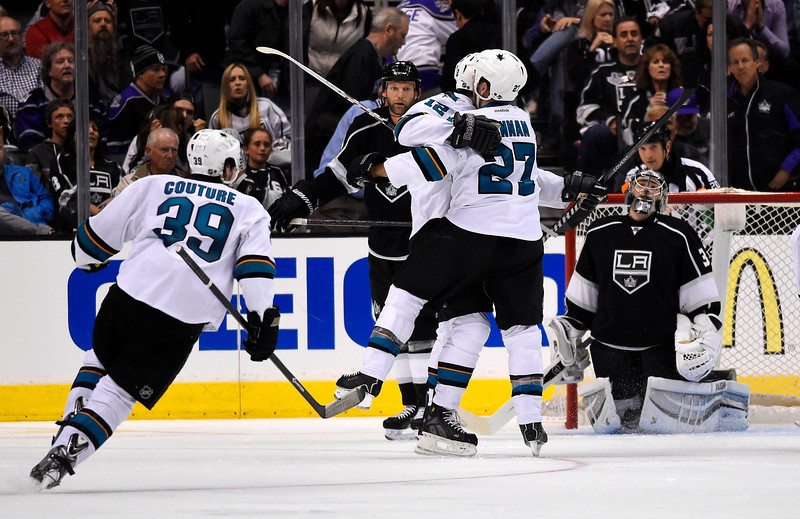
Patrick Marleau, Scott Hannan, Jonathan Quick, Logan Couture

By Mary Walsh

The San Jose Sharks are not the only team to lose a Game Seven in 2014, or even in the first round. Because they began with a three game lead, the loss was considered an upset, a collapse. Other teams who lost in Game Seven when they were expected to win include the Boston Bruins, and the Pittsburgh Penguins.The Bruins were grumpy in the handshake line, the Penguins fired their GM.

The Anaheim Ducks were the regular season Conference champions. They held a lead at one point in the series against the Los Angeles Kings, but they were not strong favorites, especially after the Kings’ first round comeback against the Sharks.

Does a little distance change how we should view what happened to the Sharks in the series against the Kings? Doesn’t it appear that they did not have to make many mistakes to lose to the Kings? Perhaps, but some of the mistakes were ones we have seen before that should have been avoidable.

When the Sharks flagged after the questionable goal that involved pushing Alex Stalock into the net, it was not unlike the 2011 Conference Finals against the Canucks. There, a bad call in the last 13 seconds of the third period left the team flat-footed. The Canucks tied the game and won the series in overtime.

What is this, and how do you fix it? Would making a lot of roster changes do it?

Sharks GM Doug Wilson said the team needs more than a band aid. The problem is that any major surgery takes time.

The first moves announced were actually non-moves. The coaching staff would be retained, Dan Boyle would not be resigned, and Marty Havlat would not be with the Sharks next season. The odds are very slim that this last means anything other than “Havlat will be bought out.” If Wilson were trying to trade him, he probably wouldn’t be announcing it to the media. This would be a first, a difficult first for a GM who has always been careful to not get into a contract he cannot live with.

The other announcement is the oddest of the three: the Sharks will use Brent Burns as a defenseman next season. Yes, he was acquired for that purpose, his contract was negotiated on that basis, he has more NHL experience as a defenseman than as a forward but… he really was a standout forward. He was maddeningly inconsistent as a defenseman.

The choice is not so shocking, but the announcement itself was strange. Was it a way of saying (unbidden) that the Sharks will not pursue a free agent defensemen this summer? Or that they will pursue a top six forward? Did that announcement have any place on the list of “questions people want answered?”

Dan Boyle, in discussing his time with the Sharks, said that the last two seasons were the Sharks’ best. Reminded that they had made the Conference Finals twice before, he admitted that perhaps recent seasons were just more vivid in his memory.

I think he was right the first time. The Pacific Division has become more formidable than it was when the Sharks went to the Conference Finals. The Sharks have been better in the last two seasons, but so has their competition. That means that success is even more about bounces than it ever was.

Bounces cannot be controlled, but the way a team handles them can be. A team’s psychological resilience can be improved by changing the players, but there are not very many players who can step in and hold a team together through a crisis. There may not be any who could do it for all teams.

Would trading Joe Thornton or Patrick Marleau really improve matters? Joe Pavelski? Who? And who do you get to replace them? Keeping in mind some no movement clauses would have to be worked around, who could Wilson get back? Unfortunately, those other players might come with much heavier salary burdens, assuming they could produce as well as any of the Sharks’ leaders, and also fix what ails the team.

That is a lot to expect from some player on some team a Sharks player would agree to be traded to… it is a lot to expect from even two or three players.

Wilson may have the flexibility he wants, but he has not built the team out of an NHL Leggo set. Few successful teams are built like that. You don’t replace pieces, you replace ingredients. Each player has an effect beyond the players to either side of him on the bench. The wrong big move could doom the next few seasons.

Should they move goaltender Antti Niemi? Was he really the weakest link? A better puck-mover would be nice, but every goaltender has his weaknesses. Those with few are rarely available. How much could Wilson get in trade?

Again, would that fix what ails the Sharks? What does ail them?

Composure. This is something the Kings are being praised for. They have rebounded in two playoff series now. Their goalie has recovered from some poor outings to play at his best. Give them credit, they keep their heads.

But do they keep them so much better than the Sharks? If the Kings are such a better team than the Sharks or the Ducks, why did it take them seven games to win those series? Why did they lose so badly to start the playoffs? Perhaps their playing style has to be paced. Playing a very physical game, the sort of game that produces a high injury rate, takes its toll on both teams. Perhaps it takes the Kings a while to work up to it.

Is that what the Sharks need to do, whichever Sharks remain next season? Does that style of play guarantee a win? It has gotten the Kings farther than the Sharks have gone several seasons in a row now. So why don’t more teams emulate the Kings?

Again, why did it take them seven games, twice, if they are so much better?

Maybe the Kings are not a perfect model, they are just one that works for those players with that coach right now.

Those players. Mike Richards spent a good amount of time on the fourth line. He might be a buyout candidate this summer if he cannot return to a top six role. No team is going to willingly give a fourth liner six or seven years at $5.75 million. In the mean time, he posed an enormous threat to opposition, and not because he is so tough or gritty. What distinguished him from most fourth liners is skill.

The Sharks had Mike Brown on their fourth line. They also had Raffi Torres there, with a still very troublesome knee. Had he not been injured, would he have been on the fourth line at all?

The Sharks would do well to look for more skill to go with the grit they have relied on there. They have players who could make up an over-qualified fourth line, if they added one or two top nine forwards…

Yet the coaching staff thought it would be better to try to get Marty Havlat to play there occasionally, instead of moving someone who could do that job (like Tommy Wingels) and keeping Havlat in the roll he was acquired for– a skilled top nine forward. Unless they re-evaluate how they use their assets, it doesn’t matter who the Sharks trade or acquire.

If their roster is so flawed, then significant changes have to be made. That is unlikely to produce quick results. Whether they replace a lot of players or drastically change their style of play, both will take time to adjust to. They probably won’t get off to a quick start, they might be pushing to reach the playoffs at the end of the season. Then, if they stumble again, it can be explained away by too many changes to adjust to in one season.

Not making big changes hasn’t satisfied anyone. It will be difficult now to not make them. It does seem like a shame to waste the one useful thing the team got out of that loss to Los Angeles: a painful shared memory of what they don’t want to experience again.