

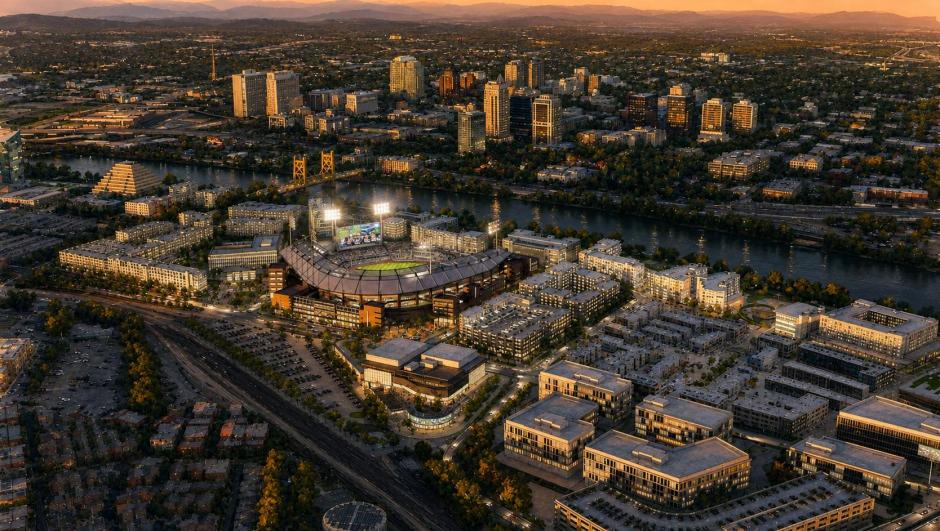
Rendering of the proposed Sacramento Major League Baseball ballpark to be built in West Sacramento that was presented by The Barn in West Sacramento Group during a press conference on Fri May 29, 2026 (Renderings presented by The Barn West Sacramento Group)
By Mauricio Seguura
WEST SACRAMENTO–West Sacramento did not just raise its hand for Major League Baseball on Thursday. It walked to the plate with renderings, money, political muscle, tribal investment, real estate, baseball names, and a message that was hard to miss: this region does not want to be a temporary stopover. It wants a permanent franchise.
The press conference at The Barn in West Sacramento launched the “Sacramento Pitch,” a formal regional campaign to land an MLB expansion team after the Athletics leave for Las Vegas. The speakers included Fulcrum Property founder and Greater Sacramento Economic Council board chair Mark Friedman, Sacramento Mayor Kevin McCarty, West Sacramento Mayor Martha Guerrero, Greater Sacramento Economic Council President and CEO Barry Broome, former MLB manager Dusty Baker, former MLB player Derek Lee, and other civic and baseball voices tied to the effort.
Friedman framed the day as the beginning of a long campaign, saying Sacramento had quietly spent the past year building partnerships, investments, and a stadium vision so it would be ready when MLB opens the expansion door. McCarty leaned into the urgency of the moment, saying the region had announced a local ownership group, laid out financing, and begun making its case.
Guerrero’s message was rooted in West Sacramento’s readiness, arguing that MLB is already seeing the area’s energy, civic pride, and capacity through its current role as host to the Athletics. Baker, a Sacramento-area native and one of baseball’s most respected voices, gave the effort its emotional spine, saying he has long believed Sacramento is a major-league city and pointing to the region’s baseball roots, loyal fans, and growing footprint.
The proposal itself is not a napkin sketch, which is what makes this worth taking seriously. The plan centers on a 35,000-to-40,000-seat ballpark in West Sacramento’s Bridge District, adjacent to the current Sutter Health Park site, paired with a larger mixed-use development of housing, hotels, retail, office space, restaurants, and entertainment.
The broader Bridge District covers 180 acres and is already zoned and entitled for millions of square feet of development, with part of that vision already built. Friedman controls roughly 50 acres, giving Sacramento something several rival markets still have to chase: a site that is not theoretical.
The money stack is also unusually specific for an expansion bid. Local leaders say they have assembled about $1.8 billion in public and private commitments. West Sacramento is expected to provide up to $1 billion through tax increment financing, hotel taxes, and related tools, with officials saying the plan would not affect the city’s general fund or require a taxpayer vote.
The private side includes $250 million each from the United Auburn Indian Community and the Shingle Springs Band of Miwok Indians, plus land and equity commitments from Friedman and the Sacramento Kings/River Cats side, each valued around $150 million. The campaign is also seeking additional limited partners.
But there is still one enormous empty chair at the table: a lead investor. That is the difference between a strong civic pitch and a real MLB franchise bid. Expansion fees are expected to land somewhere above $2 billion, possibly $2.5 billion or more, and MLB will want an ownership group with the financial strength to build, operate, absorb early losses, and still look stable on league letterhead.
Sacramento’s current pitch sets the ball neatly on the batting tee. Now it needs someone wealthy enough to take the swing and hit the ball.
So what are the chances? Better than they were a week ago, but there are still too many obstacles to give a solid assesment. Sacramento has a real case because it has land, public financing, tribal investment, a proven minor-league history with the River Cats, a top-20 media market, a metro population around 2.7 million, and only one existing major pro franchise in the Kings.
The Athletics’ temporary stay also gives Sacramento a live audition no other contender has. The problem is that Nashville, Salt Lake City, Portland, Charlotte, Raleigh, Orlando, Vancouver, and Montreal are not standing around holding bake sales. Some have stronger corporate bases, louder national buzz, or years of expansion groundwork.
Sacramento’s path improves dramatically if attendance for the Athletics strengthens, if a billionaire lead investor emerges, if the city keeps proving it can execute infrastructure without drama, and if MLB truly wants one Western expansion partner.
Two questions that have never been fully addressed, or even seriously considered, are what happens to the River Cats, who have played at Sutter Health Park for the past 25 years, and what Vivek Ranadivé makes of all this. Ranadivé owns both the River Cats and the Sacramento Kings, and the renderings of the proposed new stadium appear to show condominiums on the site where the current ballpark stands, also controlled by him.
For now, Ranadivé has not publicly laid out his position. But it is not hard to imagine that he would be reluctant to give up his ballpark, his team, or a valuable piece of downtown Sacramento real estate without a fight or a significant payout.
The other unanswered question involves the Giants. Let’s be honest: San Francisco has long wanted to maintain control over the Northern California baseball market. Three years of A’s baseball in Sacramento may be tolerable. But what would the Giants say about a permanent MLB team playing just 80 miles east of Oracle Park? And would they really remain passive if that possibility started to look real? Only time will tell, but if anyone can be an effective middleman in those negotiations, it’s Dusty Baker.
The bid is no longer a pipe dream. It is credible.
But credibility only gets Sacramento into the batter’s box. To hit the home run, the city still needs three things: a major investor, strong crowd support, and the kind of polished financial certainty that makes MLB owners stop nodding politely and start paying serious attention.

Whether you’re pre-gaming with the Kings or celebrating an A’s win, Cyprus Grille at the Holiday Inn Sacramento Downtown – Arena is your downtown go-to.
⚡Craft cocktails? Check.
🔥Game-day bites? Oh yeah.
🏟️Steps from Golden 1 Center? You bet.
Open daily, Cyprus Grille is serving up local flavor with a front-row seat to the action. Stop by before or after the game—or make it your new downtown hangout.
Cyprus Grille—where fans fuel up.
📍Located inside the Holiday Inn Sacramento Downtown – Arena @ 300 J Street
Happy Hour – 4pm-6pm
Show your ticket for additional discounts when dining in.

