
From Yankee Blue to Cardinal Red — Roger Maris Gets New Leaf on Baseball Life feature story by Daniel Dullum

Former New York Yankee Roger Maris October 1, 1961 steps in before launching his 61st home run of the 1961 season breaking the single season home run mark held by Babe Ruth since 1927 (WPIX TV 10 New York still)

By Daniel Dullum

Understandably, the seven seasons Roger Maris spent in New York as a Yankee outfielder are the most documented of his 12-year major league baseball career. Breaking a sacred home run record while playing for one of the legendary dynasties of professional sports will do that.

The two seasons Maris spent in St. Louis (1967–68) often seem like a footnote to his more celebrated days in Yankee pinstripes. With the Cardinals, there were no records, no major awards, and the big home run days were behind him.

As it turned out, that suited Maris fine. In St. Louis, he attained personal and professional tranquility, along with two more trips to the World Series.

Maris, who was contemplating retirement after the 1966 season, found a refuge of sorts when the Yankees dealt him to the Cardinals. In the April 29, 1967, edition of The Sporting News, Maris told reporter Neal Russo, “This is a new league, a new park and a new season. Maybe I’ll destroy that home run image. I’m really just a line drive hitter and all I want are base hits.

“I would like to be liked rather than disliked. Just wearing a different uniform seems to have made some difference.”

In his first homestand as a Cardinal, Maris went 8-for-17 (.471) with two doubles and a triple, and the Fargo, N.D., native didn’t have to wait long to find out what kind of welcome he would receive in St. Louis. In his first days as a National Leaguer, the Cardinal faithful treated him to one rousing ovation after another during the season-opening series at Busch Stadium against San Francisco — a far cry from his tumultuous final days in New York.

In his Cardinals debut on April 11, 1967, Maris went 2-for-5 against Giants ace Juan Marichal with a bunt single and a double. Maris told Russo, “The reception was far beyond my expectations. … It was nice to hear a reaction like that for a change. It’s been a long time. I couldn’t believe it was for real.”

Occasionally, a trade can provide a player with a new lease on life. And, for the first time in years, Roger Maris was enjoying baseball.

How Maris wound up in the National League is a story in itself.

Beginning with the successful pursuit of Babe Ruth’s single-season home run record in 1961, baseball in a Yankee uniform had evolved into a high-stress occupation for Maris. From 1962 through 1964, he returned to a level of productivity that was actually much closer to his norm. However, many critics and fans felt otherwise. The criticism stung.

In 1965, a serious knee injury and a broken hand kept Maris out of the lineup for all but 46 games. His 1966 season wasn’t much better, as the hand injury permanently robbed him of any consistent home run power. For that matter, things weren’t going well for the Yankees, either.

By the end of the 1966 season, two years had passed since the Yanks appeared in the World Series, but for the team and its fans, that stretch seemed much longer. A combination of age, injuries, abrupt managerial changes and a surprisingly thin farm system brought hard times to the Bronx Bombers. New York’s sixth-place finish in 1965 (its lowest since 1925) was merely a precursor to further woes.

The slide that began in 1965 reached its lowest ebb when the once-proud Yankees finished dead-last (10th place) in 1966, something that hadn’t happened since 1912 — their final season known as the Highlanders. For an organization that played in all but two World Series between 1949 and 1964, this was uncharted territory.

CBS, which purchased the Yankees in 1964, was not amused, as the team’s descent was a factor in the demise of the network’s “Yankee Game of the Week” for the team’s 1965 Saturday home games. Changes were on the way.

Toward the end of the 1966 season, Michael Burke, a CBS career man, took over as team president. One of his first moves was the fire Hall of Fame broadcaster Red Barber. No one was sure exactly how much Red had to do with the Yankees losing 89 games, but an incident on September 22 may have contributed to Burke’s decision. That was the day 413 fans showed up at Yankee Stadium, and Barber insisted that the TV cameras pan the rows of empty seats.

More changes came during the off season. Lee MacPhail took over as general manager, ex-GM Ralph Houk returned to managing full time, centerfielder Mickey Mantle and first baseman Joe Pepitone swapped positions, third baseman Clete Boyer was traded to Atlanta, second baseman Bobby Richardson retired, as did pitching ace Whitey Ford two months into the 1967 season. Most of Maris’ teammates from the World Series days were long gone.

During that same period, things weren’t quite as bad for the Cardinals, who, after beating the Yankees 4-games-to-3 in the 1964 Series, were stuck in the middle of the National League pack in 1965 and 1966 while trying to rebuild. Ken Boyer, Clete’s older brother and the 1964 NL Most Valuable Player, was sent to the New York Mets for third baseman Charley Smith and Al Jackson — a tough left-hander who was the Mets’ winningest pitcher in their early expansion days.

Smith led the Metropolitans with 20 home runs in 1964 and hit 16 more in 1965, yet neither Smith, Phil Gagliano, Ed Spezio or Jerry Buchek could make fans forget the popular, but declining, Ken Boyer. Their collective lack of offensive output made third base a trouble spot the Cardinals needed to address.

Seeking a solution, one part of the equation had Mike Shannon moving from right field to third base. The other was a proposed deal prepared by General Manager Bob Howsam that would send pitchers Nelson Briles and Steve Carlton, and outfielders Alex Johnson and Bobby Tolan to the Chicago Cubs for All-Star outfielder Billy Williams.

St. Louis sportswriter Bob Broeg explained how the Cardinals chose to solve their dilemma in his article “Musial and Schoendienst: How a Friendship Built a Winner” from the December 1967 issue of Sport:

“As an alternative, Mark Eagleton, a St. Louis lawyer on the ballclub’s board of directors, suggested that if the Cardinals really needed an outfielder, why not try to get one without giving up so much strength? Roger Maris for example.

“Howsam agreed and sent Charley Smith to the Yankees for Maris, making Mike Shannon’s successful conversion almost imperative.”

That was the deal the Yanks and Cardinals agreed to on December 8, 1966 — Maris for Smith, straight up. It turned out the be Howsam’s last good deed before leaving St. Louis for a similar position with the Cincinnati Reds.

Los Angeles Times columnist Jim Murray wrote of the transaction in a March 31, 1967, commentary: “The Yankees didn’t really trade him, they uncaged him … The Yankees had so little of his affection left they were glad enough to get a player named ‘Smith,’ if that’s his real name, for him. Some say they didn’t even ask the fellow’s first name.”

In an April 24, 1967, feature for Sports Illustrated, William Leggett wrote: “After the trade was announced few defended him, but the late Johnny Keane, the deposed manager of the Yankees, was one. ‘I liked Roger Maris,’ Keane said the day after the trade. ‘He is a high-class man who has gone through a lot of injuries. If the Cardinals can get him interested in playing baseball again and he can stay healthy, they will have a heck of a good player — one who can make them a strong team.’”

For the record, Smith never recaptured his power stroke with the Yankees, hitting nine home runs in 1967 and one in 1968 before a knee injury enabled (future Hall of Fame manager) Bobby Cox to beat him out of the third base job. Smith — who also saw duty with the Dodgers, White Sox and Phillies — later drifted on to San Francisco, who swapped him to the Chicago Cubs during spring training in 1969. After two hitless at-bats for the Cubs, he was out of baseball for good following a nondescript Triple-A stint with Tacoma.

Adding further salt to the Yankees’ third base wound, Clete Boyer took advantage of Fulton County Stadium’s cozy fences and clubbed 26 home runs and 96 RBIs in his first season with the Braves.

Leggett addressed the on-field doubts that surrounded the Cardinals in the spring of 1967 in the October 7, 1968 edition of Sports Illustrated:

“With the addition of Roger Maris in 1967, St. Louis went to spring training as a team with an outside chance to win the pennant. The questions were: Could (Red) Schoendienst get the most out of Maris and a shaky pitching staff? What would he do for a third baseman?

“To answer the last first, Schoendienst went to work converting Mike Shannon, an excellent outfielder. There were days when Shannon’s chest was black and blue from the balls that bounced off of it and Shoendienst’s hands swollen from hitting them to him. But in the end, Shannon was a third baseman.”

When Maris joined the Cardinals, his new teammates were understandably curious about the team’s newest acquisition. Their questions, and doubts, were answered quickly.

Left-hander Steve Carlton, a rising star in the Cardinals’ rotation, recalled, “Coming from New York, he had that air of professionalism. We were a bunch of guys playing baseball out in St. Louis, we were the Midwest guys, and we didn’t seem to have that air of sophistication that Roger seemed to bring.

“He was a great leader by example, a good man, and everyone was a friend to Roger on the Cardinals. He was a very good fielder, fundamentally very sound with a really good, above-average arm. He did everything, a very well rounded ballplayer.”

Carlton said that when Maris came to the Cardinals to play the right field position previously occupied by Shannon, the two “became best friends.”

“When Roger came to the team, he was playing right field so Mike Shannon had to move over to third base and learn how to play it; he’d never been an infielder in his life. So here’s Shannon at third base, taking a lot of balls off his chest and learning how to play that position. But Mike was a gutsy kind of a guy, hard-nosed, and he learned how to play it pretty well.”

Shannon said, “We became such good friends when he came over from the Yankees. I got some security by moving to third, but more importantly, I got to meet a fellow that became one of my closest friends, and my dearest friends, and that’s Roger Maris.

“The friendship that developed between us, I’ll remember and hold dear to my heart.”

Among other angles of his TSN report on the Cards’ new rightfielder, Russo addressed what he called “the old tug-of-war’ between Maris and the New York media, saying the writers still insisted that “Maris’ bad attitude was the cause of his difficulties. Rog contends it was the writers’ attitude that caused all the trouble that led to ‘six years of misery.’”

Relief pitcher Wayne Granger, who spent his rookie season with the Cardinals in 1968, was called up in May and found himself wanting to separate truth from fiction when it came to Maris.

“When he played for the Yankees, Roger had the reputation of being a rebel rouser and I thought that about him over the years before I joined up with him in St. Louis,” Granger said. “When I met him, I said, ‘You’re not Roger Maris — you’re too nice of a guy!’ He’s one of the nicest guys I’ve ever met.”

From the book “From Ghetto to Glory — The Bob Gibson Story,” Gibson wrote (with Phil Pepe):

“We all read and heard so much about him. Was he really the brooding, sullen, unapproachable ogre he was made out to be? … Now we would see for ourselves just what kind of monster he was.

“I guess I had a preconceived idea of what he would be like from all the derogatory things I read about him. I expected him to be snobbish. I couldn’t have been more wrong.

“From my personal firsthand experience, I can only say that Roger Maris is one hell of a guy, easy to get along with and a real team player. I think he’s great. He was mistreated and abused so badly he became bitter, but he was not at like that with us. I don’t think he ever got a fair shake from the press when he was in New York.”

Curt Flood was the centerfielder during Maris’ stay in St. Louis. In 1972, Flood wrote (with Richard Carter) “The Way It Is,” a nonfiction work that explained his history-making challenge of the reserve clause, along with his observations of the business of baseball.

Flood said of Maris: “Instead of being lionized (for the home run record), he was represented to the public as an egocentric grouch. Anyone with the dimmest curiosity or sensitivity might have been able to understand Roger’s frame of mind during that pressure cooker of a year. But those qualities were in short supply, and Rog came off with an almost uniformly bad press.

“His problem had been one of trying to maintain personal equilibrium — including his powers of athletic concentration — while being hounded by reporters and fans. To rebuff one reporter was enough to launch chain reactions of outrage. To accommodate all fans and all reporters was physically and mentally impossible. … I think (after hitting 61 homers) he was psychologically incapable of exposing himself to another ride on that particular merry-go-round.

“We were apprehensive about him when he joined us in 1967. Would he fit in? He turned out to be a great guy. He loved the Cardinal atmosphere. He joined our revels with great enthusiasm and although he was a hard-used 33 years old, hampered by the after-effects of many injuries, he was as instrumental as anyone in our victories in 1967 and 1968.”

Russo observed in TSN, “The once glum-faced Maris had a happy spring training. He meshed well with his new teammates, joining them in barbecues and chatting and joking often with them at the club’s motel.”

Dick Sisler, the Cardinals’ hitting coach, told Russo, “I’ve found that a lot of the things written about Roger just don’t hold water. I read that he was a loner and wouldn’t cooperate. But I often see him with the other players and signing autographs politely, no matter where he is.

“People should know that he really is very friendly and warm. He showed great desire to get into shape and have a good year. I think he’ll do it on desire alone.”

Cardinals manager Red Schoendienst concurred with Sisler, “Rog worked hard in Florida in every way. After playing five or six innings, he’d do a lot of hard running and do his pickups. He got into good shape and he was swinging the bat pretty well.”

Leggett reported in the April 24, 1967, edition of Sports Illustrated that when Maris arrived in St. Petersburg, Florida, for spring training, Schoendienst told his new right-fielder, “We know that you are a pro and we know what you can do, because you’ve already proved it. Just get yourself in shape and don’t worry about the hits in the spring. Get in shape. We’ve got a heck of a bunch of guys on this team, and they’ll make it easier for you. Don’t throw hard in the outfield. We’ll leave it up to you, but we want you in the best shape you can get yourself in.”

In a not-so-thinly veiled swipe at the Yankees’ CBS ownership, Maris told Russo in TSN, “I’m happy as a meadowlark. Maybe it’s because baseball men are running things on this club — Red Schoendienst and Stan Musial. But I’ve found a relaxed atmosphere. This seems to be a fairly well-knit organization, closer than most.”

Maris’ new teammates were impressed with more than just his work ethic and easy-going manner. Little things like his baserunning and the ability to break up a double play, or the strength and accuracy of his throwing arm, didn’t go unnoticed. During spring training in 1965, Tony Kubek, the former Yankee shortstop, heard a common observation from many players.

“It was interesting when Roger went from the Yankees and played with the Cardinals on their pennant-winning teams. The next spring (after the ’64 Series), we were down in Florida and saw some of the Cardinal players like Ken Boyer, Dick Groat, Bob Gibson and Mike Shannon. They all said, ‘You know, we knew he could hit home runs. We didn’t have any idea he could run and do all these other things!’” Kubek recalled. “For seven or eight years, he was as good as anybody in the game, and I include the players I played with and against — Mickey Mantle, Al Kaline, Willie Mays, Hank Aaron, Frank Robinson or Roberto Clemente.”

Shannon, a long-time Cardinals broadcaster, felt Roger’s subtle contributions to the St. Louis pennant winners “showed what a ballplayer Maris was,” saying, “he no longer had the power to hit home runs, but what a complete player he was. In the two years he played for the Cardinals, I never saw Roger make a mistake in the outfield. He never threw to the wrong base. I saw him make errors, but I never saw him make a mistake on throwing the ball or playing a guy out of position.”

Granger recalled, “Roger was a great hitter, not just a power hitter. He was a wonderful hitter. He hit the ball to the opposite field, a good defensive ballplayer. He was just aces to me. I was totally impressed with Roger.”

Maris batted .261 in 1967 while playing 118 games in right field — in both cases his best in three years. He had nine home runs, 55 runs batted in, and of the Cardinal regulars, only Lou Brock and Tim McCarver struck out fewer times than Roger’s 61 in 410 at-bats.

“We have a great club and Maris is a great guy. More important, Maris is happy in St. Louis. That’s what counts. I know because Roger has been doing a great job, 100 percent all the time,” Orlando Cepeda, the 1967 National League MVP, said in the January 1968 issue of Pro Sports magazine.

Shannon explained that the top of the St. Louis batting order — leftfielder Lou Brock, centerfielder Curt Flood and rightfielder Roger Maris — was a key factor in returning the Redbirds to the October Classic.

“We had Lou Brock, he’d get on, steal second base. Curt Flood would hit a ground ball to the right side, and then Maris would drive (Brock) in. It was 1–0,” Shannon said. “I’ll bet we started off 50, 60, maybe even 70 games 1–0 in the first inning because of that combination. Maris was the best I’ve ever seen at getting a guy home from third with less than two out.

“Roger had the great knack of being able to pull the ball, he’d have the second baseman back, Brock would score and we’d be leading 1–0.”

A prime example of what Shannon spoke of can be found in the first game of the 1967 World Series at Fenway Park in Boston. St. Louis won the game 2–1 behind Gibson’s pitching and single runs in the third and seventh innings scored by Brock. Both were driven in by Maris — on ground balls to the right side.

The Associated Press preview of the 1967 World Series stated: “Roger Maris, both at bat and in the field, has a wide edge in right field over either Ken Harrelson or Jose Tartabull. Maris’ backup men, Bob Tolan and Alex Johnson, rate on par with Harrelson and Tartabull.

“Who knows what Roger Maris will do in the World Series? But it’s nice to think that Maris will be in it. Just because Maris hit 61 home runs in 1961, people expected too much of him. He joined the Cardinals with a .260 career average, but in the Series, he’ll be the most feared .260 hitter ever to play in one.”

Statistically, the ’67 World Series was Maris’ best:

· His .385 average was a personal high in postseason play and fourth overall in the Series, behind the Red Sox’s Dalton Jones (.389) and Carl Yastrzemski (.400), and Brock’s .414 clip.

· Maris’ seven RBIs, also a personal postseason best, was tops for both clubs.

· In the sixth inning of Game 3, after Brock bunt-singled and moved to third on pitcher Lee Stange’s wild pickoff throw, Maris drove him in with a single to right. In the eighth, Maris scored on a Cepeda double to insure the Cards’ 5–2 win.

· Maris’ two-RBI double (scoring Brock and Flood) and run scored (on a Tim McCarver single) keyed a four-run first inning in Game 4, won by St. Louis 6–0.

· Maris’ sacrifice fly drove in the Cardinals’ fourth run of Game 7 and helped chase Boston starter (and AL Cy Young Award winner) Jim Lonborg in the Series-clinching game. St. Louis won 7–2.

· Roger also homered off Lonborg in the Cardinals’ 3–1 loss of Game 5 at Busch Stadium. Maris’ round-tripper came with two out in the bottom of the ninth.

“Everything about the trade that sent me to St. Louis has turned out great. The trade is the best thing that could have happened to me,” Maris told The Associated Press on October 8, 1967, after Game 4. “After all the abuse I took in New York, it gives me great satisfaction to do well in the World Series.”

Following Game 7, Shirley Povich of The Washington Post wrote: “The Series finally returned Roger Maris to the company of gifted athletes he finally belongs with.

“In all the welter of champagne, shaving cream and beer foam in the Cardinals’ clubhouse, the man dressed hurriedly with the spiked hair is the only one who already has his pass to the Hall of Fame.

“The Cardinals had an edge at several positions, but their edge in right field was the widest of all.”

Maris decided to play another season with St. Louis, but injuries again plagued him early in the 1968 campaign. With Bobby Tolan and Ron Davis filling in at right field, Maris’s timely pinch-hitting helped get the Cards rolling toward a second consecutive National League championship. However, as Flood observed in “The Way It Is,” Maris was “a hard-used 33.”

Though his batting average dipped only six points (to .255), the cumulative effect of a career’s worth of injuries had finally taken its toll. Maris played in 100 games in 1968, 84 of them in the outfield while hitting five home runs along with 45 RBIs. He announced his retirement, effective at the end of the season, on August 5.

Maris said he decided to make his announcement before the end of the season because “I did not really care to be bothered by the press after this season.”

The Cardinals went on to win the last National League pennant prior to divisional play, finishing with a nine-game lead over second-place San Francisco. Before the ’68 World Series against the American League champion Detroit Tigers, Frank Skaff, a Tigers scout, told Bob Addie of The Washington Post, “As for Roger Maris, we think he’s lost it. We plan to jam him — although he still can be dangerous.”

As a pinch-hitter in the ninth inning of Game 5 at Tiger Stadium, Maris struck out with two on in a 5–3 loss to eventual Series MVP Mickey Lolich. However, Maris did have his moments, like when he scored two runs in the Redbirds’ 7–3 win in Game 3.

In a 13–1 loss to Detroit’s 31-game winner Denny McLain in Game 6, Maris was 2-for-4 and scored the only St. Louis run. Roger’s ninth-inning hit off McLain turned out to be the last of his career. Playing in six of the seven games, Maris hit .158 with one RBI in the ’68 Fall Classic.

Detroit battled back from a 3-games-to-1 deficit and defeated the Cardinals 4–1 in Game 7 at St. Louis. Maris played right field, batted sixth, and went 0-for-3 against Lolich in his final major league game.

And while the Tigers celebrated their triumph on the Busch Stadium infield, Roger Maris quietly hung up his uniform for good on October 10, 1968, bowing out with two National League pennants and a World Series championship in two seasons as a Cardinal. In 12 major league seasons, Maris played in seven World Series.

When Maris announced his retirement two months earlier, he said of his stay in St. Louis, “It’s a pleasure playing where people like you. These were probably two of the most enjoyable years of my career.”

Daniel Dullum hosts Headline Sports each Sunday at http://www.sportsradioservice.com
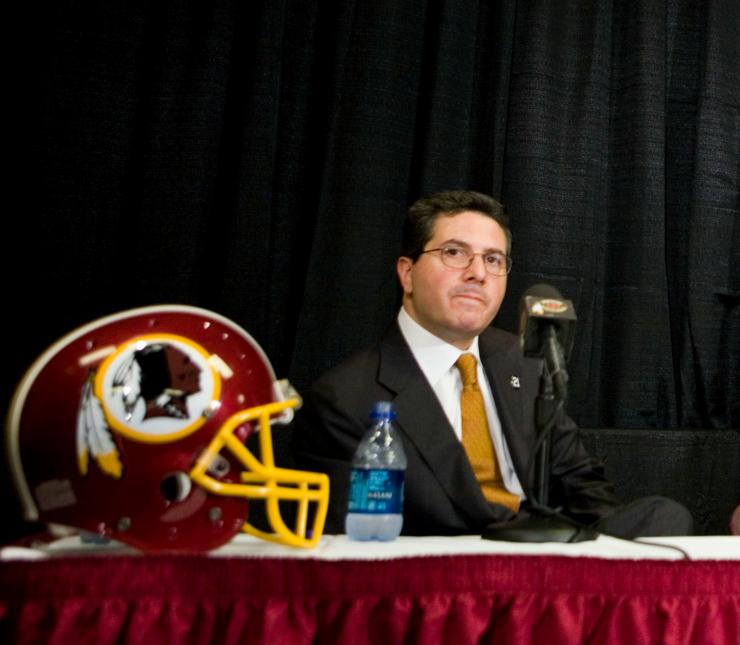
Headline Sports podcast with Jessica Kwong: Redskins won’t change racist name but will remove founding owner’s racist memory

Washington Redskins owner Dan Snyder won’t change the racist name of his team but has removed all memory of former founding owner George Marshall because he didn’t integrate until 1962 (file photo: fanedge.com/Washington_Redskins)

On Headlines podcast with Jessica:

#1 The Washington Redskins won’t change their racist team name but they did remove the name of one their former racist owners George Preston Marshall who was the founding owner of Washington. Marshall didn’t allow a black player on the team until 1962 he was the last owner to integrate in the NFL.

#2 Washington removed Marshall’s statue from outside of RFK Stadium and removed his name out of Washington’s Ring of Fame. His name was also removed outside of Washington’s locker room called the “Redskins History Wall” at the team’s training facility.

#3 Washington said the would retire their second number in team history No.49 Bobby Mitchell who was the first black player to play for Washington.

#4 While all these gestures are in line with what’s politically correct what about changing the team name from Redskins to something else?  Washington has been stalling on a name change team owner Dan Snyder says he has no intention of changing the name and said the name is out of respect and honor for Native Americans. 49% Native Americans polled beg to differ saying it’s derogatory and demand the name be changed.

#5 Washington DC Mayor Muriel Bowser said that the city will not go forward to get behind a new stadium effort for Washington until the team changes it’s name. That said Snyder still refuses to budge as the team is currently playing outside of DC at Fed Ex Field in Landover MD.

Jessica does Headline Sports podcasts every other Thursday  at http://www.sportsradioservice.com

Headline Sports podcast with Jerry Feitelberg: Tigers and A’s setting up camp at home parks in Detroit and Oakland; Lets take a look

Comerica.ticketoffice.org file photo: Comerica Park in Detroit will be welcoming back the Detroit Tigers as workouts start June 26th and the regular season begins July 3rd

On Headlines pod with Jerry F:

#1 The Detroit Tigers were wasting no time as they will open up Comerica Park in Detroit to players and staff, no media and fans were allowed access on Wednesday July 1st. It was spring training take two as Tigers general manager Al Avila is bringing the team back from Lakeland Fla.

#2 The Alameda County Health Care Services said on Monday that the Oakland Coliseum is ready for use and the A’s will be bringing the show back to Oakland but with no fans in the park.

#3  In a statement from the A’s HCSA director Colleen Chawla “We are pleased to share that the A’s may resume operations and on-field practice as of June 26, 2020, and games without spectators may commence after July 3, 2020.”

#4 Although the Tigers and A’s are ready to throw around the old horse hide there is another side of caution at hand with the Colorado Rockies Charlie Blackmon and other Rockie players coming up positive for Corona also Philadelphia Phillies staff members and players also came up positive. Three teams have closed their training facilities the Toronto Blue Jays, San Francisco Giants and Phillies.

#5 MLB is developing safety guidelines for staff, stadium personnel, players, coaches, managers, equipment and medical staff the basics, facemasks, six feet apart, and lots of handwashing.

Jerry joins us each Thursday for Headlines podcasts at http://www.sportsradioservice.com
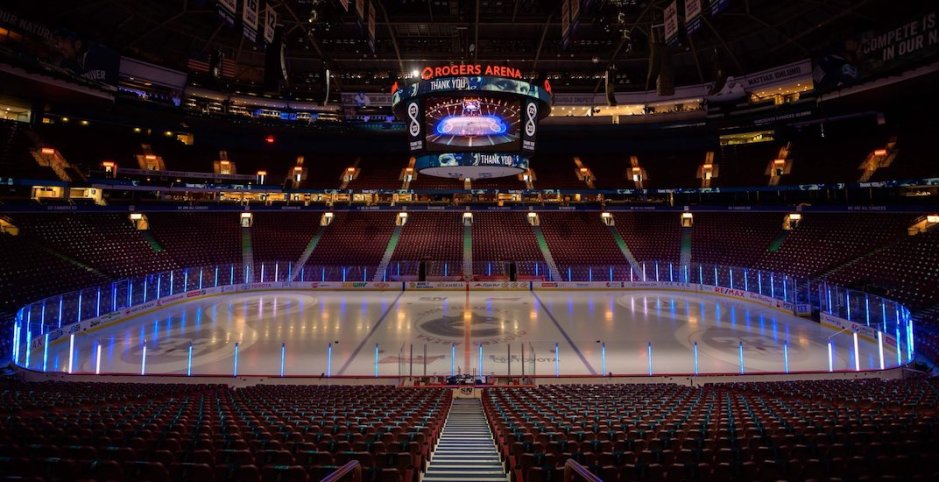
Headline Sports podcast with Marko Ukalovic: As NHL players were coming back to train so were the Covid test results; Hub city choices stand at seven; plus more

Vancouver’s Roger’s Center stands by as a hopeful out of six cities in the running for a shot at being a hub city for the Stanley Cup Playoffs (dailyhive.com file photo)

On Headline Sports podcast with Marko:

#1 The NHL has found that 11 more players who have tested positive for Covid-19. While the NHL was opening practice facilities, as the players were coming back so were the test results.

#2 Seeing that 11 players came up positive how much further could this push back the NHL schedule?

#3 The NHL is down to just seven cities to chose from as playoff hubs from the original ten. Pittsburgh, Columbus, and Dallas were eliminated leaving Chicago, Edmonton, Las Vegas, Los Angeles, Minneapolis, Toronto and Vancouver. It was reported that Vancouver and Las Vegas were selected but the NHL denied such rumors.

#4 The NHL is very happy that the Canadian government has waived the 14 day quarantine requirement and will allow teams to come and go for the playoffs. The three cities in the running as a hub city Edmonton, Vancouver and Toronto.

#5 Fans and media have been commenting about the practicality of opening the camps followed by the playoffs saying because of the rapid rise in Corona cases it would be best to try and start pre season followed by the regular season in September and October.

Marko joins Sportstalk each Wednesday night for Headline Sports podcasts at http://www.sportsradioservice.com
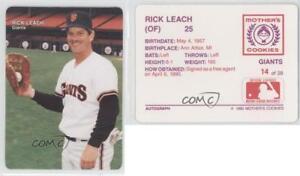
 

He was a Giant? Feature on former Giant Rick Leach by Tony the Tiger Hayes

Rick Leach former San Francisco Giant on his 1990 Mother’s Cookies baseball card (ebay photo image)

HE WAS A GIANT?

Rick Leach – OF/1B – 1990 – # 25

By Tony the Tiger Hayes

In 1990, the “San Francisco Treat” didn’t just refer to the family of tasty Rice-A-Roni dishes, it also described the City’s gourmet collection of quarterback talent.

That season a pair legendary Hall of Famers: Joe Montana and Steve Young, topped SF’s depth chart. Waiting deeper in the wings was the athletic passer Steve Bono.

But Candlestick Park was also home to another record setting signal caller whose college career rivaled all three of those Forty Niners QBs.

This south-paw passer was a four-year Michigan starter, Sports Illustrated cover boy and noted Ohio State killer: Rick Leach.

A college contemporary of Montana, Leach choose to persue a pro baseball career after leading the Wolverines to three straight Rose Bowl appearances in the 1970s.

In a backup role for the Giants in ‘90, Leach batted .293 in 78 games before abruptly leaving the club under a cloud of suspicion in mid-season.

Why Was He a Giant?

After seven checkered seasons in the American League – he went AWOL from a couple of teams – the Giants took a flyer on Leach after Atlanta released him in spring training of ‘90.

Before & After

Leach was the rare athlete whose lengthy big league career was considered an after -thought to his amateur completion in another sport.

Leach will forever be known first and foremost for his quarterback play at Michigan from 1975-78 when he led Big Blue to three consecutive Big 10 Conference Championships.

Though he went 0-3 in the Rose Bowl, Leach is an icon in Ann Arbor because of his ability to beat bad blood rival Ohio State. Leach compiled a 3-1 career record vs. the Buckeyes.

Though he dominated on the collegiate gridiron, Leach was considered an even better pro baseball prospect.

Along with fellow Michiganensian Kirk Gibson – who starred at the same time in both football and baseball at Michigan State – Leach signed with the home state Detroit Tigers in 1979.

Though he never reached star status on the diamond, Leach was a serviceable back-up, compiling a career average of .268.

He was actually having one of my his best MLB seasons with SF when he suddenly vanished with a puff of smoke in early August of ‘90.

Actually that may have been the problem. After one of his previous unexcused absences with Texas, authorities discovered a stash of weed in his hotel room.

On 8/7/90 it was announced that Leach had failed a league mandated drug test and was suspended 60 games – effectively ending his season – and as it turned out his baseball career.

He Never Got His Own (Giants) Bobblehead. But…

After Giants opening day starting RF Kevin Bass was shelved with knee surgery in late May, Leach became the Giants de facto starting RF for a spell.

He was particularly adapt at hitting in difficult Candlestick Park, batting .341 there, a full 100 points better than his road average.

In a 7-3 home shellacking of Houston (6/3/90), Leach tied a career high with four hits, going 4-for-5, with an RBI.

Later, in back- to -back 4-3 home wins over division rival Cincinnati (7/26-27/90), Leach bashed a HR in each contest- his only long balls for the Orange & Black.

He socked a two-run dinger off Jose Rijo in the first game and ripped a solo round-tripper off Scott Scudder in the later.

Giant Footprint

Leach was a productive and popular Giant, making it all the more difficult for the club when it was announced he was suspended for the remainder of the ‘90 contests season.

“This is a real shock. He’s devastated,” said Giants manager Roger Craig. “He’s done so much for us. He’s been a real leader. We’re going to have to pick up from here.”

A year after winning the NL pennant in 1989, the Giants would finish third, six games behind Cincinnati.

Leach was with the Giants in spring training in 1991, but was a late cut. He never played organized ball again.

Tony the Tiger Hayes does He was a Giant? features at http://www.sportsradioservice.com
That’s Amaury News and Commentary: Exclusive Interview with Manny Sanguillen

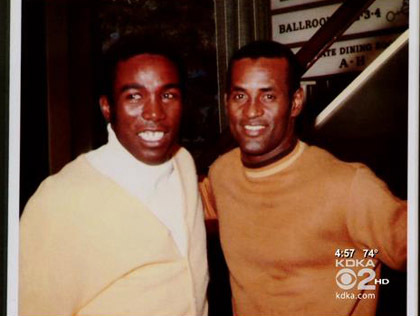
KDKA CBS 2 Pittsburgh file photo: Pittsburgh Pirates catcher Manny Sanguillen (left) and rightfielder Roberto Clemente (right) pose for a photo in the glory days of the 1970s their best years in Pittsburgh

Exclusive Interview with Manny Sanguillen

That’s Amaury News and Commentary

By Amaury Pi-González

Back in the 1970’s when he was catching for the Pittsburgh Pirates, Manny Sanguillen, Roberto Clemente and Willie Stargell walked into a Howard Johnson and could not get service, They were a couple of hours late to Spring Training that day in Ft Myers, Florida.

This is one of the many stories told to me by a man born in Colón, Panamá, an excellent catcher for 12 seasons in the major leagues, 11 of those with the Pirates and one, in 1977 with the Oakland Athletics. He ended his excellent career with a solid .296 batting average (something not common these days) especially for a catcher,  Sanguillen was selected to three All Star games and won the 1971 World Series when the Pirates defeated the Baltimore Orioles.

Sanguillen was one of the best catchers in major league baseball during the 1970’s his lifetime average was higher that Hall of Fame catcher Johnny Bench. The Pirates catcher was a contact hitter and an integral part of the success by the Pittsburgh teams of that time.

As a contemporary of Manny Sanguillen, I remember interviewing him when he played for the Athletics in 1977, he always had a kind smile great attitude and very proud of his Panamanian roots. Living now in Boynton Beach, Florida, he was very gracious and courteous when I called to talk to him. “I had my friends in Oakland when I played there, like Vida Blue and Billy North” he said. My friends in the media that also covered Sanguillen, all tell me he was very good with the media in the bay area.

Sanguillen, like many other Latino players suffered discrimination and humiliation, when I asked him about the years in Pittsburgh where Clemente and the media did not get along, as he would complain of being misquoted by newspapers, Sanguillen told me “Yes, that was true, they just didn’t like him because some were racist” The 76-year old catcher told me about himself and his career in Pittsburgh “they wanted me fired, there were always rumors that I was going to be traded, at that time there were very few Latino catchers”. (He paused) other catchers like Eliseo Rodríguez and Paul Casanova”

About the story that he was going to Managua, Nicaragua, with Roberto Clemente on that DC-3 chartered plane Clemente was taking a loaded plane with help for the victims of that earthquake, he said that was not true. But he did talk to Roberto before he left from San Juan, Puerto Rico, but Sanguillen tells me he was not planning to go, Clemente had a lot of friends with him, he was always surrounded by people. He learned about the plane crash from Luis Mayoral, a veteran sports journalist and broadcaster born in Puerto Rico.

Manny Sanguillen “Clemente told me once, if we make it to a World Series, I will take care of everything”. He did, in 1971 Clemente hit .411 won the World Series MVP like Bill Blass, who pitched a complete game seven to clinch it for the Pirates said after the game about Roberto: “Clemente did it all”.

He talks about his three All Star Games, like the one in Atlanta in 1972 when he was hitting behind Billy Williams: “I got a single to centerfield against pitcher Wilbur Wood advancing Williams to third.” His memory is sharp as a tack. He has not played since the late 70’s but he remembers stuff like it was last year.

Like many Latino players he had to handle the discrimination that did not go away after Jackie Robinson broke the color barrier in 1947. He played in the 1970’s and still, like former A’s outfielder Tony Armas once told me “for us Latino players, we have to be twice as good as a white player to prove ourselves here.”

I asked Sanguillen about what Armas told me back then and he told me Armas was correct. Orlando Cepeda once told me that when he arrived in the major leagues, there was a pecking order; the White players, then the African-American players and then the Latino players, we were at the bottom of the totem pole, not only because of skin color, but also the language barrier”.

Born in Panamá, he is friends with three of the most famous athletes in that country – three institutions. “I talk to Rod Carew with frequency, saw him in Miami, as far as Mariano Rivera he lives in Panamá and I do not see him as often, Roberto Durán, yes I see him”

Manny Sanguillen is part of the great tradition of Latin American ballplayers in the major leagues. Manny is an Evangelical Christian and although he only played with the A’s for one season he left many good memories and friends here in the Bay Area, during a time where the number of Latino players was not as it is today, which is close 30 percent of all players.

Sanguillen was inducted into The Hispanic Heritage Baseball Museum and Hall of Fame/ His good friend Roberto Clemente not only has a statue at PNC Park, but also a bridge in Pittsburgh named the Roberto Clemente bridge. Not many superstars have a bridge with his name on it.

Muchas gracias a Manny Sanguillen por la entrevista, espero que siga bien con su buen humor, muy positivo con esa gran sonrisa tan contagiosa.

Thanks to Manny Sanguillen for the interview, hope he stays well, with his good humor his positivism and that great contagious smile.

Stay well and stay tuned.

Amaury Pi Gonzalez is the vice president of the Major League Baseball Hispanic Heritage Museum and does News and Commentary each week at http://www.sportsradioservice.com
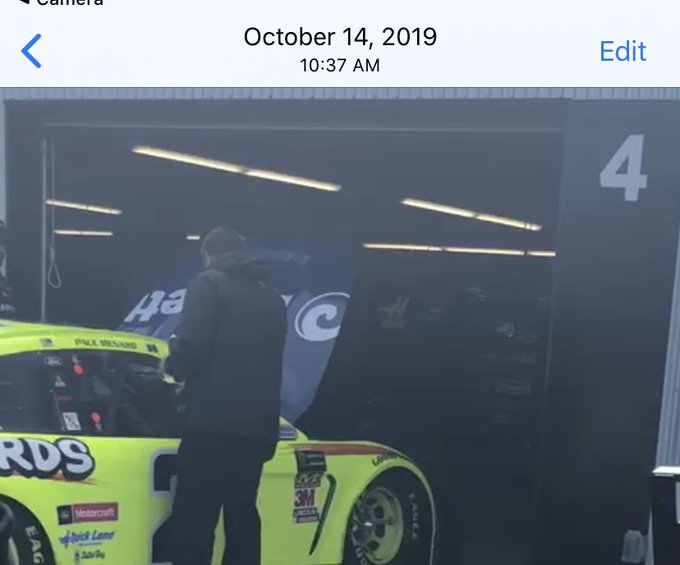
Headline Sports podcast with Barbara Mason: Calif Legislature looking into legalizing sports betting;Wallace insists rope was noose (see photo) ; plus more

@bobpockrass photo: NASCAR’s only black driver Bubba Wallace’s crew member found a noose in his garage stall on Sunday night. Wallace had pushed for banning the Confederate flag symbols at NASCAR races. The FBI concluded from video evidence that the noose had been at stall number four since October 2019 long before Wallace was booked for that stall last weekend it was later determined it was not a noose but a door pull. Wallace on Don Lemon Tonight on CNN said he knows what a noose looks like adding, “tied in 2019 or now it was a noose.”

On Headline Sports podcast with Barbara:

#1 California Legislature is considering legalizing sports betting but casinos are putting up a fight as it would cut into their sports book business.

#2 Bubba Wallace NASCAR’s only black driver who two weeks ago pushed for banning the Confederate flag at NASCAR events. A member of Wallace’s crew found a noose in his garage stall late Sunday afternoon. After bringing in 15 FBI agents for an investigation into who left the noose in garage stall four where Wallace was at Talladega. Video evidence showed that the noose had been there since October 2019 and it was determined it was not a noose but a door pull.  No one would have known that Wallace would have been at that stall going forward. The FBI said they will not pursue federal charges. Wallace insisted on CNN’s Don Lemon Tonight on Tuesday night that it was a noose.

#3 Webb Simpson won the RBC Heritage on Sunday after finishing 7 under Par 64 at Harbour Town at Hilton Head Island in South Carolina.

#4 Tiz the Law set a record winning the Belmont Stakes last Saturday in what is one of the few live sports in the Coronavirus era. Tiz the Law with his victory became the first New York bred horse to win at the Belmont in 138 years.

#5 After someone who visited the San Francisco Giants training facility in Scottsdale who was Covid-19 positive the facility was immediately shut down on Friday night. The person was a family member and several other individuals are being tested who had come in contact with this positive tested person. Teams who have closed facilities Toronto Blue Jays, Philadelphia Phillies and the Giants.

Join Barbara for Headline Sports each Tuesday night at http://www.sportsradioservice.com
That’s Amaury’s News and Commentary: MLB Final Score – Both sides Lost; Opener set for July 24th

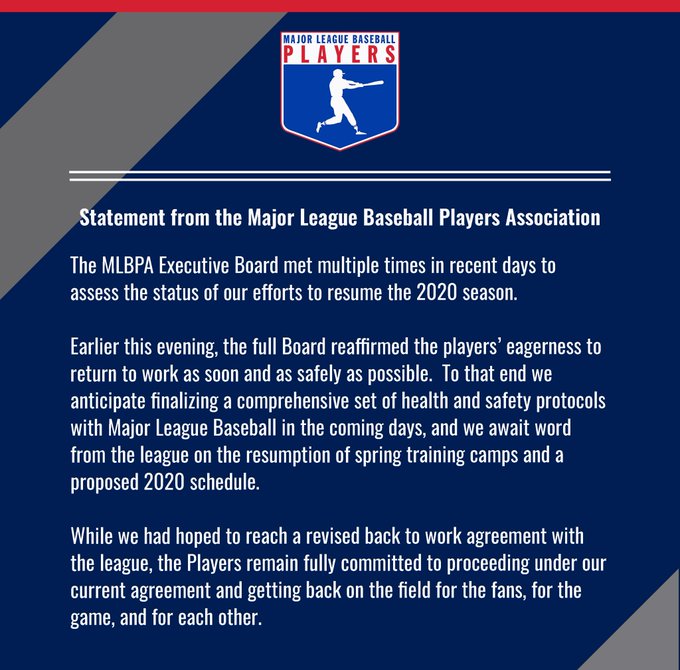
Statement from the Players Association saying their prepared to get back to work July 24th. The players will be getting their full prorated pay. The season will last for two months and a week prior to the post season starting in October (MLB Players Association image)

MLB: Final Score – Both sides Lost; Opener set for July 24

That’s Amaury’s News and Commentary

By Amaury Pi Gonzalez

There will be baseball. An abbreviated regular-season starting by the end of July and ending by the end of September. The only hurdle left is the unpredictability of this Covid-19 virus. Because of the history of the two protagonists, you could have predicted the final result. And there is no winner here. If you believe there was a winner then you are a great candidate to buy beach front property in Tennessee.

Anybody that loves this game, now feels like when you wake-up the morning after with a terrible hangover after a party, that was not really what you where hoping for. Unlike other sports, a game that ends in a tie is not part of the game of baseball (for now anyway) and after three months of negotiations just regurgitated all the distrust between both sides, we are going to play for about two months and a few days, plus playoffs.

In a season of this kind, teams like the Seattle Mariners, who have never won a World Series since their franchise was born in 1977, have the best chance. Ironically the Mariners last year had a 13-2 start; something very rare in baseball history, they were the 17th team since 1900 to win at least 13 of their first 15 games. If they repeat such start during a season of some 60 games, they might just do it.

Hopefully the two month and a week season will go without a hitch, since the navigation would be a virus that is still without a vaccine.

Nobody won. At the end, there was an even bigger loser than the owners, players, and the fans.

Stay well and stay tuned.

Amaury Pi Gonzalez is the vice president of the Major League Baseball Hispanic Heritage Museum at the Oakland Coliseum and does News and Commentary at http://www.sportsradioservice.com
That’s Amaury’s News and Commentary podcast: Cepeda’s daughter in law says former Giant slugger no longer competent; Cepeda says he can make his own decisions

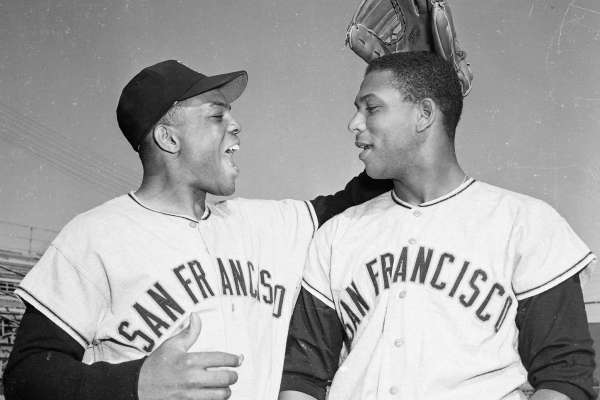
Former San Francisco Giants centerfielder Willie Mays (left) and first baseman Orlando Cepeda (right) from their playing days. Cepeda is the center of a family legal battle over his financial affairs with his daughter in law Camille who is seeking conservatorship of Cepeda and Cepeda says he does not have dementia (San Francisco Chronicle file photo)

On That’s Amaury’s News and Commentary podcast:

#1 Recently former San Francisco Giant first baseman and Hall of Famer Orlando Cepeda has been marred in a legal battle with his daughter in law Camille Cepeda who says she should be the authorized conservator of Cepeda’s financial and medical affairs.

#2 Camille who is married to Cepeda’s son Ali and Ali’s brother support Camille’s attempt to win conservatorship because they claim that Cepeda no longer can care for himself, a petition says Cepeda has dementia. Ali’s two other brothers stand with Cepeda.

#3 The petition goes onto to say that Cepeda no longer is able to provide for his personal needs and needs help with food, clothing, shelter, physical health and is at risk to be influenced.

#4 Cepeda’s attorney responded to Camille’s petition saying he was able to make his own decisions medically, physically. That his lawyer continued saying that Cepeda had a recent psychiatric evaluation twice the last one May 21st and that it was concluded that the former Giant-Cardinal slugger can make medical choices and financial decisions on his own.

#5 The timing of Camille’s request for conservatorship is under suspicion according to Cepeda and that Cepeda says there are “numerous shocking, unauthorized charges” made by Camille on Cepeda’s financial accounts, including luxury items from Louis Vutton, Nordstrom, wine club memberships and car rental payments all totaling $15,000 just for the month of December.

Amaury Pi Gonzalez is the Spanish play by play talent for Oakland A’s radio on 1010 KIQI San Francisco and does That’s Amaury News and Commentary each week at http://www.sportsradioservice.com
That’s Amaury News and Commentary: MLB Two Month Season or No Season

MLB logo image from wamc.com

MLB Two Month Season or No Season

That’s Amaury News and Commentary

By Amaury Pi-González

The clock has ran out.

Today MLBPA voted against the 60-game season proposed by the owners, by a vote of 33-5. Now the Final, REAL FINAL decision rest in Commissioner’s Manfred’s next announcement. By fiat he can set the schedule for a season, which will be around 50 games, basically two months of baseball. Or he can opt on cancelling this Soap Opera and saying, No season, for reasons he will then explain. There are owners that are fine with no season at all, it is a minority, but now that the players rejected the last pitch by the owners, others might join in the cry to cancel 2020.

The wild card continues to be Covid-19. Is it going to comeback in the fall or not? There are many opinions on that, depends who you listen to, but even the “experts” in science who study this stuff for decades have already contradicted themselves. This is no secret and is for everybody to see. But, in this subject both sides agree. There is a possibility the season begins and then has to be stopped because the cases of Covid would continue to rise and players will have contracted the virus.

If Manfred announces the shortened season, he must guarantee the security and well-being of the players. If he makes the decision to play this year, then the Players Union have the right to file grievance, mostly alleging that the owners did not negotiated in good faith.

I am sure there will be re-runs of this very sad exercise between owners and players, from the time MLB stopped Spring Training to the day and time Mr. Manfred makes his final decision. It would be documented and recorded in history as not one of the great moments for the National Pastime.

Season or no season, baseball has hurt themselves like never before. The old saying “timing is everything” could have not been more accurate in 2020 as MLB and MLPBA battle for two months and will come down to one of two very sad decisions.

Stay well and stay tuned.

Amaury Pi Gonzalez is the vice president of the Major League Baseball Heritage Museum located at the Oakland Coliseum and does News and Commentary each week at http://www.sportsradioservice.com