World Baseball Classic: Columbia edges Mexico 5-4 in Phoenix

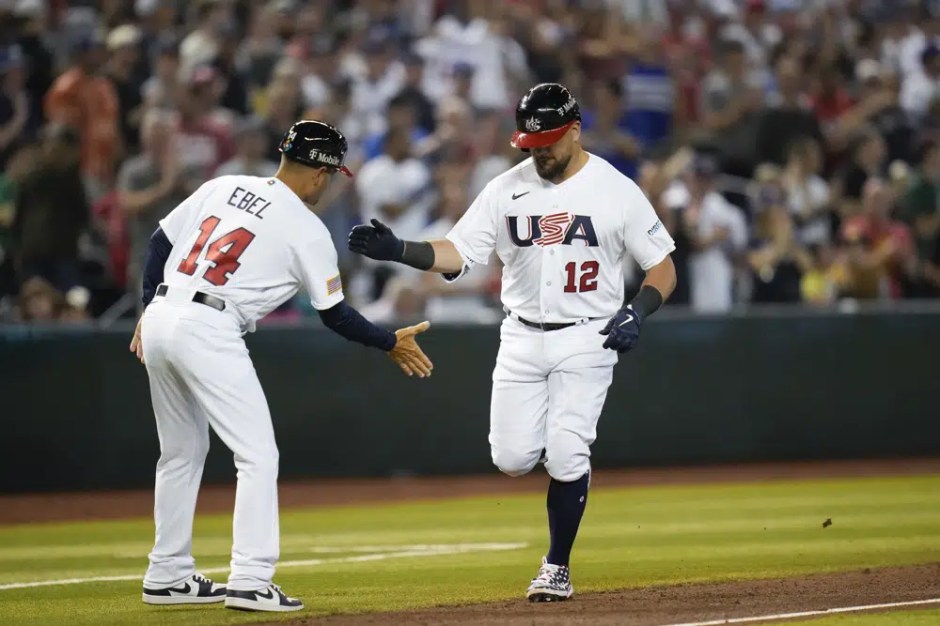
Colombia just gets by Mexico in the World Baseball Classic on Sat Mar 11, 2023 at Chase Field in Phoenix (mlb.com image)

Colombia vs. Mexico

Colombia 5 7 1

Mexico 4. 9. 1

Sat Mar 11, 2023

By Lewis Rubman

PHOENIX–Oscar Mercado fouled off Julio Urías’s first pitch at 12:38 Mountain Time this warm and sunny Saturday afternoon under the closed roof of Chase field signaled the opening of the long awaited start of the 2023 World Baseball Classic in the western United States.

The Dodgers stellar southpaw would go five innings for Team Mexico against Colombia, the other Latin American entry in Group C ,before giving way to Luis Cessa.. Urías hurled 62 pitches, 19 of which were balls, allowing three runs, all of them earned, on there hits, one of them a homer, and striking out six,in what proved to be a stunning extra inning win for Colombia, who defeated the favored Mexicans in 10 innings, 5-4.

Colombia used seven pitchers, with righty Guillermo Zúñiga, who hurled the last two frames getting the win. Mexico sent five men to the mound, and the loss went to Jesús Cruz, who lost because of circumstances beyond his control in the tenth, the only frame he pitched.

Urias didn’t allowing a base runner over his first four frames. And thens roof fell in. Back to back doubles by Jorge Alfaro and Elias Diaz brought in the former and a 342 round tripper over the left field fence off the bat of Elias Diaz gave the Colombians their second and third scores. The bottom third of lineup then went down in order.

Colombia’s skipper Edgar Remteria and pitching coach Walter Miranda entrusted his teams fortunes to Nabil Crismatt, a righty who’s pitched for the Cardinals and Padres, going 5-2, 294 for San Diego last year. He pitched well out of the gate.

Although he couldn’t match Urias’s perfect performance over the four opening frames, Colombia’s starter shut out he Mexican squad over 3-1/3 innings, allowing only one hit, a double to right center by Randy Arozamena in the first that showed that, in spite of the success the the visitors would owe to a that play,

The Curse of the Led Off Double applies to the WBC. But then, Mexico broke through in the home fourth on a single lead off single to center by Joey Menenses, who advanced to second on Rudy Téllez’s bouncer to the mound and scored on Isaac Parades’s double to center.

Crismatt gave way to Jhon Romero as soon as Mexico came up in the bottom of the fifth. Crisatt had thrown 57 piches, 34 strikes, over his four inning stint, during which he allowed one run, which was earned, on three hits and struck out an equal number of Mexico’s batters, while walking one.

Romero lasted a mere 2/3 of an inning, blowing his inherited 3-1 lead on a 389 two run blast into the left field seats by first baseman Reynaldo Ramirez. The reliever threw 18 pitches, 10 for strikes, yielding one walk on two hits. Both of the runs he allowed were earned. Adrían Almeida replaced him to get the third out and returned to the mound for the sixth. He escaped damage in that frame thanks to an inning ending 6-4-3 twin killing.

Both teams pushed a man across the plate in the seventh. Colombia did it on a single by Reynaldo Rodgríguez plated Jorge Alfaro, who had doubled. They would have scored more if it hadn’t been for a beautiful around the horn double play started by Isaac Paredes’ grab of a hard grounder down the line by Jordán Díaz of the Oakland Athletics.

Mexico re-tied that score on Alex Verdugo’s single to center that drove in Aleck Thomas, who also had reached on a single to center and gone to second on another safety by Austin Barnes. The run was charged to Reiver San Martin, although it was Pedro García suffered Verdugo’s punishing blow.

Colombia scratched out a run in the top of the tenth off Jesús Cruz. Zombie runner Alfaro advanced to third on Díaz’s fly to right .Mexico conceded a walk to Rodríguez.

Jarren Durán pinch ran for emplaced runner Verdugo. Meneses struck out swinging. Téllez flew out to left, and Paredes was called out on strikes, the last one of which was questionable.

Great Britain will play the United States at 7:00. If the visitors pull off a win, THAT would be an upset!

World Baseball Classic: How rule changes impact the WBC

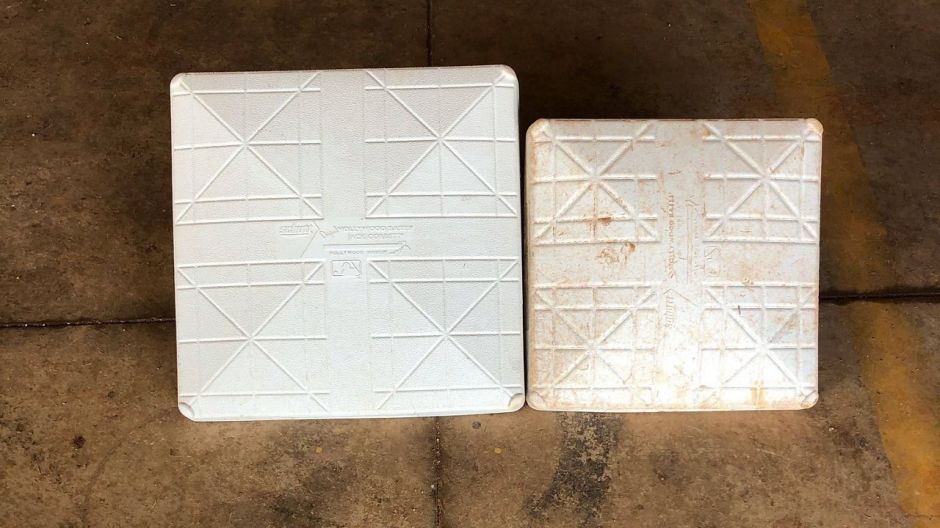
Part of the new rule changes include the larger base shown with the former smaller base (photo by spectrumnews1.com)

Fri Mar 10, 2023

By Lewis Rubman

If you thought the new MLB rules were hard to digest, you were right, but you’ll still have to process a few more in order to understand what’s happening in this year’s World Baseball Classic.

We’ve already looked at the rules for team grouping and seeding as well as those governing player eligibility, so we can skip them. We also can skip the rules concerning the makeup of roster, MLB vetoes of player participation, and the various types of leaves players can be granted. We should note, however, the importance of team rankings in the determination of home and away teams.

  • The first seed will play three games as the home team and one as the visitors. • The second, third, and fourth seeds will be the home team for two games each. • The fifth seed will be the home team for one game and the visitors to all the others.

Ties in the standings will be broken based on the following criteria, in this order of priority: • The tied teams won-lost record against each other. In case more than two teams are tied and one of them beat all the others, that team will be placed above them. Likewise, a team that lost to all the others would be placed at the bottom of the list. • The teams will be ranked according to the ratio of runs and defensive outs between the tied teams during the round. Needless to say, the team with the lowest ratio goes to the top of the list. • This criterion is the same as the previous one, except that the ratio will be earned runs per defensive out. • Team batting average in the round against the teams that still are tied. • Drawing of lots.

The games will be played according to the 2022 rules–the statement released on MLB.com doesn’t say whose 2022 rules– with a few of what MLB calls “supplements.” They are: • The three batter or to the end of the inning minimum for relief pitchers will be enforced. • Mound visits won’t be limited. • The DH rule will be in effect. • MLB’s replay rule will be followed unless the WBC decides otherwise and gives the teams prior notice of the change. One change, announced a few paragraphs after this declaration, is that two replay challenges per game will be allowed in the championship round and one per game in all the other rounds.

  • The new rules on pitching time limits, the size of bases, and the positioning of infielders will not be applied. • If a pitcher has thrown 50 or more pitches, he won’t be allowed to pitch for at least the next four days. • For 30 or more pitches, he must wait a day before his next appearance on the mound. • A pitcher cannot work for more than two consecutive dalys. • The pitch limit per game in the first round is 65. It goes up to 80 and 95 in the following two rounds. Pitchers will be allowed to exceed those limits if it’s necessary to complete a batter’s plate appearance. • Pitches thrown in “for the purpose of effectuating an intentional walk” don’t count. What ever happened to the 2022 rule on declared intentional walks? • The zombie runner rules for extra innings will be in effect. • The official scorer will determine who is the winning pitcher.

Got that?

World Baseball Classic: First time since 2006 WBC will not be hosted in California

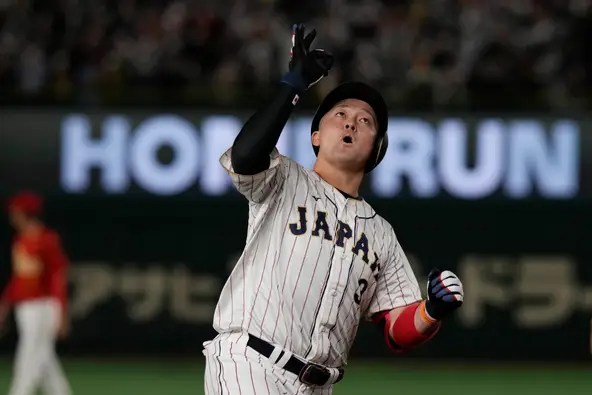
March 9: Shugo Maki of Japan celebrates after hitting a home run from Su Changlong of China in the 8th inning. EUGENE HOSHIKO, AP

March 8, 2023

By Lewis Rubman

For the first time since  its inception in 2006, the World Baseball Classic will not stage its semi-final and final games in California. San Diego hosted the first championship round, followed by Los Angeles in 2009, San Francisco in 2013, and then it was back to Dodger Stadium in 2017. This year the closest Bay Area fans will get to the action will be Phoenix, one of the four venues for the first round.

Teams representing the United States, Mexico, Colombia, Canada, and Great Britain will duke it out in Chase Field. This quintet has been designated as Group C. The  teams with the two best won-lost records in this round will advance to the quarter finals, AKA round 2, where they’ll face the two top finishers of Groups A,B, and D. 

Now, let’s take a look at those groups.

Group A, consisting of  the Netherlands, Cuba, Italy,  Panama  and what the organizers refer to as Chinese Taipei opened the action when the Netherlands beat Cuba 4-0  in Taichung Intercontinental Baseball Stadium on what was March 7 here, but the afternoon of March 8 in Taiwan. In what was the nightcap in Asia, visiting Panama pummelled  the host team, 12-5,  but outhit them by only one run, 14-13.

No other scores were in for either of the Asian venues when I took  a break for packing my bags for Phoenix to write this. Group A’s next round, AKA the quarter finals, will be played in Taichung, with the sole surviving squad moving on to Miami for the championship round, i.e., the semi-final  and final series.

Japan, Korea, Australia, China, and the Czech Republic make up Group B. Their first game is scheduled to start in the Tokyo Dome at 4:00 pm here on a west coast Wednesday afternoon, about two hours from now, and will feature Australia and Korea. The advancing teams will remain in Tokyo for the quarter-finals and then go to Miami for the semi-final and final rounds.

Group D consists of Puerto Rico, Venezuela, the Dominican Republic, Israel, and Nicaragua. They’ll play their games in Miami, starting with the Puerto Rico-Nicaragua match up at 9:00, Pacific time, on March 11. The team that wins this Group D first round at Loan Depot Park in Miami will  continue to play there as long as they remain in the running.

All of the above invites a few questions. Among them are how does a team qualify,  what is the basis on which a qualifying team is assigned to one group rather than another, how are teams ranked with their pools?

There are three criteria for qualification. They are

• The host country automatically qualifies. As with sausages, it’s best not to inquire about what goes into making the decision of which country that will be.

•  Any team that reached the 2017 semi-finals makes it into the first round in 2023 and will be the top seed in its group.

• This point is delicate.  MLB, the WBC’s parent organization, describes it this way:  “… the remaining teams will be assigned based on December 31, 2021, WBSC [World Baseball  Softball Confederation] rankings in order to guaranteed [sic] competitive balance. Commercial, geographic and geopolitical considerations may also be applied to this process.”

Let that last sentence sink in.  When you’ve done, you can clear your mind by glancing at MLB.com’s ranking of the top ten teams. They are

 1) The Dominican Republic 

 2) The USA

 3)  Japan

 4)  Puerto Rico 

 5)  Mexico

 6)  Venezuela

 7)  Cuba

 8)  Canada

 9)   Italy

10) Korea.

I chose this source because I couldn’t find the final 2021 WSBC ratings and, in any case,  2022 was not a good year for lower level baseball and softball. I don’t know how accurate this MLB.com table is, but I suspect that it’s relevant that, of the four previous WBC titles, Japan has won two and the Dominican Republic and the United States have won the two remaining crowns. Cuba, the Netherlands, and Korea also have had notable success in the tournament.

In my next article, I’ll discuss, among other things, some thorny  “geographic and geopolitical considerations” that could affect the inclusion  and group placement of  a country as well as  individual players’  eligibility  to play for any given team. After that, I plan to send two more dispatches before I begin reporting on the games of the Phoenix round on March 11. They will deal with other tournament rules and with the representation of players from bay area  teams in the WBA.

Lewis Rubman is covering the World Baseball Classic for http://www.sportsradioservice.com

World Baseball Classic: Packing for Phoenix

World Baseball Classic logo (mlb.com image)

Packing for Phoenix

March 9, 2023

By Lewis Rubman

For the first time since its inception in 2006, the World Baseball Classic will not stage its semi-final and final games in California. San Diego hosted the first championship round, followed by Los Angeles in 2009, San Francisco in 2013, and then it was back to Dodger Stadium in 2017.

This year the closest Bay Area fans will get to the action will be Phoenix, one of the four venues for the first round. Teams representing the United States, Mexico, Colombia, Canada, and Great Britain will duke it out in Chase Field. This quintet has been designated as Group C. The teams with the two best won-lost records in this round will advance to the quarter finals, AKA round 2, where they’ll face the two top finishers of Groups A,B, and D.

Now, let’s take a look at those groups.

Group A, consisting of the Netherlands, Cuba, Italy, Panama and what the organizers refer to as Chinese Taipei opened the action when the Netherlands beat Cuba 4-0 in Taichung Intercontinental Baseball Stadium on what was March 7 here, but the afternoon of March 8 in Taiwan.

In what was the nightcap in Asia, visiting Panama pummelled the host team, 12-5, but outhit them by only one run, 14-13. No other scores were in for either of the Asian venues when I took a break for packing my bags for Phoenix to write this. Group A’s next round, AKA the quarter finals, will be played in Taichung, with the sole surviving squad moving on to Miami for the championship round, i.e., the semi-final and final series.

Japan, Korea, Australia, China, and the Czech Republic make up Group B. Their first game is scheduled to start in the Tokyo Dome at 4:00 pm here on a west coast Wednesday afternoon, about two hours from now, and will feature Australia and Korea. The advancing teams will remain in Tokyo for the quarter-finals and then go to Miami for the semi-final and final rounds.

Group D consists of Puerto Rico, Venezuela, the Dominican Republic, Israel, and Nicaragua. They’ll play their games in Miami, starting with the Puerto Rico-Nicaragua match up at 9:00, Pacific time, on March 11. The team that wins this Group D first round at loanDepot Park will continue to play there as long as they remain in the running.

All of the above invites a few questions. Among them are how does a team qualify, what is the basis on which a qualifying team is assigned to one group rather than another, how are teams ranked with their pools?

There are three criteria for qualification. They are

  • The host country automatically qualifies. As with sausages, it’s best not to inquire about what goes into making the decision of which country that will be. • Any team that reached the 2017 semi-finals makes it into the first round in 2023 and will be the top seed in its group. • This point is delicate. MLB, the WBC’s parent organization, describes it this way: “… the remaining teams will be assigned based on December 31, 2021, WBSC [World Baseball Softball Confederation] rankings in order to guaranteed [sic] competitive balance. Commercial, geographic and geopolitical considerations may also be applied to this process.”

Let that last sentence sink in. When you’ve done, you can clear your mind by glancing at MLB.com’s ranking of the top ten teams. They are

1) The Dominican Republic 2) The USA 3) Japan 4) Puerto Rico 5) Mexico 6) Venezuela 7) Cuba 8) Canada 9) Italy 10) Korea.

I chose this source because I couldn’t find the final 2021 WSBC ratings and, in any case, 2022 was not a good year for lower level baseball and softball. I don’t know how accurate this MLB.com table is, but I suspect that it’s relevant that, of the four previous WBC titles, Japan has won two and the Dominican Republic and the United States have won the two remaining crowns. Cuba, the Netherlands, and Korea also have had notable success in the tournament.

In my next article, I’ll discuss, among other things, some thorny “geographic and geopolitical considerations” that could affect the inclusion and group placement of a country as well as individual players’ eligibility to play for any given team. After that, I plan to send two more dispatches before I begin reporting on the games of the Phoenix round on March 11. They will deal with other tournament rules and with the representation of players from bay area teams in the WBA.

World Baseball Classic preview: Almost On the Road to Phoenix

St. Louis Cardinals’ Nolan Arenado takes batting practice Thursday, Oct. 6, 2022, in St. Louis. The Cardinals and Philadelphia Phillies were preparing to play Game 1 of a National League Wild Card baseball playoff series on Fri Oct 7, 2022 in St. Louis. Arenado will be playing for Team USA for the 2023 World Baseball Classic (AP News file photo)

Almost On the Road to Phoenix

March 8, 2023

By Lewis Rubman

OAKLAND–Major League Baseball should be congratulated on its honesty in admitting that “[c]ommercial, geographic and geopolitical considerations may … be applied to [the] process” of assigning teams to the four pools of the round one round robin. No one will be shocked to learn that MLB applies commercial criteria in its decision making.

Still, it’s nice to see that monopoly admitting that it isn’t a philanthropy, even if that admission comes wrapped in a fig leaf of “competitive balance.” It certainly is a change from the sanctimonious declarations that we hear about keeping politics out of baseball.

The declared main factor in the assignment of teams to and seeding within pools is the rankings of the World Baseball Softball Confederation, which describes itself as “the international governing body for baseball and softball.” This raises a few questions.

That’s not because the WBSC’s decisions are unfair but because it’s not always clear what constitutes a country or, for that matter, a t possession, a territory or a Territory. (It would be an excessive digression to go into the details of that distinction, but, believe me, it’s real, and it’s important).

Wars have been fought–are being fought this very instant–over the status of a particular piece of land. Think of Ukraine or the middle east. There are separatist movements that haven’t reached that advanced a stage of conflict Catalonia and Puerto Rico are just a few of the places that come to mind.

That last observation is particularly relevant to the question of membership in and ranking by the WBSC. Puerto Rico is considered a separate country for purposes of the World Baseball Classic and the Caribbean Series. It isn’t an integral part of the United States, but it’s not an independent country.

There is no such thing as Puerto Rican citizenship, and although Puerto Ricans are American citizens, they cannot, while residing on island, vote in federal elections for any position other than their non-voting representative before Congress.

The federal appeals court that hears insular cases is located in Boston, and this Caribbean island’s zip code is grouped with New England’s. Puerto Rico doesn’t control its own immigration laws, so Cubans, for example, can move from their country of birth to Puerto Rico and become naturalized as US citizens and vote in Puerto Rico or move to the mainland and vote in federal and local elections there.

There is considerable debate about whether Puerto Rico is US territory or a US Territory, with a capital T. In any case, the federal government claims full sovereignty of the island (actually, islands, but no one calls it that) subject to the terms of the compact between the two entities. In Puerto Rico, that compact is called in the constitution; on the mainland, it’s just a federal law. Puerto Rico is a member of both the WBSC and the Caribbean Baseball Confederation.

The Netherlands Antilles, of which Curaçao and Aruba had been members, was dissolved in 2010, and the islands became separate constituent counties under the Kingdom of the Netherlands. Both islands are represented in the WBSC, but neither belongs to the Confederation of Caribbean Professional Baseball.

Nonetheless, Curaçao, like Cuba, participated as a guest in this year’s Caribbean Series. Kenley Jansen, Xavier Bogaerts, and Jurickson Profar, and are among the Curaçao and Aruba born MLBers playing for the Netherlands.

To participate in The World Baseball Classic, a player must

  • Have been on final roster at the start of a previous qualifier or tournament round or; • Be a citizen or permanent legal resident of the team’s country or territory or; • Have been born in the team’s country or territory or; • Be the child of someone born in the country or territory in question or a citizen of it or; • Would be granted citizenship or a passport if he applied for it and was not required to renounce his current citizenship.

Under these rules, Nolan Arenado. who was born in California but grew up in Cuba until he was six and who has a Queens-born Puerto Rican mother and native-born Cuban father, could play for Cuba, Puerto Rico, or the USA. He chose Team USA in 2017, after giving serious consideration to playing for Puerto Rico, and will be on the roster for the States this year as well.

Team Israel, playing in Group D, provides another interesting case. Jews who immigrate to that country automatically become Israeli citizens, as do their children and grandchildren and the spouses of their children and grandchildren.

In Asia, baseball has its own two China policy. Baseball is a popular sport on Taiwan, but it isn’t among MLB’s top ten teams, although they qualify for this round as a host country. The People’s Republic is no baseball powerhouse, but is participating in first round games in Tokyo. Is this the result of a geopolitcal consideration?

Lewis Rubman is a Major League Baseball beat writer for http://www.sportsradioservice.com

That’s Amaury News and Commentary podcast: Machado and Padres come to an 11 yr $350 million extension agreement; plus more news

The San Diego Padres third baseman Manny Machado became the game’s first player to get called for the auto strike during Cactus League action (photo from yahoo.com sports)

On That’s News and Commentary podcast:

#1 Amaury, how important is it for the San Diego Padres and team owner Peter Siedler to have stepped up and have signed superstar Manny Machado to an 11 year $350 million contract extension this coming after Machado saying he would have opted out after this season?

#2 Machado this week became the Majors first player to take a strike on a at bat violation he went 0-1 on the count against the Seattle Mariners last Saturday in the first exhibition game of the Cactus League as called by plate umpire Ryan Blakney. It goes as a first in the book, Machado said humbly that might the first of many.

#3 The Boston Red Sox and Atlanta Braves also saw the auto strike end a ball game, on Sunday Braves minor league hitter Cal Conley was at the plate in the ninth with the bases loaded with two outs and a 3-2 count. Conley didn’t get set to hit in time and was called for strike three which ended the game and a chance for the Braves to tie or win it.

#4 Regional Sports Network and AT&T SportsNet has informed some ten MLB teams that they are preparing to discontinue regional sports coverage streaming. The Networks also have informed the teams to take back their distribution rights before the end of March. What ever happened to simple local coverage and live play by play radio coverage now the business just to cover a game has turned bureaucratic.

#5 Chicago Cubs outfielder Seiya Suzuki will be out for the World Baseball Classic. Suzuki has an oblique injury and will not play in the World Baseball Classic as the Cubs announced on Monday. Suzuki got injured earlier in camp and had not be participating in practices since.

Join Amaury Pi Gonzalez for all Oakland A’s home games live Spanish radio play by play on the A’s Spanish radio Network with Manolo Hernandez Douen and Amaury does News and Commentary at http://www.sportsradioservice.com
That’s Amaury News and Commentary podcast: Fujinami might be the drawing card the A’s need for 2023

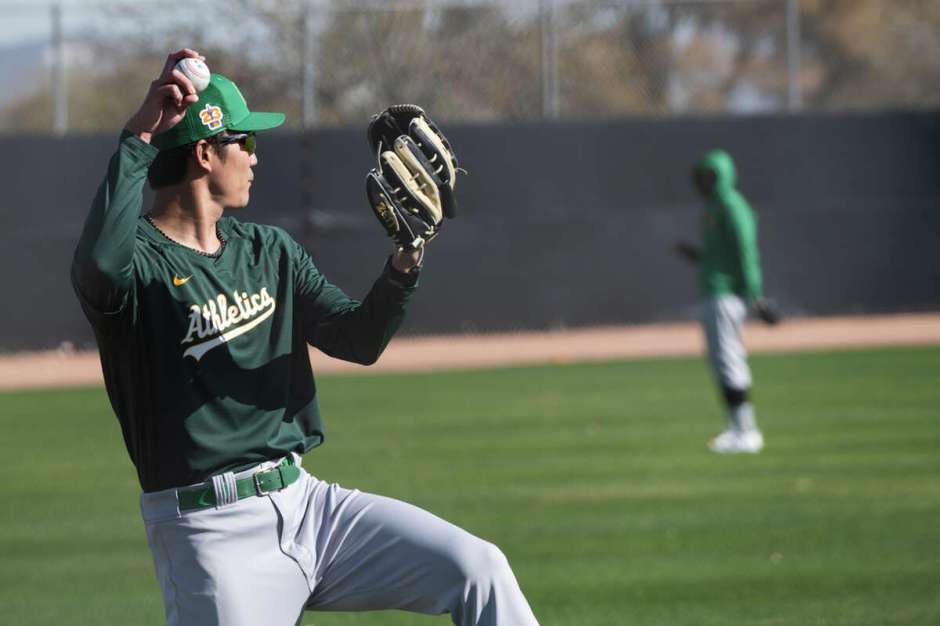
Oakland A’s pitcher Shintaro Fujinami tunes up at A’s spring training camp on Wed Feb 15, 2023 in Mesa AZ at Hohokam Park (photo from the San Francisco Chronicle)

On That’s Amaury News and Commentary podcast:

#1 Amaury, taking a look at Shintaro Fujinami in spring training and in his bullpen sessions he’s no joke Fujinami is throwing with a mean fastball and splitter and he’s in the upper 90s.

#2 Jesus Aguilar the A’s first baseman and designated hitter the A’s are expecting some punch in the line up out of Aguilar he did have a career worst wRC with the Miami Marlins and Baltimore Orioles last season 86 in 129 games.

#3 Amaury, are the A’s on the fence about keeping Cristian Pache. Pache will have to showcase this month in spring training and that includes hitting and manager Mark Kotsay is looking for an everyday outfielder that can provide hits and RBIs. Pache has ability with the glove in centerfield but can he be that everyday player that Kotsay is looking for?

#4 Taking a look at former St Louis Cardinal and former San Francisco Giants broadcaster Tim McCarver. McCarver a former two time All Star and who called signals for former Cardinal pitchers Bob Gibson and Steve Carlton passed away this week.

#5 Amaury, It’s been six years since the World Baseball Classic has been played the games have expanded to 20 teams and have added three more teams, Great Britain, the Czech Republic and Nicaragua.

Join Amaury Pi Gonzalez for That’s Amaury News and Commentary podcasts every Tuesday at http://www.sportsradioservice.com