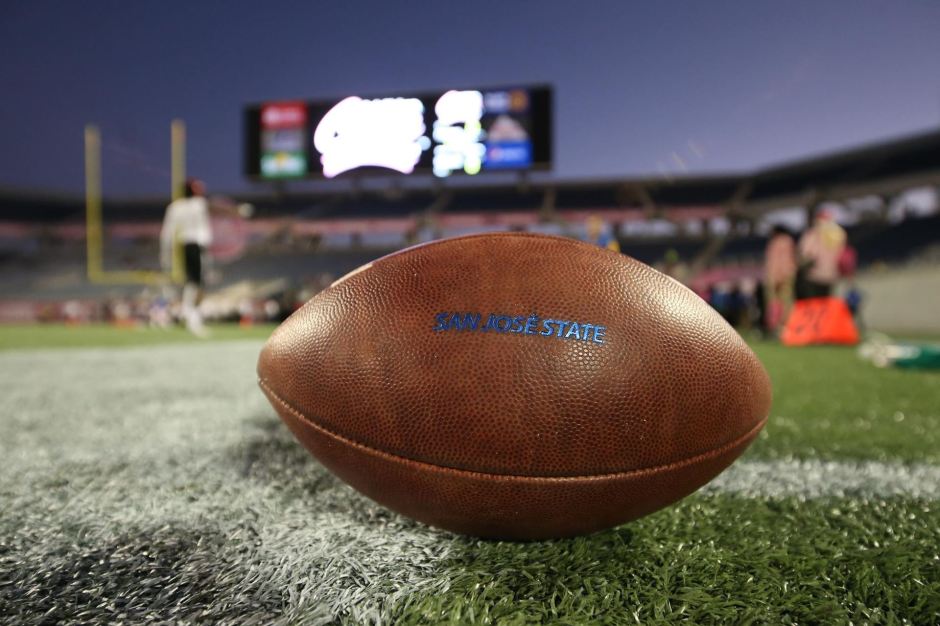
San Jose State, Hawaii to Collaborate for Dick Tomey Legacy Trophy

Photo credit: sjsuspartans.com

By: Ana Kieu

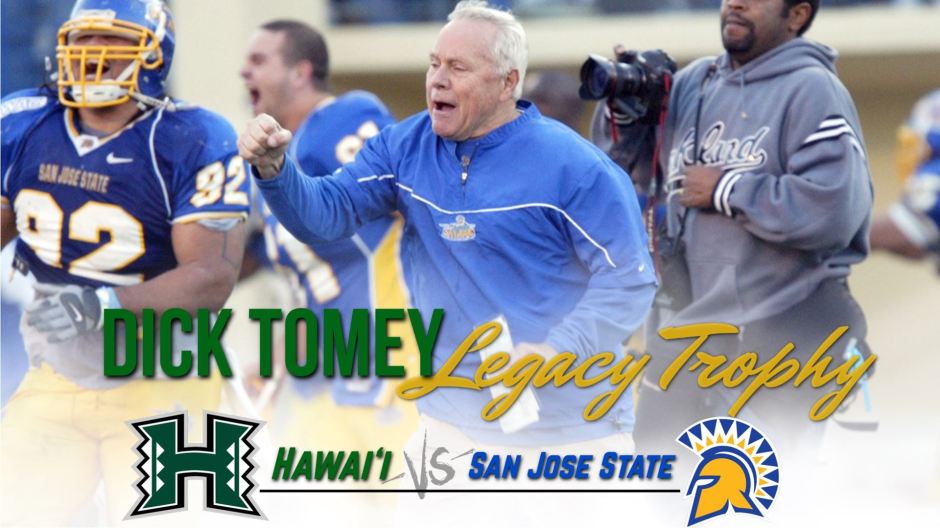
During the late Dick Tomey’s football coaching career, a point of emphasis were two words repeated emphatically three times. “THE TEAM, THE TEAM, THE TEAM” was paramount to one of the game’s most accomplished and revered head coaches.

San Jose State University and the University of Hawaii, two of Coach Tomey’s three head coaching opportunities, are embracing his slogan taken from former Miami University and University of Michigan football coach Bo Schembechler and turning it into “THE TEAMS, THE TEAMS, THE TEAMS” starting in the 2019 season.

In honor of Coach Tomey, who put Hawaii football on the NCAA Division I map and later revitalized and energized San Jose State’s program, the schools will be playing for the Dick Tomey Legacy Trophy for the first time on November 9 in Aloha Stadium.

Coach Tomey was the head coach at Hawaii for 10 seasons (1977-86) and San Jose State for five (2005-09). In between, he coached the University of Arizona for 14 seasons. His head coaching record was 183-145-7. After the 2018 season, he still ranked in top-50 for FBS head coaches for most games coached (19th, 335 games coached) and games won (39th).

The concept of honoring Coach Tomey was a collaboration first conceived in a conversation between head coaches Brent Brennan of San Jose State and Nick Rolovich of Hawaii and approved by the athletics directors Marie Tuite of the Spartans and David Matlin of the Rainbow Warriors.

“Coach Tomey has been a huge part of both our schools’ histories, personally and professionally. Playing for this trophy will be a special way to honor and remember the man who has meant so much to each program,” said Brennan. “Every year, we will be reminded of his impact and the important lessons he taught each of us.”

“If there was anyone deserving of having a legacy trophy named after him, Dick Tomey is the one because of what he meant to the game of football,” Rolovich said. “I’ve had the privilege to coach with him and being mentored by him for many years and he is responsible for me being able to sit in this chair. It is only appropriate that both Hawaii and San Jose State programs honor him in this way.”

“Dick Tomey meant so much to San Jose State football and San Jose State University. His impact was far more reaching than just his five seasons as our head coach. Personally, I turned to him every single time I was making an important decision to gain his insight and guidance,” said Tuite.

“Given his close ties with the University of Hawaii and San Jose State University, it truly is appropriate to recognize his impact and aloha spirit on the two programs that meant so much to him. For Coach Tomey was about ‘THE TEAM, THE TEAM, THE TEAM.’ When we play Hawaii this November 9 in Aloha Stadium, this trophy will represent the love and admiration we all have for Coach and the entire Tomey family.”

“Coach Tomey was an inspirational leader and kind warrior,” said Matlin. “I was blessed to call him a mentor and a friend. This legacy trophy memorializes the impact he had on so many people in both Honolulu and San Jose.”

In addition, the Dick Tomey Legacy Fund has been established through Positive Coaching Alliance (501c3), providing scholarships and programming for underserved youth in Arizona, Hawaii, and the San Francisco Bay Area. For more information, check out the website, www.positivecoach.org/tomeyfund.

SJSU President Mary Papazian Appointed to NCAA Board of Directors

Photo credit: blogs.sjsu.edu

By: Ana Kieu

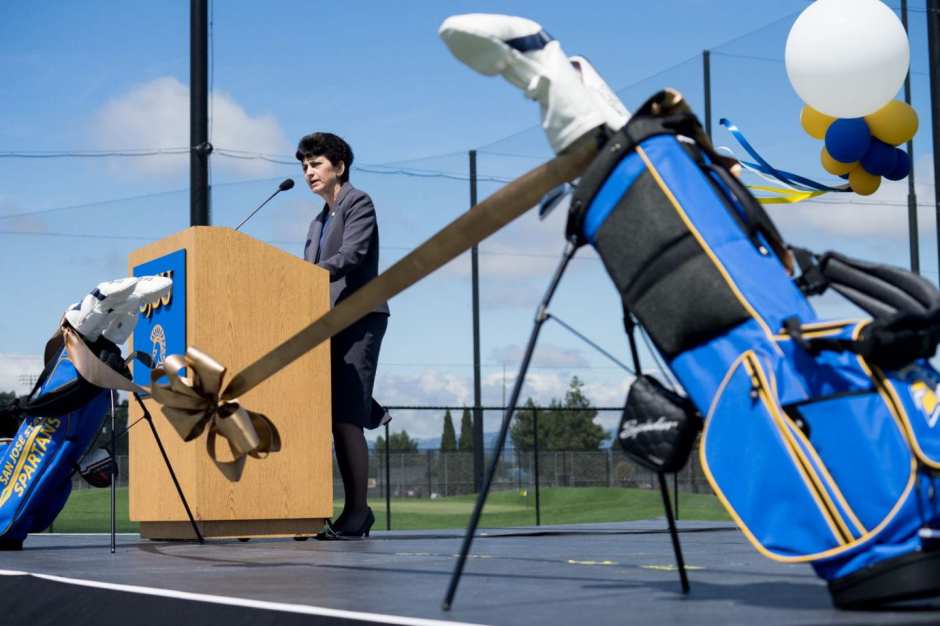
San Jose State University President Mary A. Papazian has been appointed to the NCAA’s Division I Board of Directors.

Papazian’s term of service on the committee began at the close of the association’s May 2019 Board of Directors meeting and continues until the end of the August 2023 Board meeting.

“Representing San Jose State and the Mountain West on the NCAA Board of Directors is quite an honor,” said Papazian. “While the NCAA manages and governs intercollegiate sports for more than 1,100 colleges and universities, the heart of the association’s mission is providing opportunities for student-athletes to earn a college degree. That academic focus is one I gravitate toward and an area where I can contribute the most in this role.”

As an NCAA Board member, Papazian will be charged with helping to sustain and advance the Association’s mission, traditions, values and reputation. Board members regularly participate in committee meetings and conference calls and address a variety of issues. Last year, Papazian served as vice chair of the NCAA Division I Presidential Forum.

The 24-member Board of Directors committee consists of one university chancellor or president from each of the 10 FBS conferences; one Senior Woman Administrator from a FBS conference; seven representatives consisting of university presidents, an athletics director and a faculty athletics representative from FCS conferences; five university presidents from Division I institutions that do not sponsor football; and a student-athlete from a Division I institution.

“President Papazian’s role and service on the Mountain West Board of Directors will prepare her well in representing the league on the NCAA Board of Directors. The combination of responsibilities to both will enable her to transition in the Mountain West Board Chair position in 2020 and we look forward to her active participation,” said Mountain West commissioner Craig Thompson.

“President Papazian has an incredible pulse on the daily life of a student-athlete.  She is keenly aware of the challenges, fortitude and exhilaration student-athletes experience as they navigate their daily lives.  She is a student-centered President, and will serve all students, regardless of their gender or sport,” said San Jose State University athletics director Marie Tuite.

Papazian joined San Jose State University as its 30th president on July 1, 2016. Recent milestones at SJSU include the opening of the new, $130 million Spartan Recreation and Aquatics Center; a series of Town Hall meetings hosted by SJSU’s Institute for the Study of Sport, Society and Social Change; and the launch of a new, 10-year strategic plan known as Transformation 2030. Next week, SJSU and its Division of Intercollegiate Athletics will host a groundbreaking ceremony for the future construction of a new Football Operations Center.

About San Jose State University
The founding campus of the 23-campus CSU system, SJSU provides a comprehensive university education, granting bachelor’s, master’s and doctoral degrees in 250 areas of study offered through its eight colleges.

With more than 35,000 students and nearly 4,370 employees, SJSU continues to be an essential partner in the economic, cultural and social development of Silicon Valley and the state, annually contributing 10,000 graduates to the workforce.

The university is proud of the accomplishments of its more than 260,000 alumni, 60% of whom live and work in the Bay Area.

About San Jose State Athletics
San Jose State sponsors 22 (nine men’s and 13 women’s) NCAA Division I intercollegiate sports programs for approximately 470 student-athletes annually. In football, the Spartans are a member of Division I’s FBS, the NCAA’s highest level of competition.

The Spartans’ primary conference affiliation is with the Mountain West. Selected teams belong to the MPSF, the WAC, and the GCC.

SJSU has 10 NCAA team championships and 52 NCAA individual titles. 62 Spartans competed in one or more Olympic Games. SJSU athletes have won seven gold, six silver and seven bronze medals at the Olympics.

SJSU assistant men’s basketball coach Will Kimble shares his story

Photo credit: sjsuspartans.com

By: Ana Kieu

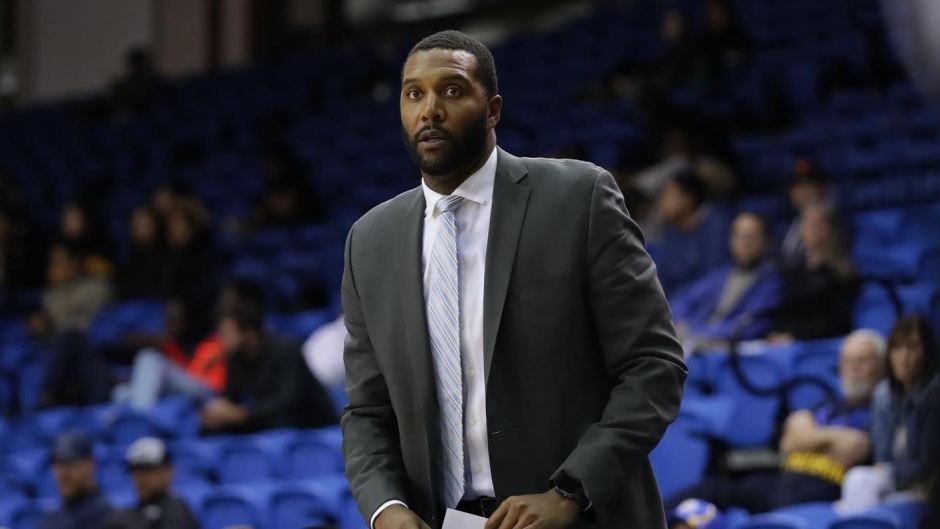
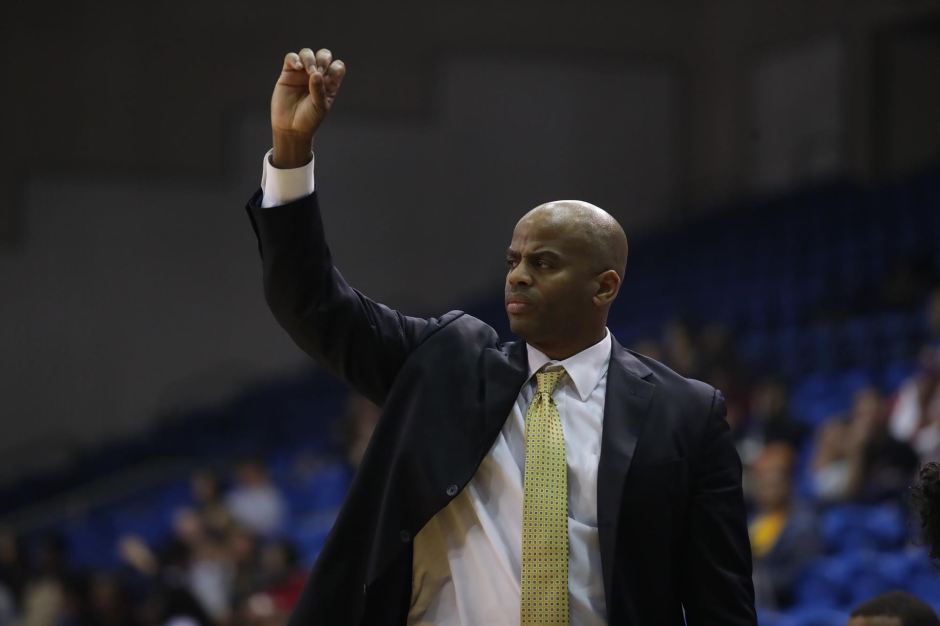
SAN JOSE, Calif. — When Jean Prioleau was hired as the head coach of the San Jose State men’s basketball program, one of the first things he was tasked with was assembling a coaching staff. Knowing how important it would be to have someone on staff that is familiar with the area, one of the first names he went after was Will Kimble, an up-and-coming assistant coach at UC Riverside.

“It has to do with the locale at the job that you take,” Prioleau said on why he went after Kimble. “We are in California. San Jose is in Northern California and I needed California guys on my staff. Will is well-known in California, knows a lot of people and has really helped us close out a lot of guys in the state recently. He also has connections outside of the state too, and I’ve actually tried to push him to broaden his horizons in the recruiting world to try to reach outside of California, because we are going to have to do that here. That’s what I wanted in an assistant coach and that’s what I went after and got.”

Kimble joined the program with Prioleau at the start of the 2017-18 season and has just wrapped up his second season as an assistant on Prioleau’s staff. Tasked with coaching the bigs (forwards and centers), Kimble has thrived in his role because he has first-hand experience at what it takes to play the position. He started his college career at Pepperdine as a center and led the team to the NIT in his first year and the NCAA Tournament in his second year.

“I think he’s done a great job at developing and working the guys out,” Prioleau said. “He shows them different paths in terms of what they need to be looking for during the game and runs individual workouts to help them become better players. He really just helps them mentally as well, because he was a big guy in college, so I think that helps as well.”

When a new coach and coaching staff are brought in, there are some kinks to work out at the beginning, but Prioleau feels that Kimble is the type of person that was able to grasp the system early on and help make the transition as smooth as possible.

“A large part of it was just getting used to the system,” Prioleau said. “Every assistant coach has a system or a way they’d like to do things when they become a head coach. Some assistants go around to different programs and bounce around, and don’t know or haven’t absorbed all the information that they needed to going from one coach to another, but I think Will has grasped what we are trying to do and that’s a sign that he knows where we are trying to go with this program. He also has his own thoughts on that as well and brings good thoughts to the table.

“I think the first year everyone was just learning me,” Prioleau continued. “What I want, what I’m trying to do, and what we are trying to do as a whole. I think Will has done a great job of trying to be the best that he can be for me and the program.”

After two years as Prioleau’s lead assistant, Kimble will be tasked with an even bigger role moving forward as he has taken over the role of lead recruiter. He has done well in that role so far. He landed two 2019 recruits in just a few days in forwards Eduardo Lane and Ralph Agee. Both players will join recruits Omari Moore and Richard Washington.

“He’s taken on some more responsibilities in scheduling and recruiting. He’s really spearheaded the recruiting,” Prioleau said. “The last two years, I’ve kind of let everyone get involved with recruiting and have a say, but now he’s really taken control of it and has a say, and he’s going to be the head guy in terms of recruiting – who we are going for and where we need to go see them and stuff like that. Obviously I have enough confidence in him for him to be able to do that, and he’s earned that right.”

Overall, Prioleau is very pleased with the work that Kimble has put in in his two-plus years with the program. Kimble’s work ethic, natural ability to form relationships with players and ability to develop players on and off the court leads Prioleau to believe that Kimble is well on his way to becoming a head coach in the near future.

“Will has done a great job for us,” Prioleau said. “A lot of people don’t realize the things that he does. He’s got a great relationship with the players and understands the x’s and o’s of the game as well as the flow of the game, which helps me out a lot. I’m really pleased with his development. I want to develop him to become a head coach one day. He has the capability of doing that. I think all assistants aspire to do that, and I want that for all of my assistants. I think Will has tried to embrace all the qualities that it takes to try to be a head coach.”

Make sure heck out the video below to hear more about Kimble’s story in his own words.

ShotTracker partners with Mountain West

Photo credit: sjsuspartans.com

By: Ana Kieu

ShotTracker, the revolutionary sensor-based system that delivers real-time statistics and analytics to teams, fans and broadcast networks, today announced it has partnered with the Mountain West to provide basketball data tracking and analytics services during all conference basketball games through the 2023-24 season.

ShotTracker will install its system across 23 practice and game facilities at all 11 MW schools for both men’s and women’s basketball programs. Each student-athlete will wear a ShotTracker player sensor and use the ShotTracker-enabled version of their school’s basketball provider. The sensors track player and ball movement in real time, providing MW programs with 70+ unique statistics. This provides the MW with access to instantaneous data that no conference has unilaterally had access to before.

The MW and ShotTracker worked together during select 2018-2019 regular season basketball games and the Air Force Reserve MW Men’s Basketball Championship at the Thomas & Mack Center to test the technology. That pilot program enjoyed massive success, prompting the MW to become the first conference to integrate ShotTracker’s technology across men’s and women’s basketball programs for its conference games and practice facilities.

“The Mountain West prides itself on innovation and we’re proud to be the first conference to partner with ShotTracker conference-wide,” MW Senior Associate Commissioner Dan Butterly said. “Our coaches understand that real-time data, analytics and reporting are going to be invaluable for improving team performance. Our student-athletes will have access to post-practice and game analytics data that can help them better understand their specific performance and help them find ways to improve. Plus, Mountain West fans will, for the first time, have access to real-time analytics to better follow their favorite teams.”

Currently, the NCAA doesn’t permit the transmission of data to the bench during game play. The conference-wide partnership with ShotTracker allows the MW to submit a waiver request to the NCAA competition committee to get access to ShotTracker’s data and video on the bench during every conference game via the ShotTracker app. ShotTracker has been involved in testing for teams to provide feedback to the NCAA as it relates to a possible change to this rule. Bench access to ShotTracker’s team app could be granted to visiting non-conference teams who also approve the use of the system. This partnership uniquely positions the MW to help redefine the use of technology and instantaneous analytics at the NCAA level.

ShotTracker’s data is also provided to conference broadcast partners, offering commentators unparalleled opportunities to integrate these statistics into their commentary. During the 2018-19 pilot, MW broadcasts featured real-time shot charts, player spacing and ball movement metrics, as well as offensive and defensive trend comparison graphics that supported the announcer’s commentary live and during replays — all with sub-second latency.

The MW partnership represents the next monumental step for ShotTracker to revolutionize the sport and become as integral to basketball facilities as WiFi is to coffee shops.

“It is incredibly exciting getting to work with conferences like the Mountain West that recognize and understand ShotTracker’s vision for how it can overhaul sports,” ShotTracker president and co-founder Davyeon Ross said. “We’re proud to provide teams with unparalleled game and practice data while also giving their fans an enhanced viewing experience.”

This is the latest example of the MW’s commitment to innovation. In September 2006, the MW became the first conference to launch its own 24/7 linear television network, The Mountain West Sports Network, also known as The MTN. The conference also was the first to work with DVSport to design and implement the basketball instant replay system that is now utilized in the NCAA Tournament and across the nation. In 2003, the MW became one of the first college basketball conferences to sign with Precision Timing Systems.

“The Mountain West continues to stand out for being a pioneer in adopting the latest cutting-edge technologies,” Ross added. “As the sports world continues to embrace technology, ShotTracker and the Mountain West have set a new standard for what teams and fans can expect for the speed and detail of basketball player tracking data. We know other conferences will soon follow their lead to ultimately increase on-court performance through our technology.”

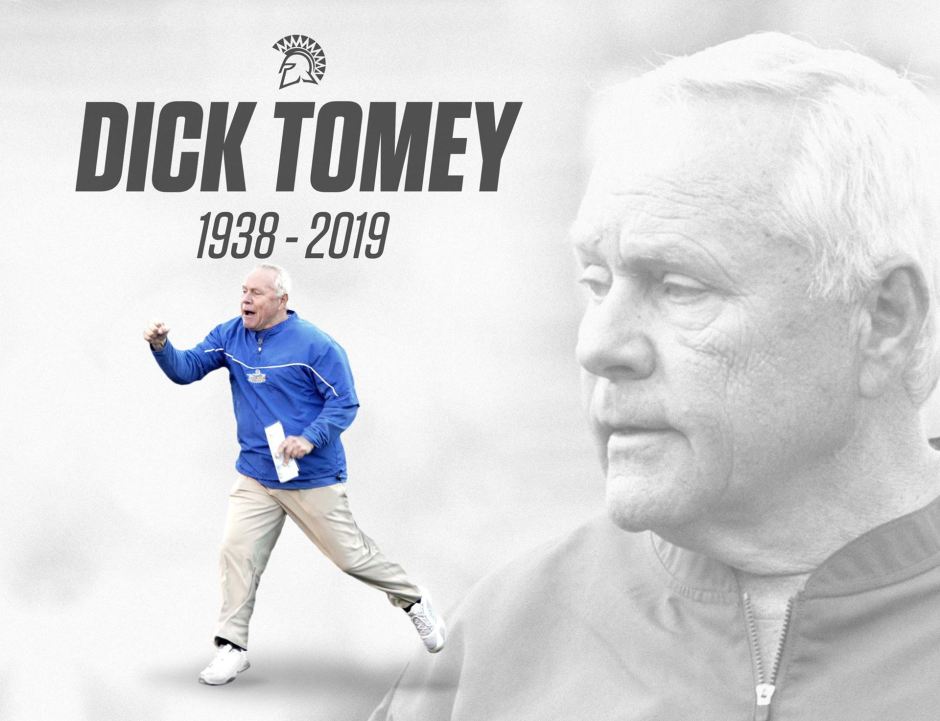
Remembering former San Jose State football head coach Dick Tomey (1938-2019)

Photo credit: sjsuspartans.com

By: Ana Kieu

If you’re a longtime San Jose State Spartans football fan, you’d be well-aware of the former football head coach Dick Tomey. Tomey died of lung cancer on Saturday at the age of 80. Tomey was born in Bloomington, Indiana on June 20, 1983.

Tomey wasn’t only a coach, but also a mentor, friend and former football player. Tomey played college football at DePauw University from 1957 to 1960.

Here’s the official press release:

When Dick Tomey was named San Jose State University’s football head coach on December 29, 2004, he described himself as a “competitor.”

“I believe San Jose State University can be successful in college football. I always felt San Jose State had tremendous possibilities. The opportunity to be the head coach is really appealing and compelling,” he said upon taking the job.

In recent months, Mr. Tomey competed against lung cancer until the evening of May 10 at age 80.

“Coach Tomey was a legend. He had the unique ability to reach into your soul and get the best out of you. He was different. He loved the game of football. But it was more about the players, the coaches, the families, the TEAM. You knew he sincerely cared about the men that played and coached for him,” said San Jose State football head coach Brent Brennan, one of Mr. Tomey’s many coaching protegees.

“It’s rare when someone you work for mentors and teaches you everyday, even when you’re done working for them, but Coach Tomey is that for me. His impact is incredibly far reaching. I will miss him everyday. I love you Coach Tomey.”

His professional life as a football coach dated back to 1962 when he was a graduate assistant coach at Miami University of Ohio for eventual Big Ten Conference head coaches Johnny Pont, later of Indiana and Northwestern, and Glenn “Bo” Schembechler, who would go to fame at Michigan. There would be stops as an assistant coach at Northern Illinois, Davidson, Kansas and UCLA. While at UCLA, he worked for San Jose State grad and later Rose Bowl and Super Bowl winning head coach Dick Vermeil. Later in his career, he also would serve as an assistant at Texas, the San Francisco 49ers and at Hawaii, where he was the head coach from 1977 to 1986.

Mr. Tomey also had college football head coaching opportunities at the University of Arizona (1987 to 2000) and San Jose State University (2005-09). His head coaching record was 183-145-7. After the 2018 season, he still ranked in top-50 for Football Bowl Subdivision head coaches for most games coached (19th, 335 games coached) and games won (39th with 183).

Mr. Tomey took eight teams to bowl games, seven at Arizona and the 2006 Spartans to a New Mexico Bowl victory. He was a two-time conference “Coach of the Year” – 1981, the Western Athletic Conference Coach of the Year with Hawaii and 1992, the Pac-10 Coach of the Year with Arizona.

He was most proud of being a FBS head coach to win nine games in a season at each one of his three schools and for a lineage of head coaches and assistant coaches. Current head coaches Brent Brennan of San Jose State and Dino Babers at Syracuse, and former head coaches Rich Ellerson, June Jones, Pat Hill, Tom Williams and Ron McBride are among that group.

Mr. Tomey would be known as a turnaround specialist taking Hawaii, Arizona, and San Jose State to unprecedented success on and off the field. In each case, his organizational and people skills and knowledge of college football were invaluable.

“He was a ‘beacon’ for me and countless others. I turned to him often for his counsel, guidance and support. Spartans everywhere are grieving his passing as we reflect on how blessed we were to know him. Our warmest thoughts and prayers to Nanci and his entire family,” said San Jose State University athletics director Marie Tuite.

At Hawaii (1977-1986), he was the first coach to lead the Rainbows to a top-20 national ranking. Home attendance more than doubled from his first season to his final one in 1986. When he moved on to the University of Arizona as the Wildcats’ head coach in 1987, his Hawaii teams manufactured a 63-46-3 win-loss record that included eight winning seasons.

The University of Arizona (1987-2000) was next. There were seven bowl game appearances with four bowl victories and the 1993 and 1998 teams that won at least 10 games. Prior to his arrival, the Wildcats won one bowl game in 85 seasons. Arizona was the only program to beat national powerhouses Mimai (Fla.) and Nebraska in the decade of the 1990’s.

“Not only was it (Arizona) the most enjoyable five years of my life, Coach Tomey helped me grow into the man I am today,” said former University of Arizona defensive lineman and New England Patriots All-Pro linebacker Tedy Bruschi.

After 14 seasons at Arizona and one-season stints with the San Francisco 49ers of the National Football League in 2002 and the University of Texas for the 2004 season, Mr. Tomey accepted the San Jose State football head coaching position.

“He’s the type of guy who can help you through hard times and really wants to make you win,” said former San Jose State quarterback Adam Tafralis.

The 2006 Spartans finished with a 9-4 win-loss record, were invited to play in a post-season bowl game for the first time in 16 seasons and won the inaugural New Mexico Bowl over host University of New Mexico.

More importantly, Mr. Tomey provided the necessary leadership and vision to significantly overhaul the academic deficiencies that plagued the San Jose State football program at the time he became head coach. San Jose State became the model institution among NCAA Division I Football Bowl Subdivision (FBS) for academic reform.

“I’ve been fortunate to have three head coaching jobs in the highest level of college football. The one here at San Jose State may be the most rewarding. We’ve come so far and accomplished so much in five years. Terrific young men took a leap of faith when we started in 2005 and put the program back on a sturdy foundation for future San Jose State teams,” Mr. Tomey said in his 2009 retirement announcement as the Spartans’ head coach.

In appreciation for his continued athletics program involvement and impact, the Dick Tomey Class Act Award is presented each spring at the SAMMY awards sponsored by the San Jose State Student-Athletes Success Services (SASS) unit.

Richard Hastings Tomey was born on June 20, 1938 in Bloomington, Ind. Mr. Tomey graduated from DePauw University in 1960 where he played football and baseball.

In addition to his coaching accomplishments, he is a past president of the American Football Coaches Association (2009), was inducted in the DePauw University Hall of Fame in 1994 and a 1999 recipient of a “Provost Award” as the University of Arizona ‘s “Outstanding Teacher” – the first coach in the school’s history to be so honored by the university’s faculty.

A Celebration of Life will be announced at a later date.

In lieu of flowers, the Dick Tomey Legacy Fund has been established through the Positive Coaching Alliance (501c3). 100% of these funds will go directly to providing scholarships and programming for underserved youth in the markets where Dick spent the majority of his years in the community as the Head Football Coach.

Visit www.positivecoach.org/TomeyFund to designate the Hawaii, Arizona or Bay Area chapter as the beneficiary to the Dick Tomey Legacy Fund.

San Jose State men’s basketball signs 2 players

Photo credit: sjsuspartans.com

By: Ana Kieu

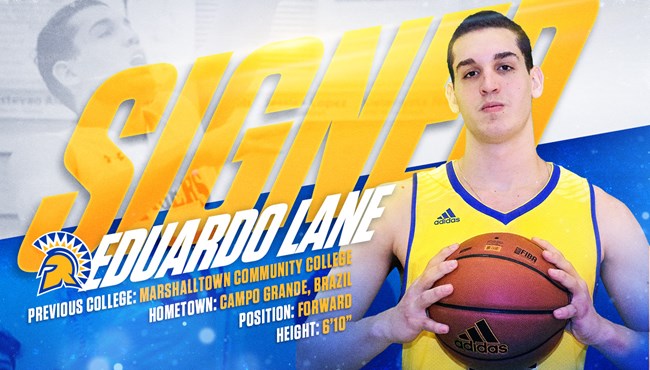
SAN JOSE, Calif. — San Jose State men’s basketball has signed Eduardo Lane and Ralph Agee as part of their 2019-20 class, SJSU head coach Jean Prioleau announced on Tuesday.

Photo credit: @SanJoseStateMBB

“I’m excited to have Eduardo and Ralph join the program,” Prioleau said. “They are a couple of big guys that will give us some size and depth up front, and I feel that both can make a big impact for us next season.”

Lane averaged 9.9 points and 4.4 rebounds per game in 30 appearances last season with Marshalltown, a community college in Marshalltown, Iowa. The forward drew 15 starts and tallied 14 games of double digit scoring, including a stretch of eight-straight games in which he averaged 15.5 points. He topped the 20-point plateau twice, including a season-high 21 points on 9-of-12 shooting against Kirkwood on November 28.

The 6-foot-10 prospect also played his freshman season at Marshalltown, averaging 5.5 points in 23 appearances. Lane played high school basketball at Capinas High School in Campo Grande, Brazil, where he was born and raised.

“I’m looking forward to joining San Jose State and am excited about the new changes and challenges of going there to play in the Mountain West,” Lane said. “It’s a new team, new coaches, new experiences and new everything. I’m thankful for the opportunity that Coach Prioleau has given me to become a Spartan.”

Agee joins the Spartans after spending his sophomore season at East Los Angeles College, where he helped lead the South Coast Conference champions to a 24-5 record and clinched the second seed in the California Community College Athletic Association Southern California Regional.

A 6-foot-9 forward, Agee appeared in all 29 games at ELAC last season while drawing five starts. He had one of his best games against Mesa Community College, finishing with a double-double of 13 points and 10 rebounds. In the final regular season game of 2019 against LA Trade Tech, Agee chipped in 11 points in 17 minutes off the bench to help the Huskies clinch the conference title.

“Ralph provided ELAC with physicality and toughness at the power forward position,” ELAC head coach John Mosley said. “He is athletic, has a great motor and plays inspired. He is loved by his teammates and campus community here at ELAC. He still potentially ha a high ceiling and should have an immediate impact for the Spartans in the Mountain West.”

Prior to ELAC, Agee played his redshirt freshman season at CSU Dominguez Hills, where he started 11-of-30 games played, averaging 4.9 points and just under 3 rebounds per game. He tallied 14 blocked shots and had double-digit rebounds twice. His best game came on November 11, 2017 as he dropped 24 points against Holy Names.

“I’m happy to be a Spartan and do what I need to do to help my team win,” Agee said. “Coach Prioleau, Coach Kimble and the rest of the coaching staff treated me like family and showed me how good the program fits my family and me. I can’t wait to get there and get to work.”

Agee played his school ball at Silverado High School and is a native of Victorville, California.

Lane and Agee are the third and fourth members of the 2019-20 class, joining Omari Moore and Richard Washington. Both have two years to play at SJSU.

San Jose State football games named to Mountain West national TV package

Photo credit: sjsuspartans.com

By: Ana Kieu

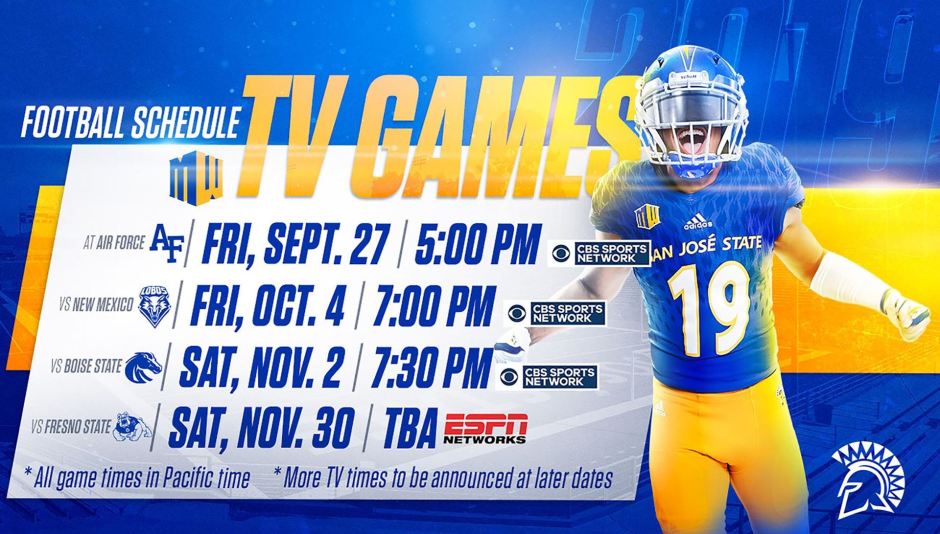
Three San Jose State Spartans home football games and one Mountain West conference road game are part of the conference’s 44-game national television package with CBS Sports Network and ESPN Networks.

San Jose State will be playing twice on Friday night starting with their Friday, September 27 conference opener at Air Force on CBSSN starting at 6:00 pm MT/5:00 pm PT. SJSU will be on CBSSN again the following Friday, October 4 for a 7:00 pm PT conference home game vs. New Mexico in CEFCU Stadium.

SJSU’s November 2 home game hosting Boise State now has a 7:30 pm PT game time and carried on CBSSN.

The Spartans’ final game in the conference’s national television package is Saturday, November 30 home game against Fresno State for the Valley Trophy. The game will be assigned to the ESPN Networks, but the game time will be announced at a later date.

With today’s announcement, AT&T SportsNet, Stadium, Spectrum Sports (Hawaii), CBSSN and ESPN will have an opportunity to select additional SJSU games for their respective broadcast packages.

Season tickets, group tickets and mini-plans are available for the entire San Jose State Spartans home football schedule at www.sjsuspartans.com/tickets or by calling (408) 924-7589.

Here’s the 2019 SJSU football schedule:

Josh Oliver was a Jacksonville Jaguars’ third round draft pick

Photo credit: sjsuspartans.com

By: Ana Kieu

For San Jose State University tight end Josh Oliver, a dream came true on the second day of the 2019 NFL Draft as the Jacksonville Jaguars’ first selection in the third round.

Oliver was the 69th overall selection in the Draft. He was the fifth tight end, the second from the 12-team Mountain West, and the second player from one of the three Bay Area schools that included Pac-12 Conference members Stanford and Cal to hear his name announced in the Draft so far.

Video Highlights

“I like to pattern my game after Tony Gonzalez. As a freshman coming in (to San Jose State), my college coach showed me a lot of Tony Gonzalez tape and I’d like to do as much as he can,” Oliver said in his first interview with the Jaguars media. He will be united with new Jags offensive coordinator John DeFilippo, who had the same position at SJSU during the 2010 and 2011 seasons.

Oliver, the 6’5″, 250-lb tight end from Paso Robles, Calif., is the first SJSU player in 10 years to be chosen in the first three rounds of a Draft. In 2009, defensive lineman Jarron Gilbert, the 68th overall selection by the Chicago Bears, and cornerback Christopher Owens, the 90th overall pick by the Atlanta Falcons, were among the top 100 players drafted that year.

Oliver was a first-team All-MW choice as a senior in 2018. He caught a team-high 56 passes for 709 yards and four touchdowns. 38 of his receptions (67.8%) resulted in a first down, one of the top three percentages by a NCAA Division I FBS tight end last season. He concluded his college career playing in the 2019 Senior Bowl.

For SJSU, Oliver is the third tight end drafted by a NFL team since 1996. Brian Roche was a third-round draft choice, 81st overall selection, by the San Diego Chargers in 1996. In 2004, Courtney Anderson was an Oakland Raiders’ seventh round pick, 245th overall.

Groundbreaking Ceremony Set for San Jose State Football Operations Center

Photo credit: sjsuspartans.com

By: Ana Kieu

SAN JOSE, Calif. — San Jose State University and its Division of Intercollegiate Athletics will host a groundbreaking ceremony for the future construction of a new Football Operations Center on the east side of CEFCU Stadium, Home of the Spartans. The ceremony is scheduled for Wednesday morning, June 5 at 11:00 am inside CEFCU Stadium.

Conceived in 2016 as a centerpiece in the development of the university’s 62 acres of land at the South Campus, the Football Operations Center will be a multi-story structure centralizing all of Spartan Football’s needs into one state-of-the-art building. The new facility will enhance all facets of football operations and provide a first-class environment for our student-athletes to succeed in the classroom, in competition, and in life.

“The Football Operations Center will provide our football team, athletics department and the entire university state-of-the-art spaces to compete and learn. This critical project will provide much needed services for our football program and will be utilized by other sport teams and campus divisions. The center will provide enhanced game-day experiences for our fans,” said Marie Tuite, SJSU’s director of athletics.

“This project is a crucial footprint to the overall renovation and enhancement of facilities on South Campus. Although our football program will be the main tenants, building multi-use facilities is always our objective.”

The new operations center will include locker rooms, an auditorium, offices, spectator seating on the 50-yard line and a Hall of Champions event space. The total project would be a rebuild on the stadium’s east side and also provide support to the Spartans’ men’s and women’s soccer programs.

Currently, the project budget is listed at $40-million. To date, $24.7 million has been raised for the Football Operations Center.

The work slated to take place during the summer includes removing bleacher sections along the stadium’s east side and landscape in order to set the foundation for building. During this time, SJSU will initiate a formal bidding process to determine both construction and architecture firms.

After the 2019 football season, the next phase of work will include moving the hill and relocating the scoreboard including lighting currently located along the east side — all required preparation for the physical construction of the center.

When the Football Operations Center is completed, the Spartan football program would move out of the Simpkins Stadium Center, opened in 1993 on the 7th Street side of CEFCU Stadium, to the opposite side of the stadium.

“The Football Operations Center will be a game-changer for San Jose State University. We are building a winning program here and our new home will provide our players, coaches, and staff the opportunities to succeed on the field, academically, and through our Beyond Football program,” said SJSU football head coach Brent Brennan.

“It will show future Spartans that we have a vision and a plan for a winning football program that goes to bowl games and competes for conference championships.”

The groundbreaking ceremony is open to the public. Parking will be available in the Park & Ride Lot, located across the street from the 7th Street side of CEFCU Stadium.

To learn how you can support Spartan football, please visit sjsufootball.com or contact Josh Thiel, deputy athletics director for athletics advancement, at (408) 924-1697 or joshua.thiel@sjsu.edu.

San Jose State and Western Michigan announce home-and-home football series

Photo credit: sjsuspartans.com

By: Ana Kieu

SAN JOSE, Calif. —  San Jose State University will play Western Michigan University in a non-conference home-and-home football series during the 2021 and 2022 seasons, respectively. Marie Tuite, the Spartans’ Director of Athletics, made the announcement for the university.

SJSU will travel to Kalamazoo, Mich. for the first time in program history for a Sept. 25, 2021 road game. The return game in San Jose, Calif. will be in CEFCU Stadium on Sept. 24, 2022.

When the Spartans face the Broncos on the road in 2021, it will be the first time these teams are competing against each other in football.

Western Michigan has been a member of the Mid-American Conference (MAC) since 1947. SJSU, a Mountain West member, has faced current MAC institutions: Miami (Ohio), Bowling Green, Northern Illinois, Toledo, Eastern Michigan and Central Michigan in its football history since 1979.