
Penguins Take 3-1 Series Lead With 3-1 Win

By Mary Walsh

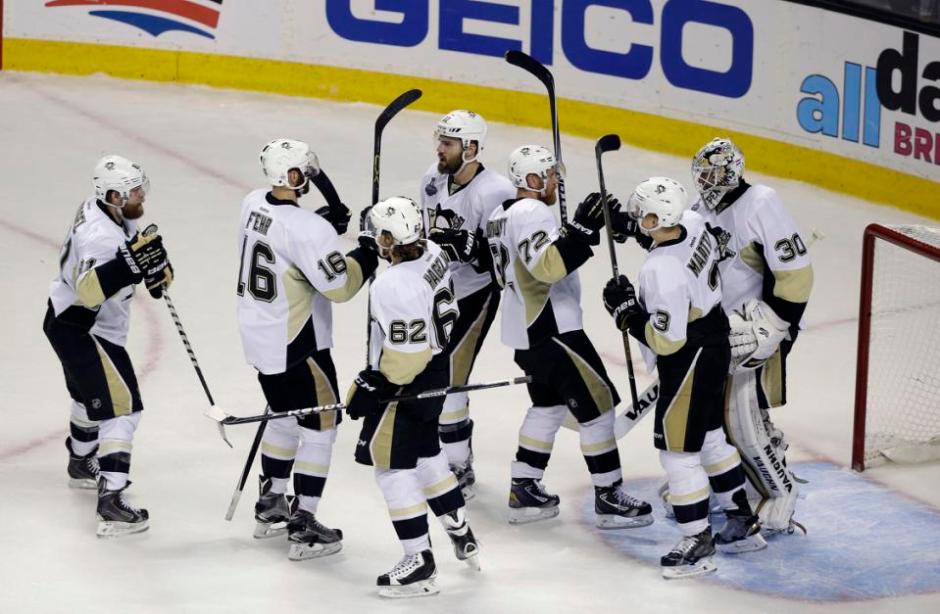
AP photo: The Pittsburgh Penguins celebrate after defeating the San Jose Sharks in game four at SAP Center on Monday night

SAN JOSE- The San Jose Sharks fell to the Pittsburgh Penguins by a score of 3-1, giving the Penguins a 3-1 series lead to boot. After the game, Sharks head coach said: “There’s no quit in our group. We’re the best road team in the league. We’re gonna show up and try to get this back here for Game 6 and play to win four, this isn’t over.” Then he went on:

We’ve been chasing the game the whole series by not scoring first so that takes you out of your four line… it effects all parts of your game. We’ve been on the other end of that in the playoffs where we jumped out to a lead on some teams and made them change their game. But I think that’s probably the biggest thing we have to fix. We’ve got to find a way to get on the board early in the game instead of chasing them.

Scoring first may require more than a tweak, but the Sharks game on Monday was fairly different from the first three games in the series.

Five minutes into the third period, Logan Couture sent Patrick Marleau up the slot all by his lonesome but Matt Murray stopped his shot. Both teams had chances in flurries but that one was a microcosm of the Sharks’ woes in Game 4. They did the things they had failed to do in prior games: staying even and leading in shots, winning faceoffs, getting zone time, blocking shots. And still they trailed on the scoreboard. Perhaps the one lopsided stat was the key: giveaways. The Sharks more than doubled the Penguins there. At one point in the game, it was almost triple.

Through the first six minutes of Game 4, there was just one shot, from San Jose. Both teams were pushing shooters to the outside when possible and blocking shots.

At 7:36, Phil Kessel and Ian Cole skated into the Sharks zone and, while three Sharks attended to Kessel, Cole found the pass and shot from the other side of the ice. It was Cole’s first goal of the post season. Assists went to Kessel and Evgeni Malkin.

Down by a goal, the Sharks had to kill an interference penalty to Marc-Edouard Vlasic at 11:37. They did, but the Penguins’ shot count had gone up by two, so the it was now 6-2 Penguins.

The Sharks had their chance on the power play at 14:45 when Ben Lovejoy went to the box for holding the stick.

The top unit held the zone and took a couple of shots but did not score. With almost a minute left, DeBoer sent the second unit out. They did not score either but neither did they get evicted from the zone before the power play expired.

The teams traded chances for the rest of the period, and at the end of 20 minutes the score was 1-0 Penguins, the shots 8-6 Sharks.

Melker Karlsson was called for interference just 2:28 into the second period, putting the Penguins power play back on the ice. It took them eight seconds to score, as a tipped shot from Kris Letang got past Martin Jones to Malkin, who was waiting at the far post to nudge it over the line. It was Malkin’s first goal of the series and fifth of the playoffs. Assists went to Phil Kessel, who tipped it, and Letang.

The Sharks got their second power play at 17:33 of the second. Bryan Rust was called for hooking Brent Burns. The Sharks power play did not start out with much traction. The second unit did not look much better, and with 10 seconds left in the penalty, gave up a nearly three on one going the other way. Sharks skaters caught up before any real damage could be done but they ended the power play with a defensive zone draw, and still trailing by two goals.

Melker Karlsson lifted the crowd’s spirits with a goal at 8:07. He was back on a line with Nick SPaling and Chris Tierney. The line charged into the Penguins zone and held a little riot around the net until finally Karlsson could see an opening. He took the shot while falling but managed to lift it over Murray. Assists went to Chris Tierney and Brenden Dillon.

The third period forward lines were: Couture centering Ward and Marleau, Tierney centering Karlsson and Spaling, Thornton centering Pavelksi and Donskoi. Wingels, Nieto, and Zubrus were seen but little in the third. Wingels and Zubrus did not take a shift, and Nieto took only one. The cut-backs started in the second period, where Zubrus and Wingels only had three shifts in the latter part of the middle frame

Another oddity in the lineup was evident in the third, with the defensemen being shifted around. It was not clear if this was due to some power play time or intentional line mixing. Braun and Dillon were on the ice together, and then Paul Martin and Roman Polak. For the final two minutes of the game, Vlasic and Burns were on the ice, but that was after Eric Fehr had scored another goal, assisted by Carl Hagelin and Olli Maatta.

Apart from the sound of some exuberant Penguins fans, a hush settled over the Tank. One last call for cheers and towels waving had some effect. With 1:25 left in the game and probably the last home game of the season for San Jose, the crowd waved and cheered.

The Sharks pulled their goalie with a little more than a minute left in the period and racked up some shots, to no avail.

Final score: 3-1 Penguins, with a series status to match. Game 5 will be in Pittsburgh on Thursday at 5:00PT.

Sharks Win Game 3 in OT, Climb Back in Series

By Mary Walsh

AP photo: San Jose Sharks Joonas Donskoi celebrates with teammates after scoring winning OT goal against the Pittsburgh Penguins at SAP Center on Saturday night

SAN JOSE–The San Jose Sharks defeated the Pittsburgh Penguins in Game 3 of the Stanley Cup Final Saturday, by a score of 3-2. The Sharks now trail in the series 2-1. The game winning goal came in overtime from rookie Joonas Donskoi. Joel Ward and Justin Braun also scored for the Sharks, while their goaltender Martin Jones made 40 saves on 42 shots for the win. Ben Lovejoy and Patrick Hornqvist scored for the Penguins. It was the Sharks’ first overtime win this post season.

There was some talk about the Sharks being wide-eyed on their first trip to the Stanley Cup Final. There may be something lost in translation, but Joonas Donskoi, first-year NHL player, does not seem particularly nervous. Asked what it felt like to score probably the most important goal in Sharks history, he said: “I think I had a lot of scoring chances through the whole Final, and this was a good time to get it in.”

The game was the first time the Sharks won a majority of the faceoffs against the Penguins. The Sharks had three power plays and scored on none of them. Neither team scored on the power play. The Sharks won on the strength of their even strength play. It was an impressive change from Games 1 and 2.

The headliners for both teams were kept off the highlight reels Saturday. Of how Marc-Edouard Vlasic and Justin Braun handled Sindey Crosby’s line, Sharks head coach Pete DeBoer said: “I thought Vlasic and Braun… you have to mention Brauny when you mention Vlasic too, I thought those two were excellent tonight, both ends of the rink, Brauny got a goal, defending, playing big minutes, they were fantastic.”

Melker Karlsson started the game in Tomas Hertl’s spot with Joe Thornton and Joe Pavelski, and the line had a good first shift. At 2:58 of the first, the Penguins were given a power play as a result of a call on Joel Ward for high sticking. Oddly, his stick did not appear above waist-high while the player he struck was bent down with his head low. It was odd because Ward took a stick to the face while falling that even drew blood in Pittsburgh, but that was not called.

The Sharks also seemed impatient with the penalty and went after the kill with determination. It was only after the Sharks killed the penalty that the Penguins scored off a shot from the blue line. The puck touched Roman Polak in front of the net. The goal was Ben Lovejoy’s.

As the ten minute mark approached, the Sharks still only had one shot on goal to the Penguins’ 8. They had not looked that bad. As if on cue, Justin Braun scored. He got the puck from Joe Thornton near the middle of the blue line, and with Melker Karlsson skating through the crease as a moving screen, Penguins goaltender Matt Murray never saw Braun’s shot coming. It sailed clean into the top right corner to tie the game. Assists went to Thornton and Marc-Edouard Vlasic.

The Sharks were not as bad as their shot count. Through the game, the Penguins blocked 38 shots. After the game, Joel Ward was asked about that number: “That’s a good sign. If you’re playing in the offensive zone, they’re blocking shots, you’re getting opportunities. So, just keep firing away.”

The Sharks were energized after Braun’s goal. The Penguins’ Phil Kessel had a breakaway shortly afterwards but Sharks goaltender Martin Jones stopped the shot and a defender came in fast to carry the puck away again.

The Penguins continued to outshoot the Sharks but in the final five minutes of the period, the Sharks racked up a good four shots and were generally looking stronger. The Penguins spent some time in the Sharks’ zone but both teams were doing a pretty good job of keeping the other to the outside and under heavy guard.

At the end of the first, the score was tied and the shots were 14-6 Penguins.

Early in the second, the game shifted gears for rougher terrain. Brent Burns took a punch to the face in the Penguins crease while trying to poke a puck past the goalie, and after that Justin Braun hauled a Penguin to the ice in the Sharks’ zone, but neither act was called as a penalty.

A little later, Chris Tierney and Joel Ward had a two on one chance but Penguins goaltender Matt Murray handled it. It served as a reminder that the Sharks had given up far too many two on ones in earlier games, and they seemed to be doing a better job of preventing them this time.

In the tenth minute of the period, the Sharks held the Penguins pinned in their zone for a long enough spell to draw a tripping penalty from Carl Hagelin. This gave the Sharks their first power play of the game. The Penguins killed it, but not without giving up a few more shots.

After 10 minutes, the Penguins had two shots on the period. After 15 minutes, they still had two. The Sharks had eight in the first fifteen minutes.

Just after the announcer proclaimed that there was one minute left in the game, Ben Lovejoy picked up a puck that looked like it was going out and threw it back at the net to regain the lead. The puck went off of Patrick Hornqvist, with assists to Ben Lovejoy and Olli Mattaa. It was the Penguins’ sixth shot of the period.

Almost five minutes into the third period, Nick Bonino caught Joe Thornton with a high stick and drew blood. It took the Penguins almost ninety seconds to clear the puck the first time. The power play seemed to lose energy after that and with 1:19 left in the penalty, DeBoer took his time out and gave his top power play unit a rest. That helped them a little but they still could not convert.

The second unit came on with seconds left in the penalty. The Penguins cleared the puck to the neutral zone. The Sharks stopped it short and went the other way. Joel Ward took the puck up the slot. With a Penguin between himself and the goalie, he took what must have been a deceptively hard shot. The puck went over Murray’s left shoulder, bending his glove back and tying the game just as the penalty expired. It was Ward’s seventh of the post season, with assists going to Joonas Donskoi and Joe Thornton.

At the end of regulation, the score was tied at two and the shots were 33-22 Penguins.

The first seven minutes of overtime went back and forth with grueling suspense. The Penguins were outshooting the Sharks 5-1. The Sharks lines seemed jumbled, whether by incomplete line changes or actual line adjustments. In any case, Chris Tierney, Melker Karlsson and Joonas Donskoi were in the Penguins zone stirring things up behind the net and along the boards. At 12:18, Donskoi carried the puck behind the net and came out the other side, then spun and shot in a quick motion. The game winner was Donskoi’s sixth goal of the playoffs. An assist went to Chris Tierney.

For Game 4, the teams will return to SAP Center in San Jose. Game time is 5:00 PT.

Sharks Without Hertl for Game 3

By Mary Walsh

AP photo: San Jose Sharks Tomas Hertl who sat out game three vs. the Pittsburgh Penguins in the Stanley Cup Finals

SAN JOSE–Sharks head coach Pete DeBoer has confirmed that Tomas Hertl will not play in Saturday’s Game 3 of the Stanley Cup Final. He described Hertl’s injury as a lower body one. Of Hertl’s performance so far, DeBoer said:

He’s arguably been our best player for the first two games but injuries are no excuse this time of year, we’ve got someone who will go in for him and we’ll roll out there and be ready to play.

As for who will draw into the lineup, there is little mystery. When Matt Nieto returned to the lineup for Game 2, Dainius Zubrus was the odd man out. He will most likely be back in. On the subject of who will play in Hertl’s spot on the top line with Joe Thornton and Joe Pavelski, DeBoer said:

We’ve got a couple guys that’ve played in that hole before. Melker has before, and so has [Zubrus] played there before. I think the one thing that those two guys… you’ve got a guy that’ll hound the puck and work for it. Those two guys pretty much take care of the rest. I think we’ve got a lot of options there because of who we’re sticking them in with and I think it should be fairly seamless.

Sharks captain Joe Pavelski also weighed in on how Hertl has contributed to the team in the playoffs:

He’s been a big part of this team, especially the second half. You saw the smile on his face the last few rounds. He’s really enjoyed playing, he brings that energy. It’s tough to miss a guy like that if you have to. But somebody steps in, we’ve done it, we’ve done it for a while. We still expect a great effort from whoever comes in in a good role. We haven’t had a ton of injuries so there’s been somebody always ready to step in.

A the dust settles from Logan Couture’s comments on faceoffs, there remains the fact that the Sharks have not been very good in the faceoff circle. Among playoff teams, they have consistently been at the bottom in faceoff win percentage. It begs the question, what does the team do to still win the game, or 12 games, despite rarely starting with the puck? Logan Couture explained: “Get it back right away, put it in good places so we can forecheck and hold on to the puck in their end. There’s a few things you can do off a faceoff or forecheck that can turn the puck over.” So far, the Sharks have not been able to do any of those things very well against the Penguins. They will get another chance tonight.

Something else they will get a chance to do tonight is get back to their game. Apart from moving the puck quicker with simpler plays, thereby improving their execution, their forwards could probably backcheck more aggressively. Some time ago, I asked Sharks defenseman Paul Martin what it is about the Sharks that make them effective defensively:

[Jones] playing the puck, our forwards come back and support us and we rely on them to get out of the zone. I think everyone’s capable on our d-corps. When Roman [Polak] came over he kind of solidified that last pair and Brenden Dillon’s had  a break out year and he’s been great and he continues to improve. And the top four have been around for a while now. As far as experience, with [Vlasic] obviously, he’s a world class player, along with [Burns] they can bring something else that a lot of guys can’t.

I think we all can skate and get around the ice, and the ability to make that first pass out of the zone is big and I think we all understand the way we want to play. We all get along and so that’s big. The chemistry that we have is important.

Ironically, the formula Martin described there, with the forwards being as crucial to defense as defensemen are, pretty well describes how the Penguins have been playing. One has to wonder if it is even possible for two teams to play that way at the same time, or if they must first defuse their opponent’s arsenal.

The fact that Pete DeBoer has been here before, with the New Jersey Devils against the Los Angeles Kings, can only give fans so much comfort: his team forced a Game 6 but did not win the series. Is he hunting with a bigger boat this time?

Stanley Cup Final Preview: Sharks and Penguins

By Mary Walsh

design presented by penguins.nhl.com: Pittsburgh Penguins and San Jose Sharks digital preview design

In their first appearance in the Stanley Cup Final, the San Jose Sharks are in a good position to win, and so are the Pittsburgh Penguins. Not surprisingly, the two teams accumulated were very similar numbers on their way to the Final. Perhaps those are just the kind of numbers winners needed this year. Perhaps they are as irrelevant as statistics from the regular season. The Sharks and the Penguins could play each other four times or seven times, and it won’t add up to the number of games they played getting here. Games, and by association the series, can still be won or lost on a bounce. Either team could have trouble adjusting to a new sort of opponent, a heretofore unseen weakness could be exposed. This is why they play the games, because the NHL can’t award the championship based on past performance. Still, the likeness is uncanny.

Statistically, the Sharks and the Penguins are pretty even when you balance offensive and defensive numbers. The Sharks’ power play has a slightly higher success rate at 27%, with he Penguins scoring just 23.4% of the time. But balanced against the penalty kill, where the Penguins have been slightly better than the Sharks (83.4%-80.4%), the power play difference is even more negligible than 3.6%.

In shots per game, the Penguins have 35.1 where the Sharks have 28. San Jose’s Joe Pavelski and Brent Burns have taken 60 and 61 shots respectively, but Pittsburgh’s Phil Kessel has thrown a whopping 73 shots at the net. Again, put next to the shots against per game, it evens out. The Sharks have allowed an average of 27.1 while the Penguins averaged 29.7.

In goals, the numbers are so close (Sharks at 3.5 and Penguins at 3.22) that a counterbalance is hardly necessary, which is a good thing for Pittsburgh since the Sharks have allowed an average of 2.28 while the Penguins allowed 2.39. That gives a tiny edge to the Sharks in the area of goal differential.

The counterbalance actually comes from the fact that the Penguins have shown greater depth in scoring. The Sharks have more goals but they have come from fewer players. The Sharks have seven skaters with five or more goals in these playoffs, and four more with two to four goals. That gives them eleven skaters with more than one goal. The Penguins have just five skaters with five or more goals but eight with two to four goals, for a total of thirteen skaters with more than one goal. It is not a big difference, but neither is the difference between how many goals the teams have scored on their way to the Final.

The Penguins may have an edge in experience because they do have some players who have competed for and won a Stanley Cup in the past. Only the Sharks’ goaltender Martin Jones can say that, though he did so as the backup goaltender. The Sharks have plenty of players with enough mileage that, if they do not know what it takes to win at this level, they will probably learn quickly. I would not put a lot of stock in the “been there” factor.

In goal, the teams have fairly similar situations. Both teams, coaches and players, have talked about how calm and unflappable their young goaltender are. Martin Jones has more NHL starter experience but he is still in his first season. He has not been replaced during the playoffs, he has started every game for the Sharks. Jones put together a .919 save percentage through the first three rounds, with the full demonstrable confidence of his coach and his team.

The fact that the Penguins’ Matt Murray came onto the scene later than Jones should not be held against him. Marc-Andre Fleury was the presumptive playoff starter for most of the season. That Murray had to earn his spot very recently could be an asset if he is still trying to establish himself. The Penguins did experiment, having Fleury start a game in Murray’s place, and Zatkoff started a game before Murray did. Even if any of that undermined Murray’s confidence, he still played well enough to help his team win. His save percentage has been .875. Jones seems to have the edge over Murray there, but those numbers can change quickly.

Ultimately, few of these comparisons matter. All of the games played to this point were conference exclusive. The Sharks’ numbers were against western teams, the Penguins’ against eastern. The Sharks had to defeat a recent Cup winner, and then defeat the team that defeated another recent winner. It would not be outrageous to say that it is harder to score a goal, or prevent one, in the west. But it would be pure speculation since the Final is the only time East meets West. Both teams earned their spot in this series, and the odds are good that they will both bring their best games yet.

Marleau Scores 1000, Sharks Win Streak At Five

By Mary Walsh

photo credit: tjcnewspapers.com Patrick Marleau skated to his 1000th career point vs. Pens 11-21-15

In a 3-1 win over the Pittsburgh Penguins, San Jose Sharks forward Patrick Marleau earned his 1000th career point, and his 1001st. Former Penguin, now Sharks defenseman Paul Martin scored his first goal of the season, and the Sharks extended their winning streak to five. Brent Burns scored two goals and goaltender Martin Jones stopped 38 of 39 shots. The Sharks did this despite the absence of head coach Peter DeBoer, who was away due to a personal matter.

The win holds added promise as the team changed their lineup somewhat from the group that won the last game in Philadelphia. Defenseman Matt Tennyson was in, Mirco Mueller was out. Nikolay Goldobin was in, while Micheal Haley was out. This was also the first game of this road trip that the Sharks won by more than one goal. It was a step forward in an already excellent road trip. After the game, Patrick Marleau described the team’s success on this road trip:

I think when we haven’t been our best, there’s different guys stepping up and playing key roles. Jonesy’s been playing great, but finding a way  to get those points, those wins is big. You’re not going to have it every night, and I think last game against Philly we saw that and we still found a way to get it in overtime. I think tonight we played a pretty strong sixty minutes against a very powerful offensive team with a  lot of good players over there.

The first power play of the game went to the Penguins, after a hooking call against Melker Karlsson. The Sharks penalty killers kept the Penguins at bay and only allowed one shot to get through to Martin Jones. The penalty ended in a two on one for Patrick Marleau and Joel Ward. Marleau opted to shoot, but he hit the near post.

The penalty kill seemed to energize the Sharks. After the break, they spent three long shifts in the offensive zone. During the third one, Brent Burns picked up a rebound from a Ward shot and put the puck in an open net. The second assist went to Marleau.

The assist was Marleau’s 1000th career point. When this was announced, the Pittsburgh crowd gave Marleau an understandably subdued but gracious round of applause.

The Sharks had to kill a second penalty when Mike Brown was called for kneeing at 12:40. The Sharks killed that off and had two unsuccessful power plays of their own before the first period ended. At the first intermission, the shots stood at 12-9 Pittsburgh.

The Sharks took another penalty early in the second. Joe Pavelski was called for high-sticking Rob Scuderi at 6:39. The stick drew blood so the Penguins had four minutes with a man advantage. It took the Sharks 90 seconds to clear the puck the first time. On a third zone entry, Phil Kessel found some space and tied the game. The goal came just shy of the two minute mark, so the Sharks had to kill the second minor despite the goal.

The Sharks regained the lead at 13:06 when Burns took a shot from the point just as Ward cruised across in front of Marc-Andre Fleury. The puck clipped Scuderi enough to change direction and make the Penguins goalie’s job harder. Assists went to Paul Martin and Patrick Marleau.

The Penguins had another power play at 17:21. when Paul Martin was called for high-sticking. Pittsburgh had an early shot but the Sharks kept them out of the zone for most of the penalty.

San Jose failed to convert on yet another power play early in the third, but some good chances set the tone for a strong period. 8:27 into the third, Paul Martin extended their lead to 3-1. His shot from the blue line went through traffic and Fleury after a great shift from Matt Nieto, Tomas Hertl and Joonas Donskoi. While Nieto and Hertl wreaked some havoc near the Penguins net, Donskoi sent the puck up to Martin for the shot. An assist went to Donskoi.

By the end of the game, the Penguins had a shot lead of 39-29 but the score was still 3-1 Sharks.

Logan Couture skated on Saturday in full gear. Couture explained that this was part of the process, and that he still had no specific return date: “I don’t plan that far in advance, I didn’t plan this whole trip in advance, like I said it’s kind of a day by day thing. All how it reacts.”

The Sharks next play on Sunday at 2:00 PT, in Columbus against the Blue Jackets. It will be their second meeting of the season. The Blue Jackets defeated the Sharks 5-2 on November 3 at SAP.

Sharks Sign Paul Martin

By Mary Walsh

The San Jose Sharks have signed Paul Martin to a four year deal, according to Pierre LeBrun of ESPN. The former Penguins defenseman was reportedly sought by a number of teams. A four year contract might be surprising for a 34-year old defenseman, but most teams overpay for the players they get on the first day of free agency. This is why the Sharks have not traditionally gone this route. Sharks GM Doug Wilson must feel that Martin is worth the risk.

Martin started his NHL career with the New Jersey Devils. After five seasons with New Jersey, he was moved mid-season to Pittsburgh where he was a mainstay on the blue line for another five years. Dan Rosen had Martin in his list of top 20 free agents at NHL.com, saying that he can be effective in many roles, including special teams and top pairing. Presumably, the Sharks will not require him to be on the top pair but that versatility certainly added to his value.

Last season, Martin came in 38th league-wide in average ice time, 33rd on the penalty kill and 70th on the power play. On his team, he was second in power play time, third short-handed and second in all ice time to Kris Letang. His defensive numbers suggest that he should be a reliable addition, at least for a couple more seasons.

Sharks Finish Road Trip With Shootout Loss to Penguins

By Mary Walsh

For the second time this season, the Sharks and the Penguins went to a shootout to resolve a tied score. This time, the Penguins prevailed, jumping over the New York Islanders for second place in the Metropolitan Division. The Sharks earned a single point but despite having a four on three power play for most of overtime, they could not grab the extra point that they urgently needed to keep fighting for a playoff spot. On the bright side, Al Stalock was featured in the NBC save of the game. Stalock was starting the second of back to back games, after playing Saturday afternoon in Philadelphia.

The shootout winner was scored by Pittsburgh’s David Perron. Patric Hornqvist and Chris Kunitz also scored for Pittsburgh. Marc-Andre Fleury made 30 saves on 32 shots for the win. Ben Smith and Logan Couture scored for the Sharks and Al Stalock made 31 saves on 33 shots for the Sharks.

The Sharks were without defenseman Marc-Edouard Vlasic, so Taylor Fedun was called up to fill the empty spot on the blue line. The Penguinswere also missing some key players. They only had five defensemen after Kris Letang sustained a concussion on Saturday.

The Sharks held their own for the first minutes of the game, but gave up two goals in a 56 second span mindway through the first period. At 7:08 of the first, Patric Hornqvist opened the scoring off his own rebound. After some tenacious play behind the net, Daniel Winnick got the puck ahead of the goal line. Hornqvist and Sidney Crosby were hovering around in front of the blue paint to make something happen. They did. Assists went to Winnick and Ian Cole.

33 seconds later, Taylor Fedun took Evgeni Malkin down with a hook. It was difficult to see why Malkin fell, but the hook was called and the Sharks went on the penalty kill. The eighth ranked Pittsburgh power play did not take long to score. In less than 30 seconds, the Penguins had the Sharks moved out of position and heavy on the right side. This gave Crosby plenty of time to draw Stalock to the left and then pass to Kunitz on Stalock’s right. Crosby’s pass went under Brenden Dillon’s stick as the Sharks defenseman attempted to help his goalie out. The goal was scored by Kunitz with assists to Crosby and Derrick Pouliot.

The Sharks stopped the bleeding for the rest of the first, and ended up outshooting the Penguins 12-9. Melker Karlsson was hit in the hand by a shot from Brent Burns late in the period but he was back on the ice for the second period.

The Sharks cut the lead in half when Barclay Goodrow controlled the puck on the half boards long enough to pass it to Justin Braun at the point. Braun took a quick shot that Ben Smith deflected past Marc-Andre Fleury’s shoulder and in. Assists went to Braun and Goodrow.

The Sharks had their first power play opportunity at 11:06 of the second when Maxim Lapierre was called for hooking. The Sharks did not get a shot on goal during the power play. They had another chance at 14:53 of the same period when Ben Lovejoy was called for cross-checking Chris Tierney. This time, Logan Couture made the most of the situation and scored at 15:38. After one failed zone entry, the Sharks regrouped quickly and Brent Burns’ neutral zone pass caught Patrick Marleau, who was able to hand it off cleanly to Couture who was moving to the net. Assists went to Marleau and Brent Burns.

At the end of the second, the Penguins had edged ahead of the Sharks on the shot clock 20-19.

The Sharks had another power play early in the third period when Crosby tripped Brent Burns in the Sharks’ zone. Brent Burns created one good chance carrying the puck into the zone and getting it in front of the net, but the Penguins’ penalty killers did not give the Sharks any room to work. The score remained tied.

The Sharks took the next penalty, a high-sticking call against Tommy Wingels at 12:51 of the third. San Jose’s penalty killers were more effective this time, clearing the puck more than once and, obviously, not allowing another goal against.

A penalty against Pittsburgh followed right on the heels of their power play, when Nick Spaling went to the box for holding. The Sharks could not take the lead with the power play and the next best scoring chance went to the Penguins’ David Perron but the buzzer sounded.

A play by Justin Braun almost ended the game early in OT but Marleau could not get his stick on it before the Penguins cleared it away from the crease and out. The Sharks came back in quickly. In a battle along the boards to keep the puck in, Hornqvist caught Brent Burns in the mouth with his stick. He did look remorseful, as he had been trying to lift Burns’ stick and not cut him in the face. In any case, Hornqvist went to the box for a four minute power play.

The Sharks started the four on three power play with a Thornton shot off the post. Pavelksi shot next, then Couture opted not to shoot. That was probably the tidiest part of the extended power play. The Penguins seemed to find their rythm and pushed the puck out a few times. One interesting hiccup came when the puck looked like it was going out but Burns kept it in with his body. Unsure whether it had been kept in, several players loitered near it as if expecting a whistle.

Sharks coach Toddd McLellan used his timeout to rest his players after the next stoppage, instead of changing his four man power play unit. The strategy did not pay off and the Penguins killed the penalty. Their fans gave them a standing ovation for their efforts. The final shot count after overtime was 33-32 Penguins.

David Perron went first in the shootout. After a careful hesitation, he beat Stalock with a backhand to give Pittsburgh the lead. Melker Karlsson shot next but lost the puck after faking a shot.

Sidney Crosby shot second for the Penguins and scored. Logan Couture shot second for the Sharks but hit the post.

Final score: 3-2 Penguins.

Logan Couture led the Sharks in shots with seven. Brent Burns led the Sharks in hits with three and ice time with 26:08. Brenden Dillon led the team with three blocked shots. The Sharks had a slight edge in the faceoff circle, winning 36 to the Penguins’ 33. Tommy Wingels had the best faceoff win percentage on the team with 60%, but he only took five faceoffs. Joe Pavelski won 9 of 16 for a win percentage of 56%. Pittsburgh’s Maxim Lapierre beat pretty much everyone most of the time, winning 93% of 14 faceoffs, against a variety of opponents.

The Sharks return home to play at 7:30 PT on Wednesday against the Colorado Avalanche.

Sharks’ Win Streak Ends With 5-1 Loss to Pens

By Mary Walsh

PITTSBURGH- The San Jose Sharks were overwhelmed Thursday, by a team they had handled very well in past meetings. The final score was 5-1 Penguins. The Sharks had their work cut out for them in Pittsburgh, as Sidney Crosby has still never scored against the Sharks, so that was and is probably on his to do list. The job got much bigger when the Sharks went down 4-0 with just over half of the game remaining. That hole was too deep for San Jose to climb out of.

Thursday morning, Pierre LeBrun offered the Sharks at Penguins game as a good alternative to the All Star Game. In the first period, the comparison was grossly inaccurate, as both teams played stifling defense. Play opened up in the second period, with one team racking up the shots, and the other piling up goals. The Sharks got credit for 24 shots in that fateful period, while the Penguins scored four goals.

Before the game, Penguins Head Coach Dan Bylsma said, of his team’s third line:

…it’s not a typical physical it’s not a shut down line, they do it with speed. All those guys have some tenacity to their game too, it’s not just speed, you can’t knock them off the puck that easily. Chris Connor, we said it when we called him up “he’s going to knock someone down every game” and against Toronto his first game, right before his goal he reversed shoulders and knocks a guy down in the offensive zone but the speed at which they play as a unit is a factor… and they’re tough to handle and they’ve been able to do that with some consistency for our group in all the games they’ve played.

That formula turned out to work well against the Sharks, not only for the line Bylsma was describing.The Sharks had a lot of shots, but they didn’t have much time to set those shots up.

Much was made of how the Penguins and the Sharks were not especially familiar with each other, but they each had players who had faced the other team more than once. The above-mentioned Chris Conner had faced the Sharks as recently as late last season, while playing for the Phoenix Coyotes. Some of the Penguins, though, had not played the Sharks before. Penguins defenseman Simon Despres, recently recalled from the AHL, looked forward to the challenge:

I know nothing about San Jose, it’s my first time playing a West[ern] team personally, so I’m excited to play them … They’re a top team in the league, it’s going to be a good challenge for the team.

Familiar with San Jose or not, the Penguins were prepared for the game.

Sharks’ Head Coach Todd McLellan didn’t make too much of the absence of Evgeni Malkin from the Penguins lineup. Before the game he pointed out that the Penguins have a lot of recent experience playing without their top scorers, and playing well.

The Sharks took two penalties in the game, and both went to John McCarthy. On the second of those, the Penguins scored their fourth goal of the game. McCarthy’s penalty minutes were not the only thing going wrong for the Sharks. There were few mistake-free players for San Jose, and the team’s overall composure was badly rattled by the early second period onslaught from Pittsburgh.

In the first period, both teams kept their opponents to the outside and most of the shots taken were hurried. One good chance came for the Penguins when Andrew Desjardins and Scott Hannan both failed to get control of the puck in the slot, Chris Conner sped in and got a shot off. Niemi stopped it. Neither team had many great chances in the first period, even on the power play.  The period ended with shots 12-7 Pittsburgh.

The second period started inauspiciously for the Sharks, with the home team scoring less than 30 seconds in. Pascal Dupuis scored the first of the game on a tip from Brooks Orpik’s shot from the point. The Sharks responded  with a good shift from the Pavelski line, but that was followed by a three-on-one rush when Despres pushed the puck past Jason Demers. Jayson Megna and Joe Vitale went the other way. Megna took the shot, scoring his third of the season.

With the score 2-0, Pittsburgh’s Matt Niskanen was called for interference on McCarthy. The Penguins stopped the Sharks from scoring on the power play, and came back with offensive pressure that exposed the Sharks yet again.  After a turnover in the Sharks’ zone, Niemi stopped a Sidney Crosby shot but Chris Kunitz picked up the rebound and made it 3-0.

San Jose’s fourth line looked like they might shift the momentum as they got in the zone and had the Penguins scrambling, until McCarthy was called for tripping Olli Maatta in front of the net. It took the Penguins 14 seconds to score on that power play. The goal went to Kunitz, from James Neal and Sidney Crosby. 4-0 Penguins.

The Sharks finally got on the board at 9:27 of the period, with a goal from Tomas Hertl, possibly off of Pittsburgh’s Derek Engellund’s stick. Shortly thereafter, Andrew Desjardins drew a penalty, giving the Sharks a power play that seemed to let them regroup. They had eight shots before the penalty expired but failed to score.

By the end of the period, Todd McLellan had replaced Joe Pavelski with Andrew Desjardins at center with Tyler Kennedy and Martin Havlat. Pavelski was moved to center John McCarthy and James Sheppard.

The second period ended with the score 4-1 Pittsburgh, and the shots 31-27 San Jose.

McLellan changed goaltenders for the third period, putting Alex Stalock in to replace Antti Niemi. The forward lines remained as they had finished the second, with Pavelski centering McCarthy and Sheppard.

The Penguins started the period in the Sharks’ zone. Four minutes later they extended their lead to 5-1, a goal from Kris Letang. It was the Penguins’ first shot of the period. They only got credit for two more, to the Sharks’ 14. The final count was 45-30.

Marc-Andre Fleury made 33 saves on 34 shots for the win. For the Sharks, Antti Niemi made 21 saves on 24 shots in the first two periods, Alex Stalock made two saves on three shots in the third. The Sharks’ power play went 0-3, their penalty kill 1-2.

It was Dan Boyle’s 900th NHL game, Tyler Kennedy’s 400th, and Sidney Crosby’s 500th.