Sharks Beat Ducks With Lively 3rd in Home Opener

By Mary Walsh

SAN JOSE– Saturday, the San Jose Sharks won their home opener 2-0 against the Anaheim Ducks. The Sharks’ best period of the game was their third, and it was a relentless one. It seemed to be just the kind of game head coach Pete DeBoer was looking for from the Sharks:

That’s how we want to play with the lead. You want to keep your foot on the gas. We kept rolling four lines to keep our energy and our legs. The best defense for me in that situation is spending the period in the other team’s end and I think we did a good job of that.

After the game, Sharks captain Joe Pavelski also talked about that third period push:

We kind of got better as the game went on, right from the start. The second was a little better and the third was definitely our best and it needs to be. I’d say last year that was one of the problems in this rink, we didn’t have strong thirds. So hopefully we can continue with that trend.

Joel Ward was asked about the developing chemistry between himself and his linemates, Logan Couture and Patrick Marleau:

When you get a chance to play with guys like Cootch and Marleau, it makes it a lot more fun, how dynamic they are and how skilled, what they can create on their own is pretty cool to watch. So, as you can see what Patty did tonight was a good example of that. Just try to get in the open areas and I just try to feed off them and know what they want from me, just communicating as best we can, it’s just going to continue to build.

Ward seemed to be communicating quite well with his linemates on Saturday, turning up in the right spot again and again, on both ends of the ice.

Sharks goaltender Martin Jones has also made an excellent impression in this two game sample. Martin Jones, after his second game and second win as a Shark, praised the team in front of him:

I thought we did a really good job. I mean, that’s a big, strong team up front and typically they do a really good job, getting in front of the net with bodies and with sticks. I thought we did a really good job boxing out and I was able to see a lot of pucks tonight.

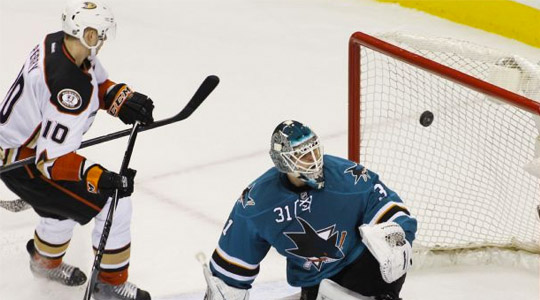
As second games of the season go, this one was impressive: two goals from Patrick Marleau, two points for Joel Ward, and a second win from Martin Jones. The game even had two 31s in net, one at each end. Jones and Anaheim goaltender Frederik Andersen both wear 31.

With nine minutes left in the first, the shots were 7-3 Anaheim. Sharks had killed one penalty, but had had no power plays. They did, however, have a very good spell right about then, lasting almost three minutes and shifts for as many lines. The third line started it, with some aggressive play in the Ducks’ zone. The top line followed it up and the Sharks seemed to be on a roll and likely to score. When they finally had to defend again, Martin Jones was there to stop the Ducks. The game remained scoreless, but by the end of that little sprint, the shots were almost even, 9-8 Ducks. By the end of the period, the Sharks had a solid 13-9 lead in shots.

They were right back at it to start the second period, spending most of the first two minutes in the Ducks’ zone. After that, however, the Ducks pinned the Sharks for a solid couple of minutes. A breakaway from the third line broke up the Ducks’ momentum and ended with a discussion by the Ducks’ net. The second line picked up where the third left off, and added three shots to the Sharks’ tally in the space of a few seconds. By now, the Ducks were getting a little incensed.

By the middle of the second period, the game was clearly a goaltender battle. Both 31s were snuffing out scoring chances wherever they cropped up. Admittedly, they were few but that was partly due to quick reactions from the goalies.

The other limiting factor for those scoring chances was timing. A couple of shots fell flat for lack of follow-up and bodies in the right places. It was a reminder that this was only the Sharks’ second game of the season.

The game took on a delayed back and forth tempo, with each team trapping the other for a long shift before going the other way. The Ducks seemed to have the edge at the end of the period, catching up in shots and holding the zone just a little longer than the Sharks could.

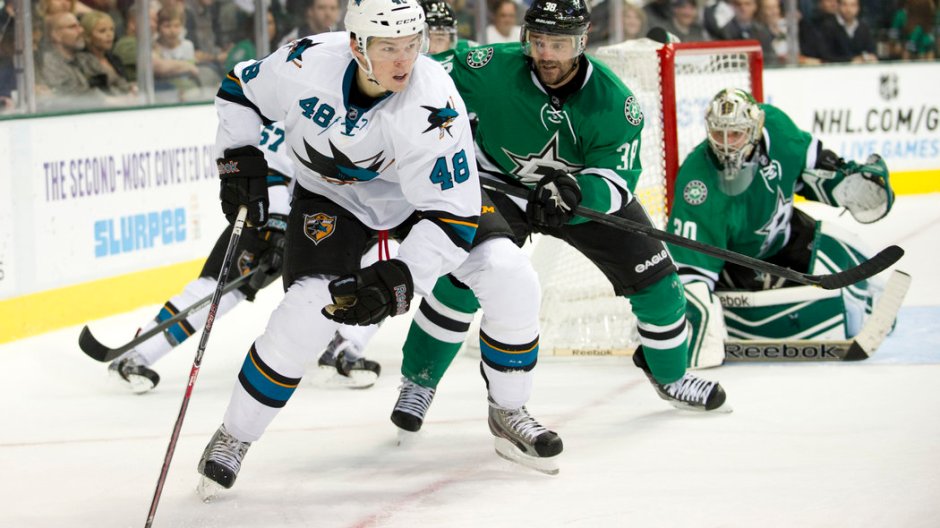
The period was winding down to a scoreless close, but the Sharks’ second line had other plans. Joel Ward and Logan Couture chased the puck into the corner and kept after it. The announcer had just made the “one minute left” call when Ward got the puck to the net. Couture caught up with it on the other side and took a shot. Just then, Marleau followed up to take the third and fourth shots. He gave the Sharks a 1-0 lead with the fourth one. Assists went to Couture and Ward.

The Sharks ended the second period up by one goal and three shots, 27-24.

In the middle of the third period, the fourth line of Barclay Goodrow, Chris Tierney and Mike Brown had a very good shift, holding the zone with tenacity, getting a couple of shots in, and maintaining their composure when the Ducks finally got the puck out. They finished by slowing Anaheim down enough in the neutral zone for the defense to get organized for a line change.

Around the 13 minute mark, the fourth line held the zone again with aplomb, aided by Tomas Hertl Hertl, who had missed his line change. Eventually, he did manage to switch with Tierney, without the Ducks ever gaining control of the puck. It was an impressive shift by the fourth line and the top defensive pair of Marc-Edouard Vlasic and Justin Braun.

With almost six minutes left, the Sharks had taken twelve shots during the period. The Ducks had taken three.

Shortly after the next faceoff, Marleau scored his second of the game on the team’s 40th shot. It was a lovely wraparound after he carried the puck across the blue line and through the o-zone against two Ducks. The lone assist went to Joel Ward, who apparently made the pass while also playing it safe:

I knew he can do that so I just kind of “here, you take it, you go.” I came back to the bench… I knew we were in our zone a little bit and I just kind of tried to play it safe, I didn’t want to get caught up the ice. Next thing you know hands are up in the air and I was looking for water.

The Sharks got their first power play with 3:07 left in the game. The penalty went to Mike Santorelli for hooking Barclay Goodrow. They did not score but the power play prevented Anaheim from pulling their goalie or coming back in the last minutes.

The final shot count was 44-27 Sharks.

Patrick Marleau led the Sharks in shots with seven. Mike Brown led in hits with eight. Brent Burns had the most time on ice with 24:43. Martin Jones made 27 saves for the shutout.

Frederick Andersen made 42 saves for the Ducks, no small feat. That earned him the third star of the game. The first star was Marleau and the second was Martin Jones.

Jakob Silfverberg led the Ducks in shots with four, and Andrew Cogliano made the most hits for them: four.

The Sharks will hit the road and play Tuesday in Washington against Ward’s old team, the Capitals. The game will start at 4pm PT.
Senators Hand Sharks 8th Home Loss

By Mary Walsh

SAN JOSE- A 4-2 loss to the Ottawa Senators was not the game the Sharks were looking for. Home is where the heart is, or maybe it’s just where they have to let you in when you come knocking. In any case, home has not been a very lucky place for the Sharks. After seven straight losses, the Sharks were looking for their first home win in February. They finished the month with not one home win.

Sharks goals were scored by Tommy Wingels and Patrick Marleau. Wingels is the only Shark to have faced Senators’ goalie Andrew Hammond before Saturday, as they played against each other in college. Ottawa goals were scored by Mike Hoffman (2), Mark Stone and Erik Karlsson. The loss left the Sharks still two spots and three points out of a wild card playoff position, with just 19 games left to play. Eight of those will be played at home, for better or worse.

The game started auspiciously for the Sharks. Matt Irwin battled his way past one Senator then eluded three more to put the put in the vicinity of the blue paint. From there, James Sheppard and Tommy Wingels took over to push the puck past Ottawa goaltender Hammond. Coming off of back to back shutouts, it ended his streak at 122:27. Assists on the goal went to Matt Irwin and Matt Nieto.

The Sharks continued to assert themselves through the rest of the first period. The shot gap was as high as 9-2 at one point, which did not accurately reflect how disorderly the Senators were. Their best chance came during the final minute of the period, when a couple of shots and rebounds made Niemi work in the Sharks’ net. The Senators buzzed but the Sharks pushed them back out.

The first ended with the score 1-0 Sharks and the shots 12-10 Sharks.

A couple of minutes into the second period, Tommy Wingels was called for hooking. It was the first penalty of the game. The Sharks handled the penalty kill well, and a couple of minutes later Brent Burns was called for interference after taking Colin Geening into the boards a little bit late.

The Senators’ power pay had a good chance early when Mika Zibanejad got around the Sharks defenders. He skated in close enough to push Niemi back a little but the Sharks netminder gloved the puck anyway.  It took the Sens another try to tie the game. A shot from the point came off the back boards to Erik Karlsson. Karlsson put the puck under Niemi’s pads for his 15th of the seaosn. Kyle Turris was given the assist.

The teams were also tied on the shot clock near the midpoint of the game, with 17 shots each.

To balance things further, each team sent a player to the box at 9:10: Logan Couture for tripping and Mark Stone for cross-checking. The game did remain pretty even for a while, with the teams trading shots and not scoring.

The Sharks got their first power play with 7:03 left in the second period, when Colin Greening went to the box for boarding. It took the Sharks 22 seconds to sort out their power play. A shot from Brent Burns at the blue line hit Pavelski in front of the net and bounced to Marleau on the side. Marleau put it past Hammond for his 14th of the season. Assists went to Pavelski and Burns.

The calls kept coming. With 5:42 left in the second, Kyle Turris went to the box for holding. The Senators started their penalty kill better this time, making the Sharks chase them around the ice for a bit. The Sharks got control of the puck with almost a minute gone in the power play, and then they were called for icing. Their next attempt produced a shot but did not hold the zone for long.

The second power play was a mess but the shift after it ended was good. Barclay Goodrow made a legitimate nuisance of himself for the Sens, at both ends of the ice. The fourth line seemed to lead the way back for the Sharks, as the Thornton-Pavelski-Hertl line came back with a better shift than they had had in some minutes.

The Senators had a good last minute of the second period, as they had in the first, but they only gained ground on the shot clock, not the score board. The second ended with the Sharks still ahead in both categories, 23-22 in shots and 2-1 on the scoreboard.

The Senators tied the game up again when Antti Niemi could not corral a rebound, leaving a gap for Mark Stone to shoot through. The goal came at 3:52. The assist went to Kyle Turris.

Brendan Dillon went to the box for tripping, a reasonable penalty to take as he was stopping a dangerous-looking breakaway. The gamble did not pay off, as the Senators took the lead during the ensuing power play. A shot from the point went close by the outside of one post, came off the backboards perfectly for the Senators’ leading scorer Mike Hoffman. The assists to Mika Zibanejad and Erik Karlsson.

There were moments in the latter part of the third period that looked like a mirror image of the first period, with the Sharks struggling to get through the neutral zone and the Senators stopping them at every turn. The Sens crept ahead on the shot clock and held fast to their 3-2 lead.

In the last five minutes, the Sharks did show more composure, minimizing turnovers and throwing the puck away less. But the Senators had their game in order and the lead made them steadfast. When the Sharks pulled Niemi for the extra skater, it did not take long for the Sens to take the puck off of them. It was Mike Hoffman who scored in the empty net.

Line changes: Tye McGinn was inserted on a line with Andrew Desjardins and Barclay Goodrow. Matt Nieto moved to a line with Tommy Wingels and James Sheppard. Tomas Hertl got another shot at the top line with Joe Thornton and Joe Pavelski. That left Melker Karlsson on a line with Logan Couture and Patrick Marleau.

Joe Pavelski led the Sharks in hits with five, and in shots with four. Marc-Edouard Vlasic blocked four shots and Brent Burns led in ice time at 25:17. Antti Niemi made 27 saves on 30 shots.

Six Senatoers had three shots apiece, while only four had no shots. Mark Borowiecki led the Sens in hits with six and Erik Karlsson was their ice time leader at 28:22. Andrew Hammond made 28 saves on 30 shots for the win.

The Sharks next play on Monday against the Montreal Canadiens.

With the trade deadline looming, Sharks fans may have no more than trade envy to look forward to. To that end, the Blackhawks have acquired pending UFA Antoine Vermette from the Arizona Coyotes, in exchange for defenseman Klas Dahlbeck and a 2015 first round pick. They also added Kimmo Timonen from the Philadelphia Flyers in exchange for conditional picks.

The Anaheim Ducks acquired Tomas Fleischmann from the Florida Panthers in exchange for Dany Heatley and a third round pick.

The Panthers added Jaromir Jagr to their lineup in exchange for picks to the New Jersey Devils. With the Dany Heatley addition they must have felt a need for some veteran playoff experience to guide their thriving young group forward. They got it.

The LA Kings acquired defenseman Andrej Sekera from the Carolina Hurricanes in exchange for a prospect and a first round pick. The Winnipeg Jets acquired Jiri Tlusty from the Hurricanes, in exchange for a 2016 third round pick and a 2015 conditional sixth round pick.

Out of the conference but still worth noting for Sharks fans: Daniel Winnik has been traded from the Maple Leafs and has joined the Pittsburgh Penguins for the playoff run.

Oilers Slip By Sharks 2-1

AP Photo/The Canadian Press, Jason Frans

By Mary Walsh

A 2-1 loss in Edmonton ended the San Jose Sharks’ winning streak at four, and the Oilers’ losing streak at eleven.

As they have done often lately, the Sharks started slow in Edmonton. A poor first period did not seem to hurt them much, as they finished tied at zero. But their sluggish start may have given the Oilers some much needed confidence. Fairly solid defense in the third allowed the Oilers to hang on to a 2-1 lead and break their eleven game losing streak. It was also the Oilers’ first win this season over a western conference team.

The game winning goal went off of Sharks’ defenseman Brenden Dillon. After the game, he said: “A shot like that, it’s going wide, I’m kind of almost just trying to get out of the way, it hits me perfectly and just goes in.”

The Sharks’ lone goal was scored by Tye McGinn, in his first game since November 29. He described the goal after the game:

I just tried to get to the net. Paddy’s a great player, he can find you pretty much anywhere you are on the ice, so I tried to go to the net as quick as I could and he made a great pass.

It was a great pass, a very pretty backhand pass from the corner. Marleau had a very good game in general. He led the team in shots, had a couple of breakaways, and created several good chances for his team.

The Oilers goals were scored by Nail Yakupov and David Perron. Devan Dubnyk made 21 saves for the win, while Al Stalock made 22 saves on 24 shots. It was Stalock’s first game after returning from a knee injury.

The Oilers outshot the Sharks 11-2 in the first period. That may have helped goaltender Al Stalock find his game in a hurry. After the game, Stalock said as much: “I felt good, got some work early, got into the game, got my legs under me and got into it. So it was good that way.”

The first period saw Tomas Hertl miss a few shifts with an arm or wrist problem after he fell over an Oiler, but he was back in play before the end of the first.

The first penalty of the game went to Mirco Mueller for delay of game. That was almost 15 minutes into the period. A close call during the power play had Al Stalock scrambling but alert. He did stop it in his skates. Another Edmonton chance found Stalock out of the net and playing the puck. The Sharks finished killing the penalty off without incident.

6:18 into the second period, James Sheppard and Keith Aulie went to the penalty box with fighting majors and minors for roughing (Sheppard) and boarding (Aulie). Neither team got a power play out of that but just over a minute later Brenden Dillon was called for holding.

Seconds into the power play, Jordan Eberle skated through the paint in front of Stalock as the goaltender came out to freeze the puck. After the game, Stalock explained how he and Eberle ended up tangled up away from the net: “He had his stick under my glove and I was trying to freeze it and he wanted the puck and he won the battle.”

That became more complicated when Justin Braun, skating backwards, fell over Stalock, leaving the net open and two Sharks out of play. The Oilers managed to capitalize on that and take the lead with a power play goal. Nail Yakupov was the beneficiary, with assists going to Eberle and Jeff Petry.

A couple of minutes after that vaudevillian moment, the Sharks came back with a goal from Tye McGinn off a very slick backhand pass from Patrick Marleau in the corner. It was McGinn’s first of the season and as a Shark. Assists went to Marleau and Brent Burns.

By the end of the second, the Sharks had nine shots for the period, to the Oilers’ seven.

Early in the third period, Logan Couture drew a high sticking penalty against Boyd Gordon. The Sharks power play did not go particularly well, despite a good start. Once the Oilers got the puck out, the Sharks could not get set up again. Edmonton responded with some aggressive offense, keeping the Sharks on their heels for several shifts. That ended with a roughing penalty to Oilers forward Steven Pinizzotto at 5:30. This Sharks power play was a little more tenacious. Even after the penalty expired, the Sharks continued to attack for several shifts.

The Oilers got themselves together by the middle of the period, and after a long spell in the Sharks’ zone, took their second lead of the game. A shot from David Perron near the faceoff dot deflected off of Brenden Dillon and in. Assists went to Teddy Purcell and Mark Fayne.

Patrick Marleau led the Sharks in shots with five. Brenden Dillon led the team in hits with four. Brent Burns led the team in ice time with 24:33.

Tayor Hall led the Oilers in shots with three. Andrew Ference led is team in hits with six, and in ice time with 26:25.

With Matt Nieto out for a second game in a row, and Tyler Kennedy injured in Saturday’s game, the Sharks had all available skaters in the game with Tye McGinn and John Scott both playing.

The Sharks play the Oilers again on Tuesday in San Jose at 7:30 PT.

Sharks Fend Off Flames, Win 4th in a Row

AP Photo/The Canadian Press, Larry MacDougal

By Mary Walsh

The Sharks started a two game road trip with a 3-2 win against the Calgary Flames. Going into Saturday’s game, the Flames had won four in a row, Sharks had won three. The Flames were 11-1-2 when scoring first, as they did Saturday. To up the ante, the Flames had a third period scoring differential of 24, while the Sharks had a lamentable minus 4. If the Sharks thrive on a challenge, entering the third period tied with the Flames was a fine one.

It was not a pristine performance from the Sharks, but head coach Todd McLellan summed it up well after the game:

We… found a way to beat a hot goaltender, found a way to get ourselves back into the game. Our first period was not anywhere near what we needed it to be, but we chatted a little bit between periods and we responded well.

Sharks goaltender Antti Niemi stopped 33 shots for the win. Patrick Marleau scored the game winner, while Tommy Wingels, Logan Couture and Justin Braun all had two point games.

The Flames dominated play for the first five minutes, peppering Niemi with shots while the Sharks had trouble getting through the neutral zone. The Sharks started to show some cohesion around the ten minute mark, with some sustained zone time and a few shots. Overall, the Flames dominated play in the first, keeping the Sharks’ recorded shot count to just three in the first fifteen minutes of the period.

Kennedy left the game during the first period with an undisclosed injury and did not return for the second.

The Flames scored the first goal in the last three minutes of the period. David Jones passed the puck to Mark Giordano who was just coming across the blue line with some speed. His slapshot came so fast that Niemi never saw it coming. It was Giordano’s seventh goal of the season. Assists went to David Jones and Curtis Glencross.

In the final minute, Logan Couture took a shot that went off the post, and the Sharks picked up their game in the final few shifts of the period. By the end of the period, the Flames led the Sharks in shots 12-8, and the score stood at 1-0 Flames.

The Sharks started the second period by losing the faceoff, but they chased the puck down and pushed the Flames into the offensive zone. Justin Braun came up with the puck off some good forechecking from Tommy Wingels. With a backhand shot that looked like an afterthought, Braun beat Karri Ramo to tie the game. The assist went to Wingels.

That backhand worked so well that Logan Couture decided to try one after some nifty stick handling around a Flames defender. He got control of the puck after John Scott wrested it from the Flames’ Raphael Diaz. Couture’s shot went off the far post and in, abruptly giving the Sharks the lead. Assists went to to John Scott and Justin Braun.

The Sharks took the first penalty of the game midway through the second period, an interference penalty to Brent Burns. Not only was the Calgary power play seventh in the league, but it was also on a four game scoring streak. The Sharks killed that off without allowing a shot to get through to the net.

The next penalty went to the Flames, with just under five minutes left in the period. The Sharks held the zone well but only got one shot to the net during the power play.

Back at even strength, the Flames tied the game after the Sharks lost track of Johnny Gaudreau, who set himself up in front of the net. Jiri Hudler passed the puck to him and he had plenty of time to push it past Niemi. Assists went to Hudler and Matt Stajan.

At the end of the second, the Flames led in shots 21-16. For the period, the shots were 9-8 Flames.

The Sharks’ Brendan Dillon was called for interference just 3:26 into the third period, putting the Sharkson the penalty kill. Johnny Gaudreau had a quick chance that had Niemi scrambling to stop it but the Sharks penalty killers did come to the rescue. Another close call came with 35 seconds left in the penalty, with the puck bouncing like a lotto ball, but the Sharks killed the penalty off. The Flames managed three shots on that power play.

Midway through the period, the Marleau-Couture-Wingels line had a spectacularly relentless shift, moving the puck through and around the Flames zone. Scott Hannan and Matt Irwin held the blue line, while pass after pass kept the Flames chasing the puck around. Finally, a few quick moves behind the goal line between Wingels and Couture ended with a shot from Patrick Marleau to give the Sharks the lead again. Assists went to Couture and Wingels.

The Flames responded ferociously, hemming the Sharks into their zone for a very long shift. An icing gave the Sharks a chance to regroup, and the Sharks escaped for line changes after Goodrow blocked a shot out of the zone.

Driving the net at 14:55, Tomas Hertl drew a holding penalty against TJ Brodie. 31 seconds into the power play, Matt Stajan was called for hooking, giving the Sharks a two man advantage for nearly 90 seconds. The first minute of that 5 on 3 produced just two shots but looking promising. Ramo stopped the shots, holding the second.

The Flames won the next faceoff and the Sharks’ power play fell apart after that, with the Flames clearing the puck twice and getting a short-handed breakaway. Niemi stopped the shot but the Flames came alive, running roughshod through the Sharks zone. The Flames drew a penalty and played with an empty net for more than 30 seconds before their power play even started.

With Braun in the box for tripping, the Flames pulled Ramo for a sixth skater. Burns, Couture, Vlasic, Thornton, Pavelski and Hannan all pitched in for the closing penalty kill. The Sharks only got the puck out twice, but it was enough to hold on for the win.

The final shot count was 35-30 for the Flames.

Joe Pavelski led the team in shots with six, Marc-Edouard Vlasic led the team in shots blocked with four. Vlasic also led the Sharks’ skaters in ice time with 24:32.

Johnny Gaudreau and Sean Monahan led the Flames in shots with five each. Curtis Glencross and Ladislav Smid each blocked three shots. Karri Ramo stopped 27 of 30 shots for Calgary. Dennis Wideman led all skaters in ice time with 28:44.

Matt Nieto was out with an injury, while Tye McGinn and Mirco Mueller sat as healthy scratches.

The Sharks next play on Sunday at 6:00 PST in Edmonton against the Oilers.

Sharks Jump Out to 4 Goal Lead, Hang On to Win

By Mary Walsh

SAN JOSE– Before Saturday’s 6-4 win over Anaheim, the Sharks were not sure whether or not Logan Couture would be able to play. “This morning I woke up and my eye was swollen, I could barely see out of it, so I knew something was up,” he said after the game. Considering how Couture played on Saturday, maybe he should consider wearing an eye patch before all of his games, to mimic a pregame eye problem.

After the game, Sharks head coach Todd McLellan said of Couture’s performance:

I thought he had a hell of a game, probably his best game of the season in my opinion. He was all over the puck, he played well defensively, he looked really good.

Couture and Patrick Marleau ended the game with two points each while Wingels earned the first star and four points for the game. They were the most effective line in the game. Antti Niemi made 30 saves on 34 shots (seemingly all in a frenetic third period), and Tomas Hertl’s backhand goal ended up as the game winner. Corey Perry and Ryan Getzlaf scored three of the Ducks’ four goals.

The Sharks started very well, but ended the second period and started the third in a muddle. With the Ducks closing in, McLellan used his time out. In those seconds, Wingels explained, the coaches reminded to team to get back to the way they started:

What made us effective in the first two periods? Playing a north-south game, that was being physical, getting in on the forecheck and creating pressure. I thought when they did score, we kind of started circling a bit, taking pucks east-west.

Clearly, the reminders worked.

The first goal of the game came from Logan Couture, midway through a grinding first period. The puck bounced a bit in front of the net and it was on a second or third bounce that Couture put it over the prone Ducks goaltender. Wingels and Marleau got the assists on the goal.

Almost two minutes later, Ducks forward Matt Beleskey tied the score on Anaheim’s fourth shot of the game. Defenseman Hampus Lindholm’s shot from the blue line traced a line of four players all stacked in front of Niemi, making the shot very difficult to see. Beleskey tipped it in to score his 11th of the season. Assists went to Lindholm and Devante Smith-Pelly.

At 12:41, Justin Braun went to the penalty box for delay of game, taking the first penalty of the game. Perhaps disatisfied with a waste of a perfectly good lead, Logan Couture promptly took it back with a short-handed breakaway, made possible by a fallen Duck at the  blue line. Couture was patient and precise taking the shot, scoring his tenth of the season.

With just over a minute left in the period, Matt Irwin drew a high-sticking penalty on Jakob Silfverberg. At the time, the Sharks were pinned in their zone and they needed a break. The break they got, and a power play goal as well. With 13.6 seconds left in the period, Wingels and Pavelski moved the puck into the zone, then passed it to Joe Thornton in the opposite corner. He passed it back across the blue paint to a waiting Pavelski.

The period ended with the Sharks leading 3-1, and leading in shots 14-5.

Almost three minutes into the second period, Tommy Wingels tipped a Patrick Marleau shot from the blue line to stretch the lead out to 4-1. It was Wingels’ seventh of the season. Assists went to Marleau and Justin Braun.

The Sharks’ fifth goal came from Tomas Hertl, after he collected the puck along the wall when Josh Manson tried to clear it. Hertl punctuated the goal with a little stick handling in front of the goalie, with James Sheppard acting as a screen. That was it for Ducks’ goaltender Frederik Andersen. Jason LaBarbera came on in relief.

The Ducks used their time out, and seconds after play resumed, the players were piled up in the corner for some fisticuffs. James Sheppard, Matt Irwin and Tomas Hertl were all in the thick of it. In the end, Hertl and Sheppard were in the box for the Sharks, while Devante Smith-Pelly and Matt Beleskey went for the Ducks. The Ducks got a power play out of it as Sheppard received and extra two minutes for boarding.

The Sharks killed the penalty off and the ice opened up until Mike Brown was called for closing his hand on the puck. That was 9:37 in to the second.

With 3:33 left in the period, John Scott was called for hooking. The Sharks did a good job of clogging up the neutral zone and kicking the puck back out when the Ducks did dump it in.

Back at even strength, Ryan Getzlaf carried the puck over the line and passed it to Corey Perry as he bore down on the net. A nifty lift put it over Niemi’s pad and gave the Ducks a boost.

At the end of the second period, the Sharks led 5-2 and shots were 26-19 Sharks.

After the game, Logan Couture commented one of the Sharks’ more glaring bad habits this season:

For some reason this year we’ve just been getting away from it for periods at a time, letting the other team get back in games and take it to us. And that’s exactly what we did, we turned pucks over, we.. I don’t know, it’s tough to understand why we do that but luckily we were able to survive it.

Seconds into the third, Corey Perry cut the Sharks’ lead to 5-3. Matching penalties to Mike Brown and Patrick Maroon followed shortly after, putting the teams four on four. After a save and a fairly spectacular second save, Antti Niemi was beaten again, this time by Ryan Getzlaf. The assist went to Corey Perry. With the gap closed to one goal, McLellan used the Sharks’ time out.

The next good chance for the Sharks came from the Sheppard-Hertl-Nieto line, after the Thornton-Pavelski-McGinn line pushed the action back into the Ducks’ zone for a bit. The Sheppard line had a couple of good chances, both featuring shots from Hertl after strong work along the walls from Nieto and Sheppard.

A penalty to the Ducks came at 6:30 of the period. Renee Bourque went for hooking Nieto. Little came from that, though Niemi had to make some good saves on more short-handed chances from the Ducks. By the middle of the period, the shots were 31-30. At 10:13, Mike Brown went back to the box for hooking.

The Sharks survived a broken stick for Vlasic, then escaped to the Ducks’ zone for a game of catch. Another trip up and down the ice, another short-handed chance, and Matt Nieto drew a penalty on the Ducks, negating the last 18 seconds of the Brown penalty, and putting Ryan Kesler in the box. The Ducks did not get a shot on goal during that power play.

The power play generated three or four shots for the Sharks, and kept the Ducks busy for a spell.

The Sharks earned another power play with just over two minutes left in regulation, when Josh Manson went to the box for hooking Tommy Wingels. The Ducks pulled LaBarbera to even things up. With 26 seconds left in the power play, Matt Nieto scored into the empty net after Tommy Wingels got the puck to him with a neat pass. It was Wingels’ fourth point of the game. It was Nieto’s second point of the season.

Tommy Wingels led the Sharks in hits with seven, Tomas Hertl led the team in shots with five. Brendan Dillon led the team in blocked shots with four, but he and his defense partner Brent Burns both finished with minus two ratings.

Frederik Andersen made 14 saves on 19x shots, Jason LaBarbera made 15 saves on 15 shots for the Ducks. Corey Perry led the Ducks in shots with six, Tim Jackman led in hits with five, Mat Clark led them in blocked shots with three.

Mirco Mueller, Matt Tennyson and Barclay Goodrow were scratched. Tyler Kennedy also did not play.

The Sharks next play the Philadelphia Flyers on Tuesday, December 2, at 7:30 PT in San Jose.

Sharks Defeat Stars 5-3, Score 4 Goals in 3rd

By Mary Walsh

In a 5-3 victory over the Dallas Stars, the San Jose Sharks turned some early season habits upside down. So far this season, the Sharks played many strong first periods, only to struggle in third periods. Saturday, despite a hat trick from Tyler Seguin in the first two periods, the Sharks came back with four goals in the third period.

Brent Burns scored twice, James Sheppard scored to extend his goal scoring streak to three games. Patrick Marleau scored, after being without a goal for nine games. Logan Couture earned three assists in the game. Al Stalock made 37 saves on 40 shots for the win, after sitting as backup for five games.

After the game, Sharks head coach Todd McLellan talked about the third period recovery:

We talked between periods about checking well, not giving them anything else, power play being ready in case we got one, it was. We just stuck with it, we didn’t go away. The way the League is this year, we’ve seen it with our group, there is no lead that’s safe, and you’re never out of it when you’re coming from behind.

Not unlike the Sharks, the Stars have been having trouble with third periods. Also like the Sharks, Dallas has a bad record at home this season. They have only one win in eight home games.

In response to the suggestion that the Sharks knew the Stars are vulnerable in the third period, Logan Couture said:

I didn’t know that, no. In this dressing room we’re worried about our own game. We’ve got to start playing better and we know that so we’re not looking at the other team. We believe that if we play our game we’re able to beat any team any night so we’re worried about ourselves in here.

The first Dallas goal started as a shot from Sergei Gonchar at the blue line. The puck bounced off the skate of Adam Burish, then off the chest of Tyler Seguin and past Stalock. About two minutes later, Seguin shot the puck around Matt Irwin and past more traffic in front of the crease.

James Sheppard salvaged the Sharks’ spirits with a hard-working goal after he corralled a rebound at 17:14 of the first period. After the game, Sheppard said:

It really does happen fast, just trying to get pucks on net. Fortunately there was an open net so I didn’t have to beat a goalie, just get it in there. So it was just a good job by our line.

The second period featured two penalties to Tyler Kennedy and a power play goal for the Stars. Kennedy went to the box for goalie interference 12 minutes into the period, then again for tripping at 15:18. On their second power play of the period, Tyler Seguin finished his hat trick, taking advantage of a big rebound and plenty of space.

The third period turnaround started with a power play goal from Patrick Marleau. Marleau came up from behind the goal line to grab a rebound off a shot from Joe Pavelski.

A couple of minutes later, while the teams were playing four on four, Logan Couture and Brent Burns went in two on one to tie the game. Couture chose to pass and Burns shot before Lindback could get across.

With almost ten minutes left, while the Sharks’ third line of Sheppard, Hertl and Kennedy wreaked some havoc in front of the Dallas net, a rebound popped out for Burns, who put it away to give the Sharks the lead.

The last couple of minutes were hectic. The Stars were pressing and Stalock had to make some very impressive saves. Discipline broke down, and in the last 90 seconds overlapping penalties came after Stalock shot the puck out of play and then got hit in the face by Antoine Roussell. A number of scuffles followed, including a cheap shot on Justin Braun. Of the last, McLellan said:

What disappoints me is when a guy is vulnerable and being held and he gets punched. That’s the disappointing thing. I don’t think anybody in our league, the 750 players and coaches want to see that. So, just not a classy moment.

McLellan did not have any more information about Braun’s status.

Regarding the hit on Stalock, Logan Couture said:

I’ll have to see the video, I didn’t really see it. I saw it quickly, Roussell’s kind of known for that, so watch it on the video and see what really happened.

After the referees sorted that out, the teams finished the game four on four. The Stars pulled their goalie for a man advantage but Couture and Thornton escaped through the neutral zone and Thornton scored into the empty net.

The Sharks scored on one of two power plays, and killed four of five penalties. The Stars led on the shot clock through the game and in every period, for a total shot count of 40-29.

Brent Burns and Patrick Marleau led the Sharks in shots with four each, Tommy Wingels led the team with four hits, and Burns led the team in time on ice with 22:21.

Anders Lindback made 24 saves for the Stars. Shawn Horcoff and Tyler Seguin led Dallas in shots with five each, Ryan Garbutt led the team with five hits, and Alex Goligoski led the Stars in ice time with 24:43.

The three stars of the game were Brent Burns, Tyler Seguin and James Sheppard.

The Sharks continue their road trip Sunday at 4:00 PT, against the Blackhawks in Chicago.

Sharks Shut Out Jets in Home Opener

By Mary Walsh

SAN JOSE-One shut out is not like another. Where the Sharks played a solid game on Wednesday, their shut out of the Winnipeg Jets Saturday was not so shiny. Al Stalock showed that he absolutely deserves to be in contention as the starter, but the rest of the team went off the rails after the first 20-30 minutes of the game. The final score was 3-0, but the Sharks’ power play went 0-8.

Todd McLellan was blunt about how ominous that is:

… Three-nothing, people that didn’t see the game are going to say the Sharks are off to a pretty good start, but that was not a well-played game on our behalf by any means.We probably played a good 26-27 minutes and then after that we weren’t close to being the better team.

I thought our power play absolutely sucked the life out of our team tonight. Probably as weak as it’s been in a long long time and we’ve got some work to do there.

Despite the power play’s failure, the Sharks demonstrated that they can keep pucks out of their own net, and that they can play well defensively in front of either goaltender. Stalock, on the change of momentum in Saturday’s game, summarized what he saw of the Jets’ play:

They changed it up after the first period, obviously. They got pucks in deep, got pucks to the net, banged and crashed, sometimes maybe a little too hard. It was a tough game to battle through some of their big guys in front of the paint. Our defensemen did a good job clearing them out.

The win looks good on paper, the Sharks can bank the points, but the next practice agenda wrote itself tonight: power play, power play, power play.

The first goal of the game was scored with the second line on the ice. It was Vlasic’s goal with assists to Logan Couture and Patrick Marleau.

The second goal of the game came from a hard shot off Tomas Hertl’s stick. The Jets let Hertl get away and skate up the slot. He had time but he did not waste it. His shot appeared to go right through Jets goaltender Ondrej Pavelec. Assists went to Thornton and Pavelski at 5:12.

The Sharks’ first power play was a little untidy. The Jets were getting some short handed chances and seemed likely to get another when they were called offside. That gave the Sharks a moment to regroup but they never really got it together.

They had another chance in the last minute of the period when Toby Enstrom was called for holding. That was unproductive, in the end of the first and the start of the second.

The shot count was comfortably (for the Sharks skaters) lopsided. At the end of the first, the count was 15-3.

Their next power play came at 11:01 of the second. This time, Marleau was tripped along the boards in the offensive zone.

The shot count stood at 20-7 for San Jose. Stalock had seen a couple of shots a few seconds earlier as Jets crowded his net, two or three of them at least. In the mass of bodies, it was surprising that the puck did not find its way in.

The Sharks’ third power play did not come to anything either. Joe Thornton seemed very much off his game. His passes were going awry at an inordinate rate. I am sure he could have hit the side of a barn Saturday night, but an outhouse might have been a challenge.

The Jets got their first power play at 10:33 of the second. Adam Burish went to the box for closing his hand on the puck. The first penalty killers were Braun, Vlasic, Pavelski, and Marleau. Hannan, Wingels, Burns and Couture were the second unit. Nieto replaced Wingels in the last dozen or so seconds of the penalty kill. The Jets managed no shots on that power play.

The Sharks’ next power play came from a goalie interference call on Dustin Byfuglien late in the second. While the Sharks did not score, they did make some progress in terms of holding the zone and getting some shots on net. This is how the bar drops.

With almost thirty seconds left in the period, Patrick Marleau claimed the puck off a Jets miscue, and carried it all the way up the slot to beat Pavelec with a neat little lift. He had plenty of time, alone as he was in the zone, to take a shot without haste, giving the Sharks a 3-0 lead.

Joe Pavelski was called for hooking seconds later, so the Jets ended the second and started the third on a power play. The second period ended with shots at  26-16 for the Sharks.

Al Stalock held up well, whether waiting for the few shots he faced, or fighting through and around traffic in front of him. His forays out of the net were not too hair raising, and he seemed to be seeing the game well enough to not take too many chances in that department.

During the Sharks’ next power play, (a tripping call on Adam Pardy),  Matt Nieto was pushed into the Jets’ net without any semblance of subtlety. Unfortunately for the Sharks, most of their power play had already expired and they only had 20 or so seconds of five on three.

The Jets were making some progress on the shot clock, and had closed the gap to 26-22. The Sharks did not do a very good job of anything in that power play, aside from preventing short handed goals.

They would have yet another chance when Byfuglien went to the box again, this time for tripping at 9:03.

The Sharks did not score and Byfuglien was freed, but he was not out for long. As Stalock covered a relatively harmless shot, Byfuglien skated in and gave him a little snow shower. Stalock clearly saw it coming and he braced himself. Several Sharks took issues with the snow shower, as did the referee. Byfuglien received a two minute penalty for unsportsmanlike conduct and then a ten minute misconduct was tacked on.

One has to wonder what he said to get all of that for such indirect contact with the goaltender.

While the game started out very slowly for Stalock, it certainly picked up for him in the third. By the end of the second Byfuglien penalty, the Sharks still did not have a shot in the third period and the Jets had taken the lead for the game by the 14 minute mark.

The teams played a little four on four while Zach Bogosian and Scott Hannan spent two minutes in the box for roughing.

With two minutes left in the game, the Sharks were still looking for their first shot on goal.They never took it, but defended their own net sufficiently to hang on to the shut out.

The game ended in a frantic scramble in front of Stalock, but he kept the puck out. It was a fitting close to the game.

Sharks Need to Get Stories Straight

By Mary Walsh

The way the San Jose Sharks have proceeded this summer has been heavy on theory and light on specifics. Their plan has been revealed primarily through  inaction and subtraction. “Giving more responsibility to young players,” for example, sounds like a great idea, but removing the C and the A from Joe Thornton and Patrick Marleau is the first specific step the team has taken in that direction. They also removed some veterans, letting Dan Boyle walk, and buying out Martin Havlat. Beyond that, Doug Wilson has left his plan wide open for interpretation. For those of us who like to think the team will take another run at the playoffs fueled mostly by the angry memory of recent failure, there is fodder enough to think that. But that same fodder, the minimal roster and staff changes, could be used to argue pretty much anything or nothing at all.

The Sharks’ captaincy is the more glitzy story, but the Raffi Torres knee surgery mess is at least as significant. In neither case are the specifics that momentous. Hockey players get hurt and sidelined all the time, and the knee should be a long way from a life-altering injury. The importance of who wears which letter is of debatable importance, but both stories red-flag communication problems with the Sharks.

One hint that information does not flow well in San Jose is the apparently catastrophic state of Raffi Torres’ knee. Why Torres had to have his knee repaired a second time due to an infection resulting from a procedure known to be highly susceptible to infections… well that is a saga that boggles the mind. Knee surgeries are supposed to be straight forward, more commonly complicated by things like advanced age. The Sharks have had too many problems with player knee surgeries to ignore the stink. It is enormously disappointing that there is no return date for Torres. In the few games he has played with the Sharks, he has been very much a difference maker, and not for the reasons his dubious reputation would suggest. When playing with discipline, he is exactly what the Sharks need right now: a middle-six winger with all the tools to score and create scoring chances. All of that is moot now, as he is out indefinitely.

The fiasco around who knew what when regarding the letters suggests that the Sharks will need more than new software to fix communication problems. Coach Todd McLellan accepted blame for not being clear in a meeting with Joe Thornton and Patrick Marleau. That lack of clarity resulted in Thornton not being aware of the decision until asked by reporters. Sometimes being clear is only a matter of saying exactly what you mean. Euphemisms and metaphors are nice but people really do need to know what you are doing as well as why you are doing it.

It is easy to see why the phrase “clean slate” would not necessarily mean “we are stripping you of your letters to start training camp.”  In such an environment, McLellan should know that he has to spell things out, especially to his players. It is better to be accused of tedious repetition than of vagueness.

In an interview with TSN last week, Larry Robinson suggested that Joe Thornton might not have been as approachable as a captain needs to be. That came as a surprise to me, not because Thornton is such a jovial fellow with the media. The easy-going style the cameras are used to would not be very effective at motivating his team, so one could only hope Thornton shows a more assertive persona to his team-mates. Yet Robinson suggested the opposite, that Thornton maybe needed to have a softer touch to be a successful captain.

Obviously, leadership methods have evolved a lot since the Middle Ages, where a club served as well as courtesy, but even Machiavelli knew that subtle manipulation often worked better than mass terror. Certainly a hockey team captain should be available to listen to his teammates, but his teammates have to be willing to speak as well. Even if Thornton lacks the mastery to encourage a taciturn person to speak, I don’t buy that the Sharks are a particularly timid lot. I think it is misguided to put communication failures on any particular player.

Sharks media coverage misses Ryane Clowe, we will miss Dan Boyle. They were two of the more outspoken players in public. Were they also the most outspoken in team meetings? Few NHL players share as much as they did, few were as emotive in post game interviews. (Raffi Torres can be a good interview. Too bad his availability has been and will be so limited by injury.)

Is there really such a large gap between what we see in front of the cameras and what goes on off camera? Are the Sharks too careful with their words to get the job done? Will deposing the captain make a difference? Do players defer to a letter or to reputation and status? If longtime Sharks defer to players like Thornton and Marleau out of habit, then new arrivals will be hard pressed to do anything else.

It will take more than putting letters up for grabs to get this team talking. It might sound silly, but maybe they need to get a talking stick and pass it around at every meeting. Nothing could be sillier than a group of grown men unwilling to air their thoughts, good or bad, with a team they are supposed to be part of. They certainly need to do something to get in the habit of saying whatever is on their minds, before it festers and scuttles another season.

NHL: “If They Can Take The Job…”

-By Mary Walsh

The San Jose Sharks did not make any moves this week, they did not even turn up in the rumor mill. For better or worse, it does look like Joe Thornton and Patrick Marleau be in teal next season. As I have said before, I think that is for the best.

Listening to a radio interview with the Red Wings’ Mike Babcock, I was reminded of Doug Wilson’s comments about the role he expects younger players to take this coming season.

Back in May, Wilson described part of his plan for the team. He was talking about Al Stalock’s chances of taking the starter’s role:

Every one of our young players will be given the chance to take whatever role they want. That includes him. When you go through this you have guys who are aching and begging for that opportunity. If they can come in and do it they can take it.

In an interview with Detroit Sports 105.1 on July 17, Mike Babcock said something very similar:

We’re gonna play the best players. So just like we did last year- it’s always a hard thing when a veteran on a one way contract doesn’t make the lineup, but that’s life- we’re committed to the growth of this team. Most franchises to get back on top have to get bad for ten years. That’s not our plan. We’ve scrounged to get in the playoffs the last two years in a row. I think we did a real good job, had a real good run against Chicago. I didn’t like us in the playoffs last year against Boston, but we like what we have coming. And we like our kids, so the biggest thing is not to rush them. We could really use some puck-moving D. Well we just happen to have some puck-moving D in the minors, big guys who can skate. When are they ready? We’re sure not going to rush them but if they’re capable of taking jobs they’re gettin’ the jobs.

There are some differences there, the focus on giving players time is something that Wilson has put less emphasis on lately. The last part, about giving the young players a chance to take jobs if they are capable, this sends up some red flags for me. My confusion stems from how you get from the first sentence (“We’re gonna play the best players.”) to the last one (“We’re sure not going to rush them but if they’re capable of taking jobs they’re gettin’ the jobs.”).

If these guys are the best players you have, why in the world would they NOT, under any and all circumstances, get the job?

Maybe I am misreading the “taking jobs” part. Do they simply mean “if they are capable of doing the job, since we don’t have anyone better, we will let them play instead of going out and finding someone older”? Shouldn’t they also mean “if they are better than the older players we have, we will use them”? Shouldn’t they always mean that?

It certainly seems like the Sharks have not followed that last rule. Yes, Matt Irwin lacked experience, but all signs pointed to him being a better option in many games last season than Brad Stuart or Scott Hannan. Given the ice time to develop his game, won’t he be a quicker, higher return asset than those two were last season? If he doesn’t play he won’t develop, but that is true of any young player. The team followed the same pattern with Marc-Edouard Vlasic and Justin Braun and to a lesser extent Jason Demers: using older veterans again and again while the young players seemed ready and in need of ice time.

This notion that a younger player with more upside will be benched to let a veteran play is insane. Yes, the veteran might represent a lower short-term risk but if a younger player is capable of taking the job, doesn’t that mean he is not a higher risk long term? Doesn’t that mean he is capable of taking the job from the veteran? To say a younger player will get to play if he is capable of taking the job sounds like the team had previously given far to much consideration to veteran status. This is not just a matter of fairness and meritocracy, it is the difference between winning and losing.

On the other hand, it can be risky to put too much on a younger player. Eric Gilmore published a piece on NHL.com suggesting that Mirco Mueller could crack the Sharks lineup this coming season. Doug Wilson has suggested as much in the past. Tomas Hertl cracked the lineup last season, in his first year in North America. Couldn’t Mueller make the big club early too? Other defensemen have done it but comparing Hertl’s role to Mueller’s is clearly comparing apples to oranges. A defenseman’s job is much more complicated, traditionally defensemen take longer to develop their professional game. To move any player up to the NHL too soon can have a negative impact on his game, and with defensemen that impact can be that much worse.

So, as eager as fans might be to see Mueller make the jump, it seems unlikely that such a move would be a good thing for the Sharks or Mueller.

It might just be noise. Hannan is returning, Thornton and Marleau very probably are too. The team will have no shortage of veterans to fall back on. If their humiliation as group at the end of last season stung them as much as they claim, less roster turnover is better than more.

How to Tell if You Have Mad Shark Disease

By Mary Walsh

The San Jose Sharks are engaging in some very strange behavior. They seem hell bent on alienating a fan base that they spent decades building up. They are firing favorites and making deranged threats about a losing season and possible relocations. Someone put something funny in the San Jose water.

The relocation noise seems to be connected to complaints about a painfully horrible 14 year tv contract that the Sharks have with CSN Bay Area. In theory, if the Sharks moved to Seattle, where they have no new arena, they would no longer be in the Bay Area and CSN could not hold them to the punitively bad agreement. The other relocation theory is that the Sharks would move only as far as Santa Clara, to be near the fancy new Levis stadium. Like Seattle, Santa Clara also does not have a new rink waiting for an NHL team to move in.

So either destination requires a lot of waiting and building. After the waiting and the building, there’s more waiting while people figure out that there is an NHL team in town (Seattle) or where their NHL team went (Santa Clara). Neither option will save the Sharks, directly or indirectly, from the gushing monetary losses they are (theoretically) suffering at the hands of CSN Bay Area.

The second symptom of mad Shark disease was the firing of Drew Remenda.

@MercPurdy: Just my opinion: Drew sometimes too honest on air for team’s taste. Also, were issues involving him not living here.  “@indgiuli1. Remenda?”

That is just one journalist’s opinion but it is ironic that he used the word “honest,” since that is Doug Wilson’s new catch phrase. The Sharks don’t have a problem with honesty. Their issue is with openness. There are obvious reasons to keep business dealings confidential but the degree of secrecy displayed by this team baffles the mind and I suppose reflects poorly on the reporters who are expected to dig things up. Nonetheless, it isn’t that the Sharks lie to the public, they just withhold so much that it borders on the absurd.

And that, I would argue, is where the team might have been at odds with Remenda. He shared his opinions… but if that isn’t an analyst’s job, what is?

Maybe it was because of Twitter. Remenda would not join Twitter and clearly everyone must join Twitter.

Whatever reasoning behind that decision, it was petty. It also revealed a complete disregard for the fan base, and for what worked for the Sharks. Dumb, dumb, dumb.

Yet another symptom of Shark madness is all this rebuild talk. Granted, Doug Wilson may be planning to take a different tack this Summer but to be throwing the R word around is confusing. The notion that the Sharks need to move their remaining vets out and prepare to lose a season or more has most people crying cuckoo.

Does he say “rebuild” to convince his vets to move on? Will that word send Thornton or Marleau running for the Eastern hills? Really? If they want to win so badly as that, do the Sharks want them to leave? And if it took outsiders a matter of minutes or hours to figure this ruse out, what are the chances it would work on hockey players or their agents?

Wilson doesn’t describe this rebuild process as anything like the many seasons the Kings and the Blackhawks spent missing the playoffs. In his interview with NHL Live, he talked about one or two poor seasons. If he can bolster a team so significantly in just one or two seasons, he’s redefining “rebuild.”

What I think it means is simply that Wilson has no plans to add major pieces to the team. He is not going to follow a “win now” plan. He will use his draft picks, he will give his younger players time to mature. He won’t tinker. Or I hope that’s what he means, because my second choice explanation is that Wilson has cracked up.