On the Stanford Cardinal podcast with Jerry Feitelberg:
#1 The Stanford Cardinal (4-4) got a very needed victory over the Arizona Wildcats (4-4) last Saturday 41-31 and they chalked up their third win in four games. Coach David Shaw has to like the direction the club is taking?
#2 The Cardinal have won three of their last four games. The win over the Wildcats is good for the emotion going into the Cardinal’s next game in Colorado.
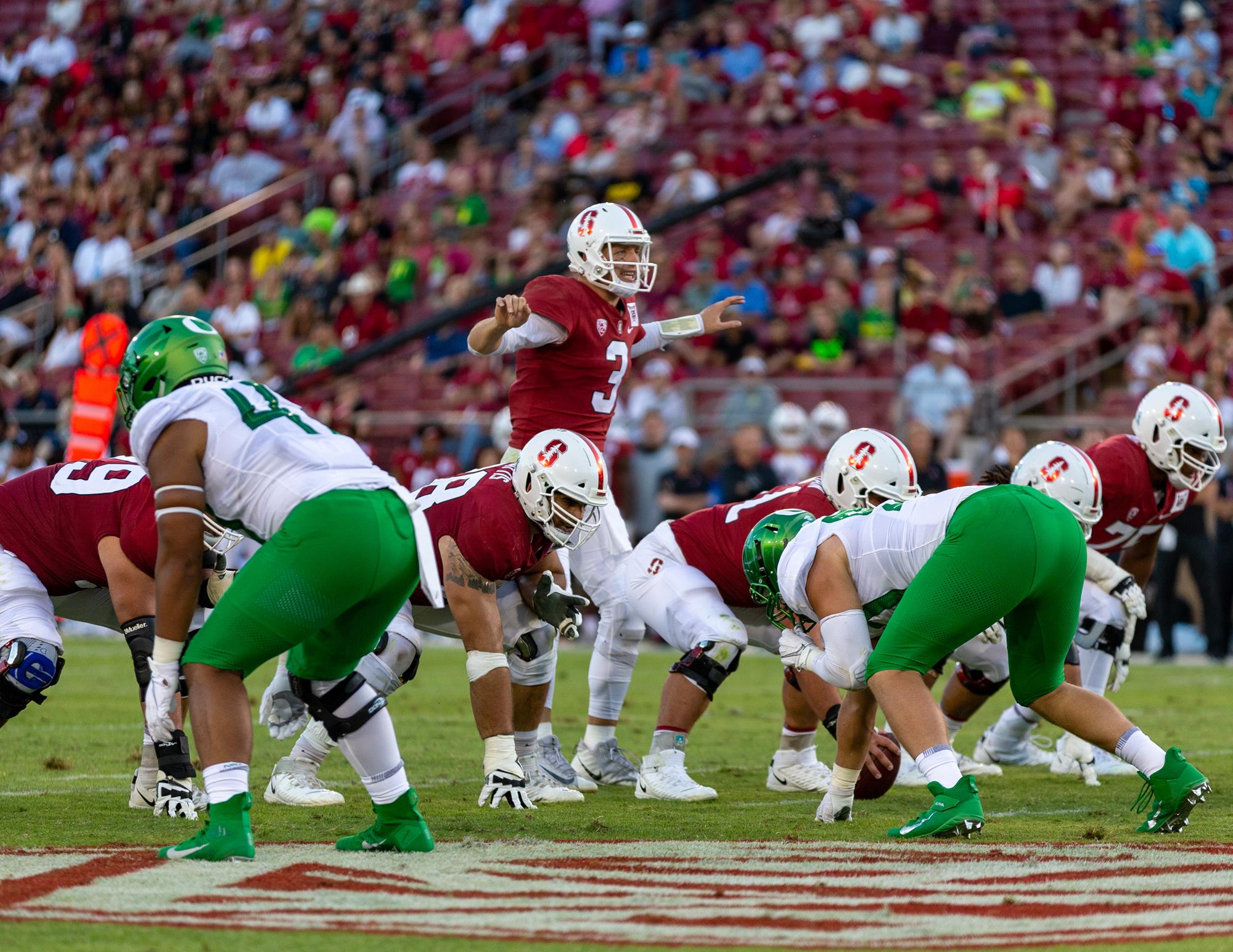
#3 After missing three weeks, Stanford quarterback KJ Costello was back in the line up and threw 30 for 43 for 312 yards and three touchdowns. Looks like the O-line provided him some time to throw the football.
#4 Cardinal receiver Simi Fehoko had three receptions for 97 yards and two touchdowns. The running game was in full effect for the Cardinal as they accrued over 150 yards on the ground.
#5 The Colorado Buffaloes (3-5) have had some setbacks this year and they are looking for some offense, but it will be on both sides of the ball they’ll be concerned with. On the other hand, the Cardinal come in after that win against Arizona with some confidence as this game is Boulder.
Stanford fifth-year outside linebacker Casey Toohill was named a finalist for the prestigious William V. Campbell Trophy on Wednesday, announced by the National Football Foundation. The Campbell Trophy annually recognizes the best football scholar-athlete in the nation for his combined academic success, football performance and exemplary leadership.
“Casey Toohill is a great example of what it means to truly be a scholar-athlete,” said David Shaw, the Bradford M. Freeman Director of Football. “His work ethic, attention to detail and the passion he plays the game with is matched only by his desire to excel as a student at Stanford University.”
Toohill, who is one of 12 members of the NFF National Scholar-Athlete Class, will be recognized in New York during the 62nd Annual Awards Dinner on Tuesday, December 10. He will receive an $18,000 postgraduate scholarship, with one member of the class being declared the winner of the 30th William V. Campbell Trophy and having their scholarship amount increased to $25,000.
“This is the most prestigious honor I could have imagined receiving at Stanford,” Toohill said. “I am so honored to represent Stanford and to honor the legacy of Bill Campbell. My parents have always stressed the importance of academic pursuits and have been crucial in my development as a Stanford student-athlete. I owe it to my family and the structure they provided to help me succeed.”
A San Diego native, Toohill is a team captain who will graduate in December with a degree in political science. He’s a three-time Pac-12 All-Academic member and earned CoSIDA Academic All-District in 2017. Toohill holds a 3.71 GPA and would like to attend business school following his playing career.
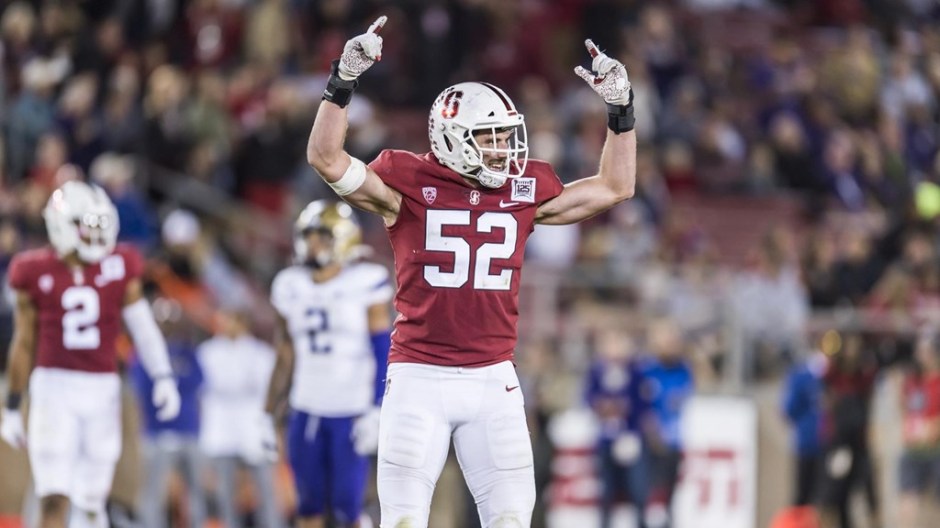
On the field, Toohill leads the Cardinal with 45 total tackles, including 7.5 tackles for loss and five sacks. He has added a forced fumble and nine quarterback hurries. He’s tied for fifth in the Pac-12 in tackles for loss while his sack total ranks third.
He’l become the 13th Cardinal in school history to earn NFF National Scholar-Athlete honors and the first since Jordan Richards in 2014. Toohill, Richards and Owen Marecic (2010) are the only three Cardinal to earn NFF Scholar-Athlete honors since 1997.
Stanford NFF Scholar-Athletes (13)
1967 John Root
1970 John Sande III
1976 Duncan McColl
1980 Milt McColl
1981 Darrin Nelson
1983 John Bergren
1992 Glyn Milburn
1994 Justin Armour
1995 David Walker
1997 Damon Dunn
2010 Owen Marecic
2014 Jordan Richards
2019 Casey Toohill
Gaither runs fast. Gaither talks fast. One cut, one wiggle and Gaither’s a blur down the field.
The slow slog of injury rehab, however, made the senior wide receiver appreciate that speed even more.
Last year as a junior, Gaither was off to a quick start, with six catches for 137 yards and two touchdowns against UC Davis. He had two more catches against Washington State and grabbed six balls for 90 yards at Oregon. In the Mountain West opener against Hawaii, Gaither had already made a 42-yard catch in the first quarter. Then, in the second quarter, the Paso Robles, Calif., native took a Josh Love pass 55 yards to the house for a touchdown. It was his last play of the season.
“I was running and a guy clipped the back of my foot and I landed funny,” Gaither said. “I had to hop in to the endzone. That was that.”
Gaither tore his Achilles tendon on the play. Just as he was starting to take off as the Spartans’ go-to deep threat, Gaither faced surgery and a long rehabilitation process.
Almost every day for seven months, Gaither got up in the morning and headed to the training room in the Simpkins Stadium Center. He’d do exercises to strengthen his repaired Achilles. Exercises to get the range of motion and flexibility back. It was a lot of heat and ice and work.
With all that, Gaither still thinks the mental part of rehab was the most difficult.
“Trusting myself, telling myself that I’m going to be okay, that I’ll get through it,” Gaither said. “Dealing with myself mentally.”
The mental side of rehab for Gaither included dealing with the false alarms. A string of good days would be spoiled by a painful morning. But that’s all part of the process.
“It’s such a tedious injury,” Gaither said. “It’s hard to tell people that you feel better one day and then worse the next. I didn’t like having to tell people that I was hurting, I wanted to be better. But I needed to be honest with myself. You push it one day and the next day it hurts. Sometimes if you went too easy it would hurt the next day. Rehab is a jagged line, it’s not smooth.”
Eventually, the ins and outs of rehab started to level out. Seven months after surgery, Gaither was able to do the thing he does so well. Run.
Gaither wasn’t able to cut yet, but the straight-line speed that has made him a weapon for the Spartans was still there. He could still get up and go.
“That was definitely the worst injury I’ve had in my life,” Gaither said. “I had my family supporting me through it and all my close friends. The rehab was tough, but it made me stronger.”
Gaither’s family includes his mom, dad and younger brother. Growing up, Gaither used his speed to become a multi-sport star at Paso Robles High School. The 6’1″ wide receiver racked up 3,277 yards receiving and 41 touchdowns over three varsity seasons. He was also the San Luis Obispo Country Player of the Year as a shortstop, hitting .500 his junior year with 32 stolen bases. With colleges calling with offers for both sports, Gaither decided to follow his friend and high school football teammate, Josh Oliver, to San Jose State.
After a redshirt season and limited playing time as a freshman and sophomore, Gaither was enjoying his breakout junior year until going down against Hawaii. The adversity has made his standout senior season even sweeter.
Heading into Saturday’s showdown against No. 21 Boise State, Gaither has been on the receiving end of 27 passes from fellow fifth-year senior quarterback Josh Love for 491 yards and four touchdowns. Love has experienced his own sets of ups and downs during his career, something the pair has bonded over.
“Me and Josh have been friends through this whole process,” Gaither said. “Both a little overlooked when we first got here. Not really in the picture. Kudos to him, he worked really hard for this. He deserves this. A bunch of different coaches and staffs, we’ve been through it all together. New beginnings have been good to us.”
Throughout Gaither’s rehab process, one goal he had was to get back to where he left off. Not only figuratively — starting a season strong and becoming a go-to target — but literally as well. He wanted to get back into the endzone, the place where we was helped off the field a year earlier.
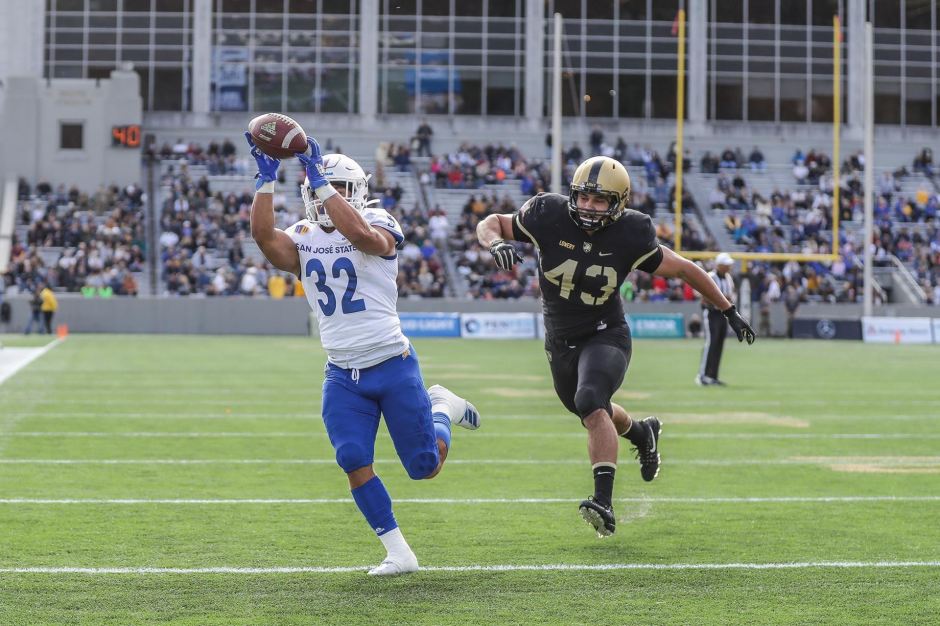
It took a little while, until the Spartans’ fifth game of the season. Against New Mexico on October 4, Gaither showed off his trademark speed with an 80-yard touchdown bomb from Love. Crossing the goal line, Gaither couldn’t help but soak in the moment.
“It just felt so good,” Gaither said. “It felt so good, like this is where I’m supposed to be.”
Back to blazing down the field. Back in the end zone. It took a long time to get back to that place, but Gaither has made quick work of reclaiming his role as the Spartans’ deep threat.
Tavita Pritchard was not sure who his starting quarterback was going to be against Arizona until Saturday morning. He was hoping it would be senior K.J. Costello, who had missed the last three games due to injury.
When did Pritchard find out?
“When I showed up at the team hotel,” said Pritchard, the Andrew Luck Director of Offense and Kevin M. Hogan Quarterbacks Coach. “He didn’t know. I looked at him and said, ‘Yep, he’s going.'”
Costello was itching to get back on the field. He resumed practice this week on a limited basis, but was questionable until pregame warmups.
Once Costello got the go-ahead from Bradford M. Freeman Director of Football, David Shaw, he jump-started the Cardinal offense. Costello’s experience, leadership, personality and right arm sparked Stanford to a 41-31 victory on Reunion Homecoming. Showing little rust, he connected on 30-of-43 passes for 312 yards and three touchdowns in helping Stanford record a season high in points.
“It seems like it’s been an eternity,” Costello said. “Three, four weeks standing on the sideline, guys going down left and right. Being one of those guys, it doesn’t feel good. It feels awful, especially when you play this game because you want to do anything for your boys.”
Teammates loved having Costello back.
“He ran the ship today,” said junior offensive tackle Foster Sarell. “He’s fun to block for and I love playing with him. He’s got great energy.”
Added fifth-year senior running back Cameron Scarlett, who eclipsed 100 yards (102) for the second time this season and scored two touchdowns, “He’s one of the best leaders I’ve ever been around. I know it was hurting him not to play but having him back shows how dangerous he and our offense can be.”
Shaw gave Costello a game ball afterward in the raucous locker room.
“I can’t say enough about K.J. Costello, him coming back, and it wasn’t just him throwing the football,” Shaw said. “Two-time captain, senior leader, felt his energy, felt his passion, pushing guys, talking to them, giving us great feedback. Can’t say enough about the juice he gave us.”
Once Costello made it through warmups, Shaw knew he was ready.
“We got over the hump this week in practice,” Shaw said. “Last week, he tried to go, and he threw the ball extremely well on Monday night, and the next day he couldn’t throw it. This week, we got past Monday and crossed our fingers for Tuesday; got past Tuesday and crossed our fingers for Wednesday. It was just one of those weeks.”
Costello, however, isn’t 100 percent.
“We gave him that opportunity and he went out there and played one of the better games of his career,” said Shaw. “Really, really proud of him.”
TEAM EFFORT
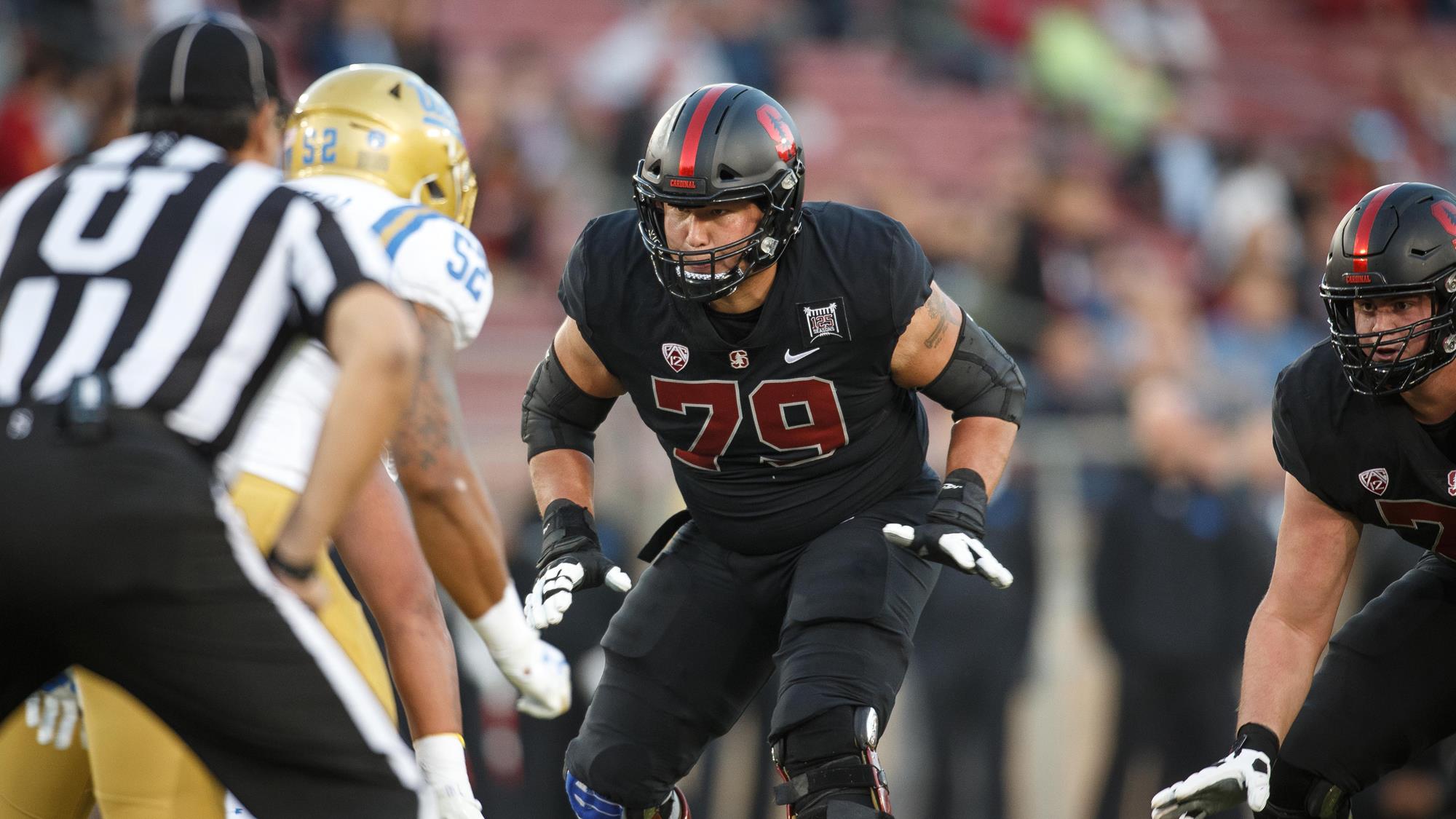
Costello had plenty of help. After allowing seven sacks the previous week against UCLA, the young offensive line surrendered zero against the Wildcats and helped the Cardinal accumulate 222 yards on the ground.
“It was awesome,” said Sarell. “We ran the ball right down their throat until the game ended. It’s what you dream about.”
Freshmen Walter Rouse (left tackle), Barrett Miller (left guard) and Jake Hornibrook (right guard) continue to learn and improve with every snap.
“I think as a whole, the O-line did a great job,” Rouse said. “There are always little things we can get better at. I feel like we have come a long way and still have so far to go.”
Apparently, the young unit’s fight surprised the Wildcat defense.
“I guess we underestimated their line,” said Wildcat senior safety Tristan Cooper. “We didn’t think their line was going to be that good. They came out balling. They’re better on the field than they are on film.”
RECEIVER, RECEIVER
Eleven Stanford players caught passes — 12 if you count a deflection Costello caught. Sophomore wide receiver Simi Fehoko hauled in three for a career-high 97 yards and two went for scores.
Sophomore wide receiver Brycen Tremayne made a one-handed grab in the end zone for a 14-yard touchdown; junior Connor Wedington collected a team-high seven passes for 61 yards; sophomore wide receiver Michael Wilson caught six for 45; and junior tight end Colby Parkinson grabbed five for 68.
“I feel like it was just a long time coming,” Tremayne said. “We’ve been working so hard to make those plays and it’s finally clicking. Coach (Bobby) Kennedy said it was just a matter of time.”
It was the most downfield throws the Cardinal has attempted all season.
“Our guys knew it was a possibility and were ready for it,” said Pritchard, citing man-to-man and soft coverages they had seen on film. “We got those opportunities early and all of our guys capitalized.”
TWO PICKS
Junior cornerback Paulson Adebo intercepted two passes and is now tied for the Pac-12 lead with four on the season. He also ranks first in passes defended with 14.
“Big-time players make big-time plays,” said Shaw, who awarded Adebo a game ball.
Both of Adebo’s thefts came in the fourth quarter.
“It felt really good just to help my team and come out with a win,” he said. “It was fun to finish it at the end.”
TRIPLE DUTY
Freshman Ryan Sanborn joined a small club of Stanford players by doing all kicking duties against Arizona. He kicked off eight times, with six going for touchbacks; punted five times and averaged 43.8 yards; made both field goal attempts and all five extra points.
“The special thing is the game is not too big for him,” said special teams coordinator Pete Alamar. “You would hope a senior would handle it the way he handled it. He had one punt he’d like back, but everything else, he hit the ball pure.”
Sanborn’s role expanded when senior kicker Jet Toner was lost for the season against UCLA. Alamar limited Sanborn in practice and pregame warmups.
“We had to change everything we do just to keep him fresh,” Alamar said.
Photo credit: gostanford.com
UP NEXT
Stanford (4-4, 3-3 Pac-12) has a welcome bye next week and resumes play on November 9 at Colorado. The Buffaloes (3-5, 1-4 Pac-12) fell to USC on Friday night, despite stellar performances from senior quarterback Steven Montez and junior wide receiver Laviska Shenault. The scrappy Montez threw for 324 yards and three touchdowns, while the elusive Shenault caught nine for 172 yards, including a 71-yard score.
Colorado plays at UCLA on Saturday.
Blake Strenstrom, a redshirt freshman and the son of former Stanford quarterback Steve Stenstrom, spelled Montez briefly and ran once for 27 yards. Steve Stenstrom played five seasons in the NFL, including 1999 with the San Francisco 49ers. He was inducted into the Stanford Athletics Hall of Fame in 2016.
REAL RECOGNIZE REAL
Members of the 1999 Pac-12 Championship Stanford football team and head coach Tyrone Willingham were recognized on the field in the second quarter. The upstart team was the first to play in the Rose Bowl in 28 years.
Photo credit: gostanford.com
NOTES
Senior inside linebacker Andrew Pryts led the Cardinal in tackles with eight, while junior strong safety Stuart Head added seven … Stanford produced seven tackles for loss — two by sophomore defensive end Thomas Booker — and three sacks … Fifth-year senior outside linebacker Casey Toohill had a sack and now ranks third in the conference with five and fifth in tackles for loss with 7.5 … Wedington had two nice kickoff returns and ranks first in the Pac-12, averaging 28.4 yards per attempt. He’s also fifth in all-purpose yards (114.1) and 10th in receiving with 39 catches … The Cardinal ranks second in the league in red zone scoring at 92.3 percent … Stanford ranks first in the conference in kickoff returns and kickoff coverage … Former Stanford great Paul Wiggin was recognized as part of the program’s 125-year celebration of football. A standout defensive tackle, he received All-America accolades in 1955 and 1956. Wiggin played for the Cleveland Browns from 1957-67, then turned to coaching. He was head coach of the Kansas City Chiefs from 1975-77 and returned to The Farm as head coach of the Cardinal from 1980-83. He was inducted into the College Football Hall of Fame in 2005 … David Yankey, a stellar offensive guard/tackle for the Cardinal and a member of the 2013 and 2014 Rose Bowl teams, served as Stanford’s honorary captain. He started 40 games for the Cardinal and was a consensus All-American in 2012 and unanimous All-America in 2013.
Photo credit: gostanford.com
QUOTE
“It seems like an eternity.” — Freshman offensive tackle Walter Rouse on his progression since his first start against USC on September 7.
SAN JOSE, Calif. — After a horrendous win to Army last year, San Jose State bounced back with a 34-29 victory over the Black Knights this year. So what happens next? The Spartans will watch the tape and prepare for their next opponent, Boise State, this Saturday. The Broncos are currently ranked #21 in the AP Top 25 Poll.
Here’s what you need to know before Saturday’s game.
Game #9
San Jose State vs. #21 Boise State
CEFCU Stadium, San Jose, Calif.
Saturday, November 2, 2019, 7:30 p.m. PT
CBS Sports Network
SJSU record
4-4, 1-3 Mountain West. Most recently, San Jose ended a two-game losing streak with a 34-29 win at Army West Point.
#21 Boise State record
6-1, 3-0 Mountain West. Boise State lost their first game of the season to BYU, 28-25, on October 19. The Broncos had a bye the week ending October 26.
Radio coverage
KKSF (910 AM, Oakland), RealTalk 910, is the new flagship radio station for San Jose State Spartans football. Justin Allegri calls the play-by-play. Kevin Richardson provides commentary. The Boise State broadcast begins at 7:00 p.m. PT with a pregame show.
KSJS (90.5FM, San Jose) also will carry a play-by-play broadcast of the San Jose State vs. Boise State football game. Air time is 7:15 p.m. PT with a pregame show.
Television
CBS Sports Network will provide broadcast coverage. Carter Blackburn calls the play-by-play. Aaron Taylor provides commentary. Jenny Dell is the sideline reporter. The CBS Sports Network presentation begins at 7:30 p.m. PT.
Series history
Boise State leads the series, 13-0. The teams are meeting for the first time since the 2016 season when the Broncos won, 45-31, in Boise. Saturday’s game will be the seventh time the teams have played in CEFCU Stadium.
Of the 13 meetings, the 2004 and 2006 games in San Jose were the closest. In 2004, Boise State pulled out a 56-49 double overtime win. Both teams scored a touchdown in the first overtime. In 2006, Anthony Montgomery kicked a 37-yard field goal on the final play of the game for a 23-20 Boise State win.
.500 again in 2019
For the fourth time this season, San Jose State’s at the .500 plateau with a 4-4 win-loss record. The Spartans have been above .500 three times and below .500 once.
Playing ranked teams the first weekend in November
Two of the biggest wins in San Jose State football history occurred on the first full weekend in November. The Spartans are 2-5 against nationally-ranked teams the first full weekend in November. Two of the five losses are to Boise State.
November 4, 2000 at San Jose State 27, #9/#9 TCU 24
November 1, 1980 San Jose State 30 at #10/#11 Baylor 22
Next opportunity for a winning streak
San Jose State has its 17th opportunity since the 2014 season to have a two-game winning streak when it hosts Boise State. The last Spartan two-game winning streak was a pair of victories hosting UNLV, 33-10, on October 4, and at Wyoming, 27-20, in overtime, on October 18, 2014.
2019 season win total matches 2016
The 34-29 win at Army West Point on October 26 gave San Jose State its fourth win of the season matching the win total of the 2016 season with four regular season games remaining. The last time the Spartans won five games in a regular season was in 2015 with a 5-7 record before capturing the inaugural AutoNation Cure Bowl over Georgia State, 27-16.
Victories in three time zones
For the first time since 2015, San Jose State has victories in three time zones. The Spartans have two home field wins in CEFCU Stadium in the Pacific Time Zone, a 31-24 win over Arkansas in the Central Time Zone, and a 34-29 win at Army West Point in the Eastern Time Zone.
In 2015, the Spartans won regular-season games in the Pacific Time Zone, won at Hawaii, and defeated Georgia State in the AutoNation Cure Bowl in Orlando, Fla.
The win over Army West Point gave San Jose State three wins in its last four games and 3-7 overall playing in the Eastern Time Zone.
30-point games in 2019
San Jose State has scored 30 or more points in five of its eight games this season compared to four a year ago. The Spartans are 4-1 in games the team scored 30 or more points this season. The one loss was a 41-38 defeat at Nevada on October 12.
Points off of turnovers
After eight games, San Jose State has scored 58 points off of opponent turnovers compared to the opponent’s seven. Seven of the Spartan points came in the win at Army West Point in a 34-29 decision. The first opponent points off a Spartan turnover came in the October 12 Nevada victory on an interception return for a touchdown.
Penalty countdown
In San Jose State’s last three games, the Spartans were assessed nine penalties — five at Nevada, one versus San Diego State, and three at Army West Point. In the first five games, San Jose State was charged with 33 penalties. The Spartans enter the Boise State game ranked 23rd nationally in fewest penalties per game at 5.25 per game.
Finding the quarterback
Despite just 12 quarterback sacks on the season, San Jose State has seven of them in the two most recent games prior to the Boise State contest.
The Spartans had two against San Diego State on October 19 and a season-high five in the win at Army West Point on October 26.
Five possessions lead to five first-half scores
For the first time this season, San Jose State scored every time it was on offense in the first half of a game. Against Army West Point, the Spartans scored two touchdowns and kicked three field goals to build a 23-10 halftime lead.
Adding a two-point play to the scoring column
For the first time since the 2016 season, San Jose State successfully converted a two-point PAT when quarterback Josh Love completed a pass to wide receiver Tre Walker in the October 26 win at Army West Point. The Spartans are 1-for-2 on the season on two-point conversations.
photo from sfgate.com: Utah’s Zack Moss (2) reaches the end zone while scoring one of his two touchdowns in his a win over Cal in Salt Lake City.
On The Cal Bears Football podcast with Morris:
#1 In one of the most difficult games of the season for the Golden Bears (4-4) and no doubt their worst of 2019. The Utah Utes (7-1) went to work on the Cal scoring the opening volley with a touchdown. Running back Zack Moss carried for a 4-yard run at 4:50 in the first quarter.
#2 Cal would remain scoreless in the first half as the Utes would score three more touchdowns in the second quarter on a Utes quarterback Bryan Thompson 40-yard pass to Tyler Huntley, a Jason Shelly 1-yard run, and a Brant Kuithe 1-yard pass to Jason Shelly. At the half, Cal could have asked for the mercy rule. It was 28-0.
#3 In the second half, the Utes picked up one more score in the third quarter at 9:26. Zack Jones carried for ten yards to put the frosting on the cake as the Utes would win it 35-0.
#4 Morris, what best explains best why Cal just simply couldn’t get any offense going and did quarterback Spencer Brasch, who went 7-19 for 47 yards, lack enough time and protection to throw the ball?
#5 Washington State (4-4) is up next. Cougars lost to Oregon on Saturday 37-35 and are 1-4 in their last five games. Taking some of WSU’s defensive issues under consideration, do you see Cal with a light at the end of the tunnel to win this game this coming Saturday?
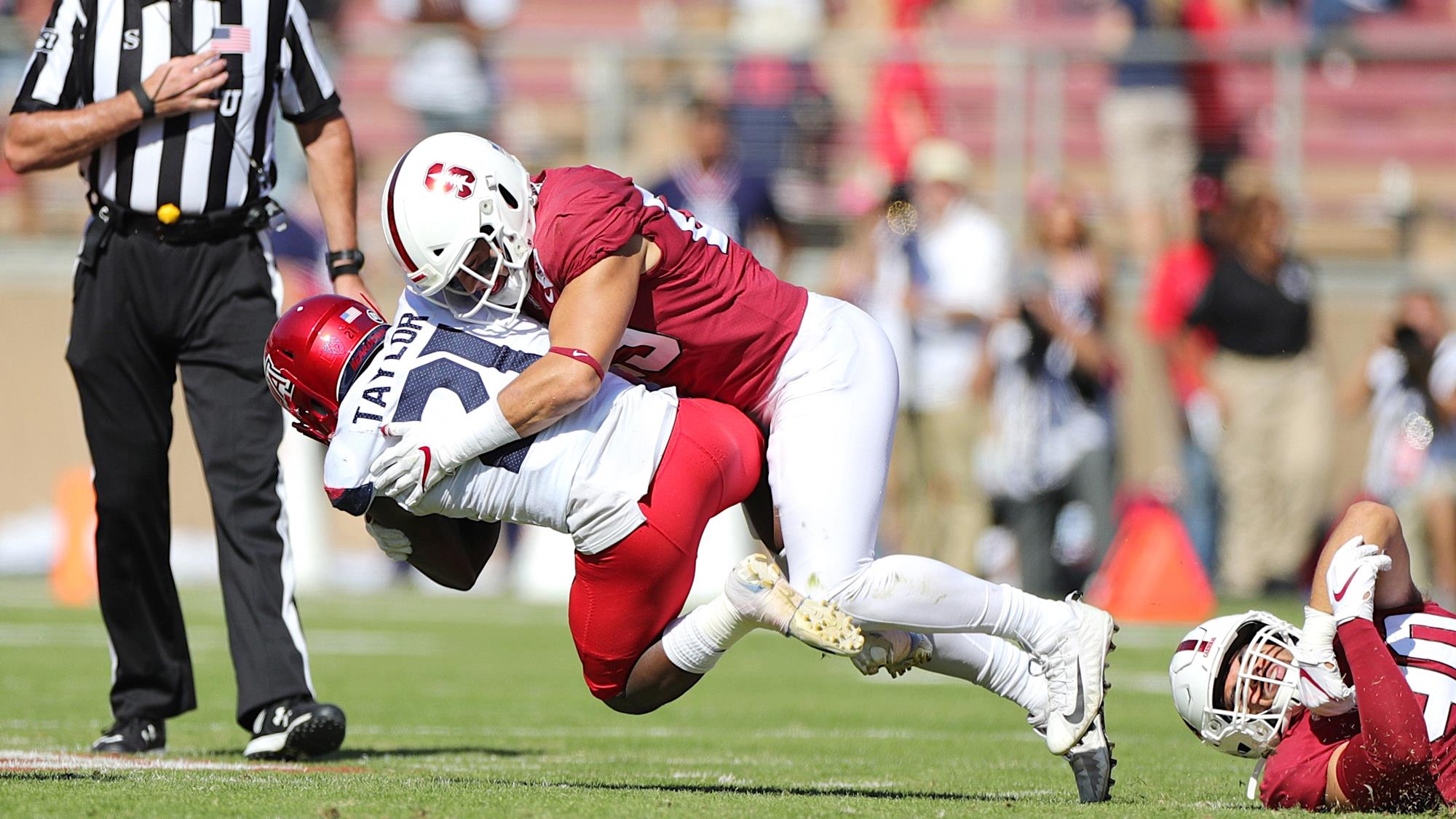
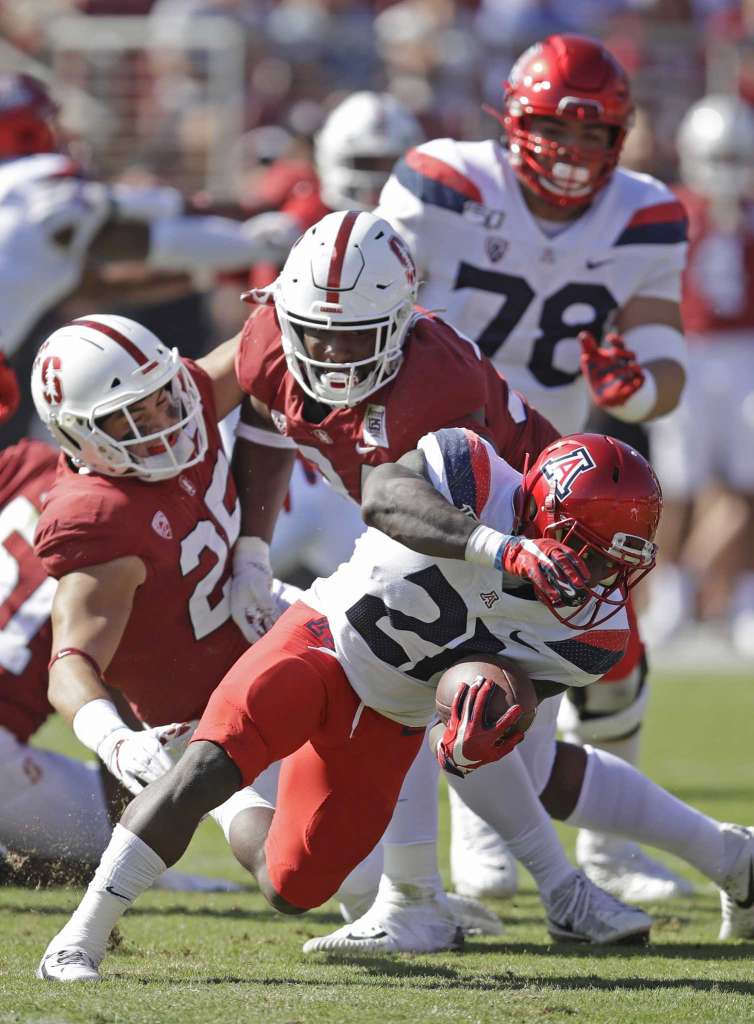
sfgate.com photo: Arizona Wildcat Jaxen Turner (21) breaks through Stanford Cardinal defender Andrew Pryts in the first half at Stanford Stadium on Sat Oct 26th game.
By London Marq
PALO ALTO–The Stanford Cardinal football program has had an up and down season in 2019. Entering play on Saturday afternoon they were a game under .500. After losing a tough home game to UCLA last week they looked to get back on track against the feisty Arizona Wildcats.
Stanford Quarterback KJ Costello was hoping to right the ship after missing the past three games due to injury. Despite jumping out to an early lead with a potent offense in the first quarter, Arizona couldn’t contain Costello on his return. The Wildcats took a 10 – 7 lead before the Cardinal exploded for 24 points in the second quarter.
Costello had 312 yards and three touchdowns and was in sync with his wideouts all game. Costello found 9 different receivers for positive gain. Simi Fehoko had three receptions for 97 yards and two touchdowns. The running game was in full effect for the Cardinal as the accrued over 150 yards on the ground.
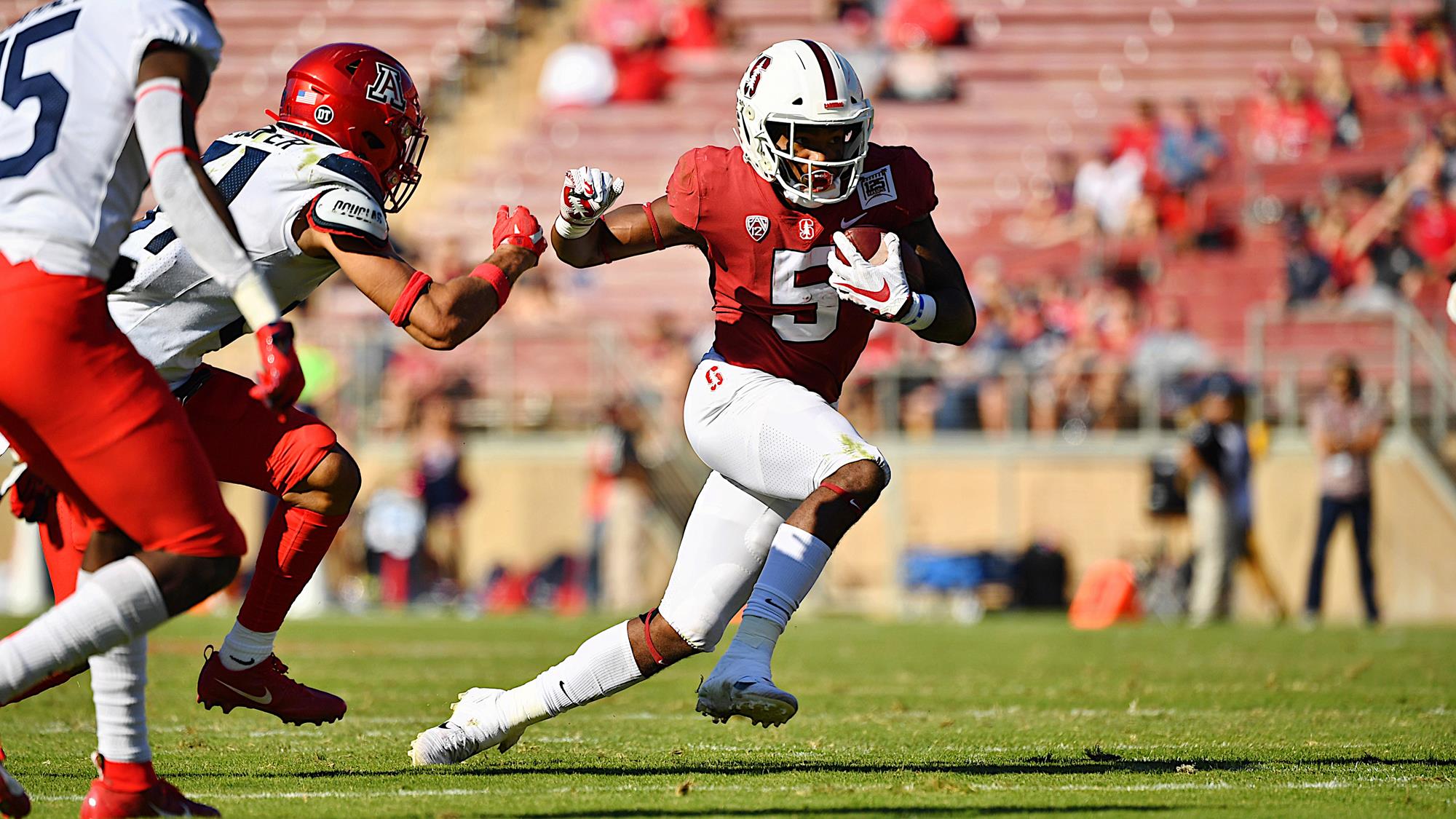
The bell cow, Cameron Scarlett carried the ball 102 yards, averaging 5.4 yards a carry and also had two scored. Arizona was well in this game in the second half despite using two quarterbacks. Arizona put up one of their highest scores of the season but could not recover from two interceptions by quarterback Khalil Tate.
The second half of the game was a defensive battle. The Cardinal were able to hold Arizona to seven points in the half and hand Arizona its third consecutive loss. Stanford has bye next week in which they will gladly use to get healthy before they push for a bowl game in their final four matches.
Final: Stanford def. Arizona 41-31
The Cardinal have a bye on Nov 3rd and travel to Colorado to face the Buffaloes on Sat Nov 9th.
San Jose State had lost two in a row, but they redeemed themselves with a win over Army West Point at Michie Stadium on Saturday afternoon.
The Spartans got on the board first, thanks to Isaiah Hamilton. Hamilton scored a 19-yard touchdown off a pass from Josh Love to put San Jose State up 7-0 at 11:44 of the first quarter.
The Black Knights evened the score 7-7 when Kelvin Hopkins Jr. threw a pass to Camden Harrison for a 31-yard touchdown. The score was tied at 7 at the end of the first.
But the Spartans refused to back down. San Jose State opened the second quarter with a Matt Mercurio 30-yard field goal at 14:42. Then, the San Jose State scores kept on coming. Love threw a pass to Kairee Robinson for an 18-yard touchdown at 11:36. Mercurio added two field goals, a 23-yarder and a 38-yarder with 5:37 and 0:02 left in the second, respectively.
The Black Knights’ lone score in the second was a Cole Talley 41-yard field goal with 0:52 left. The Spartans led 23-10 at the halftime break.
The third quarter was a low-scoring affair, but the Spartans remained on top 23-17 after three. Sandon McCoy ran for a 4-yard touchdown to pull within six with 8:09 left in the third.
The back-and-forth fourth quarter had fans on the edges of their seats. Love threw a pass to Bailey Gaither for a 21-yard touchdown and Love connected with Tre Walker for the 2-point conversion to put the Spartans up 31-17 at 14:53. Christian Anderson ran for a 1-yard touchdown, but the Black Knights’ 2-point run conversion failed, so they just pulled within eight. Mercurio kicked a 28-yard field goal to make it 34-23 with 3:48 left. Anderson responded with a 33-yard touchdown, his second of the game, but once again, the Black Knights’ 2-point pass conversion failed, so the Spartans still led 34-29 with 31 seconds left.
This wasn’t the prettiest game for the Spartans, but they left West Point, N.Y. with a 34-29 win over the Black Knights. San Jose State improved to 4-4, while Army fell to 3-5. Mercurio was 4-for-4 for the day.
The Spartans return home to host the #22 Boise State Broncos on Saturday, November 2 at 7:30 pm PT. The game will be broadcasted on the CBS Sports Network.
To recognize the 125th season of Stanford football and the 150th year of college football, GoStanford.com has celebrated and highlighted Stanford’s football history with a season-long series by decade.
Here are the Games of the Decade of the 1970s.
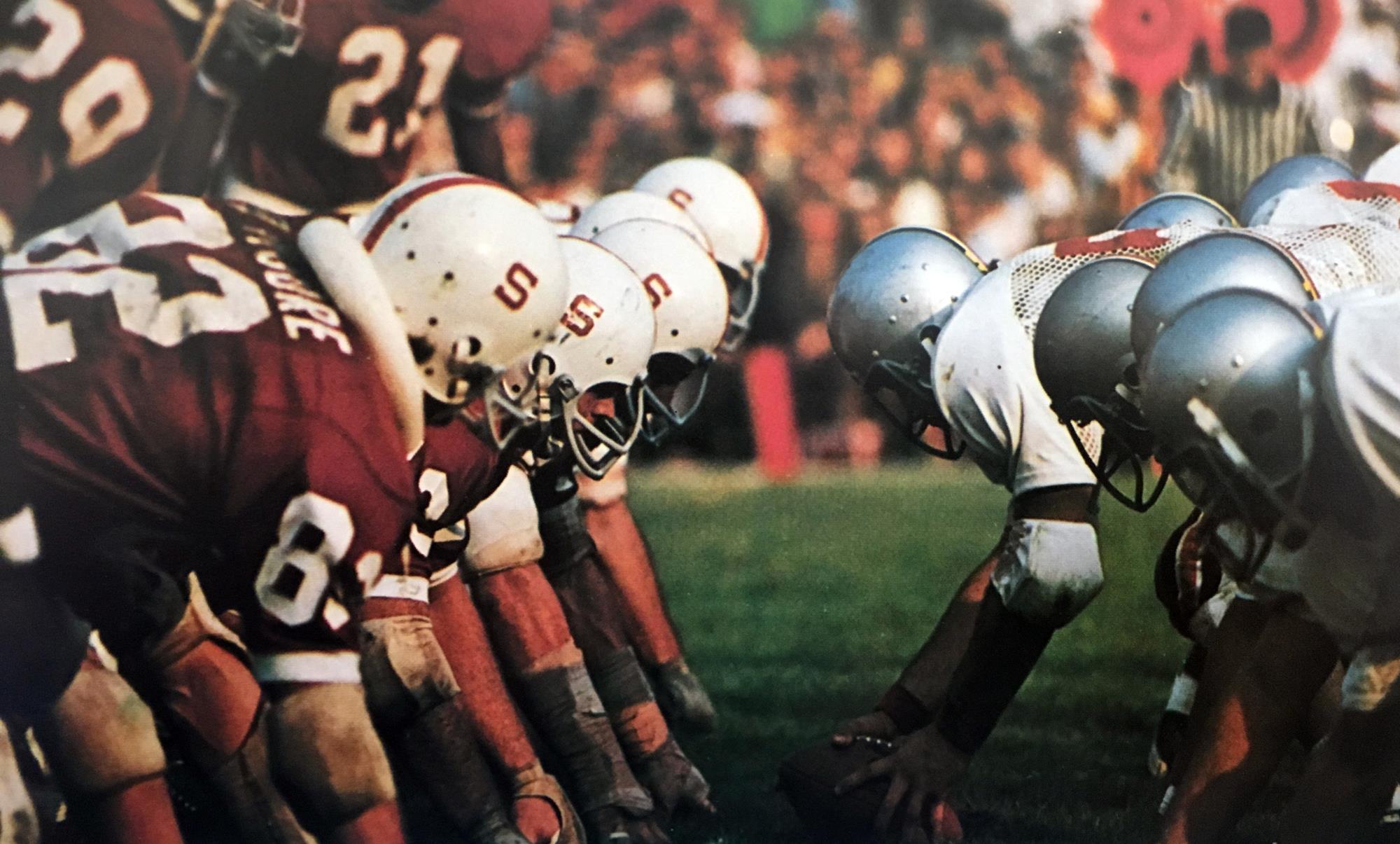
January 1, 1971 (Rose Bowl): Stanford 27, Ohio State 17 Stanford hadn’t won a Rose Bowl in 30 years when it took the field against undefeated and No. 2 Ohio State, but it did have Heisman Trophy winner Jim Plunkett and the Thunder Chickens.
Stanford (8-3) lost its final two games of the regular season and came into the game as a 13-point underdog against the Buckeyes (9-0), who were two years removed from a national title with many of the same players and hadn’t lost to a team other than Michigan in more than three years. The Buckeyes’ defense included the fearsome Jack Tatum and Outland Trophy-winning nose guard Jim Stillwagon, and an offense led by quarterback Rex Kern and fullback John Brockington, While Stanford enjoyed the sights and sounds of Bowl Week, Ohio State coach Woody Hayes kept his players behind closed doors, practicing as many as three times a day, and didn’t even let them out to a scheduled roast beef-eating contest.
Photo credit: gostanford.com
The tone was set on the game’s opening drive. Ohio State moved downfield to the Stanford 39, where the drive stalled. Facing a fourth-and-1, the Buckeyes went for it, but Greg Sampson stuffed Kern for a two-yard loss. Moments later, Stanford’s Eric Cross took the ball on a reverse and ran 41 yards to set up a short touchdown run by Jackie Brown. Ohio State was in for a battle.
Stanford coach John Ralston and his staff worked overtime to think of wrinkles to throw the Big Ten power off its game. Though Plunkett threw 30 times, he also became a runner, carrying on options and draw plays.
“People asked John why he didn’t do that a lot before then,” Plunkett said. “He said it was a long season and they were saving it for that big game. It paid off big time because it caught them totally by surprise.”
With Ohio State up 17-13 on the strength of two Brockington touchdown runs, the Buckeyes sought to put Stanford away, gambling on another fourth-and-one, this time at the Stanford 20 on the opening play of the fourth quarter. But linebacker Rod Kadziel hit Brockington head-on for no gain on the game’s pivotal play.
Stanford followed with a drive of its own, but found itself facing 3rd-and-15 at the Ohio State 37. Plunkett dropped back, but was forced to scramble by a heavy rush. On the run, he spotted tight end Bob Moore downfield and threw. Between two defenders on the right sideline, Moore leaped to make the catch and came down at the 2 for a 35-yard gain. Brown gave Stanford the lead on a 1-yard run, culminating an 80-drive in which Plunkett went 5-for-5 passing.
Having to play catch-up, Ohio State was forced uncharacteristically to the air, playing into Stanford’s hands. Safety Jack Schultz intercepted a Kern pass to set up the clinching score, a 10-yard pass from Plunkett to Randy “Rabbit” Vataha with 8:18 left. And Stanford pulled out a remarkable 27-17 victory before 103,389 at the Rose Bowl.
Years later, Stillwagon said, “We had a great team. I always say, if we had played Stanford nine more times, we would have beaten them nine times. But in that one hour, we weren’t a team to adjust. We were a team that stuck to our game plan. The more the game got tight, the more we would be predictable.”
On the other side, Stanford felt it deserved the victory. Also, that result returned Stanford to prominence, and Plunkett’s performance helped popularize the passing game in the wishbone-era of college football.
“Maybe some guys would be happy just to get here,” said Plunkett, the game’s Most Valuable Player. “But we were planning on winning, too.”
Two hours after the final gun and long after the San Gabriel Mountains disappeared in the darkness, sportswriters began to return to the press box to type their stories and Ralston was left alone, finally, to be with his family. He uttered the words everyone in cardinal red was thinking.
“Wasn’t that fun?” Ralston said.
Photo credit: Sports Illustrated
January 1, 1972 (Rose Bowl): Stanford 13, Michigan 12
Don Bunce, a product of nearby Woodside High, had the misfortune of being in the same Stanford class as Jim Plunkett. As a senior, Bunce redshirted so that he could have one season as the starting quarterback after Plunkett graduated.
In his first home start, Bunce and Stanford faced their first big test of 1971, an Oregon team led by future Pro Football Hall of Fame quarterback Dan Fouts and running back Bobby Moore (later Ahmad Rashad).
Bunce left no doubt of his abilities when he hit Miles Moore for passes of 78 and 41 yards, and threw 36 yards to John Winesberry. Bunce tossed three touchdown passes in a 38-17 Stanford victory. Afterward, Oregon coach Jerry Frei said, “I wasn’t misquoted before when I said Bunce is as good as Plunkett was. After this game, I still believe. Could I believe anything else?”
The Rose Bowl against No. 2 Michigan provided Bunce with a chance to join Plunkett in Stanford lore. The undefeated Wolverines, coached by Bo Schembechler, were 12 ½-point favorites and outscored opponents 358-40 over the first nine games.
Stanford held its ground because of two crucial sequences. Trailing 10-3 early in the fourth quarter, Stanford was forced to punt from its own 33. Jim Kehl, lined up as an upback, received the snap on a fake and handed the ball forward to Jackie Brown through Brown’s legs. Brown ran 33 yards for a first down, and followed a minute later with a 24-yard touchdown run to tie the game.
Michigan took a 12-10 lead when Stanford’s Jim Ferguson tried to return a missed field goal, but was hit at the 2 and driven back into his own end zone. Officials ruled it a safety, though Stanford felt it should have gotten the ball where Ferguson’s forward progress was stopped. Now, Stanford had to surrender the ball on a free kick with only three minutes left. But the Stanford defense held, forcing a punt after a three-and-out.
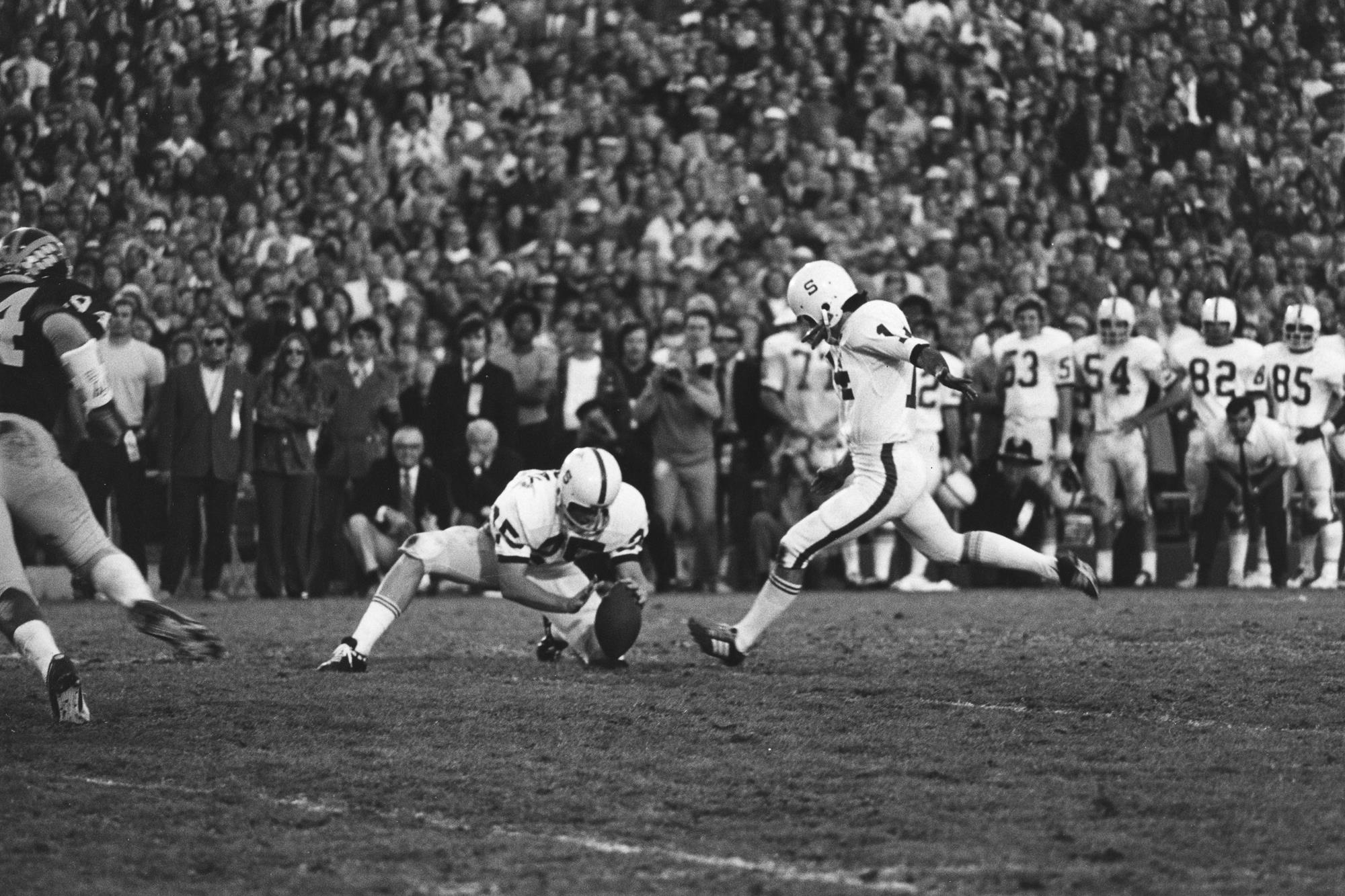
Stanford was in jeopardy, setting up on its own 22-yard line with 1:48 left. This is where Bunce shined brightest. He threw five consecutive completions and got the Indians downfield. With 12 seconds left, Rod Garcia, out of Steve Murray’s hold, kicked 31-yard field goal to give Stanford a 13-12 upset victory.
Bunce played one year of pro football, as a teammate of Carl Weathers (Apollo Creed of Rocky fame) with the CFL’s B.C. Lions, and used the money earned to pay his way through med school. Bunce became an orthopedic surgeon. Bunce passed away in 2003 of a heart attack at age 54.
Photo credit: gostanford.com
December 31, 1978 (Bluebonnet Bowl): Stanford 25, Georgia 22
In only two years, Bill Walsh led a Stanford resurgence, taking the Cardinals, as they were known at the time, to consecutive bowl games. In 1977, Stanford trounced LSU in the Sun Bowl, 24-14, and faced heavily-favored Georgia (9-1-1) in the 1978 Bluebonnet Bowl in the Astrodome.
Georgia immediately set out to dominate, taking a 22-0 lead by the early third quarter. However, Steve Dils, a fifth-year senior in his only season as a starter, sensed that the Bulldogs had grown overconfident — Georgia made mocking gestures toward the Stanford bench — and began to attack.
Dils threw touchdown passes to Ken Margerum (32 yards), Darrin Nelson (20 yards), and again to Margerum within a span of four and a half minutes to tie the game, 22-22.
The Cardinal defense provided those scoring chances in that span, forcing a Georgia punt and three fumbles, one of which set up a go-ahead 24-yard field goal by Ken Naber with 14:50 left in the game.
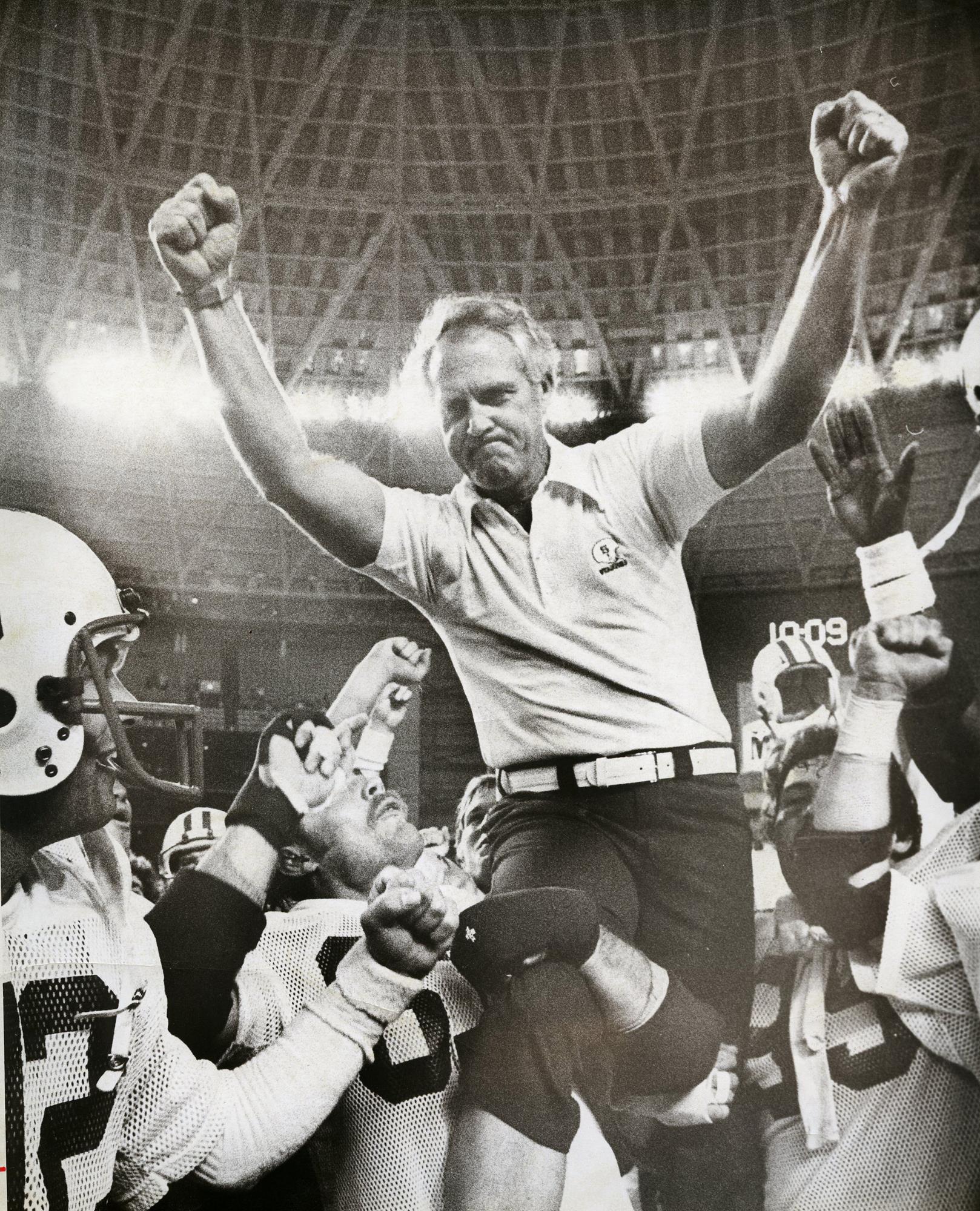
Gordy Ceresino made 20 tackles and earned Defensive MVP honors, while Dils (16 of 28 for 210 yards) was the Offensive MVP. The Cardinals lifted Walsh upon their shoulders in triumph afterward and San Francisco 49ers owner Eddie DeBartolo was impressed too. He already had come to agreement to hire Walsh as the 49ers’ next coach, and made it official nine days later.
“Listen up for a minute,” Ceresino said to his teammates in the locker room after the game. “At halftime, I told you that in two years I have never seen you quit on Bill and I asked you not to quit on him today. I knew you wouldn’t.”
Photo credit: gostanford.com
Now, let’s move on to notable Cardinal coaches.
Bill Walsh (1977-78, 1992-94)
The Stanford job came at just the right time for Bill Walsh. Though he had great success in creating what would become “The West Coast” as a Cincinnati Bengals’ assistant, and was assumed to be Paul Brown’s successor, he was passed over for the head coach opening by Brown himself, the general manager. Walsh was heartbroken. Brown expected Walsh to stay, but when Walsh said he could not, Brown labeled Walsh as disloyal, damaging Walsh’s reputation around the league.
Walsh spent a season as the San Diego Chargers’ offensive coordinator, but wanted to be a head coach and no NFL interest was coming. Stanford, however, gave him a chance. Walsh, with Guy Benjamin in 1977 and Steve Dils in 1978, had the quarterbacks to make his system work, and receivers like James Lofton and Ken Margerum excelled under him.
Taking advantage of the intellectual capabilities of his players, Walsh unleashed a sophisticated passing offense that rivaled any NFL team. Stanford led the nation in passing twice under Walsh, who compiled a 17-7 record in 1977 and 1978, and coached Stanford to two bowl victories over Southeastern Conference teams.
“He looks and acts like a man who was bred for the role,” the San Francisco Chronicle wrote in 1978, “and he has made Stanford football the best show in town.”
Walsh thrived in Stanford’s academic environment and, after his NFL career ended, famously returned to The Farm in 1992 with the exclamation, “This is my bliss.”
With the 49ers mired in a 2-14 season in 1978, Ron Barr, who produced Stanford football’s weekly television highlight show, recommended Walsh to 49ers owner Eddie DeBartolo, who disregarded skeptical league contacts to hire him. Walsh coached the 49ers to three Super Bowl victories and gained a reputation as one of the NFL’s greatest coaches. “The Genius” was inducted into the Pro Football Hall of Fame in 1993.
Photo credit: gostanford.com
Jack Christiansen (1972-76)
In five years, Jack Christiansen never had a losing season, but he also presided over a quarterback controversy – Mike Cordova or Guy Benjamin – that divided the team. And, because he fell between John Ralston and Bill Walsh on the Stanford coaching order, Christiansen’s place in history is murky, despite a 30-22-3 record.
Christiansen was a Pro Football Hall of Fame defensive back for the Detroit Lions and head coach of the 49ers from 1963-67 before he arrived at Stanford as a linebackers coach in 1968. As offensive backfield coach in 1969-70, Christiansen helped create Stanford’s pro-style attack in which Jim Plunkett thrived, and the quarterback credited Christiansen for his role.
Under Christiansen, quarterback Mike Boryla earned consensus first-team All-America honors in 1973 and Duncan McColl had a school-record 17 sacks in 1976. Christiansen also converted high school quarterback Tony Hill into a wide receiver who would earn two second-team All-America seasons and reach three Pro Bowls in 10 seasons with the Dallas Cowboys.
Photo credit: gostanford.com
John Ralston (1963-71)
Stanford’s only two Rose Bowl victories over a 71-year span were under John Ralston’s watch. Ralston also oversaw the racial integration of the football program and the hiring of the team’s first African American assistant coach, and he helped create a better communication and understanding between the admissions and athletic departments.
Ralston accomplished another first — becoming the first Stanford head coach to jump straight to an NFL head coaching position. Ralston left The Farm for the woeful Denver Broncos and coached them to their first winning seasons. The Broncos finished second in the AFC West all four seasons under Ralston, who was named the 1973 UPI AFC Coach of the Year.
In 1976, the Broncos posted their best record to that point, 9-5, and just missed out on their first playoff appearance. As general manager and coach, Ralston drafted, or signed as a free agent, 36 players on that team, including stars Randy Gradishar, Tom Jackson, and Louie Wright. But a group of players thought the team could have done better and forced Ralston’s firing. With mostly the same players, the Broncos reached the Super Bowl the next season.
Ralston was embittered by the firing, but never showed it. He believed in positive thinking and the Dale Carnegie philosophy. Ralston always greeted guests with a firm grip, a look in the eye, and repeated their name before releasing their hand. Ralston, who passed away September 14, always made a strong impression.
Photo credit: gostanford.com
Now, let’s take a look at prominent Cardinal players.
Jim Plunkett (1968-70) In 1970, Jim Plunkett became Stanford’s first and, thus far, only player to win the Heisman Trophy Award as the best player in college football. Plunkett led the Indians to a thrilling 27-17 upset over previously undefeated Ohio State in the Rose Bowl, capping a 9-3 season that included a Pacific-8 Conference championship.
Wrote Mike Antonucci in a 2010 issue of Stanford Magazine:
“Jim Plunkett’s Stanford career nearly ended before it began. A month before his enrollment, Plunkett was told by doctors that the lump he had felt at the base of his neck was cancerous. In a call with Rod Rust, the assistant coach who had recruited him, Plunkett relayed his fears. The surgery required to remove a malignant tumor would end his football playing days. Rust didn’t hesitate: We will honor your scholarship, Antonucci said.
Rust remembered making that promise impulsively, confident that Stanford would back him up. Rust’s mother had gone blind, and he related so strongly to the Plunkett family’s closeness that he had moved beyond any concern about what Plunkett could contribute to Stanford. “I worried more about Stanford being good enough for Jim Plunkett,” Antonucci said.
The tumor turned out to be benign, but Plunkett has never forgotten the generosity shown by Rust. It foretold the enduring intensity of Plunkett’s relationship with Stanford. Only his family means more, and even in that context, there is a special rapport. “Stanford is in both our hearts,” said Gerry Plunkett, Jim’s wife, “because I see how very much it means to him.”
Plunkett completed 191 of 358 passes for 2,715 yards in 1970, and he ran for another 183 yards, giving him 2,898 yards of total offense that season (a school and Pac-8 record). He led the Indians to their first Rose Bowl appearance in 19 years and their first Rose Bowl victory in 30 seasons, earning game Most Valuable Player honors. He finished his career with an NCAA-record 7,887 yards in total offense.
Plunkett went on to become the No. 1 NFL Draft pick by the New England Patriots, earning Rookie of the Year honors. He played 16 NFL seasons, with the Patriots, 49ers, and Oakland/Los Angeles Raiders, the franchise he led to two Super Bowl titles and was named MVP of Super Bowl XV in 1982.
In 1991, Plunkett’s No. 16 became the second number retired in Stanford history (the other is Ernie Nevers’ No. 1). He’s a member of the National Football Foundation College Football Hall of Fame and the Stanford Athletic Hall of Fame.
Photo credit: gostanford.com
James Lofton (1975-77)
It says much about the athletic ability of receiver James Lofton that 41 years after setting Stanford track and field records in the long jump and 200 meters, those records still stand. Lofton, the 1978 NCAA outdoor long jump champion, could run, jump, and catch passes. Lofton caught 14 touchdown passes in the 1977 season, a school record tied by JJ Arcega-Whiteside last year, and averaged 18.00 yards per catch for his collegiate career.
In the 1977 Sun Bowl, Lofton caught a 49-yard pass from Guy Benjamin in stride for Stanford’s first touchdown, and caught another touchdown pass in the third quarter for the go-ahead score in a 24-14 victory over LSU.
Lofton, who earned a degree in industrial engineering, played 16 years in the NFL, with the Packers, Raiders, Bills and Eagles. He’s among three former Stanford players enshrined in the Pro Football Hall of Fame in 2003.
Photo credit: gostanford.com
Jeff Siemon (1969-71)
Only one Stanford defensive player in the two-platoon era is enshrined in the College Football Hall of Fame: Jeff Siemon.
Siemon was a Thunder Chicken.
Before the 1970 season, some of the defensive linemen thought their position group could use a nickname. For example, USC called it’s defense, “The Wild Bunch.” Defensive end Pete Lazetich said there was a motorcycle gang in his native Montana called the “Thunder Chickens.”
It was meant as a private joke among the linemen, but after the press got a hold of it, the nickname took off. The original 1970 Thunder Chicken starters were Larry Butler, Greg Sampson, Dave Tipton and Lazetich. In 1971, Roger Cowan replaced the graduated Tipton and the linebackers were added to the group. It’s one thing to have a great nickname, but the Thunder Chickens produced on the field.
In the 1971 Rose Bowl victory against Ohio State, Stanford twice stuffed the Buckeyes on key fourth-down plays. In the 1972 Rose Bowl, Stanford stuffed Michigan late with a key three-and-out, enabling Stanford to get the ball back for its winning drive.
Siemon earned the Silver anniversary Dick Butkus award his senior year as the nation’s top linebacker, and the Pop Warner Award as the top senior player on the West Coast. He was inducted to the College Football Hall of Fame in 2006 after a five-year NFL career with the Chargers and Eagles.
Photo credit: gostanford.com
Now, let’s take a look at the Cardinal’s best teams.
1970 (9-3)
Forty-nine years ago, Stanford unleashed one of the most remarkable seasons in its modern football history. Stanford’s story features a defensive line called the Thunder Chickens, a Heisman Trophy winner, and a Rose Bowl victory over an invincible opponent and its legendary coach.
The 1970 Stanford football season ended in Pasadena with coach John Ralston carried off under the night sky by his players in the afterglow of a stunning 27-17 victory over previously undefeated Ohio State and coach Woody Hayes, before 103,839 fans.
The Indians went 9-3, captured the Pac-8 title and finishing No. 8 in the AP rankings. And Stanford was rewarded with its only Heisman to date, to quarterback Jim Plunkett, and would repeat its Rose Bowl victory a year later in another upset, 13-12 over Michigan.
The effect of that 1970 season continues to be felt at Stanford with its quarterback tradition. Stanford had outstanding quarterbacks over the years, beginning with Frankie Albert, the first ‘T’ Formation quarterback, and the likes of Gary Kerkorian, Bobby Garrett, John Brodie, and Dick Norman. But it was Plunkett who began a true revival of the idea that Stanford was the cradle of quarterbacks.
His success ignited a golden age of quarterbacks that cemented Stanford’s reputation. Following Plunkett were Don Bunce, Mike Boryla, Mike Cordova, Guy Benjamin, Steve Dils, Turk Schonert, John Elway, and John Paye. The string of years in which the position was manned by a future pro went uninhibited from 1968-86.
But even more than that, the 1970 season proved that Stanford could achieve success in modern football and still be loyal to its strict academic requirements. That model continues to drive the program today.
Photo credit: gostanford.com
1971 (9-3)
Stanford’s season certainly wasn’t smooth. A 13-12 loss to San Jose State — when Rod Garcia missed four field-goal tries and an extra point — was particularly disappointing, as was a 24-23 loss at home to Washington State.
But Stanford had its moments. A 33-18 victory over USC was Stanford’s first road win over the Trojans in 14 years, and a 20-9 victory at home over UCLA clinched a second consecutive trip to Pasadena, and the opportunity to take down undefeated Michigan.
For an understanding of what it was like to attend a game at Stanford Stadium in 1971, consider that the atmosphere. The area behind the Stanford bench was the territory of Prince Lightfoot, a Native American of the Yurok tribe who performed traditional dances at Stanford games for more than 20 years.
The revolutionary Stanford Band was at its irreverent creative best, but still was playing Indian-themed fight songs before “All Right Now” made its LSJUMB debut at halftime of the 1972 Rose Bowl.
One of the most entertaining non-football aspects of the game was the flinging of Carnation Malted Milk lids onto the field. From the end zone seats, this was more than a pastime. Wooden spoons could be fastened together to form boomerangs, and the stacks of Stanford Daily football editions begged for the assembly into paper airplanes or were torn into confetti. Beer- and soda-can pull-tabs? Great rocket-launchers.
The air hummed with flying objects — malted milk lids, paper airplanes, and wooden spoon-contraptions until debris filled the track and littered the end zone. A deafening roar could be heard whenever an object soared deep past the goal line … the 10! … the 20! … the 30!
The game’s accompanying soundtrack was provided by the deep understated tones of Ed Macauley, who served as public-address announcer nearly every season from 1952-92. Decades of Stanford Stadium memories are incomplete without a backdrop of Macauley’s “Bunce to Miles Moore!”
At the game’s conclusion, young fans bolted from the splinter-inflicting wooden bleachers, weaved through the narrow tunnels, skirted the crowded staircases, and sprinted across Angell Field to intercept the players before they could enter the locker room a half-mile away at Encina Gym. With the twin gryphon statues standing guard, a supply of autographs, chin straps, bloody towels, and sweaty wristbands were treasures to be had.
Photo credit: gostanford.com
1977 (9-3)
This was the first season of the first Bill Walsh era. Stanford featured Guy Benjamin at quarterback and James Lofton at receiver. But the biggest revelation for Stanford football was freshman running back Darrin Nelson.
Before 1977, no Stanford player rushed for 1,000 yards in a season. And certainly no Stanford back ran like Nelson, whose shifty moves, quickness, agility, and ability to feint and cutback brought a new dimension to the Stanford attack.
Playing before a home Stanford crowd for the first time, Nelson rushed for 89 yards and caught five passes for 42 yards, and scored a touchdown in a little over a half in a 37-24 victory over Illinois.
On November 12, against San Jose State, Nelson took a pitch around left end and burst through the defense for 12 yards. That was his first carry of the game, and he didn’t stop until a 4-yard run on the game’s final play enabled him to break the Stanford single-game rushing record. Nelson gained 211 yards on 20 carries — breaking Lou Valli’s 209 from the 1956 Big Game. Nelson finished the season with 1,105 yards on 194 carries.
Stanford, at 5-2, finished one game out of first for the Pac-8 title. A 45-21 loss at Washington kept the Cardinals from the Rose Bowl. But for the first time in its history, Stanford was allowed to go to a different bowl. The Pac-8 champ always had the right to go to the Rose Bowl, but no other conference schools were allowed to go to a bowl until 1975.
Stanford’s reward in 1977 was a Sun Bowl matchup against LSU. All-American Charles Alexander rushed for 197 yards altogether and put the Bayou Bengals’ ahead, 14-10, but Gordy Ceresino and the Stanford defense shut out LSU in the second half to allow Stanford to come back. Ceresino finished with 22 tackles and was the game’s Defensive MVP. The Offensive MVP was Stanford quarterback Guy Benjamin, who completed 23 of 36 passes for 269 yards and three touchdowns, without an interception.
Photo credit: gostanford.com
Now, let’s take a look at the key Cardinal moments.
The Fumble That Wasn’t (October 13, 1979)
Long before its epic 2007 victory over heavily-favored USC, Stanford had another Trojans upset to savor. Trailing 21-0 at halftime at the Los Angeles Coliseum, Stanford rallied to hand No. 1 USC a 21-21 tie.
The pivotal play was the fumble that wasn’t. Having closed to within 21-14 midway through the fourth quarter, Stanford faced a 4th-and-1 at the USC 11. Turk Schonert pitched to Mike Dotterer, who fumbled. But, somehow, the ball bounced back into his hands deep in the backfield. Dotterer reversed direction and sliced forward, gaining exactly the 1-yard needed to keep the drive alive.
Two plays later, Schonert rolled left, saw an opening up the middle and cut through the defense, holding the ball aloft while crossing the goal line on 10-yard touchdown run. Ken Naber’s extra-point tied the game with 4:33 left.
The included great individual efforts. USC’s Charles White gained 221 yards on 32 carries and scored two touchdowns., Schonert relieved freshman John Elway at halftime and completed 16 of 27 passes for 163 yards and touchdowns. Even more impressive was Schonert’s ability to stay cool against a supposedly invincible Trojan defense.
After Stanford drew even, both teams had chances to win. Naber missed a 43-yard field-goal try with a minute left, and USC drove downfield to set up its own try on the game’s final play. But the holder fumbled the snap and an awkward kick was smothered by Stanford players as time expired.
“We were simply fighting for our lives every minute of the game,” Stanford coach Rod Dowhower said. “The players on the field made it work — give them all the credit.”
Photo credit: gostanford.com
Goal Line Stand (September 12, 1970)
Stanford hadn’t won a conference title since 1951 or a Rose Bowl since the 1940 season, but the opener in Little Rock provided a hint of what was to come. Beginning an 11-game regular season for the first time, Stanford took on No. 4 Arkansas in a nationally-televised game in the days when the NCAA only allowed one nationally-televised game per week.
Despite being huge underdogs, Stanford got two touchdown runs from Hillary Shockley on the way to building a 27-0 second-quarter lead. But Arkansas roared to life, cut the deficit to six with 7:25 left, and drove to the Stanford 5-yard line in the final minute, before facing third-and-2.
With fans screaming “Woooo, pig, sooey!” Arkansas coach Frank Broyles sent his best runner, Bill Burnett, into the line. But Stanford middle linebacker Jeff Siemon stuffed him for no gain.
After a timeout, only 29 seconds remained for a pivotal fourth-down play. Arkansas quarterback Bill Richardson darted to his left on a sprintout option. He looked to receiver Chuck Dicus, who was covered by Stanford cornerback Benny Barnes. Richardson turned to run, only to be met by linebacker Mike Simone short of the first down, clinching a 34-28 Stanford victory.
“Our defense came of age,” Stanford coach John Ralston said.
And so did Plunkett’s Heisman Trophy campaign. By completing 22 of 39 passes for 262 yards and one touchdown against one of the top teams in the country on the road and on national television, Plunkett now was on the radar of every Heisman voter in the country.
Photo credit: gostanford.com
The Kick (November 23, 1974)
Stanford had the ball on its own 19-yard line with 19 seconds left and trailed Cal, 20-19, in the 1974 Big Game at Berkeley’s Memorial Stadium.
The back-and-forth game had swung back Cal’s way. Stanford trailed 10-3 in the third quarter before coach Jack Christiansen replaced starting quarterback Mike Cordova, who had thrown three interceptions, with Guy Benjamin. The move ignited the Cardinals to 16 consecutive points.
But Cal, featuring running back Chuck Muncie, rallied with 10 points of its own, taking the lead with 26 seconds left on Steve Bartkowski’s 13-yard pass to Steve Rivera. Pandemonium ensued and officials barely were able to stop jubilant Cal fans from tearing down the goalposts.
With those 19 seconds to work with, Benjamin hit Ted Pappas for 19 yards to the Stanford 38. After an incompletion, Benjamin found tight end Brad Williams on a crossing pattern. Williams angled for the sideline while picking up every possible yard before the clock expired. By the time he stepped out of bounds after a 25-yard gain, two seconds remained.
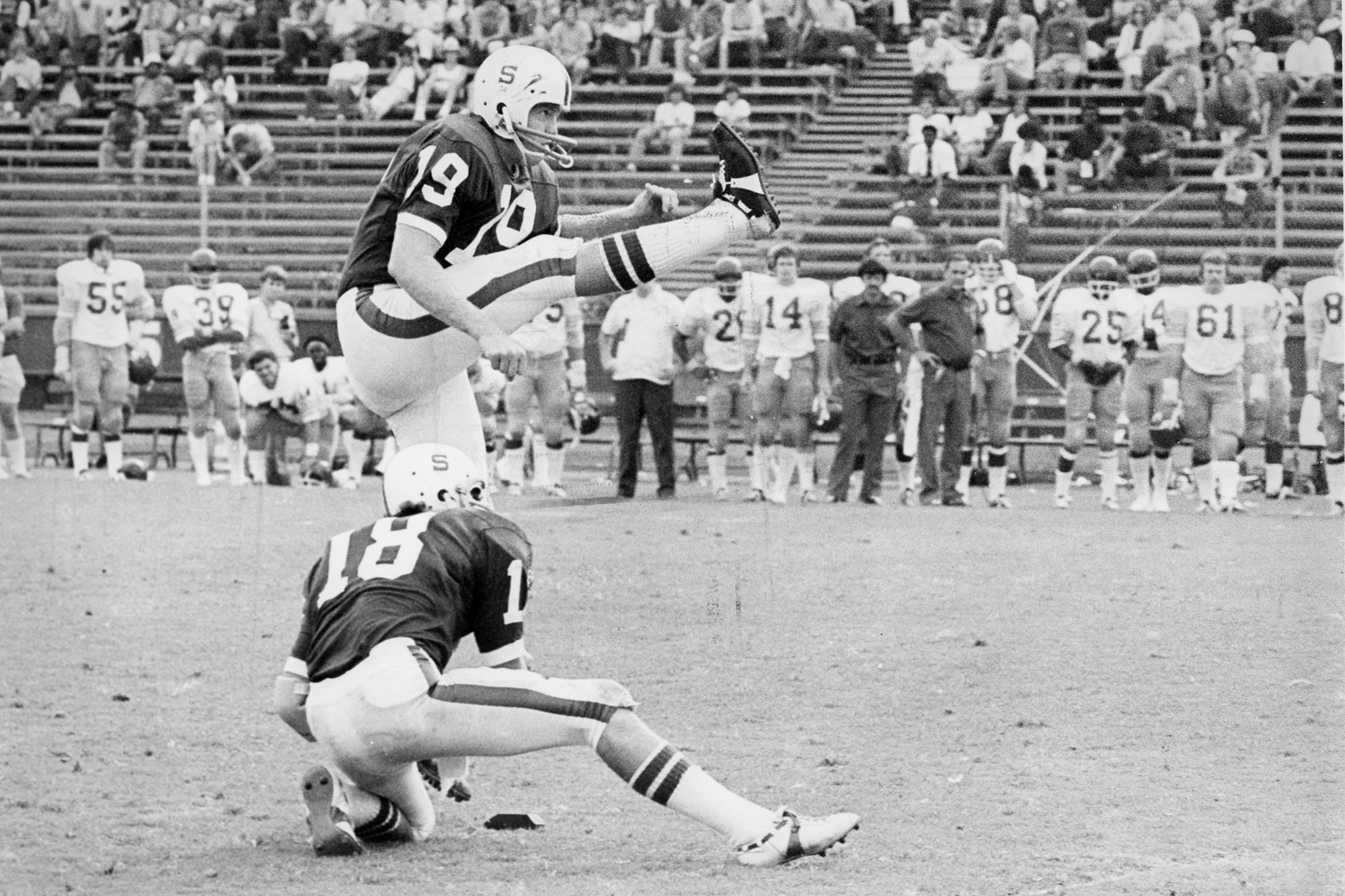
Mike Langford, a straight-on kicker, lined up for a 50-yard field-goal try at the right hashmark. Holder Eric Test calmed Langford and told him to keep his head down and follow through. Langford did indeed and swung his toe at the ball. When he looked up, he was being swarmed by his teammates.
The kick went through the uprights and Stanford earned a dramatic 22-20 Big Game win.
Mike Langford, shown against Washington earlier in 1974, beat Cal with a 50-yard field goal. Photo by David Madison.Rose Bowl-winning quarterbacks: Don Bunce (left) and Jim Plunkett (right).
Stanford strong safety Stuart Head, who is a junior, is exploring all options during his time on campus. He has spent the last two summers interning for Dr. Michael Fischbein in the cardiothoracic lab at Stanford. Dr. Fischbein is working with a murine model of Marfan Syndrome to study aortic aneurysm formation via biological assays, including gene expression.
“I gained a solid understanding of what factors might cause failed heart surgeries,” Head said. “We analyzed patient data, finding similarities and differences, then thought about how to fix their situations. I felt this was something I could apply myself to in the medical field someday.”
Head was joined in the lab this summer by sophomore inside linebacker Jake Lynch, sophomore defensive end Trey LaBounty, and sophomore offensive tackle Grant Pease. Junior fullback Houston Heimuli also knows his way around.
“Dr. Fischbein was so welcoming, and I love working with the staff,” said Head. “My first year, we were more hands on and got to be lab assistants and did gene typing and sectioning for experiments they were working on. This year, we were doing more data entry and patient records, so I kind of got to see both sides.”
Initially, Head was leaning toward pre-med and took human biology classes. But he switched to political science — the same major as his roommate, junior defensive end Dylan Boles.
“I took a bunch of classes and loved it,” Head said. “Now I kind of want to go to law school and maybe get into health or medical law.”
Head doubts there would be as many options for football players at other universities.
“I don’t think I’d be able to do this at any other school,” Head said. “Just the people that connected me about what you can do at Stanford. I hope young guys and recruits pick up on that and learn you can actually do that during your summers while playing football.”
Head was projected for early playing time this season, but was injured during fall camp. He has played the last three games and earned his first start against UCLA.
“Stuart’s been great,” said Bradford M. Freeman Director of Football David Shaw. “First on the special teams side, we’ve missed his speed and athleticism on the coverage units. He does a great job of closing down on plays or at least tying up multiple blockers so somebody else can make a play.”
Added fifth-year senior outside linebacker Casey Toohill, “It’s great to have him back. The guy hits hard. He’s a great tackler, fast and athletic. I’m excited for his future.”
Rehabbing an injury is never fun, but Head made productive use of his down time.
“Coach (Duane) Akina emphasizes ways to get mental reps and experience when you’re hurt,” Head said of the Couch Family Defensive Backs Coach. “Finding the best way to improve yourself and your game and not taking steps back. Guys in my group have all been out and we can all relate to each other. When you’re out, you have to lean on your brother more, so I think it brings our team closer together. Just keep that standard high … that’s the goal.”
Head plays like heat-seeking missile.
“I feel great and haven’t had any setbacks,” Head said. “Malik (Antoine, senior free safety) has done a great job running the show back there, but it’s great being back.”
Photo credit: gostanford.com
INJURY UPDATE
Senior kicker Jet Toner is out for the season after sustaining a lower body injury while covering a kickoff in the first quarter against UCLA.
Senior quarterback K.J. Costello, who has been sidelined since the second half of the Oregon game on Sept. 21, has practiced this week, sharing duties with sophomore Jack West.
“We’re hopeful,” Shaw said of Costello after practice Wednesday night. “We’ll know how he feels over the next couple of days. K.J. is somewhere between questionable and probable.”
Junior Davis Mills has been ruled out.
Shaw said sophomore strong safety Kendall Williamson could practice this week and might be available for Arizona.
TRIPLE DUTY
For the foreseeable future, true freshman Ryan Sanborn will handle punting and kicking chores. He performed admirably in both areas after Toner was injured.
To add depth, freshman Alexander Thorpe joined the team this week and will wear No. 39. His father, Allen, played soccer at Stanford.
Additionally, freshman wide receiver Diego Preciado has been kicking in practice. He kicked and punted during his sophomore season at Classical Academy in Escondido, Calif.
Photo credit: gostanford.com
YOUNG AGAIN
For the second straight game, true freshmen Walter Rouse (left tackle), Barrett Miller (left guard) and Jake Hornibrook (right guard) will start on the offensive line.
“I think our young guys are all going to be really good,” Shaw said. “They have their moments where inexperience shows up playing against guys that are a little bit older that have a few more tricks. Every snap they play is a learning experience.”
Shaw praised the play of junior right tackle Foster Sarell and junior center Drew Dalman.
“Foster Sarell is playing his best football,” said Shaw. “Drew has been really good all season.”
CONTINGENCY PLAN
Boles is now practicing with the offensive line to provide added depth. Additionally, junior tight end Tucker Fisk is taking reps with the group.
“If I’m the guy they want to step up, I’ll do it,” said Fisk. “Hopefully, I don’t have to. Just kind of the next guy up mentality.”
Fisk is often used as a blocker and said the transition is manageable.
“A lot of the things we do are pretty much the same,” Fisk said. “As far as liking it, it’s something new.
And anytime I’m learning something new on the football field it’s a good time.”
To add more depth, junior Jake Koffman joined the team this week. He threw the discus for the track and field team the last two years and was a team captain. He’ll wear No. 54.
SCOUTING ARIZONA
For the second week in a row, the Stanford (3-4, 2-3 Pac-12) defense will be tasked with containing a dynamic and athletic quarterback. Last week, it was Dorian Thompson-Robinson; this week, it’s Khalil Tate of Arizona (4-3, 2-2 Pac-12).
The teams meet Saturday at 12:30 p.m. on Reunion Homecoming.
“They’ve had their ups and downs,” Shaw said. “There are moments when Khalil Tate looks like one of the best offensive skill players in America. Being able to corral him and keep him under wraps is a priority.
“On the defensive side, they’ve got great movement, size up front, and speed in the secondary.”
Photo credit: gostanford.com
TEAM RECOGNITION
In 1999, Stanford surprised many by winning the Pac-10 Championship and played in the Rose Bowl for the first time in 28 years. Led by record-setting quarterback Todd Husak, now a radio analyst for the Cardinal football games, the Cardinal went 8-4 under Tyrone Willingham and closed the regular season with victories against Arizona State, Cal, and Notre Dame.
Husak set a single-season school passing mark that still stands by throwing for 3,712 yards. His favorite target was Troy Walters, a consensus All-American who won the Biletnikoff Award given to the nation’s top wide receiver.
Team members will be recognized on the field during Saturday’s game.
NOTES
“Defensively, the majority of the game we played really well,” said Shaw of his team’s performance last week. “We just allowed too many explosive plays.” UCLA hurt Stanford with five plays of 20-plus yards and two of 50-plus … On offense: “Too many negative plays,” Shaw said … On West’s performance: “Pre-snap, he was really good. Post-snap, didn’t play as well as he wanted to or as well as we need him to.”
QUOTE
“I’m not in the business of raising people’s spirits. These guys have a finite amount of time to play this game. The high percentage of them understand that, appreciate that, and play and practice with energy and passion. At the same time, that’s the bare minimum. It’s coming ready to play, fired up to play and excited to play.” — David Shaw
















 Sports Radio Service