Sharks Shut Out Devils 3-0

Photo credit: San Jose Sharks

by M. Walsh

The San Jose Sharks started a five-game road trip on Friday, with a 3-0 win in New Jersey. Melker Karlsson scored the first goal of the game, with Joe Pavelski and Joonas Donskoi adding to the score. Martin Jones made 28 saves for the shutout, while Keith Kinkaid made 30 stops for the Devils.

Asked if starting the trip a day early helped prepare the team, Sharks Captain Joe Pavelksi said:

Sometimes it does, sometimes it doesn’t. We won, so it helped. Coming off our home stand which wasn’t the best, I think it was good for us to get on the road an extra day and realize it’s a business trip for sure but we’ll have some fun, and it’s a great way to start it tonight.

The New Jersey Devils have had an excellent start to their season, winning six of seven games before the loss to the Sharks. Two of their young stars, forward Nico Hischier and defenseman Will Butcher get some credit for the early season success. In Friday’s game, Butcher led his team with five shots on goal. So far this season, Butcher has nine assists, while Hischier has two goals and five assists. After the game, Martin Jones described the Devils’ game as “They’re quick, they’re really good around the net. They make a lot of quick little plays in and around the net, so they’re definitely a dangerous team.”

The Sharks lineup looked the same as it had in their last game, one of just two wins this season. After the game, Sharks head coach Pete DeBoer said:

We need our depth, I thought our depth guys were good tonight. I thought all the guys on Tierney and Carpenter’s line were solid and we got good contributions from them. If not offense, then zone time and offensive zone play. So that was a good sign… It was the best that our depth forwards I think have played as a group, which is what we need.

The first goal came in the first period at 14:11. Tim Heed shot the puck in and the Sharks forwards swarmed the net. After Kinkaid made a couple of stops, Hertl made a quick pass from behind the net that found Karlsson right on the edge of the blue paint. From there he was able to put the puck into the far corner. Assists went to Hertl and Heed.

During that sequence, Logan Couture seemed to take the a shot off of his ankle and he left the game for the rest of the period. He did return to play the second period, but then missed some minutes at the start of the third.

The second goal came early in the second period. The Devils had the Sharks stuck in their own zone for a spell, but when the Sharks broke out they moved quickly. Defenseman Justin Braun sent the puck down low to Joe Thornton, who sent it right back as Pavelski got to the net. Braun took the shot from the blue line and Pavelski tipped it in. Assists went to Thornton and Braun. Of the goal, Pavelski said after the game:

I was a little surprised it went in, I was really tight to the goalie at the time. A lot of times they’ll be able to shut those down. Actually, one of my uncles passed yesterday and that was the one thing, you know, from family that they said, get a goal for that. And I don’t think that goal probably should have went in so I’m sure he had a little bit to do with it.

In the final two minutes of the second period, Joonas Donskoi showed off his skill and tenacity with the third goal. He carried the puck over the line, accompanied by his linemates Jannik Hansen and Ryan Carpenter. Donskoi took a shot from the faceoff circle which Kinkaid stopped and kicked back out. Donskoi caught the rebound on his backhand and threw it back in. An assist went to Justin Braun. Of Donskoi’s performance, DeBoer said:

He’s a very good player. Whether he plays with Thornton and Pavelksi or whether he plays with Tierney or Carpenter, he comes to work every game and he’s got to find a way to create offense for us. So I thought he was good tonight, played well. He’s just got to keep building on that.

The Sharks play again Saturday in Brooklyn against the New York Islanders at 4:00 PM PT.

Sharks Cup Run Ends With Game 6 Loss

By Mary Walsh

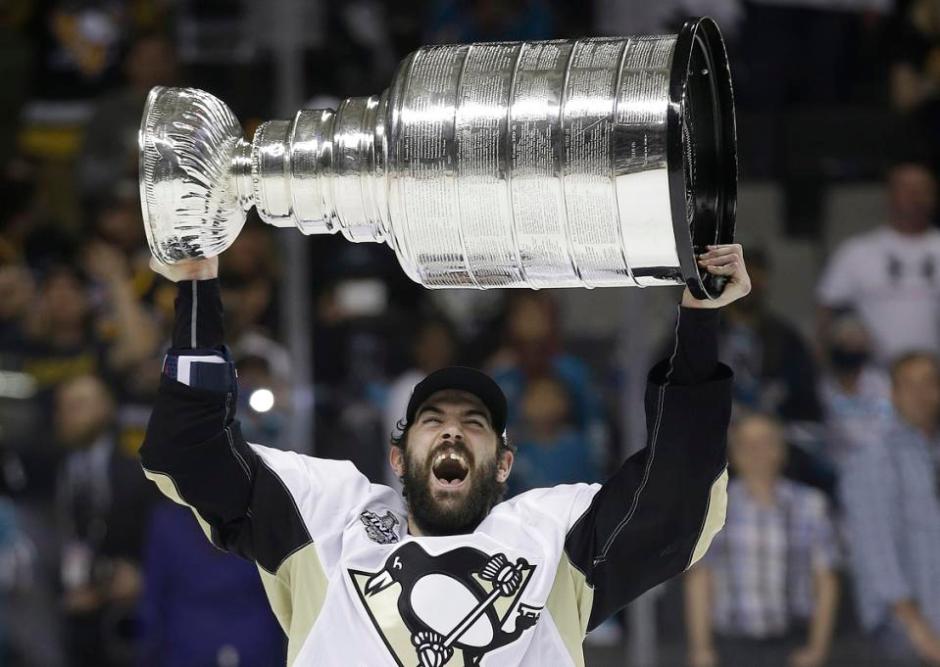
AP photo: The Pittsburgh Penguins Justin Schultz raises the cup proceeding the clinching win over the San Jose Sharks in the Stanley Cup Finals Sunday at SAP Center

SAN JOSE– With 8:58 left in the third period, Brent Burns was called for slashing Phil Kessel. The Sharks penalty kill held up but the team still only had one shot in the period when the kill started. They had no more when it ended. The minutes ticked away and the Penguins would not let the Sharks get close to a shot. The score remained stubbornly at 2-1 Penguins.

The San Jose crowd stood and cheered with four minutes left. It was a sight to see. Were they just happy to be at a game on June 12? Were they simply urging their team on?

The Sharks pulled Jones with a little over a minute left and put Marc-Edouard Vlasic on as the extra skater to try to tie the game. It took a few moments but Sidney Crosby got the puck away from the Sharks and put it into the empty net to make the score 3-1. The Sharks had just two shots on goal in the final period.

The buzzer went, the Penguins threw themselves into a celebratory pile near their net, having won the Stanley Cup for the fourth time in their history.

The crowd stood again, cheering. Then they chanted “Let’s Go, Sharks! Let’s Go Sharks!” They got a salute from their team. Sharks fans were still happy that their team made it to the dance, even if they had to go home early this time.

Did the fan reaction to the loss surprise the Sharks players? Goaltender Martin Jones said simply “No, no. They’ve been great all year.” Forward Joel Ward said:

“It was really cool for the fans to stick by us. You know, I think they appreciate some of the effort we put in and for us…” he paused “I mean, for them sticking by us through some tough times at the beginning. But you know, it was good to see. We love the fans here, love the building, love the tank. We just got to get back on the horse for next season.”

After the loss, Logan Couture described the process of getting over a defeat like this: “End of hockey seasons are never fun. It’s like you hit a brick wall. Stop. You wake up the next morning and you’ve got nothing to do.”

Joe Thornton described his feelings about the loss as: “It’s just disappointing but just super proud, the effort the guys gave all year long.”

Sharks head coach Pete DeBoer declined to comment on the specifics of Sunday’s season-ending game. Instead, he talked about his team’s performance in general:

I’m very proud of our group. I thought our guys emptied the tank and gave us everything they possibly could we just weren’t as good as them during this two week period.

DeBoer also described what he saw from the Penguins:

Their speed, their pressure they put on with their speed. It’s not just their speed, they have good sticks too. They force you into quicker decisions, they really challenge your execution. You know we hadn’t seen pressure and sticks like that through the first three rounds and I think our execution was an issue because of that.

The Sharks did not come out with the jump that many had expected from them on home ice with a chance to tie the series and force a seventh game. Through the first five minutes, the Sharks did not register a shot on goal, while the Penguins had two.

Then, at 7:50, Dainius Zubrus was called for tripping Brian Dumoulin. 26 seconds into the power pla, Dumoulin took a shot from the blue line and Melker Karlsson tried to block it but it went between his legs to the net. By the time Jones saw it, it was too late and the Penguins had the early lead. Assists went to Justin Schultz and Chris Kunitz.

Seconds later, Melker Karlsson went into the boards feet first and landed very awkwardly. No penalty was assessed, and it did not look like he was tripped or pulled down. He was helped off the ice but did return to the game later.

The Sharks finally started to push back around the 14 minute mark of the first. They threw a couple more shots on net, and the Penguins had not added any since their power play goal. The Sharks looked like they found the key for getting ahead of Penguins. They kept Pittsburgh hemmed in their own zone for couple of long shifts. Then the puck went out of play and a television timeout and the moment was gone. The Penguins attacked, the Sharks had trouble getting out of their zone and finally iced the puck. The tired defenders went back to work and pushed the attackers back.

After a short offensive push with some chances for Brent Burns, the Sharks were chased back into their own zone, where Martin Jones made half a dozen impressive saves before the Penguins were chased away again. The Penguins had five shots on goal in the final few minutes of the period.

At the end of the first period, the shots were 10-6 Penguins. After 3:13 of the second, the count was 10-9. That barrage of shots came from the Sharks’ top line. In those same opening minutes, the Penguins had a couple of chances that hit posts, but no sustained pressure like that long shift from the Thornton, Pavelski and Donskoi line.

It was several minutes later, after another long offensive shift, this time from the fourth line, that Couture tied the game up with a shot from the faceoff dot. Melker Karlsson was back, this time screening the Pittsburgh goalie. Assists went to Karlsson and Burns.

The Penguins did not take long to regain the lead. Sidney Crosby found Kris Letang with a pass behind the net. Letang’s shot went right into Jones and trickled under him. Assists went to Crosby and Connor Sheary.

Marc-Edouard Vlasic left the bench at 7:46 and did not return until 18:05.

The shots stayed uncannily even as the period went on. First tied at 13, then at 16. But by the end of the second, it was 20-17 for Pittsburgh. The only stat that showed a gross difference between the teams was the faceoff wins. The Penguins had won 65% of them.

Five minutes into the third period, the Sharks got their first power play when Connor Sheary hooked Justin Braun to the ice. The Sharks did not get a shot on goal. The Penguins knocked the puck back up the ice several times, often aided by a careless pass. The Sharks never got their game back and the single goal they needed to tie it up never came.

No injury information was released after the game. That information may be released Monday afternoon.

Sharks Win Western Conference Final 4-2

By Mary Walsh

AP photo: San Jose Sharks celebrate their first Western Conference title in franchise history with the Western Conference title Cup on Wednesday night at SAP Center

SAN JOSE– The San Jose Sharks punched their ticket to the Stanley Cup Final on Wednesday, by defeating the St. Louis Blues 5-2 in Game 6 of the Western Conference Final. The 4-2 series win represents the first time the Sharks have prevailed in a conference final, the first time they will compete for the Cup.

Joe Pavelski scored the first goal of the game, Joonas Donskoi scored the fourth, Joel Ward scored the two in between and Logan Couture tidied up with an empty net goal. Vladimir Tarasenko scored twice for the Blues late in the third period. Sharks goaltender Martin Jones made 24 stops for the historic win, while Brian Elliott made 22 for the Blues.

It is the third time that some of the Sharks have been to the Western Conference Final, among these is Joe Thornton. He talked about the win after the game:

It’s a pretty cool feeling. Obviously it’s our first time here so it was pretty neat to get this done at home. Fans here have waited so long, 25 years, and we’ve waited” here he turned to verify with Patrick Marleau, “18 years or so. So it’s a great feeling. And this team, we’ve always said we’ve got a deep team and we truly believe we’ve got a deep team. And you saw tonight all twelve forwards played big parts, all six D played big parts and Joner played great. This is really truly a team effort from top to bottom.”

Patrick Marleau said he does not wonder why this group has made it so much farther than previous Sharks teams:

“We’re just enjoying the ride right now. We’ve had some really good teams over the years but like Joe was saying, this team’s a little bit different. The confidence we built over the regular season and now in the playoffs. I think winning on the road helped us get close as a group during the regular season and it carried over into the playoffs so far. Just having each other’s back out there and working for each other.

Head coach Pete DeBoer said that he believed this team could get this far right at the start of the season. This, despite or perhaps because of their troubled recent seasons:

They were coming off a down season but they were coming off a decade of great hockey. They had been well coached. Todd McLellan and the previous staff are as good as there are in the business. These guys had a great foundation. Right place, right time. Everyone was ready for something a little bit fresher and newer, not anything that much different. But that and the additions Doug [Wilson, Sharks GM] made, it just came together.

“I inherited a similiar team in New Jersey when I went there. Same type of thing, they had missed the playoffs for the first time in a long time the year before I got there. I think when you go into that situation, when you have really good people like there was in New Jersey when I went in there, like there was with this group. They’re pissed off, they’re embarassed by the year they just had and they’re willing to do and buy into whatever you’re selling to get it fixed again.”

Today I heard someone suggest that the other three teams in these conference finals get more air time than the San Jose Sharks do because there is nothing controversial about the Sharks. They are not swapping their goalies around, they are not switching their lines around, their star players are not underperforming, there is no supplementary drama. They just go out and do what they are supposed to do. But for fans of this team, this playoff run has been very dramatic, very suspenseful. They may be cheering like mad in the audience, but there are a lot of fans just holding their breath through every game.

The Sharks played up to that hum-drum reputation when Joe Pavelski got credit for the first goal of the game just 3:57 in. Assists went to Joe Thornton and Tomas Hertl.

Apart from the last half minute of the period, the Sharks won the first period handily. Those final thirty seconds were getting out of hand, as the Sharks failed to clear several times and had the puck snatched away from them a few more. But they were saved by the bell and came away form the first with a 1-0 lead and a 9-5 shot advantage.

Seconds after that shot, play went the other way and the Tierney line wrought some havoc in the Blues’ zone. A Brent Burns shot went off Joel Ward’s stick for his fifth goal of the playoffs. Assists went to Burns and Tierney.

The Sharks earned their first power play when Troy Brouwer took an interference penalty early in the second period. San Jose’s power play did not convert but did bump their shot count to 13 without alowing the Blues to take a shot before close to the five minute mark of the period.

Scottie Upshall, back in the Blues lineup after sitting out the last three games, caught Tommy Wingels in the face with a high stick at 6:08 and drew blood, earning himself a double minor.

The four minutes of power play time seemed to lull the Sharks into complacency, or else it galvanized the Blues. The Blues took a couple of short-handed shots and the Sharks had more trouble getting through the neutral zone than they had previously. They accomplished the most immediate goal: of maintaining a two goal lead.

That was not enough for coach DeBoer. He used his timeout with just over five minutes left in the period. The Sharks had been scrambling and the Blues were making up ground on the shot clock. The end of the second had that in common with the end of the first: the Blues pushed the Sharks and Martin Jones had to make a few more stops. The Couture line had a good shift in the final 20 seconds but the Blues outshot the Sharks in the second, 11-10.

That second line picked up where they left off to start the third period, crowding into the Blues’ zone and making Elliott stop a shot from close in. It took them a few more shifts, but they finally caught what they were hunting: a third goal. It was only part of the Couture line. Ward was on the ice momentarily instead of Donskoi. As a result, he scored his second of the game and seventh of the playoffs. Assists went to Couture and Patrick Marleau.

The crowd went a little bit crazy. Richard Dean Anderson was shown helping duct tape Sharkie’s drum back together in one of the tunnels.

The Blues ruined the shut out with 8:21 left in the game. Vladimir Tarasenko got his first point in the series by way of a goal. Assists went to Jori Lehtera and Colton Parayko.

At 15:35, the teams were both penalized after a scuffle by the benches. Tommy Wingels (slashing) and Kevin Shattenkirk (cross-checking) both went to the box for two minutes. The Blues pulled Elliott for the additional skater and Tarasenko made a game of it with a second goal at 16:25. It squeezed through a gap between Jones’ blocker and the pipe. Assists went to Paul Stasny and Alex Pietrangelo. The Blues tried the same shot again a few seconds later but Jones adjusted.

The Blues continued to push right to the end of the period, until Logan Couture was able to put the puck in the empty net.

The Sharks will play the winner of the Eastern Conference Final in Game 1 of the Stanley Cup Final on Monday.

Blues Turn Tables On Sharks, Tie Series With 6-3 Win

By Mary Walsh

AP photo: St Louis Blues Jori Lentera (12) scores in the first period against the San Jose Sharks in game four at SAP Center on Saturday

SAN JOSE-Saturday’s Game 4 of the NHL’s Western Conference Finals was a complete reversal of Thursday’s 4-0 victory for San Jose. The St. Louis Blues tied the series 2-2 with a 6-3 victory, beating the San Jose Sharks in all three zones. The Blues’ power play went 2-4 while the Sharks’ power play went 0-4. Troy Brouwer and Kyle Brodziak each scored two goals for the Blues, with Jori Lehtera and Alex Pientrangelo adding to the tally. For the Sharks, Joe Pavelski, Chris Tierney and Melker Karlsson scored.

Oddly, the Sharks won on the shot clock and in the faceoff circle, the same way the Blues won those in the previous game. The fact that the Sharks were not shut out seems like a negligible detail.

It was the first time in these playoffs that Sharks head coach Pete DeBoer decided to pull goaltender Martin Jones from the game and put backup James Reimer in. It was a stark contrast to the consecutive shutouts that Jones pulled off in the last two games. On the performance of Jones, Sharks forward Tommy Wingels said afterwards:

We hung him out to dry tonight, he made some big saves there and he gave us a chance. We kept giving them more opportunities, odd-man rushes and guys alone at the net. So that’s certainly not on [Jones] at all, it’s on every guy in front of him.

It is anyone’s guess whether we will see these teams bring their best game to the same game in this series. The first game may have been the closest we will see, as each subsequent game has shown one team or the other at their best and the other very much not so. Of the Sharks’ performance Saturday, forward Logan Couture said: “We weren’t ourselves early. When you give a good team a two-nothing lead, and you give up a short-handed goal, that’s pretty much it.”

Tommy Wingels went into some detail about what the Sharks did wrong in this game:

We got away from our game. Our game is going north with it, it’s making plays where we’re there, it’s gettin pucks past their d-men, through the neutral zone and in on the forecheck. We got away from that, we turned pucks over, we turned it into a track meet for the first twenty, thirty minutes.

The only change in either lineup from Game 3 was Jake Allen, replacing goaltender Brian Elliott in the Blues net. After the game, Blues head coach Ken Hitchcock talked about the decision to put Jake Allen in net:

He gave us exactly what we needed. He’s a competitive son of a gun and we needed a battler in there. We needed somebody to really help us play better defense. And we played with more passion in front of him in our own zone because I made the goalie change. And I had to make that decision. But I just felt like we were allowing them too much easy space with [Elliott] in there. And [Elliott] was getting bombarded and we needed to just dig in a little bit deeper defensively if we were going to have a chance in this series.

Almost four minutes in, Roman Polak took a shot from the blue line that looked like it was in, at least from one end of the rink. A section in the audience got half way to their feet before seeing that it was not a goal. The crowd was ready and confident that any Shark could score from anywhere. The game did not fulfill their expectations.

Instead, five minutes in, the Sharks took the first penalty, a tripping call to Brent Burns. Before that power play was over, the Blues had taken the lead. The goal was Troy Brouwer’s, with assists to Robby Fabbri and Paul Stastny. Coach DeBoer challenged the play as offside but the goal stood up and the Sharks lost their timeout.

Shortly after the half way mark of the first, matters got worse for the Sharks. Jori Lehtera took a shot that Jones stopped, and the rebound went to the other side of the crease, where Robby Fabbri was waiting. Jones got across and stopped two shots, but a third rebound went out front to Lehtera, who put it under a prone Brent Burns and into the net.

The Sharks had their first power play a few seconds fater that, an interference call on Paul Stastny. The first power play unit did not look their worst, but they were not as sharp as they have been. The Blues took advantage of some poor passes and overdressed plays and killed the penalty. The second unit had no more success, and only a little less time. The first unit went off the ice with just under a minute left in the power play.

The next power play came with just 21 seconds remaining in the period, and it went to the Blues. As they waited for a delayed slashing call on Vlasic, another shooter drew Jones away from the net and got the puck behind him. Burns was there again he knocked the puck away.

Just over half way through the Vlasic penalty, Logan Couture put the puck over the glass and gave the Blues a two man advantage for 48 seconds. The Sharks survived both penalties and got a round of applause for it.

Their next power play, though, earned applause only from the Blues fans in the building.
Jaden Schwartz and Kyle Brodziak escapaed through the neutral zone with the puck, attacking two on one against Marc-Edouard Vlasic. Schwartz passed and Brodziak shot at the far corner on Jones, scoring his first of the playoffs short handed at 6:09, while Kevin Shattenkirk sat in the box for interference. An assist went to Jaden Schwartz. Their escape was explained by Joe Thornton after the game: “It was going to [Pavelski] and Pav thought [Couture] was behind him so he let it go. But it was just one of those plays where usually we make that happen and it just didn’t.”

The Blues’ second even strength goal came just after the half way point of the second. This one looked a lot like the previous one, when Jones had to get from one side of the net to the other and ended up too far from the center of his crease, giving [] an open net to shoot at. After that fourth goal, Peter DeBoer did the same thing Ken Hitchcock did in Game 3: he replaced the goalie. James Reimer hit the ice for the first time in the playoffs.

A minute or so later, a puck hit the netting above the Blues net, which caused the official to blow his whistle. When the puck landed, Hertl knocked the puck inth=o the Blues net. That got a reaction out of the Blues and got ?Hertl all tangled up in a scuffle. Oddly, the officials felt that Thornto ought to go to the box, along with Brouwer, both for roughing, but not each other.

The Four on four play seemed to favor the Sharks, or maybe it was the Blues sitting back on their 4-0 lead. In any case, the penalties elapsed and the score was still 4-0.

As the second wound to an end, the score stood at 4-0 and the shots were 21-15, both in favor of the visitors.

1:05 into the third period, the Sharks pushed back a little. The Thornton-Pavelsk-Hertl line worked their way into the offensive zone, accompanied by the Sharks wrecking ball defenseman, Burns. Burns took one of this familiar skates around behind the net to loosen things up and then made his way back out to the top of the slot. This all seemed to be a distraction as the puck got back to Joe Thornton while Joe p/avelski was making his way to the net.Hertl was already there, possibly screening Allen’s view of Thornton’s pass to Pavelski. It was Pavelski’s tenth goal of the playoffs, Thornton’s 11th assist and Martin’s 4th.

The Blues put the kibosh on the Shark’s excellent third period start when Joel Ward put the puck over the glass at 3:48. Just seven seconds into the power play, Troy Brouwer put the puck around Reimer, off the post and in. Assists went to Alexander Steen and Paul Stastny.

The next attack came the Sharks’ third line of Chris Tierney, Joel Ward and Melker Karlsson. It started with an uncustomary skate deep into the offensive zone, by Justin Braun. That set off a chain reaction that had the Blues scrambling around the energy and quickness of Tierney and Karlsson. They put at least four shots in the direction of the net before one went in at 6:57. The goal went to Chris Tierney with an assist to Melker Karlsson.

The Sharks had another power play at 7:07, but all they got for that was some padding for their shot count. Yet another power play came their way at 10:51. Stastny was in the box again, this time for tripping Chris Tierney. Still the Sharks power play could not launch.

With more than four minutes left, DeBoer pulled Reimer for the extra skater. All that accomplished was the Blues’ sixth goal into an empty net.

With Reimer back in the net, a good push by San Jose’s third line resulted in the Blues’ scoring an own goal while trying to clear Tierney’s pass out of Karlsson’s reach.

With 2:11 left, after a group discussion around the faceoff circle, Brenden Dillon and Carl Gunnarson came to blows. The crowd deemed Dillon to be the winner. Both players left the game. Alexander Steen and Tommy Wingels also received ten minute misconducts.

The final shot count was 34-27 San Jose.

Game 5 will be in St. Louis on Monday at 5:00 PT.

Sharks Hang On To Beat Predators 3-2, Take 2-0 Series Lead

By Mary Walsh

USA Today photo: San Jose Sharks Martin Jones stops a shot by the Nashville Predators in game two at SAP Center on Sunday

SAN JOSE–The San Jose Sharks took a 2-0 series lead with a 3-2 victory against the Nashville Predators. Four of the goals were scored in the second half of the third, three of those in the final three minutes. It was not the Sharks’ best game, defensively or offensively, but it got the job done. After the game, Sharks head coach Peter DeBoer said as much:

We won and in the playoffs you’ve got to win all kinds of different ways. I really liked our first period. I thought their desperation level was just a little bit higher than ours in the second and third. I think that’s what you saw, and rightfully so. You got a team that is facing going down two game and no one wants to lose the first two game of a series. We knew their desperation level was going to be high and we found a way to weather it and Jonesy was fantastic and the important this is we won.

The win was significant also for being a home game. Not only have the Sharks been better on the road, but the Nashville Predators have too, at least in the first round of these playoffs. The Sharks were out shot and out hit on Sunday but they won where it mattered. Goals were scored by Joe Pavelski, Logan Couture, and a game winner from Joe Thornton. Martin Jones made 37 saves for the win. Mattias Eckholm and Ryan Johansen scored for Nashville, and Pekka Rinne made 22 saves.

Craig Smith was back in the Nashville lineup after missing Game 1. The first period did not look anything like the first period of the first game. This time, both teams started fast and earned chances early. They were slim chances, with no one having much room to choose a shot or get in position to make a play.

The Sharks were the beneficiary of that speedy play, in the form of an early power play. Roman Josi was called for cross-checking Chris Tierney at 6:24. The Sharks’ power play started out very well, with the Predators giving San Jose plenty of room to get set up. A rather cavalier behind-the-back pass from Joe Thornton to Logan Couture exemplified how composed the Sharks were with the man advantage. Yet that excess of time and space did not benefit the Sharks in the most practical sense: they did not score.

At even strength, the fourth line was very effective, making the Nashvile defense burn a lot of defensive fuel and block shots.

The Sharks went on the penalty kill at 13:38 when Joel Ward was called for tripping. Karlsson got the first clear, Couture the second, Dillon a third. The Predators got three shots through to Jones but he stopped them.

As the first ended, the Predators led the Sharks in shots by 10-7. That count did not include the ten shots that Nashville blocked. The Sharks had blocked five.

The Sharks started the second mostly trapped in their own zone. When they finally escaped, they came out with their best chance to that point. Couture and Donskoi went fast down the left wing and Couture managed to get a shot off. Rinne kicked out a rebound but Donskoi could not elevate it enough to beat Rinne’s right pad.

As the second period wore on, the Predators dominated on the shot clock and continued to block shots. By the 13 minute mark, Nashville had 11 shots to the Sharks’ 4.

At 15:16, the Sharks were penalized for too many men on the ice. The penalty kill started out fairly chaotic, with a snarl of bodies just in front of the blue paint. Finally they got untangled, with broken sticks sliding around and no one really able to control the puck. From that helter-skelter start, the Sharks pulled off another kill that ended with a short handed chance. Matt Nieto and Marc-Edouard Vlasic made a nice play but Rinne stopped them.

The Predators took their own too many men penalty shortly thereafter. Trying to avoid the call, Roman Josi tried to get off the ice by climbing over the wall in front of the Sharks bench. That did not pass muster. After the game, DeBoer was asked about the incident: “I’ve never seen that before. 25-30 years of hockey, and I’ve never seen that situation before. I don’t know, it’s a good question. I’m assuming it’s a rule, that they’re not allowed to change into our bench.”

32 seconds into that power play, a Brent Burns shot produced a rebound for Logan Couture to put away. Couture had been lurking around behind the net, making an inconspicious pass or two, then moving in front of the net just as the puck made its way to Burns. Burns did not have to wait long after receiving the puck from Thornton before taking his shot. Pavelski deflected the shot which created a rebound for Couture, who had an open net. It was Couture’s fourth goal of the playoffs. Assists went to Pavelski and Burns.

At the end of the second period, the Sharks led 1-0, despite their shot deficit of 16-25 for the game. The Sharks had blocked ten shots in the second, while the Predators had blocked twelve.

The Sharks found themselves short handed again 6:34 into the third. Brenden Dillon was called for roughing. He Just 23 seconds into the kill, Marc-Edouard Vlasic was hit in the head by a Shea Weber shot. He stayed down for a spell before returning to the bench. He did not go to the room.

At 12:56 of the third, Nashville tied it up. Mattias Eckholm took a shot from the blue line, just as three skaters converged in front of Martin Jones. The shot went just wide of Jones’ glove.

The Sharks got it back at 17:23. Thornton skated into the slot and passed the puck to Matt Nieto on the wing. Nieto waited until the last moment to take a shot. Rinne stopped the shot but it bounced off of a Nashville skater and landed in front of Joe Pavelski. He put it where it belonged. It was an unlocky bounce for Nashville, especially coming so late in the game. Assists went to Nieto and Thornton.

The Predators responded by pulling Rinne with more than two minutes to go. They sustained pressure for about a minute before a puck went over the glass and Nashville used their time out. When play resumed with a defensive zone draw for the Sharks, Pavelski controlled the puck and passed it out of the zone. Joe Thornton was on his way through the neutral zone when Pavelski’s pass found him. Thornton took his time and put the puck in the empty net.

Nashville responded with a furious attack on the Sharks’ net. With just 1.6 seconds to go, Ryan Johansen scored, making Thornton’s empty net goal the game winner.

The series now moves to Nashville for Game Three on Tuesday at 6:00 PT.

————————–

In case you missed the black cat tale from Game 1, you can read the updated version with video at NHL.com here: Sharks working to find home for ‘Joe Paw-velski’

NHL Playoffs, Game 1, Round 2: Sharks Take Preds Down 5-2

By Mary Walsh

AP photo: San Jose Sharks Joel Ward 42 celebrates scoring goal with teammates in third period in game one at SAP Center

SAN JOSE– The Sharks beat the Nashville Predators in the first game of the NHL’s Western Conference Semi-Finals. The Sharks won by a score of 5-2, with goals from four different shooters. Logan Couture scored a power play goal and an empty netter. Tomas Hertl, Joel Ward and Tommy Wingels all added to the tally. Mike Fisher and Ryan Johansen scored for Nashville, and Pekka Rinne made 33 saves on 36 shots. Martin Jones made 29 saves for the Sharks on 31 Nashville shots.

The Sharks looked tentative in the first period, as did the Predators. Perhaps the teams were feeling each other out, perhaps the Sharks were rusty and the Preds tired, but not very much happened in the first period. By the third period, the Sharks were firing on all cylinders and running away with the game. Sharks fans can only hope this is indicative of how the team will play this series.

The game was uneventful until one of the Nashville skaters tripped over a breaking Sharks and fell into Pekka Rinne, taking out the goalie and his net. That play was reviewed but no goal was awarded.

The next noteworthy event was a penalty called against Melker Karlsson for hooking. The Sharks’ penalty kill started pretty well, with play moving out of the Sharks zone and into the Predators’ zone for a good part of a shift. Nashville eventually made it back in and stayed a spell but the Sharks did not give them much to shoot at. Nashville had a couple of better chances just after the penalty expired but the Sharks kept the puck out of their net.

The Sharks made a good push during the final minutes of the first period, hemming the Preds in and evening up the shot count. For most of the period, the Sharks trailed in shots by a few. At the end of the period, the Predators led 12-11, but the score was still tied at nil.

The second period started out stoppage-heavy. It seemed like one every 10 seconds but that probably was not the case. At 2:45, Matt Nieto was called for tripping Colin Wilson, which the crowd booed with gusto.

The Sharks’ penalty kill looked like it would be successful, with the Predators being evicted frequently from the offensive zone. In the final seconds of the power play, the Predators took the lead. Mike Fisher caught a pass from Ryan Johansen and held the puck for a moment while drifting backwards into the faceoff circle. He took his shot and it went by three Sharks, including Martin Jones.

The Sharks’ first power play came from an interference call on Eric Nystrom at 5:31. The Sharks’ power play did not score but it was a sight to see. The Predators got the puck out in the first 10 seconds and then not again until the last few. The Sharks put a lot of shots at the net, though few got through. The penalty killers blocked a lot of shots and looked weary by the end of it.

Trailing by a goal, the Sharks did wake up. The Predators did not have a shot on goal [between 11:03 and 2:11 left.], and then they had two before the period ended.

Fifty seconds into the third period, Ryan Johansen was called for holding and the Sharks went on their second power play. This power play did not start up as well as their first power play. It took the Sharks good forty seconds to finally get set up, and then Nashville booted them out after just a couple of chances. The second unit came on (Ward, Vlasic, Hertl, Donskoi and Martin) and changed things up. They started by carrying the puck over the line instead of dumping it in. After that, they survived a broken stick, holding the zone while it was replaced. As the penalty time ran down, Joel Ward took a pass from Marc-Edouard Vlasic and sent it along to Tomas Hertl. Hertl was posted at the corner of the net and quickly put it past Rinne to tie the game. Assists went to Ward and Vlasic.

Ward picked up another point almost ten minutes later, when he took a pass from Joonas Donskoi as they skated into the zone. Ward had enough space to duck one way and go the other, freezing Rinne at the top of his crease. Ward then put the puck behind the goaltender, who reached back with his glove and either missed the puck or knocked it in. It was Ward’s first goal of this post-season, with assists to Donskoi and Brent Burns.

Things deteriorated from there for Nashville. With 4:40 left in the game, Calle Jarnkrok was called for high-sticking Donskoi. Seconds into the power play, Logan Couture and Joe Pavelski skated in, moved the puck back and forth a couple of times, and scored again. It was Logan Couture’s goal, that he lifted lightly over Rinne’s pad from close range.

Nashville pulled Rinne with more than two minutes left, and with just under two minutes left, a bouncing puck went over Martin Jones to bring the Predators back within a goal. They kept their net empty. A few seconds after the next faceoff, Logan Couture took advantage of that and restored the Sharks’ two-goal lead.

Tommy Wingels added yet another, in a similar manner but on the other side of the ice. After that, the Predators put backup goaltender Carter Hutton in the net to prevent yet a third empty net goal.

The final shot count was 38-31 Sharks.

Game Two will be on Sunday at 5:00 PT at SAP Center in San Jose.


Sharks v. Predators: NHL Playoffs 2nd Round Preview

By Mary Walsh

SB Nation photo: Nashville Predators come calling at SAP Center in San Jose against hosts the Sharks in game one of second round

“Sharks versus Predators” sounds a little bit like a made for tv monster movie, but the San Jose Sharks will face the Nashville Predators to start the second round of the NHL Playoffs on Friday.

The Predators came out of the Central Division as a wild card, so the Sharks did not see as much of them in the regular season as they saw of their first round Pacific Division opponent, the Los Angeles Kings. Nashville’s wild card status also gives San Jose home ice. The Sharks will have to do without their road advantage to win this series.

Probably the most important information to glean from the first round is the most obvious: the Predators played seven games, while the Sharks played only five. The Predators spent more travel time going between Nashville and Anaheim, while the Sharks traveled back and forth to Los Angeles. Round One put more mileage on the Predators than the Sharks by a big margin.

Another question would be about goaltending. Pekka Rinne has long been considered one of the league’s top goaltenders, despite his team’s conspicuous lack of playoff success. Martin Jones has performed admirably so far, despite this being his first time as a playoff starter. Neither goalie has been perfect but they have both been crucial to their team’s success.

Pekka Rinne gave up 17 goals through seven games, with a save percentage of .915. Martin Jones gave up 11 goals through five games, with a save percentage of .912. Martin Jones’ 2.18 GAA ranks fifth among playoff goalies, while Rinne’s 2.85 ranks ninth. Their save percentages are seventh and eighth in the same field.

Noteworthy in the rankings of 2016 playoff goaltenders is that two of the top three goalies in save statistics played for teams that have been eliminated. Maybe goaltending statistics do not tell you much about how a series will go.

Both Rinne and Jones finished all of their first round games, so the quality of their backups has not been an issue. If it were, I would give the edge to the Sharks’ James Reimer over the Predators’ Carter Hutton.

On paper, the Sharks have a better record in most categories than the Predators, in both the regular season and the first round. The Sharks scored more against a Pacific Division team than the Predators. But the Predators have not been and still are not an offense-first team. Much of their success comes from stingy defense. The Predators are a completely different kind of opponent than the Kings were.

In the few meetings between San Jose and Nashville this season, the Sharks lost the series 2-1. Their one win was in a shootout, and they lost one game 6-2. The Sharks have not fared well against the Predators. There is a glimmer of hope in that record, that the shootout win was the most recent game, played just 26 days ago. It caught the Sharks on the upswing, which is where they started these playoffs. It is reasonable to put more stock in the April 4th game than in the February 6th game, but those six goals have to be in the back of the Sharks’ minds. While the Kings are generally considered a more offensively loaded team than the Predators, the Kings that the Sharks played were not as they were a couple of seasons ago.

Colin Wilson and Shea Weber led the Preds in the first round with five points each. Goal scoring was pretty spread out, with Wilson, Weber, James Neal and Mattias Ekholm each scoring two goals. Six other skaters, including Filip Forsberg and Ryan Johansen scored goals against the Ducks. Forsberg and Johansen were both scoring at a good clip during the regular season so they bear watching. Defenseman Roman Josi was second in points during the regular season and he had three against the Ducks.

Craig Smith also scored a goal for the Predators, but missed two games and most of a third with an injury. The Predators did not win the games he missed. He was third on the team in goals scored with 21 in the regular season. He played the last two games in the Ducks series without much of a drop in minutes, so the Sharks can probably expect to see him on Friday.

The Sharks had more points as a group, though they played two fewer games than Nashville did. Brent Burns had eight points in the first round, with Joe Pavelski and Logan Couture collecting six apiece. Patrick Marleau and Joel Ward each had four and Joonas Donskoi and Joe Thornton each had three. That last one is a surprise, and Nashville will probably pay as much attention to Thornton as the Kings did to keep his numbers low.

Donskoi could also be considered a surprise, but a happy one for Sharks fans. His playoff performance might be attributed to a couple of things.Donskoi was a consistent points producer all season, and his time in the Finnish league cannot be overlooked. It could not have been assumed that his MVP performance in the Finnish playoffs would translate to success in the NHL playoffs, but it was a strong possibility.

Another factor that benefitted Donskoi is the fact that the Kings did not have the depth to match the Sharks. Do the Predators? Can they keep Joe Thornton in check and also stay on top of Donskoi, and for that matter, the likes of Chris Tierney, Melker Karlsson and Matt Nieto? Those three scored goals against the Kings. I don’t believe the Predators will have an easy time of it keeping all of the Sharks shooters off the board.

How successful will they be against the Sharks defense? The Sharks gave up almost as many goals as they scored in the first round. In total, they scored 16 and gave up 11, which does not seem that close unless you look at it in goals per game, where there is a difference of just one: 3.2 goals for and 2.2 goals against. One goal is enough to win the game but it leaves little margin for error.

The Sharks’ power play was pretty good against the Kings, at 23.8%. Their penalty kill was nothing special, with a 78.6% success rate. Nashville’s power play success was tiny, at 3.8%, but their penalty kill chugged along at 84% against the Ducks’ formidable power play.

The Predators scored a miniscule 0.13 more goals than they gave up in the regular season. In the first round, their numbers dipped into the negative as they scored 14 goals but gave up 18.

This is the challenge for the Sharks, to ignore what happened in the first round. The team with the most goals wins, but somehow the Predators turned that rule on its head. Obviously, the numbers are explained by a couple of bad losses that skewed the averages. That would be the second and third games where they lost by three goals both times. They also won one by 3-0, and then, like the Sharks, usually won by a single goal.

I think the Sharks’ offensive depth will again be their best asset. That is always a safe bet, but with a stifling defensive opponent like the Predators, nothing is certain.

Sharks Win Game 4, Take 3-1 Series Lead

By Mary Walsh

AP photo: Los Angeles Kings goalie Jonathan Quick was kept busy all night by the Sharks here a shot goes wide in the first period at SAP Center on Wednesday night

SAN JOSE– The San Jose Sharks defeated the Los Angeles Kings at SAP Center on Wednesday, by a score of 3-2. The win gives San Jose a 3-1 series lead, sometimes called a stranglehold. Despite rumors that there would be changes to the Sharks lineup for Game 4, there were none. Sharks head coach Peter DeBoer did not even alter his line combinations. The lack of change paid off. The team as a whole was sharper and more balanced than it had been on Monday. Even when they gave up two goals early in the third period, they corrected quickly enough to hold on for the win. It was altogether an impressive performance.

The fourth line that struggled in Game 3 pulled themselves together and played very effective minutes. After Wednesday’s game, coach DeBoer talked about the line of Chris Tierney, Tommy Wingels and Nick Spaling:

They were excellent. Again, I think with our group, every time this year that we’ve challenged them to be better, they responded and I think that speaks to the character in the room. And those guys I thought were excellent tonight for us. I didn’t hesitate to put them out with four or five minutes left in the game.

All three Sharks goals were power play goals, scored over four power plays. This was a vast improvement over their 0-5 power play performance Monday. The game winner was scored by Patrick Marleau, with additional goals scored by Brent Burns and Joe Pavelski. Martin Jones made 26 saves for the Sharks. Jonathan Quick also made 26 saves, for the Kings. Los Angeles goals were scored by Trevor Lewis and Luke Schenn.

The Sharks spent most of the first five minutes in the Kings zone, but could not find any good shots. Near the five-minute mark, the Kings went the other way, frst two on one, then when Justin Braun caught up to them, three on two. That led to a prolonged attack in the Sharks’ zone. Martin Jones stopped the three shots that came his way, but when the Sharks finally got the puck out it was by icing it. The Sharks were on their heels for several minutes even after that. Their forays into the Kings’ zone were short and not productive. Slowly, the Sharks started pushing back. They were spending less time trapped in their own zone when the 10 minute mark ticked by. But the shots were still 7-2 Los Angeles.

By the time the period ended, the Sharks had corrected that disparity. They saw a good number of excellent chances pass them by, since no one was in the right spot to take advantage of unexpected, glaring opportunities. The shots were 11-8 San Jose, and 9-2 San Jose for the second half of the period. The teams were even in faceoff wins.

Jeff Carter started the second off with a roughing penalty 30 seconds in, against Marc-Edouard Vlasic. The Sharks maintained the attack for a solid 40 seconds and then a crazy bounce sent the puck off the back boards and through the crease, then off a skater and back through the crease, still not going in. This disrupted the play enough for the Kings to clear the zone.

The Sharks retrieved the puck behind their own goal line and resumed the attack. This time the Sharks did not take long. A cross-ice pass from Joel Ward to Brent Burns found him above the left faceoff circle. Quick could not get across in time and Burns’ trademark shot blew by him to give the Sharks the lead. Assist went to Ward and Vlasic.

Before the cheers died down, play had resumed and Jonathan Quick was handling the puck behind his net. Matt Nieto, chasing the puck down, caught Quick in the back of his skates. Both players went down and Nieto went to the box. The Sharks penalty killers started out well and had a short-handed chance half way through the penalty, with Chris Tierney almost skating in front of Quick for a shot before being held up by Kings defenders.

In the final seconds of the penalty kill, Karlsson, Vlasic and Thornton carried play back into the offensive zone and set the Kings spinning for a shift.

Unfortunately, that penalty kill was followed by another less than a minute later. Joel Ward was called for high sticking. The Kings had a good chance about half way through but an overhead clear by Vlasic allowed the Sharks to regroup and change.
The Sharks finished that up with another short handed chanced, and not long after it expired, yet another outrageously improbable missed chance. A Kings skater got tangled up with his goalie and a Shark and all were out of play for several seconds, with the puck sitting in the blue paint. No Sharks skater could get to it, including the one trapped in the body tangle inches away.

The score remained 1-0.

The Sharks drew another power play when Tomas Hertl was tripped next to the Kings net by Rob Scuderi. 39 seconds into the power play, Patrick Marleau sent the puck behind the net to Thornton, who sent it out front for Joe Pavelski. A fast shot as he fell to his knees earned Pavelski his fourth goal of the playoffs.

The game tempo increased after that. The Sharks drove play for a long spell after that. When they did not have th epuck, they wasted little time stripping the Kings of it, or knocking them off of it. Brenden Dillon made Dustin Brown pay for sendng the puck around the boards, and Patrick Marleau added a solid hit or two.

The Kings finally did get some traction in the last three minutes of play, but it did not last for more than a minute. The Sharks were back in the Kings’ zone at 7:30 when Luke Schenn was caught roughing Joe Thornton. The Sharks did not convert on their third power play but the Kings did not take any leisurely skates into the Sharks’ zone either.

The shots for the period were 13-8 San Jose.

The teams picked up where they left off for the third. 1:34 into the period, Jamie McBain caught Joonas Donskoi in the face with a high stick. Five seconds into that penalty, Patrick Marleau stopped the puck with a skate, kicked it to his stick, and put the puck in the net. Assists went to Logan Couture and Brent Burns.

The Kings got on the board just 69 seconds later when Luke Schenn’s shot from the blue line got by Martin Jones. Trevor Lewis was in front of Jones, wrestling with a Sharks defender. As the shot came in, Lewis fell into Jones. Coach DeBoer challenged the goal for goaltender interference but the call stood up. The goal went to Lewis, with assists to Luke Schenn and Kris Versteeg.

The game got a little more interesting at 6:44, when Schenn took a shot through a long line of traffic and beat Jones, closing the gap to one goal. Assists went to Anze Kopitar and Marian Gaborik.

After that, the Kings tried more of those shots, but Jones seemed to see them better. The Kings kept pushing, they caught up on the shot clock, and as the final minutes ticked away, the game lost none of its intensity. The Sharks spent a lot of time with the puck but they were not getting the shots or the chances they had before. Even with the Kings net empty, the Kings kept the Sharks from taking good shots. The Sharks managed a couple of shots from their own zone but missed the net.

With 18.3 seconds to go, Los Angeles took their time out, then sent six skaters back on the ice for an offensive zone draw. It was to no avail as Game 4 slipped away from the Kings.

Game 5 will be back in Los Angeles at Staples Center on Friday.

Sharks Lose Game Three to Kings

By Mary Walsh

AP photo: LA Kings Tanner Pearson (bottom) celebrates his game winning goal in overtime as the Kings take game three 2-1

SAN JOSE- The San Jose Sharks lost the third game of the Western Conference Quarter Finals to the Los Angeles Kings by a score of 2-1 in overtime. The Sharks still lead the series by 2-1. The game followed a peculiar statistic for the NHL playoff games Monday: all three games saw a goal scored in the first minute of the game, by the losing team.

In San Jose, that goal was scored by Joe Thornton. Anze Kopitar scored the tying goal for Los Angeles, and Tanner Pearson scored the overtime winner. Jonathan Quick made 29 saves for Los Angeles, and Martin Jones made 22 saves for San Jose.

Monday’s game was a grueling affair for both teams, with all the regulation scoring coming early in the first period. After that, it was a push-me-pull-you match up and down the ice for more than 40 minutes. The Sharks did a very good job of limiting the Kings’ chances, but they could not take advantage of the chances they had to score. They outshot the Kings 30-24, and in the third period by 9-3.

After the game, Sharks head coach Pete DeBoer said:

Over the second and third, I thought we grabbed it back, did a lot of good stuff tonight. Reality is, they’re a very good team. They’ve got multiple Stanley Cup winners over there.

We knew this wasn’t going to be a sweep. We’re in a good spot, I think we could have won the game tonight too, need to keep rolling out the same kind of game.

Through much of the game, the Sharks played well defensively but were less sharp in the offensive zone. Their power play stood out as being especially ineffective. It went 0-5 while Los Angeles went 1-3. Joe Thornton talked about the fifth power play after the game:

The last one especially, it felt like we were going to get it. The crowd was into it, we were into it, they broke a stick, we got a lot of shots and it felt like it was right there. But unfortunately it just didn’t happen.

Pete DeBoer is not overly concerned about the lack of results on the power play:

We had a lot of good looks, we had a lot of zone time. Because we don’t score doesn’t mean we’re not doing the right thing. That’s how the NHL goes. You’re not going to score on your power play every time. If we weren’t getting in and getting set up and getting looks, I’d be worried.

Did the Kings change their game much after losing two in Los Angeles? Shark goaltender Martin Jones did not think so:

Not really. They have their game plan, it’s crash the net, put pucks to the net. I thought we’ve done a really good job keeping them to the outside. But, yeah, I don’t think too much changed for them.

It took 30 seconds for the Sharks to score their only goal of the game. After pushing the puck out of their own zone, and touching it through the neutral zone with a pass or two, the Sharks’ top line made a couple of moves in the corner and suddenly Joe Thornton was skating behind the net and picking up the puck. He looked for a pass but did not see one so he carried it into the slot and took a shot. The puck went under Jonathan Quick without any fuss. The shot was so subtle that no one reacted for a beat. An assist went to Tomas Hertl.

The Sharks did not convert on their first power play of the game, at 5:33, but the Kings did score on their first, at 7:50. While Tommy Wingels sat in the box for hooking, Anze Kopitar picked up the rebound off of a Milan Lucic shot. A second assist went to Jake Muzzin.

At the half way point of the first period, things were not looking great for the Sharks. The score was tied, the shots were tied, but the Sharks had blocked more shots and the Kings had won 73% of the faceoffs. The Kings were bearing down.

At 11:50, Nick Spaling was called for tripping Rob Scuderi, putting the Sharks on their second penalty kill of the period. The Sharks did kill it off, but Los Angeles managed some good chances during the power play.
By the end of the period, Los Angeles had outshot San Jose by 13-7 but the score was still knotted at 1.

The Sharks started the second period with some energy, and had an early power play when [] went off for []. The Kings’ penalty kill was formidable. They not only prevented the Sharks from taking any shots, they kept most of the play outside their zone.

For the middle half of the period, the Sharks had trouble getting far beyond the Kings’ blue line. Any attempt to dump it in or carry it in was met with fiercely efficient resistance.

The Sharks had another power play at 13:01, after an interference call against Marian Gaborik. This power play was a lot more effective, but still did not score. The Kings still played well in front of their goaltender, blocking shots and crowding any skater that came near the blue paint.

Chris Tierney had a good chance near the 16 minute mark, a point blank shot on Jonathan Quick. Tierney caught a pass as he skated through the slot and tried a reverse shot, but Quick got his body in the way.

In general the second period was a frustrating one, with many missed calls and failed chances. The Sharks gained ground on the shot clock, but saw their power play fall to 0-3. With 2:19 left in the period, the Kings had still only taken two shots to the Sharks’ ten.

With 1:23 left in the period, Chris Tierney was called for playing the puck with his hand. The resulting Kings power play was fairly good, keeping the Sharks on their toes. The Sharks weathered the last seconds of the period and finished the second still tied at 1.

The Kings had six shots during the second period, to the Sharks 11.

The Sharks killed off the last seconds of the Tierney penalty and jumped out to a good start in the third. They put a couple of good shots on net in the first 90 seconds.

The period ground along after that, with neither team making any progress to speak of. At 9:40, Milan Lucic was called for slashing and the Sharks power play had another chance. The first 1:50 of the penalty was all Sharks, with the Kings’ penalty killers unable to change or get control of the puck at all. But the Sharks did not score.

With 5:56 left in regulation, the Kings’ Tanner Pearson put the puck over the glass in the defensive zone. The Sharks had only allowed the Kings one shot in the period to that point, and had taken five. Their power play, however, still could not produce a goal.

Peter DeBoer used his timeout with just under four minutes left, after an icing trapped some tired Sharks on the ice.

With 53.8 left in regulation, Tomas Hertl and Dustin Brown received roughing minors. They went to their respective rooms and the teams finished the period 4-on-4.

Heading into overtime, the shots were 27-22 San Jose.

3:47 into overtime, Tanner Pearson ended it after a miscue on the Sharks blue line by Brenden Dillon. Dustin Brown knocked Joonas Donskoi off the puck and Dillon tried to do the same to Brown. The puck escaped and Pearson picked it up behind Dillon and re-entered the Sharks zone two on one with Vincent LeCavalier. Neither Couture, Wingels, nor Hertl could catch him and Roman Polak could not block his shot. Assists went to Dustin Brown and Vincent LeCavalier.

Game Four will be Wednesday at 7:30 PT at SAP center.

Sharks And Kings Preview: Playoff Remix 2016

By Mary Walsh

photo credit docsportstalk.com: San Jose Sharks Joe Thornton and teammates will be in L.A. to try and take the Kings out of the first round of the playoffs starting Thursday

The San Jose Sharks will face the Los Angeles Kings Thursday, in game one, round one of the 2016 Stanley Cup Playoffs. They say that lightning does not strike twice. A lot happens in a hockey game, and a playoff series can produce the same result in many different ways. But it is probably safe to predict that the Sharks will not win three games in a row and then lose four. The odds of that happening again are very slim indeed, and I don’t need to be a math genius to know that.

The Los Angeles Kings are probably the best first round opponent for the San Jose Sharks. The Kings are not only a “must play” for any team trying to get through the western conference, they also have a special place in San Jose’s heart. The last two seasons have been dark for San Jose, starting with their humiliation at the hands of the Kings two seasons ago. While the meek of heart would probably want to avoid Los Angeles entirely, few professional hockey players can be described as meek.

Two seasons is long enough to see any team change, even if change is not their objective. The Sharks have made several changes. Head coach Pete DeBoer brings a new angle to the Sharks’ game. The Kings have seen DeBoer’s Sharks several times this season, but they are nowhere near as familiar with them as they were with Todd McLellan’s team. DeBoer has coached against the Kings in the playoffs, when the New Jersey Devils faced them in the 2012 Stanley Cup Final. That was a long time ago, and he has a very different team now, except in one respect: the Kings are still the favorites to win.

Those expectations are a little bit strange. Even though the Sharks were embarrassed by their lost 3-0 lead in 2014, they did beat the Kings three times before losing. The Sharks also won the 2015-16 regular season series 3-2, going 3-1-1. The Kings have a terrible habit of starting slowly, in the regular season and the playoffs. That is a habit that is bound to trip them up eventually. It is far from unlikely that the Sharks could win this series.

The Kings have the home ice advantage over the Sharks, but that advantage has proven to be less and less significant over the past few seasons, not only for the Sharks but for most playoff teams. What has been true for the Sharks over the past couple of seasons is that they play better on the road. It is not a stretch to say that the Sharks have the “road advantage” in this series.

Wherever they play, the Sharks have every reason to be hungrier and angrier than the Kings. The Kings have won two Stanley Cup Championships. The Sharks have not gotten to the Final yet. If NHL parity is not a myth, it is the Sharks turn for a shot.

Both teams have made significant changes to their rosters since 2014. For the Sharks, Martin Jones and James Reimer are a more formidable goalie tandem than Antti Niemi and Alex Stalock were. Jones’ star is rising. He proved this season that he can be a reliable presence in net, and can even steal a game here and there. James Reimer has proven that he can gut out some pretty gruelling playoff games, and he has already turned in some very impressive performances for San Jose.

With Martin Jones in net, the Sharks are starting the goalie who carried them through most of the season with only a few hiccups. That he used to play for the Kings should not be much of a factor, since any familiarity the Kings have with Jones will be matched by his knowledge of their skaters. Jonathan Quick is not exactly an unknown quantity for the Sharks, either. The Sharks know him well from many meetings.

The Sharks have Matt Nieto and Marc-Edouard Vlasic coming back from injury. The last time the Sharks appeared in the playoffs, also against the Kings, the collapse began with the loss of Vlasic to injury. The Sharks have added a couple of veteran defensemen since then, in Paul Martin and Roman Polak, but Vlasic’s importance cannot be understated. The Sharks played pretty well down the stretch without him but they will need all their best blue liners to go far in the playoffs.

The Sharks also have some added depth in the scoring department, in Joel Ward and Joonas Donskoi. Ward is a seasoned veteran of playoff games, and scored timely goals for Washington. Donskoi is going into his first NHL Playoffs, but he has some experience with championship games from his time in Finland. Both players were consistently helpful during the regular season, and as additions to a group that has been to the playoffs together many times, they could be difference makers for San Jose.

Melker Karlsson joined the team last season and showed that he could contribute in the scoring department. He has spent a lot of time this season on the fourth line, but DeBoer’s fourth line is very different from the fourth line that Todd McLellan would put together. It is reasonable to expect more offense and fewer penalties from the likes of Karlsson and Dainius Zubrus.

If there is an x-factor for the Sharks, I would say it is Joel Ward or James Reimer. Any of the rookies could surprise the Kings and all have to contribute to get the Sharks through the first round. But Ward and Reimer both have enough playoff experience to do some heavy lifting. Even if Reimer does not play, he provides an added sense of confidence and security that should permeate the team’s mental game.

On the Los Angeles side, defenseman Alec Martinez and forward Marian Gaborik have returned from late season injuries. The team has confidence in their readiness to play, as they recently reassigned forward Nic Down and defenseman Kevin Gravel to the AHL. Other changes to their roster over the last season include the addition of Milan Lucic, and the losses of Justin Williams and Jarret Stoll. The last two were historically problematic for the Sharks, if in very different ways. Lucic combines some of both of those, as a cagey and tough competitor.

The Kings also picked up some scoring depth in Vincent LeCavalier. LeCavalier is nothing if not streaky but he should not be ignored. He has a lot to prove after his dismal stay with the Philadelphia Flyers. Since he is supposed to retire after this season, he can be expected to give it his all.

For the Kings, I would not identify particular players as x-factors. Rather, their tendency to start slowly should be seen as the critical factor. If they let the Sharks get ahead of them, they might not catch them again. If the Sharks can avoid having key players injured early, the Kings might not need to spot them the lead. They might just take it fair and square.