
Sharks Prepare For the Unexpected in Outdoor Game

By Mary Walsh

SANTA CLARA– Saturday, it may be a good thing that California, North or South, is not generally considered a traditional hockey market. There will be no blizzard, no high winds, no unexpected glare, no ice storms, no life-threatening and ice-tilting weather conditions to contend with. After a successful outdoor game last season in the southern part of the state, the Levi’s Stadium game might put the nail in the coffin of the old stereotype: the one that says bad weather is hockey weather. Maybe good weather is hockey weather too, and bad weather is just bad weather.

Friday, some of the Sharks talked with the media about several aspects of the upcoming game. For fans, the event is the main thing. For the Sharks, the game has to be front and center, a game against a divisional rival. How long will it take the Sharks to get into the game, to forget the football stadium and the audience of 69,000 in the stands? Justin Braun said they should be in the game “right away. I think by the time warmups kicks in and you’re going and you’re in that zone, you don’t even think about that. Maybe the anthem, you give a quick look around and you’re ready to go.”

Scott Hannan has played outside before, in the NHL Winter Classic, when he was a member of the Washington Capitals. Of his prior experience outdoors, he said:

“The conditions are always a little bit different. You gotta be expecting a bad bounce, the puck to bounce a little bit more or maybe to stick. You gotta expect the unexpected out there. Sometimes it’s a tough bounce that make or break it in the game.”

Does Hannan feel the Sharks are missing out on something to not be facing extreme weather? Outdoor games in more traditional hockey markets feature wind, rain and extreme cold. Is that an important part of the outdoor game experience? Hannan answered:

When I talk about experience, experience is the day, the buildup, the coming into the rink and seeing the fans tailgating. That’s just not something you get to experience every day. Yeah the experience of a blizzard, sure that would be great. I mean rain wasn’t too great in Pittsburgh. But getting to play outside, getting a change of scenery as far as just going to the next arena, waking up at the hotel doing the same routine. I mean it’s something different, I think it’s something different for the fans.

Obviously having a big game against LA. Everybody knows the standings and the series so it’s a big game in that respect.

In the buildup to this very big event on an extra large stage, Sharks’ rookie Tomas Hertl has been finding his way slowly back onto the scoresheet, but more slowly than anyone had expected in his (almost) second NHL season. After his first season was cut short by injury, he has struggled to play with the confidence and sharpness of his first partial NHL season. Has he felt extra pressure to score, from the team or from himself? “I don’t know, it’s a little bit, maybe both. I have 15 goals last season after 35 games. Now I have just 10, it’s making me say ‘what is wrong? I have just ten goals after almost 60 games.'”

He described his approach to the game now as trying to just play, and play hard. He recognizes that the team badly needs every player to chip in for the wins they need. He has also adjusted to playing on the left wing. Before coming to North America, Hertl had played primarily as a center, and had a little experience as a right winger. He does prefer to play as a center but he says it is not a game breaker: “I start left or right, I just go play.”

Hertl and his team will be playing in a once in a lifetime kind of game Saturday. After practice Friday, Sharks forward Chris Tierney described what he expects from tomorrow night’s game:

It’ll definitely be a chip and chase game, you know the ice probably won’t be as good as it is in a normal rink. But I think everyone will be excited so I think it will be a good experience and I’m sure everyone’s adrenaline will be pumping.

Playing in a football stadium has a very different feel for hockey players. There will be no fans along the glass, and the space outside the rink gives the stage a very different feel from an indoor arena. Tierney played in an outdoor game once before, at the junior level. It was not an event of the same magnitude as this one, but it gave him a scale for comparing the venues:

Last time I thought it was kind of far away and you couldn’t really hear the crowd that much. But when you come out here and see the stadium here, it looks like the stands are pretty close to the rink. So I think with this many people it will be loud and it will be a cool experience.
Sharks Catch Flames But Can’t Beat Them

By Mary Walsh

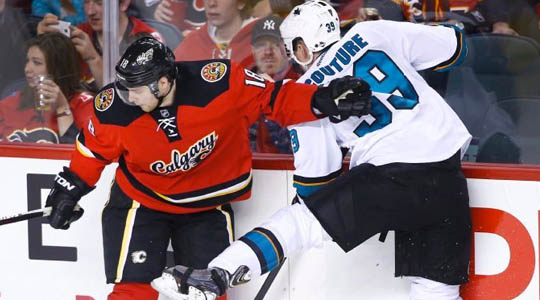
SAN JOSE-After a very poor first period, the San Jose Sharks rallied but still lost 4-3 to the Calgary Flames Saturday. The game winner was scored by Sean Monahan just 24 seconds into overtime. Other Flames goals were scored by Dennis Wideman, Joe Colborne and Jiri Hudler. Sharks goals were scored by Joe Thornton, Logan Couture and Melker Karlsson. Joni Ortio made 19 saves on 22 shots for the win, while Antti Niemi made 19 saves on 23 shots for the Sharks.

Todd McLellan did not mince words after the game: “We got what we deserved and we’re probably fortunate we got that. The start was unacceptable to a man.”

A number of Sharks mentioned that some video clips and the right words during the first intermission helped them right the ship in the second and third periods. It is hard to ignore the fact that coach McLellan changed the line combinations after the first. When the game started, the forward lines were: Patrick Marleau-Joe Thornton-Matt Nieto, Joe Pavelski-Logan Couture-Melker Karlsson, Barclay Goodrow-James Sheppard-Tommy Wingels, Tomas Hertl-Tyler Kennedy-Tye McGinn. To start the second period, those top two lines had been changed to: Thornton-Karlsson-Pavelski, Couture-Marleau-Wingels.

Asked whether those changes had anything to do with the second period recovery, Joe Pavelski said: “Woke everyone up. Whether you shuffle them around or not, in that situation, I think we’re going to be much better. Couldn’t be much worse there.”

The Flames scored their first two goals early, leaving the Sharks reeling a little. With Justin Braun and Marcus Granlund battling for space in front of him, Sharks goaltender Antti Niemi did not see Dennis Wideman’s shot coming in from the blue line. In 40 seconds flat, Calgary had the lead. Assists went to Joe Colborne and Mason Raymond.

About four minutes later, Jiri Hudler went to the box for tripping, giving the Sharks the first power play of the game. The power play started with a couple of quick clears by Calgary, then an offsides call that pushed the Sharks back out a third time. The Sharks did gain the zone a couple of times but never got a shot on goal. Instead they were pushed out again and again, and finally lost control of the puck in their own zone to give up a short-handed goal. The goal was scored backhand by Joe Colborne, his fourth goal of the season. The assist went to Matt Stajan.

With five minutes left, the Sharks went on the penalty kill as Tyler Kennedy went to the box for slashing. The penalty kill looked almost as good as the Flames’ had looked, allowing just one shot to get to the net, and ousting the Flames from the zone without allowing them to loiter for too long.

The Sharks spent the last minute of the period in a prolonged attack at the Calgary end, but still finished the period with only four shots on goal to the Flames’ 11.

The Sharks came out for the second period so ferociously that it broke the jumbotron. Just 12 seconds in to the second period, Couture took a shot from the half boards to beat Joni Ortio. The scoreboard picture flickered, froze and went black. It took about five minutes to recover. (There is no evidence that Couture’s shot actually caused the technical failure.)

At 2:10 of the second, the Flames were called for too many men on the ice, putting the Sharks on a power play. This Sharks power play was much more effective. A first unit of Joe Thornton, Joe Pavelski, Logan Couture, Patrick Marleau and Brent Burns tied the game up in 30 seconds. The goal was scored by Joe Thornton, with assists going to Joe Pavelski and Patrick Marleau.

In less than five minutes, the Sharks had almost pulled even on the shot clock as well, outshooting the Flames 6 to 1.

Before the midpoint of the period, the puck went in the Flames net yet again but the play was reviewed. It had gone off of Melker Karlsson’s skate and the call had to go to Toronto to count as a goal. It did, giving the Sharks their only lead of the game. Assists went to Joe Pavelski and Justin Braun.

The Flames tied it back up when Jiri Hudler scored off of a pass that had bounced of a Sharks skate. It was a good shot from just below the hash mark, through quite a few bodies.  Assists went to Mikael Backlund and Mark Giordano.

The shot count for the period was 10-6 Sharks.

Both teams looked a little tentative to start the third period. In the first five minutes, the Sharks had two shots on goal, the Flames none.

Near the half way point of the third period, Matt Tennyson was called for hooking, which occurred in a tumble into the boards. Tennyson seemed to get the worst of that encounter despite being the one in the box.

The Flames power play had a good chance when Sean Monahan found some space to Niemi’s left but the Sharks goalie came out to stop him and the penalty killers had the rest of the ice covered. It was a very efficient kill.

Patrick Marleau tried to untie the game with about five minutes left. He skated up the ice and through some Calgary defenders and got a shot off, then caught the rebound and threw it back in. The Calgary goalie was having none of that solo act.

Several Sharks had more chances to untie it but time ran out. The shot count at end of regulation was 22-21 Sharks. The Sharks had outshot the Flames 8-4 in the third.

McLellan put Wingels, Couture, Dillon and Braun out to start OT. The Flames got the first shot and ended the game quickly after the offensive zone faceoff. It was over just 24 seconds into the fourth period.

Joe Colborne was named the first star of the game, while Logan Couture was the second. Couture not only had a goal but he will also need some dental work on two or three teeth after meeting some errant sticks in the game. Couture’s three blocked shots were also commendable. The third star went to Justin Braun, who finished the game with two assists.

The Sharks’ next game is on  Monday when they host the visiting New Jersey Devils at 7:30 PT.

Sharks Fend Off Flames, Win 4th in a Row

AP Photo/The Canadian Press, Larry MacDougal

By Mary Walsh

The Sharks started a two game road trip with a 3-2 win against the Calgary Flames. Going into Saturday’s game, the Flames had won four in a row, Sharks had won three. The Flames were 11-1-2 when scoring first, as they did Saturday. To up the ante, the Flames had a third period scoring differential of 24, while the Sharks had a lamentable minus 4. If the Sharks thrive on a challenge, entering the third period tied with the Flames was a fine one.

It was not a pristine performance from the Sharks, but head coach Todd McLellan summed it up well after the game:

We… found a way to beat a hot goaltender, found a way to get ourselves back into the game. Our first period was not anywhere near what we needed it to be, but we chatted a little bit between periods and we responded well.

Sharks goaltender Antti Niemi stopped 33 shots for the win. Patrick Marleau scored the game winner, while Tommy Wingels, Logan Couture and Justin Braun all had two point games.

The Flames dominated play for the first five minutes, peppering Niemi with shots while the Sharks had trouble getting through the neutral zone. The Sharks started to show some cohesion around the ten minute mark, with some sustained zone time and a few shots. Overall, the Flames dominated play in the first, keeping the Sharks’ recorded shot count to just three in the first fifteen minutes of the period.

Kennedy left the game during the first period with an undisclosed injury and did not return for the second.

The Flames scored the first goal in the last three minutes of the period. David Jones passed the puck to Mark Giordano who was just coming across the blue line with some speed. His slapshot came so fast that Niemi never saw it coming. It was Giordano’s seventh goal of the season. Assists went to David Jones and Curtis Glencross.

In the final minute, Logan Couture took a shot that went off the post, and the Sharks picked up their game in the final few shifts of the period. By the end of the period, the Flames led the Sharks in shots 12-8, and the score stood at 1-0 Flames.

The Sharks started the second period by losing the faceoff, but they chased the puck down and pushed the Flames into the offensive zone. Justin Braun came up with the puck off some good forechecking from Tommy Wingels. With a backhand shot that looked like an afterthought, Braun beat Karri Ramo to tie the game. The assist went to Wingels.

That backhand worked so well that Logan Couture decided to try one after some nifty stick handling around a Flames defender. He got control of the puck after John Scott wrested it from the Flames’ Raphael Diaz. Couture’s shot went off the far post and in, abruptly giving the Sharks the lead. Assists went to to John Scott and Justin Braun.

The Sharks took the first penalty of the game midway through the second period, an interference penalty to Brent Burns. Not only was the Calgary power play seventh in the league, but it was also on a four game scoring streak. The Sharks killed that off without allowing a shot to get through to the net.

The next penalty went to the Flames, with just under five minutes left in the period. The Sharks held the zone well but only got one shot to the net during the power play.

Back at even strength, the Flames tied the game after the Sharks lost track of Johnny Gaudreau, who set himself up in front of the net. Jiri Hudler passed the puck to him and he had plenty of time to push it past Niemi. Assists went to Hudler and Matt Stajan.

At the end of the second, the Flames led in shots 21-16. For the period, the shots were 9-8 Flames.

The Sharks’ Brendan Dillon was called for interference just 3:26 into the third period, putting the Sharkson the penalty kill. Johnny Gaudreau had a quick chance that had Niemi scrambling to stop it but the Sharks penalty killers did come to the rescue. Another close call came with 35 seconds left in the penalty, with the puck bouncing like a lotto ball, but the Sharks killed the penalty off. The Flames managed three shots on that power play.

Midway through the period, the Marleau-Couture-Wingels line had a spectacularly relentless shift, moving the puck through and around the Flames zone. Scott Hannan and Matt Irwin held the blue line, while pass after pass kept the Flames chasing the puck around. Finally, a few quick moves behind the goal line between Wingels and Couture ended with a shot from Patrick Marleau to give the Sharks the lead again. Assists went to Couture and Wingels.

The Flames responded ferociously, hemming the Sharks into their zone for a very long shift. An icing gave the Sharks a chance to regroup, and the Sharks escaped for line changes after Goodrow blocked a shot out of the zone.

Driving the net at 14:55, Tomas Hertl drew a holding penalty against TJ Brodie. 31 seconds into the power play, Matt Stajan was called for hooking, giving the Sharks a two man advantage for nearly 90 seconds. The first minute of that 5 on 3 produced just two shots but looking promising. Ramo stopped the shots, holding the second.

The Flames won the next faceoff and the Sharks’ power play fell apart after that, with the Flames clearing the puck twice and getting a short-handed breakaway. Niemi stopped the shot but the Flames came alive, running roughshod through the Sharks zone. The Flames drew a penalty and played with an empty net for more than 30 seconds before their power play even started.

With Braun in the box for tripping, the Flames pulled Ramo for a sixth skater. Burns, Couture, Vlasic, Thornton, Pavelski and Hannan all pitched in for the closing penalty kill. The Sharks only got the puck out twice, but it was enough to hold on for the win.

The final shot count was 35-30 for the Flames.

Joe Pavelski led the team in shots with six, Marc-Edouard Vlasic led the team in shots blocked with four. Vlasic also led the Sharks’ skaters in ice time with 24:32.

Johnny Gaudreau and Sean Monahan led the Flames in shots with five each. Curtis Glencross and Ladislav Smid each blocked three shots. Karri Ramo stopped 27 of 30 shots for Calgary. Dennis Wideman led all skaters in ice time with 28:44.

Matt Nieto was out with an injury, while Tye McGinn and Mirco Mueller sat as healthy scratches.

The Sharks next play on Sunday at 6:00 PST in Edmonton against the Oilers.

Sharks Win Preseason Game in Arizona

-By Mary Walsh

Friday night, the San Jose Sharks won a contentious preseason game against the Arizona Coyotes. Prospects Barclay Goodrow, Chris Tierney, Eriah Hayes and Mirco Mueller all played well, suggesting that any of them could end up starting the season in San Jose.

Goals from Matt Nieto, Tye McGinn and Tommy Wingels gave the Sharks their third win of the preseason. Alex Stalock was in goal and made 23 saves on 24 shots. Rob Klinkhammer scored for the Coyotes, and Mike Smith made 31 saves on 33 shots faced.

Matt Nieto opened the game with an early goal, in his line’s first shift. Couture’s backhand pass went right to Nieto for a goal at 1:08 of the first period.

A few minutes later, Couture was hit from behind by Kyle Chipchura. Justin Braun took issue with that and fought Chipchura. Couture made his way to the bench under his own steam. Braun was given a two minute penalty for boarding, a five minute major for fighting and a ten minute misconduct. Chipchura received five minutes for fighting, five minutes for boarding, and a ten minute game misconduct. It came out to two minutes of five on five, followed by three minutes of five on four for the Sharks.

More than ten minutes went by in the first period without the Coyotes getting credit for a shot. In the same time, the Sharks had five. The hit and the fight seemed to turn the tide for the Coyotes in the minutes before the power play started. They had a couple of good chances but the Sharks defense held them off.

Right at the end of the power play, Matt Irwin was also hit hard, by Joe Vitale. No penalty was called.

The second period started out more evenly, with the shot clock registering almost equal (3-2) for the first five minutes. A shot from Eriah Hayes in the sixth minute lead the way for a Sharks charge. Despite a lost faceoff, the fourth line stirred things up in the offensive zone. A penalty to Rob Klinkhammer for goaltender interference tilted the ice back in the Sharks’ direction. A simultaneous hit by Vitale on Braun went unmentioned by officials.

The power play did not pay off for the Sharks.

After the power play expired, Tye McGinn and B.J. Crombeen fought right after the faceoff. While the game was contentious, it is not clear whether any particular incident led to the bout.

By the thirteen minute mark, the shots for the period were up to 10-3 Sharks.

Eriah Hayes hit Keith Yandle in front of the Coyotes net, and then attempted to fight him but Yandle declined. This raised the ire of the Coyotes and after the scrum was dispersed, Hayes went to the penalty box. A roughing minor to John Scott and an embellishment minor to Yandle took them out of play for two minutes as well. The Sharks killed the penalty off.

The last five minutes of the period saw the Coyotes pushing to tie the game, and getting their shots to the net. The Sharks were saved by the bell as the period ended with a pile of bodies in front of Alex Stalock and the Coyotes nipping at the puck.

The shot count for the period ended 11-8 for the Sharks.

Stalock faced some pressure from Shane Doan early in the third period but he was ready for it.  The teams played a balanced game for the first five minutes, with some good chances but few sustained onslaughts from either side.

A handful of penalties came out of a mess along the boards at 6:55 of the second. Tommy Wingels went to the box for kneeing Michael Stone, while Brent Burns and Matt Smaby went with matching roughing minors.  That brought the power play count even with two per team. Stone did stay in the game after some attention from the Coyotes trainer.

Barclay Goodrow and Chris Tierney got involved with a number of Coyotes after a hit by Goodrow on Hodgman. Tierney caught a punch but after some discussion, no penalty was called.

Seconds after the next faceoff, Joe Pavelski spotted McGinn’s stick in front of the net. Mike Smith had just made an impressive save but lost his stick in the process. Pavelski and McGinn took advantage of the situation to put the Sharks up 2-0. Assists went to Pavelski and Brent Burns.

A defensive zone pass from Mueller to Nieto went awry when Nieto lost his footing. Rob Klinkhammer took advantage of that and put the Coyotes on the board.

The period was not the Sharks’ most dominant, with the Coyotes finally nosing ahead on the shot clock. The Coyotes pulled their goaltender late to try for the tying goal, but Tommy Wingels put the game away in the last thirty seconds. A pass from Justin Braun found Pavelski near center ice, and Pavelski found Wingels in position to shoot at the empty net.

The final shot count was 34-24 Sharks.

=====================
The absence of Nikolay Goldobin from the last two games suggests that he may not crack the roster to open the season. Still, his performance thus far suggests that he will be in the NHL sooner than later. His linemates, however, are looking more ready by the day. Barclay Goodrow and Chris Tierney were on a line with Tommy Wingels in the Arizona game, and one of them could very well push out a more seasoned player for the early part of the season. They have kept pace and made good plays in all of their preseason appearances.

Eriah Hayes used Friday’s game to make a good argument against him being pushed out. With hard work in the corners, four hits, and two blocked shots, he made the most of his spot on the fourth line with Adam Burish and John Scott.

At the start of camp, many expected Matt Tennyson to be kept in San Jose as the seventh defenseman. That did not come to fruition, and he has (for now) been assigned to the Sharks’ AHL team in Worcester. At the moment it looks like Mirco Mueller could well open the season in San Jose. The Sharks’ new radio team made particular mention of how Mueller knocked Rob Klinkhammer down, in a game that started off with a lot of physicality.  The 19 year old Mueller does not appear intimidated by the NHL preseason. He did make an error in the first period that had his goalie scrambling a bit but on balance he played a very smart game. He also acquitted himself well on the penalty kill.

It is still possible that Taylor Doherty of Taylor Fedun will stay, but Mueller is certainly making a good case for himself.

The Sharks’ lines were as follows in Arizona:
Forward lines: Goodrow-Wingels-Tierney/McGinn-Pavelski-Hertl/Marleau-Couture-Nieto/Hayes-Burish-Scott
Defensive pairs: Demers-Irwin /Braun-Vlasic /Mueller- Burns
Stalock in goal

The Sharks will play their final game of the preseason on Saturday, against the Ducks in Anaheim.

Sharks Putting Pieces Together

By Mary Walsh

Training camp is well under way for the San Jose Sharks. Some players are getting a shot to make the team, others have a guaranteed spot but have to move on from an offseason that was too long. The way last season ended should not be forgotten, but Sharks players, coaches and staff have to forgive themselves and each other, and move forward. That will involve some mental acrobatics that will last well beyond training camp and into the season.

Justin Braun’s five year contract extension is an excellent step ahead. With Braun under contract through the 2019-20 season, the Sharks have secured yet another talented and still improving young defenseman. From the Sharks’ press release:

“Justin has emerged as one of our most well-rounded and dependable defensemen,” said Wilson. “He’s an excellent skater who excels in matching up against the opponents top players on a nightly basis and fits in well with our core group of younger players. We feel Justin has just scratched the surface of his talent and we are excited to have him under contract for the next six seasons.”

Last season, Braun was second on the team in average time on ice per game (20:59), tied-for-first in shorthanded ice time per game (2:11) and set career-highs for points (17), goals (4) and assists (13). He was one of four Sharks to play in all 82 games in 2014-15. In addition, he tied a franchise record with eight blocked shots on Nov. 29 vs. St. Louis.

Braun also added two points (one goal, one assist) in seven Stanley Cup Playoff games.

It is clear that Braun has been doing the job the Sharks need him to do, logging a lot of minutes in pressure situations. There is little doubt that he can be expected to continue doing this for the team. In his first season with the team, he seemed a little more eager offensively. That is something he may build on now that he has garnered the “dependable” label usually reserved for more seasoned veterans.

What the press release does not brag about is how salary cap friendly the deal is for the Sharks. Starting in 2015, Braun’s cap hit is just $3.8 million, a modest number for a defenseman the team plans to depend on for so many years. Five years is a long time of course, the risk of injury always looms. But it is a risk the team was wise to take. Braun is a smart, cool-headed player. He is much more likely to improve than regress over the next few seasons.

Speaking of the salary cap, how unfamiliar is it for the Sharks to still be so far down CapGeek’s list (at 21 today)? They have $6,145,000 available, with 23 players signed and the stated intention of not shopping for help. It is an unfamiliar situation to not be in the top five list of teams that have no money to spend.

The hot topic at the start of camp was still who was not wearing a letter on their sweater. At this point, I am willing to examine the decision to remove the letters from Joe Thornton and Patrick Marleau less as an indictment of those two and more as a challenge to the rest of the team.

The idea that there are more than three or four leaders in the room is not a new one. It is something players have said over and over on many teams. But what does it really mean? If you take away the title of captain, everyone has to look a little harder at everyone in the room and ask themselves who they would like to hear from, who they should be listening to. So long as someone wears the letter, there must be some expectation that that guy will start the conversation if it needs to be started.

The decision to have a team meeting in Tahoe before camp came from Adam Burish and Jason Demers. Both are known for being engaging and media friendly, good ambassadors, but neither has worn a letter on the team. Perhaps this is a sign that different players, more players, are warming up to the idea of leading with or without a letter. Or maybe those two would have come up with that idea no matter what the state of designated leadership was. In any case, it is an example of what can occur when leadership roles are up for grabs.

In that sense, it may be regrettable that a team needs to put letters on anyone at all for games. To switch them around frequently could cause confusion during games. To put them on will quell the useful chaos that a lack of letters can produce.

While the captaincy question may produce some positive chemistry for the team, it is hard to ignore the way the decision was initially communicated- or not- to the players involved. That still makes it seem like a reprimand to Thornton and Marleau as well as the rest of the team. Of course if everyone is responsible, then that includes them.

Sharks Extend Streak to 5, Another Shutout for Stalock

By Mary Walsh

SAN JOSE- The San Jose Sharks won their fifth game in a row, defeating the Winnipeg Jets 1-0. Goaltender Alex Stalock got his second shutout in a row, the first being on January 16 in Florida against the Panthers.

Sharks head coach Todd McLellan was glad to see the Sharks play a much better game than they had Monday:

It was a tight game, I thought both teams played that way. Not many chances at either end. And when there were, both goaltenders played well. We’re lucky enough that [Pavelski] batted one out of the air and [we] got away with the win.

Good to see our team play a tight game. I thought against Calgary we weren’t any where near that, we were sloppy. Great to see Alex [Stalock] get another shut out. We’re excited for him. Some good things tonight.

As well as keeping their own zone in order, the Sharks also outshot the visitors. An imbalance on the shot clock was all but predicted by Jets head coach Paul Maurice, after the morning skate:

A huge, huge challenge in here tonight… in terms of their quickness and speed on the puck and the time that they take away from you when you have the puck it’s a huge challenge for the back end.

We loved the gritty effort in Anaheim, it was fantastic but the facts at the end of the day were our goalie made 40 saves and we blocked 36 shots. We didn’t have the puck enough, and I’m not complaining about our effort. So that tells you they were pretty good. I’m expecting to see that from San Jose.

The Sharks delivered, outshooting the Jets 32-20, with Winnipeg blocking 16 more shots. That was a closer margin than the Jets saw in their last game.

Thursday morning, Todd McLellan had predicted the first period to a tee, when asked what he expected from the game:

Tough game, probably a fast game when you look at their lineup and the way they’ve been playing the last four or five games. We know our opponent is confident, fast, they can play an aggressive game so I think we’ll see that type of night.

Bold plays abounded from both sides, the Sharks made quick, short passes through the neutral zone. The puck was bouncing much like it had the game before but the Sharks looked like they were used to it now. No matter how many times the puck hopped over a stick or went shooting into the air unexpectedly, they looked calm about waiting for it to come back into line. After the game, Joe Pavelski didn’t want to give the ice too much credit for either game:

I think it was a little better. You can’t put it all on the ice… You can make one play where the ice probably doesn’t affect it, and then there’s another play where it might make a difference.

It wasn’t a tough period in terms of physical play, but it tested the focus of both teams, with long stretches between stops. Neither team was able to execute or finish elaborate plays.

Pavelski went to the box at 3:33 of the first for holding the stick. That got some boos from the crowd and the Sharks killed the penalty off without giving the Jets much to work with.

The second penalty also went against the Sharks, this time to Tommy Wingels for tripping at 12:38. More boos from the audience, still no joy for Winnipeg.

The boards were unusually lively, as demonstrated by a Winnipeg shot that went wide, only to bounce back at the net. It missed the outside of the post, bounced off of Stalock, and across the blue paint. Luckily for the Sharks, the bounce was unlikely and fast, and no Jets players were in position to take advantage of it before the Sharks were on it.

The period ended with the teams even in shots at 11 each.

The second period was not so fast. The middle of the period was bogged down with pucks out of play and offside calls. The shot clock ticked along but neither team maintained lengthy attacks.

Finally, after a pile up in front of the Winnipeg crease, Olli Jokinen was called for holding.

It took the Sharks less than ten seconds to put the puck in the net, but the referee waived it off. Joe Thornton was on top of Jets goaltender Ondrej Pavelec when the puck crossed the line. That he was pushed there by Winnipeg’s Mark Stuart did not make a difference. The game remained scoreless, and the power play did not change that.

Shortly thereafter, Mike Brown helped Winnipeg’s Jacob Trouba into the end boards. He didn’t hit him with a full body check but he gave him a distinct push from behind and Trouba hit the glass awkwardly. Brown went to the box for charging. The Sharks killed off their third penalty of the game. They did not allow the Jets a shot on goal.

The shots for the second period were 11-4 San Jose.

The Jets had a scare to start the third period, when a shot from Brent Burns stung Ondrej Pavelec. After consulting with the trainer, Pavelec stayed in.

The Sharks earned their second power play of the game when Matt Nieto drew a hooking call on Bryan Little. The Sharks couldn’t convert on that one either.

The score finally got to change after Justin Braun cut a path to the slot and threw a backhand on Pavelec. Braun described the shot after the game:

I just kind of put it on my stick there. Maybe I should have shot it right away but it kind of worked out: soft backhand, Pavs made a nice play, whacked it out of the air.

Pavelski did knock it out of the air, but described it as if it happened in slow motion:

It’s one of those that’s just kinda, well it’s hovering there. You’re going to the net just hoping for something like that.

In case anyone was still wondering if Pavelski is in the zone, if he’s seeing pucks hovering while the rest of us see them not at all, yes, he is officially in the zone. That is a good thing for the Sharks, a good thing for Pavelski, and dare I say it? Sure, it’s a good thing for America too.

Alex Stalock made 20 saves in the shutout win, Ondrej Pavelec made 31 saves for the Jets. The Sharks and the Jets both had perfect penalty kills on three chances each.

Braun, Andrew Desjardins, Brent Burns and Matt Irwin each had four shots on goal. Brad Stuart led the Sharks with five hits, followed by Eriah Hayes with three. Olli Jokinen led the Jets in shots, with 5. Jacob Trouba led the Jets in blocked shots, with four. The Sharks won 45 of 69 faceoffs.

The three stars were Alex Stalock, Ondrej Pavelec and Joe Pavelski.

The Sharks next play on Saturday at SAP Center. They will host the Minnesota Wild at 7:30 pm.

Sharks Underwhelm in 3-2 Win Over Calgary

By Mary Walsh

SAN JOSE- The San Jose Sharks defeated the Calgary Flames Monday night. With a final score of 3-2, the game was distinctive for seeing three goals scored in a minute and 14 seconds. There was only one penalty called in the game, and the third period was scoreless. It was a muffled ending to a game that started with a bang.

Sharks head coach Todd McLellan was similarly underwhelmed by his team’s performance:

Well, the win is important. Obviously when we start the night, that’s what our goal is. When you look back and evaluate the game, that’s where it gets a little bit disappointing.

We weren’t very good obviously. I didn’t think we skated well, we didn’t move our feet, and then we tried to pass standing still and those [passes] were errant. Had no rhythm or tempo in the game and really didn’t establish a forecheck game other than the first four or five minutes of the game…

We’ve got to regroup here. If we continue to play like that we won’t be winning.

That is a fairly gloomy assessment of a win. On the bright side, there was Justin Braun:

Another Justin Braun game. That’s probably the best way to put it. One of the few guys that had legs and used them properly, made the right play at the right time, blocked some shots when it was important. So he’s Mr Consistent right now for us.

How Braun escaped the sweeping bad marks on Monday night is a little mysterious, in view of the first goal of the game. It isn’t as if that goal was Justin Braun’s fault, but he was there too.

Sharks captain Joe Thornton described a game from which no one really escaped with an unblemished performance:

I think it was just a tough night for everybody. It was one of those weird nights, we were thankful to get two points out of it.

The first goal of the game was scored by Calgary, on their second shot of the game. Three Flames entered the zone, with only two Sharks to defend. Bracken Kearns got back quickly but not quickly enough to stop Jiri Hudler as he slipped away from Braun and Brad Stuart in the corner. He faked a shot at the side of the net that fooled Sharks goaltender Antti Niemi, then skated around him. By then, all he had to do was sweep the puck in, and he did. Assists went to TJ Brodie and Mark Giordano.

It looked like the period would be a slow one after that. Instead, after the half way mark, the teams scored three goals in 1:12.

It took the Sharks several minutes to repair that damage, but finally, with a beam of a shot from the blue line that bounced up and over Karri Ramo, Joe Pavelski tied the game. Assits to Justin Braun and Brent Burns.

While the SAP announcer was saying “Sharks goal…” Tommy Wingels collected the puck along the wall and threw it on net. It hit Ramo’s pad, and bounced over into the net. Assists to Patrick Marleau and Brad Stuart.

The Flames answered right back after that one. A play through the neutral zone had the Sharks a little off track, and Brian McGrattan carried the puck in and shot it off Niemi’s pads. The rebound was there for Kevin Westgarth to pick up. Matt Irwin was close but couldn’t stop the shot. It may have even gone off of his stick, sneaking just around Niemi.

And that was it for the first period. No penalties, no additional goals. There weren’t even a lot of shots in the last three minutes. There may have been three total, one for the Sharks and two for Calgary, for a period total of 10-8 Sharks.

Tyler Kennedy had five of those shots for the Sharks.

With six minutes gone in the second period, the Flames had only one shot for the period and the Sharks only had three.

At 11:51, Matt Nieto took a puck to the face and went down briefly. Play stopped and he went to the room.

Eriah Hayes came up from the fourth line to take Nieto’s spot with Marleau and Wingels. That line drew the only penalty of the game, against Matt Stajan for interference on Hayes. That was at 14:28 of the second period.

26 seconds into that power play, Joe Thornton took a shot from above the faceoff circle and Joe Pavelski tipped it in. The “USA” chants took a minute or so to get going but go they did, for Pavelski’s second goal of the game.

James Sheppard made a noteworthy save a couple of minutes later. First he stopped a shot with this stick, then dove to clear it out of the reach of the shooter until it could be sent out of the zone.

The Flames ended the period with an extended stay in the Sharks’ zone. They didn’t take a lot of shots, they may not have taken any, but they played a solid game of keep away. It looked like a Calgary power play, without the actual man advantage. Why they passed up a few chances to take a shot, when they were down by a goal anyway, was not clear.

The shot count for the period was 11-4 San Jose.

Nieto returned for the third period. The Calgary Flames’ offense also returned. After four and a half minutes, the Sharks only had one shot on goal and the Flames had taken six.

The Flames pulled their goalie in the final minutes but couldn’t score.

Final score 3-2 Sharks. Final shot count 27-23 Sharks. The Sharks scored on their only power play of the game, and did not have to kill a penalty.

The Sharks shot leader was Tyler Kennedy with six shots. Eriah Hayes had four. Three Flames had three shots apiece: Dennis Wideman, Sean Monahan and Jiri Hudler.

Antti Niemi made 21 saves on 23 shots for the win. Karri Ramo made 24 saves on 27 shots for the Flames.

The Sharks next play on Thursday at 7:30 pm. They will host the Winnipeg Jets at SAP Center.

Sharks Drop 3rd in a Row, Lose 3-1 to Wild

By Mary Walsh

ST PAUL-  Sunday afternoon, the Sharks’ losing streak grew to three with a 3-1 loss to the Minnesota Wild. Two second-period goals were scored by Zach Parise and Mikko Koivu. Wild goaltender Josh Harding made 37 saves. The Sharks finally scored at the end of the game with their net empty. That goal was scored by Patrick Marleau with just over a minute left in regulation. Instead of going on to tie the game, the Sharks gave up an empty-net goal, Zach Parise’s second of the game.

During pre-game, Drew Remenda asked Sharks defenseman Justin Braun what the defense needed to do to get the team back on track. Braun’s answer was straightforward:

We’ve got to get the puck up to the forwards’ hands as fast as possible, we can’t be slow tonight.

The Sharks did get credit for a lot of shots in the game, the forwards did have the puck a lot. They were rarely trapped in their own zone, but their play in the offensive zone was hampered by a determined Minnesota defense.

Matt Nieto, back from the AHL, led the Sharks in shots with six, while Patrick Marleau and Brent Burns led the team in hits with three each. The Sharks’ game went from uninspired in the first period to discombobulated in the third.

As expected, Todd McLellan made several changes to the Sharks’ lineup for the Sunday afternoon game in Minnesota. Joe Pavelski was moved to the right wing on a line with Couture and Marleau. Martin Havlat sat, possibly due to injury from a blocked shot in the previous game. John McCarthy also sat, while Matt Nieto took a spot on a line with Andrew Desjardins and Tommy Wingels. Freddie Hamilton was slotted in at center on a line with James Sheppard and Tyler Kennedy. Both Jason Demers and Matt Irwin played, with Scott Hannan sitting out. Irwin was paired with Dan Boyle while Demers was with Brad Stuart, putting Marc-Edouard Vlasic and Justin Braun back together. The only line that was untouched was the Thornton line with Brent Burns and Tomas Hertl.

The first period could be called tentative. The Sharks outshot the Wild, and the Sharks had one power play after Charlie Coyle was called for holding the stick. It was as tepid a period as could be without a lot of stoppages. There was little indication that the lineup changes had energized the team. Luckily for San Jose, Minnesota wasn’t much more lively. The period ended scoreless, with the shots 11-5.

The Sharks came out with more energy in the second period, but those second period problems are starting to look like a curse more than a habit. With only 2 shots on goal, the Wild had a 2-0 lead. The Sharks were unlucky with a non-call when Minnesota’s Zach Parise knocked the stick from Justin Braun’s hands. Seconds later, Parise scored off the rebound of a shot made easier by Braun being stickless.

A bad line change from the Sharks followed, leaving two Sharks to defend a three man rush that became a four on two before reinforcements could arrive. As mistakes go, that was a bad one and it put the Sharks down 2-0.

The Sharks were not able to make any of their 21 shots pay off. Joe Pavelski and Justin Braun each had chances one on one with Wild goaltender Josh Harding, but they couldn’t beat him.

Probably the best Sharks chance of the period came on a short-handed attack from Matt Nieto, who was almost more that two Wild defenders and Harding could handle. He had a couple of shots in close before they fended him off.

The second period ended 2-0 Minnesota, with the shots at 32-11. The Sharks also finished the period a man down, as Brad Stuart was in the box for holding the stick, though it was hard to say whose stick he held or when.

The Sharks started the third still on the penlty kill. Joe Pavelski and Andrew Desjardins had a good 2 on 1 shorthanded chance to end the kill, but Desjardins couldn’t make the shot. A good backcheck from Minnesota and a quick slide by Harding cut down his options.

The Sharks only managed 5 shots in the first half of the third, though the Wild still had none. Nino Niederreiter took a high-sticking penalty about six minutes in, but the Sharks power play still couldn’t score.

In all, the Sharks’ power play went 0-4, their penalty kill 2-0. Antii Niemi made 10 saves on 12 shots.

The three stars of the game were: 1st: Josh Harding, 2nd: Mikko Koivu with one goal on one shot, and 3rd: Torrey Mitchell with two shots.

Blackhawks Embarass Sharks, Hand San Jose Toughest Loss of the Season

By Matthew Harrington

The San Jose Sharks were downed by the defending Stanley Cup Champion Chicago Blackhawks 5-1 Sunday evening at the United Center, suffering their worst defeat of the season. Patrick Sharp had 3 points (2 goals, 1 assist) while Brandon Pirri and Kris Versteeg notched a goal and an assist each. Joe Pavelski scored the lone goal for the Sharks who saw a three-game win-streak snapped with the loss.

Chicago opened up the scoring in the first period when a Patrick Kane shot deflected off Scott Hannon’s leg. The puck landed on Brandon Pirri’s stick and he fired it past an out-of-position Antti Niemi with 3:26 remaining in the first for the 1-0 lead.

Pavelski evened the score 8:16 into the second period when what appeared to be a harmless wrist shot popped out of Corey Crawford’s glove and trickled in to the back of the net. Tyler Kennedy and Justin Braun were credited with the assists. Crawford would go on to turn away the rest of the Sharks shots, making 23 saves in the game.

Patrick Sharp scored the game-winner just 3:58 after Pavelski’s tally, cashing in on a Marcus Kruger one-timer feed to beat Niemi. Niemi made 22 saves on 27 shots.

Jonathan Toews and Kris Versteeg, who made his first appearance back in a Blackhawk jersey following a trade with the Florida Thursday, added third period scores. Sharp finished the scoring with a penalty shot goal with 1:11 left in the game after Marc-Edouard Vlasic hooked him on the original breakaway attempt.
The Sharks faced a 27-24 shot deficit. San Jose failed to score a power play goal on two opportunities, while the Sharks foiled the Blackhawks on their lone chance.

The Sharks will have a few days to dwell on the loss. They return home to face the Tampa Bay Lightning at the SAP Center for a Thursday night contest.

Game of Firsts Keeps the Sharks on Top

By Mary Walsh

OTTAWA- Sunday, the San Jose Sharks defeated the Ottawa Senators 5-2 with goaltender Alex Stalock making his first NHL start. Stalock had played in 2 NHL games before, but always in relief. James Sheppard and Andrew Desjardins also scored their first goals of the season, bringing the number of 2013-14 Sharks with goals to 16. The Sharks are now 10-1-1 this season.

After the game, Stalock spoke on CSNCA‘s television broadcast:

Being there before, going in in relief is a little bit easier, because you don’t have all day to think of it. But you’re thinking about it all night– I found out yesterday– and thinking about it all day today. But it was nice to have a five o’clock game, a quick turnaround, didn’t have much time to think, just go and play.

Stalock stopped 38 of 40 shots from the Senators. The Sharks had not allowed more than 31 shots in a game before Sunday. The Senators’ quick, persistent forecheck was one reason they had so many shots. The Sharks’ energy level was inconsistent, almost sluggish at times. That could be because Sunday’s game followed a very quick turnaround.

The Sharks’ game in Montreal had ended a mere 17 hours earlier. Only two San Jose players had not played the night before: Stalock and forward Mike Brown. Other changes to the lineup included moving James Sheppard to the top line with Joe Thornton and Tomas Hertl. Sheppard had been a healthy scratch two games earlier. Matt Nieto was out, though he had been expected to play. After the game started, news came that he was not a healthy scratch.

The Sharks didn’t look especially weary to start the game. Tomas Hertl reminded everyone that he bears watching when he elluded the Senators defense and slid the puck by Craig Anderson just 1:16 into the game. Andrew Desjardins followed at 6:35 with a quick, hard backhander that surprised everyone. Desjardins had to look over his shoulder to follow his shot, since his back was to the net. That gave the Sharks a two goal lead.

The Sharks played with that lead for just over four minutes. At 11:07 of the period, Senators defenseman Erik Karlsson cut the lead in half with a shot from the point, while Cory Conacher screened Stalock.

With under three minutes to go in the period, San Jose’s Mike Brown was called for interference on Kyle Turris. With Brown in the box, Logan Couture initiated a short-handed rush off a pass from Tommy Wingels. Couture’s shot was stopped, but Anderson went down to stop Couture’s shot. Before he could recover, Wingels pounced on the puck for a shorthanded goal.

It was during the second period that the Sharks looked weary. With very little zone time, they still managed 11 shots, but the Senators outskated them at every turn. Karlsson’s first period goal served as a model for the Senators’ second goal, the only one scored in the second period. Near the midpoint of the period, with traffic buzzing in front of Stalock, Marc Methot‘s slapshot from the blue line brought the Senators back within one.

The Sharks came out refreshed for the third period. It took Joe Thornton under 90 seconds to get behind the goal line with the puck. James Sheppard, just arrived in front of the net, took Thornton’s pass and put the Sharks back up by two.

A little over six minutes later, Justin Braun and Joe Pavelski executed a play that should show up on the week’s highlights. Tommy Wingels picked up a mishandled puck from Senators defenseman Jared Cowen, carried it out of the Sharks’ zone and passed it to Pavelski who was just crossing the Senators’ blue line. Pavelski sent the puck to Justin Braun, who entered the zone at a good clip. Each player had pressure to contend with. The Sharks’ defenseman continued almost to the corner, drawing defense away from Pavelski and Anderson far out and to the side of the net. Anderson slowed Braun’s shot but it got by, sitting behind the goalie for a beat before Pavelski came flying in to put it home. Pavelski finished by crashing into the goal post. The goal was reviewed in case it had gone off of his skate. The goal held up as Pavelski had his stick well in position on the way in.

Each team had 3 power plays in the game, neither scored on any of those. The Sharks return to California tonight, finishing up their road trip on Wednesday, against the Kings in Los Angeles.