
How Will the Sharks Be Composed?

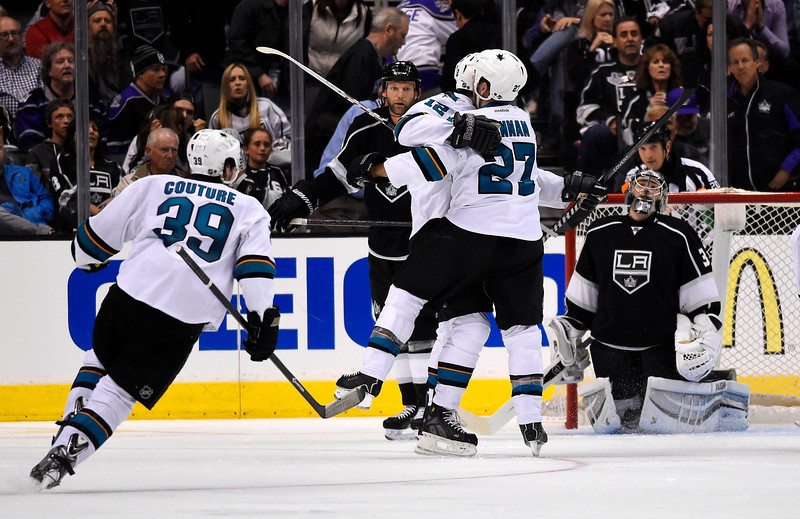
Patrick Marleau, Scott Hannan, Jonathan Quick, Logan Couture

By Mary Walsh

The San Jose Sharks are not the only team to lose a Game Seven in 2014, or even in the first round. Because they began with a three game lead, the loss was considered an upset, a collapse. Other teams who lost in Game Seven when they were expected to win include the Boston Bruins, and the Pittsburgh Penguins.The Bruins were grumpy in the handshake line, the Penguins fired their GM.

The Anaheim Ducks were the regular season Conference champions. They held a lead at one point in the series against the Los Angeles Kings, but they were not strong favorites, especially after the Kings’ first round comeback against the Sharks.

Does a little distance change how we should view what happened to the Sharks in the series against the Kings? Doesn’t it appear that they did not have to make many mistakes to lose to the Kings? Perhaps, but some of the mistakes were ones we have seen before that should have been avoidable.

When the Sharks flagged after the questionable goal that involved pushing Alex Stalock into the net, it was not unlike the 2011 Conference Finals against the Canucks. There, a bad call in the last 13 seconds of the third period left the team flat-footed. The Canucks tied the game and won the series in overtime.

What is this, and how do you fix it? Would making a lot of roster changes do it?

Sharks GM Doug Wilson said the team needs more than a band aid. The problem is that any major surgery takes time.

The first moves announced were actually non-moves. The coaching staff would be retained, Dan Boyle would not be resigned, and Marty Havlat would not be with the Sharks next season. The odds are very slim that this last means anything other than “Havlat will be bought out.” If Wilson were trying to trade him, he probably wouldn’t be announcing it to the media. This would be a first, a difficult first for a GM who has always been careful to not get into a contract he cannot live with.

The other announcement is the oddest of the three: the Sharks will use Brent Burns as a defenseman next season. Yes, he was acquired for that purpose, his contract was negotiated on that basis, he has more NHL experience as a defenseman than as a forward but… he really was a standout forward. He was maddeningly inconsistent as a defenseman.

The choice is not so shocking, but the announcement itself was strange. Was it a way of saying (unbidden) that the Sharks will not pursue a free agent defensemen this summer? Or that they will pursue a top six forward? Did that announcement have any place on the list of “questions people want answered?”

Dan Boyle, in discussing his time with the Sharks, said that the last two seasons were the Sharks’ best. Reminded that they had made the Conference Finals twice before, he admitted that perhaps recent seasons were just more vivid in his memory.

I think he was right the first time. The Pacific Division has become more formidable than it was when the Sharks went to the Conference Finals. The Sharks have been better in the last two seasons, but so has their competition. That means that success is even more about bounces than it ever was.

Bounces cannot be controlled, but the way a team handles them can be. A team’s psychological resilience can be improved by changing the players, but there are not very many players who can step in and hold a team together through a crisis. There may not be any who could do it for all teams.

Would trading Joe Thornton or Patrick Marleau really improve matters? Joe Pavelski? Who? And who do you get to replace them? Keeping in mind some no movement clauses would have to be worked around, who could Wilson get back? Unfortunately, those other players might come with much heavier salary burdens, assuming they could produce as well as any of the Sharks’ leaders, and also fix what ails the team.

That is a lot to expect from some player on some team a Sharks player would agree to be traded to… it is a lot to expect from even two or three players.

Wilson may have the flexibility he wants, but he has not built the team out of an NHL Leggo set. Few successful teams are built like that. You don’t replace pieces, you replace ingredients. Each player has an effect beyond the players to either side of him on the bench. The wrong big move could doom the next few seasons.

Should they move goaltender Antti Niemi? Was he really the weakest link? A better puck-mover would be nice, but every goaltender has his weaknesses. Those with few are rarely available. How much could Wilson get in trade?

Again, would that fix what ails the Sharks? What does ail them?

Composure. This is something the Kings are being praised for. They have rebounded in two playoff series now. Their goalie has recovered from some poor outings to play at his best. Give them credit, they keep their heads.

But do they keep them so much better than the Sharks? If the Kings are such a better team than the Sharks or the Ducks, why did it take them seven games to win those series? Why did they lose so badly to start the playoffs? Perhaps their playing style has to be paced. Playing a very physical game, the sort of game that produces a high injury rate, takes its toll on both teams. Perhaps it takes the Kings a while to work up to it.

Is that what the Sharks need to do, whichever Sharks remain next season? Does that style of play guarantee a win? It has gotten the Kings farther than the Sharks have gone several seasons in a row now. So why don’t more teams emulate the Kings?

Again, why did it take them seven games, twice, if they are so much better?

Maybe the Kings are not a perfect model, they are just one that works for those players with that coach right now.

Those players. Mike Richards spent a good amount of time on the fourth line. He might be a buyout candidate this summer if he cannot return to a top six role. No team is going to willingly give a fourth liner six or seven years at $5.75 million. In the mean time, he posed an enormous threat to opposition, and not because he is so tough or gritty. What distinguished him from most fourth liners is skill.

The Sharks had Mike Brown on their fourth line. They also had Raffi Torres there, with a still very troublesome knee. Had he not been injured, would he have been on the fourth line at all?

The Sharks would do well to look for more skill to go with the grit they have relied on there. They have players who could make up an over-qualified fourth line, if they added one or two top nine forwards…

Yet the coaching staff thought it would be better to try to get Marty Havlat to play there occasionally, instead of moving someone who could do that job (like Tommy Wingels) and keeping Havlat in the roll he was acquired for– a skilled top nine forward. Unless they re-evaluate how they use their assets, it doesn’t matter who the Sharks trade or acquire.

If their roster is so flawed, then significant changes have to be made. That is unlikely to produce quick results. Whether they replace a lot of players or drastically change their style of play, both will take time to adjust to. They probably won’t get off to a quick start, they might be pushing to reach the playoffs at the end of the season. Then, if they stumble again, it can be explained away by too many changes to adjust to in one season.

Not making big changes hasn’t satisfied anyone. It will be difficult now to not make them. It does seem like a shame to waste the one useful thing the team got out of that loss to Los Angeles: a painful shared memory of what they don’t want to experience again.
Deja Vu Puts Sharks Up By Two

By Mary Walsh

SAN JOSE- Sunday, the San Jose Sharks defeated the Los Angeles Kings to take a 2-0 series lead in the Stanley Cup Quarter Finals. The game winner was scored by Justin Braun, Antti Niemi made 24 saves for the Sharks, and Jonathan Quick made 33 saves for the Kings on 40 San Jose Shots. Though the Kings scored first, the Sharks’ dominance through the second two periods was a repeat of an unexpectedly dominant Game One victory.

After the game, Mike Brown said:

Games like this, you don’t stop playing, you don’t give up. That’s how the whole series is going to go and you see what happened when we didn’t stop.

We’re planning on low-scoring games and we gotta play solid defensively. So we can’t really look at these two games and think that the series is gonna go this way.

After a 6-3 victory in Game One series, everyone knew that the Sharks would not have to navigate the mental burden of a five goal lead again. It turns out that everyone was wrong. The Sharks defeated the Kings Sunday by a score of 7-2, scoring seven unanswered goals in the second and third periods. They not only took the five goal lead, they held it until the end of the game.

Talking after the game, Sharks captain Joe Thornton summed up the Sharks’ success thus far:

To do that two games in a row… We’ve been working hard for our goals, and the fourth line just brought this game back in grip for us. But scoring seven tonight… it was… was just a weird night.

That fourth line was the clutch factor in the game. The combination of Andrew Desjardins, Raffi Torres and Mike Brown scored the first two Sharks goals of the game, bringing the Sharks back from a deficit to a tie game in the space of five minutes. After the game, Logan Couture said of the trio:

They got us going, they generate a lot of energy in the building, a lot of energy on our bench. You can tell when they’re out there that they’re going to forecheck hard and if I was a d-man I’d be scared of those guys bearing down on me all the time. So they’ve done a great job in this series.

The Kings opened the scoring under two minutes in. A Jake Muzzin shot from the point went past Sharks goalie Antti Niemi with some help from a screen set up by Marian Gaborik. Drew Doughty and Anze Kopitar were awarded the assists.

The Sharks responded with a good chance of their own but Kings goalie Jonathan Quick had time and space to see the shots and stop them.

After an extended spell in their own zone, and numerous takeaways for both teams, the Kings struck again. Kings forward Jeff Carter got the puck away from Sharks defenseman Jason Demers and sent it in front of the net where Trevor Lewis tapped it in the far corner. Carter got credit for the lone assist.

By the half way point of the first period, the shots favored the Sharks 10-6, but the score was all Kings, 2-0.

One of the Sharks’ better shifts came from an offensive zone attack that included Tomas Hertl, Tommy Wingels and Scott Hannan, with about six minutes left in the first. As the shot clock indicated, the other lines were spending time in the Kings’ zone but they did not make life very uncomfortable for Quick. Many of their shots were completely unscreened.

Mike Brown gave the fans something to cheer about with some solid hits in the final four minutes, and the Thornton line joined in with a scrum in front of the Kings’ crease. Two penalties came out of that: two minutes each for roughing to Slava Voynov and Brent Burns.

The Sharks ended the first period with a two-goal deficit and a reduced lead in shots, with 15 to the Kings’ 10.

Early in the second period, Tomas Hertl took the ice with Joe Thornton and Brent Burns, after taking a shift with Burns and Desjardins moments earlier.

That did not seem to do much, but the Sharks avoided being scored on for almost five minutes, then reversed the dismal trend with a goal of their own. It was Mike Brown’s first playoff goal. Andrew Desjardins centered a pass that found Brown skating into the Kings’ zone. Brown’s shot beat Quick fair and square from the slot.

Moments later, the Sharks got their first power play of the game. That produced a few good chances but did not add to the scoresheet.

It was near the half-way mark of the game when Raffi Torres scored his second of the series. After skating through traffic alongside Desjardins, he found an opening and tied the game. Assist to Andrew Desjardins.

About a minute later, Los Angeles got their first power play after Jason Demers was called for charging. It took the Sharks over 90 seconds to clear the puck for the first time in that penalty kill, but when they did they were rewarded by some inattention from the Kings that lead to an icing. With under 20 seconds left in the penalty the faceoff was in the Kings’ end. That was that and both teams remained perfect on the penalty kill.

The Sharks kept the pressure on. With 5:15 left in the period, James Sheppard won the puck along the boards and put it on net from a bad angle. The rebound went to the wall and Justin Braun, who shot it back in from the point. His hard shot flew by Tommy Wingels and Jonathan Quick to give the Sharks their first lead of the game. Assists went to Sheppard and Pavelski.

The Kings took a third penalty to finish the second, putting the Sharks on the power play to end the middle frame. It was an uninspiring power play, with the Kings ejecting the Sharks very effectively from their zone more than once before San Jose could get set up.

The period ended with shots 27-17 and the score 3-2 Sharks.

Tomas Hertl stayed on the Thornton line, with Pavelski playing third line center. The next goal did not come from either of those lines. The Sharks’ fourth goal came off a brilliant rush from the second line at 1:08 of the period. Matt Nieto centered the puck perfectly for Patrick Marleau who carried it as far as the opposite faceoff circle to put it by Jonathan Quick. Nieto and Logan Couture got the assists.

A nice neutral zone poke check from Scott Hannan started the next rush, sending the puck in for James Sheppard. Sheppard and the third line held the zone well, but it took a second neutral zone takeaway and another rush to put the Sharks up by three. Joe Pavelski scored that, after Dan Boyle  got the puck to him at the Kings’ blue line. The Kings were in the middle of a line change when Boyle snatched away that puck. Assists to Boyle and Wingels.

At 11:42 of the period, Marleau carried the puck in along the wall and passed it to Couture. Couture skated around two Los Angeles defenders to beat and unscreened Quick, who was moving across the crease.

6-2 Sharks. Assists to Marleau and Nieto.

A scrum at the Kings’ net resulted in a few penalties being doled out. Four minutes to LA for roughing, and two to San Jose for roughing. The offenders were Kings defenseman Matt Greene and Sharks’ forward Raffi Torres. Once again on the power play, the Sharks would not score in the five on four advantage, but just 30 seconds in to that penalty, Jarret Stoll gave the Sharks a two man advantage by high-sticking Joe Thornton and going to the box for two minutes.

After some nice passing around the perimeter, Thornton was left holding the puck in the right faceoff circle, with just Jonathan Quick between him and the Sharks’ seventh goal.

7-2 Sharks. The seventh goal assists went to Pavelski and Boyle. It was the Sharks’ first power play goal of the game.

With just over five minutes left, more hostilities broke out, sending several players to the locker room early and putting the Sharks on the power play again. For LA, Kyle Clifford got two minutes for roughing and a ten minute misconduct, Dustin Brown got a ten minute misconduct. For San Jose, Desjardins received a ten minute misconduct and Mike Brown got the same. Finally, the Kings’ Mike Richards went to the box for four minutes, confined for spearing.

As expected, Todd McLellan did not alter his lineup for Game Two from the group that won Game One. The scratches were Martin Havlat, Tyler Kennedy, Bracken Kearns, Matt Irwin and Adam Burish. He did exercise his right of misdirection by putting Havlat out for warmups but that was all we saw of Number 9 on Sunday.

The Sharks and the Kings meet for Game Three on Tuesday in Los Angeles.

Pavelski’s 3rd Hat Trick Propels Sharks to 5-2 Win

By Mary Walsh

Joe Pavelski has found the trick to three-goal games. Tuesday in Edmonton, he scored his third hat trick, after starting the season without even one hat trick in his NHL career. His three goals boosted the San Jose Sharks to a 5-2 win over the Edmonton Oilers.

Patrick Marleau scored the first Sharks goal of the game, and Martin Havlat scored the game winner in the second period. The Sharks scored three  goals on the power play (two were Pavelski’s). Edmonton goals came from David Perron and Taylor Hall. Antti Niemi made 28 saves for the win, Ben Scrivens made 29 saves for the Oilers.

It took the Sharks a full period to find their legs in the second part of back to back games in Alberta. The Oilers, rested after an embarrassing loss to Calgary, came out fast against the Sharks. They opened the scoring when David Perron brought the puck in while his teammates drove the Sharks’ defense back. Perron skated around Tyler Kennedy and shot around Brad Stuart to score at 4:11 of the first period. Assists went to Taylor Hall and Jeff Petry.

The Sharks’ fourth line responded well to that goal, gaining the zone and earning an excellent scoring chance, but Mike Brown lost the puck on a wrap-around try. In the same shift, a shot from Sharks’ defenseman Marc-Edouard Vlasic caught the Oilers’ Ryan Jones in the knee and sent him limping off the ice.

The rest of the first was marked by some good luck for the Sharks that defended them against several attacks from the Oilers. The period ended with the shots 11-10 Sharks.

The second period began with the Sharks outshooting the Oilers 6-1 in the first five minutes. The first penalty of the game was called against the Oilers when Ryan Smyth went to the box for holding. It only took the Sharks 37 seconds on the power play to tie the game. Oilers goaltender Ben Scrivens stopped a shot from Patrick Marleau but Joe Pavelski was in position to pick up the rebound and put it in to an open net. The assists went to Marleau and Joe Thornton.

A few minutes later, a good chance for the Sharks’ third line drew another penalty against the Oilers. Andrew Ference went off for holding James Sheppard. It took the Sharks considerably longer to score on this second power play, but the Sharks’ top power play unit of Thornton, Marleau, Burns, Pavelski and Boyle held the zone and fired a flurry of shots without losing possession. Finally a shot from Marleau went in, with assists going to Pavelski and Burns.

The Sharks took their first penalty at 11:43 of the second period, when Brad Stuart went to the box for hooking. The Sharks killed it off but shortly thereafter, Adam Burish blocked a shot and left the ice with what looked like a serious hand injury.

The Sharks had a few close calls later in the period, but with just 39 seconds left, the third line caught a break and Martin Havlat skated into the Oilers’ zone with Tommy Wingels two on one. Despite taking a slash to his stick, Havlat put a hard shot past Scrivens to give the Sharks a two goal lead.

Through the period, the Sharks had 17 shots to the Oilers’ 7.

Matt Nieto drew a penalty from Taylor Hall to start the third period. The second power play unit did not get a chance to play, as Pavelski scored just 46 seconds in, bouncing a shot off the inside of Scrivens’ skate. Assists went to Dan Boyle and Brent Burns.

Several minutes later, Pavelski made it 5-1 for the hat trick after the Sharks kept the Oilers trapped in their zone for too long. Assists went to Joe Thornton and Brad Stuart.

The Oilers got one back with just over five minutes left in the game. Some hard work on the boards sent the puck in front of Niemi, where a diving Taylor Hall was able to scoop in into the net. A hooking call against Matt Nieto gave the Oilers a second chance on the power play with less than a minute left in the third period, but they could not change the score from 5-2.

Tommy Wingels got credit for 12 hits, leading all skaters in the game in that statistic. Brent Burns and Joe Pavelski each had four shots. David Perron lead the Oilers in shots with six.

The three stars of the game were Joe Pavelski, Patrick Marleau and Taylor Hall.

The Sharks next play in San Jose on Thursday at 7:30 pm. They will host the Winnipeg Jets.

Have the Sharks Figured Out Who’s On Third?

By Mary Walsh

Before last Thursday’s game in San Jose, Anaheim Ducks coach Bruce Boudreau was asked about the difference between playing the San Jose Sharks and the Los Angeles Kings. He said:

They’re a little further north? I think LA is more of a harder team as far as bigger and more physical, where these guys play physical but they’re a better skating team and have more depth in their scoring. I mean, if they ever get completely healthy and they have Pavelski back on the third line, that’s… that’s pretty deep. They’re as deep as any team in the NHL I think.

That comment echoes a sentiment held by most Sharks observers from the start of the season. The team is still missing Tomas Hertl and Raffi Torres, but will they need to move Joe Pavelski back to the third line at all? Or has the Sharks coaching staff finally found a new third line that doesn’t need the team’s second best scorer at its center?

The present third line includes two players who have been used most erratically through the season. Martin Havlat and James Sheppard have spent time on just about every line, including the fifth. Their performance has been accordingly inconsistent– maddeningly so– until now. Seeing them in the lineup and in the same position with some consistency is gratifying. Both players bring skill to the team, and the team will need it on a regular basis.

The budding stability of that line is somewhat dependant on the top six. Asked about the Sharks’ top line on Saturday, Washingon Capitals coach Adam Oates said: “Well first of all, which one’s their top line? They got two…”

If you look at ice time per game, you certainly don’t find a season-long indication of which Sharks make up a top line. The usual suspects are there, the top three forwards being Patrick Marleau, Joe Thornton and Joe Pavelski, in that order. Yet they do not make up one line. The next three forwards in even strength ice time are Brent Burns, Logan Couture and Tommy Wingels. So in terms of time on ice, which points to coaching staff expectations, the top six have been a fluid group all season.

What about points? Same list, though in a slightly different order: Thornton, Pavelski, Marleau, Couture, Burns and Wingels. But those players are not all playing in the top six now, and the top three on both lists are not the top line, with the second three being the second line: it has been Thornton centering Burns and Pavelski, while Couture centers Marleau and Matt Neito. The performance of the top six forwards has been so even that they are hard to tell apart in terms of stats.

The Sharks are deeper than they have ever been. This is precisely why, at the start of the season, the general assumption was that the Sharks could afford to not have Joe Pavelski in the top six, that he could center an over-fortified third line. Despite that depth and due to an unprecedented number of injuries for the team, the coaching staff struggled through most of the season to find a third line that worked. The current stretch of five games in a row with the same three players there looks like a record for the 2013-14 Sharks.

The third line of Havlat, Sheppard and Wingels is not the only thing that has been fixed for the last five games. The top six have also been steady, and only one winger on the fourth line continues to rotate. This is surely a function of being in the home stretch- the team needs stability to get ready for playoffs. But it is also a sign that the coaching staff likes these lines. Otherwise, the rotation of players would probably accelerate.

Before Thursday’s game against the Ducks, Sheppard said:

I think our whole team is playing well, that helps. Everyone’s moving the puck and kind of getting into a rhythm so I think all the lines kind of benefit from that. We want to keep it simple with a little bit extra, because I think we can do both: get pucks deep and make sure we don’t turn pucks over at the blues, but at the same time we can make plays like we did in New York.

Though it isn’t the only unit settling in, the third line still jumps out at me as being a “final piece” of this team. Havlat and Sheppard have not had a chance to find their game in such a consistent situation all season. Both have been scratches, both healthy and not quite healthy. Both have played all over the board with every linemate on the the team. Until recently, their play was inconsistent at best. Wingels has done the same marathon line swapping, but he has thrived. It takes all kinds.

Much of the success of this third line can be attributed to Sheppard’s improved play. Where Havlat’s play has consistently been better when he has time with the same linemates, Sheppard’s path to a regular spot in an NHL lineup has been rocky. It was littered with enormous early pressure, an intractable injury, and finally a long road back. For him to perform consistently is not surprising given the original assessment of his skill: he was a first round draft pick and his first NHL coaching staff believed he should and could be ready to play in the NHL at 19 without any time in the AHL. They say that what doesn’t kill you makes you stronger. That looks to be true of James Sheppard.

If Raffi Torres comes back sooner than later (which looks increasingly unlikely), will the lines shift again to move Pavelski to the third line? Will he end up there in the playoffs? If both Torres and Tomas Hertl come back, probably there will be another significant line shuffle, but there is no rush. Tommy Wingels has shown that he can be as versatile as Pavelski, and Havlat and Sheppard are finally finding their game. The line is strong enough to not justify pulling a top scorer out of the top six.

Sharks Finish Road Trip with 4-2 Win Over NJ Devils

By Mary Walsh

The San Jose Sharks ended a three game road trip with a 4-2 win over the New Jersey Devils on Sunday. They picked up two wins in five days to close the gap between the Sharks and the Division-leading Ducks to five points in the standings.

Sharks goals were scored by Joe Pavelski, Raffi Torres, Matt Nieto and Patrick Marleau. Alex Stalock turned in a very good performance with 21 saves in his second win in a row. Devils goals were scored by Adam Henrique and Patrick Elias.

The first star of the game was Matt Nieto. Of Nieto, Sharks coach Todd McLellan said:

He played an excellent game, he seized the opportunity, played really well, was effective penalty killing, was very good on that line, obviously scored the winning goal.

What about Nieto sitting out the last game?

In his case it wasn’t so much sending a message it was getting some other people into the game who had to play. It was nice to see that he handled it properly and was ready to go today.

Nieto replaced Brent Burns on the top line Sunday. McLellan explained that decision:

I thought Burnzie had a good game but it’s been a long time since he produced and scored on that line. And just like everybody else we’ve got to to hold him accountable. Brent will work his way back.

The game was the first time the Sharks had played against ex-teammate Ryane Clowe, and he welcomed them to town with four hits. He gave one each to Justin Braun, Dan Boyle, Tommy Wingels and Jason Demers. During the second intermission, he was asked if those hits had a little extra energy behind them for his ex-teammates:

You’re right, you lean into them a little more. It’s something where obviously they’ve had a core together for a while, you know all those guys. It’s a little bit of me is trying to play physical, probably trying to play a little more physical against those guys.

But it’s also part of the game, I think we’ve got to get on our D and play physical against that D who skate well, who move the puck well, but we’ve got to make them defend.

The first period ended scoreless, with just one penalty call in the last minute of play. That call went to the Sharks. The shots were very close, just 10-8 for the Sharks.

New forward lines for the Sharks’ were clearly trying to find their way, most notably the line composed of Brent Burns, James Sheppard and Martin Havlat. How McLellan had never put those together is a mystery, as McLellan can be relied on to try everything at least once, and those three can provide some skill and scoring. How to communicate smoothly after not playing together is another matter. The line did not get credit for any shots on goal in the first period but did spend more time in the offensive zone than defending.

The other lines were adjusted accordingly, putting Tommy Wingels on a line with Logan Couture and Patrick Marleau. Matt Nieto came back into the lineup, on a line with Joe Thornton and Joe Pavelski. The fourth line was made up of Raffi Torres, Andrew Desjardins and Tim Kennedy. That line did not have much trouble sorting themselves out, and were generating good chances for themselves early in the game.

The defensive pairings had also been changed since the game in Buffalo two nights before: Matt Irwin was with Dan Boyle, Marc-Edouard Vlasic was paired with Jason Demers, and Justin Braun was with Scott Hannan. Finally, Alex Stalock was in net.

The first goal of the game came early in the second period. The Sharks’ Tommy Wingels screened the goalie for a Jason Demers shot from the point that was tipped by Patrick Marleau. The shot created a small rebound that came out to Couture who was sliding in near the post. Assists went to Marleau and Demers.

The second goal came from the Devils’ Adam Henrique to tie the game. What looked like a fairly manageable two on three fell apart for the Sharks when Henrique came down the slot and received a pass from Steve Bernier, who had escaped Tyler Kennedy along the boards. Sharks defenseman Justin Braun did not get back across the ice quickly enough to tie up Henrique. Assists went to Bernier and Eric Gelinas.

The Devils also scored the third goal, during another incident of missed coverage. Patrick Elias scored that, with assists going to Jon Merrill and Henrique.

The next goal tied the game again. This time a neutral zone pass from James Sheppard went to Raffi Torres, who went in to the Devils’ zone in a two on one with Joe Pavelski. Torres passed it to Pavelski, who passed it back. Torres had an open net and scored his third goal in two games this season.

The second period ended with the Devils on a power play after Marc-Edouard Vlasic was called for tripping Travis Zajac. The shots were 18-14 for the Sharks, the score still 2-2.

The Sharks killed off the last 30 seconds of the penalty without incident. Sharks’ goaltender Alex Stalock had to make some good saves on Jaromir Jagr and Ryane Clowe in the first minutes of the period.

A little over six minutes into the third, the Sharks had a scare after a giveaway in their offensive zone. A relentless attack from the Devils required several good saves from Stalock. The Sharks finally cleared the puck and executed a line change, putting the Thornton line on the ice. One quick pass from Joe Pavelski to Matt Nieto gave the Sharks the lead again.

The Sharks went right to the penalty kill when Jason Demers went to the box for tripping. The Sharks killed that off very effectively, as they had the two previous penalties. The Sharks spent a good deal of the penalty kill outside their own zone.

The Sharks went to the penalty kill yet again with less than six minutes left in the game. Justin Braun was called for hooking. The Sharks did not allow the Devils to spend much time in the offensive zone, but iced the puck shortly after the penalty expired. Sharks coach Todd McLellan took his timeout with 3:22 left in the period.

Shotrly after play resumed, the Devils made a fatal mistake, letting Patrick Marleau get off on a break away to score the Sharks’ fourth goal of the game. Tommy Wingels helped the Devils make that mistake by going ahead and driving for the net to take away a Devils defender and distract Cory Schneider.

The Devils pulled their goaltender with a little less than two minutes left, but even with the extra attacker the Devils could not score again.

Final score: 4-2 Sharks. The Sharks killed four of four penalties, Alex Stalock made 21 saves on 23 shots. The Devils killed one penalty, Cory Schneider made 18 saves on 22 shots. The teams were even in faceoff wins with 24 each.

The three stars were Matt Neito, Adam Henrique and Joe Pavelski. Justin Braun lead the Sharks in ice time with 21:03, Joe Thornton lead in shots with four.

The Sharks next play at home against the Carolina Hurricanes on Tuesday at 7:30 pm.

Sharks Extend Streak to 5, Another Shutout for Stalock

By Mary Walsh

SAN JOSE- The San Jose Sharks won their fifth game in a row, defeating the Winnipeg Jets 1-0. Goaltender Alex Stalock got his second shutout in a row, the first being on January 16 in Florida against the Panthers.

Sharks head coach Todd McLellan was glad to see the Sharks play a much better game than they had Monday:

It was a tight game, I thought both teams played that way. Not many chances at either end. And when there were, both goaltenders played well. We’re lucky enough that [Pavelski] batted one out of the air and [we] got away with the win.

Good to see our team play a tight game. I thought against Calgary we weren’t any where near that, we were sloppy. Great to see Alex [Stalock] get another shut out. We’re excited for him. Some good things tonight.

As well as keeping their own zone in order, the Sharks also outshot the visitors. An imbalance on the shot clock was all but predicted by Jets head coach Paul Maurice, after the morning skate:

A huge, huge challenge in here tonight… in terms of their quickness and speed on the puck and the time that they take away from you when you have the puck it’s a huge challenge for the back end.

We loved the gritty effort in Anaheim, it was fantastic but the facts at the end of the day were our goalie made 40 saves and we blocked 36 shots. We didn’t have the puck enough, and I’m not complaining about our effort. So that tells you they were pretty good. I’m expecting to see that from San Jose.

The Sharks delivered, outshooting the Jets 32-20, with Winnipeg blocking 16 more shots. That was a closer margin than the Jets saw in their last game.

Thursday morning, Todd McLellan had predicted the first period to a tee, when asked what he expected from the game:

Tough game, probably a fast game when you look at their lineup and the way they’ve been playing the last four or five games. We know our opponent is confident, fast, they can play an aggressive game so I think we’ll see that type of night.

Bold plays abounded from both sides, the Sharks made quick, short passes through the neutral zone. The puck was bouncing much like it had the game before but the Sharks looked like they were used to it now. No matter how many times the puck hopped over a stick or went shooting into the air unexpectedly, they looked calm about waiting for it to come back into line. After the game, Joe Pavelski didn’t want to give the ice too much credit for either game:

I think it was a little better. You can’t put it all on the ice… You can make one play where the ice probably doesn’t affect it, and then there’s another play where it might make a difference.

It wasn’t a tough period in terms of physical play, but it tested the focus of both teams, with long stretches between stops. Neither team was able to execute or finish elaborate plays.

Pavelski went to the box at 3:33 of the first for holding the stick. That got some boos from the crowd and the Sharks killed the penalty off without giving the Jets much to work with.

The second penalty also went against the Sharks, this time to Tommy Wingels for tripping at 12:38. More boos from the audience, still no joy for Winnipeg.

The boards were unusually lively, as demonstrated by a Winnipeg shot that went wide, only to bounce back at the net. It missed the outside of the post, bounced off of Stalock, and across the blue paint. Luckily for the Sharks, the bounce was unlikely and fast, and no Jets players were in position to take advantage of it before the Sharks were on it.

The period ended with the teams even in shots at 11 each.

The second period was not so fast. The middle of the period was bogged down with pucks out of play and offside calls. The shot clock ticked along but neither team maintained lengthy attacks.

Finally, after a pile up in front of the Winnipeg crease, Olli Jokinen was called for holding.

It took the Sharks less than ten seconds to put the puck in the net, but the referee waived it off. Joe Thornton was on top of Jets goaltender Ondrej Pavelec when the puck crossed the line. That he was pushed there by Winnipeg’s Mark Stuart did not make a difference. The game remained scoreless, and the power play did not change that.

Shortly thereafter, Mike Brown helped Winnipeg’s Jacob Trouba into the end boards. He didn’t hit him with a full body check but he gave him a distinct push from behind and Trouba hit the glass awkwardly. Brown went to the box for charging. The Sharks killed off their third penalty of the game. They did not allow the Jets a shot on goal.

The shots for the second period were 11-4 San Jose.

The Jets had a scare to start the third period, when a shot from Brent Burns stung Ondrej Pavelec. After consulting with the trainer, Pavelec stayed in.

The Sharks earned their second power play of the game when Matt Nieto drew a hooking call on Bryan Little. The Sharks couldn’t convert on that one either.

The score finally got to change after Justin Braun cut a path to the slot and threw a backhand on Pavelec. Braun described the shot after the game:

I just kind of put it on my stick there. Maybe I should have shot it right away but it kind of worked out: soft backhand, Pavs made a nice play, whacked it out of the air.

Pavelski did knock it out of the air, but described it as if it happened in slow motion:

It’s one of those that’s just kinda, well it’s hovering there. You’re going to the net just hoping for something like that.

In case anyone was still wondering if Pavelski is in the zone, if he’s seeing pucks hovering while the rest of us see them not at all, yes, he is officially in the zone. That is a good thing for the Sharks, a good thing for Pavelski, and dare I say it? Sure, it’s a good thing for America too.

Alex Stalock made 20 saves in the shutout win, Ondrej Pavelec made 31 saves for the Jets. The Sharks and the Jets both had perfect penalty kills on three chances each.

Braun, Andrew Desjardins, Brent Burns and Matt Irwin each had four shots on goal. Brad Stuart led the Sharks with five hits, followed by Eriah Hayes with three. Olli Jokinen led the Jets in shots, with 5. Jacob Trouba led the Jets in blocked shots, with four. The Sharks won 45 of 69 faceoffs.

The three stars were Alex Stalock, Ondrej Pavelec and Joe Pavelski.

The Sharks next play on Saturday at SAP Center. They will host the Minnesota Wild at 7:30 pm.

Sharks Underwhelm in 3-2 Win Over Calgary

By Mary Walsh

SAN JOSE- The San Jose Sharks defeated the Calgary Flames Monday night. With a final score of 3-2, the game was distinctive for seeing three goals scored in a minute and 14 seconds. There was only one penalty called in the game, and the third period was scoreless. It was a muffled ending to a game that started with a bang.

Sharks head coach Todd McLellan was similarly underwhelmed by his team’s performance:

Well, the win is important. Obviously when we start the night, that’s what our goal is. When you look back and evaluate the game, that’s where it gets a little bit disappointing.

We weren’t very good obviously. I didn’t think we skated well, we didn’t move our feet, and then we tried to pass standing still and those [passes] were errant. Had no rhythm or tempo in the game and really didn’t establish a forecheck game other than the first four or five minutes of the game…

We’ve got to regroup here. If we continue to play like that we won’t be winning.

That is a fairly gloomy assessment of a win. On the bright side, there was Justin Braun:

Another Justin Braun game. That’s probably the best way to put it. One of the few guys that had legs and used them properly, made the right play at the right time, blocked some shots when it was important. So he’s Mr Consistent right now for us.

How Braun escaped the sweeping bad marks on Monday night is a little mysterious, in view of the first goal of the game. It isn’t as if that goal was Justin Braun’s fault, but he was there too.

Sharks captain Joe Thornton described a game from which no one really escaped with an unblemished performance:

I think it was just a tough night for everybody. It was one of those weird nights, we were thankful to get two points out of it.

The first goal of the game was scored by Calgary, on their second shot of the game. Three Flames entered the zone, with only two Sharks to defend. Bracken Kearns got back quickly but not quickly enough to stop Jiri Hudler as he slipped away from Braun and Brad Stuart in the corner. He faked a shot at the side of the net that fooled Sharks goaltender Antti Niemi, then skated around him. By then, all he had to do was sweep the puck in, and he did. Assists went to TJ Brodie and Mark Giordano.

It looked like the period would be a slow one after that. Instead, after the half way mark, the teams scored three goals in 1:12.

It took the Sharks several minutes to repair that damage, but finally, with a beam of a shot from the blue line that bounced up and over Karri Ramo, Joe Pavelski tied the game. Assits to Justin Braun and Brent Burns.

While the SAP announcer was saying “Sharks goal…” Tommy Wingels collected the puck along the wall and threw it on net. It hit Ramo’s pad, and bounced over into the net. Assists to Patrick Marleau and Brad Stuart.

The Flames answered right back after that one. A play through the neutral zone had the Sharks a little off track, and Brian McGrattan carried the puck in and shot it off Niemi’s pads. The rebound was there for Kevin Westgarth to pick up. Matt Irwin was close but couldn’t stop the shot. It may have even gone off of his stick, sneaking just around Niemi.

And that was it for the first period. No penalties, no additional goals. There weren’t even a lot of shots in the last three minutes. There may have been three total, one for the Sharks and two for Calgary, for a period total of 10-8 Sharks.

Tyler Kennedy had five of those shots for the Sharks.

With six minutes gone in the second period, the Flames had only one shot for the period and the Sharks only had three.

At 11:51, Matt Nieto took a puck to the face and went down briefly. Play stopped and he went to the room.

Eriah Hayes came up from the fourth line to take Nieto’s spot with Marleau and Wingels. That line drew the only penalty of the game, against Matt Stajan for interference on Hayes. That was at 14:28 of the second period.

26 seconds into that power play, Joe Thornton took a shot from above the faceoff circle and Joe Pavelski tipped it in. The “USA” chants took a minute or so to get going but go they did, for Pavelski’s second goal of the game.

James Sheppard made a noteworthy save a couple of minutes later. First he stopped a shot with this stick, then dove to clear it out of the reach of the shooter until it could be sent out of the zone.

The Flames ended the period with an extended stay in the Sharks’ zone. They didn’t take a lot of shots, they may not have taken any, but they played a solid game of keep away. It looked like a Calgary power play, without the actual man advantage. Why they passed up a few chances to take a shot, when they were down by a goal anyway, was not clear.

The shot count for the period was 11-4 San Jose.

Nieto returned for the third period. The Calgary Flames’ offense also returned. After four and a half minutes, the Sharks only had one shot on goal and the Flames had taken six.

The Flames pulled their goalie in the final minutes but couldn’t score.

Final score 3-2 Sharks. Final shot count 27-23 Sharks. The Sharks scored on their only power play of the game, and did not have to kill a penalty.

The Sharks shot leader was Tyler Kennedy with six shots. Eriah Hayes had four. Three Flames had three shots apiece: Dennis Wideman, Sean Monahan and Jiri Hudler.

Antti Niemi made 21 saves on 23 shots for the win. Karri Ramo made 24 saves on 27 shots for the Flames.

The Sharks next play on Thursday at 7:30 pm. They will host the Winnipeg Jets at SAP Center.

Stalock Shuts Out Panthers, Sharks Win 3-0

By Mary Walsh

Thursday, the San Jose Sharks defeated the Florida Panthers for the first time in head coach Todd McLellan’s tenure. The final score was 3-0, with goals from Joe Thornton, Matt Nieto and Joe Pavelski.

Alex Stalock earned his first NHL shutout, stopping 24 shots from the Panthers. The Sharks limited Florida’s “Killer Bs” to three shots on net. Those Bs are Brad Boyes, Sean Bergenheim and the second overall draft pick of 2013, Aleksander Barkov.

As of puck drop on Thursday, the Sharks had not beaten the Panthers since 2006, well before Todd McLellan became their head coach. They hadn’t played the Panthers a whole lot either (only four games) but that was an unexpected statistic.

While he remains the points leader for the Sharks, Joe Thornton still finds a way to make scoring a goal surprising. At the end of the second period, he broke away from the Sharks’ blue line, getting a step on several nearby Panthers, and gave himself room to beat one of the craftiest goaltenders in the NHL.

The obvious way to beat a goalie like Tim Thomas is to get enough traffic in front of him, force rebounds and hope to clean up some garbage. Do all that, or send a fellow veteran ex-Bruin in to outfox him one on one.

Before the start of the third period, CSN asked Sharks assistant coach Larry Robinson to confirm that Joe Thornton displayed excellent hands for that first goal of the game. Robinson chuckled:

Well, not bad, but he gave the puck away four or five times on the power play, so I was wondering where his hands went.

That described well how the game went for the Sharks. With four power play opportunities, including a minute and 29 seconds of five on three, the Sharks did not score a power play goal. Their penalty kill was much better, giving them some short-handed chances as well as preventing the Panthers from scoring on three power plays.

The Panthers started out with a flurry of shots on Alex Stalock. He kept them out of the net and the rebounds weren’t dangerously placed but he didn’t hold on to any of those shots, and the Sharks had their hands full trying to get the puck out of their zone.

Once they did get it out, the top line of Thornton, Brent Burns and Pavelski had better luck holding the puck in the Panther’s zone and putting some shots on net. Florida goaltender Tim Thomas didn’t let that go on for very long before catching hold of one of those shots.

After four minutes, the teams had a combined eight shots on net, three of those for the Sharks, two of them from Brent Burns. Three minutes later, the Sharks had taken the lead in shots at 9-6. That early push from Florida had not disconcerted the Sharks.

The Sharks’ first power play came at 10:55 of the period, when Barkov went to the box for hooking. With 1:29 left in power play, Bracken Kearns drew a high sticking call against Marcel Goc, giving the Sharks a lengthy five on three. San Jose was too tentative about moving the puck, letting Florida clear the puck several times, even five on three.

Not long after the penalties expired, San Jose’s Tommy Wingels went to the box for an illegal check to the head. With more review than referees are allowed, it was hard to see where Wingels made contact with Upshall’s head. The Sharks killed it off anyway.

Through the first period, the Sharks registered 21 shots on goal. The Panthers only added two more over the second half of the period.

3:20 into the second, Bergenheim escaped the San Jose defense and drove to the net to meet Stalock one on one. Stalock closed the door and held on through a few extra whacks and jabs before the whistle blew. That was an important save but it didn’t motivate the Sharks right away. A few minutes later, the Sharks had to kill a penalty when Brad Stuart was called for cross checking Tomas Kopecky.

The Sharks survived that penalty, and followed it up with a foray into Panthers territory, but almost eight minutes in to the period, the Sharks didn’t have a shot on goal, while the Panthers had six. The Sharks got their first shot at 12:08 of the period, from John McCarthy.

The Sharks were back on the penalty kill at 9:12, when Bracken Kearns was called for high-sticking. The Panthers’ power play was more dangerous this time, registering several shots in the first minute.

The Panthers lost the last 15 seconds of their power play to a high stick of their own, a questionable call on Scottie Upshall. The Sharks didn’t waste a lot of time starting their attack, but the Panthers cleared the puck and attacked short-handed in the first minute of the Sharks’ man advantage.

The last 30 seconds of the power play showed more urgency from San Jose but didn’t produce. Upshall gave them another chance less than three minutes later, with a hooking call. This call was less dubious as he hooked his stick securely around Sharks defenseman Justin Braun.

Upshall sat in the box for the full two minutes, as the Sharks’ power play did not score.

As the period wound down, with the game still scoreless, Stalock had a close call with Jonathan Huberdeau right up in his lap. After a brief scuffle along the boards, Joe Pavelski and Brent Burns got control of the puck and sent it up ice, where Joe Thornton was making a break. With Florida’s Mike Weaver and Dmitry Kulikov chasing him, Thornton pulled away and lifted the puck gently over Thomas to break the zero-zero tie. Assists went to Burns and Pavelski.

Early in the second period, Matt Nieto tried that. The breakaway was less surprising sice Nieto is known for his speed, but he tried to go five hole. Tim Thomas wasn’t likely to let the rookie get the better of him so soon after Thornton had beaten him. Thomas is notorious for luring players into shooting five hole, and disappointing them. A quick study, Nieto wouldn’t make the same mistake twice.

Back in the Sharks’ zone, Dan Boyle made the curious decision to put his stick shaft down on the ice to prevent a pass from getting to Upshall in front of the net. That didn’t work at all, and cost him seconds to get back in position. Nieto was all over Upshall, which gave Stalock just barely enough time to get a leg back across the crease and block the shot.

Tim Kennedy went the other way after that, where he drove the net and took an awkward-looking shot. Patrick Marleau and Matt Nieto were in hot pursuit and when the rebound popped out with Tim Thomas off balance, Nieto was able to get a quick shot over the Florida goalie. Assists went to Kennedy and Marleau.

Seven minutes later, the Sharks took a 3-0 lead when Pavelski took advantage of Thomas’s aggressive style. Thomas came out of the paint to cut down the options for Brad Stuart as he took a shot from the blue line. Brent Burns tipped that shot, but Thomas blocked it. Unfortunately for Thomas, Pavelski was there too, almost behind him, to pick up the rebound and knock it in. Assists initially went to Stuart and Braun, but were changed to Burns and Stuart, confirming the tip.

The Sharks outshot the Panthers in that final period 11-5, and 39-24 in the game.

The Sharks will play their next game on Saturday at 11am Pacific Time, in Tampa Bay against the Lightning.

Roster notes:
Martin Havat came off of the injured reserve list Thursday but did not play. Scott Hannan went on the list with what is likely a head injury, but is still described as only “upper body.” Logan Couture, Tomas Hertl, Raffi Torres and Adam Burish remain on the injured list.

Predators Bring Down Sharks 3-2

By Mary Walsh

Amid the hubbub of Olympic roster announcements Tuesday, the San Jose Sharks had a game to play in Nashville. They lost 3-2, but made a game of it despite yet more changes to their lineup, including the loss of Logan Couture to injury. Couture is scheduled for surgery, and is expected to be out for three to four weeks.

The Sharks were still without Tommy Wingels (upper body), Martin Havlat (lower body), Tyler Kennedy (flu) and Tomas Hertel (knee). No reinforcements were coming from the old list of injured, no Raffi Torres, no Adam Burish. Freddie Hamilton had just been sent down to Worcester, while Matt Nieto, Bracken Kearns and Eriah Hayes stayed with the big club. Hamilton was called right back up.

The game was an opportunity for new players to step up. One always wants a win, but it is not surprising that recently-arrived players in new positions, with new linemates, will probably need more than one practice to get in sync. Seeing the team find some cohesion as the game wore on should make the loss a little more palatable.

A failure to call goaltender interference in the second period made the Predators’ game winning goal count. The official explanation was that Marc-Edouard Vlasic had pushed Colin Wilson into Antti Niemi. Todd McLellan said a few words about that after the game* (from CSNCA broadcast):

Even if there was a touch of contact there, you’re not allowed to jump on top of the goaltender. We all know that, there’s a lot of people that understand that, but… it happened.

The game started out inauspiciously, when Joe Thornton was called for hooking just ten seconds into the game. The Predators’ power play was ranked 7th in the league. The Sharks’ penalty kill was ranked 14th. The Sharks killed the penalty, despite some failures to clear.

At 8:57, Matt Cullen was called for interference on Jason Demers, putting the Sharks on the power play.  It was an unspectacular power play. They only mustered one shot with that man advantage.

Possibly the Sharks’ best chance of the period came in the final minute, when Matt Nieto passed the puck from the blue line to Patrick Marleau in the slot, with Joe Pavelski in range of a rebound. Apart from that, the first period was a grind, at least for the Sharks.

The Predators kept them well to the outside whenever they gained the offensive zone. At the end of the period, the Predators led 10-7 in shots on goal and 9-4 in faceoffs.

At 6:11 of the second, David Legwand opened the scoring to give the Predators the lead. Joe Thorton and Jason Demers were both trying to move the puck away from Craig Smith but the puck got through both of them. Legwand got behind Demers and put a shot past Antti Niemi on the far side. It was Legwand’s first goal in 11 games. Assists went to Smith and Shea Weber.

The Sharks answered a few minutes later with a power play goal, after Mattias Ekholm was called for delay of game at 6:11. Joe Pavelski tipped a Dan Boyle shot from the blue line to tie the game. It was Pavelski’s 19th goal of the season, his 10th in the last 14 games. Assists went to Boyle and Demers.

Less than a minute later, the Predators retook the lead. Despite good pressure from Justin Braun, Ekholm got a backhand shot off, with good traffic in front of Niemi. The assist went to Legwand. It was Ekholm’s first NHL goal.

The Predators’ third goal came after Colin Wilson fell across Niemi’s right leg, pinning him in place and leaving the net wide open for Nashville defenseman Roman Josi’s shot. Officials apparently believed Wilson was pushed by Marc-Edouard Vlasic. Assists went to Weber and Wilson.

The Sharks didn’t score on their next power play, when Nick Spaling was called for holding the stick at 13:38 of the second. Nevertheless, the Sharks’ third power play was miles better than their first. The new lines seemed to be finding a groove.

The Predators outshot the Sharks through the second period as they had done in the first, 13-10.

Brent Burns drew a hooking call on Shea Weber with a driving play that gave the Predators a scare at 4:05 of the third period. The Sharks held the zone for about 45 seconds before the Predators could push the first power play unit out of the zone. The next good chances fell to Bracken Kearns on the second unit. The Sharks had four shots on that power play.

With under two minutes left and the Sharks’ net empty, Nieto found Marleau in front of the net for a tip in to make it 2-3. Assists went to Nieto and Demers. Todd McLellan used his time out shortly thereafter, but the Sharks ran out of time.

The Sharks outshot the Predators in the third, to bring the final count even at 28. Nashville won 32 faceoffs to the Sharks’ 20. The Sharks got credit for 12 takeaways to the Predators’ 9. The Sharks’ power play finished 1/4, the Predators’ 0/1.

Brent Burns led the Sharks in shots with five, and Patrick Marleau had four.  Ryan Ellis and Roman Josi each had five for Nashville. Mike Brown led the Sharks in hits with five, while Rich Clune and Kevin Klein led the Predators with four each.

————————————

*More of what McLellan said about that non-call:

Does it make it tougher? That’s a blown call, and we played 44 games, I go back to the Buffalo blown call in overtime, I go to the blown call in Winnipeg. I go to one against Minnesota, and I go to another one tonight, and that’s one in every eleven games. And I understand mistakes, because I make a lot of them behind the bench. But when you get an explanation from a group of people and it didn’t happen, it’s disappointing. It really, really is disappointing. And there’s also a protocol to follow in our league. That protocol is you get together and you discuss it. That didn’t happen either. So obviously I’m not very happy with it.

The lines McLellan started with, and pretty much kept in place through the game were: Burns-Thornton-Pavelski, Nieto-Marleau-Kearns, Hamilton-Desjardins-Sheppard, and Hayes-McCarthy-Brown. Defensive pairs were Stuart-Demers, Boyle-Vlasic, and Braun-Irwin. The only healthy scratch was Scott Hannan.

Avalanche Win 4-3, Block Sharks Comeback

From NHL.comBy Mary Walsh

DENVER- The Colorado Avalanche did not run roughshod over the San Jose Sharks, on their way to a 4-0 lead Saturday. What they did for a brief spell early in the second period was run around them. The Sharks looked to be in control of the game several times, except for their opponent’s scoring opportunities. Those squeaked through at first, then flowed as from an open spigot.

The game seemed all but over when the score reached 4-0, after the Avalanche scored three times in just over one minute in the second period. The Sharks scored twice in the same period, with the help from some power plays. A third tally from Logan Couture early in the third pulled a comeback within reach, but the Avalanche held on to win 4-3.

The Avalanche had two very good chances early in the game, getting the puck and bodies to the net. Sharks goaltender Antti Niemi made the saves but the Sharks seemed to start out a step behind the speedy Avs.

The Sharks had a couple of early shots, first from Andrew Desjardins and James Sheppard, and then from Matt Nieto on a line with Logan Couture and Patrick Marleau. After the five minute mark, the Sharks picked up their game and started racking up the chances. By the ten minute mark, the Avs had gone for six minutes without a shot.

Colorado finally did make a push the other way and Niemi had to glove a shot from John Mitchell to halt play. A moderate ruckus in front of the net ensued, with Andrew Desjardins in the middle of it. Cody McLeod caught the linesman with a stick but no penalties came out of it.

The Sharks took the game back after that, putting relentless pressure on the Avs, leaving Niemi with little to do except be ready for the occasional and very fast Colorado incursion. One such drew a penalty against the Sharks, when Justin Braun was called for hooking Matt Duchene, at 14:44 of the period.

It took the Colorado power play almost a minute, but they did make that power play pay off at 15:28. Andre Benoit shot the puck at the net from the blue line, and Nathan McKinnon tipped it in. Assists went to Benoit and Paul Stastny.

Shots for the period were 10-8 San Jose.

The Sharks started the second period with two dump-ins but no extended control of the puck, and then Sharks Captain Joe Thornton took an interference penalty on Ryan O’Reilly just 23 seconds in. The Sharks penalty killers minimized Colorado’s chances and survived the early setback.

The Sharks seemed to be getting their act together when a series of mistakes in their own zone created an opportunity for Jamie McGinn to score his ninth of the season, extending his goal streak to three games. Assist to Matt Duchene. That goal seemed to leave Niemi unsettled, and when a bouncing shot came down from the blue line and went by him 52 seconds later, Sharks Coach Todd McLellan replaced him with Alex Stalock. The goal went to Erik Johnson, with assists to Gabriel Landeskog and Paul Stastny.

Right off the faceoff, McKinnon sped into the Sharks zone and put a shot past Stalock, giving the Avs three goals in a minute, six seconds. The next faceoff started with a fight or two. Desjardins, Bracken Kearns and McLeod ended up in the box, giving the Avalanche a five-on-four power play.

37 seconds into the power play, Logan Couture drew a roughing call against Matt Duchene, putting the teams at four on four. 25 seconds later, Jan Hejda was called for slashing Joe Pavelski, giving the Sharks a brief five-on-three. While the Avalanche were busy knocking Couture down repeatedly in front of the blue paint, they missed Pavelski coming in to fire on an open net. That put the Sharks on the board with a minute left in the power play. Assists went to Marleau and Thornton. That penalty expired but seconds later, as Alex Stalock flew to the bench during a delayed penalty, Patrick Marleau came on to the ice and his quick shot brought the Sharks within two.

A chance in front of the Avalanche net ended with the net off its moorings and Desjardins fighting Max Talbot in the corner, after the linesman did make an effort to restrain them. Desjardins quickly took the upper hand in that one. While he and Talbot sat in the box for the fighting major, the Sharks put together some good time in the offensive zone, but the Avalanche kept them from finishing.

With just a minute and 46 seconds left in the period, Alex Stalock was penalized for delay of game after he played the puck over the glass. The Sharks kept the Avalanche power play from scoring before the end of the period.

The shot count for the second period was 13-9 San Jose.

The Sharks finished off the penalty kill to start the third period, and the game proceeded at a subdued pace. With five minutes gone, the Sharks were having trouble maintaining possession of the puck. After playing catch with the Avs in the neutral zone for nearly a minute, the puck finally landed on Couture’s stick so he could carry it into the zone with Marleau. A pass back to the blue line gave Scott Hannan a chance to shoot. Marleau couldn’t get the first rebound in but Couture was there to grab the second one, and put it past Varlamov. That cut Colorado’s lead to one at 5:44 of the third period. Assists went to Marleau and Hannan.

The Sharks had a power play at of the third, when James Sheppard and Jan Hejda collided in front of the Avs net. The refs called Hejda for interference. The Sharks couldn’t score on that power play, despite many close calls. A series of failures to keep the puck in burned seconds off that power play. With about a minute and a half left, McLellan pulled Stalock for the extra attacker, but the Sharks still couldn’t sustain pressure in the offensive zone. The Avalanche held on for the 4-3 win.

Patrick Marleau was the game’s points leader with a goal and two assists. Joe Pavelski led the Sharks in shots with seven, Erik Johnson led the Avalanche with five. The Sharks’ power play went 1/3, their penalty kill 3/4. Antti Niemi stopped 11 of 14 shots, Alex Stalock stopped 6 of 7 for the Sharks.

Roster Notes:
Eriah Hayes made a difficult trip through a storm to get to Denver from Boston, but he did not crack the Sharks lineup. Mike Brown, hit twice by friendly fire at the end of the game against the Oilers in San Jose, was good to go. Tommy Wingels, however, was still not able to play and has been placed on IR for an upper body injury, not a head injury.