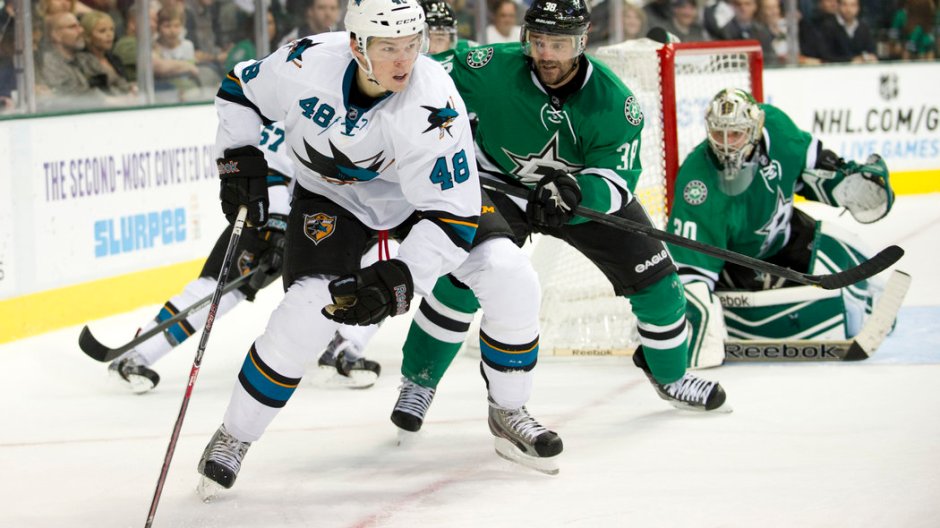
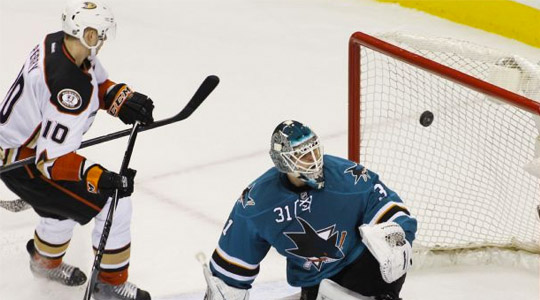
Sharks Jump Out to 4 Goal Lead, Hang On to Win

By Mary Walsh

SAN JOSE– Before Saturday’s 6-4 win over Anaheim, the Sharks were not sure whether or not Logan Couture would be able to play. “This morning I woke up and my eye was swollen, I could barely see out of it, so I knew something was up,” he said after the game. Considering how Couture played on Saturday, maybe he should consider wearing an eye patch before all of his games, to mimic a pregame eye problem.

After the game, Sharks head coach Todd McLellan said of Couture’s performance:

I thought he had a hell of a game, probably his best game of the season in my opinion. He was all over the puck, he played well defensively, he looked really good.

Couture and Patrick Marleau ended the game with two points each while Wingels earned the first star and four points for the game. They were the most effective line in the game. Antti Niemi made 30 saves on 34 shots (seemingly all in a frenetic third period), and Tomas Hertl’s backhand goal ended up as the game winner. Corey Perry and Ryan Getzlaf scored three of the Ducks’ four goals.

The Sharks started very well, but ended the second period and started the third in a muddle. With the Ducks closing in, McLellan used his time out. In those seconds, Wingels explained, the coaches reminded to team to get back to the way they started:

What made us effective in the first two periods? Playing a north-south game, that was being physical, getting in on the forecheck and creating pressure. I thought when they did score, we kind of started circling a bit, taking pucks east-west.

Clearly, the reminders worked.

The first goal of the game came from Logan Couture, midway through a grinding first period. The puck bounced a bit in front of the net and it was on a second or third bounce that Couture put it over the prone Ducks goaltender. Wingels and Marleau got the assists on the goal.

Almost two minutes later, Ducks forward Matt Beleskey tied the score on Anaheim’s fourth shot of the game. Defenseman Hampus Lindholm’s shot from the blue line traced a line of four players all stacked in front of Niemi, making the shot very difficult to see. Beleskey tipped it in to score his 11th of the season. Assists went to Lindholm and Devante Smith-Pelly.

At 12:41, Justin Braun went to the penalty box for delay of game, taking the first penalty of the game. Perhaps disatisfied with a waste of a perfectly good lead, Logan Couture promptly took it back with a short-handed breakaway, made possible by a fallen Duck at the  blue line. Couture was patient and precise taking the shot, scoring his tenth of the season.

With just over a minute left in the period, Matt Irwin drew a high-sticking penalty on Jakob Silfverberg. At the time, the Sharks were pinned in their zone and they needed a break. The break they got, and a power play goal as well. With 13.6 seconds left in the period, Wingels and Pavelski moved the puck into the zone, then passed it to Joe Thornton in the opposite corner. He passed it back across the blue paint to a waiting Pavelski.

The period ended with the Sharks leading 3-1, and leading in shots 14-5.

Almost three minutes into the second period, Tommy Wingels tipped a Patrick Marleau shot from the blue line to stretch the lead out to 4-1. It was Wingels’ seventh of the season. Assists went to Marleau and Justin Braun.

The Sharks’ fifth goal came from Tomas Hertl, after he collected the puck along the wall when Josh Manson tried to clear it. Hertl punctuated the goal with a little stick handling in front of the goalie, with James Sheppard acting as a screen. That was it for Ducks’ goaltender Frederik Andersen. Jason LaBarbera came on in relief.

The Ducks used their time out, and seconds after play resumed, the players were piled up in the corner for some fisticuffs. James Sheppard, Matt Irwin and Tomas Hertl were all in the thick of it. In the end, Hertl and Sheppard were in the box for the Sharks, while Devante Smith-Pelly and Matt Beleskey went for the Ducks. The Ducks got a power play out of it as Sheppard received and extra two minutes for boarding.

The Sharks killed the penalty off and the ice opened up until Mike Brown was called for closing his hand on the puck. That was 9:37 in to the second.

With 3:33 left in the period, John Scott was called for hooking. The Sharks did a good job of clogging up the neutral zone and kicking the puck back out when the Ducks did dump it in.

Back at even strength, Ryan Getzlaf carried the puck over the line and passed it to Corey Perry as he bore down on the net. A nifty lift put it over Niemi’s pad and gave the Ducks a boost.

At the end of the second period, the Sharks led 5-2 and shots were 26-19 Sharks.

After the game, Logan Couture commented one of the Sharks’ more glaring bad habits this season:

For some reason this year we’ve just been getting away from it for periods at a time, letting the other team get back in games and take it to us. And that’s exactly what we did, we turned pucks over, we.. I don’t know, it’s tough to understand why we do that but luckily we were able to survive it.

Seconds into the third, Corey Perry cut the Sharks’ lead to 5-3. Matching penalties to Mike Brown and Patrick Maroon followed shortly after, putting the teams four on four. After a save and a fairly spectacular second save, Antti Niemi was beaten again, this time by Ryan Getzlaf. The assist went to Corey Perry. With the gap closed to one goal, McLellan used the Sharks’ time out.

The next good chance for the Sharks came from the Sheppard-Hertl-Nieto line, after the Thornton-Pavelski-McGinn line pushed the action back into the Ducks’ zone for a bit. The Sheppard line had a couple of good chances, both featuring shots from Hertl after strong work along the walls from Nieto and Sheppard.

A penalty to the Ducks came at 6:30 of the period. Renee Bourque went for hooking Nieto. Little came from that, though Niemi had to make some good saves on more short-handed chances from the Ducks. By the middle of the period, the shots were 31-30. At 10:13, Mike Brown went back to the box for hooking.

The Sharks survived a broken stick for Vlasic, then escaped to the Ducks’ zone for a game of catch. Another trip up and down the ice, another short-handed chance, and Matt Nieto drew a penalty on the Ducks, negating the last 18 seconds of the Brown penalty, and putting Ryan Kesler in the box. The Ducks did not get a shot on goal during that power play.

The power play generated three or four shots for the Sharks, and kept the Ducks busy for a spell.

The Sharks earned another power play with just over two minutes left in regulation, when Josh Manson went to the box for hooking Tommy Wingels. The Ducks pulled LaBarbera to even things up. With 26 seconds left in the power play, Matt Nieto scored into the empty net after Tommy Wingels got the puck to him with a neat pass. It was Wingels’ fourth point of the game. It was Nieto’s second point of the season.

Tommy Wingels led the Sharks in hits with seven, Tomas Hertl led the team in shots with five. Brendan Dillon led the team in blocked shots with four, but he and his defense partner Brent Burns both finished with minus two ratings.

Frederik Andersen made 14 saves on 19x shots, Jason LaBarbera made 15 saves on 15 shots for the Ducks. Corey Perry led the Ducks in shots with six, Tim Jackman led in hits with five, Mat Clark led them in blocked shots with three.

Mirco Mueller, Matt Tennyson and Barclay Goodrow were scratched. Tyler Kennedy also did not play.

The Sharks next play the Philadelphia Flyers on Tuesday, December 2, at 7:30 PT in San Jose.

Sharks Lose to Coyotes in Shootout

By Mary Walsh

SAN JOSE–Saturday night, the Arizona Coyotes beat the San Jose Sharks 4-3. The game went to a shootout giving the Sharks one badly needed point but little else to celebrate. The game’s first and last goals were both scored by Antoine Vermette. The Coyotes’ Devan Dubnyk made 40 saves for the win. For the Sharks, Tommy Wingels, Andrew Desjardins and Joe Pavelski all scored to get the team to overtime.

The Sharks’ first goal of the game snapped a five game pointless streak and a ten game goalless streak for Tommy Wingels. It was an impressive short-handed goal to boot. After the game, Wingels said:

Our penalty kill gave one up early in the game so to get one back was important for us.

You’re not happy when you get scored on the penalty kill, and whether that makes you anticipate better or try harder, psychologically, I don’t know but Goody made a really good play. Both getting it out and on the rush so I just had a the easy job of putting it in.

Andrew Desjardins’ goal was his first of the season.

While many have said that practice is very important, so important that the lack of it may account for some of the Sharks’ recent losses, Todd McLellan did not think it important enough to sit a player who has never practiced with the team. After being traded to the Sharks for Jason Demers, Brenden Dillon arrived in time for the morning skate, but his gear did not. Despite not being able to participate in that practice, he was in Saturday’s game, paired with Brent Burns. Matt Irwin sat out.

The Arizona Coyotes have found ways to lose a lot of games this season. Sometimes they play very badly, other times they just draw the short luck straw. In any case, they quickly tumbled down the Pacific Division standings and have languished there through the first quarter of the season. All of that, next to the Sharks’ recent habit of losing to weak teams, did not bode well.

The Sharks gave up the first goal at 6:08 of the first period, to the Arizona Coyotes power play. The puck trickled out in front of Niemi and Antoine Vermette tapped it through the five hole. The Sharks seemed to have a serious communication failure there, as no one at all was defending Vermette as he loitered in the slot not far from the blue paint.

The Sharks also gave up the second goal, this one a shot from David Schlemko as he skated in fast enough to give himself a clear view of the net. It went just inside the post and out again, almost as if it did not want to rub the two goal lead in.

The Sharks did outshoot the Coyotes in the first, 11-7, despite the penalty. Still, none of those shots could beat Coyotes goaltender Devan Dubnyk.

The Sharks started the second period with some unconvincing play in the offensive zone. They were not very difficult for the Coyotes to push back out.

At 2:46, Andrew Desjardins went to the penalty box for tripping Tobias Rieder. A short-handed excursion quickly followed and gave the Sharks a draw in the Coyotes zone. After the draw, the Sharks again took control and after a couple more tours of the Coyotes’ end, Barclay Goodrow, Mirco Mueller and Tommy Wingels went in three on one to get the Sharks on the board. After such a lackluster start to the game, that brazen attack was certainly surprising.

Tommy Wingels also drew the Sharks’ first penalty, a holding call on Shane Doan at 11:34. The Sharks’ power play had a couple of good chances, most notably an opening for Brent Burns, but he hooked the puck up into the netting and out of play.

At 15:34, Vermette went to the box for boarding Tyler Kennedy. The second Sharks power play looked a lot less dangerous than any of their penalty kills. Then, 19 seconds after the power play ended, Andrew Desjardins found himself with a clear view of the net from the faceoff circle. He also had the puck. He shot it past Dubnyk and tied the game.

By the end of the second period, the Sharks led in shots 25-13.

The tie did not last long. 52 seconds into the third period, during a ferocious Coyote attack on the Sharks’ net, a rebound came out and pinballed around before Shane Doan helped it past Dillon and Niemi. Assists to Sam Gagner and Tobias Rieder.

At 7:12 of the period, Arizona’s Michael Stone went to the penalty box for tripping Patrick Marleau. Just prior to the penalty, the Sharks were showing distinct signs of life. A couple of good passes to get them out of the zone involved McGinn and Dillon, and some clean, composed puck movement from the Thornton line, put pressure on the Coyotes defense.

The power play was a little slow getting started, marked by a number of passes that required some patience. The Sharks waited the Coyotes out, until Couture was able to find Burns at the middle of the blue line with a tidy pass that Burns blasted on net. Joe Pavelski deflected it in to tie the game again.

The rest of the period seemed to be played mostly in the Sharks’ zone, but in the final seconds of the period the Sharks made a very good push, complete with good shots from Joe Pavelski and a zone entry with maneuvers through traffic from Sheppard. That last one, had Sheppard managed to put the puck in the net, would have been a nice addition to a highlight reel. Alas, he did not and neither did anyone else.

1:05 in to overtime, Coyotes captain Shane Doan went to the box for high-sticking Matt Nieto, who went to the bench holding his right hand gingerly. The Sharks’ power play featured an amazing almost goal saved by a Coyote sprawled in the net behind Dybnyk. Nothing else came close. A small pile up in the net at the end of the power play did remind me of this accident. Just like that pileup, everyone walked, or skated away. Unlike that accident, it was over very quickly.

The shootout went all three rounds, with Logan Couture, Joe Pavelski and Barclay Goodrow shooting for the Sharks. Sam Gagner, Mikkel Boedker and Antoine Vermette shot for the Coyotes. Vermette shot last and was the only shooter to score.

Joe Pavelski led the Sharks in shots with seven. Tommy Wingels led the team in hits. Three Sharks blocked three shots each: Patrick Marleau, Marc-Edouard Vlasic and Justin Braun. Antti Niemi made 22 saves on 25 shots.  Newcomer Brenden Dillon had one shot on goal, four hits and one blocked shot.

Jason Demers, who presumably had his equipment in time for the morning skate, seems to be fitting in nicely with the Dallas Stars.

The Sharks next play at 7:30 on Wednesday the 26th. They will face the visiting Calgary Flames at SAP Center in San Jose.

Troy Grosenick Steals One for the Sharks

By Mary Walsh

Sunday’s 2-0 win over the Carolina Hurricanes was one of the more compelling games the Sharks have played this season. It was not high-scoring and the Sharks did not outplay their opponent, except in goal. It was Troy Grosenick who made the 2-0 win exciting. He finished his NHL debut with a 45 save shut out. He even had to make one of those saves with Tyler Kennedy’s stick. He was a man on a mission.

After the game, Grosenick said:

It’s kind of a dream come true. It’s kind of like… just like you write it up when you’re a little kid. The guys played great in front of me, I saw so many pucks, not too many difficult ones.

At the other end, Anton Khudobin only faced 19 shots. It was an unusual way to welcome a goalie to the NHL, unless letting him steal a game was the Sharks’ plan. From Todd McLellan’s post game comments, no, that was not their plan:

A lot of guys score in their first games. Did we expect a shutout and 45 shots? No but he played extremely well and we certainly believed he could do that. So to get a young man like that to come in and steal us a game, when we didn’t have our A game yet, I thought as the night wore on we wanted to do it more and more for him and we improved.

All’s well that ends well.

Grosenick was called up last week when Alex Stalock had a knee procedure that will keep him out at least for a few games, but it was not assumed he would start a game.

The Carolina Hurricanes presented a different kind of challenge for the Sharks. They had a very poor start to the season, and suffered a lot of injuries to key players early. Their record so far is lousy but their recent record is much better. Their roster is getting healthy and they are playing well. So they might have looked like an underpowered opponent but they are more capable than that. With the backup to their backup in net, Matt Nieto and Scott Hannan out, the Sharks had some pressure from within if the Hurricanes did not offer enough inspiration.

None of that seemed to help much, as the Sharks started as slowly as ever. Their rookie goaltender had to keep the Sharks in it while his team was outshot 12-3 through the first 15 minutes. Part of that time was spent on the penalty kill but the Sharks did not look much better at even strength.

That penalty was a hooking call to Joe Pavelski at 18:03. It gave Grosenick a chance to get in the game, as he had to make a few saves in quick succession. He looked confident and composed. The Sharks had to kill another penalty, this one to Jason Demers in the last four minutes of the period. The Sharks’ penalty kill featured two different short-handed chances, one from Adam Burish and one from Patrick Marleau backed up by Mirco Mueller.

The pressure they started to generate on that kill outlasted the penalty, when Tomas Hertl gave the Sharks the lead. He took advantage of a miscue by the Hurricanes in the Sharks’ zone, escaping into the neutral zone with the puck. Hertl went in two on one with Joe Thornton with only Carolina’s Andrej Sekera back. Hertl tried to get the puck to Thornton but it hit Sekera. The puck came back within Hertl’s reach as all three skaters converged at the blue paint, so Hertl poked it under goalie Anton Khudobin. The assist went to Barclay Goodrow.

The shots by the end of the first were 16-5 for the Hurricanes.

At 12:08 of the second, the Sharks went on the power play after Barclay Goodrow drew a hooking penalty from Brad Malone. Despite a couple of good chances, the Sharks only got a few shots through the Carolina penalty kill. Khudobin stopped those.

At the end of the period, Grosenick had a chance to really show off when the Sharks got trapped in their zone and several shots came at the Sharks goaltender, rapid fire through traffic. The last shot was at a nearly empty net but Grosenick got across with just enough of his glove to stop it. (Click on that link to see the video of that sequence)

The period ended with the Hurricanes still leading in shots 31-14, 15-9 for the period.

The Hurricanes did not let up during the third period, and the Sharks only managed five more shots. No penalties were called, few stoppages gave relief to the tired teams. Until Joe Thornton broke away in the final seconds to shoot at the empty net, the shutout looked very uncertain.

Six Sharks got credit for two shots, none had more. Marc-Edouard Vlasic led the team in ice time with 23:22, while Justin Braun led the team with six hits. The Sharks power play was 0/1 while their penalty kill was 2/2.

Nathan Gerbe led the Hurricanes (and all skaters) with seven shots. Three Hurricanes got credit for three hits each, John-Michael Liles, Elias Lindholm and Brett Bellemore. Andrej Sekera led his team in ice time with 27:07.

In the faceoff circle, the Hurricanes beat the Sharks 34-24.

The Sharks next games is against the Sabres in Buffalo, on Tuesday at 4:30 PT.

Sharks Defeat Stars 5-3, Score 4 Goals in 3rd

By Mary Walsh

In a 5-3 victory over the Dallas Stars, the San Jose Sharks turned some early season habits upside down. So far this season, the Sharks played many strong first periods, only to struggle in third periods. Saturday, despite a hat trick from Tyler Seguin in the first two periods, the Sharks came back with four goals in the third period.

Brent Burns scored twice, James Sheppard scored to extend his goal scoring streak to three games. Patrick Marleau scored, after being without a goal for nine games. Logan Couture earned three assists in the game. Al Stalock made 37 saves on 40 shots for the win, after sitting as backup for five games.

After the game, Sharks head coach Todd McLellan talked about the third period recovery:

We talked between periods about checking well, not giving them anything else, power play being ready in case we got one, it was. We just stuck with it, we didn’t go away. The way the League is this year, we’ve seen it with our group, there is no lead that’s safe, and you’re never out of it when you’re coming from behind.

Not unlike the Sharks, the Stars have been having trouble with third periods. Also like the Sharks, Dallas has a bad record at home this season. They have only one win in eight home games.

In response to the suggestion that the Sharks knew the Stars are vulnerable in the third period, Logan Couture said:

I didn’t know that, no. In this dressing room we’re worried about our own game. We’ve got to start playing better and we know that so we’re not looking at the other team. We believe that if we play our game we’re able to beat any team any night so we’re worried about ourselves in here.

The first Dallas goal started as a shot from Sergei Gonchar at the blue line. The puck bounced off the skate of Adam Burish, then off the chest of Tyler Seguin and past Stalock. About two minutes later, Seguin shot the puck around Matt Irwin and past more traffic in front of the crease.

James Sheppard salvaged the Sharks’ spirits with a hard-working goal after he corralled a rebound at 17:14 of the first period. After the game, Sheppard said:

It really does happen fast, just trying to get pucks on net. Fortunately there was an open net so I didn’t have to beat a goalie, just get it in there. So it was just a good job by our line.

The second period featured two penalties to Tyler Kennedy and a power play goal for the Stars. Kennedy went to the box for goalie interference 12 minutes into the period, then again for tripping at 15:18. On their second power play of the period, Tyler Seguin finished his hat trick, taking advantage of a big rebound and plenty of space.

The third period turnaround started with a power play goal from Patrick Marleau. Marleau came up from behind the goal line to grab a rebound off a shot from Joe Pavelski.

A couple of minutes later, while the teams were playing four on four, Logan Couture and Brent Burns went in two on one to tie the game. Couture chose to pass and Burns shot before Lindback could get across.

With almost ten minutes left, while the Sharks’ third line of Sheppard, Hertl and Kennedy wreaked some havoc in front of the Dallas net, a rebound popped out for Burns, who put it away to give the Sharks the lead.

The last couple of minutes were hectic. The Stars were pressing and Stalock had to make some very impressive saves. Discipline broke down, and in the last 90 seconds overlapping penalties came after Stalock shot the puck out of play and then got hit in the face by Antoine Roussell. A number of scuffles followed, including a cheap shot on Justin Braun. Of the last, McLellan said:

What disappoints me is when a guy is vulnerable and being held and he gets punched. That’s the disappointing thing. I don’t think anybody in our league, the 750 players and coaches want to see that. So, just not a classy moment.

McLellan did not have any more information about Braun’s status.

Regarding the hit on Stalock, Logan Couture said:

I’ll have to see the video, I didn’t really see it. I saw it quickly, Roussell’s kind of known for that, so watch it on the video and see what really happened.

After the referees sorted that out, the teams finished the game four on four. The Stars pulled their goalie for a man advantage but Couture and Thornton escaped through the neutral zone and Thornton scored into the empty net.

The Sharks scored on one of two power plays, and killed four of five penalties. The Stars led on the shot clock through the game and in every period, for a total shot count of 40-29.

Brent Burns and Patrick Marleau led the Sharks in shots with four each, Tommy Wingels led the team with four hits, and Burns led the team in time on ice with 22:21.

Anders Lindback made 24 saves for the Stars. Shawn Horcoff and Tyler Seguin led Dallas in shots with five each, Ryan Garbutt led the team with five hits, and Alex Goligoski led the Stars in ice time with 24:43.

The three stars of the game were Brent Burns, Tyler Seguin and James Sheppard.

The Sharks continue their road trip Sunday at 4:00 PT, against the Blackhawks in Chicago.

Sharks Win 3-1, Score 2 Goals in 3rd

By Mary Walsh

SAN JOSE–Saturday night, three Sharks lines scored three goals to defeat the New York Islanders 3-1. Additionally, instead of giving up a lead in the third frame, the Sharks picked up the pace, took the lead and stretched it out. This marked a shift away from recent bad habits.

Tomas Hertl and James Sheppard scored the Sharks’ first and third goals of the game. The game winner was a goal from Logan Couture, the second Sharks goal of the night. Even if the lines were switched around a bit during the game, getting goals from three of the four lines had to please Sharks’ head coach Todd McLellan.

While he started the game on the fourth line, Hertl continued to be part of the second power play unit. That is where he was playing when he scored Saturday. After the game, head coach Todd McLellan said of Hertl and the bottom six:

We moved him up a line and rewarded him with that. In turn, Shep gelled with Burr and Desi down the stretch in the last period and a half. So, as it turns out we had a kid line and a veteran group of players that both contributed to the win tonight.

The Islanders struck first almost ten minutes in to the first period. Kyle Okposo scored it. Okposo had spent a lot of time in the Sharks’ zone, he seemed a likely candidate to score first Saturday.

The game to that point had been a tough back and forth affair, with the shot count low but even. Of the Sharks’ lines, the Couture-Marleau-Wingels line seemed to be spending the most time in the Islanders’ zone.

The Islanders’ goal was followed closely by a power play for the Sharks, when Ryan Strome went to the box for high sticking. The Sharks’ first power play unit of Thornton, Couture, Marleau, Pavelski and Burns had some excellent chances but Islanders’ goalie Jaroslav Halak was there every time. A line change brought Tomas Hertl and Tommy Wingels out with Nieto and Vlasic. At 10:23, Tomas Hertl scored his first of the season to tie the game. Assists went to Tommy Wingels and Matt Nieto.

After the game, Hertl said of the goal:

Tommy Wingels’ pass was very very nice for me so it was [a] very easy goal.

Tommy Wingels said, of that goal and what it may portend:

It’s good to see him score. I think everyone could see a big smile on his face after. Sometimes it only takes one goal to really get you going and we hope that’s the case with Tomas.

By the end of the first period, the shots on goal had tilted dramatically for the Sharks, 17-6.

To start the second period, the Sharks were missing a defenseman as it was announced that Scott Hannan was questionable to return. At 2:45, Tommy Wingels went to the box for holding. The Sharks penalty kill was efficient and teal jerseys spent some time in the Islanders’ end as well. Matt Nieto blocked a shot that looked painful, and Antti Niemi made some good saves to keep the game tied.

The Sharks were still outshooting New York 2-1, but that lead was getting harder to maintain. By the 15 minute mark, the Sharks only had two shots on goal. McLellan predictably started jumbling the lines. Hertl moved to the third with Goodrow and Tierney, Sheppard down to the fourth with Burish and Desjardins. It looked briefly as if Marleau might have been moved to the Joe line but on the next faceoff, Nieto was still with Thorton and Pavelski.

The second period ended with only 11 shots fired, five by the Sharks, six by the Islanders.

At 1:55 of the third period, Jason Demers went to the box for contact to the head of Cory Conacher. Conacher left the game for about ten minutes of play. He returned to the bench with 9:31 left in the period.

The Islanders used that power play to eat into the Sharks’ shot lead. It took the Sharks several minutes to regain their momentum, but they took the lead for the first time at 11:50 of the period. Logan Couture redirected a shot from Justin Braun. The second assist went to Marc-Edouard Vlasic.

The game went from good to better for the Sharks at 15:35 when James Sheppard scored his first goal of the season, off a nice short pass from Adam Burish. A secondary assist went to Andrew Desjardins.

With 3:50 left in regulation, Conacher was escorted from the game by an official with a ten minute misconduct.

At 18:47, Adam Burish was called for holding. The Islanders used their timeout but the Sharks held on for the win.

Final score: 3-1 Sharks.
Joe Pavelski led the Sharks in shots on goal with 7. Brent Burns led the team in hits with 6. Mirco Mueller led the Sharks with 6 blocked shots, Brent Burns also led the team in ice time with 26:29. Antti Niemi made 19 saves on 20 shots.

For the Islanders, the shots leader was Anders Lee with 3, while Cal Clutterbuck led the team with 11 hits. Hamonic, Visnovky and Hickey each blocked 3 shots. John Tavares led the Islanders in ice time with 23:51. Jaroslav Halak made 28 saves on 31 shots.

—————————–
The Sharks’ scratches were John Scott, Tye McGinn and Matt Irwin.

The Sharks next play at 7:30 pm on Thursday at SAP Center, against the visiting Vancouver Canucks.

Sharks Bested By Bruins in Boston

By Mary Walsh

BOSTON– Tuesday, the San Jose Sharks fell to the Boston Bruins 5-3 at TD Garden. In many ways, the game was uncharacteristic for both teams. While it was a predictably close game, the score did not reflect a game between two defensively exceptional teams. After the game, Joe Thornton said:

The game went back and forth, back and forth. We thought we had it, we had a good chance on the four minute power play. In the end we just didn’t bury it. Tough game to lose.

The shot count was a little high on both sides (34-33), and five goals were scored in the first two periods. It is the third time Tuukka Rask has bested the Sharks, and the Bruins have yet to lose to San Jose with Rask in net.

Sharks head coach Todd McLellan said, after the loss:

If we’re comparing it to the last game in New York, it was a much better effort. I don’t know if that’s a wise thing to do or not but we have to take steps forward so that’s a positive. We still got to get better. We’re giving up four games a night we’re not going to win very many games at all doing that.

The Sharks did improve their power play numbers, scoring once in two tries, or once in three tries if you count the second as two since it was a four minute power play. Either way, better than before the game. Beyond that, the game was a step back in most areas.

After the 5-3 loss, Logan Couture said:

We needed to get at least a point. We kind of let that one slip away. With this team you can’t be doing that. So we need to get a lot better.

The first whistle for more than icing came with just under seven minutes left in the first period. That whistle blew to send Brent Burns to the box for tripping. It was a peculiar sort of trip, more of a shoving the feet from behind, but he did interfere pretty overtly with Seth Griffith’s feet and cause him to fall.

Seconds in to the power play, 17 and 47 drew attention to themselves by cycling the puck around a bit. When Brad Marchand took control of the puck near the point, 17 and 47 had the Sharks penalty killers slightly out of position. Marchand’s shot went cleanly over Niemi’s blocker to put the Bruins on the board first.

At 15:56,the Sharks got their own power play when Marchand went to the box for cross checking Justin Braun. After the second faceoff of the power play, Patrick Marleau took a shot from the point and Logan Couture redirected it in from his spot just in front of the blue paint. Assists went to Marleau and Burns.

The Sharks came out with a little more punch to start the second, earning a couple of good chances on the first shift for Logan Couture’s line with Patrick Marleau and Tommy wingels. The fourth line of Adam Burish, Eriah Hayes and John Scott, however, could not hold the zone and then got trapped in their own zone for too long a spell. The Sharks were lucky to escape without giving up a goal.

That second line was by far the most effective through the first seven minutes, consistently getting shots and giving the Bruins defense grief.

Almost seven minutes in, Desjardins went to the box for tripping Loui Eriksson. This time, the Bruins did not do much cycling before Torey Krug put the puck past Niemi, again from above the faceoff circle. Assists went to Milan Lucic and David Krejci.

Tomas Hertl followed Desjardins to the box for tripping, less than two minutes after the Bruins’ second goal. The Sharks managed to kill that penalty off.

With just 3:45 left in the period, that second line came back with some fight. Patrick Marleau got to the net and Wingels got the puck to him. Marleau’s back was to Rask and a Bruin was in his face but he held  his ground and the puck until Couture came in to help out. He helped out nicely and put the puck in the net.

Seconds later, the top line followed suit and gave the Sharks their first lead. Joe Thornton scored that one, assisted by Joe Pavelski and Justin Braun.

To start the third period, James Sheppard was on a line with Eriah Hayes and Tomas Hertl. A line of Adam Burish, Andrew Desjardins and Tommy Wingels foolowed that. Then Thornton came out with Pavelski and Nieto for a touch of normalcy.
Seth Griffith, David Krejci and Milan Lucic for the Bruins came out against Couture, Marleau and Hertl, and tied the game.  The goal was Griffith’s first NHL point. Assists went to Lucic and Torey Krug.

The Bruins’ fourth goal came after Vlasic failed to control the puck (his stick slipped from his hands as he tried to catch a pass from Braun) and Paille got control along the boards. Unfettered by any Shark, he was able to shoot. Two other Bruins were crowding the crease and the puck slid through them and under Niemi. One of those was Gregory Campbell. He got credit for the goal, so evidently it touched him on the way through.

After that goal, the Sharks’ lines fell back into a more familiar order, with Hertl on a line with the Joes, and Nieto with Marleau and Couture. Hayes joined Sheppard and Wingels. This seemed to be working pretty well, and then Justin Braun took a stick to the face, putting the Sharks on a four minute power play. That would give the Sharks most of the rest of the game with a man advantage. Unfortunately, it also sent Braun to the dressing room for repairs. He was gone for over two minutes of play.

The Sharks pulled Niemi with about a minute left to play, but that did not work out. Instead, the short-handed Bruins scored an empty net goal with 24.5 seconds left. Goal scored by David Krejci.

=======================

John Scott only played five minutes. Whether or not he allows goals or shots against, if he cannot skate more minutes than that, his teammates have to make up the difference, in minutes and line adjustments. The Sharks, like most of the top teams right now, are moving to a more balanced four line system. Having a player they cannot or will not use evenly seems like a terrible handicap. That handicap is no less of a problem for being entirely predictable before the season started.

=======================

Scratches: Tye McGinn, Mirco Mueller, Chris Tierney.

Sharks next face the Columbus Blue Jackets on Thursday October 23, at SAP Center.

Kings still too much for Sharks

by Ivan Makarov

SAN JOSE, CA — Playing their toughest opponent yet, the current Stanley Cup champion Los Angeles Kings and the team that eliminated them from playoffs in the memorable fashion last season, San Jose Sharks failed to impress and fell 4-1 at home.
It was a preseason game and Sharks head coach Todd McLellan benched a few key players, including Joe Pavelski, Marc Eduard Vlasic  and Justin Braun. But the Kings were also missing Marian Gaborik, Jarret Stoll, Jeff Carter and Tyler Tofolli, so on paper, the rosters looked evenly matched.

But it all came down to the Kings being more effective with their scoring chances, and more stingy in goal.

Joe Thornton opened the score in the game 88 seconds into it after a good puck possession inside the Kings zone. Sharks center got the puck from a rookie defenseman Taylor Fedun, paused and put it past Jonathan Quick.

Half way through the first period Drew Doughty tied the game at 1-1 on a great individual effort as he picked up the puck around center ice from Justin Williams, skated past two Sharks players and put it top shelf on Antti Niemi, scoring his first goal of the preseason.

Sharks could have taken the lead towards the end of the period when Patrick Marleau got out on a breakaway, but he was unable to shoot the puck as Kings’ defenseman caught up with him and blocked his stick at the same time as Marleau got close to the net.

Kings took the lead in the game early in the second period when Dustin Brown capitalized on the Sharks’ mistakes in their own end and put the puck high into the net. The Sharks were scrambling to get into the position unable to match the Kings speed on the zone entrance and it was too late.

Justin Williams doubled the lead and scored the third goal for the Kinds towards the end of the second period. He was the first on the rebound from the shot by Dwight King as LA players surrounded Antti Niemi. The follow up shot by Williams did not look all that strong, but it squeezed into the goal under Niemi’s pad.

Dwight King made it 4-1 for the Kings half way through the third period as he broke into the Sharks zone with speed on the left wing, and put the puck into the net above Antti Niemi’s shoulders who did not react fast enough.

On the positive side of things, Sharks rookies looked confident against a strong opponent, generating scoring chances and speed. Sharks looked faster on the transition and while entering the zone. On the negative side, Antti Niemi looked rusty and is in part to blame for the score, failing to save the Sharks when they needed him the most. Sharks were also sloppy with the puck giving it away 22 times vs just 9 giveaways for the Kings. The Sharks also allowed the Kings to outshot them at home 30-24 – not something that happened very often last season against any opponent.

The crowd also expected the game to be a bit more heated after the history between the two teams in the last post season, with Sharks blowing 3-0 lead in the series and allowing the Kings to beat them in the best of seven and go on to win the Stanley Cup. But overall the players kept their emotions and tempers in check, perhaps saving them for the regular season opener on Wednesday, October 8, when they meet again in Los Angeles. It’s preseason and not many are paying attention just yet, so why waste energy?

Sharks preseason games continue on Friday when they travel to Arizona to face the Coyotes.

Sharks Defeat Ducks 3-1 in 4th Preseason Game

By Mary Walsh

SAN JOSE– Saturday, the San Jose Sharks defeated the Anaheim Ducks 3-1 in their fourth preseason outing. The game featured a preposterous number of penalties from the Ducks and yet another good showing from the line of Barclay Goodrow, Chris Tierney an Nikolay Goldobin. They earned all three stars. Two of the goals were Goodrow’s.  Goldobin picked up assists on both of those, and Tierney had an assist on one. The third Sharks goal was Logan Couture’s, while the lone Ducks goal was scored by Matt Beleskey.

Saturday, the Sharks again started with a jump ahead on the shot clock, but the gap was not so big. Midway through the first period, the shots were 6-2, the Sharks were working on their second power play and a 0-0 tie. Unlike last night’s squad, these Sharks also grabbed the lead on the scoreboard, during that power play. That goal was scored by Logan Couture and a power play unit of Demers, Irwin, Marleau and  Nieto. A few minutes later, Barclay Goodrow scored to give the team a two goal lead. The assist went, of course, to Goldobin.

The Sharks started the second with an early power play that quickly turned into a five on three with a delay of game penalty coming just four seconds in. Into the second minute of that power play, I was still looking to see who the second power play unit was. The first unit would not get off the ice, since the Ducks could not clear the puck. The top unit did not score either, but with 40 or so seconds left, Anaheim goaltender John Gibson stopped the puck and gave his penalty killers a rest. The Sharks’ second unit finally appeared: Barclay Goodrow, Chris Tierney, Nikolay Goldobin, with Matt Tennyson and Mirco Mueller on the blue line. It took them a few seconds but they scored, Goodrow’s second of the game. Assists went to Tierney and Goldobin.

The power play units got some more practice with yet another Ducks penalty. Just a shift or two had gone by when Nicolas Kerdiles was called for tripping. This time the first unit left almost a minute for the second unit to work with.  The second unit included DeMelo instead of Mueller this time.

At 8:42, San Jose’s Taylor Doherty and Anaheim’s Matt Belesky went to the box for matching slashing minors. That was kind of an unusual call.

In the last minutes of the first, Stalock made a save on a wraparound attempt that was very impressive. He does not look like someone trying to get up to speed. He looks more like someone competing for a spot, which, of course, he is. It may not be a spot in San Jose, he has that. But he is certainly capable of challenging Niemi for the starter’s role. No time like the preseason.

The first Ducks power play came at the end of the first period. The second Ducks power play came at the end of the second period. Both times, Melker Karlsson was in the box. In the first period it was for holding the stick. In the second it was for tripping. It was not his night.

The Sharks got another 5 on 3 power play, 1:16 long at 18:48 of the second period. That brought the Ducks to ten penalties, if you do not count the two matching minors. McLellan did not change anything on the first unit, and continued sending them out first. They seemed to need the practice.

It was not Jason Demers’ best night either. He could not seem to get a handle on the pucks sent his way during those many power plays. He spent a lot of time on the left side of the net. That looked like an awkward spot for him.

The third period started with the score at 3-0 Sharks and the shot count at 24-10 Sharks.

One of those rule changes made an appearance about seven minutes in to the third period. The officials called Anaheim’s Nicholas Kardiles for hooking, and gave a matching minor to Goldobin for embellishment. As if the call threw them off, the Sharks gave up a goal 1:38 in to the four on four. It was a fair case of the goalie being beaten by a good shot from an open player. Matt Belesky scored his first of the preseason with assists going to Marc Fistric and Kevin Gagne.

Shortly thereafter, Taylor Doherty fought Clayton Stoner. Stoner got an additional two minutes for roughing, but the Sharks’ power play did not score.

Final score: 3-1, shot count 33-17 Sharks. Attendance announced as over 16, 000.

Saturday’s roster:
Forwards: Andrew Desjardins, Patrick Marleau, John Scott, Logan Couture, Melker Karlsson, Freddie Hamilton, Eriak Hayes, Nikolay Goldobin, Matt Nieto, Barclay Goodrow, Daniil Tarasov, Chris Tierney

Defensemen: Jason Demers, Mirco Mueller, Matt Irwin, Dylan DeMelo, Taylor Doherty, Matt Tennyson

Alex Stalock was in net with Grosenick listed as backup.

Line combos:
Nieto/ Couture/ Marleau, Tierney/ Goldobin/ Goodrow, Hamilton/ Karlsson/ Tarasov, Hayes/ Desjardins/ Scott
Later in the game, Nieto and Hamilton swapped lines

Tennyson/Irwin, Demers/DeMelo, Mueller/Doherty

Power play units:
Marleau, Couture, Nieto, Demers, Irwin
Godolbin, Goodrow, Tierney, Tennyson, Mueller/DeMelo

Win, Lose or Draw, Sharks Shoot First

By Mary Walsh

SAN JOSE- Friday’s game was the third of three preseason games that featured a gross shot advantage for the Sharks. It seems that no matter who is playing or how you line them up, Sharks will outshoot the other team. That does not mean they will win, but it certainly gives them a fighting chance. Friday the Sharks lost 2-1 to the Arizona Coyotes in a game that went to a shootout.

What goes in to these shot advantages? Defenseman Taylor Fedun, in his first training camp as a Shark, has had some time to learn something about the team’s playing style:

I think we have a pretty good shoot first mentality and it’s been working for us where we get pucks on net and then we’re able to retrieve them and it kinda gets defensive teams on their heels a little bit. It’s one of the ways to keep the game simple in the preseason here, where you’re not as sharp on the system as you will be a little bit later on in the season. So it keeps things simple, just throwing pucks on net and trying to outwork teams.

This is something the Sharks consistently do,  well into the season. It has been their style for a while now, it will probably continue to be what they do. How do they do it, even with players new to the team or even the league? Fedun said:

It’s something that’s touched on by the coaching staff that we want to get the puck on net as often as we can, try and generate second and third opportunities in doing so.

No surprise there. It is an old idea: you have to shoot to score. So the real question is: why doesn’t everyone do this? Or, do the Sharks just do it better than most?

Shooting a lot is not new for the Sharks, and neither is talking about simplifying their game. It is a style that happens to suit the Sharks’ new and young recruits. Of Fedun and Mirco Mueller, Sharks head coach Todd McLellan said:

I thought he and Mirco both did some really good things on the rink, heightened our awareness, both of them and improved their status amongst the club. We’ll have some decisions to make. We often think about just keeping one, but maybe two of them, or three of them could push the veterans out. When I look at the game in Vancouver, we had a couple of players who were sub-par and if we have to make those changes we will, if the young D continue to play the way they do.

We should know after Saturday’s game how many will stay in San Jose to push the veterans.

Friday’s game was well attended, particularly for a preseason game.

The Sharks’ Tye McGinn started with an early penalty, which lead to the Coyotes’ first goal on their only shot for the first 13 or so minutes. That goal was Justin Hodgman’s, with assists to Max Domi and Michael Stone. McGinn tried to make up for it a few minutes later with a beautiful breakaway up the middle of the ice but his shot went awry. His game on Friday was a portrait of energy and hard work with communication gaps. The same could be said of the rest of the team, not surprising for a preseason game. It was the second game for most of the players, but they were not playing with the same group as they played with on Tuesday.

For Antti Niemi, it was the first game of the preseason. That, combined with the sad shortage of shots coming at him, did not show him at his best. He gave up a goal on the first Coyotes shot, but he did stop the rest until the shootout.

Arizona’s one goal lead persisted through the middle of the second period. The Coyotes steadily gained on the Sharks’ shot lead.By the seven minute mark, Antti Niemi had made a seven saves. At the other end, Devan Dubnyk made nine in the first period, and another 13 in the second.

The one he did not make was a power play goal from Joe Pavelski at 7:15 of the second period. The assist went to Brent Burns. Pavelski’s shot came from the blue line and blew right by Arizona’s new backup goaltender.

By the end of the second period, the Sharks had run off with the shot clock again, Niemi had done very little for several minutes.

In the final 19 seconds of the period, Nikolay Goldobin had the honor of being tripped by veteran defenseman Zbynek Michalek. Goldobin was tripped while making a very impressive dash for the net. He didn’t get the shot he wanted, and his team did not score on the resulting power play.

By the end of regulation, the shots stood at 38-16 Sharks with the score tied at 1. There was a symmetry to this result, as the Sharks already had one loss and one win under their belt. Seemed only natural they should have an overtime game.

A little over a minute into overtime, Michalek went to the box for tripping Joe Pavelski. The first power play unit included Goldobin, and the second included Mueller. Mueller wound up for a great big shot at the top of the slot… but he was only faking. He passed it. Neither power play unit scored. Neither team scored, the game went to a shoot out.

Joe Pavelski shot first, and scored. Justin Hodgman shot next, for Arizona. He scored too. Goldobin made one too make moves and lost his balance on the third shot. He did not score by accident either. Lucas Lessio, shooting third for Arizona, did not lose his balance and he scored. Joe Thornton did not score.

Mueller continues to play well, most of the time the puck goes where he is sending it. He perhaps could be more reckless, send the puck to the net more, or not send it anywhere at all. At one point, he executed a very pretty pass to a teammate in the neutral zone, sort of a hand off between players going in opposite directions. The problem with it was that there were two Coyotes in hot pursuit of that other player and Mueller might have accomplished more just by hanging on to the puck or even dumping it in. With time, his decision-making should catch up with his skating and puck handling skills.

Mike Brown made some good plays, including one breakaway that didn’t work out but looked dangerous. He also made a defensive zone pass that got some tired Sharks out of trouble. As he has shown before, he can be helpful in the right situation.

Sharks and prospects will play again Saturday against Anaheim Ducks and prospects. The game will be at SAP Center in San Jose at 5:00.

NHL: New Rules 2014-15

By Mary Walsh

Many of the rule changes announced by the NHL this week could improve player safety. A couple of changes are unrelated to safety but could improve fairness. Others look like half-measures and one seems entirely nonsensical.

The changes around the face off dot will certainly have the most immediate impact. Putting more distance between the players taking a faceoff will make even the most skilled NHL center adjust his routine. The only advantage would be to players transitioning from international leagues, since the new 5’7″ distance matches international rules.

That change has not been confirmed yet, so players can’t properly prepare for it until the season starts. The new hash marks will be tested in preseason before a decision is made. It could cause some ice surface problems if the changes is not made and everyone has to repaint at the last minute.

The change to the tripping rule is the one I find the most symbolically significant. Those heroic last-ditch efforts where a player dives for the puck after he loses the race? That extreme no-quit stretch and slide? No more will those be forgiven. Instead they will be called a minor penalty, and in some cases cause for a penalty shot.

Like some of the other changes, the tripping rule change gives officials greater latitude to penalize dangerous plays. Rule 23 has been expanded to include elbowing, clipping, kneeing, and other physical fouls. Where Rule 23 game misconducts used to apply only to hits from behind and boarding, almost anything that is likely to cause a head injury can now be penalized under Rule 23. If applied properly, this may reduce serious injuries, but as with all rules, the proper application is a big if.

To counter abuse of these safety rules, the NHL has increased penalties and fines for embellishment. The fines increase according to the number of recorded infractions. The first infraction gets a warning, the next a $2000 fine, up to the fifth through eight infractions which each merit a $5000 fine. The fourth infraction introduces a fine for the head coach as well as the player, and these fines keep going up to the eighth.

One rule change eliminates some penalties. The change to the out of bounds rule means that-in some cases- a team will not be pushed out of the attacking zone even if they caused the puck to go out of bounds. The situations listed that allow the faceoff to remain in the attack zone include flukey situations like broken glass, pucks off the side of the net and pucks wedged under the net. The list also includes pretty common situations like pucks deflecting out of play off the boards, the glass, or even a teammate. Short of an attacking player shooting the puck right over the glass, it looks like a team will rarely lose ground for putting the puck out of play while in the offensive zone.

The goalkeeper’s restricted area has been increased so that it now looks more like a rectangle that a trapezoid. If you pretend it is a rectangle, you could say the trapezoid has been eliminated, without eliminating the limits on where the goalie is allowed to play the puck. The new area does give the goalie two additional feet on either side of the goal posts. This will provide more options for goalies to play the puck, so that is something.

The change to rule 24, banning spin-o-rama moves in penalty shots and shootouts seems petty. Where many of the 2014 rule changes can be said to improve player safety, this change does nothing but eliminate the occasionally silly spin move. Most spin-o-ramas fail anyway, it seemed unnecessary for the NHL to remove a sometimes entertaining shot option.