

By Morris Phillips
Oh boy, have times changed.
In 2005—the first losing season under general manager Brian Sabean after eight winning ones—the criticism was coming from all directions. The Giants were finally floundering with Barry Bonds as the centerpiece—and no one to hit behind the slugger or a closer to replace Rob Nen and sew up the ninth inning—and the future didn’t seem bright.
Foremost, Sabean was criticized for the acquisition of Matt Herges, who wasn’t as effective as Nen. And things wouldn’t get better on the trade front in 2005 when Sabean brought in Armando Benitez and Moises Alou. That season marked a second straight season without a post-season and critics had no choice but to look at the team’s farm system with no prospects bubbling to the top.
At that time, the Giants hadn’t produced a homegrown position player in four years. Prior to that Bill Mueller and Marvin Bernard were the most significant names. When the Giants needed to reach for a minor-league system groomed arm that season, they had only Noah Lowry and Jesse Foppert to choose from.
On top of that, USA Today declared that the Giants’ system—in an evaluation of the each team’s baseball organization heavily weighted towards the numbers of high-level prospects on the minor league levels—was 30th and dead last.
It didn’t help that Sabean and other team execs had decided to forfeit their first pick in the 2004 amateur draft in order to save money. Critics took to wearing t-shirts that said “lunatic fringe” in reference to Sabean’s biting description of the vocal segment of the fan base that made their displeasure known.
And then—like momentum in the form of today’s starting pitcher—valuable, talented players good enough to be among the best in the National League with time began to spring forth starting in 2006.
That year, Matt Cain made his major league debut, and Tim Lincecum was drafted in the first round of the draft.
After that, Buster Posey was drafted in the first round, and Brian Wilson, Sergio Romo were groomed in the minor league system. Out of nowhere, a Panda sprung forth and assumed the third base spot.
Not that Sabean discontinued his reliance on proven talent acquired through trade, but no longer did the Giants depend solely on veterans brought in to replicate or exceed their best seasons from the past. In 2010, when the team needed a big arm to fill out its rotation, Madison Bumgarner was ready to join Cain and Lincecum.
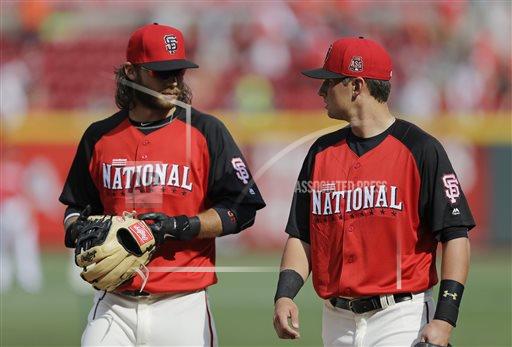
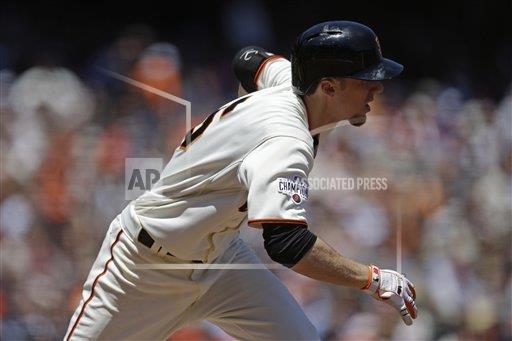
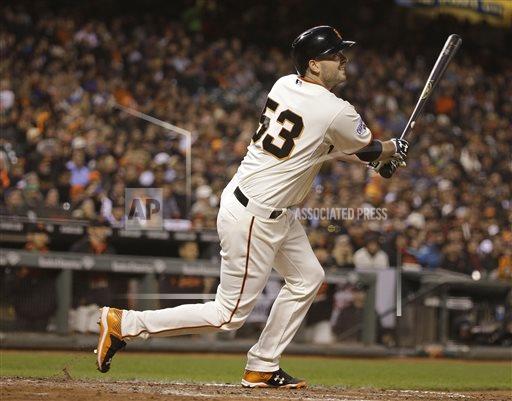
And three World Series titles later, the beat continues with the naming of 24-year old Joe Panik and 28-year old Brandon Crawford as the team’s first double play combination to be so honored in the same year since Rich Aurilia and Jeff Kent in 2000.
“Hopefully, I’ll get in the game with him,” Panik said on Monday. “To have someone that you’re comfortable with up the middle and you’ve had chemistry with the past year, it’ll be awesome.”
If paired on Tuesday, maybe Panik and Crawford can execute their favorite play—the diving stab and glove-hand flip Panik to Crawford to start a double play—just as they did in Game 7 of the World Series when Eric Hosmer attempted to single home a critical run for the Royals but was thwarted.
Since 2007 when Bonds made his final All-Star appearance, the Giants have been awash with homegrown All-Stars. Lincecum (four times), Cain, Bumgarner, Posey, Wilson (3 appearances each), Sandoval (twice), Romo and Vogelsong have all made appearances.
During that same period, only Melky Cabrera (2012 All-Star MVP), Marco Scutaro, Tim Hudson and Hunter Pence (one appearance each) have represented the Giants as players groomed outside the organization.
On Tuesday, the Giants go homegrown again with Posey and Bumgarner in addition to Panik and Crawford. Manager Bruce Bochy and bench coach Ron Wotus round out the San Francisco contingent.
 Sports Radio Service