
Sharks Keep Demers and Doherty in the Fold

By Mary Walsh

Tuesday, the San Jose Sharks announced the resigning of defensemen Jason Demers and Taylor Doherty. The team gave Demers a two year contract and Doherty one year. The moves solidified the team’s current blue line and add some depth for the future. It might not be enough to improve their offseason PuckDaddy grade from an F, but it is a start.

Last season was a bounce-back season for Demers, who performed below expectations the two seasons prior. Those seasons were marred by injury but also found him often benched as a healthy scratch. His improvement this past season could be attributed to better health and the changes on the coaching staff that occurred before the last lockout season. All of the team’s young defensemen have shown improvement since Larry Robinson and Jim Johnson joined the team.

Demers’ career path could be considered a cautionary tale about why you do not want to rush players, especially defensemen, into the NHL. He started playing in San Jose when he was just 21 years old, one season after being drafted. He got off to a great start with the team, posting 21 and 24 points his first two seasons, then bottomed out with 13 in his third season and just three in the fourth. Perhaps his sophomore slump came late, and he took a lot of heat in those two poor seasons for not repeating earlier success. Nevertheless, the Sharks’ coaches have shown slowly increasing faith in him and his performance has improved accordingly. His 34 points last season were a reminder of why expectations were so high for him.

Demers’ role as an offensively-minded defenseman will always make him prone to risk-taking. Much as fans would like to see all the players, forwards and defensemen alike, play a diligent defensive game, playing well at both ends of the ice is harder than it sounds. Well, obviously it sounds pretty hard, barring teleportation powers. Additionally, fans don’t actually enjoy perfect defensive games– those tend to be low-scoring and uneventful. So that’s the cake- eat it or leave it. If Jason Demers is supposed to keep an eye out for scoring chances and even create some, his defensive game might on occasion leave something to be desired.

His contract is eminently reasonable. Looking at the defensemen around Demers in the standings, his salary is lower than most players of equivalent value to their teams. Whether measuring by points or time on ice or age, his $3.4 million per year is a good deal for San Jose. It is such a good deal that one wonders if it isn’t a setup for a trade. The last Shark to file for arbitration (TJ Galiardi) only got one year out of the team, but he was not signed and traded either. For the sake of San Jose, we can hope the Demers contract is not just a set up to move him out.

Taylor Doherty was drafted by the Sharks in the second round in 2009. This year, he will enter his third full season with the AHL’s Worcester Sharks. Last season saw him miss a number of games due to injury, and he has yet to play in the NHL. There was a little more buzz around his name a season ago, but the Sharks obviously think he is worth another look.  Just 23 years old, 6’7″, he has not been heating up the score sheet but last season showed some improvement over the season before. With a little down tick in the +/- column (from +2 to -2), he improved his points total from 6 to 10, playing 23 fewer games. He has a strong shot that he could probably use more often.

Doherty, like Demers… and Braun, and Burns, is a right-handed shot. That is worth noting as such defensemen seem to be in short supply elsewhere.

The Sharks’ offseason is looking like a long slow one, but that is what Doug Wilson promised at the end of last season. If Wilson is serious about not wanting to bring any veteran player in who may supplant younger players, that remaining cap space ($6.145 million, per CapGeek.com) will continue to sit there and taunt those who had hoped for any exciting new additions.

NHL Free Agency Day 2: What Are The Sharks Doing?

By Mary Walsh

What are the Sharks doing? This is a question that came up over and over on Twitter today, from near and far. Today the team made three announcements. The first announcement was that the Sharks are holding auditions for women to join their co-ed ice crew, and they will wear short tops and tights. Men’s auditions tba. Second, the Sharks signed 31 year old left wing John Scott. Third, they traded a 2015 3rd round pick to the Philadelphia Flyers for 23 year old left wing Tye McGinn.

The team’s activity at the draft and on the first day of free agency seemed consistent with General Manager Doug Wilson’s promise that he was not going to make any big moves that would cost picks, prospects, or young players. He used his picks, trading them only for more picks.

He signed Taylor Fedun, a 26-year old free agent defenseman from the Oilers system on the first day of free agency. He signed him to a low-risk two-way, one year contract at a modest salary. Fedun spent last season with the Oklahoma City Barons of the AHL, scoring 38 points in 65 games.  Fedun has played 4 NHL games. He played four seasons with Princeton University, finishing with 68 points in 127 games, and receiving collegiate honors.

All seemed to be going as promised. On the second day of free agency, the gloves came off.

The ice crew is not exactly an addition, though broadcasting public tryouts for it is new. Additionally, while the ice cleaners of the past all wore simple pants and shirt, the female crew members will now wear a sort of midriff-baring modified jersey and tights, while the men will wear a style-coordinated version of what they have always worn: top and pants. The team is not calling these female crew members ice girls, but few teams do. While that news was sinking in, the Scott signing was announced.

The last GM to acquire Scott is now out of a job, after he put together a team that broke records with its awfulness. On a team that performed as badly as last season’s Sabres, Scott averaged 6:45 of ice time and managed to rack up 125 penalty minutes (25 minors, 5 majors, 4 misconducts) in 56 games. He had one goal, his first since 2009. Scoring is not what Doug Wilson expects Scott to do.

“John brings a physical, no-nonsense element to our lineup,” said Wilson. “As we integrate more younger players to our team, John’s presence alone can act as a deterrent and help keep teams and opposing players honest.”

Wilson has brought other players to the team over the last two seasons, advertising their toughness, grit, energy, or combination of those. Raffi Torres, Adam Burish and Mike Brown all got introductions of that sort. Unlike those players, the 6’8″, 259 pound Scott has not demonstrated a lot of versatility in his game. He is unlikely to surprise the team with a multi-point game just back from injury, or a timely goal, or bursts of speed at just the right moment. It is hard to say how his fighting ability will help the team, since few players will engage him. In any case, he is now a Shark. It may be safe to say that this dwarfs recent roster moves in shock value.

Tye McGinn is an interesting acquisition. Younger brother of former Shark Jamie McGinn, Tye has spent his professional career with the Flyers organization. Early last season, while the Flyers were flatlining in the starting gate, while captain Claude Giroux couldn’t score a goal to save his life, McGinn was given a chance with the big club. He scored three goals in his first two games of the season, all in losing efforts to Vancouver and Detroit. Like his brother Jamie, he seems to have a knack for performing well when everyone else is reeling. After that, he went pointless for four games before being sent back to the AHL for most of the season. The Flyers’ rationale for this is unclear, in view of the players who were put in the lineup in his place. Zac Rinaldo, penalty-taker of some repute, was probably the most productive of them. What a struggling team does might not be a model anyone should follow.

Of McGinn, the Sharks’ news release said:

“Tye is a hardworking player who plays an honest game,” said Wilson. “We’re excited to add him to our group of young forwards.”

McGinn could be a very good addition to the Sharks, if they can instill the confidence and structure he needs. He has speed and grit and has shown flashes of skill. Despite playing only 18 games a season in the NHL, his shooting percentage went up significantly from season one to season two. In the lockout-shortened 2012-13 season, he had 33 shots and 3 goals. Last season, he took 19 shots and scored four goals. He also cut down on his penalty minutes by a large margin, going from 19 to 4. The addition of John Scott makes me wonder if the Sharks care about minimizing penalties, but fans might. McGinn is a bit of a dark horse, but he is still young enough to grow into a bright spot.

These moves still do not answer the question “what are the Sharks doing?” They do, however, open up a host of possibilities. The team appears to be determined to change its image, every which way it can. Who knows, they may move after all, to Seattle or parts unknown. Maybe it’s time for the NHL to go south of the border.

How to Tell if You Have Mad Shark Disease

By Mary Walsh

The San Jose Sharks are engaging in some very strange behavior. They seem hell bent on alienating a fan base that they spent decades building up. They are firing favorites and making deranged threats about a losing season and possible relocations. Someone put something funny in the San Jose water.

The relocation noise seems to be connected to complaints about a painfully horrible 14 year tv contract that the Sharks have with CSN Bay Area. In theory, if the Sharks moved to Seattle, where they have no new arena, they would no longer be in the Bay Area and CSN could not hold them to the punitively bad agreement. The other relocation theory is that the Sharks would move only as far as Santa Clara, to be near the fancy new Levis stadium. Like Seattle, Santa Clara also does not have a new rink waiting for an NHL team to move in.

So either destination requires a lot of waiting and building. After the waiting and the building, there’s more waiting while people figure out that there is an NHL team in town (Seattle) or where their NHL team went (Santa Clara). Neither option will save the Sharks, directly or indirectly, from the gushing monetary losses they are (theoretically) suffering at the hands of CSN Bay Area.

The second symptom of mad Shark disease was the firing of Drew Remenda.

@MercPurdy: Just my opinion: Drew sometimes too honest on air for team’s taste. Also, were issues involving him not living here.  “@indgiuli1. Remenda?”

That is just one journalist’s opinion but it is ironic that he used the word “honest,” since that is Doug Wilson’s new catch phrase. The Sharks don’t have a problem with honesty. Their issue is with openness. There are obvious reasons to keep business dealings confidential but the degree of secrecy displayed by this team baffles the mind and I suppose reflects poorly on the reporters who are expected to dig things up. Nonetheless, it isn’t that the Sharks lie to the public, they just withhold so much that it borders on the absurd.

And that, I would argue, is where the team might have been at odds with Remenda. He shared his opinions… but if that isn’t an analyst’s job, what is?

Maybe it was because of Twitter. Remenda would not join Twitter and clearly everyone must join Twitter.

Whatever reasoning behind that decision, it was petty. It also revealed a complete disregard for the fan base, and for what worked for the Sharks. Dumb, dumb, dumb.

Yet another symptom of Shark madness is all this rebuild talk. Granted, Doug Wilson may be planning to take a different tack this Summer but to be throwing the R word around is confusing. The notion that the Sharks need to move their remaining vets out and prepare to lose a season or more has most people crying cuckoo.

Does he say “rebuild” to convince his vets to move on? Will that word send Thornton or Marleau running for the Eastern hills? Really? If they want to win so badly as that, do the Sharks want them to leave? And if it took outsiders a matter of minutes or hours to figure this ruse out, what are the chances it would work on hockey players or their agents?

Wilson doesn’t describe this rebuild process as anything like the many seasons the Kings and the Blackhawks spent missing the playoffs. In his interview with NHL Live, he talked about one or two poor seasons. If he can bolster a team so significantly in just one or two seasons, he’s redefining “rebuild.”

What I think it means is simply that Wilson has no plans to add major pieces to the team. He is not going to follow a “win now” plan. He will use his draft picks, he will give his younger players time to mature. He won’t tinker. Or I hope that’s what he means, because my second choice explanation is that Wilson has cracked up.

How Will the Sharks Be Composed?

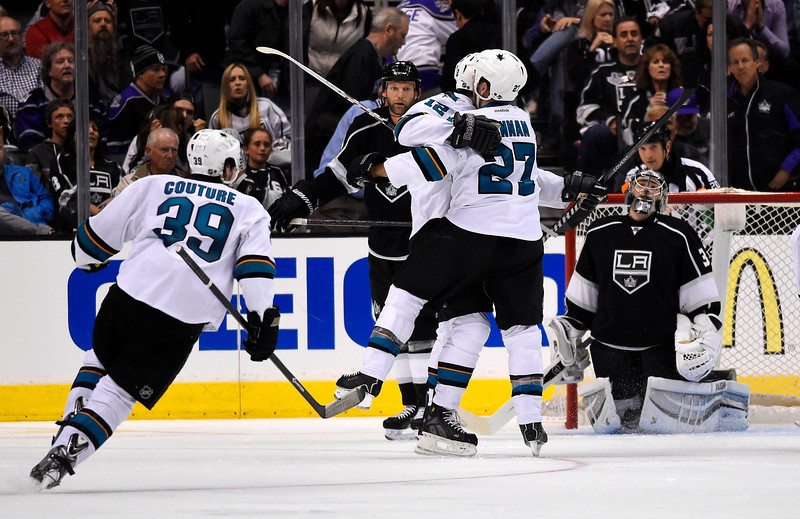
Patrick Marleau, Scott Hannan, Jonathan Quick, Logan Couture

By Mary Walsh

The San Jose Sharks are not the only team to lose a Game Seven in 2014, or even in the first round. Because they began with a three game lead, the loss was considered an upset, a collapse. Other teams who lost in Game Seven when they were expected to win include the Boston Bruins, and the Pittsburgh Penguins.The Bruins were grumpy in the handshake line, the Penguins fired their GM.

The Anaheim Ducks were the regular season Conference champions. They held a lead at one point in the series against the Los Angeles Kings, but they were not strong favorites, especially after the Kings’ first round comeback against the Sharks.

Does a little distance change how we should view what happened to the Sharks in the series against the Kings? Doesn’t it appear that they did not have to make many mistakes to lose to the Kings? Perhaps, but some of the mistakes were ones we have seen before that should have been avoidable.

When the Sharks flagged after the questionable goal that involved pushing Alex Stalock into the net, it was not unlike the 2011 Conference Finals against the Canucks. There, a bad call in the last 13 seconds of the third period left the team flat-footed. The Canucks tied the game and won the series in overtime.

What is this, and how do you fix it? Would making a lot of roster changes do it?

Sharks GM Doug Wilson said the team needs more than a band aid. The problem is that any major surgery takes time.

The first moves announced were actually non-moves. The coaching staff would be retained, Dan Boyle would not be resigned, and Marty Havlat would not be with the Sharks next season. The odds are very slim that this last means anything other than “Havlat will be bought out.” If Wilson were trying to trade him, he probably wouldn’t be announcing it to the media. This would be a first, a difficult first for a GM who has always been careful to not get into a contract he cannot live with.

The other announcement is the oddest of the three: the Sharks will use Brent Burns as a defenseman next season. Yes, he was acquired for that purpose, his contract was negotiated on that basis, he has more NHL experience as a defenseman than as a forward but… he really was a standout forward. He was maddeningly inconsistent as a defenseman.

The choice is not so shocking, but the announcement itself was strange. Was it a way of saying (unbidden) that the Sharks will not pursue a free agent defensemen this summer? Or that they will pursue a top six forward? Did that announcement have any place on the list of “questions people want answered?”

Dan Boyle, in discussing his time with the Sharks, said that the last two seasons were the Sharks’ best. Reminded that they had made the Conference Finals twice before, he admitted that perhaps recent seasons were just more vivid in his memory.

I think he was right the first time. The Pacific Division has become more formidable than it was when the Sharks went to the Conference Finals. The Sharks have been better in the last two seasons, but so has their competition. That means that success is even more about bounces than it ever was.

Bounces cannot be controlled, but the way a team handles them can be. A team’s psychological resilience can be improved by changing the players, but there are not very many players who can step in and hold a team together through a crisis. There may not be any who could do it for all teams.

Would trading Joe Thornton or Patrick Marleau really improve matters? Joe Pavelski? Who? And who do you get to replace them? Keeping in mind some no movement clauses would have to be worked around, who could Wilson get back? Unfortunately, those other players might come with much heavier salary burdens, assuming they could produce as well as any of the Sharks’ leaders, and also fix what ails the team.

That is a lot to expect from some player on some team a Sharks player would agree to be traded to… it is a lot to expect from even two or three players.

Wilson may have the flexibility he wants, but he has not built the team out of an NHL Leggo set. Few successful teams are built like that. You don’t replace pieces, you replace ingredients. Each player has an effect beyond the players to either side of him on the bench. The wrong big move could doom the next few seasons.

Should they move goaltender Antti Niemi? Was he really the weakest link? A better puck-mover would be nice, but every goaltender has his weaknesses. Those with few are rarely available. How much could Wilson get in trade?

Again, would that fix what ails the Sharks? What does ail them?

Composure. This is something the Kings are being praised for. They have rebounded in two playoff series now. Their goalie has recovered from some poor outings to play at his best. Give them credit, they keep their heads.

But do they keep them so much better than the Sharks? If the Kings are such a better team than the Sharks or the Ducks, why did it take them seven games to win those series? Why did they lose so badly to start the playoffs? Perhaps their playing style has to be paced. Playing a very physical game, the sort of game that produces a high injury rate, takes its toll on both teams. Perhaps it takes the Kings a while to work up to it.

Is that what the Sharks need to do, whichever Sharks remain next season? Does that style of play guarantee a win? It has gotten the Kings farther than the Sharks have gone several seasons in a row now. So why don’t more teams emulate the Kings?

Again, why did it take them seven games, twice, if they are so much better?

Maybe the Kings are not a perfect model, they are just one that works for those players with that coach right now.

Those players. Mike Richards spent a good amount of time on the fourth line. He might be a buyout candidate this summer if he cannot return to a top six role. No team is going to willingly give a fourth liner six or seven years at $5.75 million. In the mean time, he posed an enormous threat to opposition, and not because he is so tough or gritty. What distinguished him from most fourth liners is skill.

The Sharks had Mike Brown on their fourth line. They also had Raffi Torres there, with a still very troublesome knee. Had he not been injured, would he have been on the fourth line at all?

The Sharks would do well to look for more skill to go with the grit they have relied on there. They have players who could make up an over-qualified fourth line, if they added one or two top nine forwards…

Yet the coaching staff thought it would be better to try to get Marty Havlat to play there occasionally, instead of moving someone who could do that job (like Tommy Wingels) and keeping Havlat in the roll he was acquired for– a skilled top nine forward. Unless they re-evaluate how they use their assets, it doesn’t matter who the Sharks trade or acquire.

If their roster is so flawed, then significant changes have to be made. That is unlikely to produce quick results. Whether they replace a lot of players or drastically change their style of play, both will take time to adjust to. They probably won’t get off to a quick start, they might be pushing to reach the playoffs at the end of the season. Then, if they stumble again, it can be explained away by too many changes to adjust to in one season.

Not making big changes hasn’t satisfied anyone. It will be difficult now to not make them. It does seem like a shame to waste the one useful thing the team got out of that loss to Los Angeles: a painful shared memory of what they don’t want to experience again.

Three is Prime: Sharks Keep Stars in Place

By Mary Walsh

The San Jose Sharks really like the number three. They needed three goals to win their sixth in a row Saturday night. All three goals were scored by the Sharks who just signed three year contract extensions: Joe Thornton and Patrick Marleau.

With those contract extensions, the Sharks propped open that window people talk about, the one that is supposed to be closing on them. Whether or not they also extend Dan Boyle, the team has locked up most of its most productive players for at least three years.

One piece the Sharks do not have locked up, and are not likely to have before the summer if at all, is associate coach Larry Robinson. It is safe to say that there is little if any negotiation involved there: it is a decision Robinson will make when the time comes. Any NHL team in their right mind would want Robinson to stay as long as possible.

The arrival of Robinson and Jim Johnson was a boon. Whether it was a matter of continuing development, as with Marc-Edouard Vlasic and Justin Braun, or getting a player back on track as with Jason Demers, the new coaches have had an enormous impact on Sharks defensemen.

If Robinson does not stay, his influence will remain in what he is teaching Sharks players, but in some things it is good to be greedy. It would be very regrettable if the Sharks could not convince Robinson to stay on.

On the player front, the Sharks should retain Dan Boyle, but numerically they have the majority of their top skaters in place until 2017: Brent Burns, Joe Pavelski, Logan Couture, Vlasic, Braun, and now Thornton and Marleau. That isn’t a whole hockey team but it is a fine collection of centerpieces.

That is why signing those three year contracts made sense for Marleau and Thornton too. It is a situation that offers as much chance of success as they would be likely to find anywhere else. Anyone can argue that there is something wrong in San Jose that they have never won the Stanley Cup after so many trips to the playoffs. But there’s many a slip twixt a cup and a lip, even more slips on ice with a bunch of guys trying to jostle your hand. No outcome is certain in the playoffs, except one: you can’t win if you miss the second season.

Maybe the Sharks need to finish the playoffs every which way they can before they win it: swept out, four games to one loss, game seven OT funny bounce loss… Maybe they have a few more exits to try before they find the right door. Not keeping their top players at this point won’t help them find it any sooner.

The notion of rebuilding right now is preposterous, with Couture and Vlasic and Braun and Tomas Hertl locked up. When you have promising players like Tommy Wingels, Matt Irwin and Matt Nieto playing as well as they are right now in the NHL, when you have a few more like Eriah Hayes and Matt Tennyson in the picture, and you might have a dark horse or two lurking in Worcester, now is not the time to trade everyone away and start over.

Alex Stalock is vying for more attention than Sharks backups usually get. Unless the Sharks will give him enough work to really test his potential as a starter, they may not reap the full benefit of his skill. That Stalock got two starts in four games is a step forward here. Maybe McLellan is ready to force some rest on his starting goaltender.

That isn’t a serious problem, and it certainly would not be solved by the acquisition of another player. The team doesn’t have any gaping holes, any glaring need of another big money player- actually or figuratively.

That is why the Sharks should try to keep Dan Boyle. The Sharks don’t need a significant disruption. Boyle probably wants a multi-year contract. Why wouldn’t he? Who doesn’t? What kind of salary he wants is probably the hold up. Doug Wilson has shown that he can get players to sign for less than they would be worth on the open market. That is partly because most players would rather not hit the open market, but also because the Sharks are perennial contenders.

I would guess that Boyle stays with the Sharks. If his salary requirements are reasonable, which would be significantly less than he is presently earning, I think Wilson is likely to offer him three years. He has given as many and more to players who are less central to the team’s core. With Thornton and Marleau at three years, it would be indecent for Boyle to expect more.

I would not put money on that guess. Boyle is at the point in his career where he is deciding how and where he will finish his playing career. Wilson has more cap space to work with than he might have after signing Marleau and Thornton, but he is not swimming in it.

Wilson might need some room to keep Jason Demers.  While Demers has been in and out of the lineup for a few season, he is clearly coming into his own now. He will probably have some suiters calling if the Sharks don’t secure him early.

While other teams are giving their masthead names seven years to stay, it is a sign of confidence from Marleau and Thorton that they accepted three. A 34 year old can’t expect seven years, but players of Thornton’s and Marleau’s stature could certainly get five somewhere. 37 isn’t a great age to be looking for a new contract, but those two are willing to take the risk. If they really think San Jose is the place to be, maybe it is.