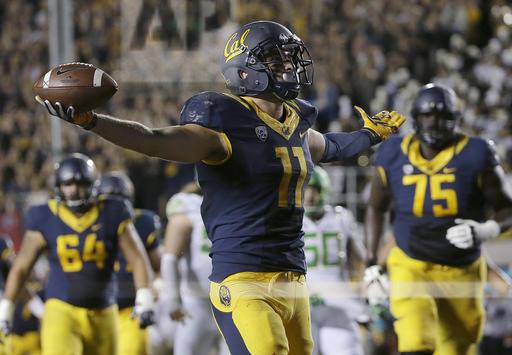
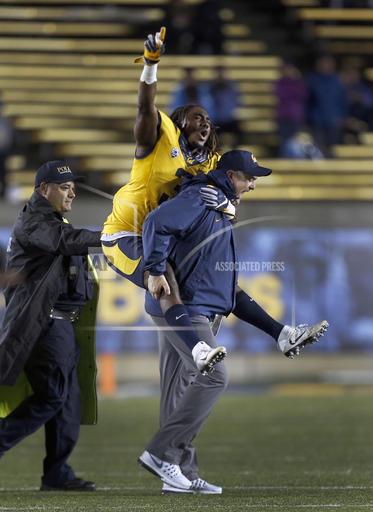
Cal captures season finale against UCLA, and at 5-7 maintains slim bowl hopes

dykes-celebration

By Morris Phillips

The Davis Webb era—brief and impactful—ended on Saturday night, and did so in a manner that was commensurate with the transfer quarterback’s contributions.

With a win.

Webb, referred to as a “pro” by Coach Sonny Dykes, threw a pair of touchdown passes, and the much-maligned Bears’ defense shut out UCLA for the first 34 minutes of the game in Cal’s 36-10 win on the heels of four-straight losses.

The Bears finished their season 5-7 and maintain slim hopes that they could be chosen for a bowl game in the absence of enough six-win teams to fill all the post-season slots.  Ironically, Cal’s improved academic standing (APR of 960) would be the reason the Bears would get the nod over similarly-situated, five win teams.

Webb, who put himself in the school record book by throwing 4,295 yards—second only to Jared Goff’s 4,719-yard season a year ago—was more than stopgap for a rebuilding program.  According to Dykes, Webb was a leader by example, and therefore critical to Cal’s younger players navigating the landscape of bigtime, college football for the first time.

“He is one of those guys that gets it,” Dykes said.  “I can’t say enough good things about him. His impact will be felt in our program for a long time just because of his work ethic and dedication and I think he is a great example for the rest of our players, especially for our quarterbacks, especially the time it takes to be a great quarterback at this level.”

Webb was Cal’s best player in a down year, a lead-by-example guy who took a bunch of hits and made very few excuses.  But Webb’s impact was diluted in the losing streak, the last three of which came to ranked Pac-12 foes.  But Webb and the Bears found a way to turn it around on Saturday against the Bruins, that rare opponent facing even greater adversity than the Bears.

Early on the Bears had to navigate the wet conditions as much as the Bruins, who were once again without standout quarterback Josh Rosen.  The first quarter downpour—for Cal, a reminder of the miserable conditions they experienced the previous week against Stanford—kept both offenses on skates.  Webb and the Bears avoided a pair of damaging interceptions when UCLA safeties Randall Goforth and Adarius Pickett couldn’t hold on to the ball.  Both interception drops could have gone for Bruins’ scores, instead the missed opportunities were the precursors to UCLA’s defensive fatigue that developed when they couldn’t successfully cover for their depleted offense.

Having avoided critical, early turnovers, Webb found a way to move the ball, but couldn’t translate the offense into touchdowns.  Instead, the Bears settled for four Matt Anderson field goals in the first half when their drives stalled.

The Bears led 12-0 at the half, the first time they shut out a Pac-12 foe in an opening half since 2011.  And while the defense was better than it’s been, the Cal offense had a lot to do with that.

Cal would run 102 offensive plays on the afternoon, totaling 496 yards in offense.  Khalfani Muhammad led the rushing attack with 116 yards, and Chad Hansen, Webb’s most frequent passing target once again, contributed 10 catches for 156 yards.  The 100-play barrier, an important barometer for Dykes’ Bear Raid offense, signaled UCLA’s demise, as well as highlighting their season-long issues with a lack of physicality on defense, issues they’ll need to address in the off-season.

With Cal pushing on offense, the Bruins’ defense got pushed.  But you couldn’t fault defensive lineman Takkarist McKinley and linebacker Jayon Brown, who combined for 25 tackles, capping exemplary seasons for both.  The last time the Bruins were in the Bay Area—in December for the Foster Farms Bowl at Levi’s Stadium—they experienced the same issues with physicality on defense in an embarrassing loss to Nebraska.  Off-season recruiting didn’t address those issues as the Bruins failed to add heft along their defensive front.  Now, with their off-season upon them, they’ll have another opportunity to regroup.

“We need to get our attitude right, and our focus right,” Brown said.  “We were a better team than our record shows.”

“We’ll rise again, we will,” said Coach Jim Mora, who is expected to return, but likely with significant changes among his assistant coaches.  “We have the right type of young men in the locker room.  We just have to make some adjustments and we’ll get better.”

The Bruins got within 12-7 on their first drive of the third quarter, capped by Mike Fafaul’s 7-yard touchdown pass to Kenneth Walker III.  But the Bears answered with a pair of touchdowns back-to-back, the first courtesy of 300-pound lineman turned fullback, Malik McMorris, who scored from a yard out.

The Bears capped their scoring with 9:41 remaining on Webb’s touchdown pass to Bug Rivera, the last of his 37 touchdown passes at Cal.

“I could tell everyone was playing for the seniors,” said Hansen, who faces his a decision whether to return, or test the NFL waters.  “That was the motto Coach Dykes was giving the whole week.  The seniors have put in so much time and effort, so much blood, sweat and tears for this program.  We needed to pay them back and I think we did that tonight.”

The Bears slim post-season hopes depend on two or three schools with 5-7 records and better APR numbers rejecting bowl invitations.  Of that group, Texas, who fired coach Charlie Strong on Saturday, is expected to pass on any bowl invites.  But North Texas, Mississippi State and Northern Illinois—all with better APR numbers—might be as thirsty for the post-season as Cal is.

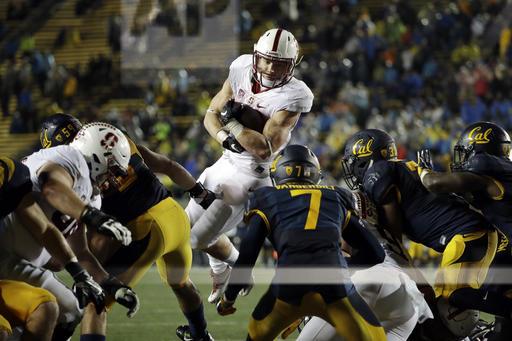
 

Cal no match for healthy McCaffrey and Stanford in 45-31 Big Game loss

big-mac

By Morris Phillips

BERKELEY–On a nasty, snarly day of weather, filled with emotion for the occasion of the 119th Big Game, in front of a sellout crowd itching for surprise, the last thing the Cal Bears could afford was for their opponent to be comfortable as if on a routine, cross-bay, business trip.

But that’s exactly what the Bears got as soon as Stanford’s Christian McCaffrey arrived and opened his ample briefcase.

McCaffrey made the spectacular look ordinary, rushing for a school-record 284 yards as Stanford ran past Cal, 45-31, and captured the Axe for the seventh, consecutive year.    Throughout, last season’s Heisman Trophy runner-up dipped, ducked, leapt and sprinted through and around the Bears as if he was performing a tightly-choreographed routine.

“He’s as good as advertised,” Coach Sonny Dykes admitted.

Luckily for Dykes, his Bears were better than expected as well, scoring on their initial, offensive play of the afternoon—a perfectly-executed screen that saw Chad Hansen catch a short pass and turn it into a 70-yard touchdown run.   In the second quarter, the Bears were even with double-digit favorite Stanford, 14 apiece, just a bit of the surprise Cal was hoping to hatch.

But ultimately, the Bears were undone by their Pac-12 worst defense and the fleet feet of McCaffrey.

Midway through the second quarter, the Bears appeared poised to answer Stanford’s tying score, driving to the Cardinal’s 21-yard line where they faced third-and-two.  But Khalfani Muhammad was thrown for a one-yard loss by Stanford’s Peter Kalambayi, forcing Dykes to forgo an opportunity to take a seven-point lead, instead settling for a 39-yard Matt Anderson field goal try.

But the normally sure-footed Anderson watched his kick sail wide right.

After an exchange of punts, Stanford took the lead for good right before halftime.  Quarterback Keller Chryst led the Cardinal on a 10-play drive culminating in Conrad Ukropina’s 40-yard field goal and a 17-14 Stanford lead.

McCaffrey, already a huge factor with a combined 147 yards rushing and receiving, then took his game to another level after halftime.  On second down from the Stanford 10, McCaffrey took a handoff, jabbed hard to his left, then again to his right.  McCaffrey’s quick change of direction left Cal’s Devante Downs and Jaylinn Hawkins lunging for air, while the junior tailback took off straight up the middle for a 90-yard touchdown run.   Equal parts athletic brilliance, and functional speed, McCaffrey’s big run put Stanford in the driver’s seat.

“At that point, Stanford had the momentum and we never seemed to get it back,” Dykes admitted.

Stanford Coach David Shaw also saw McCaffrey’s run as a game changer, but the rarely effusive Shaw had seen it before.

“I don’t know what else I can say.  Two years, I’ve kind of run out of words,” Shaw said.  “The bottom line is, he’s not the biggest guy but you can’t tell him that.  He runs like a big back.  He’s going to run in between the tackles, he’s going to make people miss and he has the speed in the open to finish the runs in the end zone.”

With Stanford comfortably ahead, Cal needed big plays, and initially, they came up with them.  Matt Anderson’s 43-yard field goal capped a 12-play drive to get the Bears within a touchdown.  Then after McCaffrey’s second touchdown run, Davis Webb led Cal on a 13-play touchdown drive that drew the Bears within 31-24.

But without a lick of defense, Cal was left grasping for straws.  Stanford scored touchdowns on two of their first three possessions of the fourth quarter to put the game away.  Webb’s second touchdown pass to Hansen with 3:01 remaining closed the scoring but had little impact on the result.

With athletic director Michael Williams watching intently, Dykes’ press conference played like a state of the union address as he patiently explained that the culture of his program is positive, and with some defensive stops, discipline and patience, the losing streak—now four straight under Dykes’ watch—to Stanford might soon come to an end.

“You can’t give up 350 rushing yards against anybody and expect to have a chance to win,” Dykes explained.  “That’s clearly something we need to get fixed.  That puts a lot of pressure on you offensively.  You feel like you have to score every possession and you can’t do that against a good defensive football team.”

The Bears’ aspirations to qualify for a bowl game for a second straight season came to end with the loss.  Once 4-4 after alternating wins and losses over their first eight games, the Bears have dropped four straight, and they failed to capitalize on their post-season rallying call that punctuated their week of preparation for the Big Game.

“We haven’t beaten UCLA in a while either, so it’s a great opportunity for our team, and we look forward to getting back to work tomorrow and finishing the season the way it should be,” Webb said.

LONG TIME CAL BROADCASTER STARKEY HONORED: Now in his 42nd year of broadcasting of Cal football, radio voice Joe Starkey was honored in a pre-game ceremony in which his broadcast booth was renamed in his honor.

Announcing his 483rd Cal football game on Saturday, and for the first time from the renamed Joe Starkey Broadcast Booth, Starkey is—for most Cal fans—the only voice they’ve ever known.

The Chicago native also enjoyed long stints as the voice of the 49ers and the former California Golden Seals NHL team.


The defense can’t rest: Cal run over by Pac-12 North leader WSU in Pullman

By Morris Phillips

Across the grand landscape of another wall-to-wall Saturday of college football, the Cal Bears were hoping to create some buzz by fashioning an upset of No. 23 Washington State in the day’s final game.

But the Cougs, undefeated in the Pac-12 north, and playing in front of their home crowd, clearly had different plans, with the part about taking advantage of Cal’s conference-worst defense written right at the top.

Washington’s loss to USC in Seattle just before the kickoff in Pullman didn’t help Cal’s cause.  Instead, the upset of the No. 4 Huskies and the prospects of WSU taking over sole possession of first place in the Pac-12 North had the Cougs flying that much higher right before kickoff.

Only one scheme can be realized, and Saturday that was WSU’s in their easy 56-21 victory over Cal that for all intensive purposes was over at halftime.   River Cracraft’s second of three touchdown catches came just 37 seconds before halftime, putting WSU up 28-7, then four minutes into the third quarter, Cracraft and quarterback Luke Falk struck again on a nine-yard touchdown pass that capped a 12-play drive.

In all, the Cougs ran 22 of 27 offensive plays spanning the half, leaving the Cal defense–already thinned by injuries—gassed by overactivity.

“I was disappointed in the way we played, especially early in the ball game,” Coach Sonny Dykes said.      “We had opportunities in the first half to keep the game close, but we got behind and certainly did not put our best foot forward. Again you have to give those guys credit.”

“This loss is solely on us not being able to move the ball in the first quarter and giving them a pretty good lead,” quarterback Davis Webb said.  “We just did not come back from that.”

Cal opened the game with the ball, but after going three-and-out, WSU’s Kaleb Fossum returned Dylan Klump’s punt for a 75-yard touchdown return.  Things went downhill for Cal from there; they trailed 14-0 after one quarter, then after Cracraft and Falk hooked up for three, consecutive touchdowns, the Bears trailed 35-7 early in the third quarter.

Throughout, Cal’s defense struggled to stop WSU’s prolific pass game, and their veteran receivers Cracraft and Gabe Marks.  The Bears—allowing a Pac-12-worst 44 points a game—weren’t helped by a scouting report and video circulating of their most recent game in which Washington rolled up 66 points in Berkeley behind quarterback Jake Browning and receivers Dante Pettis and Jon Ross.

“It is just adversity we have to get over,” safety Khari Vanderbilt said. “It is nothing we can complain about. It is football. I am sure there are a lot of other teams that are going through the same thing. We just have to learn how to fight through and come together.”

Washington State, in the midst of their best season in decades, improved to 8-2, and 7-0 in the Pac-12 North.  After beating Cal, the Cougs can see their showdown with Washington in their future with the Apple Cup sure to decide who represents the North in the Pac-12 championship game.  Prior to that WSU and No. 16 Colorado will engage in what has to be the least likeliest big Pac-12 conference game in years next Saturday.

The Bears fell to 4-6 with the loss.  After losing three of their last four games, the Bears will need to beat Stanford and UCLA at home to gain bowl eligibility.

The 119th Big Game is up next for Cal at Memorial Stadium on Saturday.


Cal puts up little resistance as No. 5 Washington rolls to a record-setting 66-27 win at Berkeley

ross-run

By Morris Phillips

Team speed, pervasive throughout Washington’s 66-27 dismantling of Cal on Saturday night, must have disembarked the Huskies’ charter flight from Seattle to the Bay Area even before the UW players and coaches.

It must have.  What else could explain the parade of Huskies racing into the end zone—some untouched, almost all racing ahead of the pack—in what would become a record setting rout for the nation’s No. 5 ranked team?

In all, five different Washington players registered at least one play of 32 yards or longer, as the Huskies rolled, at one point scoring 38 consecutive points.  The 66 points allowed was the most the Bears had allowed since 1973, and UW’s seven touchdown passes—six courtesy of quarterback Jake Browning—surpassed the Washington (9-0, 6-0 Pac-12) school record of six.

“All of the credit goes to those guys,” Cal quarterback Davis Webb said.  “They were coached well, they played really well and that’s a really great team over there.  That’s the best team we’ve played this year and I think they proved that tonight.”

Two circumstances conspired to turn this one into a rout—Cal’s injury situation which left them perilously thin in their defensive, back seven, and undefeated Washington’s psyche following the release of the first College Football Playoff rankings which placed them fifth, behind one-loss Texas A&M.  Dykes spoke about Cal’s situation that put them at the mercy of Miles Gaskin, UW’s speedy back, and their dominant pair of receivers, John Ross and Dante Pettis, who racked up 14 catches for 312 yards and all six of the touchdown passes thrown by Browning.

“We’re banged up on the backend, so Washington got some matchups on guys that weren’t necessarily a great matchup,” Dykes admitted.  “There wasn’t much we could do about it.  We knew going into the ballgame that we’d play the best players we had available to us, that’s what we do every week.”

So lopsided were those matchups between the Washington receiving duo, and Cal’s corners and safeties, one’s reaction was either wide-eyed surprise, or a frustrated shake of the head.  Ross’ 67-yard score had all of that as Browning wound up and hit the junior in stride 45 yards down field where he shook Bears’ corner Chibuzo Nwokocha.  Ross then retreated several yards while gaining momentum and that caused Nwokocha to run into teammate Luke Rubenzer, removing both from the pursuit.  Twenty yards later Ross was untouched as he crossed the goal line with safety Khari Vanderbilt able to apply only a fruitless, arm swipe.

On Pettis’ option pass for a touchdown, normal starting safety Rubenzer bit hard on the possibility of a run, allowing Darrell Daniels to slip past him where he was waiting for Pettis’ pass and a 39-yard scoring play.

Those two spectacular plays came in the first quarter with Ross’ score putting UW up 21-6.  But after Cal rallied to within 21-20 on Davis Webb’s scoring run and Chad Hansen’s touchdown catch, Washington dropped the hammer with five consecutive touchdowns, then Cameron Von Winkle’s 36-yard field goal that put Washington up 59-20 with 12:58 remaining in the game.

As Washington turned on the gas, Cal kept shooting itself in the foot.  At one point, the Bears turned the ball over on three, consecutive possessions.  Offensively, Webb got little done, even with Hansen back in the starting lineup after missing two games with injuries.  The Bears converted just one of their 13 third-down opportunities, a credit to Huskies’ effective pass rush and the cover skills of the veteran secondary.

Defensively, the Bears drew high praise from UW Coach Chris Petersen who said the Bears did well by crowding the line of scrimmage to stop the run, disguising coverages to protect their deeper defenders, and mixing it up to prevent the Huskies from recognizing any tendencies.  But Browning, the Folsom, CA product sorted through it all, making big plays in the passing game when he needed.  In all, Browning completed just 19 passes, but they covered 378 yards and six were touchdowns.

Webb finished 23 of 47 for 262 yards, but threw three interceptions.  Cal’s running game was stymied as Khalfani Muhammad rushed for just 34 yards, and Tre Watson had 10 carries for 29 yards.  Muhammad also suffered the indignity of being picked up off both feet and thrown back by UW’s 350-pound Vita Vea on a goal line play during Cal’s brief, second quarter rally.

Afterwards, the Huskies refused to say they were motivated by the CFP’s snub, with Petersen, Pettis, Browning, Ross and corner Kevin King all saying that too much football remains for them to get ruffled over the initial, playoff poll.  And who can blame them?  After 12 consecutive wins dating back to last season, the Huskies have matchups with improving USC at home, and Washington State (6-0 in conference play) on the road to consume their attention.

“There’s a lot of football left to play,” Browning said.  “Put us outside the top four and make us earn it.”

The Bears travel to Pullman next Saturday night to face the Cougars, who smashed Arizona 59-7.

NOTES: Cal’s attendance continued to suffer as the team was given a third, 7pm or later start time in four home games this season.   Only 47,000 attended the game and the stadium was half full for the second half when the outcome was all but decided.

Marshawn Lynch was honored with a bobblehead giveaway that captured his wild, cart ride following Cal’s 2006 overtime win over Washington.  Lynch recreated the ride, with his mom, Delisa in tow, then after leading the Bears on to the field with a few, sharp turns, Lynch was joined by rapper E-40 for a final spin.


The Ducks stop here: Cal ends losing streak to Oregon on an interception in double overtime

hudson-hawk
California wide receiver Raymond Hudson (11) celebrates after catching a touchdown pass against Oregon during the first half of an NCAA college football game in Berkeley, Calif., Friday, Oct. 21, 2016. (AP Photo/Jeff Chiu)

By Morris Phillips

In their recent, turbulent history with the Oregon Ducks, Cal has been embarrassed, nipped, popped, blown out, blasted, outlasted and outclassed a second time in losing annually to the Pac-12’s most accomplished program over that period.

Jared Goff let it slip away in the rain, Cal’s been cooked, roasted and boiled as well.  Had any of the seven consecutive losses gone the Bears’ way it would have been the signature win of Jeff Tedford’s final four seasons, or the biggest win in Sonny Dykes’ first three.

But none did, and Cal was only competitive once, November 2010, losing 15-13 to the top-ranked Ducks who went on to the BCS National Championship Game that season.

Flash forward to Friday night, and the Bears experienced something far different with the Ducks.

Cal jumped to a 21-0 lead, only to see the Ducks rally behind true freshman quarterback Justin Herbert to lead 35-34 early in the fourth quarter.  After Matt Anderson’s last minute field goal attempt to win for Cal sailed wide, the Bears pulled it out in overtime, 52-49 when sophomore linebacker Jordan Kunaszyk intercepted Herbert as Oregon was driving for a potential game-winning touchdown.

Enough explained in a small space?  Probably not, but this one lasted four hours, twenty minutes, with a tidy ending just before midnight on ESPN’s national broadcast.

“Just another boring Cal football game,” Coach Sonny Dykes said in jest as the opening of his postgame statements.

And a huge win for Dykes and his crew that’s bounced around through the first seven games of this season, beating ranked Texas and Utah, while getting beat up by San Diego State and Oregon State.  On Friday, the suddenly downtrodden Ducks lost their fifth straight, and the Bears nearly let them off the hook.

“You have to credit the defense,” Dykes said.  “In the second overtime, we had three offensive penalties in a row that killed us.  Matt (Anderson) came in, nailed the field goal.  Our defense’s back was against the wall, just like it was against Utah.  Jordan (Kunaszyk) made a big time play on the ball—you could kind of see it developing.”

In fact, Herbert had made the fatal mistake negating what had been an eye-opening second start for the freshman quarterback.  While no threat to burn the Bears with deep stuff, Herbert threw short crosses, scrambled impressively, and kept his team in it until his final throw, which was late and right to Kunaszyk, who wasn’t too startled to juggle it and drop it.  Instead the linebacker grabbed it, and heeded the instructions of his teammates to take a knee so that the celebration could begin.

“Coach was raving the whole time about getting to the boundary hash,” Kunaszyk said.  “That’s where they’d been throwing a lot.  So I opened up the field, and in the back of my head I remembered coach saying ‘boundary hash, boundary hash.’  Low and behold, I went to the boundary hash, found myself the ball, and made the play.”

Boundary hash, the buzz phrase for ending a painful losing streak to a key conference opponent.  On the other sideline, boundary hash wasn’t anything good, as Herbert was inconsolable coming off the field, needing coach Mark Helfrich to apply an emergency hug.

“(Herbert) has a ton of support in the locker room,” Helfrich said.  “Already you can see guys rally around him.  He’s obviously very hard on himself, how the end occurred.  We really shouldn’t have been in that position but I’d do the exact same thing at the end and trust him to make the play.”

“It was comforting but it still doesn’t ease the pain,” Herbert said of the encouragement he received from Helfrich and his teammates.  “They said to keep my head up and start working hard for next week.”

In losing four straight coming in, the Ducks allowed 41.3 points a game, and 522.3 yards per game, both numbers right at the bottom of FBS rankings.  The Bears continued the trend, living off the Ducks’ shortcomings along the defensive line where Cal made constant withdrawals.  Against Cal, Oregon surrendered 636 yards in offense, including a combined 304 yards rushing for Cal’s Khalfani Muhammad and Tre Watson alone.

But the star for Cal wasn’t Muhammad or Watson, Kunaszyk or Anderson.  And it wasn’t Dykes who admitted his fourth down decisions in the third quarter in which Cal decided to punt with a short field and shanked it, then opted to go on fourth and were stuffed, allowed the Ducks to rally.

Davis Webb stood alone for Cal in that regard, throwing 61 times, completing 42, and doing so without starting tailback Vic Enwere, who was declared out for the season with injury on Thursday, or Chad Hansen, the nation’s top receiver, who was nicked up and a late scratch.  In the absence of his biggest weapons, Webb threw five touchdowns with no picks and was sacked just twice by an ineffective Oregon pass rush.  Throughout, Webb showed great arm strength, throwing out patterns that took advantage of the Ducks’ passive corners and compensated for Cal’s inability to throw deep.

Just two weeks after Webb threw four touchdown passes against Utah, none shorter than 24 yards, he completed 42 passes, none of which went longer than 17 yards.  When things got tight in the fourth quarter, Webb calmly led Cal on an 11-play drive culminating with his touch pass to Watson that covered just 14 yards but was thrown beautifully beyond a trailing Oregon linebacker.

Is Webb having a more impressive season than Goff did last season, one which led Goff to be the NFL’s top overall pick?  Yes.

“It was a great team win,” Webb said.  “When a guy goes down of (Hansen’s) caliber, someone’s got to step up, and our whole team did.”

The Bears travel to Los Angeles for a Thursday meeting with USC at the Coliseum.  Dykes expressed his displeasure with the scheduling that not only had the Bears playing in front of a less-than-full crowd on a rare Friday at home, then needing to transition to the Trojans almost immediately.

“We have a game in six days, which is crazy,” Dykes said.

Toothless Bears: Cal run over in surprising, overtime loss at Oregon State

nall-rolling

By Morris Phillips

At some point on Saturday night in Corvallis, unheralded running back Ryan Nall transformed into a state-of-the-art, runaway freight train.

Then, 221 yards and three touchdowns later, Nall’s metamorphosis reached a conclusion as the Oregon State sophomore suffered a leg injury and was carted off with 11 minutes remaining to play, and OSU leading Cal, 34-24.

While what transpired following Nall’s departure may have been dramatic, it didn’t affect the game’s outcome, a 47-44 overtime loss for the Bears, all of it placed at the feet of Cal’s porous run defense which made Nall a temporary superstar, and was so poor that a 17-point Bears’ rally to force overtime went for naught.

Coach Sonny Dykes wasn’t fooled by the final score, acknowledging his team’s defensive effort—especially before halftime and the first play after halftime—put the team in an impossible hole, even as Davis Webb and the offense rallied to force overtime.

“I told them guys, I didn’t think we deserved to win,” Dykes said.  “We sleepwalked through the first half, for sure.”

While OSU came in as decided underdogs, losers of 12 straight Pac-12 conference games, dating back to November 2014, and looking for their first FBS win under second-year coach Gary Andersen, the Bears came with a leaky run defense that more than leveled the playing field between the two teams, and belied the encouraging outing Cal enjoyed in beating ranked Utah last week.

Against Oregon State, the Bears allowed 474 yards rushing (almost half of that to Nall) and allowed OSU to convert 8 of their 12 third-down opportunities.  The 474 yards ranks at the biggest rushing total in Oregon State school history against a conference opponent, and goes a long way to explaining how Cal trailed 10-0 after a quarter, 17-10 at the half, and 34-17 after three quarters.

On the first play of the second half, Nall enjoyed his tour de force, an 80-yard run that increased OSU’s lead to 24-10.

“You can’t come out that flat versus any team.  Any given day, anybody can be beaten,” Cal linebacker Ray Davison said.

Offensively, the Bears were out of sorts as well with OSU having success disguising their defensive looks and forcing Cal stars, Webb and Chad Hansen to play tentatively.  Both Webb and Hansen had their least productive games of the season to date with Webb needing 44 pass attempts (completing 23) to reach 118 yards passing, and Hansen catching four of those for just 16 yards.

“We were just trying to find ways to mix up our looks a little bit and make it a little tough for them to figure it out,” OSU assistant Derrick Odum said.

Starting outside linebacker Titus Failauga missed the game for Oregon State, as did safety Jay Irvine.  Nickelback Dwayne Williams was lost to injury during the game, leaving OSU with backups at two spots in their secondary.  But Treston Decoud, nephew of former Cal standout Thomas Decoud, drew the tough assignment of slowing Hansen, and the Beavers somehow held up defensively.

With both stars held in check, Cal’s running game picked up the slack with Tre Watson and Khalfani Muhammad combing for 299 yards rushing and three touchdowns.  Both backs scored in Cal’s late rally to tie, with Muhammad scoring on a 50-yards run with 2:39 remaining to bring the Bears within, 41-38.

After being held in check for three quarters, Hansen also suffered an injury, leaving the field with eight minutes remaining in regulation, walking gingerly on his left leg.

After Nall departed for OSU, Darrell Garretson and Artavis Pierce picked up the slack running the ball.  Cal had to settle for a field goal on their only possession in overtime.  Following that, Garretson scored the game winner for Oregon State, racing into the end zone nearly untouched from 16 yards out.

The loss—on the heels of two Cal wins over Top 25 opponents—dropped the Bears into the middle of the pack in the Pac-12 North.  At 3-3 instead of 4-2, the Bears have a lot of work to do in order to become bowl eligible and/or be a factor in the conference race.  What’s certain is the Bears will have to display more energy against better opponents with Oregon and USC next up on their schedule after they take next weekend off.

Cal survives game’s final minutes and beats No. 18 Utah despite huge statistical disadvantage

AP photo: Cal’s James Looney stops Utah’s Zack Moss on the game’s final play.


By Morris Phillips

While Utah ran most of the plays and bludgeoned Cal with their running game throughout, the Bears made almost all the big plays, including the game-winning goal line stand at the end.

Cal held on to beat No. 18 Utah, the Bears second win this season over a ranked opponent, despite a statistical disparity so unusually large, it was difficult for the game’s participants to explain what had just transpired.

From the Bears’ perspective, only one thing could explain their ability to protect a slim five-point in the final moments as Utah had six opportunities at a game-winning score from inside Cal’s 10-yard line: self-belief.

“The players just kept saying, ‘Coach, we got this.  We got it.  We got you,’” California coach Sonny Dykes said of much-maligned defense.  “They just kept telling me that over and over again.  Again, you’ve got to give them credit for believing in themselves.  Again, six cracks inside the 10, t0 not let Utah in the end zone just shows their character and how hard they work.”

While Davis Webb and the Bears’ offense clearly had this, coming up with four touchdown passes—all at least 24 yards in length, and two of those in the first quarter, spotting Cal a 14-0 lead—Dykes’ defense bent throughout the game, made malleable by the Utes’ powerful running game that kept the chains moving with 54 rush attempts.

But none of those 54 went for more than 13 yards, and on the game’s final play, the Utes’ Zach Moss ran for one yard and into the waiting arms of Cal’s James Looney, when he needed two to win the game.

In the final sequence, Utah’s six plays inside Cal’s 10-yard line amounted to almost nothing.  With Cal leading 28-23, and the Utes at Cal’s 9-yard line, Zack Moss ran for two yards, then Armand Shyne was stuffed for no gain.   Cal’s pass rush came up big on the next play, sacking quarterback Troy Williams for a four-yard loss.

On fourth down, Utah got a reprieve, drawing a pass interference penalty on Cal’s Marloshawn Franklin Jr. that set them up with a first down at Cal’s 2-yard line.  The referees then mistakenly charged the Utes with their second time out, one that Utah head coach Kyle Whittingham said he never asked for.

Then Moss tried the Bears’ run defense again, only to be stuffed for a one-yard gain.  After Utah’s third timeout, Williams threw too strong to Evan Moeai in the flat, an incomplete pass that left the Utes with a final shot with four seconds remaining.

But Moss was stuffed on that final play, touching a cathartic rush to the field for all those on the Cal sideline.

So how was Cal able to hold on in a game in which the Utes ran twice as many plays (97 to 49 for Cal) and held the ball for 41 of the 60 minutes?

The Bears made big plays, two of which came from their stars, Webb and the nation’s leading receiver, Chad Hansen.  The first came less than two minutes in, when Hansen slipped behind a Ute defender for a 40-yard pass play that put Cal up 7-0.

Two possessions later, Webb hooked up with fabulous freshman Demetris Robertson for a 39-yard pass play and the Bears led 14-0.

The next four Bears’ possessions resulted in three punts and a Webb interception.  That stretch into the third quarter allowed the Utah running game to get locked in, and they took a 17-14 lead on Shyne’s 1-yard run late in the third quarter.

But Webb and Hansen answered back, this time on a pretty timing pattern in the corner of the end zone and Cal led 21-17.

Robertson’s second touchdown catch saw the freshman get behind the defense on a 56-yard pass play and the Bears appeared to be in control, leading 28-17 with 9:03 remaining.  Robertson, the Bears’ highest-rated recruit, has performed as advertised, with five touchdowns in his first 15 receptions as a collegian.

But Utah wasn’t finished, scoring on their next possession to trim Cal’s lead to five.  After Cal couldn’t get a first down, the ensuing punt set up Utah for their final push which would come up a yard short.

The Bears hit the road next Saturday, traveling to Corvallis to face the Beavers.  Oregon State suffered through a rough afternoon on Saturday at Boulder, where they lost 47-6 to Colorado.


Cal bent, busted and nearly broken, in 45-40 loss to SDSU that comes down to the wire

bug-rivera

By Morris Phillips

If you’re a Cal Bears fan, get ready for a season where your team gets ran over, can’t hold on to the ball, gives up points in chunks, yet in the end still has a chance to win.

Call it a televised novella in three acts, or in this case, just call it Saturday night’s rematch between the Bears and Aztecs that wasn’t anything like the meeting in Berkeley a year ago, won by Cal in a cakewalk, 35-7.

This time record-setting tailback Donnel Pumphrey ran for 281 yards and three touchdowns to lead San Diego State to a ragged, but compelling, 45-40 win that saw Cal knocked around early, but still lurking late.  Pumphrey’s big night allowed him to surpass Marshall Faulk as the school’s all-time rushing leader, improving his total to 4, 659 yards.  For that matter, Pumphrey passed Eric Dickerson and Earl Campbell on the same play—a 33-yard touchdown run in the second quarter—to move into the No. 44 spot on the NCAA’s all-time rushing list.   If passing Faulk–the original, video game running back—wasn’t enough, Pumphrey passed three NFL Hall of Famers in the same game.

Concurrently, Pumphrey’s 281 yards carried a lot more weight than Cal’s 604 yards in total offense, a number that lost all its luster behind the Bears’ four turnovers—including three interceptions off quarterback Davis Webb.

So ridiculous was Pumphrey that on his first touchdown—the previously mentioned 33-yarder that put SDSU up 21-14 in the second quarter—Cal’s leading returning tackler, Darius Allensworth was in position to take down the shifty back, but left flailing as Pumphrey raced past.  Allensworth and the rest of the Bears’ defense had a rough night combating the Aztecs’ running attack, which rolled up 334 yards behind a big, experienced offensive line that was the talk of the lead-up to the game along with Pumphrey.

That outfit took SDSU to a 31-21 halftime lead that grew to 38-21 early in the second half.  Two Cal turnovers contributed to the halftime score, most damaging Webb’s pass that was intercepted by Ronley Lakalaka, a linebacker hiding out behind SDSU’s blitzing front that picked off an inside screen and ran it just nine yards for a touchdown.

The Bears appeared to have the Aztecs on their heels on their initial drive of the second half, only to see Webb’s pass into the end zone, deflected and picked off by in-the-right-place safety Kameron Kelly.

Three plays later—runs by Pumphrey of 15, 8 and 57 yards—San Diego St. had its biggest lead (17 points) of the night.

Suddenly, a game that began with both teams defenseless—six consecutive drives in the first and second quarters produced six touchdowns and a 21-21 tie—was becoming a rout.  It was at this point, the Bears made their stand.

The Aztecs failed to score on their three ensuing possessions—a fumble, a punt, and an interception—and the Bears rallied behind Webb to get within 38-34.  Throughout the chess match between the unpredictable SDSU blitzing defense, and the unflappable Webb raged back and forth, play to play.  But ultimately the pressure won out: Cal failed to convert their benchmark 40 percent of their third down conversions (7 of 19), ran 92 plays while seeking 100, and saw Webb misfire on 31 of his 72 pass attempts while throwing three picks.

Right after Cal closed to within four points, the Aztecs answered with the clinching score.  This time Pumphrey carried the ball on seven of eight plays, culminating with his third TD from four yards out.  That put the Aztecs up, 45-34 with 2:47 remaining.

Cal would add a quick score with less than a minute remaining, but failed to convert the two-point conversion.  In the final seconds, after Cal recovered an onside kick and reached the Aztecs’ 22-yard line, SDSU’s Damontae Kazee came up with the game-clinching interception.  In an amazing feat of clock management, the Bears would run eight plays in 35 seconds, but see it all go for naught.

Chad Hansen was again Webb’s favorite target, catching 14 balls for 190 yards.  Demetris Robertson, the Bears’ highest-rated recruit who switched from Georgia to Cal, caught his first touchdown pass, a 59-yarder that got Cal within 38-28 in the third.  Robertson finished with four catches for 81 yards.

Vic Enwere had 10 carries for 72 yards, but the Cal running game wasn’t the difference maker it needed to be with Khalfani Muhammad held to five yards on three carries, and Webb sacked three times.

The Bears return to Berkeley for the home opener on September 17 against No. 11 Texas, who walloped UTEP, 41-7 on Saturday.