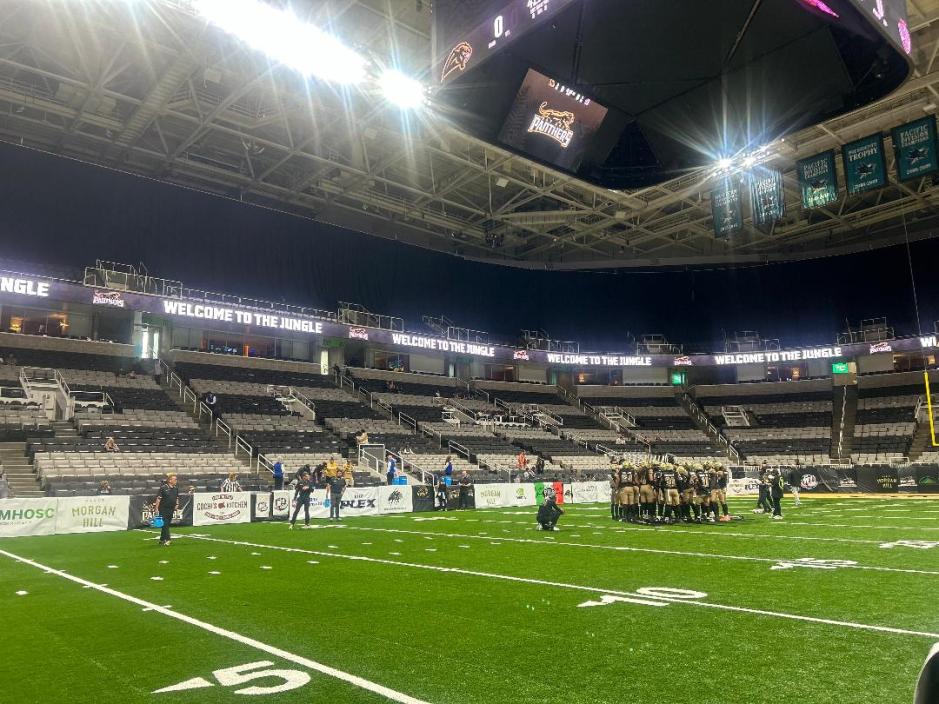
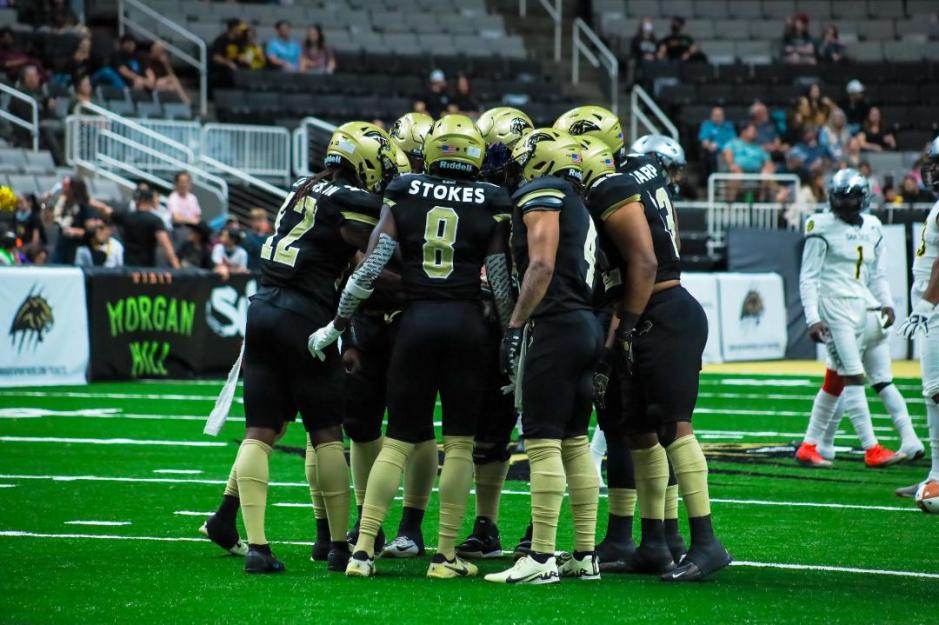
Bay Area Panthers in huddle against the San Diego Strike Force at SAP Center in San Jose on Sat Apr 20, 2024 (photo by Lauren Smith)
Title: The Smallest Yard
By: Lauren Smith
It is every young kid’s dream to make it pro and play on the big stage. Holding the Lombardi Trophy with your family and teammates next to you as you achieve one of the greatest victories of your life. But that is sadly not the reality of every kid’s dream.
It often ends in injury or lack of talent due to the huge pool of players that can be selected. According to the AS USA, “just over 16,000 [players] are draft-eligible, which is only 1.6% of that college player pool [from that]…only 259 players will be drafted.
That is a minuscule 0.016% of the draft-eligible NCAA pool” (AS USA). It is even smaller when you think about how many young kids play flag or tackle football. According to these statistics, an average person is more likely to get their car stolen, get admitted to Harvard, lose something in the mail, or even become a millionaire than they are to make it pro.
What sets these athletes apart? How do the ones who go pro compare to those playing in high school or who are expected to play in college? Do their habits and rituals differ, making one better than the other, or is it just luck of the draw?
Saint Francis High School’s Jackson Cahoon was the first to be interviewed about his year-round habits and routines when it comes to playing football. Jackson is a three-star junior, the 136th-ranked linebacker in California, with offers from the Air Force Academy, Army, Florida International University, Sacramento State, and San Diego State University.
He gave a little insight into the schedule that he follows religiously throughout the off-season to stay in shape and ready. It consists of a morning lift before school, where he then attends his classes for the day. Immediately after the school day ends, he goes to Overtime Performance, a training facility and program in San Jose, where he works on speed training and strength. After that, he goes home to work on schoolwork and fuel up for the same the next day.
Each day, the regime changes slightly to encompass all the aspects of football that he needs to master to stay at the top of his game. Something mentioned that was important to him was his recovery. Jackson said that “always stay[ing] flexible is the number one thing.
Always stay on top of what you are eating, sleeping, and drinking; that also plays a huge factor in it. Playing smart too, by putting yourself in the proper positions so you can avoid injury or getting hurt.” He also talked about the impact of his father’s college football career and how it has helped him develop the football IQ to help get him out of dangerous situations so he can stay on the field as long as possible.
Jackson Cahoon’s fellow teammate has a very similar training regiment, with one major difference: he is training to play at the University of Idaho come fall. Christopher Quinonez is a rising freshman attending the University of Idaho as an offensive lineman.
He was a three-time letter winner, a two-year varsity starter, and a senior leader in the offensive linemen group. During the off-season, he competed in wrestling as a form of off-season exercise. His training consists of a 5:30 am wakeup to get a morning lift before school, followed by film watching and practice that ends around 6:30–7 p.m. “Practices at the high school level help you realize that you have to manage your time wisely because of how late they end.”
Post-practice, Quinonez fueled up with dinner, where he calculated his total macros for the day. He said that he tried to eat “about 215 grams of protein a day, and then I try to stay under 5,000 calories,” but with his offer from the University of Idaho, he has been put on a meal plan to increase his weight up to 265 pounds for the upcoming season.
When asked about how he focuses his workouts and training, Quinonez talked about how he likes to balance both weakness-focused training and the overall skill-building required for his position. “I tend to focus on both, but I try not to focus on certain things because nothing is perfect and everything could be improved.
I feel like it’s different for other positions than offensive linemen because we have it somewhat simple with our techniques.” These skills are often built during the offseason for Quinonez since rigorous training during the season could overload the muscles leading to a higher injury risk.
For his upcoming debut with the Vandals, he has been sent a specific regimen to follow. “The only outside of school facility that I go to is City Sports, and I just do a push or pull with a mix of cardio every session. I have been trying to increase my hang power clean so I could improve my explosiveness when I am making a block or blowing through someone.”
Quinonez’s chances at playing professional ball increase as he makes his college debut. When asked about how he would approach getting drafted, he said that he would take his future journey “one step at a time [because] you never know what could happen.” As of right now, he is looking forward to playing with his new team and seeing where the road takes him.
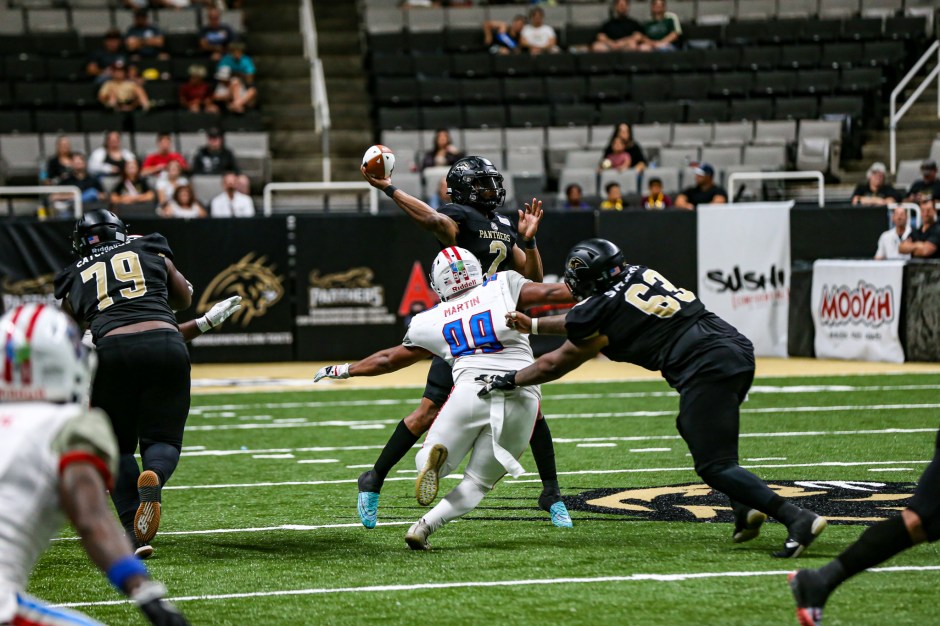
On Saturday, April 20, the Bay Area Panthers played the San Diego Strike Force. After the game, a couple of the players were willing to share their football journey and habits to see how they compared to those of high-level high school players.
Darin Hungerford is a linebacker for the Bay Area Panthers after finishing his college career at Kean University. He has just been signed to the team 2 days before the game after playing two years in the German Football League.
In high school, he started building his habits and routines with a focus on stretching, performance, and strength training. “You build all of those good habits then, it is going to carry you far and take you to the next level.” As he has gotten older and advanced to higher levels in his career, Hungerford said that he does not recover as fast, so the main focus within his training is recovery and maintenance.
He often focuses on agility to build speed and endurance or what he called “twitchy” reflexes; whereas kids in high school work on power and strength.
When posed the question, 7on7’s or tackle football, Hungerford replied with tackle football due to the fun vigor of the game. He did touch on the idea of 7 on 7’s being a great starting point for young football players. “It gives them the excitement to run around with their friends, have a good time, and just play the game.”
One of the most important things that Hungerford said was crucial to his game was diet. He said that it could “make or break you.” Putting bad things in your body will break it down over time which could lead to injury, weight gain, muscle loss, and poor performance. His final statement was targeted towards young athletes as he wanted them to build good healthy habits so they could reach their dreams.
Next, we talked to another linebacker by the name of B.J. Taufalele. Taufalele went to Weber State and played for the Frisco Fighters before coming to the Bay Area Panthers. In comparison to the training he does now, Taufalele said the high school workload was pretty much the same except for what his training focuses on.
In high school his training consisted of strength building whereas now it is more about maintaining a healthy body. He said that the consistency of practice and training remained the same throughout his career and that is how he was able to level up his game.
Upon reflection of the transition between different stages in his career, he said the switch from high school to college his schedule stayed the same but the speed of the game changed. Similarly, the jump from college to professional is an even quicker switch. “The biggest thing coming from high school to college was in high school I could sit there and eat McDonald’s every single day and go out and there and ball. As soon as I hit college, I started doing that and I started gaining weight and losing muscle.”
Taufalele wished he started dieting at a younger age and understood its importance as it is crucial to his game now. “If you are listening to this and are in high school you should definitely start dieting now.”
Last but certainly not least was Felix Harper, the Bay Area Panthers Quarterback. He is an Alcorn State Graduate, former Cleveland Browns player, two-time All-American SWAC player, and a finalist for the 2019 HBCU Player of the Year.
In his high school years, Harper worked with a specialized quarterback coach, Andrico Hines. Coach Hines helped Harper learn coverages, reads, footwork in and out of the pocket, and film study. Harper was extremely grateful for his coach who would work with him every day, even on weekends, to help Harper rise to the next level and build his overall skills.
Due to the helpful coaching from Hines, Harper felt he learned at a young age how to read coverages and adapt to situations all from film study with his coach. As Harper moved to play college ball, he said the process was humbling and difficult but appreciated the grind. His goal was to be “1% better each and every day and enjoy and love the process” as it helped him become the person he is today.
During the transition from college to professional he kept the same mentality of trying to be 1% better every day and focused on his progress, not on those around him. Similar to all the other professional players, Harper also talked about how diet was an extremely important part of the game. “Whatever you put in your system is what you get out of it.” He went on to add that water was also extremely important which people do not consider a lot of the time.
Overall the comparison between high school and professional players is very similar with some key differences. One major difference is diet. One of the high school football players interviewed said that he tracks his macros and what he eats relatively closely, while the other does not.
On the other hand, all of the professional players echoed the same message: diet is your performance. Good foods have a high possibility of increasing your performance, stamina, and energy. On the other hand, bad foods are more likely to tank performance and overall health.
These small differences create yards of gap between the best athletes and those who fall short. The habits of high school athletes are a good start but not as extreme as those who are playing professional sports. The majority of training, mentality, likes, and dislikes about football are very similar.
Each of the players think that training your body for explosiveness and recovery is extremely important in such a contact-heavy sport. All of these players’ bodies take a beating and by giving your body time to heal and recover, you can help better yourself and your performance.
There is not much that sets these athletes apart except the smallest difference or hole in a player’s routine. There is not a big margin for error and that error can be detrimental to a young player’s career in the future. One missed workout or stretch can be the small difference between being able to play professional ball or staying at the high school level.






 Sports Radio Service