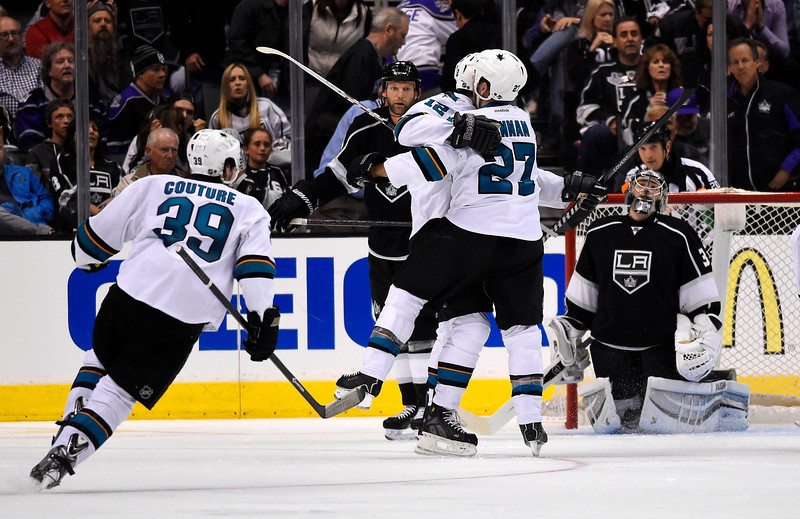
Sharks Beat Ducks With Lively 3rd in Home Opener

By Mary Walsh

SAN JOSE– Saturday, the San Jose Sharks won their home opener 2-0 against the Anaheim Ducks. The Sharks’ best period of the game was their third, and it was a relentless one. It seemed to be just the kind of game head coach Pete DeBoer was looking for from the Sharks:

That’s how we want to play with the lead. You want to keep your foot on the gas. We kept rolling four lines to keep our energy and our legs. The best defense for me in that situation is spending the period in the other team’s end and I think we did a good job of that.

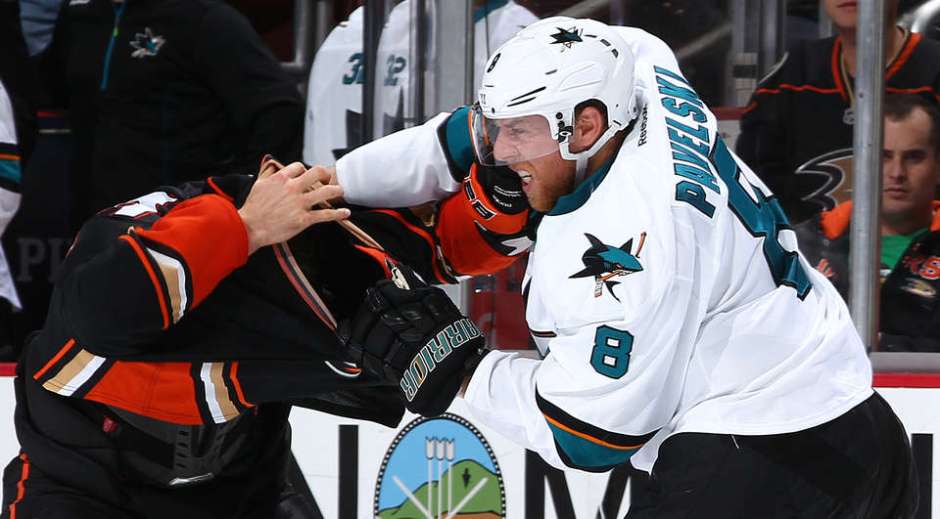
After the game, Sharks captain Joe Pavelski also talked about that third period push:

We kind of got better as the game went on, right from the start. The second was a little better and the third was definitely our best and it needs to be. I’d say last year that was one of the problems in this rink, we didn’t have strong thirds. So hopefully we can continue with that trend.

Joel Ward was asked about the developing chemistry between himself and his linemates, Logan Couture and Patrick Marleau:

When you get a chance to play with guys like Cootch and Marleau, it makes it a lot more fun, how dynamic they are and how skilled, what they can create on their own is pretty cool to watch. So, as you can see what Patty did tonight was a good example of that. Just try to get in the open areas and I just try to feed off them and know what they want from me, just communicating as best we can, it’s just going to continue to build.

Ward seemed to be communicating quite well with his linemates on Saturday, turning up in the right spot again and again, on both ends of the ice.

Sharks goaltender Martin Jones has also made an excellent impression in this two game sample. Martin Jones, after his second game and second win as a Shark, praised the team in front of him:

I thought we did a really good job. I mean, that’s a big, strong team up front and typically they do a really good job, getting in front of the net with bodies and with sticks. I thought we did a really good job boxing out and I was able to see a lot of pucks tonight.

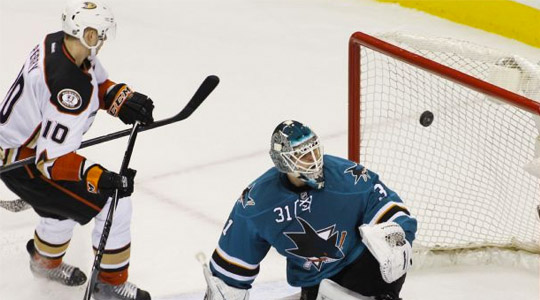
As second games of the season go, this one was impressive: two goals from Patrick Marleau, two points for Joel Ward, and a second win from Martin Jones. The game even had two 31s in net, one at each end. Jones and Anaheim goaltender Frederik Andersen both wear 31.

With nine minutes left in the first, the shots were 7-3 Anaheim. Sharks had killed one penalty, but had had no power plays. They did, however, have a very good spell right about then, lasting almost three minutes and shifts for as many lines. The third line started it, with some aggressive play in the Ducks’ zone. The top line followed it up and the Sharks seemed to be on a roll and likely to score. When they finally had to defend again, Martin Jones was there to stop the Ducks. The game remained scoreless, but by the end of that little sprint, the shots were almost even, 9-8 Ducks. By the end of the period, the Sharks had a solid 13-9 lead in shots.

They were right back at it to start the second period, spending most of the first two minutes in the Ducks’ zone. After that, however, the Ducks pinned the Sharks for a solid couple of minutes. A breakaway from the third line broke up the Ducks’ momentum and ended with a discussion by the Ducks’ net. The second line picked up where the third left off, and added three shots to the Sharks’ tally in the space of a few seconds. By now, the Ducks were getting a little incensed.

By the middle of the second period, the game was clearly a goaltender battle. Both 31s were snuffing out scoring chances wherever they cropped up. Admittedly, they were few but that was partly due to quick reactions from the goalies.

The other limiting factor for those scoring chances was timing. A couple of shots fell flat for lack of follow-up and bodies in the right places. It was a reminder that this was only the Sharks’ second game of the season.

The game took on a delayed back and forth tempo, with each team trapping the other for a long shift before going the other way. The Ducks seemed to have the edge at the end of the period, catching up in shots and holding the zone just a little longer than the Sharks could.

The period was winding down to a scoreless close, but the Sharks’ second line had other plans. Joel Ward and Logan Couture chased the puck into the corner and kept after it. The announcer had just made the “one minute left” call when Ward got the puck to the net. Couture caught up with it on the other side and took a shot. Just then, Marleau followed up to take the third and fourth shots. He gave the Sharks a 1-0 lead with the fourth one. Assists went to Couture and Ward.

The Sharks ended the second period up by one goal and three shots, 27-24.

In the middle of the third period, the fourth line of Barclay Goodrow, Chris Tierney and Mike Brown had a very good shift, holding the zone with tenacity, getting a couple of shots in, and maintaining their composure when the Ducks finally got the puck out. They finished by slowing Anaheim down enough in the neutral zone for the defense to get organized for a line change.

Around the 13 minute mark, the fourth line held the zone again with aplomb, aided by Tomas Hertl Hertl, who had missed his line change. Eventually, he did manage to switch with Tierney, without the Ducks ever gaining control of the puck. It was an impressive shift by the fourth line and the top defensive pair of Marc-Edouard Vlasic and Justin Braun.

With almost six minutes left, the Sharks had taken twelve shots during the period. The Ducks had taken three.

Shortly after the next faceoff, Marleau scored his second of the game on the team’s 40th shot. It was a lovely wraparound after he carried the puck across the blue line and through the o-zone against two Ducks. The lone assist went to Joel Ward, who apparently made the pass while also playing it safe:

I knew he can do that so I just kind of “here, you take it, you go.” I came back to the bench… I knew we were in our zone a little bit and I just kind of tried to play it safe, I didn’t want to get caught up the ice. Next thing you know hands are up in the air and I was looking for water.

The Sharks got their first power play with 3:07 left in the game. The penalty went to Mike Santorelli for hooking Barclay Goodrow. They did not score but the power play prevented Anaheim from pulling their goalie or coming back in the last minutes.

The final shot count was 44-27 Sharks.

Patrick Marleau led the Sharks in shots with seven. Mike Brown led in hits with eight. Brent Burns had the most time on ice with 24:43. Martin Jones made 27 saves for the shutout.

Frederick Andersen made 42 saves for the Ducks, no small feat. That earned him the third star of the game. The first star was Marleau and the second was Martin Jones.

Jakob Silfverberg led the Ducks in shots with four, and Andrew Cogliano made the most hits for them: four.

The Sharks will hit the road and play Tuesday in Washington against Ward’s old team, the Capitals. The game will start at 4pm PT.
Competition Too Close to Call for Sharks Blue Line

By Mary Walsh

The preseason is well under way, and the NHL season looms large for the San Jose Sharks. Their training camp roster is still long enough to easily ice two squads, so it is reasonable to expect that there will be more roster cuts this week. The Sharks have a lot of decisions to make before opening night, DeBoer explained:

Some tough decisions, some really tough decisions. It’s tough getting from 34 to 26 or -7 or whatever number we’re going to go to, and it’s going to be even tougher to go down to 22 or 23. That’s a good thing though, it’s a good problem.

Dylan DeMelo stood out as one of the young players getting a lot of ice time in preseason games. There is a little room on the Sharks blue line, and a number of players competing for it. Asked to comment on that competition, DeMelo said: “I can’t speak for the other guys but I think I’m playing pretty well and I think I’m showing kind of what’s advertised in my game.”

After the game, Sharks coach Peter DeBoer was asked if Dylan DeMelo was likely to make the opening night roster. DeBoer declined to say yes or no:

I’m not prepared to hand this job to anybody yet. Everybody’s competing, everyone’s playing well right now. It’s too close to call to be giving anybody the job right now. We’re going to take all the time we have on our side.

DeBoer did concede that DeMelo is “right in the mix,” with other defensemen. As with other players seeing a lot of preseason ice time, DeMelo is no lock for a spot on the NHL roster.

Another player who is getting a long look in these games is Joonas Donskoi. Saturday, he played on a line with Tomas Hertl and Matt Nieto. Donskoi is probably closer to a spot than DeMelo is, but the fact that he is playing only means he’s getting look, not getting the job.

The Sharks lost Saturday’s preseason game to the Anaheim Ducks. The final score was 2-1, with goals scored by Joel Ward for San Jose, Corey Perry and Chris Wagner for Anaheim. The game was a fine preseason sample of games between San Jose and Anaheim: riddled with penalties, there was even a game misconduct handed out.

Martin Jones was starting his second of the preseason, and his first at SAP as a Shark. He was glad to have a chance to play at SAP during the preseason:

I’ve had a couple games here, playing in LA, so I know what the building’s about. Yeah, it was nice to get the first one out of the way at home. Obviously, not the result we want, but we’re working through it. It’s still preseason and we’ll work it out.

The Ducks took two penalties in the first eleven minutes of the game, one to Shea Theodore at 1:22 and one to Corey Perry at 11:07. The Sharks did not score on either one of those power plays, but seconds after the Perry penalty expired, the Sharks did score. The goal was scored by Joel Ward, with assists going to Paul Martin and Brent Burns.

The goal was a good example of Ward’s playing style, and the style that DeBoer is encouraging the Sharks to employ. Asked about the goal after the game, Ward said:

It’s no secret, I’m trying to get in front of the net. I think most of my goals in the past have been around that area. So there’s no secret I’m just trying to go to the net, trying to get pucks and rebounds.

Moments after the Sharks goal, Frazer McLaren was called for boarding. He was given a game misconduct and received a five minute major. Ryan Carpenter served the penalty for him. The hit sent Anaheim defenseman, Korbinian Holzer, to the dressing room. Holzer was kept out for the rest of the game for precautionary reasons, the Ducks announced later.

The Sharks killed off the five minutes and even managed a short-handed chance near the end.

It took the Sharks several minutes before they took a shot on goal in the second period. Through the period, the Sharks had six shots.

The Ducks tied the game just over three minutes into the third period. The goal was scored by Chris Wagner, unassisted. He skated into the zone mostly unfettered and took a shot from the half boards that seemed to catch Jones off guard.

Just past the ten minute mark of the third, Perry went to the box for the second time in the game, this time for high sticking.

Before the penalty elapsed, Joonas Donskoi went to the box for a high stick. The Ducks made the Sharks pay for that, taking the lead with a goal with 7:36 left. The power play goal was scored by Corey Perry. Assists went to Shea Theodore and Simon Despres.

The Ducks went right from the celebration to the penalty kill, with Shea Theodore back in the box for interference. This put the Sharks on their fourth power play.

That came to naught, and the game wound down. With under two minutes left, the Sharks pulled their goaltender for the extra attacker. Logan Couture, Brent Burns, Tomas Hertl, Patrick Marleau and Paul Martin made up the six players for the last minutes. Hertl made a nice pass after pulling the puck from a scrum along the boards, but Couture’s shot went just wide. After a time out, the same six returned to the ice but they could not even the score.

The Sharks will play another preseason game at SAP on Tuesday, September 29. Their opponent will be the Vancouver Canucks. Start time will be 7:30 pm.

Warriors Spoil Pelicans Playoff Push with 112-96 Triumph

By Matthew T.F. Harrington

Despite a poor shooting night from Stephen Curry, the Golden State handedly topped an Anthony Davis-less New Orleans Pelicans squad 112-96. Curry went just 4 of 17 from the field, finishing the night with just 16 points, but Harrison Barnes continued his run of torrid play to beat the playoff-hopeful Pelicans in front of the Oracle Arena crowd.

Barnes, getting the starting nod from coach Steve Kerr, finished the night with 9 made shots in 13 attempts for 22 points. He now has back-to-back 20-point games for the first time since his breakout 2013 playoff campaign .

The Pelicans saw 6 different players post double-digit scoring totals Friday headlined by Norris Cole’s 16 off the bench. Quincy Poindexter and Alexis Ajinca added 15.

Golden State hit half their shots, sinking 44 of 88 Friday while New Orleans to a 42.3 shooting percentage knocking down 33 of the 77 would-be baskets.

The Warriors built a slim 30-26 lead after the first quarter, but outscored the Pelicans 56-42 over the middle two frames for the 86-68 edge heading into the final 12 minutes. New Orleans (37-32), two games back of the final playoff spot in the Western Conference, outscored the Warriors 28-26 in the fourth. By then it was too late, as Golden State rolled to its 55th victory.

The Warriors (55-13) now sit just four games shy of matching a franchise record in wins. A win Saturday over the visiting Utah Jazz Saturday night could move them one step closer.

Sharks and Others Moving AHL Teams West

By Mary Walsh

SAN JOSE– The American Hockey League will be moving five teams into California beginning next season. This AHLien invasion was the result of extensive planning and negotiations between the NHL, the AHL, and five NHL franchises. For west coast hockey fans, and California fans in particular, it is goods news. For some AHL fans, it is a sad day.

On January 21st, Mark Purdy of the Mercury News reported that the Sharks’ AHL team will play next season at the SAP Center. Thursday, the AHL and the NHL added to this news by confirming that the Anaheim Ducks, the Edmonton Oilers, the Calgary Flames and the Los Angeles Kings will also be moving their AHL teams to California.

The Oilers’ AHL franchise will play in Bakersfield, the Flames’ AHL team will move to Stockton, and the Kings’ AHL team will be in Ontario. As for the ECHL teams currently playing in those locations, Luc Robitaille of the LA Kings said that their Ontario ECHL team will be moving to Manchester to fill the void left by the Monarchs’ departure. How may others will follow that pattern has not been announced. The Ducks’ AHL team will move to San Diego.

During a press conference held at SAP Center, officials from the above NHL teams, as well as the NHL and the AHL spoke to the media about the moves. Bill Daly, NHL Deputy Commissioner and David Andrews, AHL President and CEO joined the Flames’ Brad Treliving, the Oilers’ Kevin Lowe, the Kings’ Luc Robitaille, the Sharks’ Doug Wilson and John Tortora, and the Ducks’ Bob Murray and Michael Schulman.

AHL President and CEO David Andrews opened the press conference, giving the audience a rundown of the development relationship between the AHL and the NHL. He thanked the fans of the teams being relocated for their support. Earlier this week, the Ducks purchased their AHL franchise, putting them in the same group as the Oilers, the Kings, the Flames, and the Sharks, as AHL team owners.

Sharks COO John Tortora spoke next, mentioning that the San Jose AHL team will need a new name that should be chosen in the next few weeks. He lauded the growth of hockey in California over the past decades. He then summarized the development advantages of having AHL Sharks train and play so close to the NHL Sharks. The fans will get to see the AHL players before they reach the NHL, expanding interest in the organization. The management and coaching staff will have greater access to prospects, and players will be better prepared for the NHL environment by living and working in it. On the decision to locate the team in San Jose, Tortora emphasized the organization’s desire to make the AHL franchise beneficial to the community, in terms of added jobs and opportunities in San Jose.

Tortora also thanked Worcester for being a supportive market:

We spent ten incredible years in Worcester, it is an incredible hockey market and should have a new hockey team in the near future. This relocation is not a reflection on the Worcester market, rather it is one where we look forward to ending our last season in Worcester making it a very successful one and then building the program here in San Jose.

After the presentation, Tortora answered a few more questions about the new venture. Tickets to the AHL games will be on a par with other AHL prices, making professional hockey more accessible to a new audience.

Having the AHL team play at SAP Center may not be a long-term arrangement but there are no plans at this time to move it elsewhere. I asked if the plans to expand the Sharks Ice facility were still in the works. Shark Ice is the Sharks’ practice facility that also has rinks for public use. A major expansion looks unlikely at this point, from Tortora’s answer:

We’ve looked at expanding Sharks Ice by two sheets of ice over the last three or four years, but the timing wasn’t right for us to do that. But we’re still looking to add more ice, in the Bay Area.

That leaves the question wide open: where in the Bay Area? How much? As much ice as a pro hockey venue? Bay Area communities can wonder and hope, but nothing has been decided yet.

“This is an unbelievable day for hockey in California,” began Ducks GM Bob Murray. He spoke to the importance of the AHL to the Ducks, pointing out that there are only two players on their current roster who did not play in the AHL at some point.

Kevin Lowe, Oilers President of Hockey Operations & Vice Chair OEG spoke next. The Oilers will not have their team close enough to drive to, but it will reduce travel time to games and allow for more practice time.

Flames GM Brad Treliving spoke next, re-emphasizing the value of the AHL to NHL player development. He praised Glens Falls as a hockey market, but came back to the disadvantage of cross-country travel for call-ups and management. He thanked the fans and others in Glens Falls, acknowledging that these moves mean some fans will lose their hockey teams.

Kings’ President of Business Operations, Luc Robitaille spoke next, saying how impressive it was that these five teams could work together for this move. He thanked Manchester too, and said that Manchester will be getting another team. As mentioned above, that team will be the one currently playing in Ontario.

NHL Deputy Commissioner Bill Daly spoke next. “It’s a great day for hockey, it’s a great day for the NHL.” He thanked Andrews for his efforts to coordinate the move, and thanked the five NHL clubs for their willingness to negotiate and get this done.”They presented a united front, and as a result we were able to get this done.”

Sharks Jump Out to 4 Goal Lead, Hang On to Win

By Mary Walsh

SAN JOSE– Before Saturday’s 6-4 win over Anaheim, the Sharks were not sure whether or not Logan Couture would be able to play. “This morning I woke up and my eye was swollen, I could barely see out of it, so I knew something was up,” he said after the game. Considering how Couture played on Saturday, maybe he should consider wearing an eye patch before all of his games, to mimic a pregame eye problem.

After the game, Sharks head coach Todd McLellan said of Couture’s performance:

I thought he had a hell of a game, probably his best game of the season in my opinion. He was all over the puck, he played well defensively, he looked really good.

Couture and Patrick Marleau ended the game with two points each while Wingels earned the first star and four points for the game. They were the most effective line in the game. Antti Niemi made 30 saves on 34 shots (seemingly all in a frenetic third period), and Tomas Hertl’s backhand goal ended up as the game winner. Corey Perry and Ryan Getzlaf scored three of the Ducks’ four goals.

The Sharks started very well, but ended the second period and started the third in a muddle. With the Ducks closing in, McLellan used his time out. In those seconds, Wingels explained, the coaches reminded to team to get back to the way they started:

What made us effective in the first two periods? Playing a north-south game, that was being physical, getting in on the forecheck and creating pressure. I thought when they did score, we kind of started circling a bit, taking pucks east-west.

Clearly, the reminders worked.

The first goal of the game came from Logan Couture, midway through a grinding first period. The puck bounced a bit in front of the net and it was on a second or third bounce that Couture put it over the prone Ducks goaltender. Wingels and Marleau got the assists on the goal.

Almost two minutes later, Ducks forward Matt Beleskey tied the score on Anaheim’s fourth shot of the game. Defenseman Hampus Lindholm’s shot from the blue line traced a line of four players all stacked in front of Niemi, making the shot very difficult to see. Beleskey tipped it in to score his 11th of the season. Assists went to Lindholm and Devante Smith-Pelly.

At 12:41, Justin Braun went to the penalty box for delay of game, taking the first penalty of the game. Perhaps disatisfied with a waste of a perfectly good lead, Logan Couture promptly took it back with a short-handed breakaway, made possible by a fallen Duck at the  blue line. Couture was patient and precise taking the shot, scoring his tenth of the season.

With just over a minute left in the period, Matt Irwin drew a high-sticking penalty on Jakob Silfverberg. At the time, the Sharks were pinned in their zone and they needed a break. The break they got, and a power play goal as well. With 13.6 seconds left in the period, Wingels and Pavelski moved the puck into the zone, then passed it to Joe Thornton in the opposite corner. He passed it back across the blue paint to a waiting Pavelski.

The period ended with the Sharks leading 3-1, and leading in shots 14-5.

Almost three minutes into the second period, Tommy Wingels tipped a Patrick Marleau shot from the blue line to stretch the lead out to 4-1. It was Wingels’ seventh of the season. Assists went to Marleau and Justin Braun.

The Sharks’ fifth goal came from Tomas Hertl, after he collected the puck along the wall when Josh Manson tried to clear it. Hertl punctuated the goal with a little stick handling in front of the goalie, with James Sheppard acting as a screen. That was it for Ducks’ goaltender Frederik Andersen. Jason LaBarbera came on in relief.

The Ducks used their time out, and seconds after play resumed, the players were piled up in the corner for some fisticuffs. James Sheppard, Matt Irwin and Tomas Hertl were all in the thick of it. In the end, Hertl and Sheppard were in the box for the Sharks, while Devante Smith-Pelly and Matt Beleskey went for the Ducks. The Ducks got a power play out of it as Sheppard received and extra two minutes for boarding.

The Sharks killed the penalty off and the ice opened up until Mike Brown was called for closing his hand on the puck. That was 9:37 in to the second.

With 3:33 left in the period, John Scott was called for hooking. The Sharks did a good job of clogging up the neutral zone and kicking the puck back out when the Ducks did dump it in.

Back at even strength, Ryan Getzlaf carried the puck over the line and passed it to Corey Perry as he bore down on the net. A nifty lift put it over Niemi’s pad and gave the Ducks a boost.

At the end of the second period, the Sharks led 5-2 and shots were 26-19 Sharks.

After the game, Logan Couture commented one of the Sharks’ more glaring bad habits this season:

For some reason this year we’ve just been getting away from it for periods at a time, letting the other team get back in games and take it to us. And that’s exactly what we did, we turned pucks over, we.. I don’t know, it’s tough to understand why we do that but luckily we were able to survive it.

Seconds into the third, Corey Perry cut the Sharks’ lead to 5-3. Matching penalties to Mike Brown and Patrick Maroon followed shortly after, putting the teams four on four. After a save and a fairly spectacular second save, Antti Niemi was beaten again, this time by Ryan Getzlaf. The assist went to Corey Perry. With the gap closed to one goal, McLellan used the Sharks’ time out.

The next good chance for the Sharks came from the Sheppard-Hertl-Nieto line, after the Thornton-Pavelski-McGinn line pushed the action back into the Ducks’ zone for a bit. The Sheppard line had a couple of good chances, both featuring shots from Hertl after strong work along the walls from Nieto and Sheppard.

A penalty to the Ducks came at 6:30 of the period. Renee Bourque went for hooking Nieto. Little came from that, though Niemi had to make some good saves on more short-handed chances from the Ducks. By the middle of the period, the shots were 31-30. At 10:13, Mike Brown went back to the box for hooking.

The Sharks survived a broken stick for Vlasic, then escaped to the Ducks’ zone for a game of catch. Another trip up and down the ice, another short-handed chance, and Matt Nieto drew a penalty on the Ducks, negating the last 18 seconds of the Brown penalty, and putting Ryan Kesler in the box. The Ducks did not get a shot on goal during that power play.

The power play generated three or four shots for the Sharks, and kept the Ducks busy for a spell.

The Sharks earned another power play with just over two minutes left in regulation, when Josh Manson went to the box for hooking Tommy Wingels. The Ducks pulled LaBarbera to even things up. With 26 seconds left in the power play, Matt Nieto scored into the empty net after Tommy Wingels got the puck to him with a neat pass. It was Wingels’ fourth point of the game. It was Nieto’s second point of the season.

Tommy Wingels led the Sharks in hits with seven, Tomas Hertl led the team in shots with five. Brendan Dillon led the team in blocked shots with four, but he and his defense partner Brent Burns both finished with minus two ratings.

Frederik Andersen made 14 saves on 19x shots, Jason LaBarbera made 15 saves on 15 shots for the Ducks. Corey Perry led the Ducks in shots with six, Tim Jackman led in hits with five, Mat Clark led them in blocked shots with three.

Mirco Mueller, Matt Tennyson and Barclay Goodrow were scratched. Tyler Kennedy also did not play.

The Sharks next play the Philadelphia Flyers on Tuesday, December 2, at 7:30 PT in San Jose.

Sharks almost shutout Ducks in feisty one

(Photo by Debora Robinson/NHLI via Getty Images)

By Pearl Allison Lo

ANAHEIM– In a game that featured numerous fights, San Jose broke Anaheim’s seven-game win streak along with their four-game losing streak in a 4-1 win Sunday.

Sharks’ coach Todd McLellan remarked, “It was a big win for us…The fact it comes against a rival who’s probably the best team in the league right now, we’ll take that…I’m proud of the way the group responded. We didn’t have an easy day today.”

Fights and goals marked each period as the former escalated in the third period, with 24 penalties in the final stanza. Sharks’ goalie Antti Niemi, who stopped 33 shots, had a shutout until 14:53 of the third, when Anaheim had a power play.

San Jose’s Tommy Wingels said it was the “first time we’ve shown passion this year.” “It was a solid 60-minute effort. Everyone stood up for one another,” commented Marc-Edouard Vlasic.

It was the Ducks’ second loss of the season as the Sharks moved a game above .500. Four different players scored for San Jose, Logan Couture and Patrick Marleau each had a pair of assists and Tomas Hertl had his first assist. The Sharks killed five of six power plays and scored two power play goals. Joe Pavelski said, “[Niemi] was great on the penalty kill early. That’s where we’ve struggled lately…That gave us confidence early.”

The game winner was Brent Burns’ first of the season and his second goal in as many games. Burns shot it from the point towards the line of defenders in front of goalie Frederik Andersen.  He was aided by Marleau at 8:25 of the first period.

Anaheim’s Corey Perry had a one-on-one opportunity but Niemi saved the puck.

Tim Jackman’s hooking penalty at 18:38 ended in a crash at the net and gave the Sharks their first power play. Pavelski redirected Joe Thornton’s shot from the right circle to give San Jose a 2-0 lead.

Two penalties were called for both teams 12 seconds apart in the second period. The Sharks’ Scott Hannan was called for high-sticking and the Ducks’ Sami Vatanen called for embellishment at 9:40, then San Jose’s Mirco Mueller and Anaheim’s Ryan Getzlaf called for unsportsmanlike conduct. The Ducks’ coach Bruce Boudreau replied to when frustration set in, “We got wound up when we got the embellishment penalty. There were some things going on, but it was just two teams that competed hard against one another….We were frustrated. When you’re frustrated, stuff happens.”

Eleven seconds after the second penalty, Vlasic scored through the legs of Andersen, helped by Marleau and Couture.

At 15:23, San Jose was called for a bench minor, a faceoff violation.

Near 18:21, the Ducks’ Ryan Kesler narrowly missed with a diagonal shot right in between Niemi and the net.

The Sharks got another power play at 10:18 of the third period. They capitalized again at 11:40, when Wingels scored, assisted by Matt Nieto and Hertl.

The majority of the penalties were called at 13:56.

Anaheim’s Matt Beleskey spoiled the shutout when the man advantage was almost over, scoring top shelf, aided by Kesler and Cam Fowler at 14:53.

Game notes: San Jose’s Justin Braun took a puck to the mouth during the game and left the ice. The team will try to build on their win and put together a streak when facing the Colorado Avalanche Tuesday at 6pm.

Sharks lose in sudden death

Photo credit: CHRISTINE COTTER — AP Photo

By Pearl Allison Lo

ANAHEIM– San Jose’s 1-0 lead from the first period broke at the very end, as the Anaheim Ducks scored the tying goal with less than a minute in the third to eventually win 2-1 Saturday.

Both teams had at least one power play in each period, including overtime, but the last power play in the game marked the only power play goal. The Sharks’ Antti Niemi had just avoided a shot earlier, but then Corey Perry took aim, with three San Jose players between him and Niemi, as the puck hit the crossbar at 3:37. That was Perry’s seventh shot of the night.

The preseason finale certainly had its share of fighting, especially in the second. The Sharks’ Joe Pavelski responded, “well i think it’s last preseason game, so, whatever you got to do to get ready for regular season. I  think you’re going to try to at least set a certain standard tonight, you see the lineups are close, as soon as you get a lot of good players, you start competing, a power play here, a power play there, you want to score a goal…it’s just built up.”

In the first, the Ducks’ Matt Beleskey hit Adam Burish near the net against the boards and then Burish fell backwards. The Sharks’ Mike Brown came in with a hit of his own in retaliation and Anaheim got their first power play. Matt Nieto had a solo opportunity shorthanded but his shot hit one of the Ducks’ stick.

The Ducks seemed to dominate, but San Jose was the one to get the all-important goal. At 13:58, Tomas Hertl got his first of the preseason. It started with the faceoff. The puck then got to the net from a shot from the blue line, bounced off the end boards and to an open Hertl. Hertl was helped by Pavelski and Scott Hannan.

There were five power plays during the period, with two overlapping. The last one came with 12.4 seconds left.

In the second, the Sharks had  more penalties than shots as there were five penalties per team.

Two penalties overlapped again as with just under a minute left in Anaheim Tim Jackman’s penalty, San Jose’s Jason Demers was called for interference.

Beleskey hit Braun then Hannan and Mike Brown went 2-on-1 on Jackman. Hannan was called for roughing and Brown and Jackman got unsportsmanlike conduct at 8:42.

Less than two minutes later, Demers hit Beleskey, Beleskey later responding by slashing, resulting in Demers going down, Demers called for embellishment, and then Beleskey also called for roughing as Beleskey hit Demers when he came back up from the ice.

At 13:04, Brown and Bryan Allen both got 10-minute misconducts.

Perry got called for cross-checking at 16:43.

The number of game shots ramped up in the third, with San Jose getting 11 and the Ducks 14.

After extended jostling along the boards where no one could get the puck out of the boards, Francois Beauchemin had a point blank shot which Niemi nabbed.

Patrick Maroon also had a one-on-one opportunity which Niemi gloved as well. Niemi commented, “they were coming hard, the last four five minutes.”

Anaheim took advantage of three failed clearances by the Sharks before the tying goal. Ryan Kesler was aided by Perry and Sami Vatanen.

Game notes: San Jose’s Brent Burns led all with 24:52 ice time, teammates Tommy Wingels and Logan Couture had four shots apiece, Kesler led with five hits, the Ducks’ Ben Lovejoy led with four blocked shots and Kesler won 85% of his 20 faceoffs. Attendance at the Honda Center was 13,682. Sharks will open the regular season against the Los Angeles Kings Wednesday at Staples Center at 7pm.

NHL Free Agency: Independence Day Weekend

By Mary Walsh

The Fourth of July has come and gone without much fuss for the Sharks in the free agent market. A few Sharks have moved on, several San Jose rivals in the Pacific Division appear to have gotten better while the Sharks have only made some small moves.

Along with signing free agents John Scott and Taylor Fedun, the Sharks made qualifying offers to three of their RFAs. Jason Demers has filed for arbitration, Tommy Wingels has been signed to a three year contract and there is no news yet on James Sheppard.

The announcement that the NHLPA and the NHL agreed on a lower than expected salary cap for the upcoming season has caused some consternation around the league. The cap is set at $69 million while some had anticipated it would be over $72 million.

Only Philadelphia and Chicago find themselves over the cap right now. For the Flyers, this is a mere technicality. Chris Pronger is still on their roster until they can put him back on LTIR, and removing his salary will push them back below the cap. They still do not have a lot of room to work with, but like the Sharks they are not in “win-now” mode.

Chicago is a couple million above the cap, but they have 23 players on their roster so they are only a move or two away from the line. Their roster is pretty solid, and with the addition of Brad Richards they do not have a lot of work to do.

Dallas won the Spezza trade sweepstakes, giving up several assets including Alex Chiasson, a promising young forward. In other notable moves, they also signed goalie Anders Lindback, Ales Hemsky and Patrick Eaves. The Stars have no present plans to do more.

Closer to home, Los Angeles and Anaheim are safe under the cap after making some key additions. Los Angeles resigned Marian Gaborik, a late season acquisition who worked out very well for the Kings on their run to the Stanley Cup. They are just under the cap now but they appear set.

Anaheim added Ryan Kesler, one of the bigger names available this Summer. They also lost Teemu Selanne to retirement. You can’t compare Kesler to Hall of Fame bound Selanne, but he is a good addition, so the Ducks could be considered status quo. That status was pretty good last season. On top of that, the Ducks have over $13 million left in space, and 22 on the roster.

In terms of cap space, the Sharks are in a good position. They have plummeted to 21st on CapGeek’s list, a list you want to be at the bottom of… if you plan to add players. Even after the Sharks sign Demers and Sheppard the team will have 23 on the roster and probably have a substantial sum left over. Before signing Wingels, the Sharks had almost $14 million to work with.

The loss of Dan Boyle and Martin Havlat could be significant if either or both of them plays well and healthy this upcoming season. But for San Jose’s purposes, they were often without one or the other last season, due to injury or coaching preferences. If the Sharks are roughly as good as they were last season, will it be enough to get them into the playoffs? Have their rivals improved so significantly? Marian Gaborik is arguably the biggest difference for the California teams. The Kings might have a better regular season than last.

Ex-Shark Notes:

John McCarthy, never quite a regular in the Sharks lineup, has signed a one year two way contract with the St. Louis Blues.

Sena Acolatse, who never appeared in the San Jose lineup, has signed with the Calgary Flames.

Martin Havlat, after the Sharks used one of their compliance buyouts on the remainder of his contract, signed with the New Jersey Devils.

As has been widely announced, Dan Boyle signed with the New York Rangers for two years at $4.5 million. For those concerned that he and Brian Boyle might have a conflict of 22s, no need to worry. Brian has moved on to Tampa Bay.

Also in Tampa Bay now is Evgeni Nabokov, presumably to back up Ben Bishop in goal. The Lightning roster has a very young average age, so another veteran was probably on GM Steve Yzerman’s shopping list.

Thomas Greiss, last year of the Phoenix Coyotes, has signed with the Pittsburgh Penguins.  Depending on the sort of year Marc-Andre Fleury is having, Greiss may get to start quite a few games, or at least play in several.

How Will the Sharks Be Composed?

Patrick Marleau, Scott Hannan, Jonathan Quick, Logan Couture

By Mary Walsh

The San Jose Sharks are not the only team to lose a Game Seven in 2014, or even in the first round. Because they began with a three game lead, the loss was considered an upset, a collapse. Other teams who lost in Game Seven when they were expected to win include the Boston Bruins, and the Pittsburgh Penguins.The Bruins were grumpy in the handshake line, the Penguins fired their GM.

The Anaheim Ducks were the regular season Conference champions. They held a lead at one point in the series against the Los Angeles Kings, but they were not strong favorites, especially after the Kings’ first round comeback against the Sharks.

Does a little distance change how we should view what happened to the Sharks in the series against the Kings? Doesn’t it appear that they did not have to make many mistakes to lose to the Kings? Perhaps, but some of the mistakes were ones we have seen before that should have been avoidable.

When the Sharks flagged after the questionable goal that involved pushing Alex Stalock into the net, it was not unlike the 2011 Conference Finals against the Canucks. There, a bad call in the last 13 seconds of the third period left the team flat-footed. The Canucks tied the game and won the series in overtime.

What is this, and how do you fix it? Would making a lot of roster changes do it?

Sharks GM Doug Wilson said the team needs more than a band aid. The problem is that any major surgery takes time.

The first moves announced were actually non-moves. The coaching staff would be retained, Dan Boyle would not be resigned, and Marty Havlat would not be with the Sharks next season. The odds are very slim that this last means anything other than “Havlat will be bought out.” If Wilson were trying to trade him, he probably wouldn’t be announcing it to the media. This would be a first, a difficult first for a GM who has always been careful to not get into a contract he cannot live with.

The other announcement is the oddest of the three: the Sharks will use Brent Burns as a defenseman next season. Yes, he was acquired for that purpose, his contract was negotiated on that basis, he has more NHL experience as a defenseman than as a forward but… he really was a standout forward. He was maddeningly inconsistent as a defenseman.

The choice is not so shocking, but the announcement itself was strange. Was it a way of saying (unbidden) that the Sharks will not pursue a free agent defensemen this summer? Or that they will pursue a top six forward? Did that announcement have any place on the list of “questions people want answered?”

Dan Boyle, in discussing his time with the Sharks, said that the last two seasons were the Sharks’ best. Reminded that they had made the Conference Finals twice before, he admitted that perhaps recent seasons were just more vivid in his memory.

I think he was right the first time. The Pacific Division has become more formidable than it was when the Sharks went to the Conference Finals. The Sharks have been better in the last two seasons, but so has their competition. That means that success is even more about bounces than it ever was.

Bounces cannot be controlled, but the way a team handles them can be. A team’s psychological resilience can be improved by changing the players, but there are not very many players who can step in and hold a team together through a crisis. There may not be any who could do it for all teams.

Would trading Joe Thornton or Patrick Marleau really improve matters? Joe Pavelski? Who? And who do you get to replace them? Keeping in mind some no movement clauses would have to be worked around, who could Wilson get back? Unfortunately, those other players might come with much heavier salary burdens, assuming they could produce as well as any of the Sharks’ leaders, and also fix what ails the team.

That is a lot to expect from some player on some team a Sharks player would agree to be traded to… it is a lot to expect from even two or three players.

Wilson may have the flexibility he wants, but he has not built the team out of an NHL Leggo set. Few successful teams are built like that. You don’t replace pieces, you replace ingredients. Each player has an effect beyond the players to either side of him on the bench. The wrong big move could doom the next few seasons.

Should they move goaltender Antti Niemi? Was he really the weakest link? A better puck-mover would be nice, but every goaltender has his weaknesses. Those with few are rarely available. How much could Wilson get in trade?

Again, would that fix what ails the Sharks? What does ail them?

Composure. This is something the Kings are being praised for. They have rebounded in two playoff series now. Their goalie has recovered from some poor outings to play at his best. Give them credit, they keep their heads.

But do they keep them so much better than the Sharks? If the Kings are such a better team than the Sharks or the Ducks, why did it take them seven games to win those series? Why did they lose so badly to start the playoffs? Perhaps their playing style has to be paced. Playing a very physical game, the sort of game that produces a high injury rate, takes its toll on both teams. Perhaps it takes the Kings a while to work up to it.

Is that what the Sharks need to do, whichever Sharks remain next season? Does that style of play guarantee a win? It has gotten the Kings farther than the Sharks have gone several seasons in a row now. So why don’t more teams emulate the Kings?

Again, why did it take them seven games, twice, if they are so much better?

Maybe the Kings are not a perfect model, they are just one that works for those players with that coach right now.

Those players. Mike Richards spent a good amount of time on the fourth line. He might be a buyout candidate this summer if he cannot return to a top six role. No team is going to willingly give a fourth liner six or seven years at $5.75 million. In the mean time, he posed an enormous threat to opposition, and not because he is so tough or gritty. What distinguished him from most fourth liners is skill.

The Sharks had Mike Brown on their fourth line. They also had Raffi Torres there, with a still very troublesome knee. Had he not been injured, would he have been on the fourth line at all?

The Sharks would do well to look for more skill to go with the grit they have relied on there. They have players who could make up an over-qualified fourth line, if they added one or two top nine forwards…

Yet the coaching staff thought it would be better to try to get Marty Havlat to play there occasionally, instead of moving someone who could do that job (like Tommy Wingels) and keeping Havlat in the roll he was acquired for– a skilled top nine forward. Unless they re-evaluate how they use their assets, it doesn’t matter who the Sharks trade or acquire.

If their roster is so flawed, then significant changes have to be made. That is unlikely to produce quick results. Whether they replace a lot of players or drastically change their style of play, both will take time to adjust to. They probably won’t get off to a quick start, they might be pushing to reach the playoffs at the end of the season. Then, if they stumble again, it can be explained away by too many changes to adjust to in one season.

Not making big changes hasn’t satisfied anyone. It will be difficult now to not make them. It does seem like a shame to waste the one useful thing the team got out of that loss to Los Angeles: a painful shared memory of what they don’t want to experience again.

Goalies and Go-Getters: NHL Playoffs

By Mary Walsh

Watching the French team beat the Canadians in the World Championships was one of the most entertaining viewing experiences I have had in a while. Even though I had to keep clicking through ad popups, exposing my computer to who knows what kind of hazards, the game was riveting. Sure, it went to a shootout, after a couple of power play goals from the French kept them in the game. Goalie Cristobal Huet also kept them in the game, neutralizing the not yet ready for prime time Canadian team. But who doesn’t love to see an underdog steal one?

The French are not the only underdogs playing right now. The Montreal Canadiens, though their record hardly looks like an underdog’s, had the Boston Bruins on the ropes for a bit. I wonder how many people became Habs fans then? It isn’t that the Bruins are so easy to root against, but they won the Cup so recently, and they are reputed to be big tough guys. The Habs are supposed to be quick and light in the way they play. (Hence the utter confusion about the Douglas Murray signing.) Yet even if the Bruins are the hounds and the Canadiens the foxes, it usually takes several hounds to take down one fox. That makes us root for the fox. We know one hound could never catch a fox on his own, but it still seems unfair to gang up on the little fox like that.

The thing is, it isn’t true. Apart from Zdeno Chara, the Bruins are not bigger than average for an NHL team, and the Canadiens are not small. Even their playing styles are exaggerated– the Bruins play fast whenever possible, and the Canadiens don’t scamper around the rink without standing their ground defensively.

Neither team shows the defensive recklessness of some teams (hello Pittsburgh), though both teams get reliable goaltending. Tuuka Rask and Carey Price are both exceptional, in their prime, and playoff hardened. Neither has been surprising in a good way or a bad way. They have performed as expected: very well.

The teams were more evenly matched than advertised, but hyperbole makes it a better story.

What is not exaggerated are their respective playoff records. The Bruins won the Cup in 2011 and made it to the Finals last season. The Habs haven’t been to the Conference Finals since 2010, and they haven’t won a Cup since 1993. One of these teams is due, the other has won recently enough to remember the way clearly. The latter will not go quietly, if at all. The Bruins demonstrated as much by taking the lead in the series on Saturday.

Here in the West, Sharks fans may or may not be watching the Freeway Series between the Los Angeles Kings and the Anaheim Ducks. If they are watching, they may have noticed how strange it is that two teams that did so well at home have now turned into road warriors, if across town really counts as a road game. In any case, it is strange to see the Ducks cast in the underdog role, since they were so dominant in the regular season.

One of the more talked about issues is the way Bruce Boudreau has been handling the Anaheim goaltenders. He pulled Frederik Andersen twice before he had to be replaced for injury, always putting Jonas Hiller in. Hiller has played well, has experience, and probably deserved to start Saturday. But the Ducks started the season overloaded with young goaltending talent. They even traded one away to the Oilers, they had so many goalies. Now they can’t seem to find one the coach can rely on.

It doesn’t really breed confidence, to keep switching goaltenders. It also doesn’t breed confidence to have a goalie the team doesn’t trust to make all the stops he needs to make. Here is the problem with that– some teams play better defense with a backup in the net, precisely because they don’t trust him. Doesn’t it make more sense to give defense extra attention, no matter who is in goal? What if your awesome unbeatable goalie has an off night? It wouldn’t matter if you were helping him out enough.

See the Minnesota Wild and Ilya Bryzgalov for how to make it work. Bryzgalov has one of the most mercurial records in the NHL. This season alone, he had to claw his way back into the league after starting off signed to a PTO with an ECHL team. He is not stealing games for Minnesota, but they are doing pretty well for a team working on its fourth goalie in the season. In response, he is playing better behind them.

See the LA Kings and Jonathan Quick in Games 1 & 2 against Sharks for how to let it take you down. No matter how the Sharks lit him up, it took the Kings two games to figure out that their super-duper goalie was not going to win the game for them and he needed some help. Once they gave it to him all was well, but how it could take them so long to get their act together is mind-boggling.

They say that a goalie has to steal a couple of games along the road to a Stanley Cup. That may be true but it seems awfully risky to assume that your team is going to simply fall apart for a game or two along the way. Yes, if a Sharks goalie had stolen a game, or two, maybe they would still be in it. But after the way the Sharks played in Game 5, did they deserve to be?

Sometimes a team has no choice but to flip flop goalies through the playoffs. The 2010 Flyers made it as far as the Finals, changing starting goalies mid-playoffs due to injury. Michael Leighton had only been cleared to play the day before he replaced Brian Boucher, and each goaltender gave exceptional performances in turn. In the end, they were still being swapped mid-game, I suspect because neither was truly 100% healthy. Through it all, the rest of the team held it together, killed themselves on defense (Ian LaPerriere almost literally) and went further than the Sharks have ever gone.

Maybe confidence is over-rated. Maybe will is all.

Antti Niemi was a raw rookie in his first season of North American hockey when he won. He didn’t even play in the minors. The Blackhawks made due. There really is no sure-thing formula for the role goaltending plays in a Cup run. Everyone needs to pull their weight and a little more if possible. Should it matter to the Ducks whether Anderson or Hiller or Gibson is behind them? No. If the puck is behind them, they need to get it back in front of them ASAP, no matter who is perched in the paint. That’s a good rule for any team to follow.