Headline Sports podcast with Barbara Mason: Were the women’s soccer team punished for their success?; plus much more

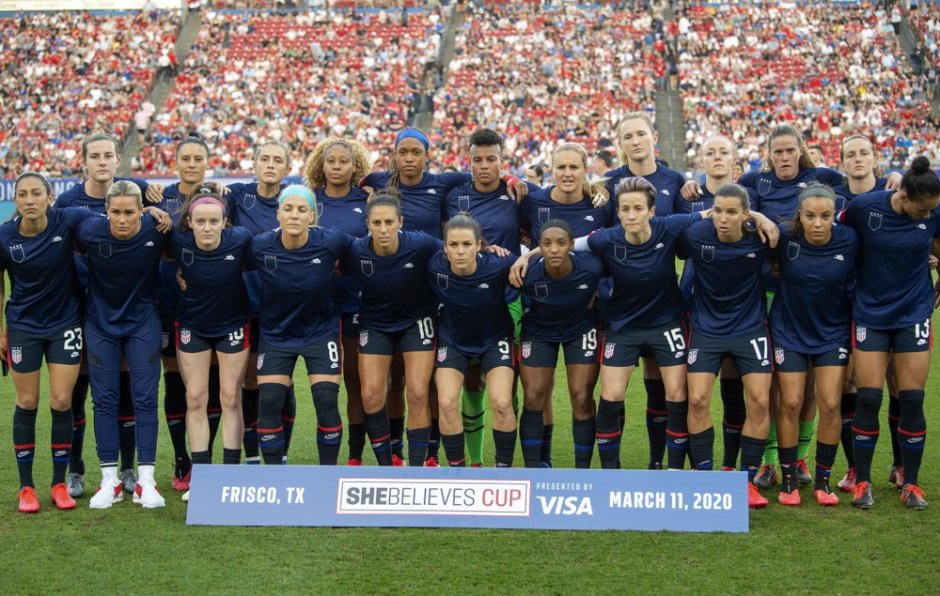
The United States Women’s National Team poses for a team photo before a SheBelieves Cup women’s soccer match against Japan, Wednesday, March 11, 2020 at Toyota Stadium in Frisco, Texas. (AP file photo)

On Headline Sports with Barbara:

#1 On Friday Judge R.Gary Klausner ruled against the US Women’s soccer team who sued the US Soccer team for underpaying them less than the men’s team.

#2 The women’s soccer team played 111 games between Feb 2015-Nov 2018. The men’s team played 87 games . The women’s team during that time earned $24.5 million or $220,747 per woman. The men’s team earned $18.5 million, $212,638 per man. Giving the women more money per game.

#3 The argument is that the women’s success was used against them in court and the men’s team had played less games because they failed to make the playoffs and the women’s won the cup playing more games.

#4 In the Michael Jordan documentary “Last Dance” Chicago writer Sam Smith quoted Jordan in 1995 after being asked why he didn’t support Democratic Harvey Gantt who was running against Republican Jesse Helms for Illinois senator who was a well known racist. Jordan told Smith that he wasn’t into politics and reportedly told Smith “I’m not into politics, Republicans buy shoes too.” But according to Jordan spokesperson Estee Portnoy she told the Slate in 2016 that Jordan never said it.

#5 ESPN has struck a deal with the Korean Baseball Organization saying they will broadcast at least one Korean baseball game a day six games total a week. Karl Ravech, Jessica Mendoza, Eduardo Perez, Boog Sciambi and Kyle Peterson will serve as the in studio play by play and analysts during each game.

Join Barbara each Tuesday night for Headline Sports at http://www.sportsradioservice.com


He was a Giant? 50 Years Ago Giants Mexican Rookie Was Orange & Black One Hit Wonder

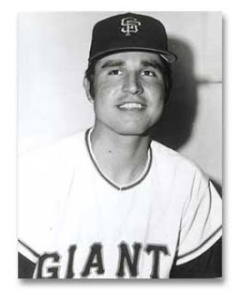
San Francisco Giant pitcher Migel Puente in 1968 file photo from JG Preston Experience wordpress.com

He was a Giant?

By Tony The Tiger Hayes

Cinco De Mayo Special

50 Years Ago Giants Mexican Rookie Was Orange & Black One Hit Wonder

MIGEL PUENTE

RHP – 1970 – # 41

In the spring of 1970, Norman Greenbaum – a an unknown San Francisco songwriter – became an improbable overnight sensation with his unorthodox divine anthem “Spirit in the Sky.”

Greenbaum’s take on psychedelic gospel rose as high as no. 3 on the Hot 100 – shockingly, competing for airtime with the Beatles and Jackson 5 – before his star soon faded.

Though the groundbreaking rock track would live on in cover versions, commercials and soundtracks, the name “Norman Greenbaum” would never again pass the lips of Casey Kasem.

During that same time frame, the Giants celebrated a one-hit-wonder of their own in Mexican pitcher Puente, who on his birthday came out of obscurity to knock ‘em dead for one night – and one night only – on center stage in New York.

But like Greenbaum, Carl Douglas and the Starland Vocal Band, Puente’s follow-ups went straight to the cut-out bin.

Why Was He a Giant?

A native of the central Mexico city of San Luis Potosí, Puente was discovered by Giants scout Dave Garcia who would manage Puente as a first-year pro at Single-A Fresno in 1968.

After pitching a Texas League no-hitter at Double-A Amarillo in 1969, the right-hander with a big kick found himself being compared to, you guessed it, Juan Marichal.

Puente shadowed his idol the following spring training, even picking up Marichal’s signature screwball pitch.

“(Marichal) didn’t teach it to me,” Puente told reporters. “He’s a star and he’s very busy, so he wouldn’t have time to teach me. But I stood around in spring training and watched him and just copied him.”

Before & After

Ironically it was when the “Dominican Dandy” was shelved with an adverse reaction to a penicillin shot early in the ‘70 campaign that Puente got a call-up to the bigs.

Overall Puente was not impressive as a Giant. He was shelled for five or more earned runs in three of his six appearances. Puente’s Giants record stood at 1-3, 8.20 and he never played in the majors again.

Puente would soon return to his native Mexico where he continued to pitch professionally for the remainder of the 1970s.

He Never Got His Own Bobblehead. But…

New York City was abuzz on the night of 5/8/70. At Madison Square Garden, the Knicks dramatically won the NBA Championship, beating the Lakers in a dramatic Game 7 (the Willis Reed game) to give NYC it’s third pro championship in a year.

Meanwhile more than 40,000 fans turned out a across town to see the visiting Giants take on the defending MLB champion Mets on a cool evening at Shea Stadium.

Puente, who turned 22 that day, would go the distance vs. New York, allowing seven hits, walking four, while striking out seven.

Powered by a pair of HR by Willie Mays and another off the bat of Bobby Bonds, the Giants won easily 7-1.

“There were so many people watching,” Puente said as teammate Tito Fuentes presented him with a huge wedge of birthday cake. “I have never pitched before so many people before.”

Giant Footprint

Probably the most famous birthday performance by a Giant came on Barry Bonds’ 39th when the HR King crushed a walk-off solo blast off Mike Myers at Pac Bell Park to settled a spirited 3-2 win over Arizona (7/24/03).

But you can’t go wrong with Bob Knepper’s 25th b-day party of 1979 when the lefty starter went 7.1 innings, earning a win, and hit a solo HR high into the night sky off future Hall of Famer Phil Niekro in 6-4 home defeat of Atlanta (5/25/79).

P.S. Believe it or not, San Francisco has had just two other Mexican born players: RHP Miguel Del Toro (1999-2000) and IF Tony Perezchica (1988, 1990-91).

That’s Amaury’s News and Commentary podcast: Passing of A’s minor leaguer Miguel Marte; Tyler Rogers and Taylor Rogers twins who could have matched up; plus more

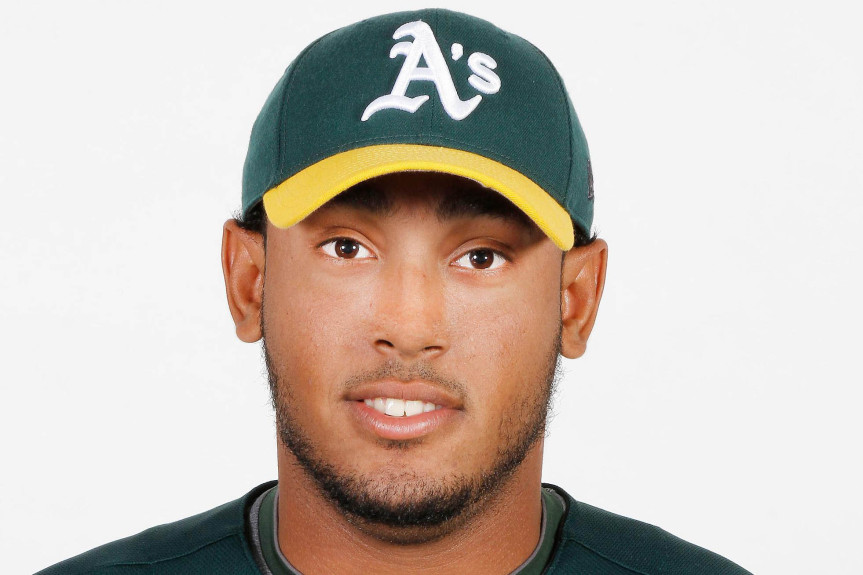
Oakland A’s minor league first baseman Miguel Marte who passed away Friday at age 30 from complications from Covid-19 (mercurynews.com file photo)

On Amaury’s News and Commentary podcast:

#1 Happy Cinco DeMayo Amaury, the sad news about Oakland A’s minor league player Miguel Marte who passed away from Covid-19 complications early last week. Marte was 30 and hit .230 with three home runs in his final season in 2012. He played for the A’s organization from 2008-12.

#2 The San Francisco Giants almost had two brothers who almost face each other the Giants Tyler Rogers and the Minnesota Twins Taylor Rogers and yes both are twins but Tyler is not a Minnesota Twin.

#3 The Oakland A’s had two heavy loses this week with Miguel Mante who we talked about to pen today’s podcast and their there was A’s pitcher Matt Keough who passed away over the weekend at age 64. Keough was part of the Fine Aces consisting of Brian Kingman, Rick Langford, Steve McCatty, and Mike Norris.

#4 Former Five Ace pitcher and A’s teammate Rick Langford said, “I was proud to call him friend I’m so sad he’s gone”

#5 With a number of states opening up is this a safe indication that there might be a chance that baseball could opening in the not too far future.

Join Amaury each week for That’s Amaury’s News and Commentary at http://www.sportsradioservice.com


Headline Sports podcast with Morris Phillips: Matt Keough was part of the A’s five aces

si.com file photo: The Five Aces of the Oakland A’s in 1981 Rick Langford, Steve McCatty, Brian Kingman (left to right top) and Matt Keough and Mike Norris (left to right front)

On Headlines pod with Morris:

#1 Former Oakland A’s pitcher Matt Keough who passed away on Saturday was remembered for his days with those Billy Martin teams in the early 80s after going a career worst  2-17 in 1979 Keough came right back with a 16-13 the next season.

#2 Keough was part of a solid pitching rotation for the A’s which consisted of Mike Norris, Brian Kingman, Steve McCatty, and Rick Langford.

#3 Keough pitching on that 1981 Oakland A’s team that went to the playoffs during the strike shortened season going 10-6. The A’s did lose to the Yankees in post season.

#4 Billy Martin led that colorful team and Billy’s antics were just as colorful with the Billy Ball brand of baseball of speed and stealing bases and pitchers almost throwing the distance and going to the bullpen if he had to.

#5 Keough also was a team executive for the A’s who gave advice to pitchers on the team and team vice president Billy Beane said that Keough left an unforgettable impression on everyone he touched in baseball.

Join Morris each Monday for Headline Sports podcasts at http://www.sportsradioservice.com

Headline Sports podcast with Daniel Dullum: Little League World Series canceled first time ever; MLB Umps make the call for pay cuts; plus more

Empty Lamade Stadium in Williamsport Pennsylvania home of the Little League World Series will not host the series this season due Covid-19 (file photo littleleague.org)

On Headline Sports with Daniel Coronavirus concerns:

1 Little League World Series cancelled for 2020, 75th anniversary series pushed to 2022

2 Umpires reach agreement with MLB for Covid-19 shortened season, accept a 30 percent pay cut

3 After 16 positive cases of Covid-19 on-site, Allegiant Stadium workers in Las Vegas will be tested for coronavirus

4 Report: Bettman says December start for 2020-21 NHL season ‘under consideration’

5 NBA postpones draft lottery, scouting combine

6 Isiah Thomas ranks Michael Jordan as his 4th best opponent

#7 RIP – Matt Keough, former A’s pitcher and special assistant

Join Daniel each Sunday for Headline Sports at http://www.sportsradioservice.com

That’s Amaury News and Commentary: Say Adiós to my Little Friend: Instant Replay

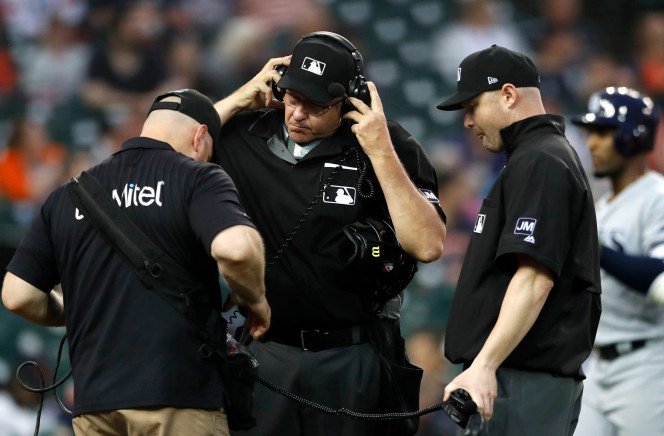
MLB struck an agreement with its umpires on a new deal Friday, according to AP (photo by AP)

Say Adiós to my Little Friend: Instant Replay

That’s Amaury News and Commentary

By Amaury Pi-González

If there is a 2020 baseball season, there is a very good chance the Instant Replay will disappear. It would be a shortened season by the Covid-19 pandemic. Although is not official yet, sources say it looks like both sides came to an agreement. The umpires are guaranteed 50 percent of their salaries for the month of May, but nothing else is there are no season and no games are played.

The Major League Umpires make on average $150,000 to $450, 000 plus, if just one regular season game is played this season the umpires are guaranteed about onethird of their salaries. Umpires already have been paid from January to April. Looks like the umps will do well either way. The MLB Umpires Union said in a statement, they were pleased to reach this agreement with the commissioner’s office.

The old saying ‘the glass is half full or half empty ‘applies to the record since 2014. When the Instant Replay was established, with about half of the challenged calls resulting in reversal. In other words, major league umpires, missed half of the challenged plays and are right on the other half.

There still no timetable for an Opening Day. The parks where they are proposing to play in Arizona and Florida are not wired for the replay review, so they would play these games without no fans, and no replays. On the other hand, it seems what the owners do not want is the “replay review”.

A good scenario would be to open the season/play in Arizona and Florida and then later, if there is an effective treatment for the virus (most experts do not expect a vaccine until 2021) and then move to the original baseball parks where all 30 teams play, under the new proposed realignment of merging both leagues into three by geographical logic: East, Central and West. Even then, it would be with no fans.

Revenues? The games will be entirely for television that means the TV revenue is the only revenue generated. No fans, No tickets sold, concessions or parking. The rest we must leave to the financial experts, but anyway you look at this, is a very ugly situation.

Finally: Since we are talking about numbers, I will make it very simple. In my book there is a 50-50 of a season in 2020.Those are my best odds.

Stay well.

Amaury Pi Gonzalez is the Oakland A’s Spanish play by play on the A’s Spanish flagship station KIQI 1010 San Francisco and does News and Commentary each week at http://www.sportsradioservice.com

Headline Sports podcast with Matt Harrington: NHL forms Return to Play Committee; Zubs joins Sens in one year deal; plus more

The Ottawa Senators signed defenceman Artem Zubs on Friday for a one year deal. Zubs played in the KHL (senshot.com file photo)

On Headlines podcast with Matt:

#1 Matt, NHL Commissioner Gary Bettman has formed a Return to play committee and is in a holding pattern as to how teams will line up the schedule and if games will be played in neutral sites or by divisions. Also decisions are being made based on how local municipalities enforcement on shelter in place.

#2 Artem Zubs has signed a one year entry level deal with the Ottawa Senators for the 2020-21 season. Although terms were not disclosed Zubs tied in the Kontinental Hockey League with a plus 35 rating and had 13 goals, nine assists, in 57 games.

#3 The new arenas in Belmont Park for the New York Islanders and Key Arena in Seattle are getting the once over as they should both be ready for play in September 2021. It’s a real can’t wait and see once they pull the sheet off the new buildings.

#4 The Calgary Flames signed a three year entry level deal with goaltender Dustin Wolf coming out of the WHL. In the WHL Wolf was 1.88 in goals against, .935 saves percentage, and had nine shutouts. He’s someone to really look forward to whenever he joins the Flames AHL affiliate in Stockton.

#5 One of the things that Chicago Blackhawks defenseman Brent Seabrooks could say about the current downtime in the NHL is that it gave him time to recover from shoulder surgery in December and hip procedures in January and February. Seabrooks has 103 goals and 361 assists in 1,114 games.

Join Matt each Saturday for Headline Sports at http://www.sportsradioservice.com

50 Years Ago: Pilots Land in Milwaukee Pt 2 of 5 part series By Daniel Dullum

image from sportslogos.net

50 Years Ago: Pilots Land in Milwaukee Part 2

By Daniel Dullum

Author’s note: This is the second of a five-part series detailing an unusual Major League Baseball franchise shift — In 1970, the Seattle Pilots arrived at spring training in Tempe, Arizona, and left at the end of March as the Milwaukee Brewers. At the conclusion of Part 1, Bud Selig’s group Milwaukee Brewers Inc. was rejected in its bid to purchase the Chicago White Sox and move the team to Milwaukee.)

Because ill feelings still lingered from the failed antitrust litigation against the National League, Selig’s group was persona non grata with the Lords of Baseball. They drove this point home at the American League owners’ meeting of October 18, 1967, when, after granting the Athletics permission to move from Kansas City to Oakland, an expansion team was promised to Kansas City for 1971. But after U.S. Senator Stuart Symington of Missouri played the antitrust exemption card and Kansas City Mayor Ilus W. “Ike” Davis threatened legal action, AL President Joe Cronin reopened expansion dialogue and moved the timetable up to 1969 for Kansas City.

Now, needing an even number of clubs, the American League awarded its 12th franchise to Seattle on December 1, 1967. Two weeks earlier, National League President Warren Giles had said the Senior Circuit would not oppose the American League’s expansion plans, and would go ahead with its own.

The second blow to Milwaukee Brewers Inc. — the one that hurt Selig the most — was delivered at the National League owners’ meeting in Chicago on May 28, 1968, when the league announced it would expand to San Diego and Montreal for 1969. Selig was so despondent after the meeting that for the next few hours, he walked the Windy City’s streets alone.

To compound Selig’s frustration, Commissioner Bowie Kuhn addressed the media in Atlanta on July 1, 1969, and told them, “I see no expansion for the major leagues over the next 10 years.” In the meantime, White Sox home-away-from-home games at County Stadium proved popular with Milwaukee baseball fans, drawing 196,684 fans in 11 dates.

One of those games was played on June 16, 1969, against the Seattle Pilots, won by Chicago 8–3. The 13,133 people in attendance didn’t realize it at the time, but in less than 10 months, the visiting team on the County Stadium scoreboard that day would be the ballpark’s next permanent residents. — – By September 1969, the Pilots were putting the finishing touches on a dismal debut season in the Pacific Northwest, winding up in the AL West Division cellar with a 64–98 record, 33 games behind first-place Minnesota.

Attendance was disappointing — 677,944 in 72 home dates (with nine doubleheaders) at rickety Sicks’ Stadium, the old home of the Pacific Coast League’s Seattle Rainiers that was never completely upgraded to major league specifications. “It was not a major league facility. It had its own uniqueness, but that’s all they [Seattle] had at the time and the players understood that,” Rich Rollins pointed out. “It was a minor league ballpark is what it was. They did the best they could with what they had at that particular time. “We didn’t think about the field all that much — we had too many other problems!”

Despite losing a reported $850,000 in 1969, the Pilots still outdrew four other teams — Cleveland and Chicago in the American League, and Philadelphia and San Diego in the National League. If there were rumblings about the team’s possible relocation, word hadn’t filtered down to the dingy Pilots’ clubhouse, at least initially.

Reserve catcher Jim Pagliaroni, acquired in mid-season from Oakland, didn’t recall any talk of the Pilots leaving Seattle. “Not at that time,” he said. “There was nothing. No talk about a move. There was no clue.” Pilots’ first baseman-outfielder Mike Hegan remembered hearing rumors of a possible move toward the end of the 1969 season. “The rumors were there,” he said. “It wasn’t a done deal at the beginning of spring training, but I was one of the few players who actually stayed in Seattle in the off-season. “What’s funny is that it was an ongoing story all winter in Seattle.”

William R. Daley, the Pilots’ absentee board chairman who made his fortune with Otis Elevator and resided in Cleveland, reportedly was ready to sell midway through the 1969 season. In mid-September, Pilots President Dewey Soriano strongly denied rumors of a shift to Dallas-Fort Worth while feuding with Floyd Miller, Seattle’s interim mayor. Miller threatened to evict the Pilots from Sicks’ Stadium unless they presented a security bond of $150,000 and a promised letter of credit for $660,000.

Dewey Soriano responded by refusing to put up the bond, claiming the city failed to keep its promises to upgrade the aging ballpark. Two weeks later, on September 28, Daley confirmed that an offer from Texas millionaire Lamar Hunt was rejected, and that the Pilots would remain in Seattle. Hunt, owner of the American Football League’s Kansas City Chiefs, wanted to purchase the club and move it to Dallas-Fort Worth.

Catching wind of the “Seattle situation,” Selig got busy. He had met secretly with Seattle co-owners Dewey and Max Soriano throughout the month of September and, during game one of the 1969 World Series in Baltimore, hammered out a deal to buy the Pilots for $10.8 million, contingent on approval from the American League and the lack of a local buyer.

The American League, fearing the possibility of lawsuits and congressional action, refused to approve the deal and spoke only in public about keeping the Pilots in Seattle. Daley, meanwhile, issued an ultimatum to the Emerald City’s baseball fans at an October 1969 press conference, declaring, “Seattle has one more year to prove itself.” Looking for a convenient scapegoat, he added, “It’s all the fault of the press.”

George N. Meyers, sports editor of The Seattle Times, noted in a column the Pilots’ top ticket price of $6, as well as 75-cent beer and 35-cent Cracker Jack at Sicks’ Stadium concession stands, then wrote, “That’s upside down, isn’t it? What we’re really doing is giving Daley one more chance.”

American League President Joe Cronin and a six-man committee of the league’s owners met with a Seattle delegation on October 21 and issued three conditions for the city to keep the Pilots: 1) Upgrade Sicks’ Stadium to the original unfulfilled specs. 2) Start construction of a new, domed stadium before the deadline of December 31, 1970. 3) Find a local ownership group to acquire the club by October 30, 1969, a deadline the league later extended to November 5.

Amidst the chaos, Pilots General Manager Marvin Milkes continued conducting the business of running the ballclub. He dismissed pitching coach Sal Maglie, first base coach Ron Plaza, farm system director Art Parrack, and scouting director Ray Swallow. Manager Joe Schultz initially was advised by the club to consider other employment offers and was eventually fired on November 20, replaced four days later by former Cincinnati Reds skipper Dave Bristol.

The Pilots completely overhauled the coaching staff, and, unlike Schultz, Bristol was allowed to select his own assistants, as per normal for major league managers. Gone from 1969 were third base coach Frank Crosetti (hired along with Maglie by Milkes), Eddie O’Brien (hired by Dewey Soriano) and Sibby Sisti (hired by Milkes). O’Brien and Sisti had been brought aboard primarily to accrue enough time in uniform to qualify for a major league pension.

Immediately, Bristol brought in Cal Ermer — a former Minnesota Twins coach and manager — as the new third base coach, along with baseball veterans Roy McMillan (the former All-Star shortstop) and Jackie Moore. To complete the staff, Seattle-area native Wes Stock was hired away from the New York Mets, where he had been the minor league pitching instructor. “It was quite an experience because Seattle was my home, so that was a special reason I wanted to go back to Seattle,” said Stock, who had pitched in the majors with Baltimore and the Kansas City A’s. “We were trying to make the best club we could come up with as far as being a pitching coach. It was a tough situation because the guys didn’t know where they were going to go.”

For a while, it looked as though the Pilots would stay put. Fred Danz, a local theater chain owner, announced on November 17 that his 12-man group of investors had purchased the club for a reported $10.3 million, and the American League approved the transaction on December 5. But on January 3, 1970, Danz held another press conference, this time to explain that the Bank of California had requested immediate payment of a $3.5 million loan it made to Pacific Northwest Sports and that his group was unable to meet that demand.

By mid-January, the AL withdrew its approval of the sale to Danz, and ownership of the Pilots boomeranged back to Pacific Northwest Sports. By now, the Hot Stove League was rampant with solutions for the Pilots. John Wilson, a sports writer for The Houston Chronicle, added grist to the rumor mill on January 23, reporting that the American League already approved a shift of the Pilots to Dallas-Fort Worth with a vote by telephone survey. But AL President Joe Cronin, White Sox owner John Allyn and Athletics owner Charles O. Finley all denied the report.

Edward E. Carlson, board chairman of Western International Hotels, announced on January 27 that he’d put a group together that wanted to run the Pilots as a non-profit organization. The AL owners, feeling the approach would devalue the league’s other franchises, also rejected the bid from Carlson’s group.

On January 28, the Pilots were given nine days to come up with necessary financing to remain in Seattle. Three days later, Edward J. Daley, president of World Airways of Oakland, California, said he was interested in buying the team and keeping it in Seattle. And on February 5, 1970, the Bank of California offered to renegotiate its $3.5 million loan — on its terms. The Bank of California later offered to remain involved for $750,000 if other Seattle banks would join in. But two banks backed out and the proposed consortium fizzled.

Despite the misinformation and ongoing chaos, Mike Hegan was so impressed that he ignored the rumors, plus the dark financial cloud that hovered over the Pilots, and decided to move from Massachusetts to suburban Seattle. Hegan explained, “It looked at one time like there was going to be an infusion of new money into the ballclub that would keep the Pilots in Seattle.

At that time, my wife and I were looking to plant roots someplace anyway, so we bought a house in Seattle.” Meanwhile, General Manager Marvin Milkes continued to make deals. He acquired veteran lefthander Bob Bolin from San Francisco for outfielder Steve Whitaker and utility man Dick Simpson. Reliable pitcher Diego Segui returned to the Athletics along with light-hitting Ray Oyler in exchange for infielder Ted Kubiak, and reliever Dave Baldwin arrived from the Washington Senators.

On January 15, 1970, the Pilots made another deal with Oakland, swapping All-Star first baseman Don Mincher and journeyman infielder Ron Clark to the A’s for outfielder Mike Hershberger, righthander Lew Krausse, catcher Phil Roof and reliever Ken Sanders. Upon joining the Pilots’ fold, Roof recalled, “Rumors [about moving] were there right off the bat. They knew the ownership in Seattle was short on cash and also, the park wasn’t a major league park. That was another detriment. They couldn’t come up with concrete plans to build a stadium on short notice at that point.”

Three days later, at the Milwaukee Baseball Writers’ 17th annual Diamond Dinner on January 18, Commissioner Bowie Kuhn discussed the possibility of the Pilots landing in Milwaukee. “If this does not take place, it would not be my advice to Milwaukee to give up hope. When I think the sponge should be thrown in for Milwaukee, I’ll say so. “I do not think that time is now, and I hope it never comes,” the commissioner continued. “I can assure you that there is no grudge in baseball against Milwaukee and Wisconsin. When and if a franchise becomes available, Milwaukee will receive serious consideration.” Kuhn added that he hoped Seattle would find a solution to its financial woes, but noted, “I do not encourage shifting of franchises because I believe they hurt the stability of baseball. But we recognize that in certain circumstances, shifts can become likely.”

Selig also spoke at the Diamond Dinner, issuing a thinly veiled reference to the Seattle situation: “We do not consider ourselves predatory raiders. At no time have we instituted any negotiations for a franchise. Accusations that we have are unjustified and completely without fact.” At a meeting of American League owners in Chicago on February 10, 1970, AL President Joe Cronin confirmed that there was one possible solution — the league could operate the Pilots until a buyer could be found. He reiterated that the league wanted the Pilots to remain in Seattle, and when the meetings concluded, the AL owners decided that the Soriano brothers and Daley would again operate the Pilots.

On the legal front, Seattle attorney Alfred J. Schweppe filed a “ticket buyer’s” lawsuit against the Pilots’ owners on behalf of himself as a season ticket holder, and obtained a temporary restraining order on March 13 to keep the Pilots from leaving Seattle. Schweppe had purchased two field box seats for $700 and a season parking space for $75 for the next four seasons.

On March 16, 1970, when rumors about a shift of the Pilots to Milwaukee resurfaced, William Dwyer, special assistant to Washington Attorney General Slade Gorton, followed through on earlier threats and filed breach-of-contract and antitrust suits against the American League. King County and the City of Seattle also joined the legal action, which involved a minimum $75 million in damages and sought a temporary restraining order and injunction to block any move of the ballclub.

In addition, Washington’s U.S. Senators — Warren G. Magnuson and Henry M. “Scoop” Jackson — said they would introduce legislation to repeal baseball’s longtime immunity from antitrust laws (dating back to a landmark 1922 Supreme Court ruling), claiming a transfer of the Pilots would clearly show baseball to be a business, rather than a sport. — — The American League owners voted to loan the Seattle Pilots $650,000 on March 9, 1970, to operate through spring training. They also appointed Roy Hamey, a semi-retired former general manager of Pittsburgh, the Philadelphia Phillies, and the New York Yankees, as “special supervisor” to oversee the operation, with Milkes still in place as the team’s general manager.

Hamey was granted a leave of absence from his part-time post as the Yankees’ West Coast scouting director to assume babysitting duties on behalf of the league. During the meeting, Milkes (who was promoted to team vice president when Hamey was brought on board) walked out in disgust when Baltimore Orioles owner Jerry Hoffberger suggested developing a trusteeship of the Pilots with the American League, and that Bill DeWitt, the former general manager of the St. Louis Browns, Detroit Tigers and Cincinnati Reds, be placed in charge.

Seattle sports writer Hy Zimmerman observed in his weekly report for The Sporting News, “Here sat Milkes, who had gone without pay, who had pleaded with and cajoled other unpaid employees to hang tough, who had kept the organization together with hairpins and chewing gum. “Now they were going to make an errand boy out of him. He could not, and would not, take it, and left in a huff.”

After the meeting — held on Ash Wednesday — concluded, one unnamed AL owner quipped, “The American League has given up $650,000 for Lent!” As the Pilots began arriving in Tempe for spring drills, work toward beginning construction of a 55,000-seat domed stadium in Seattle remained on schedule, according to John Spellman, a King County spokesman. The only visible problem was a legal tussle over whether to build the stadium downtown or in the suburbs. But other problems continued to mount for the Pilots.

When the American League granted its loan, $400,000 was paid out immediately to cover outstanding debts, leaving $250,000 — not enough to get the Pilots through spring training. After being asked by Commissioner Kuhn to resubmit its bid, Edward E. Carlson’s nonprofit group officially notified the American League on March 12 it was no longer interested in purchasing the Pilots.

As primary reasons to reconsider their offer, the Carlson group cited lagging season ticket sales, a renegotiated radio contract for less money (dropped from $815,000 to $215,000), the lack of a local television contract, and “public disgust and apathy.” When the American League owners met on March 17 in Tampa, Florida, they were served with papers by sheriff’s deputies and a representative of the State of Washington’s attorney general’s office, detailing a restraining order blocking any move of the Pilots.

The league’s owners faced possible jail time for contempt of court if they ignored the injunction. Schweppe also surprised the owners by obtaining a similar, but broader injunction from Circuit Court Judge Joe Bruton Jr. of Hillsborough County, Florida. Bruton ordered the AL to suspend its actions in the case until all legal questions were settled.

The league responded with a resolution saying it could not continue financial support of the Seattle Pilots “beyond the amount already committed.” An exasperated Cronin said, “Our hands are tied now.” Hinting at the possibility of folding the Pilots, he added, “It’s almost impossible to operate with 11 clubs.” But Alexander Hadden, the American League’s attorney, mildly disagreed, “It’s a theoretical possibility if legal constraints could not be removed before the start of the season.”

White Sox owner John Allyn agreed with Hadden, saying, “I think you’ll see your first [modern major league] baseball franchise go down the drain.” In a statement drenched in legalese, the American League admitted that the Pilots were broke. Two days later, on March 19, the Pilots’ minority owners attempt to have the lawsuits and injunctions against them and the American League withdrawn ended in failure. Meanwhile, on the field, the Pilots pressed on with its Cactus League schedule in Arizona, and the players and coaches wondered what their futures would bring.

NEXT: Part 3

Headline Sports podcast with London Marq: In with the new and out with Dalton at the Bengals; Chiefs exercise fifth year option with Mahomes; plus more

Former Cincinnati Bengal quarterback Andy Dalton (14) who threw for the Bengals for nine seasons was released on Wednesday to make room for rookie quarterback Joe Burrow (bengalswire.com file photo)

On Headline Sports with London:

#1 After nine seasons with the Cincinnati Bengals quarterback Andy Dalton was released to make room for former LSU Tigers quarterback and Heisman Trophy winner Joe Burrow. Dalton during his tenure threw for 204 touchdowns, 2757 competions, and was active in the Cincinnati community.

#2 It comes as no surprise that the Kansas City Chiefs picked up the fifth year option of quarterback Pat Mahomes, Mahomes led the Chiefs to a Super Bowl victory last season and throwing for 4,031 yards, 26 touchdowns, and five interceptions.

#3 Laiah Zuniga, 28 who attended a New York Mets and Chicago Cubs game at Wrigley Field Aug 27, 2018 was struck by a foul ball causing her to suffer a spider web fracture of here face, teeth, nose and have constant nose bleeds has filed a law suit against Major League Baseball in Cook County Circuit Court. The same law firm representing Zuniga is representing a man who was blinded in one eye by a foul ball in 2017 at Wrigley Field.

#4 Buck Showalter former Baltimore Orioles manager said that fans are an essential part of the game of baseball and without them it can be a rather dull experience playing in front of nobody which are the plans if MLB returns. Showalter on ESPN radio said the fans provide an emotional flicker.

#5 The Los Angeles Lakers LeBron James says he’s all in to get the NBA season back and started again. He said nobody is assuming anything and that he and the NBA players are ready to come back. This was asked after Golden State Warriors head coach Steve Kerr said that it’s safe to assume the NBA season  is over.

London does Headline Sports each Friday at http://www.sportsradioservice.com


That’s Amaury’s News and Commentary: Really Inside Baseball–Exclusive with Mickey Morabito A’s Traveling Secretary

Oakland A’s Traveling Secretary Mickey Morabito who has been with the club since 1981 (file photo sfgate.com)

Really Inside Baseball: Exclusive with Mickey Morabito Athletics Traveling Secretary

That’s Amaury News and Commentary

By Amaury Pi-González

Mickey Morabito is the longtime Oakland Athletics Traveling Secretary. Like everybody else in the baseball world he is on “stand by” but not just sitting at home watching the flowers bloom. I talked with Mickey, whom I have known since he came from New York to the Bay Area. At this time just beginning the month of May, if there is a baseball season it would be an abbreviated one, like the 1981 season.

Q: We all are living a unique experience, with basically the whole country paralyzed, including baseball. As a Traveling Secretary how has this affected your job?

MM: It’s been stressful. I had to keep in touch with all our hotels, letting them know to cancel our rooms. I have been canceling three weeks out, as of now I have cancelled all my hotel rooms through the Houston,Texas trip at the end of May. I also called to let out bus and truck companies know we won’t need their services….I feel bad for all of the hospitality industry…including our airline since we are not flying. I am hopeful we can play some kind of abbreviated season.

Q:As far as you can remember any other situation that resembles this when it comes to travel with the team?

MM: We have experienced weather situations. Once when a hurricane came through the Tampa area we cancelled our series there and flew to Baltimore, the next stop on that trip. We had also had mechanical situations with our plane that caused re-routing.

Morabito’s job with the Athletics is one that requires organization and communication all the time. To make the team performs well on the field, so that players are on time and rested, wherever they go, especially when they go on the road. To make sure all players, manager, coaches and staff are all on the same page.

Q: Can you give me an idea of some of the stuff that goes on before every road trip?

MM: I distribute a detailed itinerary for each trip…that has all charter times, bus times to airports and stadiums that the players and our traveling party can follow.

Q: I remember when you first arrived in Oakland from New York,with Billy Martin did you expect to be with the A’s organization this long?

MM: I didn’t really know what to expect when I came here with Billy…it looked like we would only be in Oakland for the 1980 season and then would be sold to Marvin Davis and moved to Denver. But thankfully the Haas family stepped up and bought the team from Finley and kept the A’s in Oakland. I have enjoyed my 40 years here.

Q:I know you are a big baseball fan. When you were growing up, who was your favorite team and player?

MM: I grew up a big Yankee fan,living in Brooklyn so it was a dream to get a job working for them…my favorite player growing up was Bobby Richardson.

Q:I do not think there is a school for your type of job. For those, especially young people that love the game and might be interested in doing what you have been doing so well for so many decades, did you have a mentor? What is your advice.

MM: I was the Public Relations Director in New York and when I came to Oakland, Finley told me I had to do both jobs to start. So it was a lot of on the job training, but since I have traveled with the Yankees I had a clue about what happened on the road. The Yankees traveling secretary at the time was Bill Kane, who was a good mentor for me. Somebody wanting to get into this job, I would recommend just getting any job,I would recommend just getting any job in baseball opportunities to get started.

Q: Can you name your best day as Traveling Secretary and your worse?

MM: Winning the ’89 World Series against the Giants, one of the worse was losing the wild card game to Kansas City.

Andy Dolich, longtime baseball executive in the Bay Area, with the Oakland Athletics, Dolich helped change the face of sports team advertising through the Clio Award winning “BillyBall” and who has also known Morabito for decades told me: “Mickey Morabito is the best in the business. He is the Swiss Army Knife of solving the complex world of moving teams around the country. He was the team’s answer to the GPS before there was a GPS”

I want to thank Mickey Morabito for taking his time for this interview. Just because there is no baseball as we can see he is busy today with his work. Hopefully we will see him soon.

Amaury Pi Gonzalez is the Oakland A’s Spanish play by play voice on itunes and on 1010 KIQI San Francisco and does News and Commentary each week at http://www.sportsradioservice.com