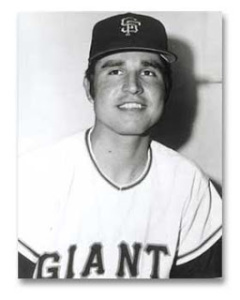
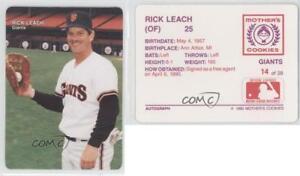
He was a Giant? Feature on former Giant Rick Leach by Tony the Tiger Hayes

Rick Leach former San Francisco Giant on his 1990 Mother’s Cookies baseball card (ebay photo image)

HE WAS A GIANT?

Rick Leach – OF/1B – 1990 – # 25

By Tony the Tiger Hayes

In 1990, the “San Francisco Treat” didn’t just refer to the family of tasty Rice-A-Roni dishes, it also described the City’s gourmet collection of quarterback talent.

That season a pair legendary Hall of Famers: Joe Montana and Steve Young, topped SF’s depth chart. Waiting deeper in the wings was the athletic passer Steve Bono.

But Candlestick Park was also home to another record setting signal caller whose college career rivaled all three of those Forty Niners QBs.

This south-paw passer was a four-year Michigan starter, Sports Illustrated cover boy and noted Ohio State killer: Rick Leach.

A college contemporary of Montana, Leach choose to persue a pro baseball career after leading the Wolverines to three straight Rose Bowl appearances in the 1970s.

In a backup role for the Giants in ‘90, Leach batted .293 in 78 games before abruptly leaving the club under a cloud of suspicion in mid-season.

Why Was He a Giant?

After seven checkered seasons in the American League – he went AWOL from a couple of teams – the Giants took a flyer on Leach after Atlanta released him in spring training of ‘90.

Before & After

Leach was the rare athlete whose lengthy big league career was considered an after -thought to his amateur completion in another sport.

Leach will forever be known first and foremost for his quarterback play at Michigan from 1975-78 when he led Big Blue to three consecutive Big 10 Conference Championships.

Though he went 0-3 in the Rose Bowl, Leach is an icon in Ann Arbor because of his ability to beat bad blood rival Ohio State. Leach compiled a 3-1 career record vs. the Buckeyes.

Though he dominated on the collegiate gridiron, Leach was considered an even better pro baseball prospect.

Along with fellow Michiganensian Kirk Gibson – who starred at the same time in both football and baseball at Michigan State – Leach signed with the home state Detroit Tigers in 1979.

Though he never reached star status on the diamond, Leach was a serviceable back-up, compiling a career average of .268.

He was actually having one of my his best MLB seasons with SF when he suddenly vanished with a puff of smoke in early August of ‘90.

Actually that may have been the problem. After one of his previous unexcused absences with Texas, authorities discovered a stash of weed in his hotel room.

On 8/7/90 it was announced that Leach had failed a league mandated drug test and was suspended 60 games – effectively ending his season – and as it turned out his baseball career.

He Never Got His Own (Giants) Bobblehead. But…

After Giants opening day starting RF Kevin Bass was shelved with knee surgery in late May, Leach became the Giants de facto starting RF for a spell.

He was particularly adapt at hitting in difficult Candlestick Park, batting .341 there, a full 100 points better than his road average.

In a 7-3 home shellacking of Houston (6/3/90), Leach tied a career high with four hits, going 4-for-5, with an RBI.

Later, in back- to -back 4-3 home wins over division rival Cincinnati (7/26-27/90), Leach bashed a HR in each contest- his only long balls for the Orange & Black.

He socked a two-run dinger off Jose Rijo in the first game and ripped a solo round-tripper off Scott Scudder in the later.

Giant Footprint

Leach was a productive and popular Giant, making it all the more difficult for the club when it was announced he was suspended for the remainder of the ‘90 contests season.

“This is a real shock. He’s devastated,” said Giants manager Roger Craig. “He’s done so much for us. He’s been a real leader. We’re going to have to pick up from here.”

A year after winning the NL pennant in 1989, the Giants would finish third, six games behind Cincinnati.

Leach was with the Giants in spring training in 1991, but was a late cut. He never played organized ball again.

Tony the Tiger Hayes does He was a Giant? features at http://www.sportsradioservice.com
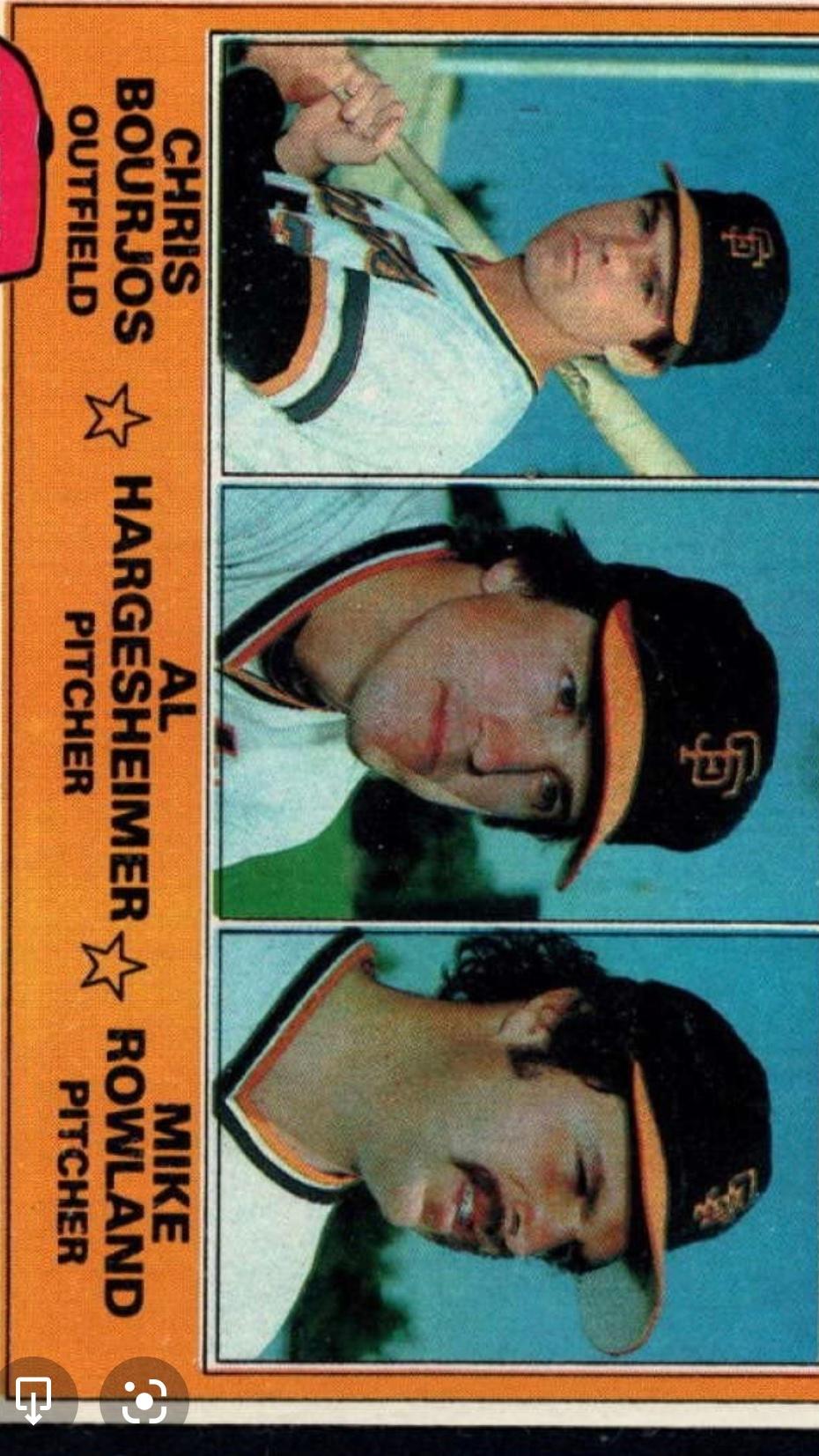
They were SF Giants? Chris Bourjos, Al Hargesheimer, and Mike Rowland former Giants history

Topps 1980 baseball card rookie card of San Francisco Giants Chris Bourjos, Al Hargesheimer, and Mike Rowland

Chris Bourjos – OF – 1980 – # 18

Al Hargesheimer – RHP – 1980-81 – # 40

Mike Rowland – RHP – 1980 – # 28

By Tony The Tiger Hayes

They Were Giants?

Unlike the “Chicago Eight,” the hirsute counterculture contingent of Yippies, socialists and Black Panthers that gained noterity for their arrests at the bloody Chicago 1968 Democratic Convention – this Giants’ “Chicago Three” were never accused of Inciting to Riot or Conspiracy.

Not unless you believe this trio – who were all born in Chicago -conspired to make their MLB debuts at the same time for old school, tobacco spittin’ manager Dave Bristol and the woebegone 1980 San Francisco club.

Then they would have been guilty as hell.

Why Were They Giants?

Two years removed from the revolutionary 1978 season, the Giants bottomed out in a big way in ‘80, finishing 17 games off the pace of the NL West Champion Houston Astros. In the process the Giants drained the minor league system looking for anyone that might help going forward.

Among the dozen or so call ups that season were this trio of Windy City natives who would have been in high school when Bobby Seale, Abby Hoffman, Jerry Rubin, Tom Hayden and the other four All-Star Protesters were running amok in the streets of Chicago in ‘68.

Before & After

Bourjos (free agent, 1977), Hargesheimer, (free agent, 1978) and Rowland (22nd round, 1975) were all signed and developed by SF.

Bourjos, a Pete Rose lookalike, played four seasons in the Giants minor league system and jumped around each year. After batting .295, 9, 86 for Phoenix in ‘80, Bourjos was called up to the parent club in September.

After his Giants cameo that month – 13 games – he was traded to the Astros, but never got another shot in the majors.

The athletic Hargesheimer made a similar swift rise to the Giants, debuting in the summer of ‘80 and winning his first two starts. He finished the season at a respectable 4-6, 4.32. He returned briefly in 1981, but was soon traded to his hometown Cubs.

The burly Rowland – with his unruly curls and droopy mustache looked as if he may have picked up a few style tips from Abby Hoffman – toiled in the minors six seasons before joining the SF bullpen.

“I want to get there, I want to get there bad,” said Rowland prior to his promotion. “But I don’t think I’m obsessed with it.”

Despite better than expected results, turns out the Giants weren’t obsessed with Rowland.

He would stay up with SF just parts of two seasons, despite fashioning a 1–2, 2.74 record in 28 contests.

They Never Got Their Own Bobbleheads. But…

In a game at Cincinnati late in ‘81, Hargesheimer was dominate, putting a major roadblock in the way of the Reds postseason goals, allowing just four hits in seven scoreless frames. Greg Minton pitched the final two frames to preserve the W for Hargesheimer and a 4-0 shutout (9/28/81).

“He kept them off balance all night. I think he was more relaxed tonight. He was a little bit more prepared for this start,” said Giants manager Frank Robinson.

Rowland and Bourjos’ top performances as big leaguers came in the same Candlestick Park game vs. the soon to be ‘80 World Series Champion Philadelphia Phillies (9/3/80).

After starter Allen Ripley and reliever Tom Griffin allowed four runs through six innings, Rowland came on and pitched a perfect three frames, in the process getting Pete Rose on a grounder and striking out Mike Schmidt.

Philadelphia starter Dick Ruthven took a 4-1 lead to the bottom of the ninth when SF’s bats suddenly came alive.

Joe Pettini, another of the rookie call ups led off with a line drive single to left. With Rowland due up next, Bristol called on Bourjos – who had yet to collect a big league hit – to pinch hit.

On a 1-1 count, Boujos connected with a Ruthven fast ball and slugged it high and far into the warm September night for a breathtaking home run.

Unfortunately the Giants would lose 4-3, but it was still a memorable night, especially for Bourjos, who in his excitement sprinted around third base and had to put on the brakes before bypassing Pettini.

“I just couldn’t trot. I was too exited,” said Bourjos post game. “Right now I just feel full of energy.”

Giant Footprint

In the psychedelic era, head shop owners couldn’t keep “Chicago Eight” posters in stock. They were staples of radical college students dorm rooms everywhere.

Now, you won’t find much Giants memorabilia in Haight – Ashbury stores that sell funny pipes, but the “Chicago Three” did something the bull-horn toting crowd never did.

They got their own baseball card.

Topps “Future Stars” card No. 502 of the 1981 set pictured in neat alphabetical order left to right Bourjos, Hargesheimer and Rowland in clear head shots taken on spring training fields.

Now that was something to shout about.

He was a Giant? 50 Years Ago Giants Mexican Rookie Was Orange & Black One Hit Wonder

San Francisco Giant pitcher Migel Puente in 1968 file photo from JG Preston Experience wordpress.com

He was a Giant?

By Tony The Tiger Hayes

Cinco De Mayo Special

50 Years Ago Giants Mexican Rookie Was Orange & Black One Hit Wonder

MIGEL PUENTE

RHP – 1970 – # 41

In the spring of 1970, Norman Greenbaum – a an unknown San Francisco songwriter – became an improbable overnight sensation with his unorthodox divine anthem “Spirit in the Sky.”

Greenbaum’s take on psychedelic gospel rose as high as no. 3 on the Hot 100 – shockingly, competing for airtime with the Beatles and Jackson 5 – before his star soon faded.

Though the groundbreaking rock track would live on in cover versions, commercials and soundtracks, the name “Norman Greenbaum” would never again pass the lips of Casey Kasem.

During that same time frame, the Giants celebrated a one-hit-wonder of their own in Mexican pitcher Puente, who on his birthday came out of obscurity to knock ‘em dead for one night – and one night only – on center stage in New York.

But like Greenbaum, Carl Douglas and the Starland Vocal Band, Puente’s follow-ups went straight to the cut-out bin.

Why Was He a Giant?

A native of the central Mexico city of San Luis Potosí, Puente was discovered by Giants scout Dave Garcia who would manage Puente as a first-year pro at Single-A Fresno in 1968.

After pitching a Texas League no-hitter at Double-A Amarillo in 1969, the right-hander with a big kick found himself being compared to, you guessed it, Juan Marichal.

Puente shadowed his idol the following spring training, even picking up Marichal’s signature screwball pitch.

“(Marichal) didn’t teach it to me,” Puente told reporters. “He’s a star and he’s very busy, so he wouldn’t have time to teach me. But I stood around in spring training and watched him and just copied him.”

Before & After

Ironically it was when the “Dominican Dandy” was shelved with an adverse reaction to a penicillin shot early in the ‘70 campaign that Puente got a call-up to the bigs.

Overall Puente was not impressive as a Giant. He was shelled for five or more earned runs in three of his six appearances. Puente’s Giants record stood at 1-3, 8.20 and he never played in the majors again.

Puente would soon return to his native Mexico where he continued to pitch professionally for the remainder of the 1970s.

He Never Got His Own Bobblehead. But…

New York City was abuzz on the night of 5/8/70. At Madison Square Garden, the Knicks dramatically won the NBA Championship, beating the Lakers in a dramatic Game 7 (the Willis Reed game) to give NYC it’s third pro championship in a year.

Meanwhile more than 40,000 fans turned out a across town to see the visiting Giants take on the defending MLB champion Mets on a cool evening at Shea Stadium.

Puente, who turned 22 that day, would go the distance vs. New York, allowing seven hits, walking four, while striking out seven.

Powered by a pair of HR by Willie Mays and another off the bat of Bobby Bonds, the Giants won easily 7-1.

“There were so many people watching,” Puente said as teammate Tito Fuentes presented him with a huge wedge of birthday cake. “I have never pitched before so many people before.”

Giant Footprint

Probably the most famous birthday performance by a Giant came on Barry Bonds’ 39th when the HR King crushed a walk-off solo blast off Mike Myers at Pac Bell Park to settled a spirited 3-2 win over Arizona (7/24/03).

But you can’t go wrong with Bob Knepper’s 25th b-day party of 1979 when the lefty starter went 7.1 innings, earning a win, and hit a solo HR high into the night sky off future Hall of Famer Phil Niekro in 6-4 home defeat of Atlanta (5/25/79).

P.S. Believe it or not, San Francisco has had just two other Mexican born players: RHP Miguel Del Toro (1999-2000) and IF Tony Perezchica (1988, 1990-91).