He Was a Giant? Ron Hunt 1968-70 by Tony the Tiger Hayes

An autographed 1968 Ron Hunt picture with the San Francisco Giants (photo from ebay)

He was a Giant? Ron Hunt 1968-70 2B #33

By Tony the Tiger Hayes

Some boys shy away from playing baseball because they are afraid of getting hit with the ball. That was never the case with Ron Hunt. In 2010, Giants broadcaster Duane Kuiper memorably coined the phrase, “Torture” to characterize the numerous vexing way the team managed to win ball games in San Francisco’s first ever World Series title season.

But that wasn’t the first time the Giants or – in this case, a singular Giant – endured high levels of pain and misery while and benefiting the Orange & Black.

Forty odd years earlier, Giants infielder Ronald Kenneth Hunt took torture to a variant- more personal – level, when he became an unofficial crash test dummy for the Orange & Black.

During his three seasons with the Bay City Bashers from 1968-70, Hunt was drilled, plunked, and bonked by pitched baseballs, a staggering – pun intended – 81 times.

If given the opportunity, Hunt would typically retrieve the offending baseballs that slogged him and nonchalantly toss them back to the pitcher as if they were mere nuisances.

For seven consecutive seasons starting with his first year with San Francisco in 1968, Hunt led the bigs in getting whacked by pitchers.

He never complained.

As a Giant strictly, Hunt accumulated a combined 50 hit by pitches over 1968-69. In 1970 – his final campaign with San Francisco- Hunt set – what was then – the modern day HBP record, amassing an astounding 31 uniform tickers and flesh finders.

But Hunt was only getting the started.

In 1971 – after a trade to Montreal Expos (more on that later) – Ron took his niche skill set to a new level when he piled up a shocking 50 HBP pitches to set a non-dead ball era standard.

“He would turn his back away from the pitcher and deflect the ball with that spin move, so that he avoided those direct hits,” former Expos play-by-play man Dave Van Horne said. “To the average person, it would look like he was trying to get out of the way of the pitch, when, in fact, he just wanted to stand in there and take it.”

Overall, in his 12 big league seasons, the St. Louis native took a perpetual pummeling in the batter’s box -averaging 22 beanings per season for a whopping grand total of 243 HBP over his career.

Buoyed by his uncanny ability to get popped by pitches and a base-on-balls friendly approach to batting, the second baseman carried a lusty .368 on base percentage during his career.

Hunt is the Poster Boy for getting clobbered by pitches – and his niche baseball skill only blossomed as a Giant.

While Hunt was bonked a higher than average number of times as a member of the Mets (1963-66) and Dodgers (1967), his magnet-to-steel-like attraction to pitched baseballs really began to excel after he joined the Giants roster in 1968.

For starters, the City by the Bay’s summer-long cool climates allowed for Hunt to comfortably wiggle into an undercover hardball cushioning scuba diving suit – an accessory he occasionally employed as a New York Met – more often at frosty Candlestick Park.

But aside from feeling less agony thanks to the wet suit, you can also thank Hunt’s Giants teammates for justifying his willingness to take a batter’s box beating.

Though the scrappy Hunt had a reputation as a bit of a red ass, his Giants teammates in general didn’t have callus feelings about the apparent bullseye painted on their second basemen’s back.

But the Giants also realized Hunt’s habit for having his arms, backside and occasionally head blocking the path of fastballs was good for San Francisco’s bottom line.

While Hunt’s previous team’s lineups – especially the woeful Mets – were largely composed of journeymen and banjo hitters, his Giants bat swinging cohorts resembled a barnstorming All-Star team, with Willie Mays, Willie McCovey and Jim Ray Hart, and a phenom vintage Bobby Bonds filling out the heart of the lineup.

All Hunt had to do was get on base by any means necessary and then wait for the Giants big bats to drive him home.

Sure enough, Hunt was a top three finisher in runs scored in each of his three Giants campaigns.

Giants run totals also climbed considerably year- to- year in each his three seasons with the club.

Hunt’s single game piece de resistance came in a Giants 4-3 win over the visiting Cincinnati Reds (4/29/69) when he was walloped three times – to tie New York Giant Mel Ott’s MLB single game record – by a trio of three different pitchers: Eddie Fisher, Wayne Granger and George Culver. Hunt also collected a hit in the win.

During his stay in Fog City, Hunt had perfected his HBP skills to the point where he rarely missed any action despite the constant pitched pastings he endured.

While never admitting that he aimed to get plunked on purpose, Hunt certainly didn’t shy away from inside pitches.

“First I would blouse the uniform — this big, wool uniform, I would make sure it was nice and loose,” he once told a reporter.

“Then I’d choke way up on the bat, and stand right on top of the plate. That way, I could still reach the outside pitch. That was the Gil Hodges philosophy on hitting: The two inches on the outside corner were the pitcher’s, the rest was his. I thought, ‘If I can take away those two inches, and he’s not perfect, I can put the ball in play and get some hits. And if he comes inside, I can get on base,” Hunt concluded.

Why Was He a Giant?

While Hunt’s penchant for HBPs, was his baseball calling card, he was also part of the historic first ever trade between the San Francisco Giants and Los Angeles Dodgers.

The extremely rare player swap between the blood rivals went down a full nine calendar years after both clubs decamped New York City for California.

After spending his first four seasons of big league ball with the Mets, Hunt was traded to the Dodgers after the 1966 season. But after just one season in Southern California, Hunt was shipped to Northern California along with infielder Nate “Peewee” Oliver in exchange for the longtime Giants starting catcher Tom Haller.

A player of Hunt’s steadiness and gritty demeanor was greatly appreciated by Giants manager Herman Franks, who had grown weary of the Giants infield inconsistency in the mid-1960s.

In 1968, the reliable Hunt set the tone for his Giants tenure, appearing in 148 games (tied for tops on the club). While his .250, 2, 28 stat line was routine, Hunt boasted an excellent .371 on base percentage thanks to 25 HBP and team best 78 walks. His 79 runs trailed only Mays and McCovey on the club.

“I was taught early that there is only one way to play the game and that is to play to win,” Hunt explained. “Sliding into a base and trying to take an infielder out of the play is part of the game. I expect others to do the same.”

Hunt’s on-field production in 1969-70 campaigns were virtual redux of his Giants debut year.

In terms of regular season wins and losses, the Giants were an extremely successful outfit in Hunt’s tour with the club, going a composite 264-222, but they were not able to reach the postseason in those years.

After finishing in second place behind Atlanta in 1970, the Giants indicated they would go with a younger roster in 1971.

The 30-year-old Hunt was informed he would likely be traded or moved to a utility role.

Sure enough, the following offseason, Hunt was traded to the Montreal Expos for the obscure Dave McDonald. The young outfielder’s entire big league career had consisted of a handful of games with the Yankees the previous summer.

Despite the forewarning, Hunt was besides himself when the trade was announced. He publicly blasted former Giants managers Clyde King and Charlie Fox who replaced Franks in rapid succession after the ‘68 season.

But Hunt saved his best material for Horace Stoneham, claiming the Giants owner – a man known as a cocktail connoisseur- was quite possibly half-in-the-bag when negotiating his trade to Montreal.

“Look who they traded me for! I can’t believe that’s the best they could do,” Hunt bellowed. “Stoneham must’ve been drunk when he made the deal.”

Though he went from a club laden with star talent to a last place club, Hunt was too far along into his HBP act to play it safe, he took even more abuse in 1971 racking up 50 HBP as an Expo.

Hunt acknowledged at the time that no kid ever dreams of getting athletic notoriety for getting beaned by baseballs, but he was hardly embarrassed.

“You’ve got to be proud of getting your name in the record books – I just take things as they come,” Hunt said. “I wouldn’t change my style because if start bailing out I won’t be an effective hitter. So I might as well just stand up there and take it.”

Take it he did.

When he retired from Major League Baseball after the 1974 season, Hunt held the sport’s modern day HBP record with 243. He’s since been passed by Jason Kendall (254), Don Baylor (267) and current modern day HBP leader Craig Biggio (285). Hall of Famer Hughie Jennings – a one-time Giants manager – a dead-ball era player is the all-time official HBP leader at 287.

Tiger’s Treasure Trove: He Was A Giant? Randy Elliott

Randy Elliott outfielder for the San Francisco Giants 1977 #16 (1977 Topps Baseball card)

Though treasured by critics and fans alike, the classic sitcom “Seinfeld” is known as a television show about “nothing.” Spring Training isn’t dissimilar. 

By Tony The Tiger Hayes

While Spring Training has become less and less practical for millionaire ballplayers – generational financial security makes year round training much easier – the sport’s preseason warmup period has become increasingly popular for sports and good-time seeking tourists over the past two decades

Spring Training has became the ultimate drug for geriatric thawing snowbirds and spry spring breakers seeking relaxation and fun in the sun.

But if you’re looking for competitive action – you’d be better off spying souvenir seekers jockeying for autographs alongside dugout railings in a preseason setting more accessible than the regular grind.

But don’t ever think of telling former big league outfielder Randy Lee Elliott that Spring Training is an exercise in unimportance.

The former Giant forever wrote his name in baseball history in 1977 when he produced arguably the greatest Cactus League campaign in the history of baseball.

This current spring, unsung Giants prospect Ismael Munguia opened eyes – winning the Giants Barney Nugent Award for best performance by a spring training newcomer with a scintillating Cactus League performance.

But somewhere along California’s central coast, Elliott was likely saying, ‘hold my beer’ in response.

In the spring of 1977 Elliott batted a jaw dropping .547 (29-for-53, with a whopping 18 extra base hits.

Within one month, Elliott went from a giant after thought to Giants Folk Hero.

Why Was He a Giant?

Though this California native played in 114 Major League regular season games over parts of four Major League seasons, Elliott would have fallen into the spittoon of big league obscurity if not for his dominating performance during San Francisco’s 1977 Cactus League campaign.

Though he had not played in a professional game since mid-1975, inactivity was hardly an issue for Randy who came to camp as a non-roster invitee.

Elliott quickly made himself comfortable at home plate –

rampaging through opposing pitching as if he were swinging an oversized cartoon bat.

As most of the country was still struggling with winter permafrost and new President Jimmy Carter, Elliott was all ready heated like a wood burning furnace on full blast stove on the first day exhibition season.

With the team in flux with a new manager Joe Altobelli and prime opportunities in the outfield, Elliott banged 13 hits in his first 18 at bats of the preseason.

By late March, Elliott was still scorching hot, as his average hovered at an ungodly number.

“It is quite obvious that Randy intends on making the club,” said Altobelli, after Elliott smoked a pair of hits including a 425-foot round tripper in a mid-spring contest March 27 vs. the Brewers and watched his average DROP 15 points to .653.

Making Elliott’s spring story even more remarkable was the fact he had missed the entire 1976 season with a shoulder separation. The debilitating injury, which occurred in mid-1975, and sidelined him throughout the 1976 season, leaving Elliott to wonder if his big league dreams had fizzled.

But the Giants- who had organizational issues on a par with outfielder’s injuries – took a flyer on Randy, inviting him to their Winter League Instructional League in late ‘76.

Elliott quickly shook off the rust and batted .331 in the Arizona based loop. Next came an invite to 1977 Spring Training.

San Francisco was hoping to stow away the Padres former top draft pick at Triple—A Phoenix. In emergency he would be a phone call away.

But Elliott had a different goal: securing a spot on the Giants Opening Day roster. Those were big plans for a guy who had essentially spent the previous summer jogging and lounging on Santa Barbara beaches.

“I figured this was my last year to make it to the big leagues. I knew if I didn’t have a heck of s spring training I’d be back at Triple-A ball,” Elliott told the Giants beat scribes. “I’m 25 now and have been in the minors for quite a long time now. The clubs start to lose interest after awhile.”

Before & After

On his 18th birthday in June of 1969, Elliott – a top prospect out of Camarillo High School – was selected by San Diego in the first round (24th overall) of the 1969 amateur draft. He waisted little time showing his ability, batting .302, 4, 50 that summer in the the expansion club’s rookie league team at Salt Lake City and then followed up with two solid seasons in 1970-71 at Single-A Lodi in the California League.

After a breakout campaign at Double-A Alexandria of the Texas League in 1972 (.335, 19, 85) the Padres appeared to have found their first home grown star in Randy and promoted to him to the big leagues in September of ‘72.

Elliott smacked his first two big league hits against future Hall of Famer Phil Niekro in a 4-1 loss at Atlanta (9/10/72). Later in the season Elliott rocketed a go-ahead RBI pinch hit triple off the Dodgers Claude Osteen in a 5-3 Friers win at Los Angeles (9/25/72)

But despite showing flashes, the 21-year-old appeared over matched in his big league audition, mustering just a .204 average (10-for-49, with 11 strikeouts).

Still the future looked extremely bright for Elliott heading into the 1973 season. Besides break out slugger Nate Colbert, San Diego had no established starting outfielders,. With a strong spring Elliott was capable of winning a starting gig with the woeful Padres.

But instead of a breakout campaign, ‘73 marked Elliott’s first extended stay on the disabled list. Shoulder and rib injuries limited Elliott to just a handful of minor league games that season making it overall a lost opportunity to propel his fledgling career.

After knocking off some initial rust, an able-bodied Elliott rebounded mightily in 1974 at Triple-A Hawaii. The burly Californian’s bat must have resembled a long board to opposing pitchers as he batted a mighty .321, 11, 69 in the Tropical setting.

Again, the Pads came calling after his luau style feast on PCL pitching and invited him to wear Brown & Mustard Yellow in September. Elliott crushed his first MLB long ball that month, ripping a solo poke of Reds ace Don Gullett in a 5-2 road loss (9/10/74); he also achieved his first three hit game as a big leaguer – batting 3-for-4 with a double and RBI in a 3-2 home win against San Francisco (9/25/74).

Elliott found himself back in paradise- Honolulu- in 1975, but not in the major leagues. His PCL numbers were solid, but he also spent more time on sidelines with injuries – he’s achilles heel turned out to be his left shoulder. The debilitating separation injury would linger for the rest of his career.

Meanwhile San Diego, wary of Elliott stalled progress moved up three top prospects- Dave Winfield, Johnny Grubb and future Giant Mike Ivie ahead of him on the depth chart.

Elliott’s days as a Frier were cooked.

The California Angels took a flyer on Elliott in 1976, but the shoulder situation kept him sidelined for the entire campaign.

The Giants- who’s outfielder situation was murky – had many players rated higher on their depth chart

Veterans Bobby Murcer and Gary Matthews had decamped via trade and free agency respectively, but the Giants outfield situation was still chock-a-block with contenders for at-bats. There were veteran holdovers Gary Thomasson and Darrell Evans as well youngsters Jack Clark, Larry Herndon and Terry Whitfield. Former Dodgers stalwart Willie Crawford was also in camp.

Elliott, shockingly, outperformed them all that spring- and it wasn’t even close.

With a week to go in spring camp, Altobelli, announced that not only had Elliott made the parent club, he was strongly being considered to start in left field on opening day in Los Angeles.

Elliott vowed to make Altobelli a proud rookie skipper. “The conditions this spring were just right, I don’t know if another manager would have given me such a complete look as Joe,” he said.

He Never Had a Giants Bobblehead Day. But…

As it turned out, Elliott did not receive the Giants Opening Day left field starter assignment in Los Angeles- Thomasson received the nod a promptly clubbed a home run to lead off the game and season vs. Don Sutton.

But Elliott was in the lineup the following game vs. Dodgers lefty Doug Rau. In his first at bat however, Elliott was hit by a pitch by Rau … on his problem shoulder. On his next at bat Elliott felt his shoulder popped loose.

He was back at square one. Not wanting to go back on the disabled list Elliott soldiered on.

The starting assignments dwindled as did his batting average. Elliott managed to stick with the parent Giants for most the 1977 season and became an adapt pinch hitter slugging three pinch home runs that season including a grand slam off the Reds Fred Norman.

In 73 games with San Francisco, Elliott batted .240, 7, 26 – all career highs.

Elliott did not play organized ball in 1978-79, but he returned to the professional ranks in 1980 and even played in a handful of games with the Oakland A’s before retiring from the sport.

Years later, Elliott was philosophical about his time in baseball and the that spring training with the Giants.

“(I played so well) because shoulder stayed in the whole time,” he told the Chronicle. “When my shoulder was healthy, I could play.”

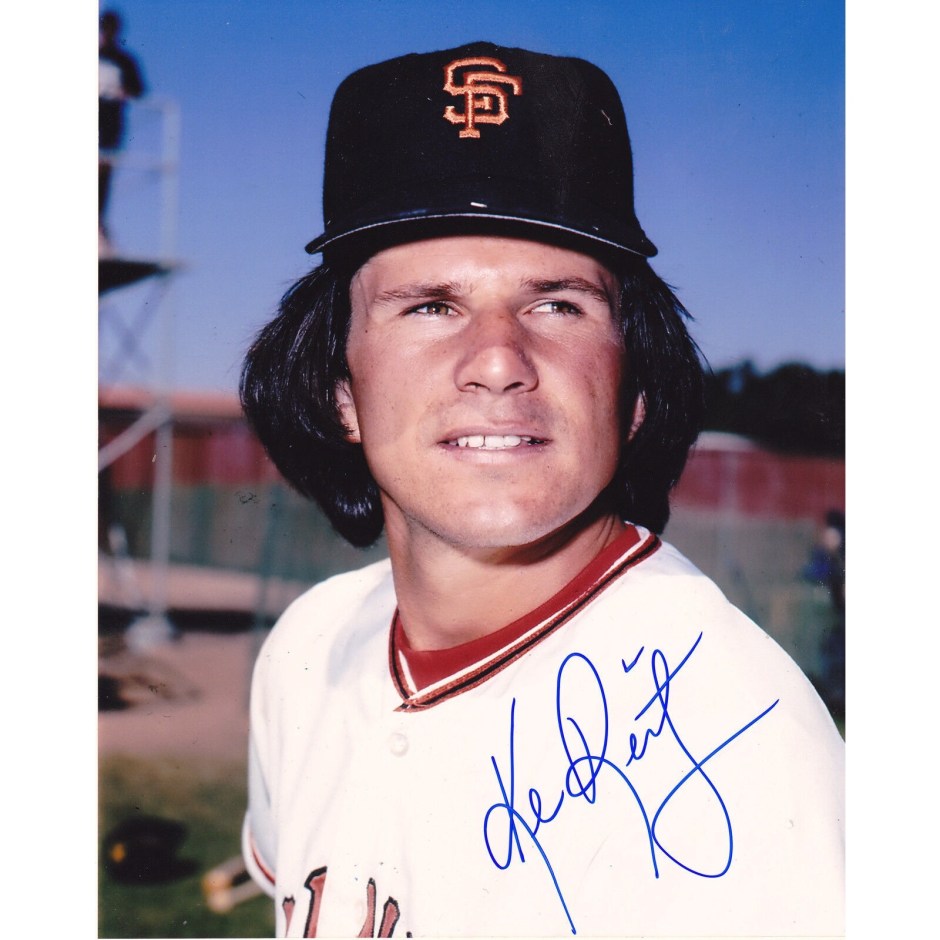
He was a Giant? Ken Reitz -3B – 1976 – #14 by Tony the Tiger Hayes feature article

Ken Reitz as a San Francisco Giant in 1975 (photo from Steiner Sports)

He Was a Giant?

Ken Reitz

By Tony the Tiger Hayes

Apparently San Francisco native Ken Reitz was on the Giants “Most Wanted” list after all.

And not for the reasons he may have envisioned.

Reitz – who grew up near the Cow Palace – had a love of sports and rooting for the Giants as a kid. Unfortunately, like most of the others kids in hard scrabble neighborhood on the Daly City border, Reitz also grew up with an

evergreen hole in the pockets of his blue jeans.

So when he wasn’t playing local organized sports, to feed his Giants appetite Reitz was honing his skills as one most prolific ticket taker evaders in the history of Candlestick Park.

While other kids in the neighborhood preferred the old bum’s rush approach to sneaking into Candlestick, the scrappy Kenny was better at scaling the exterior cyclone fences that surrounded the old concrete bowl.

So when Reitz received a call from the Giants in December of 1975, you couldn’t really blame him if he thought the financially struggling club was calling to collect on those unpaid tickets.

Thankfully, they were not. But the real reason the club’s director of scouting Jerry Donovon was calling was only slightly less troubling.

The Giants, who had long struggled at the box office, were on the brink of bankruptcy, and frantically looking for someone to purchase the club.

Meanwhile, the slick fielding Reitz had established himself as one of the most reliable third basemen in the the National League in his three season’s as the Redbirds main man at the Hot Corner (1973-75).

When the call came from the Giants, Reitz had just been awarded the league’s Gold Glove Award for third baseman.

Further more he had just bought a home in St. Louis and was looking to settle down the “Gateway to the West” city.

“First, I was shocked by the trade,” Reitz admitted. “ I thought there was one chance in a hundred that I’d be going so soon. And if I was going, I was wishing it would be to the Pirates. I’d been hearing that they were willing to give up Al Oliver or Richie Zisk for a third baseman.”

But once reality set in, Reitz grew to appreciate the deal to the Giants, or so he let on.

He’d be working out of the same clubhouse as his childhood hero’s.

“Now that I’ve thought about it I’m kinda glad to be a Giant. Id like to help turn the franchise

around. It was such a great one when was a kid, with Mays, MeCovey. Marichal and those wonderful players. Its been painful to see the franchise go down hill.”

The club was hesitant to deal Falcone – coming off a fantastic rookie season, but the hole was glaring at the hot corner.

The Giants had never really filled the position after the venerable Jimmy Davenport retired in mid-1970.

“I enjoyed watching Davenport. He was so steady. The team had superstar but Jimmy made so many contributions and was so consistent that you had to leave the ballpark as an admirer,” Reitz said.

Reitz attended his first Giants game in 1959, back at Seals Stadium, the club’s first San Francisco home after decamping New York.

“I was about six years old, I can’t remember who the Giants were playing but Willie McCovey hit two home runs.”

When Reitz reported to spring training in 1976 he was uniquely greeted by Bill Rigney, manager of the Giants in the first game Reitz attended. The elderly Rigney was rehired to manage the club in 1976 by new team owner Bob Lurie.

“He’s a professional player,” Rigney said of Reitz. “There isn’t anything he can’t do.”

Reitz would have a decent season in 1976 for the Giants, his only as a Giant. In 155 games, second most on the club, Kenny batted .267 with 5 home runs and 66 RBI for a fourth place Giants club that suffered from inner dissension and poor attendance at freezing Candlestick.

Nearly one year to that day that he was traded to his hometown team the Giants traded Reitz back to the Cardinals for right-handed pitcher Lynn McGlothen.

Reitz wasn’t shy about his joy returning to the mid-west.

“I’m real happy and saying that might be mild. There are many negative things out in San Francisco,” he said. “The writers are always on your back and the fans are rough on you too. I’m so happy, I can’t stand it.”

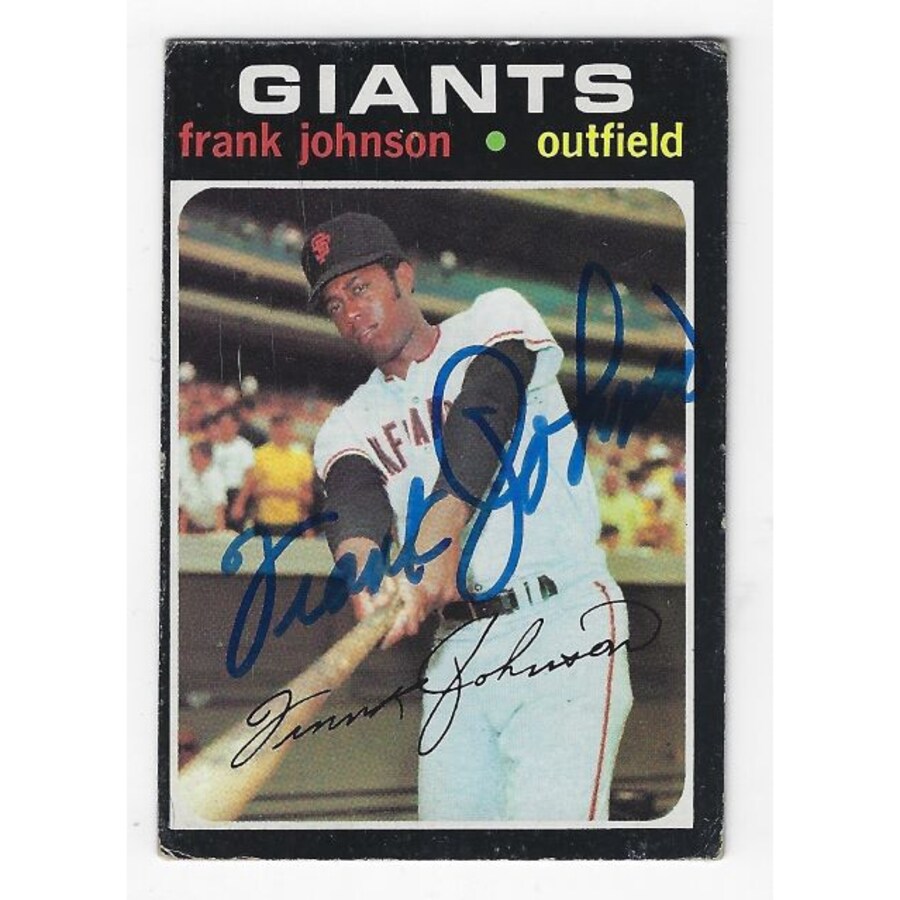
He was a Giant? Frank Johnson – OF/IF – 1966-71 – # 20; By Tony the Tiger Hayes

Former San Francisco Giants infielder/Outfielder Frank Johnson (photo from 1971 topps baseball)

By Tony the Tiger Hayes

Frank Sinatra was rarely seen out out and about sans imposing Paisan Jilly Rizzo lurking

Elvis didn’t venture two steps outside the gates of Graceland without the Memphis Mafia.

And NBA player and full drag aficionado Dennis Rodman made sure good buddy Jack Haley always had a seat at the end if the bench wherever his NBA travels took him.

Since the beginning of recorded time, bigwigs and heartthrobs have surrendered themselves yes men and back slappers.

Hey who doesn’t enjoy being told how great they are.

But Willie Mays was one baseball superstar who didnt girdle himself with toadies and personal trainers as his Godson Barry Bonds would infamously do years later during his storied years with the Orange & Black.

Willie didn’t hang with Hollywood glitterati or spend his nights tripping the light fantastic – he was actually somewhat of a loner.

But Mays was not without a Candlestick cortege. While Mays didnt often publicly talk about his charitable work – as writer John Shea documented in his New York Times best seller “24” – Willie received as much joy working with and assisting children and young people as he did making basket catches and sending Russ Hodges into a frenzy with his “bye, bye baby!” round tripper calls.

And while Mays did not surround himself with a classic entourage he did have a Candlestick Park crew of young outfielders – particularly those of black American heritage – he liked to dote on during his long Orange & Black career.

Young fly chasing prospects such Bernie Williams, Ollie Brown, Garry Maddox, Ken Henderson, Gary Matthews, George Foster all few under Mays tutelage.

Another was the now largely forgotten El Paso, Texas born and raised outfielder named Frank Herbert Johnson.

Though his fanfare never exceeded the level of an inaudible whisper, Johnson actually spent six straight seasons in the big leagues alongside Willie and the Orange & Black.

While we would never label Johnson a Hangers-On, from 1966-71, he certainly did a lot of hanging around for the Giants.

Despite seeing big league action every season from 1966-71 never rose above benchwarmer status.

Giants were a well oiled machine in the 1960s with a stacked lineup and unforgiving pitching staff. There just wasn’t many opportunities for Frank to break into the Giants starting lineup.

What kept the club coming back to Johnson was his unselfish attitude and willingness to play multiple positions. Though primarily an outfielder, Johnson made close to 50 starts at third base for San Francisco. As a Giant he logged time at each position, sans pitcher and catcher.

Though his overall numbers don’t jump out at you – the handsome journey man contributed enough in the margins to make it and did his share to make the Giants one of game’s top winning clubs and highest drawing club’s of the 1960s.

Why Was He a Giant?

Giants super-scout George Genovese discovered and signed Johnson out El Paso’s Bel Air High School in June of 1961. The 18-year-old – who was still a semester shy of graduation- had just led the Highlanders to the El Paso city championship as a dual school boy version of Shohei Ohtani. A prep third baseman and pitcher, Johnson batted .431 and posted a mound ledger of 8-3 the year he turned pro.

In his first year of pro ball, Johnson immediately opened eyes, tattooing Appalachian League pitching for a .314 average in 55 games. Of the 44 youngsters who suited up for the Salem Rebels during that 1962 season, Johnson was the only one blessed to make it to the majors.

Johnson continued to stroke the ball well over the next few seasons in the Giants system and by 1966 he had reached the Triple -AAA Phoenix Giants. No longer an inexperienced pro, the 23-year-old became the cactus Giants, most viable threats, batting .308 while competing for playing time with numerous future big league players.

Meanwhile up north at the home office at Candlestick Park, the Giants were rampaging through the ‘66 National League season.

On September 1, with rosters allowed to expand to 40 men, the Giants sat atop the NL, tied with Pittsburgh at 78-56.

A week later Johnson got the call to to the bigs and in his debut game with the Orange & Black, the rookie won a key game, driving home Willie Mays with his first Major League hit against none other than the rival Los Angeles Dodgers (9/7/66).

Tied 2-2 going to the top of the 12th at LA, Dodgers reliever Joe Moeller recorded two easy outs. With Mays due up next representing the possible winning run, Dodgers manager Walter Alston made the call to intentionally walk the fabulous Willie to get to Johnson after Moeller ran a 3-0 count to Mays.

Considering it was Johnson’s debut game, and the youngster had struck out in the 10th inning with Mays on base in his first big league at-bat, Alston considered the free pass a no-doubt decision.

But if Uncle Walt thought Johnson’s knees might be knocking in a late game situation, he was dead wrong.

Johnson, ram-rodded a line drive to right field and Mays – aided by a Dodger error scored all the way fro first.

“I was a little nervous,” Johnson admitted later in the visiting clubhouse between bites of a hot dog. “But it was just another ball game. I’d faced Moeller at Spokane so I knew a little bit about him.”

With the 3-2 win that night, the Giants sat a half game back of the Pirates.

Hoping to catch lightning in a bottle, Giants manager Herman Franks wrote Johnson’s name into the lineup several times over the next week.

In his first major league start Franks even shifted Mays, hampered by a groin pull, to right field and had Johnson play center field vs. the visiting Cubs (9/10/66). Johnson swatted a pair of hits but the Giants lost 12-3 in the Saturday matinee.

The Dodgers would eventually storm back to win the division-less NL, with San Francisco finishing in second place 1.5 games.

Despite the early promise, Johnson never could secure a regular spot in the Giants lineup.

Over the next five seasons he would shuttle between Phoenix and San Francisco. Johnson’s best campaign came in 1970 when he batted a career big league high of .273, with 3 home runs and 31 RBI in 67 games for San Francisco.

Johnson’s final Major League game came in June of 1971. He batted into a force out as a pinch batter in a 5-1 road win vs. the Mets (6/12/71).

After leaving the Giants organization after 1971 season, Johnson played a year in Japan with the Lotte Orions.

Giant Footprint

Though many players – including of course Willie Mays – played in at least six consecutive seasons with San Francisco.

And many have spent their entire big league careers exclusively with the Giants, only a handful of athletes played in six straight seasons with SF without never playing in the bigs with another club.

Those players are RHP Matt Cain, SS Brandon Crawford, C Mike Sadek, RHP Rich Robertson, IF Jimmy Davenport, C Buster Posey and… Frank Johnson.

He was a Giant? Roger Metzger-By Tony the Tiger Hayes

Roger Metzger black and white photo for autographing (photo by the San Francisco Giants)

Roger Metzger – SS – 1978-80 – #16

He Was a Giant?

By Tony the Tiger Hayes

For the first decade of his professional baseball career Roger Metzger was known as a quintessential “good field, no hit” shortstop. But after joining the Giants in mid-1978, the trajectory of not only his playing career, but his life, changed forever.

For the Cubs and Astros from 1970-78, Metzger, a career . 231 hitter, was a steady if unspectacular performer who could without question schedule a short vacation with the family during the annual All-Star Game break as the likes of Dave Concepcion and Larry Bowa lined up to tip their caps on the foul lines for mid-Summer Classic introductions during that era.

Metzger could usually also count on playing for a team without a shot at the post-season.

But that changed – at least for a few months – when San Francisco acquired Metzger from Houston in a trade deadline deal.

For the first five months of the 1978 season the Giants were a surprise legitimate contender for the National League West title.

After joining the Orange & Black Metzger would spilt time at shortstop the rest of the season with incumbent starter Johnnie LeMaster.

While San Francisco would eventually finish in third place in the West in ‘78, six games back of the Dodgers, Metzger thrived with the Giants, playing his typical stellar defense up the middle and batting .260 in 75 games after hitting just .220 in 45 games that season for the Astros before the deal.

Why Was He a Giant?

After a rather blah fourth place finish in 1977, the Giants came out blazing in 1978. Slugger Jack Clark blossomed into an All-Star, first baseman Mike Ivie scalded the baseball with a number of memorable hits including a magnificent pinch-hit grand slam against the Dodgers and cross bay trade acquisition Vida Blue gave the club an instant pre-fab ace and star attraction.

The club would stay near or atop the western division though out the summer of ‘78.

On June 15, the shocking Giants led the West by 2.5 games over the Reds when they acquired Metzger in a straight cash deal.

Before & After

Originally a first round draft pick of the Cubs in 1969, Metzger made his MLB debut just a year later, appearing in one game with Chicago in 1970. But with Don Kessenger established as their starting shortstop the Cubs dealt Roger to Houston the following offseason. The deal came as a blessing to Metzger who would not only be returning to his native Texas to play, but was joining an Astros team that was looking to upgrade defensively at shortstop.

The untested Metzger was immediately installed as the Astros starting shortstop, playing in 150 games as a rookie. Though Metzger would bat just .235, the speedy youngster took full advantage of the spacious Astrodome and led the NL with 11 triples. He would repeat the three bagger feat again two years later.

While Metzger’s overall batting average typically hovered just south of .250 and he possessed virtually zero power (just five career homers in more than 1,200 big league games), Metzger was also among the best defensive shortstops in the game during the ‘70s.

He won the NL SS Gold Glove Award in 1973, when he led the Senior Circuit with a .982 fielding percentage (just 12 errors) in 149 games. He had an even better statistically fielding season in 1976, but lost out in the Gold Gold voting to the more hyped Concepcion of the World Champion Reds who captured the fielding award every year from 1974-77.

He Never Had a Bobblehead Day. But…

In his third game with San Francisco, Metzger batted 2-for-4 and drove in two runs in a 3-0, Ed Halicki shut-out over Tom Seaver and the visiting Reds (6/21/78). In the fourth inning, Metzger laced a bases loaded single to center field off Seaver to score Clark and Willie McCovey.

That game would spark the hottest batting streak of Metzger’s career. After a three hit game in a 6-5 win at Pittsburgh which increased the Giants divisional lead to 3 games (7/15/78), Roger had batted .410 in over his first month (22 games) with the Orange & Black and temporarily replaced LeMaster as the Giants starting shortstop.

Giant Footprint

After his inspiring 1978 Giants debut, the club didn’t hesitate to bring Metzger back in 1979. While the club fell on its face with a disappointing fifth place finish, Metzger was his typical steady self, batting .251 in 94 games as a backup.

Just 32 years old, Metzger seemed to have a few more years left of pro ball. But during the winter offseason of ‘79, disaster struck Metzger. While involved with his beloved wood working hobby, Metzger accidentally severed parts of four fingers (index to pinky) on his fingers on his right hand with an electric table saw.

A dotting father of two sons, Metzger had been making a wooden playhouse for his kids as a Christmas gift in his Brenham, TX workshop.

“The saw hit across the grain the wrong way,” he told the New York Times. “I was pushing the wood with my left hand and guiding it with my right. When the saw grabbed the wood, the wood’s momentum pulled my right hand into it.”

Metzger, his right hand jammed into a bucket of ice, along with the severed tips in another container of ice, rushed to a local ER. Sadly, reattachment surgery could not be performed.

Despite the catastrophic injury to his throwing hand, Metzger soldiered on.

With former big leaguer Carlos May – who lost part of his thumb as a Military Reservist before resuming his playing career, as a role model, just three months later, Metzger reported to Giants spring camp.

Metzger stunned onlookers as he casually played catch with teammate Tom Griffin, who stood 70 yards away, on the first day of spring training.

“I couldn’t tell the difference,” said fellow shortstop LeMaster. “The guy has as much determination as anyone I’ve ever seen.”

Metzger though was cautious about his ability to hit at the big league level. The injury forced him to abandon switch-hitting and focus purely on left-handed batting.

“It’s the top hand that supplies the power,” Metzger noted. “I have to doubt whether I can hit right-handed.”

Miraculously, Metzger wound up making the Giants opening day roster in 1980 as the club’s utility infielder.

Roger would appear in 28 games, including seven starts at shortstop. In 69 innings on defense, he was charged with just one error.

Metzger was correct however about his batting. With his damaged hand, the valiant Giant could muster just a .074 average (2-for-27). He was released by the Giants on August 16.

He Was A Giant? Orel Hershiser By Tony the Tiger Hayes

Former San Francisco Giants pitcher Orel Hershiser is the subject of Tony the Tiger in “He was a Giant?” article feature (San Francisco Chronicle file photo)

Orel Hershiser – RHP – 1998 – # 53

He Was A Giant?

By Tony the Tiger Hayes

In 1998, the Orange & Black shocked their fans when they acquired a player who was about as popular at Candlestick Park as attending mid-summer night games in shorts and flip flops.

When it comes to Despised Dodgers, Orel Leonard Hershiser, IV is an all-time great.

We have the former Los Angeles goody two-shoes ranked as a Top 5 all-time Dodgers heel, trailing only Tommy Lasorda and Steve Garvey (you had to be there) and preceding Mike Piazza and Yasiel Puig.

Hershiser, who pitched for the Dodgers from 1983-94 and again in 2000, was a turn off to the Giants and their supporters on multiple fronts.

Not only did Hershiser pitch his best ball against San Francisco, he also epitomized the holier than thou attitude that permeated Los Angeles baseball during the nauseating “Big Dodger in the Sky” Lasorda era.

Hershiser came across as a baseball version of the sycophantic Eddie Haskell character from “Leave it to Beaver. ”

Like the fictional clean-cut teenager, Hershiser presented himself to the world with a gee whiz benevolence. But when no one was watching, all his supposed moral virtue flew out the window as he morphed into a mischievous wiseacre.

One night Hershiser could appear on the Tonight Show singing gospel hymns. The next, he was defiantly drilling Giants hitters and blaming his misfires on a poorly raked pitching mound.

Hershiser had the unique ability to get under the Giants skin like very few players.

Giants closer Rod Beck labeled the Buffalo, N.Y. native a “punk” after Hershiser spent the final game of the 1993 season verbally denigrating the Giants after L.A. took an insurmountable early lead in the crucial contest (10/3/93).

A Giants win that day would have forced a one game playoff with Atlanta, but the Dodgers 12-1 spanking sent the G-Men directly into the off-season, despite 103 regular season wins.

“Hershiser ragged on me the whole game from the top step of the dugout,” said a steamed Giants third baseman Matt Williams, implying the bench jockeying took on a personal tone. “If I face him again there will be line drives right back up the middle. You can bet on that.”

Hershiser was so loathed at Candlestick Park that he regularly required a full-blown San Francisco police escort when he entered and exited the field.

Yes, San Francisco fans cursed Hershiser’s very existence and the feeling was mutual.

“I don’t ever play relaxed in this ballpark,” Hershiser once said of the ‘Stick. “I don’t think they ‘re Giants fans as much as Dodgers haters.”

This was the player the Giants risked on promoting as the stabilizing component of their 1998 pitching staff.

The results could have been disastrous.

Why Was He A Giant?

In 1997, the Giants won their first division title in eight seasons. But they did so with a starting rotation that was middle-of-road at best. Left-hander Shawn Estes was a breakout 19-game winner. Fellow southpaw Kirk Rueter was steady and jouneyman right-hander Mark Gardner was adequate. But after that, there was a precipitous drop off.

To repeat their success in ‘98, Giants pitching would need an injection of professionalism and poise. A veteran arm, preferably one with postseason experience was at the top of San Francisco’s wish list. Shortly before Christmas, the perfect gift fell into the Giants lap.

The free-agent pick-up more than capably checked all the boxes. He was a record setting former Cy Young Award winner and World Series MVP with a truck load of big stage experience.

“He fits in our rotation near the top or right in the middle,” said Ned Colletti, the Giants assistant general manager. “He’ll be a great guy to have around Estes and Rueter and great for a few young guys who might be a year or two away.”

If Colletti was hesitant to mention Hershiser by name, it was with good reason. The club’s prospective new ace was roundly abhorred by Giants fans.

But after spending the previous three seasons in far flung Cleveland, Hershiser and the Giants brass were hopeful that the Orange & Black fanbase’s molten lava hot contempt for their new player had cooled sufficiently.

Hershiser allowed: “If Giants fans compiled a hate list, Tom Lasorda would be at the top… and I’d be next.”

But the long time blue blood announced he was willing to let bygones be bygones and hoped the feeling was mutual.

Orel then let everyone in on a little secret. Despite his long running animus with the Giants, he held a special kinship with Tony Bennett.

Yes, Orel Hershiser announced he had left his heart in San Francisco.

“San Francisco is my favorite part of the country,” he unabashedly pronounced, laying it thicker than the frosting on Lasorda’s birthday cake. “I’m a big fan of sweater weather. My family and I come here every year for vacation. We love the wine country and The City and everything it has to offer.”

Before & After

With a wholesome Donny & Marie veneer, Hershiser was one of the last guys you’re expect to be cast as a villain.

But early on, Giants fans had Orel pegged as part of the Dodgers weasel act.

In one of his first big league appearances, Hershiser pitched in relief against the Giants at Chavez Ravine on the night the Dodgers clinched the 1983 NL west (9/30/83).

The division title was finalized in mid-game when second place Atlanta lost at San Diego. As the Giants Darrell Evans stepped to the plate to face Fernando Valenzuela to lead off the 6th, the scoreboard announced the final from San Diego.

The game with the Giants was paused as a boisterous hullabaloo erupted in the Dodgers dugout.

With the outcome of the game vs. the Giants moot, Lasorda swiftly began swapping out key Dodgers from the lineup.

By the 7th inning Tommy had even removed himself from the game, hightailing it to the Dodgers clubhouse for a bulky wedge of sausage pizza and a full-blown celebratory shindig.

Rookie Hershiser who had been subbed in for Valenzuela, pitched the final two innings, earning a save in the 4-3 L.A. victory.

After the game, Giants manager Frank Robinson termed Lasorda, “the fat man” and ripped his opposite number’s contemptuous mid – game disappearing act.

“You see things and remember them,” said Robinson. “I don’t appreciate it. And I won’t forget it either.”

While Hershiser’s personal participation in that bit of arrogant theater was rather benign, he had officially been introduced into the long simmering rivalry. Without even knowing it, Orel was off and running as a long-term insufferable Dodgers bore.

Despite throwing a no-hitter in college and being named Pitcher of the Year in the Mid-American Conference, Hershiser was just a 17th round draft pick out of Ohio’s Bowling Green University by the Dodgers in 1979.

Though other clubs soon regretted not drafting him sooner, Hershiser was far from a finished project upon reaching L.A.

Lasorda fretted that Hershiser lacked a killer instinct and together with organizational pitching coach Dave Wallace worked diligently on his mound makeup. Lasorda in particular urged Hershiser to shelve his Mr. Rogers persona during games.

For emphasis, Lasorda rebranded the milquetoast right-hander, the “Bulldog.”

Hershiser received his first ever SFPD protective detail in 1985 after he drilled the Giants Mike Krukow (hand) and Dan Gladden (back) on successive pitches.

“They were great,” Hershiser drolly said of his armed guides on the the long hike from the visitors dugout to the Candlestick showers (8/18/85). “We’re walking out there and the (cop) says ‘watch out for the bottles.’”

For the next decade Orel would be a thorn in the Giants side, and not just for just for his unbearable personality.

Hershiser consistently pitched his best against San Francisco.

The two time All-Star recorded more career wins (22) and strikeouts (194) vs. the Giants than he did against any other single club.

In 1988, Hershiser fired-up baseball’s hottest pitching streak ever when he threw 59.1 consecutive scoreless innings – setting a new record.

Hershiser was everything and a Dodger Dog in ‘88. He led the NL in wins (23), complete games (15), and shutouts (8), to go with a 2.26 ERA. He was the obvious choice for the NL Cy Young Award. He also bagged MLB Major League Player of the Year and NL Pitcher of the Year by The Sporting News. For good measure he also took home a Gold Glove for the trophy case and was selected as Sports Illustrated’s Sportsman of the Year.

His spellbinding shutout streak was Hershiser’s career tour de force, but it was not without controversy.

Naturally, the dissension occurred in a contest vs. San Francisco.

Hershiser took the mound on a Friday night at Candlestick Park (9/24/88) with 40 consecutive shutout innings in his rear view mirror and 18.1 innings shy of fellow Dodger Don Drysdale’s all-time record.

After the Giants went down routinely in the first two innings, S.F. got something brewing in the 3rd. With one out, Jose Uribe stood on third and Brett Butler at first. Ernest Riles shot a grounder to second baseman Steve Sax who shoveled to shortstop Alfredo Griffin to force Butler. Griffin pivoted awkwardly however, and his relay sailed out of the reach of first baseman Tracy Woodson. Uribe scored on the play. The scoreless streak was snapped.

Or was it?

Second base umpire Paul Runge said, ‘not so fast.’ He ruled Butler veered from the base path, forcing Griffin’s wayward toss. The ump declared Riles out at first. Inning over. Scoreless streak still intact.

Hershiser pitched near perfect ball the rest of the game, allowing no runner past second and winning 3-0. It was Orel’s fifth straight shutout.

Afterwards, Hershiser conceded the umpire let him off the hook.

“The governor visited me in the third,” Hershiser quipped. “I got off the electric chair. I ran off that mound. I wanted to get off that field as soon as possible before they changed their minds.”

Giants manager Roger Craig meanwhile groused: “I wonder if Runge would have called it like that if Hershiser didn’t have the record going.”

In his next start, Hershiser would bypass Drysdale with an astonishing 10 innings of shutout ball. He still holds the all-time record with 59.1 blank frames.

The Dodgers would go on to win the ‘88 NL NLCS (New York Mets) and World Series (Oakland). A phenomenally dominant Hershiser was named MVP of both series, combining to post a 3-0 record and 1.06 ERA in five overall postseason games.

Hershiser’s pitching preeminence began to wane at the dawn of the 1990s, but he was still usually on his game when facing the the Orange & Black.

In the Giants 103-win ‘93 season, Hershiser handed S.F. its worst defeat of the campaign and the club’s most lopsided loss since 1975, as “Bulldog” led the Dodgers to a 15-1 mashing at Candlestick, with a complete game, five hitter (7/27/93).

After a middling performance in the strike-shortened 1994 season, Hershiser would leave the Dodgers and put his rivalry with the Giants on the back burner to sign with Cleveland of all teams.

It was a genius move. For the next three seasons, Hershiser rebuilt his game and helped turn the historically dismal “Mistake by the Lake” Indians into a winning outfit. The Tribe would capture the AL Central in each of Orel’s three seasons in Cleveland, reaching the World Series twice in 1995 and 1997, before bowing to Atlanta and Florida respectively.

After going a very impressive 45-21, 4.21 in his three-year C-Town residency, Hershiser, now 39, expressed a desire to return to the NL West and specifically to a California based club.

Hershiser rejected San Diego’s advances and cut-short talks of a Dodgers reboot. Just like the mysterious fog that would shroud his new apartment building for the upcoming baseball season, Hershiser curiously choose the “City by the Bay.”

He Never Had a (Giants) Bobblehead Day. But…

Though he heard some jeers and boos during his home opening day start (bold move by manager Dusty Baker), Hershiser’s early decision to proclaim his love for San Francisco seemed to do wonders for his reception in the City.

Orel and his family choose to live within the boundaries of San Francisco, setting up household on Nob Hill. Toe-headed 10-year-old Jordan Hershiser, even got into the act, regularly joining his pops as Giants batboy at the ‘Stick.

“Gosh, the response by the Giants fans has been so wonderful. The controversy seems more hype than reality” Orel insisted. “When I sign autographs or meet people on the street, it’s like ‘so glad to have you. This is great.’”

Pitching-wise, Hershiser took a little time to get rolling as he dropped his first three S.F. decisions.

Hershiser finally hit paydirt in his ninth Giants starting assignment when he tossed two-hit ball over eight shut-out innings at Chicago’s Wrigley Field.

“I’m done pledging,” a relieved Hershiser said after securing his first Giants “W” in the 3-0 victory. “It was time for me to become a Giant. Losing was eating at me.”

A confident Hershiser had his sea legs (one Orange, one Black) and reeled off six consecutive wins. The pitcher’s move to the rival Giants became a national feel-good story when Hershiser was named May’s NL pitcher of the month after going 5-0, with a 0.86 ERA.

But the day everyone was waiting for had yet to come. It finally arrived on Friday night, July 3. Before a Candlestick Park crowd of nearly 60,000, Hershiser found himself facing the Dodgers for the first time ever.

It also marked the first time that Hershiser would pitch in a game at the ‘Stick that involved the Dodgers in which he was not the subject ridicule and derision.

Talk about flipping the script.

On that night, for the first and the last time ever, a guy named Orel was the most popular Giant in the house.

Hershiser spread four hits over seven innings as the Giants squeezed past Los Angeles 6-3.

After the game Hershiser initially down played any emotional entanglement that came with facing his former team.

“Victories are fun period, it doesn’t matter who it’s against,” he claimed in a jubilant Giants dressing room. “The fact it was the Dodgers made it nicer, but not to the point of rubbing it in.”

But Stan Javier who had three hits in the win, let out a guffaw upon catching wind of Hershiser’s humbleness.

“He’s lying,” said the Giants outfielder, himself a former Dodger, told the Sacramento Bee. “(Orel) was crying after the game.”

Hershiser finally copped.

“It was emotionally interesting to go through,” he admitted. “I wouldn’t look into their dugout. I didn’t want to get into an emotional journey. The crowd was awesome, they helped me get through it.

“I’ve been away from L.A. for three years now. There have been so many changes, it’s not the same team anymore. I’m a Giant now and I’d like to be for a long time.”

Giant Footprint

Hershiser’s would face the Dodgers twice more as a Giant, both times at Dodger Stadium. He split two decisions.

Overall as a Giant, Hershiser performed as advertised, going 11-10, 4.41 in a team high 34 starts. After 162 games the Giants and Cubs were tied for the NL’s lone wild card slot. But, the Giants dropped a special one game tie breaker at the Windy City.

Both Hershiser and the Giants expressed a desire for the now 40-year-old pitcher to return in 1999, but they could not agree on a deal in the limited window of time they were allowed to negotiate.

Hershiser went on to play for the Mets in 1999 before closing the curtain on his celebrated career, back with the Dodgers in 2000. The plan was for Hershiser to go out triumphantly as a Dodger at age 41.

How would Giants fans respond to Hershiser this time around in Dodger Blue?

While he had proven his loyalty to the Orange & Black in his one season in San Francisco, Hershiser once again was transplanted into Dodgers colors.

But on the other hand, Candlestick Park was now humanely shuttered for baseball.

With Giants games now being played at beautiful new Pac Bell Park. Would a more genteel Giants clientele go easier on Orel?

Alas, we never found out.

Hershiser did not match up with the Giants in an abbreviated Dodgers reunion. The plug was pulled early on his ‘00 homecoming after Hershiser went 1-5, with a ghastly 13.14 ERA.

He was a Giant? Joe Carter: By Tony the Tiger Hayes

Former San Francisco Giant Joe Carter featured in the 1999 Stadium Series Card #98

Joe Carter – OF – 1998 – # 29

He Was A Giant?

By Tony the Tiger Hayes

Five years after becoming Canada’s most beloved sports hero without missing front teeth, a dejected Carter walked off into the sunset as a Giant after a rare failure to come through in a game with postseason implications.

Representing the tying run of San Francisco’s 1998 wildcard tiebreaker at Chicago (9/28/98), Carter meekly popped out to first base with two outs in the 9th to quash a late San Francisco rally. The 5-3 Giants loss punched the Cubs ticket to a playoff series with the Braves.

Carter retired from baseball after that contest, concluding a remarkable career that fell just short of Hall of Fame induction standards.

Despite the deflating finish to his Bay stay, the tenacious Carter demonstrated as a Giant why he’ll never have to pay for a can of Molson or bottle of LaBatts north of the border ever again.

Most famous for hitting a World Series winning home run for Toronto in 1993, Carter helped halt a mid-‘98 Giants free fall and assisted the Orange & Black to the brink of the post-season with one of the hottest batting sprees of his career.

Why Was He A Giant?

After winning their first western division title in eight seasons in 1997, (before being suplexed by the Florida Marlins) the Giants returned in ‘98 with most of their roster intact – except for a couple of alarming alterations.

Gone via free agency was the Giants burly longtime right-handed closer Rod Beck. Replacing the iconic, mulleted late man was the right-handed flame thrower Robb Nen – acquired from Florida, after the Marlins notoriously liquidated their roster upon winning the ‘97 World Series.

More shocking was the addition of reviled former Dodgers right-hander Orel Hershiser, who signed as a free agent to anchor the starting rotation.

If that unexpected move didn’t spin San Francisco fan’s heads, then the unforeseen ‘98 San Diego Padres – who went from worst to first in the National League West – certainly did.

Like the Giants, the Padres got in on the Marlins “ everything must go” yard sale, picking up the dominating right-handed starting pitcher Kevin Brown, a noted Giants killer. Brown went on to post one of his career best seasons for the Friars (18-7, 2.36).

Managed by Bruce Bochy, San Diego featuring a batting lineup anchored by future Hall of Fame outfielder Tony Gwynn and a dogged supporting cast: third baseman Ken Caminiti, center fielder Steve Finley, and 50-homer man, left fielder Greg Vaughn. After beginning the season a dominant 16-4, it appeared the upstart Pads might run the table.

But the resilient Giants, skippered by the charismatic Dusty Baker, got hot in late May and peeled off a sensational 11-game winning streak, moving into first place in early June.

But then, inexplicably, the Orange & Black went stone cold.

After going 2-11 after the All-Star break, Giants general manager Brian Sabean bluntly stated the club should be “disappointed and embarrassed.”

After losing 8-1 to St. Louis (7/23/98), the Orange & Black dropped 13 games back of San Diego. Second baseman Jeff Kent announced, “a black cloud is hanging over Candlestick Park right now.”

The next day, the Giants front office cleared the air, completing not one, but two, blockbuster trades.

Carter – who previously announced that he would retire at the conclusion of the ‘98 campaign – was added in a trade with Baltimore in exchange for minor league pitcher Darin Blood. In a separate transaction, utility-man Shawon Dunston, right-handed closer Jose Mesa and southpaw middle man Alvin Morman were picked up from Cleveland.

The Giants immediately ripped off wins in seven of their next 10 games.

With slugging outfielder Ellis Burks also added to the squad during that period, the Giants suddenly sported a face-lift worthy of a Pacific Heights society matron.

Of all the new bodies, Carter was the first to see action, starting in right field a little more than 24 hours after his trade was completed.

Joe immediately contributed, roping a double and scoring a run in his Giants debut, a 12-2 drubbing of visiting Cincinnati (7/24/98).

“I was so excited about the trade that I packed my things and hopped the first flight out of Baltimore,” said Carter who had been languishing on the Orioles bench. “I want to play, I think that’s the best thing. We don’t have a lot of time left.”

Before & After

It was hardly surprising that Carter would eschew the 72-hour reporting grace period before joining the Giants.

In Carter, baseball has rarely seen such a enthusiastic and determined cat. During his era, Carter was not only one of the game’s most reliable run producers, but also it’s most durable athletes.

Though Cal Ripken, Jr. received all the glory with his epic consecutive game streak during the 1980-90s, Carter could also easily be confused with an Iron Man.

Carter led his league in games played for three consecutive seasons – 1989-91, alternating between the American League and NL. Over the course of his 14 full big league seasons, Carter averaged 150 games per year.

The 6’3, 215 pound Oklahoma City native was among the game’s top run scorers throughout his career – tapping the dish on average 80 times per season.

Carter’s marquee attribute however was knocking in runs. Remarkably, he had 10 campaigns of 100 or more RBI in his 14 full seasons.

One of 11 children, Carter attended Wichita State where he not surprisingly set a college record for RBI with 121 in 1981. That and a .421 batting average and 24 home runs as a sophomore led the Cubs to draft Carter No. 2 over all that year.

Carter appeared destined to be a Wrigleyville fixture, but despite destroying minor league pitching, the North Siders gave Joe just a cursory look in the majors in 1983 before trading him to Cleveland in 1984.

With the Indians, Carter gave long suffering Cleveland fans reason to cheer. The Tribe won an unexpected 84 games in 1986 and Joe led the American League with 121 RBI.

But when the Tribe regressed, Carter was on the move again. After a one year sojourn to San Diego, Carter finally found a long-term home in Toronto.

Carter became a five-time All-Star with the Blue Jays and helped turn the club into a Junior Circuit juggernaut. The Blue Jays won the AL East in each of Carter’s first three seasons in Ontario.

After getting bounced in the playoff by Minnesota in 1991, the Jays toppled the Braves in six games to to win the World Series in 1992 for the franchise’s first ever world championship.

The Blue Jays were back in the Fall Classic the next season vs. Philadelphia.

Leading three games to two, Toronto was in a ideal spot to take the series at home in Game 6 with legendary post-season pitcher Dave Stewart taking the hill.

The former Oakland ace was on his game and the 51,105 fans in attendance at the Sky Dome could virtually taste the post-game libations after Paul Molitor poked a solo homer in the 5th to put Toronto up 5-1.

But Stewart’s maniacal glare and fastball dimmed in the 7th and the Fightin’ Phils – keyed by a three-run Lenny Dykstra blast, exploded for five runs to take a unexpected 6-5 lead.

The slim advantage held into the bottom of the 9th, when the notoriously flammable Mitch Williams – hello, Will Clark – came on to close the game for the Phillies.

Williams promptly walked Rickey Henderson on four pitches to start the inning. With one out, Molitor ripped a single to advance Henderson to second.

That brought up Carter. Williams – who as a Cub in 1989 served up Clark’s National League pennant winning hit – quickly fell behind 0-2, before evening the count at 2-2.

On the next pitch – there’s debate on whether it was a fastball or slider – Carter blasted the down and in offering over the left field fence. His celebratory run around the bases – skipping and pogoing intersected with wild arm windmills – was one of the most memorable in World Series history.

Touch ‘‘em all Joe!” exhorted Jays radio man Tom Cheek. “You’ll never have a bigger homer in your life!”

Cheek was right. Though he continued to put up gaudy stats for Toronto in the seasons to come, Carter would not play on another winning team until he was traded to the Giants.

He Never Had A (Giants) Bobblehead Day. But…

Despite doubling in his first game with San Francisco, Carter actually took a awhile to get rolling with the Giants. Joe was hitting just .159 without a home run after his first 17 games.

Carter finally got untracked in a thrilling 7-4 comeback win at Miami (8/24/98). Carter rallied the Giants from a 4-3 deficit in the 8th when he belted his first Giants homer, a two-run blast off the Marlins Brian Edmondson. He added an RBI single in the 9th.

“I feel like a giant weight has been lifted off my shoulders, Carter said afterwards.

Days later, Carter steered the Giants to a 10-3, home steamrolling of the Phillies with a three-hit performance. Carter clocked a solo homer and knocked in two other runs in the Saturday afternoon victory.

Carter’s final days as a major leaguer would be some the most productive of his career. Remarkably, his September batting average (a robust .378) set a single month personal record for Carter. He also swatted five homers and drove in 15 runs that month in a total of 17 games.

After his final game as a big leaguer, Carter reflected on the wellspring of success in his final days.

“Knowing that I was retiring I was at peace with myself, so I was relaxed. I should have felt like this 15 years ago,” Carter told the Chicago Tribune. “I was seeing pitches better. I was swinging better. You hear that you should play every game like it’s your last one. That’s really what I was doing.”

With the western division all but conceded to the high-flying Padres – who would go on to face the Yankees in the ‘98 World Series – the Giants focused on the wild card slot down the stretch.

In the Giants final home stand, Carter batted a sizzling 7–for-11, with three homers and eight RBIs as San Francisco swept a four game series from Pittsburgh.

With three games remaining on the schedule at Colorado, the sweep pulled the G-Men within a single game of the Cubs and Mets who sat tied atop the wild card standings.

“It’s going to come down to the very last day. I guarantee it,” said Carter after whacking a solo bomb and driving in another run in the 6-2 series closing victory against the Pirates (9/24/98).

Carter’s prediction wasn’t far off.

Despite’s Carter’s seventh homer as a Giant on the final day of the season, San Francisco blew a seven run lead, losing a 9-8 gut wrencher at Denver (9/27/98).

Both the Cubs and Giants stood at 89-72 forcing a special wild card tie-breaker to be played the next evening in Chicago.

Giant Footprint

Before the one and done elimination game, Carter compared the stakes to a Game 7 scenario.

“Win and go on or lose and go home,” he said. “You can’t be afraid to fail.”

But the Giants, including Joe, had difficulty getting their bats out of neutral that night.

Fueled by a two-run homer by Gary Gaetti, a two-run pinch hit single by Matt Mieske, and an RBI single by Mark Grace, the Cubs took a commanding 5-0 lead into the 9th inning.

With the end of the season staring them down, the Giants moribund bats finally awoke. Brent Mayne, Bill Mueller and Stan Javier opened the 9th with three successive singles to make it 5-1. Burks walked as a pinch hitter, to bring up Barry Bonds who drove in Mueller and advanced Javier to third with a sacrifice fly.

With the score 5-2, the Cubs replaced one former Giant (Terry Mulholland) with another (Beck) on the mound. Beck, still testy about not being resigned by the Giants, induced Kent to ground into a force to score Javier, making it 5-3.

Carter, who was 0-for-3, with a walk, was up next.

With Beck feverishly chomping on a bubble gum wad and swinging his pitching arm like a pendulum, the heavy set closer spied in at Carter and threw his 2-2 pitch.

Beck jammed Carter, with a fastball and Joe struck a looping pop up off his fists. Grace easily back handed the ball slightly beyond first base.

The Giants season and Carter’s career were over.

The coincidence of ending his career, right where it started in Chicago was not lost on Joe.

“A lot of times I’ve succeeded. But it’s ironic that my last swing, my last out, the end of my career ended right here,” Carter told the Tribune. “Wrigley Field is a place a lot of people said I should have played most of my career at. So it was destiny.”

He was a Giant? Bill Faul by Tony the Tiger Hayes

Former San Francisco Giants pitcher Bill Faul who pitched for three different clubs including the Giants from 1962-1970 is the subject of Tony the Hayes feature, He was a Giant? (photo from 1971 Topps baseball)

Bill Faul – RHP – 1970 – # 38

He Was a Giant?

Bill Faul was not an All-Star pitcher. All-Star eccentric? Well, now you’re in the ballpark.

Baseball adores an intriguing character and for a short time Faul was among the sport’s most savory. The Cincinnati native was a professional pitcher for more than a decade, but his fastball, slider or change up were rarely discussed.

The chatter surrounding Faul almost always had to do with his multitude of personal quirks.

Chief among Faul’s idiosyncrasies – but far from limited to – was the right-handler’s infatuation with self-hypnosis. Faul claimed he regularly induced himself into hypnotic trances before ball games to increase his confidence and focus.

“Most people think I’m crazy. But they don’t understand, that’s all. Sure I hypnotize myself what’s wrong with that?” asked Faul who claimed a degree in hypnosis from something called the Scientific Suggestion Center of California. “I lie down, put myself in a trance and keep telling myself to keep the ball low, throw hard and don’t get tired. “

Faul was a Giant for only a spell, but there is little evidence to suggest that he ever played for the Orange & Black while under a spell.

Or at least one that worked very well.

As a member of the Giants, Faul didn’t exactly hyptonize opposing batters. In his brief seven game trip with San Francisco, hitter’s swatted a laser-focused .357 off the 30-year-old veteran. After seven games, Faul was sent back to Triple-A Phoenix – his ERA frozen in suspended animation at 7.45.

Faul would never again appear in another major league game.

Why Was He a Giant?

A one-time starting pitcher for the Cubs and Tigers, Faul – who pitched with an old fashioned wind-mill windup – had been languishing in the minors for four seasons before the Giants brought him back to the Show in May of 1970.

A space was vacated on San Francisco’s roster when right -handed relief specialist Don McMahon was forced to “sit out” a few games due to hemorrhoid surgery.

Seriously. They put that in the paper. The team couldn’t even come up with a phantom injury for the ignominious McMahon.

Before & After

At one point in his career, Faul was one of the top pitching prospects in baseball. A University of Cincinnati legend, Faul was featured on the cover of the official annual collegiate baseball guide in 1962. In one game, Faul struck out 24 batters, a Cincinnati school record. He holds other Bearcat records, including career strikeouts (296), and single season ERA (0.80).

After posting a 18-5, 1.43 record in three college seasons, Faul was signed by Detroit to a bonus contract in ‘62.

Talk of Faul’s mind-control tactics began early on in his professional career. Initially, the Detroit brass was enthusiastically on board with Faul’s far-out beliefs.

“If Faul keeps up with his self-hypnosis. I’ll let him give the whole staff a few pointers,” a giddy Tigers manager Bob Sheffing said after his young charge dominated Washington and Boston in his first two big league starts in 1963.

But by 1964, when Faul’s pitching production dipped and the kinks in his unorthodox persona increased – Tigers management became alarmed.

They wondered aloud if their nonconformist pitching prospect had gone off the deep end.

During that time frame, Faul also became a enthusiastic practitioner of karate and started studies to become a minister in the Universal Christian Church.

More weirder was Faul’s habit of swallowing live frogs. Yep. He claimed it game him more “hop” on his fastball.

Weirder yet, Faul also reportedly had a fetish of biting the heads off live parakeets. No performance benefits were reported for that stunt however .

“You know that kid is something of a kook. ,” said a bewildered Chuck Dressen, the Tigers 1964 skipper. “He certainly has a major league arm. But whether or not he thinks or acts like a major leaguer is a different story.”

After Faul was bombed for six runs in the Tigers final game of the 1964 campaign, he was dealt to the Cubs.

Despite the blowback he received in Motown, Faul double downed on his advocacy of mind-control when he blew into the Windy City.

“Hypnosis cannot bring out talent in a player that has no talent. People just don’t understand it. They think it’s some kind of witchcraft,” Faul explained when he arrived at the Friendly Confines. “There’s nothing bewildering about it. When you’re under Hypnosis you’re really vividly alive. “

Faul thrived for awhile in the less uptight environment of Chicago. Wearing uniform number “13,” Faul hurled three shutouts for the Cubs in 1965 and remarkably, the team’s defense turned three triple plays when Faul was pitching.

A north side favorite, Faul brought color and publicity to the dismally horrible 90-loss 1965 Cubs.

The uninhibited hurler was a dream come true to the sporting press. The copy hungry scribes often portrayed the avuncular Faul as a cross between a baseball beatnik and a member of the Addams Family.

“Faul comes on like Bela Lugosi in a vampire role. Dark-eyed intense and about as animated as a sesame seed,” syndicated reporter Tom Tiede wrote in a profile. “He doesn’t look at you but through you. Any minute you expect him to bite your neck.”

Faul was primed for a breakout season in 1966, but then the Cubs hired the taciturn manager Leo Durocher. Durocher, who’s battle cry was “Nice Guys Finish Last” apparently felt the same about free-spirits. The pair were like oil and water. “The Lip” unceremoniously deep-sixed Faul to the minors in mid-1966 after the pitcher questioned the Hall of Fame manager’s decision making.

Faul would remain beating the bushes until the Giants called 45 months later.

He Never Had a Bobblehead Day. But…

Not surprisingly, Faul took part in a couple of truly uncommon games in his brief stay with the Giants.

In his initial Candlestick Park appearance (5/23/70), Faul allowed three of a combined 44 hits in a chaotic Saturday afternoon matchup with the expansion Padres. When the dust had settled, San Diego limped away from the five hour and 30 minutes long slug fest with a 15-inning, 17-16 win and the Giants announced they were changing managers.

Three days later with Clyde King now departed from the manager’s chair, the Giants met the Dodgers for the first time with Charlie Fox at the helm – it did not go well.

Los Angeles ransacked San Francisco 19-3. The 19 plate scrapers were the most ever surrendered by the Orange & Black during their west coast era.

Faul entered the game to start the sixth inning with the Dodgers up 9-1 and did not survive the frame – allowing four runs (three earned). Faul was greeted into the game by opposing pitcher Claude Osteen, who promptly ripped a double. Osteen by the way went the distance for Los Angeles and batted 4-for-5 (home run, double and two singles) with four RBI in the embarrassing poll axing (5/26/70).

Giant Footprint

In modern baseball, creative approaches to the sport are not only acceptable, but in some cases celebrated. Hunter Pence and Barry Zito scored two of the most lucrative contracts in Giants history while eating kale and viewing the game and life through kaleidoscope eyes.

The Giants currently have a staff psychologist and a “mental-skills” coach.

But during Faul’s era, the nail that stuck out in baseball was promptly hammered down.

Even though he would have been in step with the Bay Area’s counter-culture movement at the time, by the time Faul got to San Francisco in 1970 he was no longer publicly discussing “auto hypnotic twilights” or stopping at the pet store for pre-game snacks.

After spending the previous three and a half seasons pitching in minor league limbo, Faul believed – and probably rightfully so – that his free-form chitchat sessions and alternative behavior traits had led to being blackballed from the major leagues.

“Nobody wanted the bad publicity I kept getting. They kept saying I was a bad reflection on their club. I hurt their image,” said Faul in 1971, during the waning days of his pro career. “The Giants said that if they saw anything more in the papers about the Hypnosis stuff I’d be in bad trouble.”

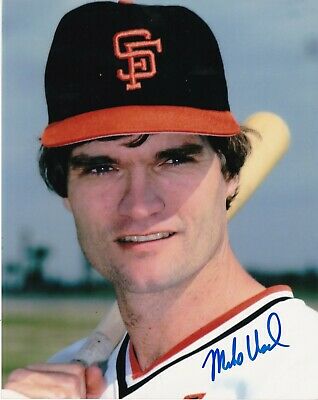
He Was A Giant? Mike Vail by Tony the Tiger Hayes

Former San Francisco Giant Mike Vail who played for the club in 1983 is the feature on today’s He was a Giant? By Tony the Tiger Hayes at http://www.sportsradioservice.com (photo ebay auction)

Mike Vail – OF – 1983 – # 32

He Was a Giant?

By Tony the Tiger Hayes

SAN FRANCISCO–From “Dirty” Al Gallagher (1970-73) to “Sweaty” Tyler Walker (2005-08), nine native San Franciscans have played for the Bay-based version of the Giants.

But we nominate Vail – a right-handed hitting journeyman OF – for being the most obscure.

Vail did not last long as a Giant and besides being born in SF, he didn’t leave much of a foot print in The City.

Vail was actually more of a product of the South Bay – having graduated from San Jose’s Archbishop Mitty High School before matriculating to Cupertino’s De Anza College.

Vail would appear in just 18 games for the 1983 Giants and was long gone before the summer fog enveloped Candlestick Park.

Vail never got his bat going with the Giants – collecting just four hits for a less than robust .154 average before moving on to the Montreal Expos in a swap for the equally stark IF Wallace Johnson.

Why Was He A Giant?

Coming off a thrilling 1982 season, the Giants were forecast as a potential contender in 1983 and they did not sit pat.

SF shed veteran stalwarts 2B Joe Morgan, LHP Al Holland and 1B Reggie Smith while taking on RHP Mike Krukow, RHP Mark Davis and IF/OF Joel Youngblood.

The .279 career hitting Vail was acquired to be the right-handed counterpart to left-handed pinch-hitter Champ Summers. Vail came over from the the Reds in exchange for swingman RHP Rich Gale.

Vail was coming off a nice ‘82 season for Cincinnati, batting .276 (8-for-29) with 9 RBI as a pinch batter – the thing was he wanted to be in the starting lineup.

At first he was gung-ho about joining the Orange & Black: “It’s great to be coming home,” Vail told the local papers. “In Little League and high school, Mays and McCovey were my guys. The big thrill will be when I get out on the field at Candlestick.”

When he realized the Giants weren’t about to bench Jeffery Leonard, Chilli Davis or Jack Clark for him, Vail’s enthusiasm waned and he came off as an ingrate.

“I could write a book, and maybe I will about not getting a chance to play,” Vail proclaimed shortly before becoming an ex-Giant.

Before & After

Originally signed by the St. Louis Cardinals, Vail made his big league debut with the New York Mets in 1975 – and what a debut it was.

Vail slashed a pinch-hit single in his first at-bat – (off no less than Houston Astros powerhouse RHP J.R. Richard.)

Then , Vail enjoyed his first multi-hit MLB game at Candlestick Park – singling twice in a 6-5 Mets win vs. the Giants (8/22/75).

Later that weekend, Vail was one of only two New York batters to reach base – he walked – as the Giants’ RHP Ed Halicki no-hit the Mets 6-0 in the nightcap of a double header (8/24/75).

The following day, Vail would bat 4-for-4 in a Mets win at San Diego.

Going forward, Vail batted safely in his next 22 games games to tie a then modern day rookie hitting streak- batting .364 over the span.

While Vail never did reach the stardom forecast after his great start, he was a reliable big leaguer – carving out a 10 – year big league career as a platoon OF.

He was a career .299 hitter vs. lefties and a credible pinch-hitter.

He Never Got His Own Bobblehead. But…

In one of the more bizarre games of 1983, Vail gave the Giants a 3-2, 7th inning lead when he knocked in two runs with a pinch-hit single off future Giant RHP Dave LaPoint at St. Louis (4/29/83).

The Cards retied the contest and it remained that way until the 13th when the Busch stadium lights suddenly cut out, throwing everyone into darkness.

Umpires were forced to suspend action until the following day. The clubs played three innings until St. Louis won in the bottom of the 16th inning by a score of 6-5, when C Milt May fumbled a throw to the plate on a force play.

Giant Footprint

Vail certainly wasn’t the only obscure native San Franciscan to play for the Giants.

RHP Keith Comstock made just 15 relief outings for the 1987 Giants – but he was notable for being included in the trade that brought Giants legend OF Kevin Mitchell to town.

OF Jalal Leach collected just one hit in eight games for the 2001 Giants – but he was well publicized at the time because he was a long time minor leaguer who had never played in the majors before.

And John Boccabella, a back-up C for the 1974 Giants hit only .138 in 29 games – but he was forever immortalized in pop culture by being mentioned in a script of an episode of “The Streets of San Francisco.”

Tony the Tiger Hayes does He was a Giant? features at every San Francisco Giants Tuesday night home game. Sure as the Giants orange and white creamsicle uniforms they wear on Tuesday night home games The Tiger delivers at http://www.sportsradioservice.com

He Was a Giant? Reggie Smith By Tony the Tiger Hayes

Former Giants Jack Clark (22) and Reggie Smith (14) celebrate a big hit during their Candlestick Park days in San Francisco during the 1982 season (photo provided by Tony the Tiger Hayes)

He Was a Giant? Reggie Smith

By Tony the Tiger Hayes

When big league teams explore signing prospective free agents, one attribute you rarely see in scouting reports is: “plus ability to leap into stands and sock paying customer in the jaw.”

Yet that was all anybody was talking about when the Giants shockingly signed long-time Dodgers slugger (the term had dual meaning in this case) Reggie Smith, to a one-year $300,000 contract just prior to the start of spring training in 1982.

After missing a good portion of the previous two seasons with a shoulder injury, the seven time All-Star’s most recent headline grabbing event had come six months earlier when the eternally gruff Smith – sporting a satin, Dodgers blue warm-up jacket, a billowing Afro and a snarl – climbed into the stands during a game (9/24/81) at Candlestick Park to throttle an abusive heckler.

A 38-year-old fan sitting adjacent to the visitors dugout had spent most of the game verbally deriding the Dodgers from his perch.

Nothing unusual about that. But when the guy upped the hectoring to a new level by whipping a plastic souvenir batting helmet in Smith’s direction, the muscular Dodger lost it.

In the wink of an eye Smith was up in the stands and working over the besotted punter with an impressive one-two combo. For several moments the boiling-mad Dodger mixed it up with the offending belligerent blowhard and a bunch of his boozed-up buddies before city cops broke up the brouhaha.

Smith, who was ejected from the game and later fined $5,000, left the field enveloped within a battalion of San Francisco Police officers. At least two beer bottles were thrown in Smith’s direction as he made his way down the right field line to the Los Angeles clubhouse.

This would be the player the Giants would soon introduce as their new starting first baseman.

Why Was He a Giant?

After coming up short three previous times in World Series action – Boston (1967) and Los Angeles (1977-78) – Smith was finally a member of a World Championship club in 1981 when the Dodgers up ended the Yankees in the Fall Classic.

But the ‘81 world’s title season had left a bitter taste for Reggie. Unlike his previous World Series experiences in which he was knee deep in the action, Smith rode the pine in the ‘81 Fall Classic, generating just a pair of measly pinch-hit at-bats.

The World Series was a frustrating extension of Smith’s ‘81 regular season. Due to a slow to heal shoulder injury, Reggie had been a forgotten man and hardly saw the field during the Dodgers strike abbreviated ‘81 campaign.

Permanently replaced in the Dodgers lineup by young slugger Pedro Guerrero, the fiercely-proud Smith spent the season on the bench counting down the days to his impending free-agency.

Smith’s relationship with the Dodgers had been deteriorating since 1979 when he said he was “lied to” by the Dodgers, claiming the club had reneged on a contract promise. Dodgers executive Al Campanis shot back, calling Smith a “disruptive influence.”

After the ‘81 season, Smith, who never exactly fit the Dodgers Hollywood rah-rah image, was free to choose his own path. But not many teams were were beating down the doors to invest in a soon to be 37-year-old outfielder, who hadn’t actually played the outfield in close to two years.

The Yankees were interested in signing Smith as a full-time designated hitter. But the macho ball player had long felt that DH-ing was emasculating. Also, given his previous torturous experience of playing in Boston, Smith wanted nothing to do with the East Coast.

So, despite his recent run-ins with the Creatures of Candlestick, San Francisco was at the top of his destination list.

He brushed off any lingering resentment from the fight in the stands.

“That incident occurred because I was doing well against the Giants,” Smith lectured the press. “So if I do well for the Giants there shouldn’t be a problem.”

Smith couldn’t help himself from tacking on: “But, I don’t play for the fans, anyway.”

Smith rattled off some of the reasons he longed to sport the Orange & Black:

The Bay Area’s close proximity to his L.A. home. A chance to play for the like-minded, hard-nosed manager Frank Robinson. And his belief that the Giants were a franchise on the come.

But everyone knew the unspoken driving force behind Smith’s Golden Gate longings was the fact that the Giants offered the best opportunity to aggrieve the shabby treatment he believed he received in his waning days as a Dodger.

As it turned out in his one-year as a Giant, Smith rarely passed on a opportunity to skewer his former club. With San Francisco Smith batted an even .300 vs. L.A. (15-for-50) and played in more games against his former club (16) than he did against any other team.

Overall, Smith enjoyed a fantastic season with San Francisco. In 106 games, Smith batted .284 with 18 home runs and 54 RBI. He was a finalist for ‘82 NL Comeback Player of the Year, but lost out to Giants teammate Joe Morgan.

Smith also crushed career home run No. 300 as a Giant, taking Cardinals right-hander Dave LaPoint deep in a 8-3 loss at Candlestick Park (5/25/82).

With San Francisco, Smith was far from a “disruptive influence” in fact he and fellow veteran star Joe Morgan often acted as on-field coaches for a resurgent Giants club that burned rubber down the tail end of the ‘82 season, falling just just two games short of a division title.

Of course Smith may have been the happiest guy in the Giants clubhouse when Morgan hit his walk off homer off the Terry Forster to spoil the Dodgers post-season dreams on the last day of the season.

Before & After

Despite is prowess as a ferocious power hitter and run producer – Smith typically took a backseat to more colorful and media friendly players in baseball during his career.

Though his career numbers are comparable to some Hall of Fame inductees, Smith – his 314 career long ball are third most by a switch hitter – he’s never been a serious candidate for Cooperstown induction.

A good portion of Smith’s career drama stemmed from his perceived image as a surly loner. And to be fair, Smith never went out of the way to portray a warm and fuzzy image.

But, on the other hand, who could blame Smith if at times he felt like a one-man band.

During his seven years with Boston, Smith established himself as a productive switch-hitter with power – cracking 149 long balls for the Red Sox. But despite his consistent production at the plate, Smith was never comfortable in New England.

As the Bosox’s first full-time black star, the fiercely independent Smith was often in the bullseye of unrelenting criticism. Disturbingly the constant panning was often tinged with racial overtones.

Critiques of his style of play came from all directions: fans, the press, team management and on one occasion, even teammate Carlton Fisk who dinged Smith for his attitude.

Smith’s stoic demeanor was interpreted as aloofness by many. Smith was accused of not running hard on routine plays and of being unwilling to play though injuries.

The Boston vitriol became so intense that the center fielder began wearing a batting helmet in the field to protect himself from projectiles (batteries, bottles, coins) hurled his way.

In 1973, Smith went AWOL from Fenway Park after leaving during the second inning of one game in which he was jeered for failing to run out a double play grounder and letting a routine fly ball drop. Smith said his cranky knees prevented him from doing his best.

Smith was fined and suspended by the team.

After Smith was traded to St. Louis after a miserable 1973 Red Sox season. The Cardinals provided Smith a respite from the Boston drama and he played very well in the shadows of the Gateway Arch.

Smith loved the more aggressive style of National League ball and established himself as one of the league’s performers, batting .300 in back-back seasons in 1974-75. He was named to the All-Star team each season, slugging a home run in the ‘74 All-Star Game.

But after a listless start to the 1976 season, Smith was on the move again – this time he was homeward bound to Los Angeles.

The Dodgers would be the perfect fit for Smith. With the slugger dropped into the heart of L.A.’s already made to win lineup, the Dodgers overtook Cincinnati’s Big Red Machine, and won the NL Pennant in 1977-78.

In ‘77, Smith was one of four Dodgers to clobber at least 30 home runs on the year.

Smith went off in the 1977 World Series bopping three home runs. Alas he was over-shadowed by another Reggie – Mr. October – Reggie Jackson, who crushed five long balls, including three in his iconic series Game 6 performance.

At age 35, Smith’s right shoulder gave out when he torn the capsule in the joint in August of 1980 and would not play the rest of that season. In 1981 Smith did not start a single game, appearing in just two games in the field.

After his one year sojourn with the Giants, Smith went overseas to play for the Yominuri Giants of Japan. Though Smith feasted on Japanese pitching, he faced some of the same prejudices that he experienced in Boston.

He Never Had a (Giants) Bobblehead Day. But…

After a season of inactivity, more than a few pundits wondered if Smith could still sting big league pitching when he joined the Giants in 1982.

But in his first official game as a Giant – played coincidentally at Dodger Stadium – Smith quickly shutdown any talk that he had lost any bat speed when he batted 2-for-3 and scored a run in an opening night 4-3 loss. (4/6/82).

“You don’t forget how to hit,” Smith commented. “I could hit in a snowbank.”

That season Smith would play his home games in a ball park that was about a cozy as a snowbank.

But Smith did fantastic at Candlestick, batting .279 and swatting 10 of his 18 home runs in the meat locker-like environments of the old concrete bowl.

In one of his more memorable games as a Giant, Smith swatted a walk-off pinch home run to lead San Francisco to a 5-4 come from behind victory over the Mets at the ‘Stick (4/31/82)

After swinging and missing two pitches from Neil Allen, Smith clocked a screaming liner in the Candlestick Park right field seats for a dramatic three-run homer to give the Giants a 5-4 victory 4/31/82).

“I’m up there to take three swings – whatever happens, happens,” Reggie said afterwards. “I’ve been there before.”

In another thriller, Smith, had four hits and a walk, leading the Giants to a comeback 7-6 win over visiting Houston (8/6/82).

Smith and Jack Clark who each homered earlier in the contest, led off the ninth with back-to-back round trippers off reliever Dave Smith. Darrell Evans then drove home the winning run with a pinch single.

After his ninth inning blast the crowd kept chanting “Reggie, Reggie, Reggie” until Smith popped out of the dugout for a rousing curtain call.

It was a slap-on -the -back compliment unlike any other Smith had received in his career.

Giant Footprint

The intense Giants and Dodgers rivalry has produced some of the most notorious fights in baseball history. But those brawls have typically taken place on the field – naturally between the players.

But beginning in the late 1970s, a good portion of the brawling during Giants/Dodgers games was being staged in the grand stands.

Where once Juan Marichal was tearing after John Roseboro with a Louisville Slugger, Gene the Giants Groupie was going dukes up with Donnie the Dodger Devotee.

The increase in fan fisticuffs dates back to the Dodgers hiring of Tommy Lasorda as manager in 1977 and an influx of transplanted Dodgers fans in the Bay Area.

By the mid-1970s, kids who grew in Southern California as first generation L.A. Dodgers fans had began migrating north for work and school.

Things did not go well when they visited Candlestick Park and rubbed the Dodgers success and abundance of riches in the faces of fans of the then threadbare Giants.

The heat was really turned up on the rivalry after the vociferous Tommy Lasorda took over as L.A. skipper, replacing the staid Walter Alston.

The rotund head Dodgers cheerleader was more than willingly to fan the flames of the rivalry by talking up his nonsense about the “Big Blue Dodger” and entering the field of play at the ‘Stick by blowing kisses to agitated Giants fans as if he were a professional wrestling heel.

With stadium beer flowing like a bathtub spigot it didn’t take much to get tensions sparked up in the ‘Stick stands.

But Smith’s 1981 rumble was something never seen before: a fight between player and fan.

Tensions had been tightener than usual that night after Giants starter Tom Griffin hit a Dodgers batter earlier in the game.

According to Smith, who was not in the lineup and spent the game standing to the right of the dugout, he and a few Giants fans had been verbally jousting in jest most of the game.

But things began turning ugly in the late innings as the alcohol consumption and the Dodgers lead increased.

The ribbing began taking more of a personal nature.

Smith explained after the game:

“The guy tells me, ‘if I come down on the field my company will lose a $40,000 employee. And if I break your arm the Dodgers might lose the pennant race.’

“I told him I kind of doubted it. Then he threatened to throw his helmet at me and I said, ‘Now that could get me in there.’ Then he whisked it at me, and I went in.”

Giants manager Frank Robinson said the whole ugly affair could have been avoided. He blamed the Dodgers manager.

“It was all Lasorda’s fault. If he gets his players back in the dugout where they belong no one is out there for the fans to yell at,” Robinson lectured. “Lasorda’s too damn interested in the TV cameras and the press box to do his job right.”

The San Francisco Police ended up filling up a paddy wagon with about a half dozen fans and carted them off to the city lock-up.

Smith did not join them at the gray bar hotel, despite apparently landing the most punches.

“I got in my licks,” Smith said post-game. “It was very dangerous because he had friends. But I took my chances. He threw the first punch and missed. I didn’t. One of his friends got me. He paid for it, too. Another guy with glasses took a shot at me too. He’s not wearing glasses anymore.”

Tony the Tiger does He was a Giant? features after Tuesday home games at http://www.sportsradioservice.com