Avalanche Win 4-3, Block Sharks Comeback

From NHL.comBy Mary Walsh

DENVER- The Colorado Avalanche did not run roughshod over the San Jose Sharks, on their way to a 4-0 lead Saturday. What they did for a brief spell early in the second period was run around them. The Sharks looked to be in control of the game several times, except for their opponent’s scoring opportunities. Those squeaked through at first, then flowed as from an open spigot.

The game seemed all but over when the score reached 4-0, after the Avalanche scored three times in just over one minute in the second period. The Sharks scored twice in the same period, with the help from some power plays. A third tally from Logan Couture early in the third pulled a comeback within reach, but the Avalanche held on to win 4-3.

The Avalanche had two very good chances early in the game, getting the puck and bodies to the net. Sharks goaltender Antti Niemi made the saves but the Sharks seemed to start out a step behind the speedy Avs.

The Sharks had a couple of early shots, first from Andrew Desjardins and James Sheppard, and then from Matt Nieto on a line with Logan Couture and Patrick Marleau. After the five minute mark, the Sharks picked up their game and started racking up the chances. By the ten minute mark, the Avs had gone for six minutes without a shot.

Colorado finally did make a push the other way and Niemi had to glove a shot from John Mitchell to halt play. A moderate ruckus in front of the net ensued, with Andrew Desjardins in the middle of it. Cody McLeod caught the linesman with a stick but no penalties came out of it.

The Sharks took the game back after that, putting relentless pressure on the Avs, leaving Niemi with little to do except be ready for the occasional and very fast Colorado incursion. One such drew a penalty against the Sharks, when Justin Braun was called for hooking Matt Duchene, at 14:44 of the period.

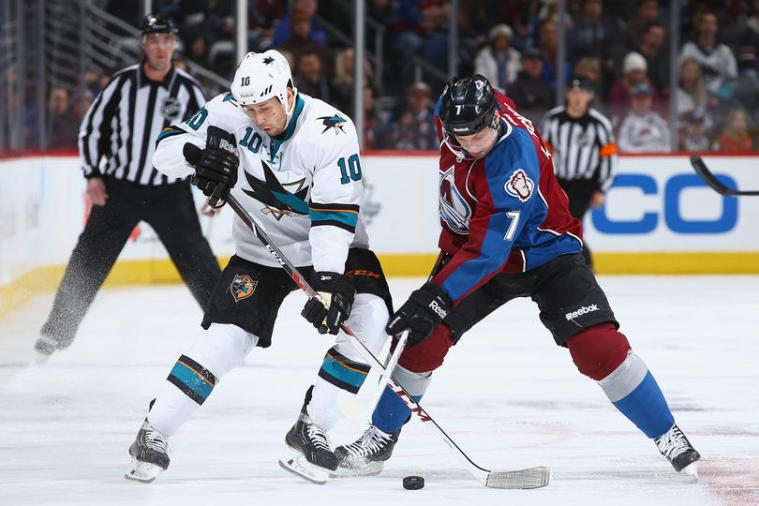
It took the Colorado power play almost a minute, but they did make that power play pay off at 15:28. Andre Benoit shot the puck at the net from the blue line, and Nathan McKinnon tipped it in. Assists went to Benoit and Paul Stastny.

Shots for the period were 10-8 San Jose.

The Sharks started the second period with two dump-ins but no extended control of the puck, and then Sharks Captain Joe Thornton took an interference penalty on Ryan O’Reilly just 23 seconds in. The Sharks penalty killers minimized Colorado’s chances and survived the early setback.

The Sharks seemed to be getting their act together when a series of mistakes in their own zone created an opportunity for Jamie McGinn to score his ninth of the season, extending his goal streak to three games. Assist to Matt Duchene. That goal seemed to leave Niemi unsettled, and when a bouncing shot came down from the blue line and went by him 52 seconds later, Sharks Coach Todd McLellan replaced him with Alex Stalock. The goal went to Erik Johnson, with assists to Gabriel Landeskog and Paul Stastny.

Right off the faceoff, McKinnon sped into the Sharks zone and put a shot past Stalock, giving the Avs three goals in a minute, six seconds. The next faceoff started with a fight or two. Desjardins, Bracken Kearns and McLeod ended up in the box, giving the Avalanche a five-on-four power play.

37 seconds into the power play, Logan Couture drew a roughing call against Matt Duchene, putting the teams at four on four. 25 seconds later, Jan Hejda was called for slashing Joe Pavelski, giving the Sharks a brief five-on-three. While the Avalanche were busy knocking Couture down repeatedly in front of the blue paint, they missed Pavelski coming in to fire on an open net. That put the Sharks on the board with a minute left in the power play. Assists went to Marleau and Thornton. That penalty expired but seconds later, as Alex Stalock flew to the bench during a delayed penalty, Patrick Marleau came on to the ice and his quick shot brought the Sharks within two.

A chance in front of the Avalanche net ended with the net off its moorings and Desjardins fighting Max Talbot in the corner, after the linesman did make an effort to restrain them. Desjardins quickly took the upper hand in that one. While he and Talbot sat in the box for the fighting major, the Sharks put together some good time in the offensive zone, but the Avalanche kept them from finishing.

With just a minute and 46 seconds left in the period, Alex Stalock was penalized for delay of game after he played the puck over the glass. The Sharks kept the Avalanche power play from scoring before the end of the period.

The shot count for the second period was 13-9 San Jose.

The Sharks finished off the penalty kill to start the third period, and the game proceeded at a subdued pace. With five minutes gone, the Sharks were having trouble maintaining possession of the puck. After playing catch with the Avs in the neutral zone for nearly a minute, the puck finally landed on Couture’s stick so he could carry it into the zone with Marleau. A pass back to the blue line gave Scott Hannan a chance to shoot. Marleau couldn’t get the first rebound in but Couture was there to grab the second one, and put it past Varlamov. That cut Colorado’s lead to one at 5:44 of the third period. Assists went to Marleau and Hannan.

The Sharks had a power play at of the third, when James Sheppard and Jan Hejda collided in front of the Avs net. The refs called Hejda for interference. The Sharks couldn’t score on that power play, despite many close calls. A series of failures to keep the puck in burned seconds off that power play. With about a minute and a half left, McLellan pulled Stalock for the extra attacker, but the Sharks still couldn’t sustain pressure in the offensive zone. The Avalanche held on for the 4-3 win.

Patrick Marleau was the game’s points leader with a goal and two assists. Joe Pavelski led the Sharks in shots with seven, Erik Johnson led the Avalanche with five. The Sharks’ power play went 1/3, their penalty kill 3/4. Antti Niemi stopped 11 of 14 shots, Alex Stalock stopped 6 of 7 for the Sharks.

Roster Notes:
Eriah Hayes made a difficult trip through a storm to get to Denver from Boston, but he did not crack the Sharks lineup. Mike Brown, hit twice by friendly fire at the end of the game against the Oilers in San Jose, was good to go. Tommy Wingels, however, was still not able to play and has been placed on IR for an upper body injury, not a head injury.

Two Milestone Goals Lift Sharks Over Ducks

By Mary Walsh

SAN JOSE- In a 3-1 victory over the Anaheim Ducks, one Shark scored his first NHL goal, another scored his 100th, and the Sharks-Ducks home ice advantage grew a little more. In seven of the last eight games between the two, the win has gone to the home team. The Sharks’ win was tarnished, however, by an injury to Tommy Wingels. Wingels left the game in the first period and did not return.

Logan Couture’s recent trouble scoring goals might be explained in hindsight by the fact that it was his 100th he was trying to score. Such a milestone is bound to play a little hard to get. Bracken Kearns was chasing his first, though he hadn’t had may chances to score it. The audience at SAP Center was suitably appreciative of the occasion, and continued to respond enthusiastically every time Kearns turned up on the video screen.

The Sharks’ best line of late tore into the Ducks defense early, pelting Andersen with shots and staying just a step ahead of the Ducks defenders. Andersen did well to stop as many as he did but finally Brent Burns put one past him from just a few feet in front of the blue paint. The first goal of the game was scored just over a minute in. Assists went to Joe Pavelski and Joe Thornton.

Pavelski was called for interference at 6:48. The second penalty killing unit to get on the ice included Andrew Desjardins, Joe Thornton, Justin Braun and Marc-Edouard Vlasic. The unit set up a good short-handed chance for Thornton and Desjardins, who made their way into the Ducks’ zone two on one and managed a couple of shots on Anderson, even after the Ducks’ defense caught up with them.

Logan Couture got off the schneid with panache, carrying the puck through the neutral zone, skating around two Ducks defenders and stick-handling his way to the net to score his 100th career goal with a backhand. The goal put the Sharks up 2-0, at 10:07 of the period. Assists went to Brent Burns and Jason Demers.

With a little over five minutes left in the first, the Ducks had a series of good chances in the Sharks’ zone, while the Sharks were caught mid-line change and unable to get the puck out. Finally Niemi was able to glove it. Kearns, Brown and Kennedy took the ice for the defensive zone draw with Stuart and Demers on defense. Kearns won the faceoff and got the puck back to Demerws but Demers couldn’t clear it the first time. They had to try again. The third line managed to move play into the Ducks’ zone, where the Couture line took over, but the Ducks quickly drove them into the neutral zone.

Todd McLellan moved Matt Nieto to the second line when Tommy Wingels went awkwardly into the boards early in the first. Wingels appeared for another shift but then went to the dressing room and would not return to the game.

First period ended 2-0 Sharks, with shots on goal at 14-13 Anaheim.

Almost ten minutes elapsed in the second, including the end of a San Jose power play to start the period, when Andrew Desjardins carried the puck behind the Ducks’ net. Under pressure he managed to pass the puck out in front where the late-arriving Bracken Kearns picked it up in the slot and scored his first NHL goal. Assists went to Desjardins and Mike Brown.

With 7:50 left in the second, Daniel Winnik was caught in the face with the butt end of a Shark’s stick. He stayed down for some time and got up with blood near his eye but no penalty was called. Logan Couture represented the Sharks in a brief conference with the referee at center ice. It did appear to be incidental contact, but Winnik and the Ducks were understandably agitated about it.

The second period ended with the Ducks still ahead on the shot clock, 24-19, but the Sharks ahead 3-0 on the score board.

The Sharks got their second power play of the game at 8:47 of the third period when Corey Perry went to the box for a high hit on Brad Stuart. The Sharks’ power play didn’t pay off and a successful penalty kill energized the Ducks. It still took them a few shifts to score.

Antti Niemi’s shut-out bid ended at 11:32 of the third, when a quick pass from behind the Sharks’ net found Patrick Maroon with no one in front of him. A shot just indside the far post brought the score to 3-1. Assists went to Corey Perry and Cam Fowler.

The game ended without any further scoring and the Sharks won 3-1. The final shot count had the Ducks still on top with 31 to the Sharks’ 23.

The Ducks’ shots leaders for the game were Ryan Getzlaf, Corey Perry and Kyle Pamieri, credited with three each. For the Sharks, Brent Burns led the team with 5 shots. Mike Brown led the Sharks in hits with five, followed by Kearns with four. Mark Fistric and Patrick Maroon led the Ducks with five hits each.

The three stars of the game were Brent Burns, Antti Niemi, and Bracken Kearns.

Back Where They Belong: Unchange the Sharks

(Ed Szczepanski-USA TODAY Sports)

By Mary Walsh

At the first intermission during the Sharks game Saturday, Jamie Baker said the Sharks seem to be missing something, possibly their mojo. If the Sharks have lost their mojo, it might be buried in Todd McLellan’s higgledy-piggledy line adjustments. It could be time to unchange all those lines.

Or maybe they found their mojo Saturday, in the process of being outshot 46-39 by the Dallas Stars, who average 31.6 shots a game. Maybe the Sharks found their mojo and that is how they survived going down by two goals, made it to a shootout and won 3-2. They won. That is important. But if a 4-2 victory in Toronto foretold of a losing streak to come, it isn’t likely that the Sharks will rest on those Dallas shootout laurels.

The Sharks started the season outstandingly well. To get back to that could be impossible, but to get back to winning more than losing is a reasonable goal. The key is to put the pieces back where they belong and leave them there for at least as long as they have been out of place. That would be nine games or so.

The Sharks’ coaching staff spent a lot of time thinking up forward lines during the off-season and training camp. The lines they started with might have some merit, even if you account for the insertion of players who came and went due to injury. During the ten game experiment the team just completed, only the Hertl-Thornton-Burns and Couture-Marleau connections lasted.

Those were dismantled Saturday against Dallas, beyond replacing the injured Hertl. John McCarthy took Pavelski’s spot as third line center, Pavelski moved to a new line with Thornton and Marleau, and Burns to Couture’s line with Havlat.

Putting McCarthy at center is not wrong per se. He played there in college and also in the AHL. But he’s been in San Jose for most of this season, playing wing. Maybe tossing him back to the middle isn’t the best way to stabilize the team.

When the Sharks started this rough patch after Toronto, San Jose started making line adjustments. Eventually, they made every line adjustment there was to make, until finally Martin Havlat was skating on a fourth line with Andrew Desjardins. The experiment may have provided some as yet unseen benefit to the team, but it certainly didn’t generate many wins.

Obviously, the inquiry into whether or not a pass can connect between Havlat and Desjardins was answered with an unequivocal “no.” But what about all those other adjustments? What about moving Pavelski to the wing? Pavelski is a perfectly capable winger, but moving him away from center punched a hole in one of the team’s most coveted qualities: daunting depth through center.

The decision to sit Tyler Kennedy for a game, then put him back in on the fourth line looked a lot like the path Havlat followed back to the second line. It’s all well and good to make a player watch a game to sort things out, then have him come back in with limited ice time.

Except it really isn’t well and good. Using the fourth line as a gateway back into the game can thoroughly handicap the fourth line if said player is not accustomed to fourth line duty. It’s hard enough for the energy line to do its job with limited ice time and the continuous changing of their membership.

When the rotation included McCarthy, Sheppard and Brown as wingers for Desjardins, at least it was just those four. They could get a feel for each other. Tossing Havlat and Kennedy in there didn’t do them any favors. They have to work fast and hard, they’re not a rehab service for top niners.

It wasn’t ideal for the top niners either. Martin Havlat, before Thursday’s game, was preparing to skate on a line with Couture and Marleau, the third line he’d played on in as many games. Despite playing all over the lineup, did Havlat think his game was becoming more consistent or not?

Not, but like you said, I’ve been all over the place. So we’ll see. I played with these guys half of the year last year at the end and it was great. So we’ll see how it is.

It went pretty well, better than other lines that night. It was the only line to score a goal and finish without a minus by their names. Tyler Kennedy was the only other skater without a minus.

Whether he sees it or not, Havlat’s game has been getting stronger. It may be taking longer than it would if he’d been left consistently with the same line-mates. While his game has suffered along with the team’s, he has at least maintained some defensive equilibrium. McLellan commented on that after the win in St. Louis last Tuesday:

When we look at Marty, I think since he’s been back in the lineup, he’s only been a minus player three nights. That’s pretty darn good. There’s not a lot of other guys that are in that situation. Would we like more offense from him? I think it’s coming.

Havlat isn’t the only player who might profit from a consistent line configuration. Kennedy did better than Havlat on the fourth line. He even got an assist in his second game there. Maybe all he needed was a little more time with his new linemates, a second game?

In Los Angeles, it looked like McLellan was ready to put the old bands back together, with Havlat and Marleau flanking Couture, and Pavelski back at center with Wingels and Sheppard. When Hertl went down, emergency changes had to be made, but otherwise the team was taking a familiar shape again.

Those lines did not win that game, but wins have been scarce for the kaleidoscope of line formations before and since. Those won three of eight games. Perhaps if McLellan gives the old lines a chance to find their footing again the team can reverse this losing trend.

Sharks Lose to Kings 4-1, Hertl Injured

By Mary Walsh

LOS ANGELES- It appears that the Visitor’s Curse still haunts the San Jose Sharks at Staples Center. The mischievous spirit might even be getting more violent. Thursday night, the Sharks lost to the Kings by a score of 4-1. They also lost star forward and rookie Tomas Hertl to a knee-on-knee hit from LA’s Dustin Brown. How long the team will be without Hertl is not yet clear.

The fact that the Kings won was not at all out of the ordinary for these teams, the home team has won going back 15 games now. What was unusual was the score: 4-1. It has been some time since a game between these two ended with such a lopsided result. Patrick Marleau, playing his 1200th NHL game, scored the only Sharks goal.

McLellan made a couple of lineup changes for Thursday’s game, including moving Martin Havlat to the second line with Logan Couture and Patrick Marleau. He put Scott Hannan back in, paired with Brad Stuart. He also put Tyler Kennedy in, on the fourth line with Mike Brown and Andrew Desjardins.

The first penalty of the game went to the Kings at 3:25, to Drew Doughty for holding. The Sharks had several good chances, a couple that looked like dead certainties (one for Couture, another for Irwin) but they missed. The Kings had a good short-handed chance late in the penalty but Niemi gloved it.

The Sharks lost a lot of races to the Kings in the first period. Dump-ins were about as effective as turnovers. As a result, the Sharks were outshot through most of the period, though by the end of it they were only behind 13-11.

With a minute left in the period, the Kings’ Dustin Brown collided with Tomas Hertl just inside the Sharks’ zone. The knee-on-knee hit earned him a five minute major. Hertl left the ice hobbling. During the ensuing delayed penalty, Brent Burns earned a penalty for interference. The teams finished the period playing 4-on-4. James Sheppard was tapped to fill in for Tomas Hertl on the Thornton line.

The second period started with the teams still at 4-on-4, and when Burns’ penalty expired the Sharks still had over 2:30 left on the man advantage. The Sharks finally found a way to sustain pressure, but two good chances in close and an Irwin shot off the post were all the Sharks had to show for the power play.

The Kings’ goaltender Martin Jones was very good, but the Sharks were unable to take advantage of the second chances they did create. As McLellan said before the game, how well Jones has played was not the Sharks’ biggest challenge:

I think for our group it’s more about preparing to face six players rather than one goaltender. The five others that are on the ice do a tremendous job for them defensively and they position themselves well around the net, it allows the goaltender to feel comfortable and make a lot of saves. They’ve been successful playing that way. It’s not just the guy wearing the pads, it’s the other five that you’ve got to beat as well.

The first goal of the game came at 5:26 of the second, scored from above the left circle by the Kings’ Alec Martinez, with an assist to Tyler Toffoli. The goal came from a shot made possible when the Sharks failed to clear the puck or control it despite several tries. At least three, maybe four Sharks touched it in the defensive zone before Martinez got it.

Joe Thornton was called for holding against Anze Kopitar at 9:03. Despite starting in their own zone, the Sharks’ penalty killers (including Mike Brown now) cleared the puck five times and even got a couple of short-handed shots off. As soon as the power play expired, however, Slava Voynov made a clean pass from the Kings’ zone, right onto Tyler Toffoli’s stick at the Sharks’ blue line. He skated in and put a shot in the far corner to give the Kings a 2-0 lead.

An impressive series of saves by Martin Jones was punctuated by three inexplicably failed shots from Sharks Joe Pavelski and Tommy Wingels. Wingels even tried from both sides of the net, and he almost poked it in behind Jones but the rookie goaltender twisted around and stopped it with his glove.

During the second period, the teams were even in shots at ten, with total shots being 23-20 for the Kings. Of course, the 2-0 score was more significant, especially since the Kings had not lost when leading after the second since March 30.

Instead of challenging that pattern, the Sharks gave up another goal 36 seconds into the third period. Jeff Carter was given far too much time in the Sharks’ zone, and an ill-advised slide to block a shot left Niemi alone with one of the better shots in the league. Assists went to Dwight King and Robyn Regehr.

The Sharks drew another penalty when Jake Muzzin pushed Martin Havlat into the boards from behind. From camera distance, Havlat didn’t appear injured but he was certainly shoved from behind. He was out playing a shift later on the second power play unit.

The Kings killed the penalty off, and then they scored again. This time it was Dwight King’s goal, with the assists going to Carter and Regehr.

The Sharks got another chance on the power play when Mike Richards went to the box for high-sticking at 6:37. As soon as the penalty expired, the Kings went the other way 3 on 2, but didn’t score.

With just over two minutes left in the game, San Jose’s second line made it in to the Kings’ zone and Marleau scored his 16th of the season. A lone assist went to Martin Havlat.

The final shot count was preposterously even at 32 for each team. The Sharks’ power play went 0-4, their penalty kill was 1-0.

The Sharks play their next game at home on Saturday against the Dallas Stars. Puck drop at 7:30 pm.

SF Bulls Make 4 Goal Comeback Against Stockton Thunder

By Mary Walsh

SAN FRANCISCO- Saturday, the San Francisco Bulls came back from a three-goal deficit to defeat the Stockton Thunder in a shootout. It was the third meeting of the season for the two teams. The first period ended tied at one, the second period ended 4-2. The teams went to a shootout tied at five goals apiece. Two of the Bulls’ goals were scored by Steven Tarasuk, his first two goals of the season. Also, there were teddy bears, lots of teddy bears tossed on the ice.

After the game, Head Coach Pat Curcio said:

From the beginning of the game tonight, we were much better than last night. I think our fans had a lot to do with it, it just gives our guys so much more energy and life out there. I thought in the second period, a couple of the mistakes that we made, it [was] unfair for us to be down 3-1. Obviously Scott Langdon got us on the board there, gave us some life and the guys just thought “if they scored three that quick, we can score three that quick.”

The game was a lot like the last game San Francisco played against Stockton: San Francisco was outshot, they fell behind by three goals, they pulled J.P. Anderson out and put Tyler Beskorowany in net mid-second period. The games were just alike, apart from four San Francisco goals scored in the second half of the game, three by defensemen.

Three and a half minutes of the first period went by before either team got a shot on goal, and then it was San Francisco’s shot. Stockton answered back quickly with two of their own, and then play was interrupted by a hit from Adrian Foster that left a Stockton player down for several seconds. A boarding call put the Bulls on the penalty kill. Stockton had two more shots on the power play but the Bulls’ penalty kill kept the game scoreless.

After 9:50, the Bulls still only had one shot on goal. This wasn’t an accurate reflection of zone time or scoring chances, which looked more even.

The Bulls also took the second penalty of the game, again to Foster, this time for high-sticking. At 14:03 of the first, Stockton scored on their eighth shot, a power play goal by Joey Martin from Corey Trevino and Matt Berglund.

At 13:29 of the period, Tyler Gron tied it up when three Bulls got the jump on the Stockton defense. The teddy bears flew, a significant improvement over last year’s teddy bear toss, when the Bulls didn’t score until the third period.

With 2:50 left in the period, Stockton’s Ryan Constant was called for cross-checking Dale Mitchell. The power play started out well enough, with a series of good chances during a long shift for San Francisco. The Bulls finally lost control of the puck and Stockton kept them from setting up again in the last few seconds of the penalty.

The period ended tied at one, with shots 10-8 for San Francisco.

During that first intermission, the Bulls thanked one of their most loyal fans, Misty. She will be moving to Florida this month and the Bulls aren’t likely to travel there often. The Bulls played a thank you message on the video cube.

The second period started quietly enough. With nearly four minutes gone in the period, Dale Mitchell and Stockton’s Mike Dalhuisen were called for roughing, putting the teams four on four. Neither team scored then, but at 6:31 of the period, Stockton’s Andrew Clark did, with a shot from the faceoff circle that beat Anderson on the far side. Assists went to Greg Miller and Garet Hunt. 33 seconds later, Stockton scored again. Goal by Alex MacLeod, unassisted.

In the next minute, the Bulls got a power play out of an interference penalty called on Larson. As the penalty expired, Stockton went the other way to put the puck in the net for the fourth time. James Henry’s shot got by Anderson but the goal was called off for goaltender interference.

The Thunder had to try again for that fourth goal a few minutes later, which Clark scored with another shot from the faceoff circle, beating Anderson on the far side. In both cases, Anderson had a player in front of him, but that was still four goals too many. Bulls Coach Pat Curcio replaced Anderson with Beskorowany.

A couple of minutes later, Scott Langdon scored his third of the season to make it 4-2. Assists went to Mitchell and Ouellet.

The period ended 4-2, with shots at 25-18, Stockton leading on both counts.

The first few minutes of the third dragged a bit, but at 3:57, Brett Findlay skated straight up the slot in the Thunders’ zone and shot the puck past Phillips to make it a one goal game. Assists went to Jordan Morrison and Steven Tarasuk.

Play picked up then, the teams trading aggressive forechecks, the goalies getting some work. Finally, Dylan King sent the puck along the blue line from one point to the other, where Tarasuk was waiting to slap it to the net. It made it through with help from a screen set by Chris Crane and Magomed Gimbatov. Assists went to Gimbatov and King.

The Bulls earned another power play with just under eight minutes left: a boarding call against James Henry. Half way through the power play, the Bulls gave up a short-handed chance but regrouped in time to go the other way again. A shot from the point gave the Bulls their first lead of the game. It was Tarasuk’s second goal of the game and the season. It was only the Bulls’ tenth shot of the period, and their third goal. Assists went to Kalvin Sagert and Gimbatov.

With under three minutes to go, Stockton tied it again and the game went to overtime tied 5-5. The goal was Mike Dalhuisen’s, with an assist from Clark.

A fast overtime period flew by without many whistles or breaks in play. The shootout went five rounds, with Dean Ouellet and Brett Findlay scoring for San Francisco and Joey Martin scoring for Stockton. Final score: 6-5 San Francisco.

For full game stats, visit the ECHL website.

Roster notes:

The last time the Bulls met the Thunder, Stockton won 5-1. Since then, the Bulls have lost Mark Lee to injury, but regained Dale Mitchell and acquired Tyler Gron. That isn’t unusual in the ECHL: roster turnover is pretty high, especially since they have to contend with a roster limit and salary cap.

Nonetheless, it is worth pausing to consider how many players have come or gone from the Bulls’ lineup since November 20. Kyle Bodie, Josh Kidd, Damon Kipp, Riley Emmerson and Rob Linsmayer had been traded away or gone to China. In their places, the Bulls acquired Kalvin Sagert, Adrian Foster, Magomed Gimbatov, and Berkley Scott. In short, the team has replaced almost one third of the roster. Half of the Bulls who scored against Stockton are not playing: Lee and Linsmayer. Worth noting, Tyler Gron did score against the Thunder this season, as a member of the Idaho Steelheads, on November 24.

For Stockton’s part, two players arrived December 11 from the AHL: defenseman Mike Dalhuisen and left wing Nick Larson. Dalhuisen played seven games with the Thunder this season, this was Larson’s first game in the ECHL.

Sharks Drop 3rd in a Row, Lose 3-1 to Wild

By Mary Walsh

ST PAUL-  Sunday afternoon, the Sharks’ losing streak grew to three with a 3-1 loss to the Minnesota Wild. Two second-period goals were scored by Zach Parise and Mikko Koivu. Wild goaltender Josh Harding made 37 saves. The Sharks finally scored at the end of the game with their net empty. That goal was scored by Patrick Marleau with just over a minute left in regulation. Instead of going on to tie the game, the Sharks gave up an empty-net goal, Zach Parise’s second of the game.

During pre-game, Drew Remenda asked Sharks defenseman Justin Braun what the defense needed to do to get the team back on track. Braun’s answer was straightforward:

We’ve got to get the puck up to the forwards’ hands as fast as possible, we can’t be slow tonight.

The Sharks did get credit for a lot of shots in the game, the forwards did have the puck a lot. They were rarely trapped in their own zone, but their play in the offensive zone was hampered by a determined Minnesota defense.

Matt Nieto, back from the AHL, led the Sharks in shots with six, while Patrick Marleau and Brent Burns led the team in hits with three each. The Sharks’ game went from uninspired in the first period to discombobulated in the third.

As expected, Todd McLellan made several changes to the Sharks’ lineup for the Sunday afternoon game in Minnesota. Joe Pavelski was moved to the right wing on a line with Couture and Marleau. Martin Havlat sat, possibly due to injury from a blocked shot in the previous game. John McCarthy also sat, while Matt Nieto took a spot on a line with Andrew Desjardins and Tommy Wingels. Freddie Hamilton was slotted in at center on a line with James Sheppard and Tyler Kennedy. Both Jason Demers and Matt Irwin played, with Scott Hannan sitting out. Irwin was paired with Dan Boyle while Demers was with Brad Stuart, putting Marc-Edouard Vlasic and Justin Braun back together. The only line that was untouched was the Thornton line with Brent Burns and Tomas Hertl.

The first period could be called tentative. The Sharks outshot the Wild, and the Sharks had one power play after Charlie Coyle was called for holding the stick. It was as tepid a period as could be without a lot of stoppages. There was little indication that the lineup changes had energized the team. Luckily for San Jose, Minnesota wasn’t much more lively. The period ended scoreless, with the shots 11-5.

The Sharks came out with more energy in the second period, but those second period problems are starting to look like a curse more than a habit. With only 2 shots on goal, the Wild had a 2-0 lead. The Sharks were unlucky with a non-call when Minnesota’s Zach Parise knocked the stick from Justin Braun’s hands. Seconds later, Parise scored off the rebound of a shot made easier by Braun being stickless.

A bad line change from the Sharks followed, leaving two Sharks to defend a three man rush that became a four on two before reinforcements could arrive. As mistakes go, that was a bad one and it put the Sharks down 2-0.

The Sharks were not able to make any of their 21 shots pay off. Joe Pavelski and Justin Braun each had chances one on one with Wild goaltender Josh Harding, but they couldn’t beat him.

Probably the best Sharks chance of the period came on a short-handed attack from Matt Nieto, who was almost more that two Wild defenders and Harding could handle. He had a couple of shots in close before they fended him off.

The second period ended 2-0 Minnesota, with the shots at 32-11. The Sharks also finished the period a man down, as Brad Stuart was in the box for holding the stick, though it was hard to say whose stick he held or when.

The Sharks started the third still on the penlty kill. Joe Pavelski and Andrew Desjardins had a good 2 on 1 shorthanded chance to end the kill, but Desjardins couldn’t make the shot. A good backcheck from Minnesota and a quick slide by Harding cut down his options.

The Sharks only managed 5 shots in the first half of the third, though the Wild still had none. Nino Niederreiter took a high-sticking penalty about six minutes in, but the Sharks power play still couldn’t score.

In all, the Sharks’ power play went 0-4, their penalty kill 2-0. Antii Niemi made 10 saves on 12 shots.

The three stars of the game were: 1st: Josh Harding, 2nd: Mikko Koivu with one goal on one shot, and 3rd: Torrey Mitchell with two shots.

Sharks Need a Quick Reset

By Mary Walsh

The Sharks lost two games in a row. How tedious of them. The Pittsburgh Penguins are having a fine season, so losing to them isn’t something to be completely ashamed of. The Carolina Hurricanes, however, should not have defeated the Sharks 5-3, even if the Sharks’ backup goaltender was in net, even if the Sharks were on the second half of back to back games with travel. The Hurricanes had matching travel issues, and San Jose didn’t give Cam Ward enough work for goaltending to be the difference.

Yes, the Sharks should be thoroughly disappointed with themselves for losing to Carolina, especially after being blown out the game before. How awful to respond to a bad loss by losing again, giving up an early two-goal lead, and being outshot 35-25. Three goals and 30 saves would normally be enough for a Sharks win this season.

Despite all that, it would be unreasonable for anyone to get too excited about that lost pair. The Sharks have a record to be proud of, 19-5-5 on the season and 7-3-0 in their last ten. Still, San Jose has a responsibility to make sure that little pair doesn’t grow up to be a great big panic-inducing streak of losses.

To that end, the Sharks made some roster moves. Matt Pelech, who didn’t play on the road trip, was sent to Worcester, while Matt Nieto and Freddie Hamilton have been called up. Mike Brown was placed on injured reserve, for injuries initially described as almost negligible.

Who will sit now? The switching of  Joe Pavelski and Andrew Desjardins at the end of the last two games could indicate that the coaching staff will focus their adjustments on the bottom six. Pavelski always seems like an unlikely candidate for the press box. Tyler Kennedy’s minutes have been slipping. Will he sit? Was that line juggling a demotion of both Kennedy and Havlat to the fourth line? Will they both sit? Or will Hamilton, a center, be in for Desjardins? Will Nieto or Hamilton replace McCarthy, he of the two penalties in Pittsburgh? Would any of that be enough?

The problem in both losses was defense. Not defensemen per se, but this creeping habit the Sharks have of giving up goals in bunches. In Toronto and Pittsburgh, the leak seemed to be confined to the second period. San Jose patched that, only to see the Hurricanes tear open a four-goal breach in the third. It is hard to see exactly how those failures can be solved by changes to the third and fourth lines. There isn’t a lot you can do when you are not on the ice.

On his first stint with San Jose, Nieto played on the top line. If McLellan really wants to mix things up, the lines may look nothing like they did in these last three games, and the winning streak that preceded them. It sounds like overkill to throw all of the forward lines into flux over two measly losses, but waiting to see how bad it can get isn’t a good plan either.

The team’s best hope won’t be found in the defensive instincts of two call-ups. Even if they are perfect, they can’t compensate for a team-wide meltdown. A change to the lineup might focus the team, make them more cautious and attentive to communication and execution. The refreshed, reset Sharks’ mantra has been speed. That is all well and good, but if you are heading into a wall, you don’t want to get there faster. It might be time for the Sharks to slow down, at least mentally.

Sharks’ Win Streak Ends With 5-1 Loss to Pens

By Mary Walsh

PITTSBURGH- The San Jose Sharks were overwhelmed Thursday, by a team they had handled very well in past meetings. The final score was 5-1 Penguins. The Sharks had their work cut out for them in Pittsburgh, as Sidney Crosby has still never scored against the Sharks, so that was and is probably on his to do list. The job got much bigger when the Sharks went down 4-0 with just over half of the game remaining. That hole was too deep for San Jose to climb out of.

Thursday morning, Pierre LeBrun offered the Sharks at Penguins game as a good alternative to the All Star Game. In the first period, the comparison was grossly inaccurate, as both teams played stifling defense. Play opened up in the second period, with one team racking up the shots, and the other piling up goals. The Sharks got credit for 24 shots in that fateful period, while the Penguins scored four goals.

Before the game, Penguins Head Coach Dan Bylsma said, of his team’s third line:

…it’s not a typical physical it’s not a shut down line, they do it with speed. All those guys have some tenacity to their game too, it’s not just speed, you can’t knock them off the puck that easily. Chris Connor, we said it when we called him up “he’s going to knock someone down every game” and against Toronto his first game, right before his goal he reversed shoulders and knocks a guy down in the offensive zone but the speed at which they play as a unit is a factor… and they’re tough to handle and they’ve been able to do that with some consistency for our group in all the games they’ve played.

That formula turned out to work well against the Sharks, not only for the line Bylsma was describing.The Sharks had a lot of shots, but they didn’t have much time to set those shots up.

Much was made of how the Penguins and the Sharks were not especially familiar with each other, but they each had players who had faced the other team more than once. The above-mentioned Chris Conner had faced the Sharks as recently as late last season, while playing for the Phoenix Coyotes. Some of the Penguins, though, had not played the Sharks before. Penguins defenseman Simon Despres, recently recalled from the AHL, looked forward to the challenge:

I know nothing about San Jose, it’s my first time playing a West[ern] team personally, so I’m excited to play them … They’re a top team in the league, it’s going to be a good challenge for the team.

Familiar with San Jose or not, the Penguins were prepared for the game.

Sharks’ Head Coach Todd McLellan didn’t make too much of the absence of Evgeni Malkin from the Penguins lineup. Before the game he pointed out that the Penguins have a lot of recent experience playing without their top scorers, and playing well.

The Sharks took two penalties in the game, and both went to John McCarthy. On the second of those, the Penguins scored their fourth goal of the game. McCarthy’s penalty minutes were not the only thing going wrong for the Sharks. There were few mistake-free players for San Jose, and the team’s overall composure was badly rattled by the early second period onslaught from Pittsburgh.

In the first period, both teams kept their opponents to the outside and most of the shots taken were hurried. One good chance came for the Penguins when Andrew Desjardins and Scott Hannan both failed to get control of the puck in the slot, Chris Conner sped in and got a shot off. Niemi stopped it. Neither team had many great chances in the first period, even on the power play.  The period ended with shots 12-7 Pittsburgh.

The second period started inauspiciously for the Sharks, with the home team scoring less than 30 seconds in. Pascal Dupuis scored the first of the game on a tip from Brooks Orpik’s shot from the point. The Sharks responded  with a good shift from the Pavelski line, but that was followed by a three-on-one rush when Despres pushed the puck past Jason Demers. Jayson Megna and Joe Vitale went the other way. Megna took the shot, scoring his third of the season.

With the score 2-0, Pittsburgh’s Matt Niskanen was called for interference on McCarthy. The Penguins stopped the Sharks from scoring on the power play, and came back with offensive pressure that exposed the Sharks yet again.  After a turnover in the Sharks’ zone, Niemi stopped a Sidney Crosby shot but Chris Kunitz picked up the rebound and made it 3-0.

San Jose’s fourth line looked like they might shift the momentum as they got in the zone and had the Penguins scrambling, until McCarthy was called for tripping Olli Maatta in front of the net. It took the Penguins 14 seconds to score on that power play. The goal went to Kunitz, from James Neal and Sidney Crosby. 4-0 Penguins.

The Sharks finally got on the board at 9:27 of the period, with a goal from Tomas Hertl, possibly off of Pittsburgh’s Derek Engellund’s stick. Shortly thereafter, Andrew Desjardins drew a penalty, giving the Sharks a power play that seemed to let them regroup. They had eight shots before the penalty expired but failed to score.

By the end of the period, Todd McLellan had replaced Joe Pavelski with Andrew Desjardins at center with Tyler Kennedy and Martin Havlat. Pavelski was moved to center John McCarthy and James Sheppard.

The second period ended with the score 4-1 Pittsburgh, and the shots 31-27 San Jose.

McLellan changed goaltenders for the third period, putting Alex Stalock in to replace Antti Niemi. The forward lines remained as they had finished the second, with Pavelski centering McCarthy and Sheppard.

The Penguins started the period in the Sharks’ zone. Four minutes later they extended their lead to 5-1, a goal from Kris Letang. It was the Penguins’ first shot of the period. They only got credit for two more, to the Sharks’ 14. The final count was 45-30.

Marc-Andre Fleury made 33 saves on 34 shots for the win. For the Sharks, Antti Niemi made 21 saves on 24 shots in the first two periods, Alex Stalock made two saves on three shots in the third. The Sharks’ power play went 0-3, their penalty kill 1-2.

It was Dan Boyle’s 900th NHL game, Tyler Kennedy’s 400th, and Sidney Crosby’s 500th.

The Sharks Got What They Need

By Mary Walsh

SAN JOSE- If the 2013-14 Sharks had to come up with a wish list right now, I believe it would take a lot of thinking. They are 2-0 against the top-ranked team in the league now. They might have a case of “if it ain’t broke don’t fix it,” though Todd McLellan is probably making some adjustments to his fourth line today. Nothing drastic, nothing GM Doug Wilson would have to get involved in.

Saturday morning, Ducks’ Head Coach Bruce Boudreau had some thoughts about what the Sharks need:

You give these guys space, they’re gonna burn you. They can skate, they’re big, they’re strong, so you have to play a perfect game or San Jose is going to eat you up.

Space. That doesn’t seem like too much to ask, and it is the kind of thing everybody appreciates. Good call, Coach Boudreau.

The Sharks do have some good space-makers. Most conspicuous of these is Brent Burns. He isn’t a new addition to the team but he is in a relatively new role. He has had some frustrating injury troubles in the last couple of seasons, and he was missed. If he can finally be a mainstay as a forward, he almost counts as a new acquisition.

Brent Burns isn’t what Doug Wilson said he wanted when he traded for him:

“Brent is an elite first-pairing defenseman that is just coming into his prime,” Wilson said. “We feel that he gives our blueline tremendous depth and versatility… -SJ Sharks press release

So Burns has not become the defenseman Wilson wanted then, but he is what the Sharks need now. The team wins more, scores more, does better with Burns the forward in the lineup. He is fast, strong, aggressive and unpredictable on the ice, and he brings intangibles that might be less obvious to the naked eye.

Of playing with him, Joe Thornton said:

He’s so big and so strong and he has such a good shot… and he just has so much fun out there. It’s so fun being a part of his line, you know I just have a smile on my face most of the game because the stuff he does is amazing.

Without Burns in the lineup, the team has scoring punch and can win plenty of games, but they do score more with him. He makes space and incites chaos that San Jose’s considerable offensive talent can take advantage of. Apparently he puts people in a good mood too.

I always say the same thing, I never want a lineup to change, but this year, I think I might finally be right. The Sharks shouldn’t need any more pieces to make this their most effective season to date. The have depth and experience on the blue line that must make most NHL teams green with envy. They have to sit defensemen that other teams would gladly play into the ground.

San Jose has a wealth of talent on their forward lines. It is safe to call the third line overqualified, with Martin Havlat, Joe Pavelski and Tyler Kennedy settling in there. The only lingering doubts are which wingers to use on the fourth line, which McLellan seems to answer on a game by game basis. Despite being a natural center, John McCarthy has been very effective as a winger there. The Sharks give Andrew Desjardins the edge as a center, but McCarthy has the experience to slide over if needed, since that is where he mostly played in Worcester and college.

Still, it is fun to play the “what piece would make the difference? There must be someone to add, shopping season is coming!” Some of those pieces are already in place in the form of a retasked Brent Burns, Tomas Hertl the wonder-rookie, and the evolution of Tommy Wingels’ game.

Wingels is clicking at a higher rate and more consistently than ever before. He hits, he shoots, he grinds and crashes, all with increasing polish and precision. He has moved flawlessly up and down the lineup, fitting in an scoring on all top three lines.

If additions and improvements like that don’t make enough difference, then the team is hopeless. If you still need more, remember the team has Raffi Torres in the shop, and they sent Matt Nieto back to Worcester. This is why the Sharks need space: they have a lot of players playing well, and reserves in the hold.

Sharks Beat the Blues, Again

sharks-blues-20111210-blog2

By Mary Walsh

SAN JOSE-Friday afternoon, the San Jose Sharks defeated the St. Louis Blues, scoring six goals against them for the second time this season. Four of those came in the first period, during which time the Blues went scoreless and only registered two shots on goal. The Blues’ game picked up after that, but that first period gave the Sharks a lead too great for St. Louis to overcome. The final score was 6-3, with three goals for the Sharks coming from Brent Burns, and one each from Tommy Wingels, Joe Thornton and Tomas Hertl. The Blues’ goals were scored by Ian Cole, David Backes and Jaden Schwartz. The Sharks outshot the Blues 32-24.

Is scoring six goals against St. Louis likely to become a pattern? Tommy Wingels addressed that and some possible reasons for the Sharks’ success against the Blues this season:

I think our game is simplified when we play a team like that, … making the easy play. We know that they’re aggressive and if you don’t, we’re probably going to be hemmed in our zone… are we going to score that many goals against them every time? I doubt it. Other games might be 1-0, 3-2 games but we’ll take the goals as they come.

The Blues started Friday’s game with a blind spot that their starting goaltender Brian Elliott could not make up for. Through the first period, the Blues treated the space between the inside of the right face-off dot and the slot like dark territory. Three Sharks scored from that space: Joe Thornton, Brent Burns and Tommy Wingels. Joe Pavelski took a shot from there as well, but Elliott grabbed it.

Two first period goals were scored by Burns. The ex-defenseman went on to score again in the third period, for his first career hat trick. Burns might seem to be back to 100% since returning from injury, but he thinks there is more improvement to come:

Hopefully the legs are going to keep getting better… I feel like I stayed in really good shape but gym shape and game shape [are] different, so I think it’s going to get better every game. I’m hoping to feel better than… today was a little weird with Thanksgiving yesterday, a lot of food, and then no skate in the morning. I think it’s going to keep getting better and better.

Sharks Head Coach Todd McLellan was very pleased with the start.

A hell of a period. Really happy with it, excited about going out and playing the next, a really good start.

Nevertheless, the Sharks had to be prepared for the Blues to push back, as they did:

They’re a first place club for a reason. They’re not going away, they weren’t happy obviously with their first. They came back and played their game and that’s the type of team you’ve got to play against for the last forty minutes.

The Sharks started the game fast and furious, going right to the Blues net. After 25 seconds in the Blues’ zone, Brent Burns put the Sharks up 1-0.

The Blues’ Kevin Shattenkirk went to the box for interference 2:06 into the first. A shot from Couture bounced off of Brian Elliott. Pavelski picked up the rebound and back-handed it to Joe Thornton, who did not wait to shoot it. 

With the score 2-0 Sharks, after four minutes of play, the Blues still did not have a shot on goal. Their first came in the next minute, but it was clear that the Sharks had come ready for the top-ranked opponent.

The Blues did not score with that shot, and did not get credit for another shot until 6:40 into the period, when they also took another penalty. Patrick Berglund was called for cross-checking Martin Havlat. Eight seconds later, Logan Couture went to the box for hooking Roman Polak, so the Sharks’ second power play was neutralized.

No matter. Shortly after the penalties expired, the Sharks made another fast rush through the neutral zone, and Burns scored his second from the slot off a pass from Thornton. The second assist went to Tomas Hertl.

Blues Head Coach Ken Hitchcock called a time out. When that was over, the Sharks went right back on the attack.

Wingels got on the board at 11:27 of the first, putting the Sharks up 4-0. The shot count now stood at 11-2. Assists went to Couture and Justin Braun.

With 5:08 left in the period, Patrick Marleau was called for tripping Alexander Steen, giving the Blues their first full power play of the game. They did not register a shot through the power play, though one shot rang loudly off the outside of Niemi’s post.

The Blues started the second with more composure and a new goaltender as Jaroslav Halak replaced Elliott. The Blues had a good early chance in front of Niemi, and the Sharks’ goaltender had to be sharp, stretching out a toe to stop a shot from T.J. Oshie. It took the Blues a little under six minutes to triple their shot count.

By then, it was time for another penalty. David Backes took it, two of them: a cross-checking minor and a ten minute misconduct. The Sharks’ power play did not score, though Couture had a good chance off a Thornton pass.

With nine seconds left in that power play, Pavelski was called for interference. The Blues’ power play started to show some of its mettle, with the Blues holding the zone fairly well and getting a couple of shots off.

As the power play wound down, the Sharks had a short-handed chance but that ended when Havlat was called for high-sticking Alec Pietrangelo. The Sharks would have had to kill back to back penalties. Instead, the Blues’ Derek Roy took an unsportsmanlike conduct penalty with 1:21 left in the Blues’ power play.

With the teams playing four on four, the Sharks had a couple of good chances before the Blues went the other way and Ian Cole shot the puck in to make it 4-1.

The Sharks took another penalty at 17:23, when Dan Boyle was called for holding Vladimir Tarasenko. As that penalty expired, Niemi made a beautiful glove save on a shot from the blue line, despite being screened by numerous players. That puck had been going right where the first Blues’ goal got by him.

By the end of the second, the shots for the period were even at 12 apiece. The total count was still 24-14 Sharks.

The Sharks started the third period with an early penalty, to Brad Stuart for tripping Tarasenko. It took the Blues over a minute and 20 seconds, but their power play finally produced, closing the gap to two goals. The goal was scored by David Backes, with assists going to Derek Roy and Alexander Steen.

That goal woke the Sharks up. They made themselves comfortable in the Blues’ zone for a couple of shifts after the goal, but the Blues were not backing down. The teams traded chances and both goalies were busy for a few minutes before T.J. Oshie took an interference penalty at 5:19. This gave the Sharks their fifth power play of the game, and possibly their least impressive. They didn’t score and spent too much time trying to get set up. The Blues’ penalty kill made it nearly impossible with timely clears and extended board battles.

The Blues followed up that penalty kill with some very tough play in the Sharks’ zone. Brad Stuart was pushed into the boards but it went uncalled. After a couple more players were knocked to the ice, Niemi covered the puck as it sat on the outside of the net. Tensions boiled over behind the net but the referees quieted the scrum without assigning any penalties.

At 9:26, they did call Boyle for high-sticking. Sharks blocked shots relentlessly, and managed three good clears, including a solid kick of the puck from Stuart. With several line changes and a timely stop by Niemi, the Sharks’ penalty killers stayed fresh until the Blues’ power play was neutralized with a holding call to Kevin Shattenkirk. With just seven seconds left before the Sharks’ power play would start, Vladimir Sobotka skated into the sharks’ zone, two-on-one with Jaden Schwartz. Sobotka passed and Schwartz scored, making it a one-goal game at 11:19. The second assist went to Roman Polak.

Seconds later, as the Sharks’ power play was just getting under way, Burns skated down the left side with the puck, evaded the Blues’ defenders and threw the puck at the net from the left faceoff circle. With Pavelski in front of the net, Burns’ shot went by Halak on the far side, giving the ex-defenseman his first NHL hat trick. That also restored the Sharks’ two-goal lead.

With just 3:54 left in the game, the Blues took a defensive zone tripping call on Shattenkirk.

That power play didn’t pay off for the Sharks. The Blues pulled their goaltender. With under 50 seconds left, Tomas Hertl extended the Sharks lead to 6-3, with assists on the empty netter going to Burns and Thornton.

The Sharks’ scratches were James Sheppard, John McCarthy and Jason Demers. That left room for both Mike Brown and Matt Pelech on the fourth line, and Matt Irwin on the blue line.