Sharks Preseason 2017: Sharks Host Knights, Win 5-2

Photo credit: San Jose Sharks

By M. Walsh

SAN JOSE- The  San Jose Sharks hosted the NHLs newest team on Thursday, defeating the Las Vegas Golden Knights 5-2. Sharks goals came from Kevin Labanc, Joe Pavelksi, Melker Karlsson, Jannik Hansen and Tomas Hertl. Knights goals came from David Perron and Teemu Pulkinen.

San Jose veterans seen in Thursday’s preseason match included Joe Pavelski, Brent Burns, Tomas Hertl, Martin Jones, Chris Tierney and Melker Karlsson. Noteable rookies seen included Timo Meir, Joakim Ryan and Kevin Labanc. The game winner was scored by Joe Pavelski, but the first Sharks goal was Labanc’s. Vegas did not have their presumed starting goaltender in net, Marc-Andre Fleury. Instead, they had Calvin Pickard, backed up by Maxime Lagace. Aaron Dell backed up Martin Jones for San Jose.

The Sharks held the Knights to a single shot for the first ten minutes of play, putting four of their own on net. Near the end of the first, Julius Bergman went to the box for tripping, giving the Sharks their second penalty in the period. By then, San Jose had six shots on goal, and Vegas took their second of the period during the power play.

A couple of minutes later, veteran Melker Karlsson went to the box for hooking. Joakin Ryan handled himself pretty well on the penalty kill, keeping the puck safely below the goal line while reinforcements arrived. The Sharks managed a couple of short-handed chances, including a breakaway for Tomas Hertl, but Vegas goalie Calvin Pickard kept it scoreless.

By the end of the period, the shots were 9-2 Sharks.

The Knights took their first penalty a few minutes into the second period. At first, the Sharks power play did not seem any more effective than the Vegas one. The Knights had their own breakaway, but Jones stopped that and when play went the other way, Kevin LaBanc found himself alone with the puck in the slot. His wrist shot found its way in for the first goal of the game at 4:13. Assists went to Timo Meier and Chris Tierney.

At 8:58 of the second, during a 5 on 3 power play, Joe Pavelski scored San Jose’s second. The first assist went to Burns for his feed from below the goal line. A second assist went to Dylan DeMelo. Curiously, Pavelksi had put one in the net moments earlier from a bounce off the safety netting. The whistle had already gone and no one really believed it was a goal.

Before the second penalty expired, Jannik Hansen picked up a rebound and put it behind Pickard for the Sharks’ third goal. Assists went to Tomas Hertl and Joakim Ryan.

The fourth Sharks goal came from Brenden Dillon all the way up at the blue line. Chris Tierney opted to pass it back to him instead of taking a shot from the faceoff circle. That was the team’s first even-strength goal of the game.

The second period ended 4-0 Sharks, with the shot count at 19-8.

The Sharks had an early power play in the third period, but it was negated by a goaltender interference call against Joe Pavelksi. With 37 seconds left in the Pavelski penalty, Timo Meier went to the box for slashing. The Knights started the five on three in the offensive zone. After three tries at cycling the puck around the boards and back to David Perron on the goal line, the Knights broke the shutout. The Knights scored again before the power play expired, a simple-looking play off the faceoff that left Teemu Pulkinen unguarded and free to shoot from the slot.

Tomas Hertl got one back in a nice play with Timo Meier. The two of them skated in and, as Meier took a shot, they switched sides and Hertl picked up the rebound to make it 5-2. A second assist went to Joakim Ryan.

During the final 34 seconds of the game, Brandon Mashinter and Stefan Matteau engaged in some fisticuffs.

Final score, 5-2 San Jose. The Sharks will play their next preseason game on Saturday in Arizona.

Sharks Cup Run Ends With Game 6 Loss

By Mary Walsh

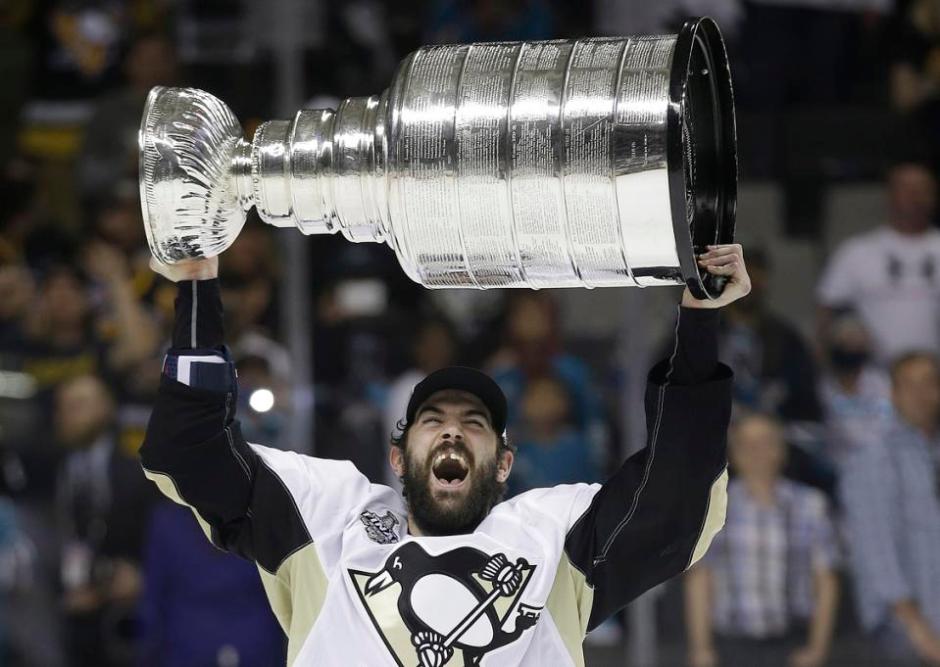
AP photo: The Pittsburgh Penguins Justin Schultz raises the cup proceeding the clinching win over the San Jose Sharks in the Stanley Cup Finals Sunday at SAP Center

SAN JOSE– With 8:58 left in the third period, Brent Burns was called for slashing Phil Kessel. The Sharks penalty kill held up but the team still only had one shot in the period when the kill started. They had no more when it ended. The minutes ticked away and the Penguins would not let the Sharks get close to a shot. The score remained stubbornly at 2-1 Penguins.

The San Jose crowd stood and cheered with four minutes left. It was a sight to see. Were they just happy to be at a game on June 12? Were they simply urging their team on?

The Sharks pulled Jones with a little over a minute left and put Marc-Edouard Vlasic on as the extra skater to try to tie the game. It took a few moments but Sidney Crosby got the puck away from the Sharks and put it into the empty net to make the score 3-1. The Sharks had just two shots on goal in the final period.

The buzzer went, the Penguins threw themselves into a celebratory pile near their net, having won the Stanley Cup for the fourth time in their history.

The crowd stood again, cheering. Then they chanted “Let’s Go, Sharks! Let’s Go Sharks!” They got a salute from their team. Sharks fans were still happy that their team made it to the dance, even if they had to go home early this time.

Did the fan reaction to the loss surprise the Sharks players? Goaltender Martin Jones said simply “No, no. They’ve been great all year.” Forward Joel Ward said:

“It was really cool for the fans to stick by us. You know, I think they appreciate some of the effort we put in and for us…” he paused “I mean, for them sticking by us through some tough times at the beginning. But you know, it was good to see. We love the fans here, love the building, love the tank. We just got to get back on the horse for next season.”

After the loss, Logan Couture described the process of getting over a defeat like this: “End of hockey seasons are never fun. It’s like you hit a brick wall. Stop. You wake up the next morning and you’ve got nothing to do.”

Joe Thornton described his feelings about the loss as: “It’s just disappointing but just super proud, the effort the guys gave all year long.”

Sharks head coach Pete DeBoer declined to comment on the specifics of Sunday’s season-ending game. Instead, he talked about his team’s performance in general:

I’m very proud of our group. I thought our guys emptied the tank and gave us everything they possibly could we just weren’t as good as them during this two week period.

DeBoer also described what he saw from the Penguins:

Their speed, their pressure they put on with their speed. It’s not just their speed, they have good sticks too. They force you into quicker decisions, they really challenge your execution. You know we hadn’t seen pressure and sticks like that through the first three rounds and I think our execution was an issue because of that.

The Sharks did not come out with the jump that many had expected from them on home ice with a chance to tie the series and force a seventh game. Through the first five minutes, the Sharks did not register a shot on goal, while the Penguins had two.

Then, at 7:50, Dainius Zubrus was called for tripping Brian Dumoulin. 26 seconds into the power pla, Dumoulin took a shot from the blue line and Melker Karlsson tried to block it but it went between his legs to the net. By the time Jones saw it, it was too late and the Penguins had the early lead. Assists went to Justin Schultz and Chris Kunitz.

Seconds later, Melker Karlsson went into the boards feet first and landed very awkwardly. No penalty was assessed, and it did not look like he was tripped or pulled down. He was helped off the ice but did return to the game later.

The Sharks finally started to push back around the 14 minute mark of the first. They threw a couple more shots on net, and the Penguins had not added any since their power play goal. The Sharks looked like they found the key for getting ahead of Penguins. They kept Pittsburgh hemmed in their own zone for couple of long shifts. Then the puck went out of play and a television timeout and the moment was gone. The Penguins attacked, the Sharks had trouble getting out of their zone and finally iced the puck. The tired defenders went back to work and pushed the attackers back.

After a short offensive push with some chances for Brent Burns, the Sharks were chased back into their own zone, where Martin Jones made half a dozen impressive saves before the Penguins were chased away again. The Penguins had five shots on goal in the final few minutes of the period.

At the end of the first period, the shots were 10-6 Penguins. After 3:13 of the second, the count was 10-9. That barrage of shots came from the Sharks’ top line. In those same opening minutes, the Penguins had a couple of chances that hit posts, but no sustained pressure like that long shift from the Thornton, Pavelski and Donskoi line.

It was several minutes later, after another long offensive shift, this time from the fourth line, that Couture tied the game up with a shot from the faceoff dot. Melker Karlsson was back, this time screening the Pittsburgh goalie. Assists went to Karlsson and Burns.

The Penguins did not take long to regain the lead. Sidney Crosby found Kris Letang with a pass behind the net. Letang’s shot went right into Jones and trickled under him. Assists went to Crosby and Connor Sheary.

Marc-Edouard Vlasic left the bench at 7:46 and did not return until 18:05.

The shots stayed uncannily even as the period went on. First tied at 13, then at 16. But by the end of the second, it was 20-17 for Pittsburgh. The only stat that showed a gross difference between the teams was the faceoff wins. The Penguins had won 65% of them.

Five minutes into the third period, the Sharks got their first power play when Connor Sheary hooked Justin Braun to the ice. The Sharks did not get a shot on goal. The Penguins knocked the puck back up the ice several times, often aided by a careless pass. The Sharks never got their game back and the single goal they needed to tie it up never came.

No injury information was released after the game. That information may be released Monday afternoon.

Penguins Take 3-1 Series Lead With 3-1 Win

By Mary Walsh

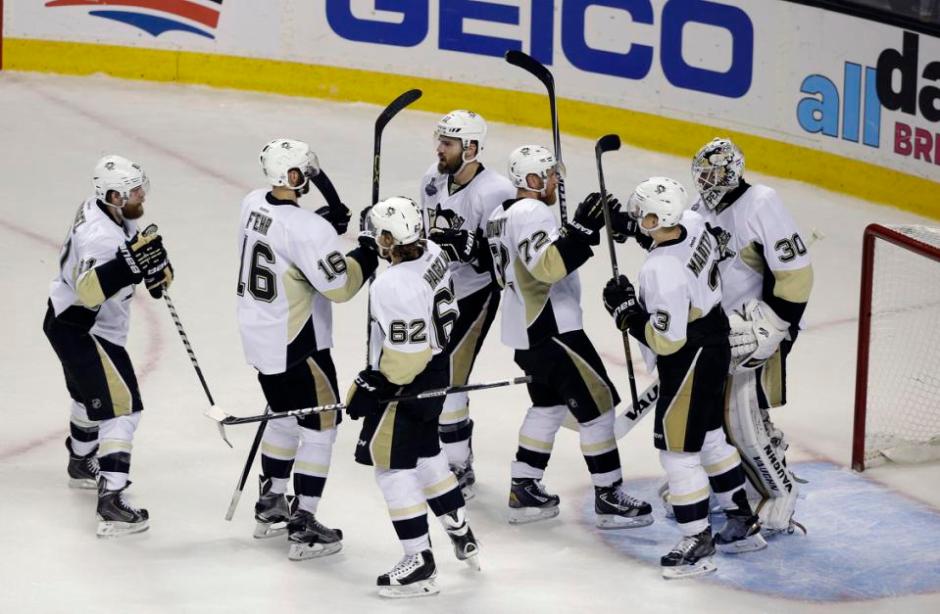
AP photo: The Pittsburgh Penguins celebrate after defeating the San Jose Sharks in game four at SAP Center on Monday night

SAN JOSE- The San Jose Sharks fell to the Pittsburgh Penguins by a score of 3-1, giving the Penguins a 3-1 series lead to boot. After the game, Sharks head coach said: “There’s no quit in our group. We’re the best road team in the league. We’re gonna show up and try to get this back here for Game 6 and play to win four, this isn’t over.” Then he went on:

We’ve been chasing the game the whole series by not scoring first so that takes you out of your four line… it effects all parts of your game. We’ve been on the other end of that in the playoffs where we jumped out to a lead on some teams and made them change their game. But I think that’s probably the biggest thing we have to fix. We’ve got to find a way to get on the board early in the game instead of chasing them.

Scoring first may require more than a tweak, but the Sharks game on Monday was fairly different from the first three games in the series.

Five minutes into the third period, Logan Couture sent Patrick Marleau up the slot all by his lonesome but Matt Murray stopped his shot. Both teams had chances in flurries but that one was a microcosm of the Sharks’ woes in Game 4. They did the things they had failed to do in prior games: staying even and leading in shots, winning faceoffs, getting zone time, blocking shots. And still they trailed on the scoreboard. Perhaps the one lopsided stat was the key: giveaways. The Sharks more than doubled the Penguins there. At one point in the game, it was almost triple.

Through the first six minutes of Game 4, there was just one shot, from San Jose. Both teams were pushing shooters to the outside when possible and blocking shots.

At 7:36, Phil Kessel and Ian Cole skated into the Sharks zone and, while three Sharks attended to Kessel, Cole found the pass and shot from the other side of the ice. It was Cole’s first goal of the post season. Assists went to Kessel and Evgeni Malkin.

Down by a goal, the Sharks had to kill an interference penalty to Marc-Edouard Vlasic at 11:37. They did, but the Penguins’ shot count had gone up by two, so the it was now 6-2 Penguins.

The Sharks had their chance on the power play at 14:45 when Ben Lovejoy went to the box for holding the stick.

The top unit held the zone and took a couple of shots but did not score. With almost a minute left, DeBoer sent the second unit out. They did not score either but neither did they get evicted from the zone before the power play expired.

The teams traded chances for the rest of the period, and at the end of 20 minutes the score was 1-0 Penguins, the shots 8-6 Sharks.

Melker Karlsson was called for interference just 2:28 into the second period, putting the Penguins power play back on the ice. It took them eight seconds to score, as a tipped shot from Kris Letang got past Martin Jones to Malkin, who was waiting at the far post to nudge it over the line. It was Malkin’s first goal of the series and fifth of the playoffs. Assists went to Phil Kessel, who tipped it, and Letang.

The Sharks got their second power play at 17:33 of the second. Bryan Rust was called for hooking Brent Burns. The Sharks power play did not start out with much traction. The second unit did not look much better, and with 10 seconds left in the penalty, gave up a nearly three on one going the other way. Sharks skaters caught up before any real damage could be done but they ended the power play with a defensive zone draw, and still trailing by two goals.

Melker Karlsson lifted the crowd’s spirits with a goal at 8:07. He was back on a line with Nick SPaling and Chris Tierney. The line charged into the Penguins zone and held a little riot around the net until finally Karlsson could see an opening. He took the shot while falling but managed to lift it over Murray. Assists went to Chris Tierney and Brenden Dillon.

The third period forward lines were: Couture centering Ward and Marleau, Tierney centering Karlsson and Spaling, Thornton centering Pavelksi and Donskoi. Wingels, Nieto, and Zubrus were seen but little in the third. Wingels and Zubrus did not take a shift, and Nieto took only one. The cut-backs started in the second period, where Zubrus and Wingels only had three shifts in the latter part of the middle frame

Another oddity in the lineup was evident in the third, with the defensemen being shifted around. It was not clear if this was due to some power play time or intentional line mixing. Braun and Dillon were on the ice together, and then Paul Martin and Roman Polak. For the final two minutes of the game, Vlasic and Burns were on the ice, but that was after Eric Fehr had scored another goal, assisted by Carl Hagelin and Olli Maatta.

Apart from the sound of some exuberant Penguins fans, a hush settled over the Tank. One last call for cheers and towels waving had some effect. With 1:25 left in the game and probably the last home game of the season for San Jose, the crowd waved and cheered.

The Sharks pulled their goalie with a little more than a minute left in the period and racked up some shots, to no avail.

Final score: 3-1 Penguins, with a series status to match. Game 5 will be in Pittsburgh on Thursday at 5:00PT.

Sharks Win Game 3 in OT, Climb Back in Series

By Mary Walsh

AP photo: San Jose Sharks Joonas Donskoi celebrates with teammates after scoring winning OT goal against the Pittsburgh Penguins at SAP Center on Saturday night

SAN JOSE–The San Jose Sharks defeated the Pittsburgh Penguins in Game 3 of the Stanley Cup Final Saturday, by a score of 3-2. The Sharks now trail in the series 2-1. The game winning goal came in overtime from rookie Joonas Donskoi. Joel Ward and Justin Braun also scored for the Sharks, while their goaltender Martin Jones made 40 saves on 42 shots for the win. Ben Lovejoy and Patrick Hornqvist scored for the Penguins. It was the Sharks’ first overtime win this post season.

There was some talk about the Sharks being wide-eyed on their first trip to the Stanley Cup Final. There may be something lost in translation, but Joonas Donskoi, first-year NHL player, does not seem particularly nervous. Asked what it felt like to score probably the most important goal in Sharks history, he said: “I think I had a lot of scoring chances through the whole Final, and this was a good time to get it in.”

The game was the first time the Sharks won a majority of the faceoffs against the Penguins. The Sharks had three power plays and scored on none of them. Neither team scored on the power play. The Sharks won on the strength of their even strength play. It was an impressive change from Games 1 and 2.

The headliners for both teams were kept off the highlight reels Saturday. Of how Marc-Edouard Vlasic and Justin Braun handled Sindey Crosby’s line, Sharks head coach Pete DeBoer said: “I thought Vlasic and Braun… you have to mention Brauny when you mention Vlasic too, I thought those two were excellent tonight, both ends of the rink, Brauny got a goal, defending, playing big minutes, they were fantastic.”

Melker Karlsson started the game in Tomas Hertl’s spot with Joe Thornton and Joe Pavelski, and the line had a good first shift. At 2:58 of the first, the Penguins were given a power play as a result of a call on Joel Ward for high sticking. Oddly, his stick did not appear above waist-high while the player he struck was bent down with his head low. It was odd because Ward took a stick to the face while falling that even drew blood in Pittsburgh, but that was not called.

The Sharks also seemed impatient with the penalty and went after the kill with determination. It was only after the Sharks killed the penalty that the Penguins scored off a shot from the blue line. The puck touched Roman Polak in front of the net. The goal was Ben Lovejoy’s.

As the ten minute mark approached, the Sharks still only had one shot on goal to the Penguins’ 8. They had not looked that bad. As if on cue, Justin Braun scored. He got the puck from Joe Thornton near the middle of the blue line, and with Melker Karlsson skating through the crease as a moving screen, Penguins goaltender Matt Murray never saw Braun’s shot coming. It sailed clean into the top right corner to tie the game. Assists went to Thornton and Marc-Edouard Vlasic.

The Sharks were not as bad as their shot count. Through the game, the Penguins blocked 38 shots. After the game, Joel Ward was asked about that number: “That’s a good sign. If you’re playing in the offensive zone, they’re blocking shots, you’re getting opportunities. So, just keep firing away.”

The Sharks were energized after Braun’s goal. The Penguins’ Phil Kessel had a breakaway shortly afterwards but Sharks goaltender Martin Jones stopped the shot and a defender came in fast to carry the puck away again.

The Penguins continued to outshoot the Sharks but in the final five minutes of the period, the Sharks racked up a good four shots and were generally looking stronger. The Penguins spent some time in the Sharks’ zone but both teams were doing a pretty good job of keeping the other to the outside and under heavy guard.

At the end of the first, the score was tied and the shots were 14-6 Penguins.

Early in the second, the game shifted gears for rougher terrain. Brent Burns took a punch to the face in the Penguins crease while trying to poke a puck past the goalie, and after that Justin Braun hauled a Penguin to the ice in the Sharks’ zone, but neither act was called as a penalty.

A little later, Chris Tierney and Joel Ward had a two on one chance but Penguins goaltender Matt Murray handled it. It served as a reminder that the Sharks had given up far too many two on ones in earlier games, and they seemed to be doing a better job of preventing them this time.

In the tenth minute of the period, the Sharks held the Penguins pinned in their zone for a long enough spell to draw a tripping penalty from Carl Hagelin. This gave the Sharks their first power play of the game. The Penguins killed it, but not without giving up a few more shots.

After 10 minutes, the Penguins had two shots on the period. After 15 minutes, they still had two. The Sharks had eight in the first fifteen minutes.

Just after the announcer proclaimed that there was one minute left in the game, Ben Lovejoy picked up a puck that looked like it was going out and threw it back at the net to regain the lead. The puck went off of Patrick Hornqvist, with assists to Ben Lovejoy and Olli Mattaa. It was the Penguins’ sixth shot of the period.

Almost five minutes into the third period, Nick Bonino caught Joe Thornton with a high stick and drew blood. It took the Penguins almost ninety seconds to clear the puck the first time. The power play seemed to lose energy after that and with 1:19 left in the penalty, DeBoer took his time out and gave his top power play unit a rest. That helped them a little but they still could not convert.

The second unit came on with seconds left in the penalty. The Penguins cleared the puck to the neutral zone. The Sharks stopped it short and went the other way. Joel Ward took the puck up the slot. With a Penguin between himself and the goalie, he took what must have been a deceptively hard shot. The puck went over Murray’s left shoulder, bending his glove back and tying the game just as the penalty expired. It was Ward’s seventh of the post season, with assists going to Joonas Donskoi and Joe Thornton.

At the end of regulation, the score was tied at two and the shots were 33-22 Penguins.

The first seven minutes of overtime went back and forth with grueling suspense. The Penguins were outshooting the Sharks 5-1. The Sharks lines seemed jumbled, whether by incomplete line changes or actual line adjustments. In any case, Chris Tierney, Melker Karlsson and Joonas Donskoi were in the Penguins zone stirring things up behind the net and along the boards. At 12:18, Donskoi carried the puck behind the net and came out the other side, then spun and shot in a quick motion. The game winner was Donskoi’s sixth goal of the playoffs. An assist went to Chris Tierney.

For Game 4, the teams will return to SAP Center in San Jose. Game time is 5:00 PT.

Sharks Without Hertl for Game 3

By Mary Walsh

AP photo: San Jose Sharks Tomas Hertl who sat out game three vs. the Pittsburgh Penguins in the Stanley Cup Finals

SAN JOSE–Sharks head coach Pete DeBoer has confirmed that Tomas Hertl will not play in Saturday’s Game 3 of the Stanley Cup Final. He described Hertl’s injury as a lower body one. Of Hertl’s performance so far, DeBoer said:

He’s arguably been our best player for the first two games but injuries are no excuse this time of year, we’ve got someone who will go in for him and we’ll roll out there and be ready to play.

As for who will draw into the lineup, there is little mystery. When Matt Nieto returned to the lineup for Game 2, Dainius Zubrus was the odd man out. He will most likely be back in. On the subject of who will play in Hertl’s spot on the top line with Joe Thornton and Joe Pavelski, DeBoer said:

We’ve got a couple guys that’ve played in that hole before. Melker has before, and so has [Zubrus] played there before. I think the one thing that those two guys… you’ve got a guy that’ll hound the puck and work for it. Those two guys pretty much take care of the rest. I think we’ve got a lot of options there because of who we’re sticking them in with and I think it should be fairly seamless.

Sharks captain Joe Pavelski also weighed in on how Hertl has contributed to the team in the playoffs:

He’s been a big part of this team, especially the second half. You saw the smile on his face the last few rounds. He’s really enjoyed playing, he brings that energy. It’s tough to miss a guy like that if you have to. But somebody steps in, we’ve done it, we’ve done it for a while. We still expect a great effort from whoever comes in in a good role. We haven’t had a ton of injuries so there’s been somebody always ready to step in.

A the dust settles from Logan Couture’s comments on faceoffs, there remains the fact that the Sharks have not been very good in the faceoff circle. Among playoff teams, they have consistently been at the bottom in faceoff win percentage. It begs the question, what does the team do to still win the game, or 12 games, despite rarely starting with the puck? Logan Couture explained: “Get it back right away, put it in good places so we can forecheck and hold on to the puck in their end. There’s a few things you can do off a faceoff or forecheck that can turn the puck over.” So far, the Sharks have not been able to do any of those things very well against the Penguins. They will get another chance tonight.

Something else they will get a chance to do tonight is get back to their game. Apart from moving the puck quicker with simpler plays, thereby improving their execution, their forwards could probably backcheck more aggressively. Some time ago, I asked Sharks defenseman Paul Martin what it is about the Sharks that make them effective defensively:

[Jones] playing the puck, our forwards come back and support us and we rely on them to get out of the zone. I think everyone’s capable on our d-corps. When Roman [Polak] came over he kind of solidified that last pair and Brenden Dillon’s had  a break out year and he’s been great and he continues to improve. And the top four have been around for a while now. As far as experience, with [Vlasic] obviously, he’s a world class player, along with [Burns] they can bring something else that a lot of guys can’t.

I think we all can skate and get around the ice, and the ability to make that first pass out of the zone is big and I think we all understand the way we want to play. We all get along and so that’s big. The chemistry that we have is important.

Ironically, the formula Martin described there, with the forwards being as crucial to defense as defensemen are, pretty well describes how the Penguins have been playing. One has to wonder if it is even possible for two teams to play that way at the same time, or if they must first defuse their opponent’s arsenal.

The fact that Pete DeBoer has been here before, with the New Jersey Devils against the Los Angeles Kings, can only give fans so much comfort: his team forced a Game 6 but did not win the series. Is he hunting with a bigger boat this time?

Stanley Cup Final Preview: Sharks and Penguins

By Mary Walsh

design presented by penguins.nhl.com: Pittsburgh Penguins and San Jose Sharks digital preview design

In their first appearance in the Stanley Cup Final, the San Jose Sharks are in a good position to win, and so are the Pittsburgh Penguins. Not surprisingly, the two teams accumulated were very similar numbers on their way to the Final. Perhaps those are just the kind of numbers winners needed this year. Perhaps they are as irrelevant as statistics from the regular season. The Sharks and the Penguins could play each other four times or seven times, and it won’t add up to the number of games they played getting here. Games, and by association the series, can still be won or lost on a bounce. Either team could have trouble adjusting to a new sort of opponent, a heretofore unseen weakness could be exposed. This is why they play the games, because the NHL can’t award the championship based on past performance. Still, the likeness is uncanny.

Statistically, the Sharks and the Penguins are pretty even when you balance offensive and defensive numbers. The Sharks’ power play has a slightly higher success rate at 27%, with he Penguins scoring just 23.4% of the time. But balanced against the penalty kill, where the Penguins have been slightly better than the Sharks (83.4%-80.4%), the power play difference is even more negligible than 3.6%.

In shots per game, the Penguins have 35.1 where the Sharks have 28. San Jose’s Joe Pavelski and Brent Burns have taken 60 and 61 shots respectively, but Pittsburgh’s Phil Kessel has thrown a whopping 73 shots at the net. Again, put next to the shots against per game, it evens out. The Sharks have allowed an average of 27.1 while the Penguins averaged 29.7.

In goals, the numbers are so close (Sharks at 3.5 and Penguins at 3.22) that a counterbalance is hardly necessary, which is a good thing for Pittsburgh since the Sharks have allowed an average of 2.28 while the Penguins allowed 2.39. That gives a tiny edge to the Sharks in the area of goal differential.

The counterbalance actually comes from the fact that the Penguins have shown greater depth in scoring. The Sharks have more goals but they have come from fewer players. The Sharks have seven skaters with five or more goals in these playoffs, and four more with two to four goals. That gives them eleven skaters with more than one goal. The Penguins have just five skaters with five or more goals but eight with two to four goals, for a total of thirteen skaters with more than one goal. It is not a big difference, but neither is the difference between how many goals the teams have scored on their way to the Final.

The Penguins may have an edge in experience because they do have some players who have competed for and won a Stanley Cup in the past. Only the Sharks’ goaltender Martin Jones can say that, though he did so as the backup goaltender. The Sharks have plenty of players with enough mileage that, if they do not know what it takes to win at this level, they will probably learn quickly. I would not put a lot of stock in the “been there” factor.

In goal, the teams have fairly similar situations. Both teams, coaches and players, have talked about how calm and unflappable their young goaltender are. Martin Jones has more NHL starter experience but he is still in his first season. He has not been replaced during the playoffs, he has started every game for the Sharks. Jones put together a .919 save percentage through the first three rounds, with the full demonstrable confidence of his coach and his team.

The fact that the Penguins’ Matt Murray came onto the scene later than Jones should not be held against him. Marc-Andre Fleury was the presumptive playoff starter for most of the season. That Murray had to earn his spot very recently could be an asset if he is still trying to establish himself. The Penguins did experiment, having Fleury start a game in Murray’s place, and Zatkoff started a game before Murray did. Even if any of that undermined Murray’s confidence, he still played well enough to help his team win. His save percentage has been .875. Jones seems to have the edge over Murray there, but those numbers can change quickly.

Ultimately, few of these comparisons matter. All of the games played to this point were conference exclusive. The Sharks’ numbers were against western teams, the Penguins’ against eastern. The Sharks had to defeat a recent Cup winner, and then defeat the team that defeated another recent winner. It would not be outrageous to say that it is harder to score a goal, or prevent one, in the west. But it would be pure speculation since the Final is the only time East meets West. Both teams earned their spot in this series, and the odds are good that they will both bring their best games yet.

Sharks Win Western Conference Final 4-2

By Mary Walsh

AP photo: San Jose Sharks celebrate their first Western Conference title in franchise history with the Western Conference title Cup on Wednesday night at SAP Center

SAN JOSE– The San Jose Sharks punched their ticket to the Stanley Cup Final on Wednesday, by defeating the St. Louis Blues 5-2 in Game 6 of the Western Conference Final. The 4-2 series win represents the first time the Sharks have prevailed in a conference final, the first time they will compete for the Cup.

Joe Pavelski scored the first goal of the game, Joonas Donskoi scored the fourth, Joel Ward scored the two in between and Logan Couture tidied up with an empty net goal. Vladimir Tarasenko scored twice for the Blues late in the third period. Sharks goaltender Martin Jones made 24 stops for the historic win, while Brian Elliott made 22 for the Blues.

It is the third time that some of the Sharks have been to the Western Conference Final, among these is Joe Thornton. He talked about the win after the game:

It’s a pretty cool feeling. Obviously it’s our first time here so it was pretty neat to get this done at home. Fans here have waited so long, 25 years, and we’ve waited” here he turned to verify with Patrick Marleau, “18 years or so. So it’s a great feeling. And this team, we’ve always said we’ve got a deep team and we truly believe we’ve got a deep team. And you saw tonight all twelve forwards played big parts, all six D played big parts and Joner played great. This is really truly a team effort from top to bottom.”

Patrick Marleau said he does not wonder why this group has made it so much farther than previous Sharks teams:

“We’re just enjoying the ride right now. We’ve had some really good teams over the years but like Joe was saying, this team’s a little bit different. The confidence we built over the regular season and now in the playoffs. I think winning on the road helped us get close as a group during the regular season and it carried over into the playoffs so far. Just having each other’s back out there and working for each other.

Head coach Pete DeBoer said that he believed this team could get this far right at the start of the season. This, despite or perhaps because of their troubled recent seasons:

They were coming off a down season but they were coming off a decade of great hockey. They had been well coached. Todd McLellan and the previous staff are as good as there are in the business. These guys had a great foundation. Right place, right time. Everyone was ready for something a little bit fresher and newer, not anything that much different. But that and the additions Doug [Wilson, Sharks GM] made, it just came together.

“I inherited a similiar team in New Jersey when I went there. Same type of thing, they had missed the playoffs for the first time in a long time the year before I got there. I think when you go into that situation, when you have really good people like there was in New Jersey when I went in there, like there was with this group. They’re pissed off, they’re embarassed by the year they just had and they’re willing to do and buy into whatever you’re selling to get it fixed again.”

Today I heard someone suggest that the other three teams in these conference finals get more air time than the San Jose Sharks do because there is nothing controversial about the Sharks. They are not swapping their goalies around, they are not switching their lines around, their star players are not underperforming, there is no supplementary drama. They just go out and do what they are supposed to do. But for fans of this team, this playoff run has been very dramatic, very suspenseful. They may be cheering like mad in the audience, but there are a lot of fans just holding their breath through every game.

The Sharks played up to that hum-drum reputation when Joe Pavelski got credit for the first goal of the game just 3:57 in. Assists went to Joe Thornton and Tomas Hertl.

Apart from the last half minute of the period, the Sharks won the first period handily. Those final thirty seconds were getting out of hand, as the Sharks failed to clear several times and had the puck snatched away from them a few more. But they were saved by the bell and came away form the first with a 1-0 lead and a 9-5 shot advantage.

Seconds after that shot, play went the other way and the Tierney line wrought some havoc in the Blues’ zone. A Brent Burns shot went off Joel Ward’s stick for his fifth goal of the playoffs. Assists went to Burns and Tierney.

The Sharks earned their first power play when Troy Brouwer took an interference penalty early in the second period. San Jose’s power play did not convert but did bump their shot count to 13 without alowing the Blues to take a shot before close to the five minute mark of the period.

Scottie Upshall, back in the Blues lineup after sitting out the last three games, caught Tommy Wingels in the face with a high stick at 6:08 and drew blood, earning himself a double minor.

The four minutes of power play time seemed to lull the Sharks into complacency, or else it galvanized the Blues. The Blues took a couple of short-handed shots and the Sharks had more trouble getting through the neutral zone than they had previously. They accomplished the most immediate goal: of maintaining a two goal lead.

That was not enough for coach DeBoer. He used his timeout with just over five minutes left in the period. The Sharks had been scrambling and the Blues were making up ground on the shot clock. The end of the second had that in common with the end of the first: the Blues pushed the Sharks and Martin Jones had to make a few more stops. The Couture line had a good shift in the final 20 seconds but the Blues outshot the Sharks in the second, 11-10.

That second line picked up where they left off to start the third period, crowding into the Blues’ zone and making Elliott stop a shot from close in. It took them a few more shifts, but they finally caught what they were hunting: a third goal. It was only part of the Couture line. Ward was on the ice momentarily instead of Donskoi. As a result, he scored his second of the game and seventh of the playoffs. Assists went to Couture and Patrick Marleau.

The crowd went a little bit crazy. Richard Dean Anderson was shown helping duct tape Sharkie’s drum back together in one of the tunnels.

The Blues ruined the shut out with 8:21 left in the game. Vladimir Tarasenko got his first point in the series by way of a goal. Assists went to Jori Lehtera and Colton Parayko.

At 15:35, the teams were both penalized after a scuffle by the benches. Tommy Wingels (slashing) and Kevin Shattenkirk (cross-checking) both went to the box for two minutes. The Blues pulled Elliott for the additional skater and Tarasenko made a game of it with a second goal at 16:25. It squeezed through a gap between Jones’ blocker and the pipe. Assists went to Paul Stasny and Alex Pietrangelo. The Blues tried the same shot again a few seconds later but Jones adjusted.

The Blues continued to push right to the end of the period, until Logan Couture was able to put the puck in the empty net.

The Sharks will play the winner of the Eastern Conference Final in Game 1 of the Stanley Cup Final on Monday.

Blues Turn Tables On Sharks, Tie Series With 6-3 Win

By Mary Walsh

AP photo: St Louis Blues Jori Lentera (12) scores in the first period against the San Jose Sharks in game four at SAP Center on Saturday

SAN JOSE-Saturday’s Game 4 of the NHL’s Western Conference Finals was a complete reversal of Thursday’s 4-0 victory for San Jose. The St. Louis Blues tied the series 2-2 with a 6-3 victory, beating the San Jose Sharks in all three zones. The Blues’ power play went 2-4 while the Sharks’ power play went 0-4. Troy Brouwer and Kyle Brodziak each scored two goals for the Blues, with Jori Lehtera and Alex Pientrangelo adding to the tally. For the Sharks, Joe Pavelski, Chris Tierney and Melker Karlsson scored.

Oddly, the Sharks won on the shot clock and in the faceoff circle, the same way the Blues won those in the previous game. The fact that the Sharks were not shut out seems like a negligible detail.

It was the first time in these playoffs that Sharks head coach Pete DeBoer decided to pull goaltender Martin Jones from the game and put backup James Reimer in. It was a stark contrast to the consecutive shutouts that Jones pulled off in the last two games. On the performance of Jones, Sharks forward Tommy Wingels said afterwards:

We hung him out to dry tonight, he made some big saves there and he gave us a chance. We kept giving them more opportunities, odd-man rushes and guys alone at the net. So that’s certainly not on [Jones] at all, it’s on every guy in front of him.

It is anyone’s guess whether we will see these teams bring their best game to the same game in this series. The first game may have been the closest we will see, as each subsequent game has shown one team or the other at their best and the other very much not so. Of the Sharks’ performance Saturday, forward Logan Couture said: “We weren’t ourselves early. When you give a good team a two-nothing lead, and you give up a short-handed goal, that’s pretty much it.”

Tommy Wingels went into some detail about what the Sharks did wrong in this game:

We got away from our game. Our game is going north with it, it’s making plays where we’re there, it’s gettin pucks past their d-men, through the neutral zone and in on the forecheck. We got away from that, we turned pucks over, we turned it into a track meet for the first twenty, thirty minutes.

The only change in either lineup from Game 3 was Jake Allen, replacing goaltender Brian Elliott in the Blues net. After the game, Blues head coach Ken Hitchcock talked about the decision to put Jake Allen in net:

He gave us exactly what we needed. He’s a competitive son of a gun and we needed a battler in there. We needed somebody to really help us play better defense. And we played with more passion in front of him in our own zone because I made the goalie change. And I had to make that decision. But I just felt like we were allowing them too much easy space with [Elliott] in there. And [Elliott] was getting bombarded and we needed to just dig in a little bit deeper defensively if we were going to have a chance in this series.

Almost four minutes in, Roman Polak took a shot from the blue line that looked like it was in, at least from one end of the rink. A section in the audience got half way to their feet before seeing that it was not a goal. The crowd was ready and confident that any Shark could score from anywhere. The game did not fulfill their expectations.

Instead, five minutes in, the Sharks took the first penalty, a tripping call to Brent Burns. Before that power play was over, the Blues had taken the lead. The goal was Troy Brouwer’s, with assists to Robby Fabbri and Paul Stastny. Coach DeBoer challenged the play as offside but the goal stood up and the Sharks lost their timeout.

Shortly after the half way mark of the first, matters got worse for the Sharks. Jori Lehtera took a shot that Jones stopped, and the rebound went to the other side of the crease, where Robby Fabbri was waiting. Jones got across and stopped two shots, but a third rebound went out front to Lehtera, who put it under a prone Brent Burns and into the net.

The Sharks had their first power play a few seconds fater that, an interference call on Paul Stastny. The first power play unit did not look their worst, but they were not as sharp as they have been. The Blues took advantage of some poor passes and overdressed plays and killed the penalty. The second unit had no more success, and only a little less time. The first unit went off the ice with just under a minute left in the power play.

The next power play came with just 21 seconds remaining in the period, and it went to the Blues. As they waited for a delayed slashing call on Vlasic, another shooter drew Jones away from the net and got the puck behind him. Burns was there again he knocked the puck away.

Just over half way through the Vlasic penalty, Logan Couture put the puck over the glass and gave the Blues a two man advantage for 48 seconds. The Sharks survived both penalties and got a round of applause for it.

Their next power play, though, earned applause only from the Blues fans in the building.
Jaden Schwartz and Kyle Brodziak escapaed through the neutral zone with the puck, attacking two on one against Marc-Edouard Vlasic. Schwartz passed and Brodziak shot at the far corner on Jones, scoring his first of the playoffs short handed at 6:09, while Kevin Shattenkirk sat in the box for interference. An assist went to Jaden Schwartz. Their escape was explained by Joe Thornton after the game: “It was going to [Pavelski] and Pav thought [Couture] was behind him so he let it go. But it was just one of those plays where usually we make that happen and it just didn’t.”

The Blues’ second even strength goal came just after the half way point of the second. This one looked a lot like the previous one, when Jones had to get from one side of the net to the other and ended up too far from the center of his crease, giving [] an open net to shoot at. After that fourth goal, Peter DeBoer did the same thing Ken Hitchcock did in Game 3: he replaced the goalie. James Reimer hit the ice for the first time in the playoffs.

A minute or so later, a puck hit the netting above the Blues net, which caused the official to blow his whistle. When the puck landed, Hertl knocked the puck inth=o the Blues net. That got a reaction out of the Blues and got ?Hertl all tangled up in a scuffle. Oddly, the officials felt that Thornto ought to go to the box, along with Brouwer, both for roughing, but not each other.

The Four on four play seemed to favor the Sharks, or maybe it was the Blues sitting back on their 4-0 lead. In any case, the penalties elapsed and the score was still 4-0.

As the second wound to an end, the score stood at 4-0 and the shots were 21-15, both in favor of the visitors.

1:05 into the third period, the Sharks pushed back a little. The Thornton-Pavelsk-Hertl line worked their way into the offensive zone, accompanied by the Sharks wrecking ball defenseman, Burns. Burns took one of this familiar skates around behind the net to loosen things up and then made his way back out to the top of the slot. This all seemed to be a distraction as the puck got back to Joe Thornton while Joe p/avelski was making his way to the net.Hertl was already there, possibly screening Allen’s view of Thornton’s pass to Pavelski. It was Pavelski’s tenth goal of the playoffs, Thornton’s 11th assist and Martin’s 4th.

The Blues put the kibosh on the Shark’s excellent third period start when Joel Ward put the puck over the glass at 3:48. Just seven seconds into the power play, Troy Brouwer put the puck around Reimer, off the post and in. Assists went to Alexander Steen and Paul Stastny.

The next attack came the Sharks’ third line of Chris Tierney, Joel Ward and Melker Karlsson. It started with an uncustomary skate deep into the offensive zone, by Justin Braun. That set off a chain reaction that had the Blues scrambling around the energy and quickness of Tierney and Karlsson. They put at least four shots in the direction of the net before one went in at 6:57. The goal went to Chris Tierney with an assist to Melker Karlsson.

The Sharks had another power play at 7:07, but all they got for that was some padding for their shot count. Yet another power play came their way at 10:51. Stastny was in the box again, this time for tripping Chris Tierney. Still the Sharks power play could not launch.

With more than four minutes left, DeBoer pulled Reimer for the extra skater. All that accomplished was the Blues’ sixth goal into an empty net.

With Reimer back in the net, a good push by San Jose’s third line resulted in the Blues’ scoring an own goal while trying to clear Tierney’s pass out of Karlsson’s reach.

With 2:11 left, after a group discussion around the faceoff circle, Brenden Dillon and Carl Gunnarson came to blows. The crowd deemed Dillon to be the winner. Both players left the game. Alexander Steen and Tommy Wingels also received ten minute misconducts.

The final shot count was 34-27 San Jose.

Game 5 will be in St. Louis on Monday at 5:00 PT.

Sharks Shut Out Blues Again, Take 2-1 Series Lead

By Mary Walsh

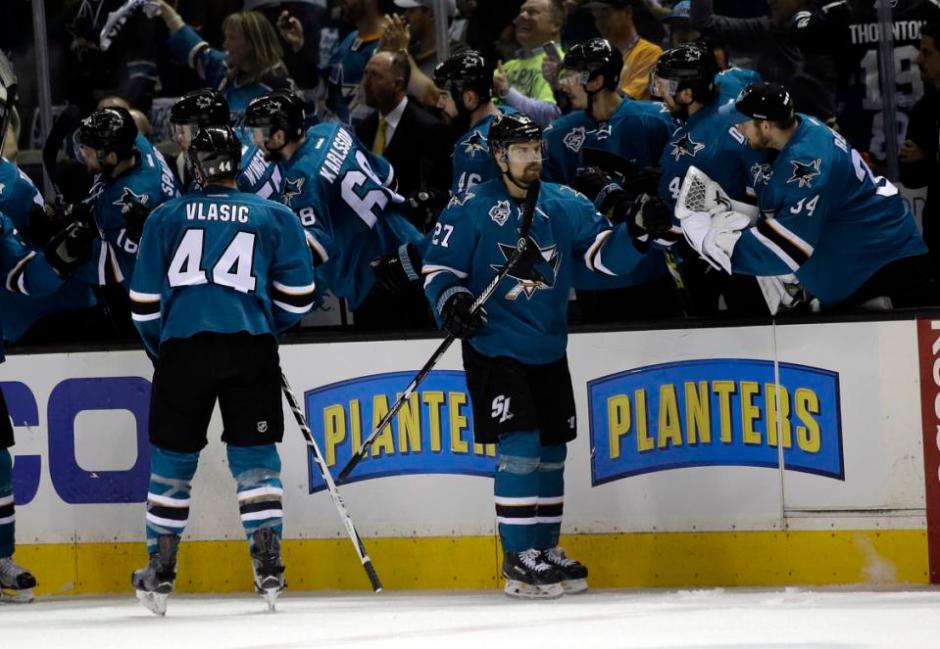
AP photo: San Jose Sharks Joonas Donskoi (27) takes goes for the victory lap from the Sharks bench after scoring in the second period in game three of Thursday night’s game at SAP Center

SAN JOSE– The San Jose Sharks took a 2-1 series lead over the St. Louis Blues with a 3-0 victory in San Jose. It was the first time that the Sharks had two consecutive shutouts in the playoffs, and the first time in a Conference Final. Though the Sharks looked unsteady in the first few minutes of the game, they made the most of their chances and limited the Blues to not very good ones.

Two goals came from Tomas Hertl, with the middle tally from Joonas Donskoi. Martin Jones made 22 saves for the Sharks. David Backes led the Blues in shots, and Brian Elliott made 11 saves on 14 shots before being replaced in the third period. Allen made two saves in relief.

The Sharks did not get off to a good start. That may be an understatement, as they looked like they are on a penalty kill when they were at even strength. The first line to muster any offensive zone time in those terrible five minutes was the fourth line. After that, the second line spent some time there, and the others followed suit. After almost seven minutes of play, the Blues had three shots to the Sharks’ 1 but that does not express how unbalanced the game had been.

The ten minute mark seemed to be the witching moment for San Jose, as the team found their legs and started launching some concerted attacks on the Blues net. Nick Spaling backed up a little too close to Blues goaltender Brian Elliott, but even though Elliott advertised the contact by throwing his mask off, no penalty was called. Later, Marc-Edouard Vlasic had a near miss but the pass was just out of reach. The Sharks almost made up the difference in shots by the end of the period. San Jose also had three odd man rushes by the 12 minute mark, while the Blues had none.

The changes to the Blues lineup showed some promise early. Dimitri Jaskin and Colton Parayko had some strong shifts in the Sharks’ zone later in the first period.

The Sharks were still trailing on the shot clock, 3-7, when a ragged-looking odd man rush by the Sharks’ top line put the puck in the back of the net. Joe Thornton picked the puck up in the neutral zone, and made a short pass to Joe Pavelski as he crossed the blue line. He quickly sent the puck in across the slot, where Tomas Hertl was headed. Hertl gathered the puck up and shot it by Elliott for his fourth goal of the playoffs. Assists went to Pavelski and Thornton.

At the end of the first, Alex Pietrangelo was called for charging and the Sharks started the second period with 1:57 of power play time. Nothing came of it, but the Sharks looked very composed. The Blues, by comparison, failed to take advantage of some fast and loose plays that left the puck up for grabs. Still, the Blues were leading in shots four minutes into the second, 9-8.

The Sharks finally caught the Blues on the shot clock with their second goal of the game, and Joonas Donskoi’s fourth of the post season. Logan Couture carried the puck into the zone and sent a pass back to Donskoi as he crossed the blue line. After looking like he might pass it to another skater in the zone, Donskoi took the shot from high in the slot. Marleau was right in front of the net and Elliott probably did not have a clean view of the shot.

The Blues had their first power play of the game at 15:01 of the second, when Couture went to the box for high sticking Patrick Berglund. The Blues held the zone very effectively and added a couple of shots to their tally but did not change the score.

Early in the third period, the Blues put fierce pressure on the Sharks, adding three shots in the first three minutes and getting the Sharks a little off balance. Six minutes into the period, the Sharks still had no shots on goal.

That first one was a doozy, as it gave the Sharks a 3-0 lead. Tomas Hertl’s second goal of the game was scored with a very simple shot from close in, that went under Elliott. Joe Thornton got the puck to him with a pass around the boards, which he picked up behind the net and skooted ot in front for the shot. Assists went to Thornton and Pavelski. After that goal, Jake Allen took the Blues net.

The Blues pulled Allen as well with over five minutes left in the game. They were able to hold the zone for about 30 seconds before sending it over the blue line themselves. Jones made some good stops but after about a minute of six on five play, the Sharks drove the game back into the neutral zone and took a swipe or two at the empty net. Logan Couture missed one, Tomas Hertle had one blocked. To their credit, the Blues did not give the Sharks much time for those shots.

With just 44.4 left in the game, Alex Pietrangelo went to the box for elbowing. The Blues kept their net empty and held the Sharks’ zone pretty well with the extra skater, but they could not break the shutout.

Game Four will be Saturday at 4:15 PT in San Jose.

Sharks and Blues: Western Conference Final Preview

By Mary Walsh

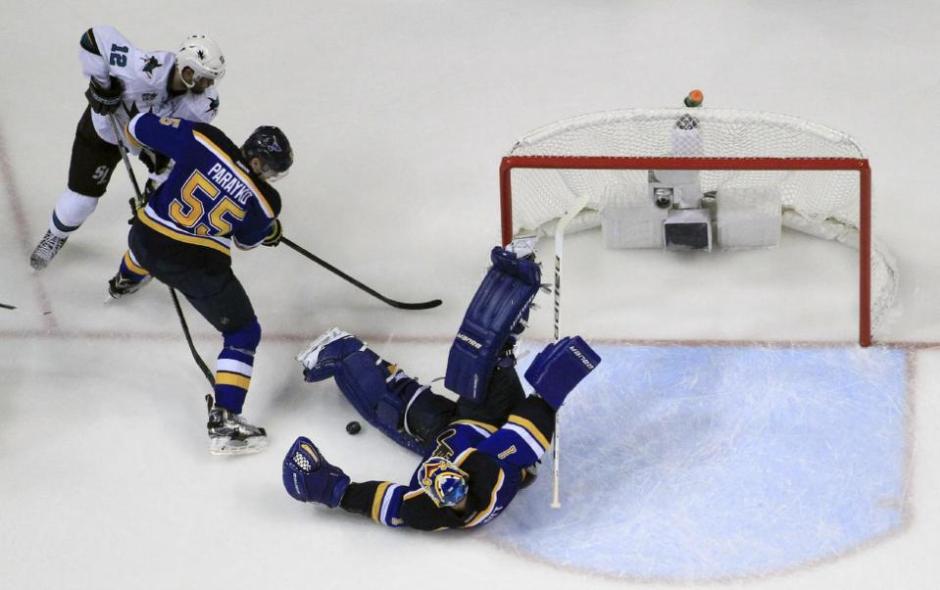
AP photo: St Louis Blues goalie Brian Elliott stops a shot from the San Jose Sharks Patrick Marleau 12 as Blues defenceman Cotton Parayko 55 watches on Sunday night in the third period

The Western Conference Final is upon us. Past results reveal that the San Jose Sharks and the St. Louis Blues have followed very similar paths to this point, and neither team is a clear choice for favorite. Even intangibles cannot give us a hint. Both San Jose and St. Louis are hungry for success. The Sharks have never made it to the Stanley Cup Final, and the Blues have not been there since 1970. They both unseated recent Cup winners in the first round. They both defeated up and coming teams in the second round, by the a five goal margin, in the seventh game. The likeness is uncanny, and utterly proper. The final teams in the Stanley Cup playoffs should be equals, it is only right that the results be entirely unpredictable. The results of the Stanley Cup Final could be easier to predict, especially with the Eastern teams taking such heavy casualties after just one game. I predict that the Western team will win the Cup, and that team will be from a city named after a saint.

A glance at the current NHL Leaderboard shows three Sharks leading in playoff scoring categories. In points, goals, and assists, Logan Couture, Joe Pavelski and Brent Burns top those charts. Logan Couture is in the top three in all of those categories, while Pavelski and Burns are top five in two. The Blues have two players in each of these categories, with Vladimir Tarasenko listed in the top five in points and goals, Robby Fabbri top ten in points and assists, and David Backes ranked fifth in goals. The teams are pretty close when it comes to high ranking for their top scorers.

Those numbers tell us which players the opponent will zero in on defensively. They also tell us, by omission, which players previous opponents probably spent most of their defensive energy on. For the Sharks, Joe Thornton did not rack up quite as many points as he might be expected to, especially being one of Joe Pavelski’s linemates. Joel Ward fell from fifth to eighth on the team in goals. Tomas Hertl dropped from fourth to ninth on the team in goals. Patrick Marleau should have produced more, especially since he spent so much time not on a line with Couture or Thornton. I say that because he should have been able to slip under the radar of the Kings or the Predators, if the top lines drew top defense away. So either Marleau did get the defensive attention he can deserve, or he just was not playing that well. Either way, he is one who could suddenly start producing in this series.

Even if underproducing players do not break out, how many goal scorers has it taken to get the Sharks this far, compared to the Blues? The Sharks have seven players with three or more goals in these playoffs. Apart from the league leaders mentioned above, the Sharks have four goals from Marleau, three each from Thornton, Chris Tierney, and Joonas Donskoi. Joel Ward, Tomas Hertl and Melker Karlsson have two each. Matt Nieto and Tommy Wingels each have one tally.

For the Blues, eight players have scored three or more goals. Tarasenko has seven, Backes has six, Troy Brouwer has five, Alexander Steen and Patrik Berglund each have four, while Robby Fabbri, Jaden Schwartz and Paul Stasny each have three. Seven more St. Louis skaters have one or two goals. During the regular season, Tarasenko also led his team in goals, and the rest of the top six were essentially the same as they have been in the playoffs: Backes, Brouwer, Fabbri and Steen.

Though none of the Blues defensemen can challenge Brent Burns in the scoring department, St. Louis has gotten more points from their defense than the Sharks have. They have four defensemen with four or more points, Kevin Shattenkirk leading there with ten points. The Sharks have four defensemen with three or more points, Justin Braun and Paul Martin having just three.

The Blues have three more goal scorers than the the Sharks have, but the Sharks have scored .28 more goals per game. The Blues have given up a few more goals (2.43) than the Sharks have (2.33), if you go by games played. One could argue that the Sharks should not have it held against them that they did not give up goals in games they did not play by defeating the Kings so quickly. But since the Blues and the Sharks will play the same number of games in this series, games played is probably a better measure than total goals against.

The Sharks’ 30.9% power play is the best among teams in the final four. The Blues are right behind them with a 27.5% success rate. The Sharks’ penalty kill is a couple of ranking spots higher than the Blues, with San Jose at 82.3% and St. Louis at 79.5%. Either of those special team rankings could be reversed in the course of a single game, so again the teams are darn close.

The Blues gave up more shots (31.3) per game than the Sharks did (28.5) , but not many more. The Blues played Chicago and Dallas, while the Sharks played Los Angeles and Nashville. The habits of their respective opponents may have skewed those figures. During the regular season games, the Sharks consistently outshot the Blues, but usually by a fairly small margin.

In the playoffs, faceoff win percentages are be heavily influenced by the opponent, but it is still worth looking at. The Blues have been better at 50.7 % than the Sharks at 46.2%. Both teams were better during the regular season, but the Blues were a little better there too at 51.3% to the Sharks’ 50.7%. Thornton and Hertl are the only Sharks who have won better than 50% of their faceoffs in the first two rounds, and Hertl has only taken 20 draws. For the Blues, Paul Stastny, David Backes and Jori Lehtera took the lion’s share of faceoffs in both the regular season and the playoffs, and all three are over 50%. Paul Stastny won an impressive 59% of his draws in the first two rounds.

Could it come down to goaltending? Brian Elliott gives the Blues and edge in save percentage (.929-.918), Jones has the edge in goals against average (2.16-2.29), and they each have one shutout. Elliott is the more seasoned starter, but he has never gotten so far in the playoffs. Jones has seen his team win a Cup, but was only there as a backup. Both teams have above-average backups, but only the Blues’ Jake Allen saw any ice time in the first two rounds. Again, and again and again, the Sharks and the Blues look so close on paper that neither clearly has an edge.

The victor will be the team that bests their best first.