

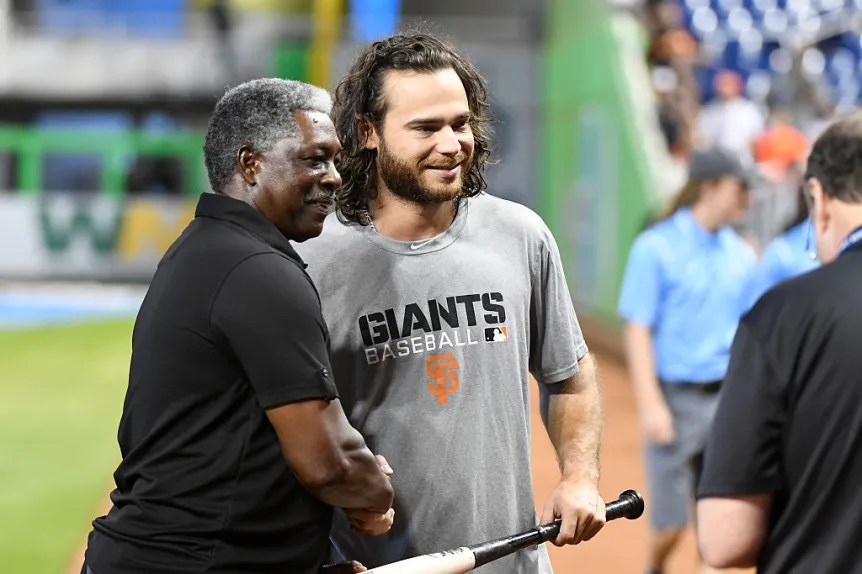
Brandon Crawford of the Giants shakes hands with former Major Leaguer and ex-Giant Rennie Stennett in Miami on Aug. 10, 2016. They are the last two National League players to get seven hits in a game. (Photo by Eric Espada/Getty Images)
By Tony the Tiger Hayes
He Was a Giant?
The Giants have had their share of free agent failures over the years. Hello, Aron Rowand, Armando Benetiz and 2024 flop de jour Jorge Soler.
But as the saying goes, “you never forget your first.”
Rennie Stennett was not only the very first Giants free agent signee to fall flat on his face, he was also the Giants first big name free agent to play for the club after the courts repelled baseball’s reserve clause in 1976.
A former star second baseman for the Pittsburgh Pirates, Stennett was one of the more exciting young players of the 1970s.
Stennett was inked by the Giants to a splashy five – year, $3 million, five year contract after the 1979 season and was expected to provide some the same production he provided the Pirates franchise for much of the ‘70s.
In 1975, Stennett had tied a big league record when he batted 7-for-7 in a nine inning 22-0 molly whopping of the Cubs at Chicago’s Wrigley Field. His seven hits tied the National League record for hits in a nine-inning game, was first established by Wilbert Robinson of the Baltimore Orioles in 1892.
But when Stennett signed with San Francisco in 1980 there was a catch. He was no longer the same player he was in the mid-1970s.
A leg and ankle injury in 1978 had robbed him of some of his quickness and hitting skills.
Stennett made it through only two seasons of his San Francisco contract before being released by the Orange & Black and he never played in the major leagues again.
Why Was He a Giant?
After a miserable fifth place finish in 1979, a season where there were high expectations for San Francisco, Giants management decided it was finally time to dip their toes in the free agent market.
The dawn of the free agent era began in 1976, but the Giants- desperately trying to get back on their feet financially after nearly going bankrupt under a previous ownership, avoided signing big name free agents.
San Francisco inked former American League infielder Mario Guerrero prior to the 1978 season but he was dealt to Oakland in a mega trade that brought superstar LHP Vida Blue back across the Bay Bridge before Guerrero played in an official game for the Orange & Black.
The Giants conservative approach to free agency ended abruptly after the disappointing ‘79 season when in one fell swoop, the Giants inked three established big leaguers on the same days to multi-year pacts.
Incoming were Stennett, veteran catcher Milt May and backup outfielder Jim Wohlford.
The Giants introduced all three players at a splashy press conference from the glorious “Top of the Mark” cocktail bar high atop the Lurie owned historic Mark Hopkins Hotel on scenic Nob Hill.
Giants general manager Spec Richardson discribed Stennett, a 28-year-old Panamanian,
as “the best young player available
Available belie
in the draft.”
The fact that Stennett was not particularly young at 28 was omitted by Richardson.
Stennett had failed to bat over .250 and lost a good deal of mobility and running speed after breaking an ankle and leg in mid-1977.
But the Giants went ahead with the deal anyway and immediately anointed Stennett the starting second baseman for 1980.
Lurie was adamant the Giants had done their due diligence on Stennett’s medical condition and deemed him fully healthy.
“We’ve put him though a couple of physicals,” Lurie commented.
To which Stennett shot back:
“It felt more like 100 physicals. I think I’m the healthiest person in the world and my ankle is 100 percent.
“l’m real excited to be coming to San Francisco,” Stennett continued.” I know I can help. I’m a winner. Now I’ll get the opportunity to win play, and I know the people here are
happy to have me.”
Signing with San Francisco closed out an awkward period of Stennett’s career. After establishing himself as one of the game’s rising stars for much of the 1970s, Stennett was not able to regain his status as a viable starter after the return from his serious injuries.
In 1979, the Pirates permanently replaced Stennett with Phil Garner as their starting second baseman and went on to win the World Series in a classic seven game series vs. Baltimore.
“I know I’ve got something to prove because of thr injury I’ve got the opportunity and I know the people here are happy to have me,” he said.
Before & After
Born in Panama in 1951, Stennett was a stellar school boy athlete for Paraiso High in Colon. Besides baseball, Stennett filled out his varsity jacket with letters in track, volleyball and basketball in which he was a voracious scorer- who collected 45 points in one game.
Unlike his longtime Pirates teammate Manny Sanguillen, a fellow Panamanian who grew up speaking Spanish, Stennett was raised the Canal Zone, then a U.S. Territory and grew up with English as his primary language.
Without a language barrier, Stennett’s transition to professional baseball became all that much easier when he signed with Pittsburgh at age 18.
Originally inked as a pitcher, Stennett made the transition away from the mound early in his professional career. He initially played both the outfield and infield.
In 1970 at Salem (Virginia) of the Class A Carolina League, Stennett led the league in batting (.326), hits (176), and triples (9).
Stennett got an early surprise call-up to the big leagues in mid-1971 when Pirates starting infielders Dave Cash and Rich Hebner were called away for a two week stint in the army reserves, a common practice during the Vietnam War era.
Though just 20 and inexperienced on defense, Stennett batted so played so well be remained
As detailed in an online bio, writer Joseph Wancho detailed Stennett’s rookie 18-game hitting streak from August 22 through September 10. was the longest streak for a Pirate in two years. Fourteen of the games in the streak were of the multi-hit variety, as his batting average rose from .278 to .405.
During that streak (9/1/71) the Pirates recorded a historic note when they became the first major league club to field an “all-minority” starting lineup.
The lineup card read:
Stennett, 2B
Gene Clines, CF
Roberto Clemente, RF
Willie Stargell, LF
Sanguillen, C
Cash, 3B
Al Oliver, 1B
Jackie Hernandez, SS
Dock Ellis, P
Hardly a publicly stunt, the lineup was not so different than the one manager Danny Murtaugh normally put on the diamond for his NL East championship club that season.
Despite Stennett’s stellar rookie season he was left off the Pirates post season roster as Murtaugh went with the more sure-handed veteran former Giant Jose Pagan instead.
Incidentally, the Pirates would defeat San Francisco in the playoffs to advance to the ‘71 World Series before defeating Baltimore in the World Series with Stennett as a bystander.
After spending 1973-74 as a Pirates super-sub – generating starts in both the infield and outfield – Stennett finally got a position to call his own in 1974 when Cash was dealt to Philadelphia in exchange for starting pitcher Ken Brett.
Stennett made 153 starts at second base for Pittsburgh in ‘74 helping the Pirates to the NL East title with a .291, 7, 56 season.
Stennett produced similar seasons for the next few seasons, typically batting around the .300 level.
He also became a fan favorite in the Steel City for his hard-nosed style of play.
His achievements have gone unnoticed by many people,” said Pirates general manager Joe Brown. “There hasn’t been a player in baseball, not even Pete Rose, has hustled more than Stennett this year.”
Stennett was enjoying his best season in 1977, batting .336, when he suffered a traumatic injury to his right leg, he fractured a bone in his right fibula and dislocated his right ankle sliding into second base in a 5-4 home loss against the Giants (8/21/77).
Though he returned to the Pirates active roster to start the 1978 season, Stennett was not the same player, he’d been previously, batting .243 in 106 games.
When the Pirates won the World Series in 1979 with their fabled “We Are Family” club, Stennett was strictly a backup for the scrappy team, batting .238 in 108 contests. He failed to start a single postseason game and registered just a single at-bat in the Fall Classic, notching a pinch-hit single in the Game 1 loss to Baltimore.
The indignity was almost too much for the proud player.
“To me it was embarrassing to sit on the bench in the World Series. I lnow I’m a quality player,” he said a short time later after signing with the Orange & Black.
Stennett saw the move to Fog City as a new beginning and even praised notoriously chilly Candlestick Park.
“One reason the Pirates always played so well in Candlestick is that it was always snowing and raining in Pittsburgh and we’d come out here and the weather would be nice.”
But once Stennett began playing for San Francisco and notoriously taciturn manager Dave Bristol the infielder began to long for his days along the Allegheny River.
“It’s very tough to play for Dave Bristol,” said Stennett. “He puts too much pressure on players. He just doesn’t communicate. He’s old-school and you can’t depend on him for any motivation.”
Stennett played in 120 games as the primary second baseman for the 1980 Giants but batted just .244 for the fifth place club. Still hobbled by his ‘77 leg injuries, Stennett committed 15 errors in the field.
The sour situation got no better in 1981 when new manager Frank Robinson pushed for the Giants to sign future Hall of Fame second baseman Joe Morgan. Stennett made only 18 starts in the strike shortened ‘81 season, batting a career low .230.
Stennett’s days in San Francisco were numbered when the Giants traded for yet another experienced second baseman in Duane Kuiper after the ‘81 campaign.
Stennett would not make it to season three of his five year pact.
He Never Had a Bobblehead Day. But…
Stennett batted over .300 in his first week in a Giants uniform, but soon bottomed out.
He did have one particularly good day that season however, batting 4-for-6 at the sight of the most famous game of his career, Wrigley Field.
Stennett swatted four singles as the Giants pilled up a generous 21 hits in a 14-6 molly whopping of the Cubs (7/23/80).
Giant Footprint
When Stennett arrived in spring training in 1982 he came with a trade request and a bitter disposition.
“Nightmare, that would be the perfect word to describe it,” Stennett said of his first two seasons in Orange & Black.
Despite averaging $600,000 in each of his first two seasons in San Francisco, Stennett claimed a lesser man could not have endured the degradation he was forced to endure by Giants management.
“Out of 100 guys who would have gone through my situation,” Stennett said, “99 wouldn’t be able to take it. They would do something drastic. There could never be a worse situation for a player. If I was a weak minded person I would be out of baseball by now.”
The Giants were just as frustrated with the marriage and tried desperately to end the union via a trade. But according to Tom Haller, the Giants freshly installed General Manager, the club found no takers, even with San Francisco offering to pay some of Stennett’s remaining salary and moving expenses.
“It’s not that we haven’t tried to accommodate Rennie’s wishes to be traded.” said Giants general manager Tom Haller yesterday. “It’s just that nobody wants him.”
“Bollocks” claimed the opinionated (delusional?) Stennett. The Giants were not doing their due diligence to move him out of Bay City.
“It’s a lie,” Stennett said. “When It comes to making a deal, there’s no such thing as ‘can’t.’ I know there’s three or four clubs interested.”
Those mystery teams never materialized and ended up working out a severance package with Stennett just prior to opening day.
Despite attempts to hook back on with Pittsburgh and a brief stint in the Mexican Leagues, Stennett would not play another game in the Major Leagues going forward.
 Sports Radio Service