

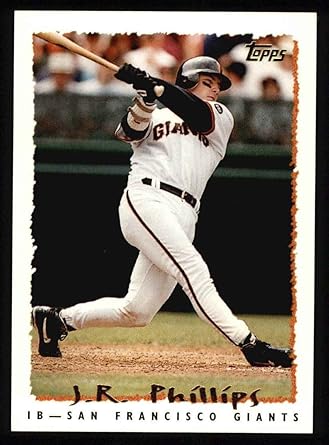
JR Phillips San Francisco Giants Topps 1995 #590
J.R. Phillips -1B – 1993-96 – # 31
By Tony the Tiger Hayes
Tall and handsome, with a tattoo of a large American Eagle perched on his rippling left bicep and a Patrick Swayze- worthy mullet – the swashbuckling J.R. Phillips would have made a great fictional character in a Hollywood sports film or even a baseball themed romance novel.
The problem for the Giants – who foolhardily floated the idea of Phillips as a replacement for franchise icon Will Clark – was that the strapping lad was not the creation of a screen writer or some drug store fiction scribbler.
The 6-foot-2, 205 pound Southern Californian was very much a real dude and in turn, not a particularly good real- life major league ballplayer.
An all or nothing slugger with gigantic, upper-cut stroke, Phillips once fanned 165 times in a baseball professional season.
That portion of his game was prominently on display as a Giant.
In fact, San Francisco had not seen a swinger as brazen as J.R. Phillips since leisure-suited lotharios populated Union Street fern bars in the 1970s.
But initially there was hope for Phillips. After Clark left the Giants via free agency after the 1993 season, the Orange & Black had their fingers crossed that they had some how struck gold with Phillips.
The 22-year-old had led the Pacific Coast League in home runs in 1993 and dazzled in a late-season cameo for San Francisco.
But it was a major ask for Phillips whose baseball pedigree was about as impressive as a junk yard dog applying for a runway slot at Westminster Kennel Club Dog Show.
Phillips ultimately flopped. But then again, so did every other dud first base candidate who tried to follow in Clark’s footsteps for several years after his decampment.
Why Was He a Giant?
Not only was the intense Clark one the most popular Giants of the Candlestick Park era, Clark was one of the most successful Giants in terms of both personal production and his prominence in transforming the Giants into a winning organization after many dormant seasons.
A charismatic 1984 baseball Olympian, Will also served as a major marketing tool for the Candlestick Park-addressed franchise.
Clark’s eight year tenure with San Francisco encompassed three of the team’s most successful seasons of the ‘Stick era: the team’s first division title in 16 seasons (1987), first pennant in 27 years (1989) and most regular season wins at that juncture (103) in 1993.
Moreover, Clark was also MVP of the 1989 NL Championship Series, a five time All-Star, Gold Glove winner (1991), and Silver Slugger winner 1989. He batted .299 in his eight-year Giants career.
In ‘89 he famously drove in the winning run vs. the Cubs to send San Francisco to the World Series vs. Oakland.
With liberally smeared lamp black under his eyes and an always turned-on intensity, the member of the College Baseball Hall of Fame was the living and dying face of Giants baseball.
To this day, Giants fans rhapsodize about Will’s first career at-bat home run off Nolan Ryan and a wild fight with Ozzie Smith and multiple Cardinals after a hard slide into second base.
But despite batting .387 in the final month of the ‘93 campaign – and a solid .283, 16, 73 for the season -Giants officials believed Clark – who would be 30 at the start of the 1994 season – was on a downward trajectory.
Club officials secretly fretted Clark was not committed to physical conditioning and his usefulness would peter out before he reached the end of his next contract period.
The club refused to budge from a three-year $15 million offer, with a club option for a fourth season.
So, disheartened Giants fans helplessly watched Clark walk away to Texas where Rangers principal owner George W. Bush was pleased to hand “The Thrill” a cartoon sized check for $30 million over five seasons.
Bay City ticket buyers weren’t the only one’s frustrated. In 1993, Giants rookie manager Dusty Baker had watched Barry Bonds, Robby Thompson, Matt Williams and Clark lead the Giants to a then club record 103 victories.
Why mess with the recipe for a delicious and deeply satisfying meal, Baker wondered.
“My first reaction is I would have loved to have kept Will,” said Giants manager Dusty Baker, after Clark’s departure became official. “But If Willie Mays and Hank Aaron can be traded, anything can happen in baseball.”
Saying he was “very disappointed” that the Giants could not come to terms on a new contract with Clark, San Francisco general manager Bob Quinn announced the club would find it’s 1994 first baseman from a hodgepodge fronted by the uninspiring Todd Benzinger with fellow journeymen Mark Carreon and Dave Martinez also thrown into the mix.
Lastly, he mentioned Phillips.
Though the marketable rookie was the most intriguing candidate, initially Giants bigwigs played down the phenom.
“We don’t want to place too much pressure on (Phillips),” said Quinn of the MLB novice, who had bopped a combined 39 professional homers during the ‘93 season. (11 to top the Arizona Fall League; 27 to lead the PCL and one with San Francisco.)
Baker also pumped the brakes on the kid.
“I’m not ready to put the “Next Will Clark” label on J.R.,” said Baker. “Todd Benzinger is my first baseman for now.”
And with that comment, absolutely zero fans went out and bought season ticket plans.
Though a decent hitter for average and an excellent defender, the mundane Benzinger possessed limited run producing power and even less pizazz.
Benzinger, a Cincinnati- area native and member of the Reds 1990 World Championship club, was steady, but hardly a highlight reel machine.
Plus, he didn’t exactly present as an bankable figure. While Phillips resembled a square-jawed professional wrestler or muscular Oklahoma oilfield roughneck in appearance -the buttoned-down Benzinger looked more like the guy you would pay to do your taxes or possibly someone who collected Osmond Brothers records for fun.
Everyone, including, apparently, Phillips, knew, the Giants were really itching for the next sellable “Will the Thrill” or at least “J.R. the Star.”
“(I know) they’re not going to hand me the job,” Phillips said after Clark’s departure became official. “But I think they want me to play first. I will be disappointed if I don’t win the position. I know what I can do.”
Why Was He a Giant?
With a young J.T. Snow entrenched at first base in the majors, California left Phillips exposed to the 1992 minor league draft. The Giants – who risked losing Clark after the upcoming 1993 season- were all too happy to take Phillips off the Halos hands for $25,000.
Phillips, an Angels fifth round draft pick out of his La Puente, CA high school had bashed 55 career home runs over his first five minor league seasons. But he was a strikeout machine, hit for a low average and was a shoddy defender.
But the Giants swiftly loaded J.R. onto the back of truck with the words “Reclamation Projects” stenciled on the side.
(Ironically, San Francisco would not solve their post-Will Clark woes until Snow – who eventually flamed out in Anaheim – was acquired from the Angels to play first in 1997.)
The club added the fledgling Phillips to the 40-man roster and invited him to 1993 spring training.
Phillips did not cause much Cactus League commotion, but once the ‘93 Pacific Coast League season began, he commenced hammering balls into the Sonoran Desert night sky like shooting stars with purple- hued afterburners.
It seems Giants veteran minor league batting coach Duane Espy had noticed some fixable flaws in Phillips’ swing. After 31 games, Phillips was batting .286, with 8 home runs and 23 RBI.
Six weeks into the PCL season, reports began filtering back to Fog City about a potential future replacement for Will Clark.
“(Espy’s) changed my whole approach to battling. He took me into this little room and showed me video tapes and told me ‘this is what we’re going to do with you,” Phillips told the San Francisco Examiner in May of ‘93. “I never realized my swing was so bad until he showed me.”
Phillips moved up onto the plate, shortened his swing and began pulling the inside pitch.
When major league rosters expanded in September, J.R. – after topping the PCL in both home runs (27) and RBI (94) – was recalled to San Francisco to help in the quest to keep the seemingly unstoppable Atlanta Braves at bay.
He Never Had a Giants Bobblehead Day. But…
In his first big league start, Phillips, subbing for Clark, teamed up with 21-year-old rookie RHP Salomon Torres – a Giants prospect even more hyped than J.R. – to upend the Cardinals, 3-1, at St. Louis (9/4/93).
Phillips barreled- up a triple that caromed off the center field fence in his first at-bat, then in his next plate appearance bombed a two-run home run to right, scoring Bonds, off future Forever Giant Rene Arocha.
“It’s a great feeling. I’ll take it anytime,” said Phillips, of his first two big league hits. “Really, on the home run, I was just trying to move Barry up.”
“We didn’t bring these guys up just to look at them,” Baker said, of the fresh reinforcements.
(The victory kept the Giants incredibly shrinking lead in the NL West at 3.5 games ahead of the rampaging Braves. Atlanta would eventually capture the NL West in the waning hours of the ‘93 regular season.)
Before & After
When spring training rolled around in 1994, Phillips appeared more than ready to take command of Clark’s vacancy.
The confident rookie started the exhibition season batting 4-for-5, including a mammoth 450-foot homer.
“We’ll go in with our eyes open,” Baker said regarding roster competition. “There’s nothing I would love more than for someone to make my decision hard.”
In the final week of Cactus League friendlies, Phillips continued his hot spring: tripling and whacking a two-run jack, to up his exhibition average to an impressive .333. J.R.’s 17 RBI topped the squad.
He was named winner of the Harry S. Jordan Award, denoting the Giants top rookie in spring camp.
The same Giants press release that publicized Phillips spring achievements, also listed Benzinger’s stats as .256, 1, 4.
Despite the wide discrepancy in spring numbers, the Giants chose to send Phillips back to Triple-A Phoenix to open the ‘94 season.
Benzinger was an eight-year veteran and top notch glove man. He also played quite well in 1993, batting .288 hitter in 86 games off the bench for San Francisco. Todd got the nod as opening day first baseman in 1994.
“Benzinger deserves the chance based on what he did last year,” Baker said. “He fits well into the lineup. We like what J.R.’s shown, we like his attitude. He’ll be back, and when he’s back, he’ll be here for a long time. People want to rush these kids too soon. If they fail, then what? It’s also important to have a person in between J.R. and Will (Clark). It’s tremendous pressure to follow. His future is ahead of him. We feel he can still get better before he’s ready to come to the big leagues.”
The second-year skipper told the stout rookie to work on raising his batting average, cut down on his strikeouts, and improve on defense after committing an alarming 28 minor league errors in 1993.
Phillips seemed to understand Dusty’s dugout perspective.
“I’m disappointed, but Todd deserves it. He’s been up there,” the husky batsman commented. “He did a hell of a job last year. I wish him all the luck in the world. What they’re doing is trying not to rush me. They told me I’m the first baseman of the future. They said when it’s my time, I’ll be there.”
But it wasn’t his time in 1994. The ‘94 season, with it’s infamous labor conflict, was a lost year for Phillips.
After beginning the season with Phoenix of the PCL, Phillips received a call-up in June, but batted a miserable .132 in 15 games.
The ball player, partially blamed the pressure of replacing a crowd favorite for his poor showing.
“I haven’t been swinging at strikes. I’m swinging at balls,” Phillips lamented.
The extended stay in the minors allowed Phillips to iron out some of his issues. Once again he proved PCL pitching was not a mystery – hitting .300, 27, 96, before breaking his forearm late in the season.
The labor issues spilled into 1995, but when spring training finally opened, the Giants, this time, proffered a full vote of confidence to the procrastinating prospect.
The hard swinger was named the Giants regular first baseman. On opening day at Atlanta (4/26/95), Phillips creamed a Greg Maddux pitch for a long home run, in an otherwise dismal 12-5 lop-sided loss.
J.R. however, soon fell into a deep slump, collecting just ten hits in his first 99 at-bats. After batting 0-for-2 in an 11-6 win at Montreal (5/29/95), the lethargic contestant was batting an icy .101.
The Giants could no longer justify playing Phillips every day and he was returned temporarily to Phoenix. Carreon was named starting first baseman by default.
Later in the ‘95 season the light seemed to come back on for Phillips.
A day after depositing a gigantic homer into the right field football bleachers at Candlestick off the Pirates RHP Paul Wagner, J.R. clocked a pair of round trippers against Pirates RHP Steve Parris for a career topping 5 RBI game in a wild 8-7 home win (8/10/95).
By September 15, the wayward phenom was batting over .300 in his previous 31 games.
At the time, Phillips took a moment to reflect on his roller coaster big league odyssey.
“It’s been very frustrating,” the weary Californian acknowledged. “Stupidity is more like it. I look at the things I could have done.”
Phillips ended up the ‘95 season appearing in a career high 92 games with San Francisco. On the positive side he achieved career bests in homers (9) and RBI (28). But he also batted an inexcusable .195 and struck out 69 times – or nearly 30 percent of the time.
It was back to the drawing board for Phillips, which in his case was located south of the border.
Phillips logged time in the Mexican Winter League after his disastrous ‘95 Giants campaign. Upon reporting to spring training in 1996, J.R. declared to anyone with a pen and pad that he was back on track.
He offered a new batting stance as evidence. Phillips would now be holding the bat very low, with his wrists about parallel to his waist before swinging.
After going 6-for-10 with a pair of homers to start the Cactus League, it looked as if he actually knew what he was talking about.
“I’m very comfortable that way,” he said.
Phillips indicated he was close to reclaiming a spot in the Giants lineup. If not at first base, then possibly the outfield. He even brought a catcher’s mitt to camp.
Phillips was also beginning to sound like someone who had brought a few extra bottles of tequila back from Jalisco.
Besides anything short of getting run over by a turnip truck, Carreon – who had reached career highs in hits, home runs and RBI in 1995 – was now San Francisco’s clear cut starter at first. The outfield was booked too. As far as catching – well – was he legitimately nuts?
Dusty Baker said it was time for some introspection on Phillips’ part.
“It’s not like I took J.R.’s job from him. Carreon did that,” Baker said. “If J.R. had been doing relatively well in the first half of the season, he might have gotten more of a chance. I was told a long time ago the best way to keep your job is to keep your competition on the bench.”
Phillips kept the spring training pressure on. After an impressive three- homer weekend in the final portion of the ‘96 exhibition schedule, he was batting a lusty .388 for the spring. The Giants had no choice but to include him on their 1996 opening day roster.
J.R. said he learned a lot by his ‘95 failures.
“I tried to keep up with the great Matt Williams and Barry Bonds, and I didn’t play my game,” he said. “The turning point was when they sent me down and Carreon started getting hot. Coming up as a pinch hitter off the bench was difficult. I’d never had to do that.”
Well, he didn’t have to do it for much longer- at least not for San Francisco.
After starting the 1996 season a squalid 5-for-25 – albeit with a pair of home runs – the Giants decided to finally cut ties with the once promising player – trading Phillips to Philadelphia for “future considerations.”
“He has tremendous power potential,” said Giants GM Quinn. “It didn’t happen in this uniform, maybe it will happen elsewhere.”
Phillips looked forward to the new horizons.
“I thought something was going to happen,” Phillips confessed before departing the Giants clubhouse. “I feel good about it.”
Phillips played in Philadelphia about as well as he did with the Giants, before moving on to fruitless stops in Houston and Colorado. He played his final pro season in 2005.
Giant Footprint
The decision to let Clark walk to the Rangers detrimentally set the Giants franchise back for years. Who knows what the team could have accomplished if Bonds, Williams, Thompson and Clark would have had more than one season together joining forces in their prime.
After going 103-56 in 1993, the Giants would not produce another winning season until 1997, with the arrival of Snow, Jeff Kent and others.
Will Clark meanwhile batted over .300 in six of his remaining seven seasons in the majors, ending his career with a .303 batting average.
Thirty years after he left the Giants as a player, San Francisco retired Clark’s familiar uniform no. 22.
In 242 career big league games, Phillips batted .188, with 23 home runs and 87 RBI.
 Sports Radio Service