

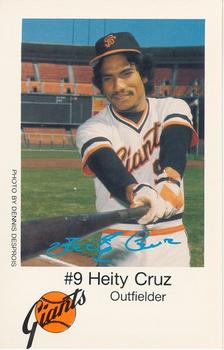
Hector Cruz of the San Francisco Giants on KNBR baseball card 1978 (KNBR photo)
He Was a Giant? Hector Heity Cruz #9 OF/3B 1978-79
By Tony the Tiger Hayes
After his professional baseball playing days were over, the former Giant Hector “Heity” Cruz began a second career as an old school, pound-the-pavement mailman. But anyone who remembers Cruz’s splashy 1978 San Francisco arrival would likely have surmised his skill set would have been better suited with an express shipment outfit.
Make no mistake about it – Cruz’s first delivery as a Giant was clearly not dispatched via “Snail Mail.”
In his very first plate appearance as a Giant, Cruz produced a violent swing of his Louisville Slugger, sending a soaring drive deep into a foggy San Francisco night for a game tying pinch-hit home run off the Mets’ Skip Lockwood.
Minutes after Heity’s cruise missle, Jack Clark sent another two-run moon shot into the same familiar left field “DMZ” territory at Candlestick Park for a walk off 7-4 victory.
The 16,429 in attendance exploded in a frenzy as Clark glided around the bases, slapping hands with third base coach Dave Bristol before being greeted by an Orange & Black throng at home plate.
Giants play-by-play man Lon Simmons was so impassioned on his call of Clark’s winning blow that his typically granite-steady baritone creaked with unrestrained emotion.
As the dejected Mets trudged off to their Union Square hotel, wildly cheering Giants fanatics partied down in the grandstand before coaxing Clark and Cruz up and out of the dugout for a much deserved curtain call.
“I wasn’t thinking about anything going around the bases. I was just so happy,” said a dazed Cruz, after his “Cash on Delivery” debut. “(Giants infielder) Bill Madlock told me before the game, ‘They’re going to pinch-hit you in the bottom of the ninth, and you’re going to hit a home run.’ I swear to God, that’s what he told me. I’ve got to believe it. It happened.”
Forty-six years later the dramatic victory remains one of most profound moments of the unbelievable 1978 season.
Cruz’s blast immediately catapulted the Puerto Rican-born utility man into cult status among Giants fans who remember the enduring ‘78 campaign that saw the Giants astoundingly lead the National League Western Division for much of the summer.
Why Was He a Giant?
For much of the 1970s the Giants were a franchise seemingly stumbling in the dark.
The decade of Watergate and neckties as wide as Van Ness Avenue saw the once proud historic ball club wither into a mediocrity. After starting the decade with a lineup of legendary stars, the club soon crumbled. By 1975 the team was on the verge of bankruptcy and preparing a relocation to Canada.
But after a long spell of losing baseball, the Giants suddenly turned it around in 1978. Thanks to a fruitful farm system, the return of wayward son Willie McCovey and the unlikely addition of super star pitcher Vida Blue via an unexpected mega trade with rival Oakland, the Giants suddenly became viable again.
The Giants got off to a decent start in April and then without warning blossomed in May as they authored a 20-6 record and clamored to the top of the NL West, leap frogging long-time nemesis the Dodgers and Reds who had taken turns winning the west most of the decade.
By mid-June of ‘78, the Giants were still holding on to first, but Los Angeles and Cincinnati were creeping up.
On June 15th, as the Giants were playing the visiting Phillies in a midweek day game at the ‘Stick, Giants General Manager Spec Richardson was busy upstairs in his mezzanine level office wheeling and dealing.
As the Giants piled up 12 hits in a 6-2 trouncing of the Phils, Richardson managed to swing three trades, netting a trio of bona fide big leaguers while subtracting just one player off the major league roster.
Incoming was shortstop Roger Metzger from Houston in a cash deal; outfielder Jim Dwyer was picked from St. Louis to complete an earlier trade of minor league pitcher Frank Riccelli; and Cruz, an outfielder and third baseman, was acquired in a swap with the Chicago Cubs in exchange for seldom used right-handed pitcher Lynn McGlothen.
The the addition of the three new charges were just the latest in a flurry of player acquisitions by Richardson, who took over the Orange & Black front office reins two years earlier.
In the previous 12 months, the trade happy Richardson had added to the roster, former 1971 American League Cy Young Award winner and Most Valuable Player Blue from Oakland for a bushel of eight prospects and veterans; swapped the disgruntled Bobby Murcer to the Cubs for batting champ Madlock, and traded for starting left fielder Terry Whitfield and slugger Mike Ivie from the Yankees and Padres respectively.
“I think we’re in good shape with the players we have now, but we want to win pennant this year and we’ll do anything we need to do to stay in the race,” said Richardson. “We’re no different than another club tryin’ to fit in the pieces of the puzzle. We’ve just been fortunate lately to get the right ones.”
(At the end of season Richardson would be named 1978 N.L. Executive of the Year.)
Both attendance and spirits were on the rise in Giants-land for the first time in years. Could the Giants actually be headed to the playoffs?
There was no doubt in manager Joe Altobelli’s estimation.
“Wouldn’t you agree that these are the types of moves a first place club would make?” asked the second- year skipper.
The Giants remained atop the western division for much of the ‘78 season until flaming out in September. The club ultimately finished 89-73 in third place, six games behind the Dodgers.
He Never Had a Giants Bobblehead Day. But…
A day after the trades for Metzger, Dwyer and Cruz – the Giants remained at home for a Friday night contest. They were in set on extending their winning streak to seven games.
Unlike the first place Giants, the visiting New York Mets were a mess. The Joe Torre led club had Willie Mays on the bench as a coach, but not much beyond All-Star center fielder Lee Mazzilli on the field.
Sixty-three games into the ‘78 campaign the Gothams sat in fifth place in the NL East, trailing the first place Cubs by 8 games.
After pitching six strong innings against the Giants a week earlier at Shea Stadium, the Mets sent journeyman lefty Kevin Kobel back out for his second start of the season to square off with Giants right-hander Ed Halicki.
After cruising through the first three innings, Halicki waded into troubled waters in the fourth, allowing three runs on four hits. “Ho-Ho” coughed up another run in the fifth.
Kobel pitched shutout ball through five frames, before being shocked by a two-out, two-run, 400-foot home run by Ivie in the 6th to pull San Francisco within two runs.
Lockwood relieved Kobel to start the seventh. But after two quick outs, he too was humbled by a solo poke by Madlock to cut New York’s lead to 4-3.
The unrelenting Giants placed two runners on to start the 8th, but Lockwood beared down and shut the door before any damage was done, preserving a 4-3 edge.
The score stood as the Giants came to bat in the 9th.
With the light-hitting Johnnie LeMaster due to lead off the frame, Altobelli saw a golden opportunity to break Cruz out of his shipping container.
Cruz, who had arrived at Candlestick Park at 5 p.m. after a flight from Houston, took a look-see pitch from the bespectacled veteran righty before uncoiling – turning around a fastball and dispatching it over the left field fence, and knotting the contest 4-4.
The blast landed in the no-man’s land between the left field screen and the permanent grandstand. On one bounce it was scooped up and pocketed by a scalawag youth before he disappeared back into the $1 seats.
Once the dust settled, Altobelli went off script and did something you wouldn’t even see managers do when pitchers were still permitted to bat.
The Italian-American field general surprisingly left relief pitcher Gary Lavelle in the game to bat, despite the fact the lefty had already pitched two innings and was not exactly Babe Ruth reincarnate. The lefty 1977 All-Star bullpen ace literally had just two hits in 44 career at- bats at that point.
Lavelle however rewarded his manager’s confidence by rapping a single to center off Lockwood. An exasperated Torre sprung from the Mets third base dugout and quickly summoned another righty, big Texan, Dale Murray.
Madlock expertly sacrificed Lavelle to second to bring up Darrel Evans. Torre called on Murray to intentionally walk the left-handed Evans to set up a potential double play.
But it was not Torre’s finest moment, as the dangerous Jack, who stung a single earlier in the contest – rammed a long ball far over the left field fence to send the Bay City Boppers into the win column.
Though Jack the Ripper’s slash was the show stopper, the post game attention focused on the new kid in town.
Cruz admitted he was aiming for the best possible first impression on his new fans and teammates.
“In that situation I was going for the long ball,” shouted Cruz over the din of A Taste of Honey’s “Boogie Oogie Oogie” blasting from Larry Herndon’s club house boom box.
“Pinch -hitting, you only look for one pitch – the fastball. I got it in the middle of the plate. I didn’t think it was going out,” Heity said. “I thought it would hit the fence. But then I see the fielder’s head go back looking and then he looks down and I know it’s gone.”
Before & After
There have been dozens of brother tandems that have played Major League Baseball, but only a handful of blood lines have sent three sons to big leagues. Count Cruz family among them. Like youngest son Hector, Jose (an all-time Astros great) and Tommy also made their debut’s with St. Louis in the early 1970s.
Though he was a bit of a vagabond in the big league career – playing for four clubs over nine seasons – Heity was a titan of minor league baseball. In 1975, as a member of the Tulsa Oilers, Heity was named The Minor League Player of Year by The Sporting News after a hearty .306, 29, 116 season.
Based on that breakout season, the Redbirds traded Ken Reitz, their long-standing slick-fielding third base to the Giants to open the hot corner for Cruz in 1976.
Though the rookie put up impressive numbers at the plate – .221, 13, 71 – Cruz was atrocious in the field, committing a league worst 26 errors at third base.
The following winter St. Louis reacquired Reitz from San Francisco to play third.
Cruz was given an opportunity to win a starting outfielder slot by the Cards in 1977, but he struggled. He was never again an everyday player in the majors.
After his fantastic Giants debut, Cruz continued to contribute off the bench for the Orange & Black, batting .223, 6, 24 in 79 games.
In a 9-0, Blue shutout of visiting Atlanta, Cruz batted 3-for-4, with a home run and 4 RBI. (6/23/78).
In a 4-1 home win vs. Montreal, Heity batted 2-for-3, with a double and long ball and 2 RBI. (8/26/78).
There was much hope for the Giants heading into 1979, but the club came crashing back to earth after a poor start. Cruz was among several players shed in midseason, with the popular Giant going to the Reds in exchange for reliever Pedro Bourbon.
It was a good landing for Cruz, as the Reds would go on to win the NL West.
As Giants fans could attest, Cruz was a valuable asset for a winning club like Cincinnati.
In August he batted .344 with 4 homers and 14 RBIs. Cruz participated in postseason action that fall, appearing in two games of the Reds playoff series vs. my
Pittsburgh.
After another campaign with Cincy, Cruz returned to the Cubs for a couple of seasons before ending his professional career in Japan.
He later settled in Chicago. Never afraid of hard work, Cruz worked for many years as a U.S. Postal Service mail carrier in the Windy City.
Giant Footprint
Hector’s nephew Jose, Jr., who was four years old when his uncle joined the Orange & Black, became a Giant himself in 2003.
Jose’s one-year run was generally positive – winning outfield Gold Glove Award and batting .250, 20, 68 in a team high 158 games – for a division winning team. But unfortunately, he is most remembered for butchering a catchable extra innings fly ball, sparking the Florida Marlins comeback win in Game 3 of the Division Series. The Giants would ultimately lose the playoff series in four games.
One last note, besides being theatrical and a vital contribution to a consequential victory, Heity Cruz’s Giants debut was historic.
While players such as Kris Bryant, Paul DeJong and Rob Wilfong all homered in their first games with San Francisco, besides Cruz, on just one other occasion did a Giants mid-season trade pick-up clobber a home run in his very first Giants at bat – Ken Lofton in 2002.
 Sports Radio Service