

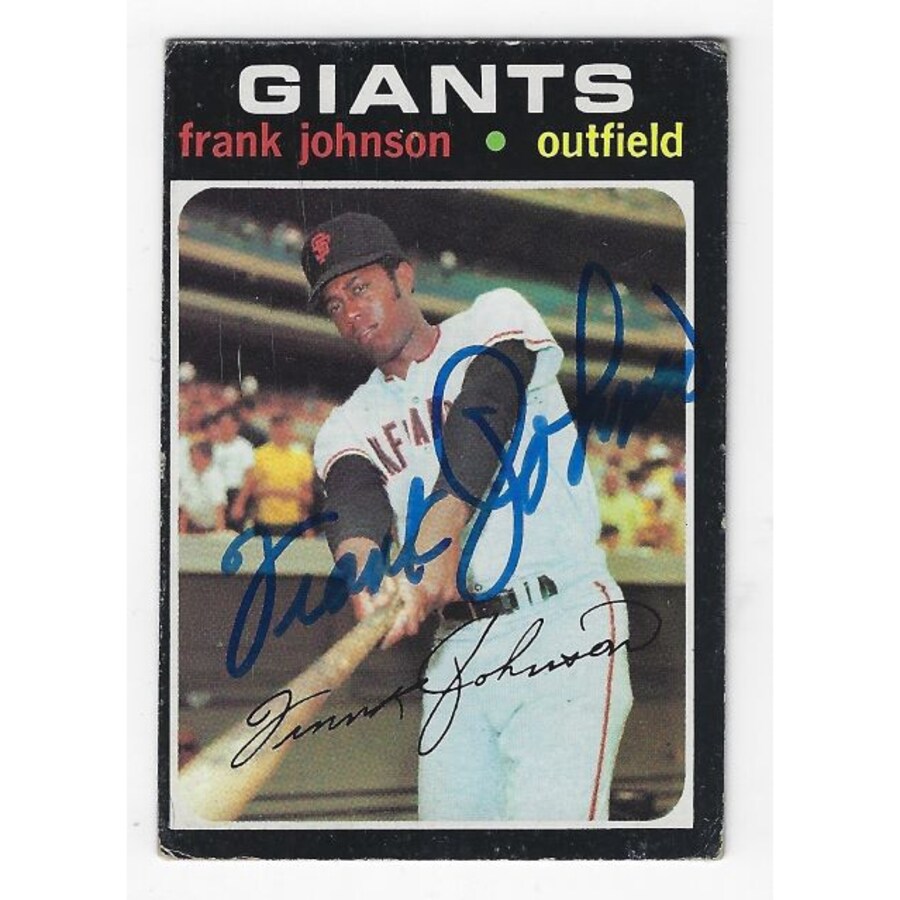
Former San Francisco Giants infielder/Outfielder Frank Johnson (photo from 1971 topps baseball)
By Tony the Tiger Hayes
Frank Sinatra was rarely seen out out and about sans imposing Paisan Jilly Rizzo lurking
Elvis didn’t venture two steps outside the gates of Graceland without the Memphis Mafia.
And NBA player and full drag aficionado Dennis Rodman made sure good buddy Jack Haley always had a seat at the end if the bench wherever his NBA travels took him.
Since the beginning of recorded time, bigwigs and heartthrobs have surrendered themselves yes men and back slappers.
Hey who doesn’t enjoy being told how great they are.
But Willie Mays was one baseball superstar who didnt girdle himself with toadies and personal trainers as his Godson Barry Bonds would infamously do years later during his storied years with the Orange & Black.
Willie didn’t hang with Hollywood glitterati or spend his nights tripping the light fantastic – he was actually somewhat of a loner.
But Mays was not without a Candlestick cortege. While Mays didnt often publicly talk about his charitable work – as writer John Shea documented in his New York Times best seller “24” – Willie received as much joy working with and assisting children and young people as he did making basket catches and sending Russ Hodges into a frenzy with his “bye, bye baby!” round tripper calls.
And while Mays did not surround himself with a classic entourage he did have a Candlestick Park crew of young outfielders – particularly those of black American heritage – he liked to dote on during his long Orange & Black career.
Young fly chasing prospects such Bernie Williams, Ollie Brown, Garry Maddox, Ken Henderson, Gary Matthews, George Foster all few under Mays tutelage.
Another was the now largely forgotten El Paso, Texas born and raised outfielder named Frank Herbert Johnson.
Though his fanfare never exceeded the level of an inaudible whisper, Johnson actually spent six straight seasons in the big leagues alongside Willie and the Orange & Black.
While we would never label Johnson a Hangers-On, from 1966-71, he certainly did a lot of hanging around for the Giants.
Despite seeing big league action every season from 1966-71 never rose above benchwarmer status.
Giants were a well oiled machine in the 1960s with a stacked lineup and unforgiving pitching staff. There just wasn’t many opportunities for Frank to break into the Giants starting lineup.
What kept the club coming back to Johnson was his unselfish attitude and willingness to play multiple positions. Though primarily an outfielder, Johnson made close to 50 starts at third base for San Francisco. As a Giant he logged time at each position, sans pitcher and catcher.
Though his overall numbers don’t jump out at you – the handsome journey man contributed enough in the margins to make it and did his share to make the Giants one of game’s top winning clubs and highest drawing club’s of the 1960s.
Why Was He a Giant?
Giants super-scout George Genovese discovered and signed Johnson out El Paso’s Bel Air High School in June of 1961. The 18-year-old – who was still a semester shy of graduation- had just led the Highlanders to the El Paso city championship as a dual school boy version of Shohei Ohtani. A prep third baseman and pitcher, Johnson batted .431 and posted a mound ledger of 8-3 the year he turned pro.
In his first year of pro ball, Johnson immediately opened eyes, tattooing Appalachian League pitching for a .314 average in 55 games. Of the 44 youngsters who suited up for the Salem Rebels during that 1962 season, Johnson was the only one blessed to make it to the majors.
Johnson continued to stroke the ball well over the next few seasons in the Giants system and by 1966 he had reached the Triple -AAA Phoenix Giants. No longer an inexperienced pro, the 23-year-old became the cactus Giants, most viable threats, batting .308 while competing for playing time with numerous future big league players.
Meanwhile up north at the home office at Candlestick Park, the Giants were rampaging through the ‘66 National League season.
On September 1, with rosters allowed to expand to 40 men, the Giants sat atop the NL, tied with Pittsburgh at 78-56.
A week later Johnson got the call to to the bigs and in his debut game with the Orange & Black, the rookie won a key game, driving home Willie Mays with his first Major League hit against none other than the rival Los Angeles Dodgers (9/7/66).
Tied 2-2 going to the top of the 12th at LA, Dodgers reliever Joe Moeller recorded two easy outs. With Mays due up next representing the possible winning run, Dodgers manager Walter Alston made the call to intentionally walk the fabulous Willie to get to Johnson after Moeller ran a 3-0 count to Mays.
Considering it was Johnson’s debut game, and the youngster had struck out in the 10th inning with Mays on base in his first big league at-bat, Alston considered the free pass a no-doubt decision.
But if Uncle Walt thought Johnson’s knees might be knocking in a late game situation, he was dead wrong.
Johnson, ram-rodded a line drive to right field and Mays – aided by a Dodger error scored all the way fro first.
“I was a little nervous,” Johnson admitted later in the visiting clubhouse between bites of a hot dog. “But it was just another ball game. I’d faced Moeller at Spokane so I knew a little bit about him.”
With the 3-2 win that night, the Giants sat a half game back of the Pirates.
Hoping to catch lightning in a bottle, Giants manager Herman Franks wrote Johnson’s name into the lineup several times over the next week.
In his first major league start Franks even shifted Mays, hampered by a groin pull, to right field and had Johnson play center field vs. the visiting Cubs (9/10/66). Johnson swatted a pair of hits but the Giants lost 12-3 in the Saturday matinee.
The Dodgers would eventually storm back to win the division-less NL, with San Francisco finishing in second place 1.5 games.
Despite the early promise, Johnson never could secure a regular spot in the Giants lineup.
Over the next five seasons he would shuttle between Phoenix and San Francisco. Johnson’s best campaign came in 1970 when he batted a career big league high of .273, with 3 home runs and 31 RBI in 67 games for San Francisco.
Johnson’s final Major League game came in June of 1971. He batted into a force out as a pinch batter in a 5-1 road win vs. the Mets (6/12/71).
After leaving the Giants organization after 1971 season, Johnson played a year in Japan with the Lotte Orions.
Giant Footprint
Though many players – including of course Willie Mays – played in at least six consecutive seasons with San Francisco.
And many have spent their entire big league careers exclusively with the Giants, only a handful of athletes played in six straight seasons with SF without never playing in the bigs with another club.
Those players are RHP Matt Cain, SS Brandon Crawford, C Mike Sadek, RHP Rich Robertson, IF Jimmy Davenport, C Buster Posey and… Frank Johnson.
 Sports Radio Service