

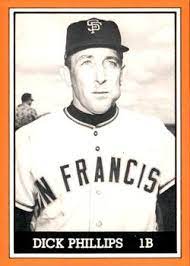
Former San Francisco Giant infielder Dick Phillips who played on the 1962 Giants is the He was a Giant? feature with Tony the Tiger Hayes (photo from Trading Card Data Base)
Dick Phillips – 1B – 1962 – # 14
He was a Giant?
By Tony the Tiger Hayes
Dick Phillips’ flaccid performance for the 1962 Giants was so inefficient that a lesser man might be left seriously despondent and in search of the type of solace the denizens of Sixth Street hope to find in bottles swaddled in brown paper sacks.
The long-time bush leaguer’s hitless performance in five games as a Giant, left him with him the mortifying distinction of being the least productive of all 31 players who suited up for the ’62 NL Champions.
But Phillips – a 30-year-old MLB rookie who looked closer to 40 -made no plans of taking a one-way trip to the Golden Gate Bridge.
After years of minor league bus rides on dubious shock absorbers and meals at greasy spoon diners – as well as seeing heavy action in the Korean War – heading up to his brief sojourn with the top-notch Giants was reason enough for his heart to take courage and forge forward in the field of his dreams.
Indeed, buoyed by his brief San Francisco cameo, Phillips would spend most of the next four decades in various pro baseball roles.
Phillips would return briefly to the majors as a player and later as a coach, but most of his assignments in the sport spent in the minors leagues.
And from all indications, Phillips enjoyed every moment of it.
Why was he a Giant?
After toiling away in the minors for years without so much of a sniff of a big league clubhouse, not to mention a spring training invite, things finally started to trend in Phillips direction in 1961.
That year, Phillips led the Giants’ dominating Triple-A Tacoma club (97-57) to the Pacific Coast League Championship and was named the loop’s MVP with a .264, 16, 98 season. The genial graybeard was also voted as the club’s most popular player by the Puget Sound fan base.
The following off-season Phillips was added to the Giants 40-man roster.
“All I’ve ever wanted was a chance,” Phillips was quoted as saying in January of 1962. “Maybe I can’t make it, but this way, I’ll know.”
After a fine Cactus League performance in the Spring of ‘62, Phillips got the happy news, he’d be heading north with the club to Candlestick Park making the cut along with a fellow 24-year-old rookie from the Dominican Republic – Manny Mota.
Opening Day vs. the was just hours away.
“The game’s the same, but it’s nice to be up here. I’ve hung around in baseball. I knew if I stayed long enough I’d get to the top,” a relieved Phillips, puffing a celebratory cigar, told the beat writers.
In 1962 the Giants were not only stocked with a bevy of legitimate All-Stars, former Rookies of the Year and Gold Glove winners, but also numerous future Hall of Fame ball players.
First base, Phillips’ best suited defensive position was already being wrestled over by a couple of young sluggers by the names of Orlando Cepeda and Willie McCovey – back to back winners of the NL Rookie of the Year award respectively in the Giants first two years in San Francisco (1958-59).
In the Giants coaching staff’s eyes, Phillips appeared to have the right amount of seasoning and temperament and versatility- he played seven positions (save pitcher and catcher) on Fan Appreciation Day for Tacoma in 1961, to come off the bench and sizzle a line drive or fill in for Chuck Hiller at second base or Harvey Kuenn at third in a late inning situation.
“A fellow of Phillips’ age and background realizes there is an opportunity as a pinch-hitter,” manager Alvin Dark told The Sporting News.
“You have to believe you’re better than the pitcher when you go to the plate,” Phillips said of his pinch hitting theory. “If you don’t, you might as well not go up at all. No one likes to sit on the bench but if I’m not needed that means the Giants are winning. That’s all right with me.”
Before & After
Phillips broke into pro ball on a high note at age 19 in 1951, batting .293 for the Fulton Railroaders, a Class D club of the original Washington Senators, managed by one Samuel Lamitina.
But then another Sam called. Uncle Sam that is.
Phillips would spend the next few years as a member of the United States Marine Corp, serving much of his hitch overseas during the Korean War.
A veteran of many fierce combat battles during the conflict, Phillips didn’t have much time to play catch over that time frame but the Wisconsin native caught shrapnel during one particularly ferocious assault by the enemy.
When he reentered civilian life Phillips attended Valparaiso University on G.I. Bill. But Phillips itched to fulfill his professional baseball dreams and hooked on with his hometown Milwaukee Braves farm system after a tryout in 1951.
After being away from pro ball for five seasons Phillips batted a sizzling .320 for the Class C Eau Claire Braves in 1955.
Phillips climbed a rung in the Milwaukee system the next few seasons before topping out at Triple-A Sacramento in 1959. Phillips consistently hit for each classification in the Braves system and produced impressive home run totals- but he never got a call-up to the parent club.
The Giants acquired Phillips in a trade for a fellow minor league player in 1960.
After his brief stay with the Giants in 1962, Phillips returned to the Tacoma club for the remainder of the season. He watched as the Orange & Black advanced to a NL Pennant – beating the Dodgers in a special three game playoff series – before taking on the Yankees in the ‘62 World Series.
Phillips was planted on his living room coach, riveted to the television in his Racine, WI home when McCovey lined out in the bottom of the ninth of Game 7 of the Fall Classic as the New York dynasty broke the hearts of Giants fans.
In the spring of 1963 the Giants cut the well-liked minor league vet a break by shipping him to Washington in a cash deal. Though nick-named the “Senators” this was not the same franchise that Phillips became his pro career with more than a decade earlier.
The original Washington Senators had decamped to Minnesota and rebranded themselves as the “Twins.”
The new D.C. expansion club retained the “Senators” nickname and unfortunately for fans of the long suffering Washington fans base, the original Senators second division status as well.
After losing 100 games in their first two years of existence, the Senators were in dire need of skilled professionals and they found one in the adroit Phillips.
Just as he had in ‘62, Phillips began the 1963 season in the majors and this time he stuck.
The Senators again dropped 100 games for the third straight season, (56-106) but Phillips still must have had a smile.
The club’s top utility man, Phillips played wherever his managers Mickey Vernon and his mid-season replacement, Gil Hodges asked, seeing action primarily at first base, but also at second and third base. In 124 games, Phillips batted .237, 10, 32.
Phillips returned to the Senators for another full campaign in 1964. The 1965 season saw Phillips back in Triple-A, but Lady Luck was shining upon Phillips – the franchise’s top minor league club just happened to be located In Honolulu. Phillips family naturally fell in love with Hawaii’s tropical setting and would eventually relocate to the Islands on a year round basis. Phillips would later serve as the manager and General Manager of the Islanders club.
After starting the 1966 campaign with Hawaii, Phillips was recalled to Washington (regrettably?) and remained with the big club through the end of the ‘66 season concluding his big league playing career. Phillips would return for one final season with the Islanders in 1967 where he concluded his playing career for good at age 36.
Phillips was hardly done with the game as he would spend the next three decades in various roles in baseball including a dozen seasons as a minor league manager.
He once described his managerial style as this: “I like to play the running game if I have speed. I like the hit-and-run, and I try and out-think the other guy,” Phillips said. “I expect the players to hustle all the time. If they don’t hustle, they don’t play.”
After piloting the Islanders – then the top farm club for San Diego- for three seasons in the late-1970s, Phillips was promoted to big league club as first base and hitting coach for the club’s new manager Jerry Coleman in 1980. However the season went notoriously bad for Coleman – who had never managed previously- and the big league coaching gig ended after just one season for Phillips.
He wasn’t McCovey or Cepeda. But…
Phillips long awaited big league debut came as a pinch hitter for Juan Marichal vs. the visiting Cincinnati Reds at Candlestick Park (4/15/62). With the Reds winning 4-0, Phillips flew out to right fielder and future Giants manager Frank Robinson off Reds starter Bob Purkey (also a future Giant) to lead off the 7th inning. Cincy would win the game 4-3.
Phillips didn’t collect a hit as a Giant, but he did record the first of 60 career MLB RBI with San Francisco and it must have tasted good because it came against Milwaukee. The team that never promoted him to the majors.
In a road game at County Stadium, (4/18/62) Phillips was sent to pinch hit for Jim Davenport with runners on second and third, with one out in the top of the ninth. With Don Nottebart pitching, Phillips hit a slow roller to Braves second baseman Frank Bolling and Orlando Cepeda scampered home. The Giants were defeated in that contest 6-4.
Giant Footprint
Though Phillips on-field play really had no impact on the Giants Pennant winning campaign of ‘62, there is no doubt he was well liked by his San Francisco cohorts.
When it came time to divvy up World Series bonus money, Phillips was awarded a third of a full share.
And as far as manager Dark projection of Phillips as a potentially lethal major league pinch hitter? That didn’t really pan out.
Phillips would bat 115 times in his big league career as a pinch hitter – collecting 15 knocks for a .152 average with 13 RBI.
Meanwhile Manny Mota, the other rookie who made the Giants ‘62 opening day roster, primarily for his speed and defensive versatility only lasted slightly longer than Phillips on the Giants active roster in ‘62.
Mota however would one day develop into the game’s most dangerous all-time great pinch batters – collecting 150 career pinch hits for a .299 average in pinch situations.
Tony the Tiger does “He was a Giant?” features every Tuesday Giants home game at http://www.sportsradioservice.com
 Sports Radio Service