

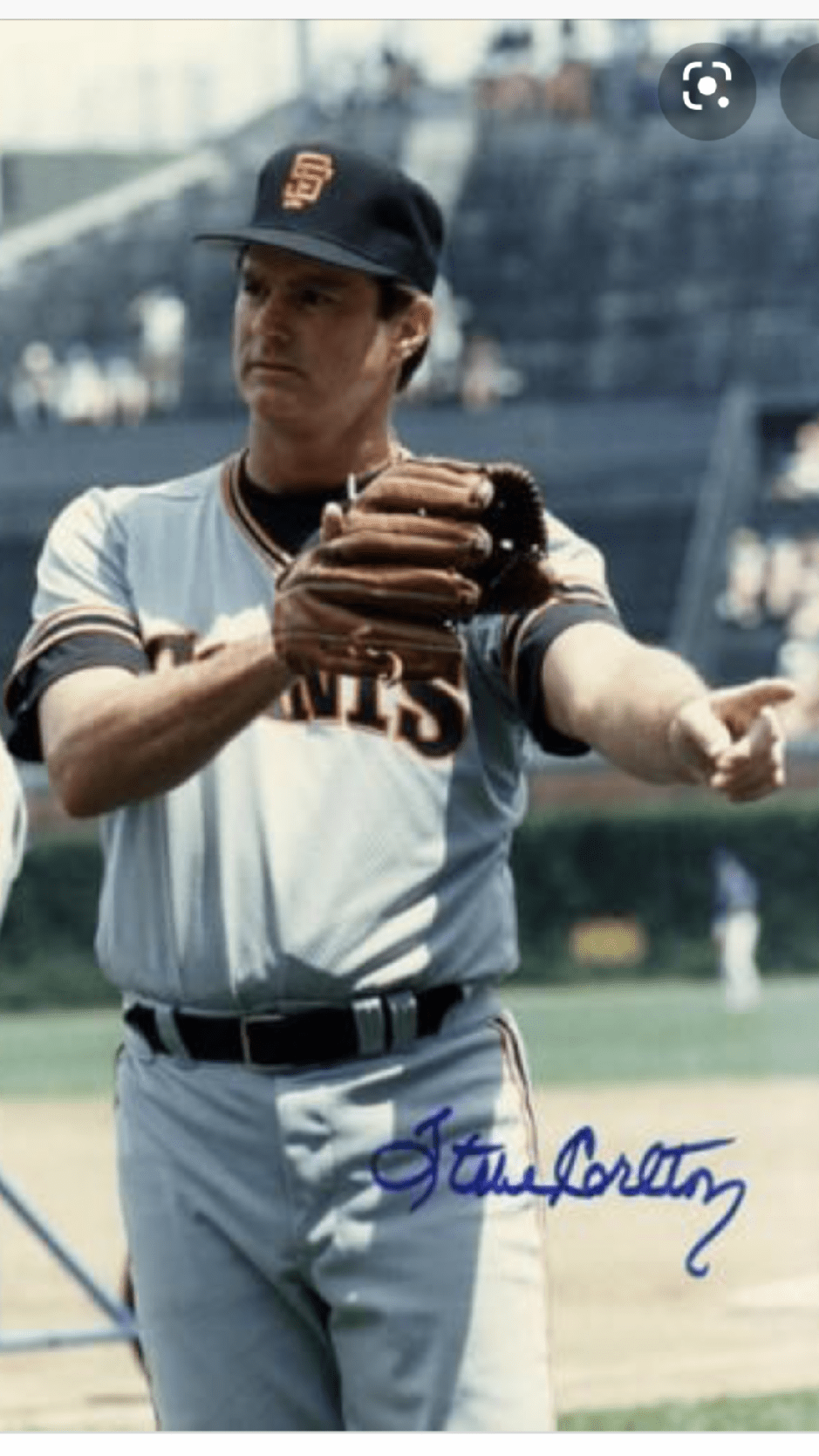
San Francisco Giants left hander Steve Carlton pitched for the Giants in the 1986 season (photo from Tony the Tiger Hayes)
Steve Carlton – LHP – 1986 – # 32
He was a Giant?
By Tony the Tiger Hayes
While assembling his ironclad Hall of Fame credentials with the Philadelphia Phillies, the mysterious Steve Carlton was an elite ace, winning multiple Cy Young Awards, but winning few friends along the way with a stiff upper lip and aloof disposition, which made the most austere Buckingham Palace guards resemble effusive, glad-handing used-car salesmen in comparison.
But upon joining San Francisco as a free agent mid-way through the 1986 season, the antisocial all-star flipped the script. While baseball’s Greta Garbo didn’t exactly go from “Silent Steve” to “Loquacious Lefty,” Carlton did warm to the point where he spoke at a press conference for the first time in nearly a decade.
The notorious lone wolf took only questions about his future pitching plans. Carlton would not entertain inquiries regarding the past or his personal life.
“It’s been 10 years since I’ve done this,” a surprisingly sheepish Carlton said as he approached a gaggle of microphones at Candlestick Park. “Pardon me, if I make any mistakes.”
At the urging of Giants president Al Rosen, Carlton agreed to the gabfest.
“You can’t make a move like this and not talk to the media,” said the superstar who had racked up 318 career wins at that point. “I can’t say if this will continue in the future.”
It didn’t.
Two days later, Carlton would pitch in his first game for the Orange & Black, beginning a brief – but not all together uneventful – tour with the Giants.
Why Was He A Giant?
By 1986, the 41-year-old Carlton was clearly near the end of a legendary run. In fact the Phillies – Carlton’s ball club since 1972 – believed Lefty’s pitching days were over after he missed most of 1985 to injury and then began 1986 a frightfully cruddy 4-9, 6.18. Phillies management urged Carlton to retire. But when the headstrong mound master scoffed at that suggestion, Philadelphia simply released the six-time, 20-game winner in spite of the fact he sat just 18 career strikeouts shy of 4,000.
(Carlton’s pursuit of that landmark strikeout figure would be the focus of his Northern California sojourn.)
After Carlton’s Philadelphia decampment, the Yankees, Reds, Angels and Braves all expressed interest in signing the legendary hurler – but Carlton had his sights set on San Francisco. He joined the Giants just as the traditional blanket of 4th of July fog was rolling into San Francisco Bay.
The combination of a young team on the rise – the upstart Giants were leading the NL West at the time – and pitching in The ‘Stick’s unique summer setting uncommonly appealed to Carlton.
“I like the climate here and love to pitch in cold weather,” Carlton stated.
The Giants admitted they weren’t exactly sure what they were getting in a pitcher who had not seen much mound success since 1984.
“Maybe a Steve Carlton on our ball club, which has so many young players on it, will be a stabilizing force,” said Giants President Al Rosen, secretively hoping Carlton had also arrived with a personality transplant. “He loves the Bay Area. He’s a wine connoisseur who intends to get into the wine business someday. And with the Napa Valley right up the road, what better place to get started.”
By the time Carlton left San Francisco a month later, it was Rosen who most likely uncorked a wine bottle, relived to have shed Carlton’s diva act.
At first though there was love in the air.
One of Carlton’s new Giants teammates was RHP Mike Krukow who pitched alongside Carlton in Philadelphia in 1982.
Krukow, not surprisingly, was fired up about the addition of Carlton.
“The way (Carlton) works on the field, his habits, he’s a champion and I think he’s going to bring that demeanor into the clubhouse. Even if he didn’t throw a pitch he could help us through osmosis,” the ever ebullient Krukow crowed.
Carlton however wasn’t ready to give up his alpha dog status, saying bluntly, “I didn’t come here to coach.”
The perennial All-Star claimed he was physically equipped to pitch until his 50th birthday.
“I would’ve walked away from the game if I thought I’d maximized all my efforts in Philadelphia. I can still pitch and win,” Carlton proclaimed.
Carlton didn’t have to wait long to show what he still had left in his arsenal. Unfortunately it looked similar to what he had in his final days in Philly.
Carlton was tabbed to face the visiting Cardinals on a sunny Sunday afternoon (7/6/86), as 40,473 packed into Candlestick Park to honor Willie McCovey on the retired Giants slugger’s upcoming induction into baseball’s Hall of Fame.
Unfortunately, the popular Mac was the only one to bring his Cooperstown certifications. Carlton struck out only two Redbirds and lasted just 3.1 innings, giving up eight hits and three earned runs – leaving with a 3-0 deficit. The Giants however rebounded with a torrid six -run 8th inning and beat St. Louis 8-3.
“I could tell he was rusty,” said Giants skipper Craig, noting Carlton had not pitched in a game in two weeks. “There’s no question he needs two or three more starts before he’s 100 percent.”
Going forward, Craig expressed interest in teaching Carlton his pet pitch – the split-finger fastball.
After the game, Carlton again spoke, albeit briefly. “They did a helluva job,” he said of his new Giants teammates. “It was a great comeback.”
With that, Lefty scooted out a back door. Carlton would not have much to say the rest of his time in the City by the Bay.
Before & After
As far back as his teen years, Carlton presented himself as a different type of cat. While he flashed outrageous athletic talent – he could hurl a football 75 yards – in his free time, a youthful Carlton practiced meditation.
When stereotypical meathead jocks of his era were sneaking peeks at “Playboy” – Carlton was cracking open the philosophical works of Freidreich Nietzsche and Paramahansa Yogananda.
Carlton’s interests in mind-bending theory would underline his remarkable career. During his heyday with Philadelphia, Carlton studied Taoism and Buddhism and engrossed himself in the martial arts. He famously strengthened his pitching arm by rotating it in a barrel of uncooked rice.
With the Phillies, Carlton helped create a behavior modification chamber deep within the bowels of Veterans Stadium. The cubby hole was filled with tactile, audio and visual stimuli and served as the cerebral competitor’s inner sanctum away from the towel-snapping, rumpus room atmosphere of a big league clubhouse.
Before making his name in the “City of Brotherly Love,”Carlton spent the first seven seasons of his big league career with the Cardinals. He was on the verge of stardom with St. Louis, posting his first 20-game winning season in 1971, but a salary dispute led to a shocking trade to the lowly Phillies.
The circumspect Carlton found a surprising home in the disparate, hard-scrabble Philly. In 1972, the last place Phillies won just 59 games – but Carlton, startlingly, was credited with nearly half their triumphs (46%) with an extravagant 27 victories.
It was in ‘72 that Carlton perfected his trademark filthy slider – a dominating bat baffler that Lefty would use as his ace card the rest of his career.
Within a couple of seasons, the Carlton and slugger Mike Schmidt-led Phillies would dramatically see an upturn in their fortunes – winning multiple National League Eastern Division titles and the franchise’s first ever World Series championship in 1980.
The introverted Carlton began a semi-boycott of the sporting press in 1973 after a Philly based sports columnist questioned his dedication to training.
By 1978, Carlton had had it with the notepad toting crowd for good and cut off all communication with reporters. It would remain that way until he joined the Giants. The velocity virtuoso did not even speak publicly after winning his landmark 300th career game in 1983.
Carlton’s oddball personality quirks are often the thing that comes up first when discussing his baseball career, but the semi-annual All-Star’s pitching preeminence should never take a back seat to his status as one of baseball’s all-time brooders.
Carlton was the first pitcher to win four Cy Young Awards – including his first in ‘72 when he achieved baseball’s rare Triple Crown of pitching: leading the NL in wins, strikeouts and ERA.
‘sAt various times between 1982-84, Carlton was baseball’s all-time strikeout leader – routinely trading the top spot with RHP contemporary Nolan Ryan.
Currently, Carlton has the second most strikeouts by a LHP (fourth overall with 4,136) he is the last NL pitcher to win 25 games or more and the last pitcher to hurl 300 or more innings in a season. His 329 lifetime wins rank 11th. He was elected to baseball’s Hall of Fame in 1994 with nearly 96 percent of the vote.
After his brief stint with San Francisco – just six games – Carlton hooked on with the White Sox to finish out the ‘86 season. He was a member of the Twins’ World Series championship club in 1987, but did not pitch in the post season. He wrapped up his big league career with Minnesota in April of 1988 at age 43. He allowed eight earned runs in his final start.
Carlton has not had much involvement in baseball since his retirement, but he has made news occasionally… ironically for opening his mouth.
In a rare interview, Carlton expressed belief in numerous loony conspiracy theories, including that the world is controlled by Russian and U.S. governments which “fill the air with low frequency sound waves” and that the AIDS virus was created in a secret Maryland laboratory.
He Never Had a Giants Bobblehead Day. But…
Overall, Carlton went an uninspiring 1-3, 5.10 in six starts with San Francisco. In his first three Giants outings, Carlton allowed a dozen runs over 14 innings.
But on a Saturday night start at Pittsburgh (7/26/86), Carlton briefly sparkled like the pitcher who previously had been named to 10 All-Star teams.
Carlton pitched seven shutout innings, allowing just three hits, in a 9-0 Giants shellacking of the Pirates. He struck out five Buccos, leaving him just eight career K’s shy of 4,000.
Carlton pitched out of a bases loaded situation in the fifth inning, as well as when two base runners were in scoring position in the fourth.
Pirates OF R.J. Reynolds gave Carlton his full endorsement. He witnessed a rejuvenated Lefty that night. In a previous game that season, Reynolds had whacked a two-run RBI double off Carlton in a 13-5 Pirates win over the Phillies.
“When he struck me out tonight, he threw me a nasty slider. The problem he had with his slider earlier this season was it broke too early and the batter could pick it up. I tip my cap to Carlton. He still has something left,” Reynolds told the Sacramento Bee’s Bob Padecky.
By this point, Carlton had reinstated his speaking restrictions and was sequestered in the training room when reporters entered the clubhouse after the game.
But Giants catcher Bob Melvin was more than glad to pipe up for Carlton.
“He seemed to be happy,” Melvin said. “He had control of every pitch.”
Melvin indicated Carlton’s side work with pitching whisperer Craig was seeing positive results.
“Carlton had a great curveball and got a few outs with his split-finger. He needed an off-speed pitch,” the young receiver said.
It was beginning to look as if the Giants’ search for pitching gold was about to pan out, when Carlton pitched well in his next outing, striking out five and allowing just a single run over 5.1 frames, receiving a no-decision in a 3-2 home win vs. Atlanta (7/31/86).
But in his next start – in which Carlton finally recorded his 4,000 career strikeout – he was blasted for seven runs in one of sloppiest games in Giants history. The end was near.
Giant Footprint
Though it certainly was not all his fault – in the month Carlton spent with the Giants – the young club regressed significantly. On the day Carlton came aboard, the Orange & Black were eight games over .500 and led the NL West by 1.5 games over Houston. After Carlton’s final game with the Giants – an embarrassing 11-6 home loss to the Reds (8/5/86) – the Giants had just three more victories than defeats and trailed the Astros by 5 games.
Like a car with a bad clutch at the top of Hyde street, the Giants were rolling backwards.
The Giants would move on from Carlton after that loss, but not before Carlton became just the second pitcher in history to record 4,000 strikeouts. That momentous event came in the third inning and it was punctuated with a standing ovation from the 17,303 paid attendance at Candlestick Park. But getting to that juncture and what followed that chilly night was not pretty.
Carlton allowed three Reds runs in the first inning, the pitcher aided Cincinnati’s efforts, by balking in one of the runs.
If this particular three-hour and 18 minutes nightmare had a soundtrack, it would have been the “The Benny Hill Show” theme song.
Combined the clubs allowed:
- Five wild pitches. * Two run scoring balks. * Thirteen walks. * And one team batted out of order.
The one saving grace – besides a mammoth Will Clark upper deck homer – was Carlton making history in the third inning, when he nullified the Reds Eric Davis on a swinging third strike on a 1-2 pitch for career 4,000 career K’s.
The Giants rudimentary, but oddly satisfying, score board lit up with the words: “Congratulations STEVE CARLTON 4,000 Major League Strikeouts! “
Carlton stepped from the mound and gave the standing audience a gentlemanly tip of his cap.
Then on his very next offering, Carlton heaved a wild pitch to the backstop allowing a run. A two-run RBI triple by Dave Parker knocked Carlton from the game in the fourth inning.
After the game, Carlton -his ERA ballooned to 5.89 – was nowhere to be found. A day later, the Giants made his non-occupancy permanent.
The move was initially announced as a “retirement” on Carlton’s part to help the Giants clear roster space for Krukow’s return from the disabled list.
“I called (Carlton) this morning to discuss the problems we are having with the roster,” Rosen said. “Out of that conversation we made the decision that he would retire. I did not ask him to retire.”
Carlton secretly played along.
“Upon reflection, I realize I’ve reached a career milestone never accomplished before by a pitcher spending his whole career in one league,” Carlton said, referencing his 4,000 strikeout. “With Mike Krukow ready to come off the disabled list, I’ve decided it is in the best interest of everyone involved to announce my retirement at this time.”
But it was all a ruse. At the time Carlton was making his “retirement” speech, his agent was already firming up a deal with the White Sox.
Carlton just couldn’t let go of the ball.
He was on the mound for Chicago a week later, surrendering six runs in three innings in a 7-3 loss at Detroit.
 Sports Radio Service