

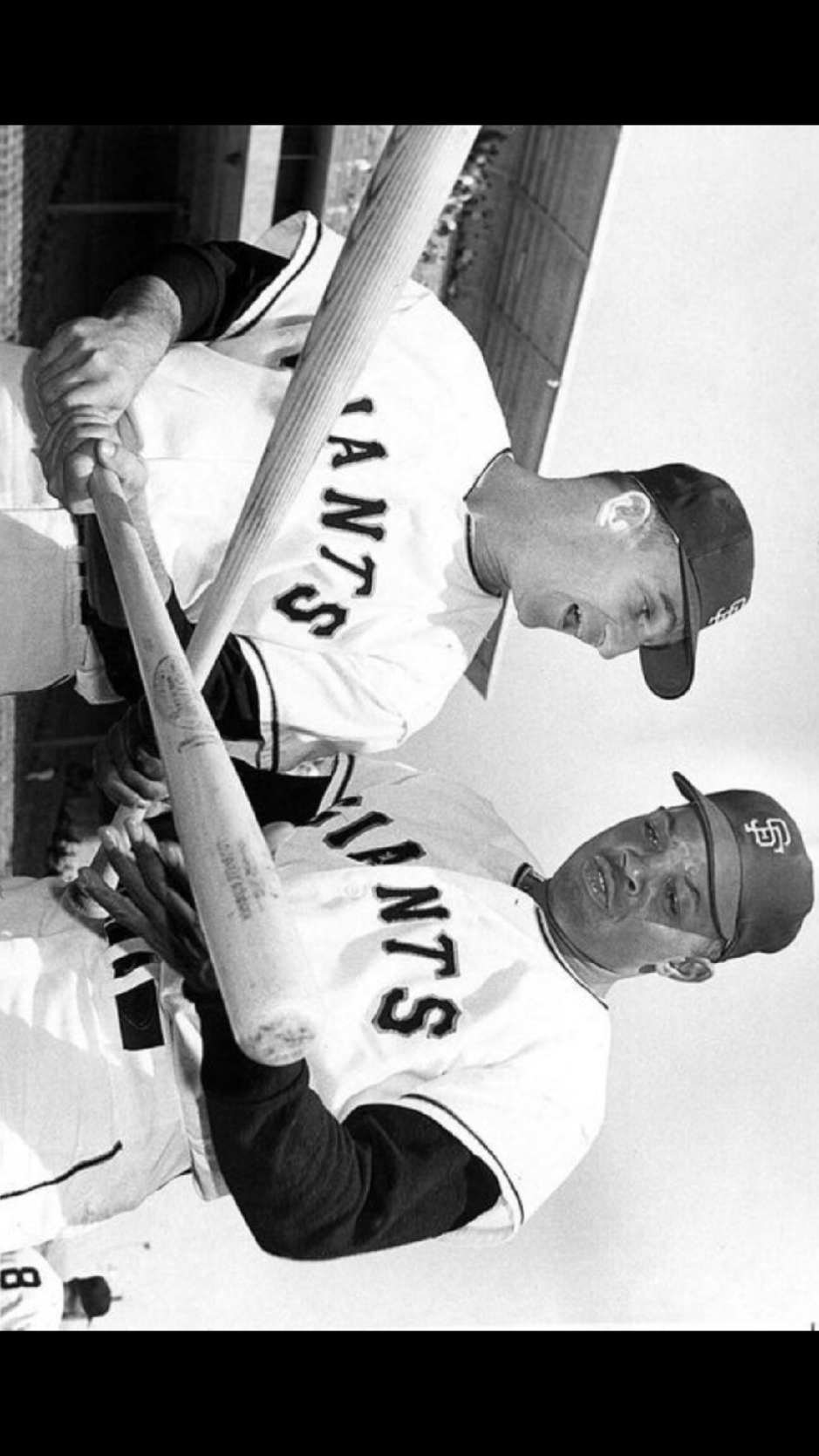
San Francisco Giants pitcher Warren Spahn (left) and centerfielder Willie Mays (right) talk over hitting in 1965 circa photo (photo from San Francisco Giants archives)
He Was A Giant?
Warren Spahn – LHP – 1965 – #21
By Tony “The Tiger” Hayes
SAN FRANCISCO–Apparently 360 lifetime victories wasn’t enough to sate the pitching appetite of baseball’s all-time winningest lefty. So after getting his walking papers from two clubs in less than a year, Spahn caught on with San Francisco in mid-1965 and chipped in three more victories before calling it a career.
What inspired the graybeard southpaw to remain chucking baseballs off a mound instead off tipping back lemonade on a country porch was open to much speculation that summer.
Critics claimed it was Spahn’s overly ambitious – some said delusional – goal of reaching 400 lifetime wins.
Others speculated it was the high-kicking ace’s burning desire to revenge the perceived shoddy treatment he received from his longtime club, the Milwaukee Braves, the previous season.
But according to Spahn, the decision to keep pitching was simple.
The Buffalo native wanted to win another World Series and the Willie Mays led Orange & Black offered the best path to the Fall Classic.
“Had I went to a club in the second division it would have looked like Warren Spahn was trying to milk baseball, like I was trying to hang on as long as I could,” said Spahn, speaking in the third person like a true superstar. “If I win a game here it means something. It’s a contribution towards a pennant instead of just another win for my record.”
Why Was He A Giant?
“I feel fine. I’m in shape. I can pitch.” Spahn proclaimed as he slipped into his familiar No. 21 in Giants colors at Candlestick Park on 7/20/65.
Why would a 17-time All-Star and author of two no-hitters have to recite the sports world equivalent of name, rank and serial number?
Well frankly, Spahn – who was aged 44 and looked closer to 64 – had been going through a rough patch and not just on his increasingly balding pate.
Before signing with the Giants, Spahn had began 1965 in the New York Mets rotation and it didn’t go well. After winning his first two decisions for the Amazins’ he lost his next eight.
With his ledger standing at 4-12, Mets manager Casey Stengel had seen enough and wanted to move Spahn – who was also serving as the Mets de facto pitching coach – into a swing role. But the 1957 Cy Young Award winner disapproved.
Spahn asked for, and was granted his release without much squabble. Spahn – who was beginning to get a reputation as sort of a grumpy old man – then passed unclaimed through waivers before signing with San Francisco.
“We know what the guy has done,” said Giants manager Herman Franks. “Let’s see what he can do.”
Making the move more appetizing to the Giants was Spahn’s sudden flexible regarding relief duty. Prior to refusing to pitch in relief for the Mets, Spahn vociferously rebuffed the Braves efforts to pitch him out of the bullpen.
“I feel I can help the Giants win the pennant,” the wizened hurler said.“I’ll work anyway the Giants want me to work, starting or relieving or both.”
Those statements came as a shock to Spahn’s former Milwaukee manager Bobby Bragen. The excitable skipper – who also had his club in contention in ‘65 – practically choked on his Red Man responding.
The spunky field general opined that Spahn’s stance on relief duty changed only after he passed through waivers without so much as a sniff.
“That shock some humility into him,” Bragen crowed. “When nobody wants you for a buck (the waiver price), I guess you’ll go anywhere.”
Before & After
After breaking into the majors in 1942, Spahn was forced to put his baseball career on hold to fight in World War II. By the time he recorded his first big league win in 1946, Spahn was already 25. He would spend the next two decades making up for lost time.
Though he was slight of stature and far from a flame thrower, Spahn would became the most victorious LHP in history.
What he lacked in zip, he amply made up by painting the corners of the strike zone with a good fastball and darting array of off speed offerings.
His pallet had no one dominant pitch. Spahn’s focus was control. Of his pitching approach, Spahn said, “If hitting is timing, than pitching is upsetting timing.”
Spahn won 20 games or more 13 times. He led the NL in victories eight times and topped the loop in complete games nine times, including seven consecutive seasons from 1957-63.
At the time of his last appearance with San Francisco, Spahn held the record for career strikeouts by a left-handed pitcher.
He was elected to the Hall of Fame in 1973.
Spahn’s last great season came in 1963 when he went 23-7, 2.60 at age 42 for the Braves.
The following season however he struggled and openly feuded with Bragen.
Based on Spahn’s age and drop off in sharpness, Bragen did not view a move to the bullpen so radical.
“He could become another Satchel Paige,” predicted Bragen. “His stuff could be there occasionally, but not on a consistent basis.”
Ultimately however, Bragen said Spahn was was only thinking about himself.
“I came to look upon him as a movie star who is great when you see him on the screen, but isn’t what you expect up close,” a revved up Bragen complained.
And he wasn’t done bloviating, adding:
“Spahn’s personal goals have always obliterated everything else. He had only a mild interest in the team. He is propelled by ego. Ego is in fact what made him a great pitcher. But I never felt that our team effort was as important to him as his personal desires.”
Ouch.
He Didn’t Get His Own (Giants) Bobblehead Doll. But …
Just as advertised, Spahn spent his time as a Giant divided between the bullpen and as a spot starter.
Impressively he completed three of his 11 Giants starts and in the process and helped keep the SF in contention until the final days of the ‘65 season. Spahn’s Giants ledger read 3-4, 3.39 in 16 games. He made 11 starts.
The day Spahn joined the the Giants in July, the club was in fourth place, 5.5 games off the pace of the Dodgers. But by the second week of September, the Giants had leapfrogged everyone.
On 9/12/65, before more than 40,000 at Candlestick Park, Spahn tossed a complete game 9-2 win over the Cubs in nightcap of a Sunday double header sweep. With the wins, the Giants increased their first place lead over the Dodgers by two games.
“I’m thrilled to be part of this Giants club. Age doesn’t mean a thing,” said Spahn. “It’s what you can do.”
It was beginning to look as if Spahn’s goal of making it back to the World Series was taking shape.
The white hot Giants ripped off a 14-game win streak in September and after Juan Marichal whitewashed the Reds 4-0 on the road (9/20/65), the Giants were winners in 17 of 18 games. The surging Orange & Black led the league by 4 games.
The Giants were brimming with confidence and not afraid to show it.
Franks and Mays – who would win MVP honors that season with a monster campaign – each predicted the Giants were five wins away from securing the pennant.
Spahn went them one further, proclaiming: “They’ll never catch us now. We’ve got the momentum.”
But the Giants would drop their next two in Cincinnati and lost that precious momentum. The Dodgers would steam past SF to win the flag by two games and eventually defeat Minnesota in the World Series.
Spahn – who would announce his retirement after the ‘65 season – made his final major league appearance vs. the visiting Reds (10/1/65). Spahn was the sixth pitcher in a conga line of eight SF hurlers in a 17-2 blowout by Cincinnati, allowing one run in a third of an inning.
Giant Footprint
A career long National Leaguer, Spahn pitched 119 career games vs. the Giants, posting a 56-43 record, including six shutouts and his second of two career no-hitters (1961). Spahn also slugged eight career HR vs. the Orange & Black- his most against any one opponent.
One constant foe in his battles with the Giants was another future Hall of Famer whose bronze likeness currently sits prominently at Third and King streets in SF.
In the late spring of 1951, Spahn took the mound as a Boston Brave at the Polo Grounds (5/28/51) to face the Giants and a much hyped rookie who had yet to deliver on his promise.
After starting his big league career 0-for-12, the fresh faced player was beginning to lose confidence in his abilities as he cautiously stepped into the box to face Spahn in the bottom of the first with two outs and the bases clear.
The young Giant took one pitch for a strike and then took a mighty cut sending a soaring drive over the left field roof of the old horse shoe shaped ball yard for his first major league hit and home run.
That rookie was none other than a 19-year-old Mays. It would be the start of a long rivalry between the two.
Mays would go on to have 222 more official at bats against Spahn. He batted .305 and bashed 17 additional career long balls off the famed twirller.
Besides the initial round tripper, Mays’ most noteworthy homer off Spahn would come 12 years later on a cold and windy mid-summer Tuesday night at Candlestick Park (7/2/63).
That was the night that the 41-year-old Spahn and 25-year-old Marichal locked horns in the ultimate pitching duel. It played out more like a death march as both legends took shutouts deep into the night.
From all accounts the game should have ended in the Giants favor in the ninth after Willie McCovey smoked a laser down the right field line and over the fence that umpire Chris Pelekoudas incorrectly ruled foul. The teams soldiered on with no score.
After Marichal retired Norm Larker on a come backer to end the top of 16th frame, the score board featured a long line of zeros. Just as astonishing there was no stirring in either bullpen. The pitchers would throw in excess of 200 pitches each that night.
After Spahn retired Harvey Kuenn on a fly ball to start the Giants half of the 16th, Mays stepped up to meet his old foe.
Though both the Braves and Giants had relocated to new cities since their initial meeting, Spahn and Mays were each wearing virtually the same uniforms they had on in ‘51.
Unfortunately for Spahn, the result on the field was the same as 1951.
After going 0-for-5, with a walk all night, Willie decided it was time to go home, and on the first pitch he powerfully connected with Spahn’s first offering and powered a bolt through the Candlestick bluster and over the left field fence for a game winning solo homer and a 1-0 Giants victory.
 Sports Radio Service