

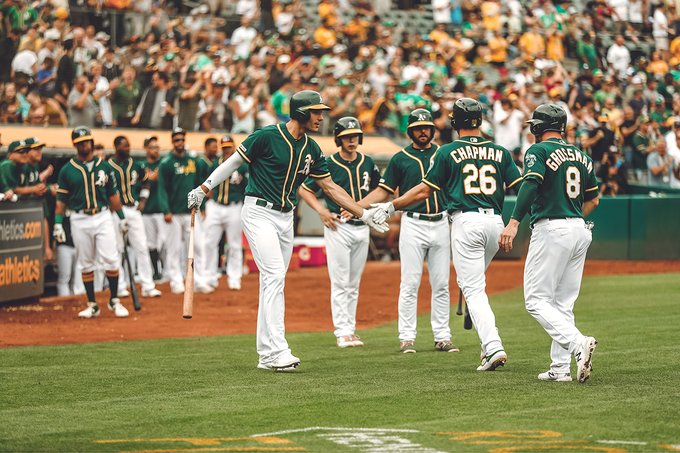
Photo credit: @Athletics
By Lewis Rubman
OAKLAND — Two things have been consistent—or nearly so—since Charlie Finley brought his Kansas City Athletics to Oakland for the 1968 season. A’s fans over the succeeding three decades could count, with short and infrequent exceptions, on the presence of the Coliseum itself and an outstanding fielder at third base.
The stadium opened in 1966 as the home of the Raiders. The A’s played their first home game there on the night of April 17, 1968, when the Orioles beat the home team, 4-1. The winning pitcher was Dave McNally, who bested Lew Krause. Tony La Russa got his first and only hit of the season, a pinch hit single to left to lead off the bottom of the ninth. Reggie Jackson made the last out, taking a called third strike. The night’s crowd of 50,164 was 6% of the A’s total home attendance for the season.
The Coliseum in its original configuration was a beautiful place to watch a ball game, although there were no seats in the bleachers, only benches, and they lacked backs. The view of the Oakland Hills to the east was lovely and easily surpassed anything Candlestick Park could offer. Baseball in the new venue was exciting as the prospects who had migrated from Kansas City developed into the stars who would earn the A’s a stranglehold on the World Series, which they won in 1972, ’73, and ’74.
Unfortunately, late summer and early fall also meant that the Raiders commandeered the field for football, with all the inconveniences that a shared use stadium and dealing with Al Davis entail. But that wasn’t the only trouble the Green and Gold would have with the Silver and Black.
Free agency for baseball players began in 1976, and Finley began to trade his best players before they could leave on their own for greener pastures. He sold Joe Rudi and Rollie Fingers’ contracts to the Red Sox for a million dollars each and Vida Blue’s to the Yankees for 1.5 million. Commissioner Kuhn nullified the deals, but the next year the three players were gone, and the A’s were in free fall.
Attendance already had been weak during their halcyon days. The World Series champions of 1973 and ’74 finished eighth and 11th, respectively, in that category among the 12 teams that comprised the American League. Attendance dropped further when the A’s stopped winning. The gate count at the April 17, 1979, game against the Mariners was all of 653. In 1980 Finley was on the verge of selling the team to Marvin Davis, who would have moved it to Denver. Shortly after that, Al Davis took his Raiders to Los Angeles in 1982, and the A’s had the Coliseum all to themselves. By that time, deferred maintenance, poor teams, and a correctly perceived disdain for the Charlie O’s fan base had led to the Coliseum’s derisive nickname of the Oakland Mausoleum.
Walter Haas, who had saved the A’s for Oakland when he bought the team in 1980, began to repair the damage Finley had wrought. Fan friendly policies and Billy Ball, which brought the Western Division title in the strike-shortened 1981 season to the East Bay, lifted spirits and attendance. By 1987, the rebuilt A’s were the powerhouse that won the AL pennant from 1988-1990 and swept the Giants in the 1989 World Series. The team had survived Charlie Finley. Now it survived the Loma Prieta earthquake.
Haas died in 1995, the same year that Al Davis brought his peripatetic Raiders back to Oakland on the condition that the Coliseum be remodeled to suit his exorbitant requirements. The work, which made access between levels cumbersome and destroyed the beautiful view of the Oakland Hills that the old configuration had provided, prevented the A’s from opening the 1996 season in their palace on the Nimitz. For the first time since their arrival in town, the A’s played a home game away from Oakland, playing their first six games as the home team at Cashman Park in Las Vegas. When baseball finally returned to the Coliseum, construction of the unfinished eyesore known as Mount Davis continued. As that monstrosity rose behind the bleachers, fans consoled themselves by watching the construction workers dance to the YMCA song during the seventh inning stretch.
Stephen Schott and Ken Hofmann, who bought the team from the Haas family on Walter Haas’ death and held on to it for a decade before selling it to John Fisher, brought a new type of Billy Ball to the Coliseum, Billy Beane’s Moneyball. Part of that complex concept consisted, in very crude terms, of getting the most while paying the least. That worked out fine on the field, but not on the ballpark. You can win, at least in the short run, with players whose strengths are undervalued on the market, and the A’s were underdog contenders in the early 21st century. But you can’t maintain a piece of real estate, without investing in its upkeep or maintain fan interest by churning your payroll contracts. Lew Wolff, who held a 10% stake in the team, was the infamous face of ownership during that period, in which the A’s got rid of their best players just as they reached baseball maturity and replaced them with a new crop of promising youngsters, who, in turn … you can fill in the rest. It was Wolff who announced the tarping over of the seats in Mount Davis, which didn’t offer much of a view of the action on the field any way, and the ones in the third deck, which did. Wolff sold most of his stock and resigned from his post as managing partner after the 2016 season, but not before sewage spills in the lower levels made a literal cesspool out of significant parts of the stadium.
The new management, led by Dave Kaval, has, when not pushing the development of a new ballpark, made real improvements to the current structure, notably the reopening of the third deck and the installation of hand rails to make climbing the steps there safer than it had been. New policies, like A’s Access, have lessened the fans’ well-earned cynicism towards the team’s front office and its home field. Even with Mount Davis there as a constant insult, the Coliseum is a grand place for watching baseball. Its sight lines and the raking of its seats provide a better view of the action than the one offered by the showcase across the bay. The most scenic part of the much-touted view from Oracle Park is of the East Bay shoreline. If you want to admire the statues of a Coke bottle and of Willie Mays’ glove, go to a game in San Francisco. If you want a view of 99% the playing area and a legible scoreboard, go to the Coliseum and sit anywhere but in the third row or higher behind sections 235 through 249. It may still be a bit of a dump, but it’s our dump and its design doesn’t detract from your enjoyment of the game.
Before I go on to talk about the A’s other constant, their apostolic succession of quality third basemen, I’d like to note briefly the other exceptions to the continuity of their use of the Coliseum for home games. The A’s were the home team in six MLB games played in Tokyo. They split two-game opening series with the Red Sox in 2008 and the Mariners in 2012 and were swept by the M’s in this year’s two-game set.
Sal Bando was the A’s regular third baseman from their arrival through 1976. Although his batting average with the team was only .255 over eleven years, he came in second in the MVP voting for 1971, third for 1974, and fourth for 1973. Captain Sal led the league in games played four times while with Oakland. A four-time All-Star, he didn’t have much range at the hot corner, but he had one hell of an arm. He also was a severe critic of Charlie Finley.
There was an interregnum following Bando’s angry departure from Oakland to Milwaukee at the end of the 1976 season. His successor,Wayne Gross, was serviceable but not in the same league as the erstwhile team captain. Gross’s replacement, Carney Lansford, was. He had a .290 lifetime batting average and one of .288 in his ten seasons (1983-1992) as the A’s third baseman. He was a spectacular fielder, throwing himself with wild abandon all over the field, an abandon he demonstrated on New Year’s Eve 1990, by injuring himself in a contract-violating snowmobile accident. Lansford was able to play in only five games the next season, but the Haas family paid him his full salary anyway.
There was another lull at the hot corner in 1993-98, but the A’s drafted a third baseman out of high school in their 1996 draft and assigned him to the advanced-A level Visalia Oaks for 1997. By the end of the next season, Eric Chavez had risen all the way to Oakland. In 1999, he started 98 games at third and, at the age of 21, was the team’s regular third sacker by 2000. Even though Chavez had played the position since high school, he wasn’t always comfortable there. At one pre-season meeting he told fans that when the signal came from the dugout to play in for a bunt by a right handed batter, his first reaction was, “Who, me?” But Chavvy polished his game under the tutelage of Ron Washington and went on to win six consecutive gold gloves from 2001 through 2006. In 2004, Chavez gave one of his growing collection of the trophies to Wash as a gesture of thanks and appreciation.
Chavez wasn’t just a great defensive player. Although his lifetime batting average was only .268 (.267 with the A’s and .273 during his Gold Glove years), he hit 230 home runs as an Athletic, for an average of 28 for each 162 games he played. Adjusted for inflation, that would be…
When Chavez’s chronic back troubles led the A’s grant him free agency after the 2010 season and to look for a new third baseman, it didn’t take them long to find one. It just took a while for them to realize that he was a third baseman. On July 28, 2008, the team had traded pitchers Chad Gaudin and Rich Harden to the Chicago Cubs for Sean Gallagher, Matt Murton, Eric Paterson, and a promising catcher named Josh Donaldson. He had played third at Auburn University but not as a professional. Oakland experimented with him in the infield in the hope that he might become a utility player but still thought of him as a receiver. An injury to Scott Sizemore gave Donaldson a chance to open the 2012 campaign at the hot corner for Oakland. He blew the chance (.153 batting average and 26 strikeouts in 28 games) and soon was back in Sacramento. While there, he tore up the PCL, hitting .335 with an OPS of 1.000 in 51 games. When Brian Inge, who by now was playing third for the A’s, injured his shoulder, Donaldson returned to the big club and hit .290 (51-for-176) with eight homers, 11 doubles and 26 RBI in 47 games. Just like that, the A’s had a star for their starting third baseman. In his remaining two seasons with the A’s, Donaldson came in fourth in the MVP voting for 2013 and eighth for ’14. He finally won the award, as well as being named MLB’s player of the year, for his work in 2015, after Oakland had traded him in the offseason to Toronto for Franklin Barreto, Kendall Graveman, Brett Lawrie and Sean Nolin.
Donaldson, every bit as much as Bando, Lansford, and Chavez, was a tough act to follow, maybe even more so. An exciting and tough new third baseman. Matt Chapman followed. The hard hitting, incredibly elegant third baseman made his MLB debut in 2017 and was last year’s winner of the gold glove for the best fielder among AL third sackers and the Platinum Glove for being the best infielder in the league, as well as of the Wilson Defensive Player of the Year award for both of the major leagues. He and Liam Hendricks represented the A’s at this year’s All-Star Game.
So, while there’s always something new happening on the field, and MLB is busy tinkering with ways to make the game resemble football, basketball, and hockey, we can pretty much rely on two aspects of Oakland’s baseball universe, their third base dynasty and the Oakland-Alameda County Whoever Has the Naming Rights Coliseum. At least until we learn the results of the search for a new home.
 Sports Radio Service