

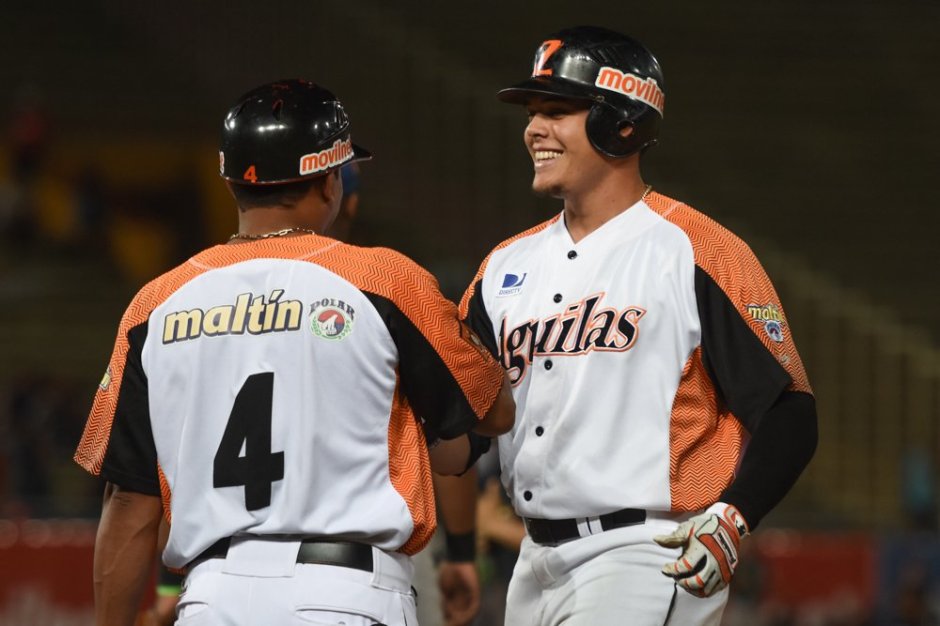
Photo credit: @RinconAguilucho
By: Lewis Rubman
Sports Radio Service contributor
November 9, 2018
MEXICALI, Baja California — Long weekends and extended seasons along the border–#1.
Charros de Jalisco: 2 | 6 | 1
Aguilas de Mexicali: 6 | 10 | 0
When my wife, washing the dishes and listening the seventh game of the 1997 World Series, heard that Edgar Rentería had singled Craig Counsell home in the bottom of the 11th, she let out a wail of despair. So did thousands of Indian fans. But my wife wasn’t an Indian fan. What she cried out was, “I don’t know how we’re going to get through six months without baseball!”
“We don’t have to,” I consoled her and, in a moment of inspiration added, “There’s a winter league in Mexico, and they have a team right on the border in Mexicali.” Within a month, we were in Mexicali for a three day week end of baseball. We’ve gone there about a dozen times in the ensuing 21 years.
Mexicali, a two-hour drive east of San Diego, is celebrating its 115th this year. It is the capital of the state of Baja California. Less well known to people on our side of the border than the beach resorts of southern Baja and the oft-maligned metropolis of Tijuana, it is a friendly, complex, and pleasant place to visit, especially in the early fall and early spring. The days are lovely in the winter, but the desert nights can be brutally cold. In the summer, the heat is brutal day and night.
Mexicali is as clean as a city can be, but it’s dusty, located, as it is, in the Sonora desert. Agriculture, maquilladora manufacturing, and government drive the local economy. The city, with a population of about 700,000, has a state-run theater, several small, well-designed and informative museums, one on the campus of the Autonomous University of Baja California (UABC), and a plethora of restaurants, over 100 of them Chinese. Indeed, until the mid 1950s, the Chinese were the largest ethnic (ethnic, not minority) group in the city. For the over-night visitor, Mexicali offers a range of hotels, from the modest with neat and serviceable rooms at about $35 a night, to the five star, at about $100. (My recommendation for the former is the Regis, across the street from my recommendation for the latter, the Lucerna).
The city also is home to the huge Plaza Cachanilla shopping mall, the Plaza de Toros Califia, and the 17,000 seat Estadio B’air, home of the Aguilas de Mexiali, the Mexicali Eagles. The stadium, also known as the Eagles’ Nest, was enlarged and spiffy-ed up for the 2009 Caribbean Series and the 2017 Qualifying Round of the World Baseball Classic.
The Eagles first played professionally in 1948, as a member of the Class C Sunset League, finishing first in the 140 game regular season, but being eliminated in the first round of the play-offs. As the length of the season indicates, the Sunset was a summer league. In 1951, they again finished first, but this time they made it to the final play-off round before elimination, The Eagles’ manager that year and part of the next was Adolfo Luque, The Pride of Havana. Among his other[ accomplishments, Luque had won 27 games as a pitcher for the 1923 Cincinnati Reds. Ernest Hemingway mentioned him in The Old Man and the Sea, and Tom Lasorda has called him “the worst human being I have ever known.”
The Sunset League folded after the 1950 season, so the Eagles flew off to the newly formed Southwest International League, finally winning a championship, and defeating the second half winner, Phoenix, four games to one in the play-offs. Mexicali remained in Class C when it moved once more, this time to the Arizona-Texas League, where it remained through 1958. After that season, the Aguilas left “organized” baseball. I’ll pick up the thread of the team’s history in tomorrow’s dispatch. Now it’s time to report on the first of the three game series between Mexicali and the Charros de Jalisco, the Jalisco Horsemen, which began tonight at the Eagles’ Nest. Going into tonight’s contest, the Aguilas were in sixth place, with a record of 10-12 and 3-3 since November 2, when Juan Gabriel Castro replaced Luis Sojo as manager. The Charros (or Equestrians), under the leadership of Roberto Vizcarra, were in third at 12-11. In tomorrow’s dispatch, I’ll explain the system used to determine the team standings.
As part of Mexicali’s anniversary celebration, the home team wore a new jersey tonight, one they plan to wear at least through the end of this week end. Instead of the traditional “Aguilas” or “Mexicali,” the plumed warriors of the Sonora desert had “Cachanilla,” emblazoned on the front of their uniforms. A Cachanilla is a person who comes from the Mexicali region.
The real story of tonight’s game was the pitching of right-hander Frankie de la Cruz. He held the Charros scoreless in seven innings and giving up only three hits to even his record at 1-1. Will Oliver, who entered the game at 2-0, 2.84 was charged with a well-earned loss. He lasted only two and two-thirds innings but gave up five runs, all of them earned. The save was credited to Jake Sánchez, even though he entered the game in the ninth inning with the bases loaded and a lead of 6-1. That is, the on deck batter didn’t represent the potential tying run.
The Aguilas will try to even their record while the Charros attempt to climb back above .500 in tomorrow evening’s encounter.
 Sports Radio Service