

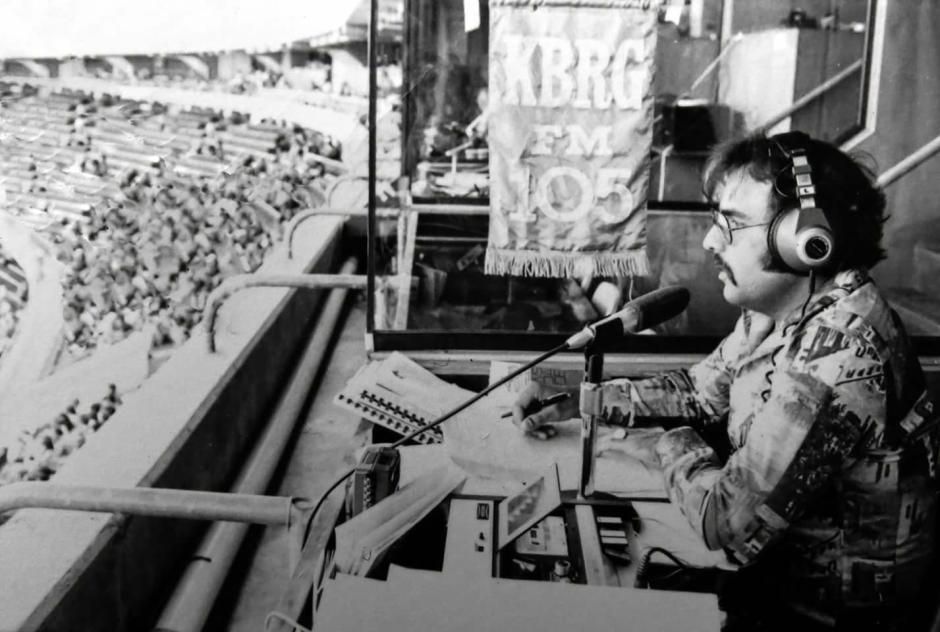
Photo credit: Amaury Pi-González
By: Amaury Pi-González
As I was doing weekend games for the Oakland Athletics’ Spanish radio on KBRG 105.3FM, San Francisco in 1978, something happened that year that was truly unique. A’s owner Charlie O Finley was trying to move the team to Denver and he had no commercial radio station in English to carry the games.
To my left in the A’s press box–I believe at that time was Box 19, sat two young UC Berkeley students broadcasting the games for KALX, one of whom was Larry Baer, who approached Finley during mid season about doing play-by-play and Charlie sold them the broadcast rights for $1.
Because the Spanish station was a commercial FM station, we had a greater signal than the UC Berkeley station, which was just a handful of watts enough to be heard at the UC Campus, and not even in the Coliseum’s parking lot. I was asked after each half-inning to repeat the score of the game, but in English. And I did.
Those were the days were radio was truly still king in the broadcast business, way before social media came about. To refresh our memories, ESPN was born in 1979, CNN in 1980 and those were trailblazers in our business. One was a 24-hour all sports, the other one 24-hour all news, but both were national. It’s a totally different world today in 2018. People talk about streaming games live on Facebook, YouTube is getting into the action, everybody has a cell phone and everything that happens is transmitted instantly. During Game 4 of the ALCS, a fan in right field “interfered” with what looked like a home run by the Astros’ José Altuve, which was declared an out by veteran umpire Joe West. The name of the fan, the video of the controversial play was transmitted immediately to the whole world. Hundreds of millions of people knew what happened at Minute Maid Park in Houston.
Back in the day (referring to the 1970’s), if you covered a game, you could not report on that game while the game was taking place (unless you/station) owned the broadcast rights. Some postseasons that I covered, as a reporter, not as a play-by-play person, I had to sign a form that specified my outfit would not report during the game. Only before and after the game(s) did I had legal permission to report.
What is coming in broadcasting the next 20 years, I will leave that for your great imagination. And everybody has an imagination. Unless you are Rodney Dangerfield, who once said: “When I was a kid I was so poor….I could not afford an imaginary friend!”
 Sports Radio Service