


By Morris Phillips
Still think the 51-50 Giants have what it takes to make a run to the postseason? Okay, you’re thinking big obviously, so I offer a big comparison. Unfortunately, comparing the Giants to the 2004 Astros may be too big, as in bigger than real life.
That season the veteran-laden Astros started fast only to stall mid-season. With a 44-44 record, ownership grew impatient, firing Jimy Williams and hiring Phil Garner. But an even bigger move loomed, with the Royals, Padres and A’s pulling off a three-team deal that would bring Carlos Beltran to Houston. The hopless Royals had no chance to retain the 27-year old, five-tool outfielder as a free agent after the season so they dealt him. Astros GM Gerry Hunsicker not only did well to craft a favorable deal that would cost him reliever Octavio Dotel, but he did so a month prior to the July trade deadline.
While the trade would eventually prove to be brilliant, the initial effect would see the first-place Cardinals increase their five-game lead in the NL Central while the Astros continued to be average, first reaching the 101-game mark 51-50, then slumping to 56-60.
The Cardinals wouldn’t look back, winning the division with 105 wins, the best regular season record in baseball that year. The Astros–at least, in the short run–appeared to be an epic failure, languishing below .500, despite a roster featuring Jeff Bagwell, Craig Biggio, Beltran (future HOFs), Roger Clemens, Andy Pettitte, Jeff Kent (considered for the HOF), along with Lance Berkman, Roy Oswalt and reliever Brad Lidge at the height of their powers.
But the light switch turned on, and the Astros blasted off, winning 36 of their final 46 games to capture the NL wild card with a 92-70 record. They would leapfrog four teams including the Giants, while taking full advantage of a schedule heavy on the downtrodden Reds, Brewers, Pirates and Rockies, an opponent in the season’s final week.
To recap, the Astros played that season’s first 116 games at a .483 clip, and in the final 46 games, their win percentage jumped to .783.
The 2018 Giants need to catch the division-leading Dodgers or one of either the Brewers or Braves, the current wild card leaders, to hypothetically qualify for the postseason. Without attempting to find a specific number of wins for each of the three clubs the Giants are chasing, we settle on 91 wins, as the projected win total for all three since that number is most likely for all three without trying to factor in the Dodgers’ acquisition of Manny Machado, the Brewers’ recent slide or the Braves’ relative inexperience.
Attempting to reach that number of wins, the Giants–currently winning at a .505 clip–would have to see their win percentage jump to .656 over this season’s final 61 games.
Needless to say that’s a difficult leap for any ballclub to make, and especially for a Giants’ ballclub that hasn’t won at that rate for an extended period of time in more than two years, since the first half of the 2016 season, the last time they strung together consecutive winning months.
So how did the Astros do it? Given the age of their stars that season, and their individual histories in regards to performance enhancers, that would be a good place to start.
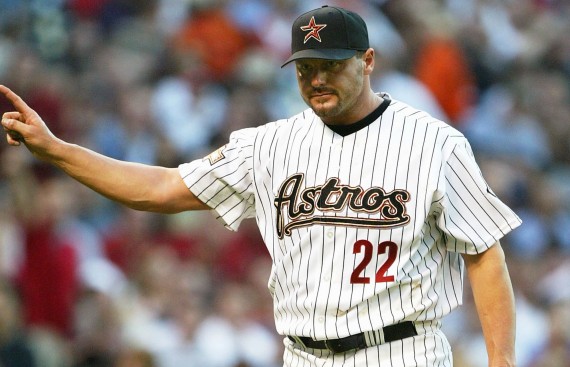
Roger Clemens, the surefure Hall of Famer were it not for his close association with PED’s, was 41 years old that season. Clemens started 5-0, and finished 18-4 with a 2.98 ERA. His win percentage that year was tops in baseball and he won his seventh and final Cy Young award.
Again, he was 41.
Jeff Bagwell would extend his streak of hitting at least 20 home runs in a season that year to 12. He also would surpass 400 home runs and 200 stolen bases in his career. Bagwell was 36 in 2004.
Craig Biggio was 38, Jeff Kent was 36, Jose Vizcaino, who played in 138 games in 2004, was 36.
Andy Pettitte was 32. Dan Miceli was 33 that season in which he pitched in 72 games prior to his faltering in the NLCS against St. Louis.
Some of these players–not all–at some point in their careers were associated to PEDs. Needless to say, a 41-year-old winning the Cy Young may never happen again.
And the Giants might not have the juice for such a torrid, frantic finish.
 Sports Radio Service