

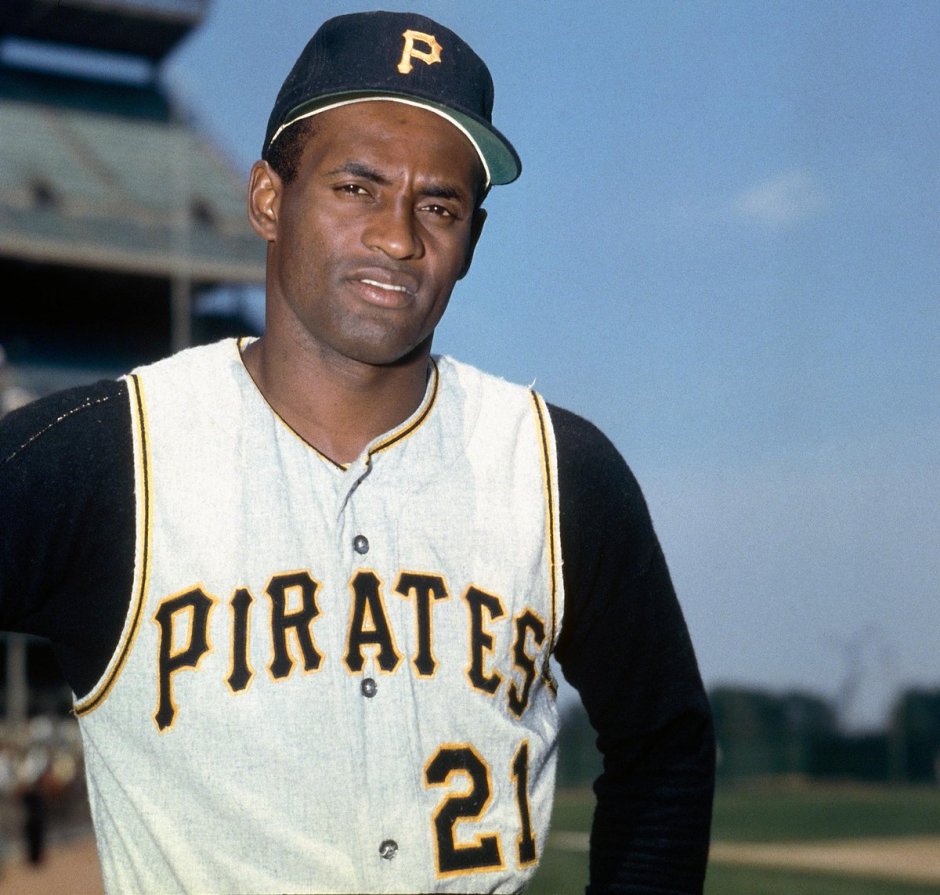
Photo credit: @Pirates
By: Amaury Pi Gonzalez
This December 31st will mark 45 years since we lost Roberto Clemente.
On December 31, 1972, Clemente’s DC-3 charter and heavily loaded plane crashed just off the Puerto Rican coast. Clemente’s body was never recovered. He was elected to the Hall of Fame in 1973 in a special election that waived the mandatory five-year waiting period.
Clemente was a very private and charitable man, not only in his native Puerto Rico, where he was the closest thing to a God, but for others outside the island. The best example was the way he died, helping people he didn’t know in another country (Nicaragua), taking a charter plane filled with aid for the suffering people of that terrible earthquake.
Clemente is a historical figure in American sports. His famous #21 was retired by Major League Baseball in all 30 ballparks across the country. Nobody else can wear #21. He’s just as historical for Latinos as Jackie Robinson (#42) was for African Americans as the first man of color to play in professional baseball.
Clemente was idolized by the players that played with and against him in the Major Leagues. “There was nobody like Roberto, he could do it all, and with class and style,” countryman and Hall of Famer Orlando Cepeda once told me.
I remember during a Hispanic Heritage Baseball Museum Hall of Fame exhibit at the San Francisco main library at the Civic Center, a man kneeled right in front of the Roberto Clemente display. When I asked him what he was doing, he told me in Spanish: “Soy Boricua, y estoy rezando por Clemente, quien Dios se le llevo demasiado temprano.”
Translation: “I am Puerto Rican, and I am praying for Clemente, God took him way too early.”
Clemente is a worldwide figure. He began his MLB career in 1955 with the Pittsburgh Pirates. He had to go through very difficult years as many Latino and Black players at that time.
In 1972, I was writing for El Mundo News, an Oakland Spanish publication, and I was covering a game between the Giants and Pirates at Candlestick Park. I can’t forget inside that press box when Clemente struck out and a writer sarcastically said: “Send him back in a banana boat!” I could not believe it, and this was 1972. The man thought that was funny? Incredible.
So, imagine what Clemente had to go through when he first began playing some 17 years prior to that game in San Francisco. Clemente was frequently misquoted by the media, which was something he really never liked. He was a proud and honorable man, born in Puerto Rico, an American, he was a US Marine in the US Marine Corps Reserve.
Most Puerto Rican players, past and present, born in the island or in New York, identify with Clemente. Most of them like Candy Maldonado, and Ruben Sierra always wanted, and some did, wear #21 in Clemente’s honor.
In today’s game between 30 to 33% of all players are of Hispanic heritage, but when Clemente played it was not like that. I remember when I went inside a locker room and wanted to conduct and interview in Spanish some players told me: “Let’s do it outside,” and some even outside told me: “I do not want to be seen talking in Spanish.”
Yes, there was racism. I know of a Latino player (of whom I will not mention his name) who told me when he played, his manager even hated him to speak Spanish in the lobby of the hotel where his team was staying. There were racist managers, players, owners, executives.
Yes, I admired all those men that had to play a game like baseball, one of the most difficult games, where concentration, focus, dedication is needed, to play under those circumstances. For me, those were real heroes.
One of my favorite players, that played with Clemente, was Panamanian-born catcher Manny Sanguillen. When I spoke to Sanguillen, somewhere in that three to five minute interview, he will find a way in that interview to say how proud and lucky he was to play next to Clemente. I do not recall another Latino player getting the same level of respect Clemente got from other Spanish speaking players.
Today every game is on television. There are shows that dissect every play of every game, and when they talk about style, they talk about the color shoes a certain super star might be wearing…or his hair style.
Clemente didn’t need any of those things because he was the ultimate professional serious ballplayer. He did everything with grace and style and dignity. Watching Clemente throw from right field, or even run from first to third, was a “work of art.” He was an artist and the field was his canvas. Image what a guy like Clemente would be paid today? I do not think there would be enough steel in Pittsburgh!
I am proud to be a Latino and proud of Clemente. When I think of him, I think of a “real baseball” strategy–hit and run, bunts, advancing the runners, great throws, catching the ball without diving (like many unnecessarily do today), respecting the game, not celebrating and going crazy every time you hit a home run.
Clemente played the game like it was meant to be played.
Happy New Year!
 Sports Radio Service