

By DANIEL DULLUM
Sports Radio Service
Saturday, March 12, 2016
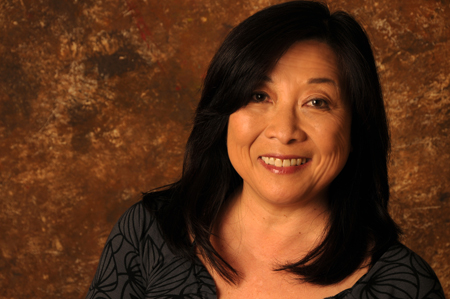
photo credit: imdb.com–Baseball Documentary Filmmaker Yuniko Gamo Romer working on the relationship of Japanese and American basebll
SCOTTSDALE, Arizona – A chance visit to a museum exhibit sparked not only interest for Yuriko Gamo Romer in the long relationship of Japanese and American baseball, but a desire to undertake the task of filming a documentary about the subject.
Romer explained, “I’m friends with Dave Dempsey, whose father Con Dempsey was a San Francisco Seal (1948-51), and Con was on the 1949 tour that Gen. MacArthur sent to Japan. Dave’s father had taken some movies, and along with seeing that display, that’s where it started.”
Along with her assistant, Kathleen Quillian, Romer visited Scottsdale Stadium Saturday prior to the Cactus League game between Arizona and San Francisco, looking for interview subjects to include in “Diamond Diplomacy – U.S.-Japan Relations Through A Shared Love Of Baseball.” Romer is the director and producer of the project, currently in the development and early production stage that began in 2014.
“Right now, it’s production, raising money, meeting with players and other stuff,” Romer said. “The hard part about making a documentary is raising the money. I’ve had some success, but I need to raise more money. We’re going to run a Kickstarter campaign, starting in May, and we’ll put social media to full use.”
Romer’s research found that the baseball connection between Japan and the U.S. started in 1872. A key part of the documentary is the 1934 Goodwill Tour highlighted by the presence of Babe Ruth, Lou Gehrig and Lefty Gomez.
“Of course, with World War II, Japan essentially couldn’t play baseball,” Romer said. “Ironically, at the Japanese-American Interment Camps, baseball was played there. After the war, during the U.S. occupation, Gen. MacArthur sent the Seals over for that Goodwill Tour. It was a lovely, diplomatic moment.
“Japan was basically bombed out and run down at that time, people were pretty much down in the dumps, and this was something that really lifted their spirits.”
Last year, Romer had the opportunity to film the 50th anniversary of Masanori Murakami’s debut with the Giants – the first appearance of a Japanese player in the major leagues. This, Romer said, is “the next main point in the film.”
In 1964, Murakami was sent to the U.S. as part of an extended training session by the Nankai Hawks. After a strong season in Fresno, Murakami was a September call-up for the Giants, sparking the sports version of an international incident that eventually led to a 1967 agreement that U.S. major league teams would not sign Japanese players.
“It was an inadvertent moment, because no one dreamt that Mashi would become a major league player,” Romer said. “He was on a Single-A team and when he was called up, he pitched in front of 40,000 people at Shea Stadium. There were some contractual issues, he came back to the Giants in 1965, but decided he needed to fulfill his obligations in Japan.”
Until Hideo Nomo pitched for the Los Angeles Dodgers in 1995, no Japanese player had appeared in the majors since Murakami pitched for the Giants.
“And then there was that hiatus of 30 years,” Romer said. “I think it was a product of the disagreements and a misunderstanding. Nomo decided he wanted to come to the U.S. and they found some loopholes in his Japanese contract, and he came to the Dodgers. That really opened the doors for what we now see for Japanese players in the U.S.
“We’re going to visit with (former Giant) Nori Aoki, we’ve talked to Kenta Maeda (of the Dodgers). And we’ve got some interesting voices, like Bobby Valentine (who managed six seasons in Japan) – he’s still a big figure there.”
“Diamond Diplomacy” also addresses the flip side – American players who went to Japan.
“I talked to Casey McGehee last year when he was with the Giants, and Leron Lee, who played in the 1980s and was the inspiration for the movie “Mr. Baseball,” Romer said. “We got tips on a couple of other players that we’ll pursue. And we’re hoping to talk soon to Marty and Matt Keough, father and son who both played in Japan.”
Romer said she’s had some success locating archival materials for the movie. “I’ve found a lot of it and we’d like to find more. I have a treasure trove from that ’49 tour, but I’ve found other stuff too, like from the ’34 tour with Babe Ruth. I have some post-war footage, and there’s more to seek out.
“We have an oral history interview with Cappy Harada (the legendary Bay Area native, scout and executive who died in 2010). He was the one who really facilitated the 1949 tour. It’s a lovely interview where he talks about Joe DiMaggio going to Japan on his honeymoon with Marilyn Monroe!”
Romer is having no problem obtaining information, but said, “some of it just isn’t relevant enough to the storyline. So there’s a few things that have to be saved to the side.”
If all goes well, Romer hopes to have “Diamond Diplomacy” released early in 2017.
“The arc of the story is how the U.S. introduced baseball to Japan in 1872 and there’s been this interesting historical roller coaster,” Romer said. “And in difficult moments, baseball has been there for both countries. Yet I think it’s a lovely common ground that the two countries have.
“Japan is one of the few countries that loves baseball as much as the U.S. does.”
EVERYTHING’S ARCHIE
Archie Bradley, Arizona’s starting pitcher on Saturday, is battling back from a rough 2015 season that saw him spend much of his time on the disabled list to recover from being hit in the face with a line drive, followed by a bout with right shoulder tendinitis.
Bradley, still a top Diamondbacks prospect, worked three innings on a strict pitch count, giving up one earned run on three hits with a strikeout and a walk.
“I would like to be more efficient, but I felt I needed to be more realistic,” Bradley said. “I think that sometimes, there’s a perception that spring training isn’t like the regular season, but it is.”
After a 1-2-3 first inning, Bradley labored through the second, giving up a double to Angel Pagan, who scored on Andrew Susac’s double, and threw a lot of pitches to work out of a two on, two out jam.
“The first inning went smooth, in the second inning I threw way more pitches than I wanted to,” Bradley said. “That’s going to happen. I was able to limit the damage with one run and I was able to make quality pitches when I needed to and get out of it.
“Throwing 60 pitches is way too many than I’d like to in three innings, but sometimes, you’re going to have those days. It’s about finding a way to get through them. I threw more changeups today than any other time in my life.”
THE GAME
Arizona won the split-squad battle in Scottsdale 9-5 over the Giants. San Francisco starter Ty Blach (0-1) saw his spring earned run average balloon from 0.00 to 6.43 by the time his three innings were complete.
Blach gave up five earned runs, including a two-run homer to Socrates Brito. But he did hold D-Backs slugger Paul Goldschmidt hitless with a strikeout in three at-bats.
The Giants did have some highlights. Jarret Parker went 2-for-5 with an RBI single and a solo home run. Besides Parker, Joe Panik and Andrew Susac also had two hits.
Reliever Santiago Casilla threw a scoreless fourth with two strikeouts.
In Tempe, the other Giants squad lost 9-6 to the Los Angeles Angels of Anaheim.
TAGS: San Francisco Giants,Arizona Diamondbacks,Sports Radio Service,Daniel Dullum,Diamond Diplomacy
 Sports Radio Service