by Amaury Pi Gonzalez
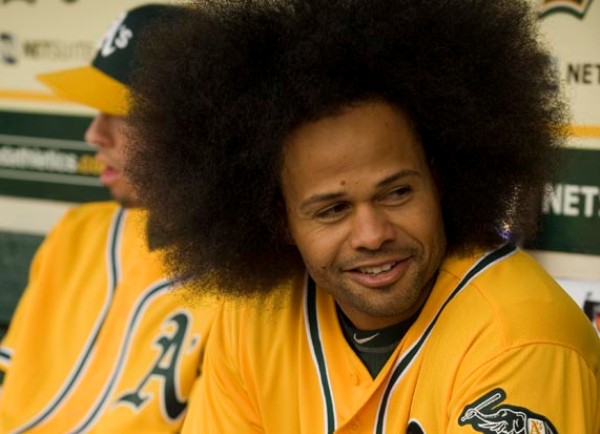
photo credit: pintablecoluringpages.co.uk One of the very few African Americans in the majors Coco Crisp of the Oak A’s
In the world, only China and India have a larger population that the United States of America. Today, of over 323 million people live in our country, the largest minority is comprised of Hispanics.US government statistics as of 2014 list Hispanics are 17.4% and African-Americans 13.2% of the total US population. It was some time ago that Hispanics passed African-Americans as the largest minority in the United States. in Baseball, Hispanic player participation in the game is much higher than the 17.4% and it keeps growing each year. With the relaxing of relations with the country of Cuba, more Cuban players are coming into the United States and are signed by major league teams.Since the 1800’s Cuba’s #1 sport has been baseball and not even the Cold War could stop Cuban players from coming into the United States.
While Hispanics continue to increase in the major leagues, the same cannot be said about African-Americans, unlike some of the other main professional sports leagues in the country, the NBA and the NFL, Major League Baseball has been struggling in recent decades making baseball more attractive to African-Americans, but not much success there. For example, right here in the Bay Area, the San Francisco Giants, recently signed outfielder Denard Span, and that makes him, the only African-American on their roster as today and the Oakland Athletics with Marcus Semien and Coco Crisp.
Asian players have also been coming to the major leagues, although not in the same numbers as Hispanics/Latinos. According to SABR(Society American Baseball Research)as of 2012 Hispanic/Latino players made 26.9 % of all players in the major leagues, African-Americans 7.2% and Asian players 1.9%. Most recent and according to SBN(Sports Business News)The percentage of Hispanic/Latino players increased from 28.4 percent in 2014 to 29.3 percent on 2015 opening day rosters.The percentage of Asian players decreased from two percent in 2014 to 1.2 percent in 2015.
Statistically speaking, baseball is changing in step with the United States That is only fitting, since baseball still likes to be called The National Pastime.


 Sports Radio Service